Episode 12 - Dr. Nancy De Andrade Connects The Body, Mind, And Spirit
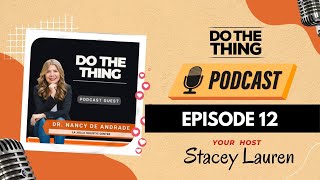
A podcast interview (Do the Thing) featuring Dr. Nancy De Andrade, a clinical psychologist turned holistic coach who integrates body, mind, and spirit. The episode covers Nancy’s background (Venezuela, psychology degrees, spiritual upbringing), her shift from clinical psychology to holistic coaching, practices she uses (journaling, body wisdom, testing boundaries, education), approaches to managing fear (worst-case analysis vs. empowerment), the ‘pain of change’, and guidance for finding purpose and self-trust. The tone is practical, supportive, and experiential; the episode includes actionable tools listeners can try (journaling, risk-assessment chains, boundary experiments).
Chapters
I do really believe 100% from every part of me that everyone has the capacity to be able to do the things that they want and not to be held back by the mental baggage that's in our head that we want to push through.
Welcome to the do the Thing podcast. In each episode, we get down and personal with people who go after the things they want to make all their wildest dreams come true. Join us as we unveil and dissect a formula for what it takes to do the thing. Here is your host, Stacy Lauren.
Hey, everyone. Welcome to the do the Thing podcast. This is Stacy Lauren. So it's. This is a hard one for me to introduce this next guest. How do you really explain the power of finding someone that you can connect with and is able to help you when you're in times of hardship in such an incredible way that you literally can transform your life while you're in the middle of a challenge? And that's what this next guest did. You're going to get to hear from Dr. Nancy DeAndrade, who has a PhD in clinical psychology, but also is doing holistic coaching. So the combination of the two really just impacts on such a deep level so much that I was referred to her by a friend who was referred to her by a friend, and then I've referred many of my friends to her. So it's funny how sometimes we'll just refer to Nancy and we all know who we're talking about. Some of us refer to her as our spiritual advisor. I refer to her as my psychologist, although I sometimes change it to advisor depending on who I'm talking to. And this episode is literally packed with just unbelievable stuff. I'm not even going to be able to put into words how much information she was able to give on this episode about really being able to learn how to empower yourself to solve your own problems, to learning how to turn into your purpose, to the power of using a journal, tapping into your body wisdom. She really went all out with being able to give powerful information that you can take and use. And in case you're wondering why I decided to have her on the show on a Do the Thing podcast, it's because I've done about 10 interviews so far, and there's just been a lot of parallels in the different people that I've interviewed, and they're all experts at doing the thing. And one of the common things that keeps coming up is really being able to tap into your why kind of conquering your mental jargon in your head and So I just felt moved to invite experts that I've been working with directly. And three came to mind immediately. Dr. DeAndrade was one. And I'm so excited to introduce Dr. Nancy DeAndrade. Hi, Nancy. How are you?
I'm so excited to be in this podcast. I'm like, beyond excited. Just.
Oh, my gosh, just so happy.
Thank you for having me.
Yeah, I am so excited to have you here. I can't even tell you how grateful I am to that you were able to come on and be able to have this conversation with me today.
Yeah, no, I'm looking forward. I honestly don't know what you're going to ask me, but I'm ready for you, baby. Let's go.
Let's do the thing.
Yes, let's do the thing.
So I'd love for you to start and just tell the listeners a little bit about you and your story.
Yeah, absolutely. So you, you'll probably hear a little bit of an accent when I speak. And that's because I was born and raised in Venezuela. Both of my parents, my, my dad is a very spiritual person who was kind of like a priest, and he would take us to the mountains and we could hear the angels speak. And of course, I didn't think it was a big deal. Like, oh, yeah, whatever, I'm tired, I'm hungry. Forget that. But now I'm really, honestly impressed of how we were able to do that. And my mom, also spiritual in the sense of more like a shaman. She would just say, like, oh, you have a stomachache, Let me get some herbs and make this concoction and just, you know, heal it for you. But also, she was intuitive and she would see dead people. You know, she would have, like, spiritual visits and things like that that. I grew up in such an environment that I didn't think spirituality was anything out of the ordinary. I, growing up, I. I did a lot of courses on, on energy healing and pranic healing, a lot of different things. And then my oldest sister introduced me to psychology and she, she was being trained as a facilitator for a psychologist who did workshops on self esteem communication. And she was like, you gotta come with me. And so she dragged me. And, you know, as a teenager, I was just so grateful that she put me through everything, meditations and things like that. And when I moved to the States in my twenties, I realized how unique that experience was. And.
I couldn't find it here as readily as I found it in Venezuela. I went into the psychology route and I studied my Bachelor's, my Master's and my PhD in Clinical Psychology and I emphasized in spirituality. Now I've been moving away, I've been practicing mental health for I don't know, 11 years or 12, but I've been moving away from psychology and more towards a holistic life coaching. I think sometimes we need to see the person as a whole. And when I, when I used to practice psychology it was more like just focus on the brain. And I believe that there is, we are everything we are our bodies, our minds and our spirit. And so when I work with people, I encourage them to tap into that body wisdom and really get to know themselves from the body level, the mind, their connection to all there is and to fine tune their vibration. So, so they live their truth, they live their authentic self. And so when I work with people, I encourage them to, to align with the truth of who they are and with that truth that they find in nature or spirit or universe, whatever, you, you name it. And I have a practice right now is online thanks to Covid and it's a holistic coaching lifestyle that I, that I encourage people to have. And I also teach some classes in psychology for National University and I teach some energy psychology classes for the Motivational Institute of Hypnotherapy. And I'm also running a course on holistic coaching so people can get trained on how to do what I do as well. I'm in the beta process right now and on my spare time I.
I'm laughing because it's like very little spare time. On my spare time I try to help as many people as I can. The majority of my, I want to say maybe 40% of the people that I work with are low income or they don't pay at all. And I believe that I can provide assistance to those of course on a limited basis, but help people that are in a position that many of us have been where sometimes we can't afford it and we need support. And so I want to give back in that way. And then the rest of, of the people that I work with, like I'm so grateful to, to work with so many amazing enlightened people. They are. The majority of the people that I work with are entrepreneurs who are searching to, searching for that step up to connect to that, that alignment and evolve their business. And in whatever way it could be financially or it could be more purpose, which is the majority of the cases is more like tuning into your purpose. And so yeah, pretty busy life. So I'm excited to be here.
Yeah. And it's amazing because I knew about your background roughly, but I didn't actually know all of that. So it's so great to get an opportunity to be able to talk to you more about it. And I didn't realize that it started with your older sister. And it's so cool when, you know, life kind of works that way where you are getting exposed to something on one level and then you're able to, as you're getting into it, you're realizing you actually really like the holistic side even more than the psychology. But your experience with the psychology is enabling you to do the holistic side even at a grander level, you know, because you understand it.
Yeah. And the thing is, we don't even know what's going to help us. We can just throw a temper tantrum when things don't go our way. But in reality, when you look back, you're like, oh, that's why, oh, that's why things are aligned for us and life is happening for us. And when we can see it that way, then we don't hold on to the pain of change, you know?
Yeah, the pain of change. Oh, I love that. Yeah, it's interesting too, because I didn't know you're still doing that low income side and helping people because I know the person that I had originally got referred to you from, who was then referred to you by someone else, he's like this wildly successful entrepreneur, both personally, financially, like in every level. And I remember him telling me the story. We were in Costa Rica on a trip there and he was telling me the story of how he started working with you. And he's kind of like the first of the people that was working were working with you. And he basically had said he didn't have the money to pay you and you, you worked with him for free. And then we were just kind of talking about how many people you've helped that he knows now. So just from that one experience of you helping him, that ripple of everyone that he's helped from having that opportunity to know you, and it's just amazing just knowing him and who he is now and the level of success he's at both personally and financially and knowing that was the start of this relationship and the ripple that's happened since then, I think it's amazing that you're still doing that even though you're wildly successful now in what you do and you're able to help people that need it. So, yeah, I just wanted to mention that, how that is.
Honestly, it's both a way of giving back and knowing that I am abundant. And it's also my way of.
Feeling like I am being of service. And it's not just about money. You know, to me, that's important because when we are on purpose, money just comes. So money is just part of how we are vibrating, how we are energetically resonating. And so I want to remember that always, you know, and so I like being of service, or I want to be of service.
Yeah, I love that.
But of course, you know, we live in a society that is consumerism, and you have to earn money to eat, you know, to, to. You have to produce money. And. And so, of course, I do charge. Not everything is free, you know, but I do want to include those who cannot afford and help them succeed if I can.
Yeah, definitely. I think that's. It's amazing because then the ripple of who they're able to touch is. It comes back tenfold.
Yeah, exactly. And that's the thing. Like, they help another and they help another, they help another. It's just a ripple effect. Exactly like you're saying. Yeah, yeah.
And I wanted to mention too, you mentioned the. And I don't think we've had this conversation. I just kind of have felt it just myself because I worked with so many people before I met you. I don't even want to go into that on this podcast, but I had a lot of. A lot of psychologists, a lot of coaches that I've worked with, and I whittled down my sphere of people to, like, really just about three that I relied on. But the thing that I love so much about you is that tapping into the body wisdom. And I didn't actually. I couldn't put it into words until you just said it. It's.
It's.
You don't make it where someone needs you. You know, you help them discover it for themselves. And that's what I think such a huge distinction is because there's so many people out there that think they. They try to make you think that you're relying on them, you know, and you've never done that. And I love that about you. And I think it's so empowering, you know, as a. As a person to be able to realize, wow, I. I actually can do know on my own.
Yeah, thank you for that. I appreciate it. I. I do believe that we all have the wisdom inside of us, and I should not have people depend on me for something that they can do themselves. And so if I can show them how to develop their Intuition. If I can show them how to tune in, how to like, really get to know themselves, that's my goal. Awareness that they create an awareness of themselves so deeply that they trust themselves. Because the truth is that who am I to say how someone should live their lives? Honestly, who am I to say that? I don't know? What if what I'm thinking is not what is in your highest interest? I would be guiding you. Wrong. And so what's best is for me to see the light in you and help you see the light in yourself. And then from there you remember how to tap into that. Because we all connected at one point in our lives when we were little. And so it's kind of like reminding you and saying, hey, you know, you have the answers. You know, practice that. Empowering. I believe more than solving their problems, I believe in empowering them.
Yeah. Yeah. And that's, that's, that's huge. It's such a. It's such a good feeling. That's powerful because having someone feel like they have control over themselves and not needing to just rely on, on people to be able to make decisions for them and finding that within themselves, I think is, Is really important. So you mentioned. Okay, it's funny, I had one direction I was going to go with you, but I feel like we have to kind of stay here for a minute, if you don't mind.
Of course. Any. Any. Anyway, okay, perfect.
You mentioned pain of change, and then you also mentioned tapping into intuition. And I'm feeling like those are two big parts in doing the thing. Right. Because if you're wanting to do something, you know, maybe scary or different, and it requires you to make a change, you have to both know that it feels right for you. It's not someone else's dream, it's your own dream. Right. So that kind of comes into tapping into your own intuition.
Yeah.
And especially if other people are saying it's a crazy idea or why would you do that? Or whatever happens when we decide to do something different and shake up things, then from there there is that pain of change that we go through. So I just thought maybe we could just talk a little bit more about that.
So when we are trying to follow our dreams, we tend to look outside of ourselves for confirmation. We try to. We compare ourselves to people we look at, oh, that person is doing it successfully. I should do it like that too, instead of hearing what we have to. What we need to hear from ourselves and follow our internal guidance. But the problem is that very often we have been disconnected from our own guidance. And we have done, we have built our lives according to what we believe society would approve or our parents or whatever. And so to really get to know yourself and fulfill your purpose, your dreams, your desires, it means that you're going to have to change a lot of things. Changing things that you have built for so long, relationships, maybe even that you have had for so long that no longer support you in the way that you need to evolve. And in that it's extremely painful. Letting go of businesses, letting go of relationships, letting go of patterns, letting go of a life that you built. But it was not based on your truth. It was based on, you know, sometimes a fantasy that we create that is painful, really painful. And to follow what you believe, despite what anyone thinks, it's also saying, holy cow, I might be doing this by myself, I might be alone in this. And that feeling of not being supported and feeling alone is also another pain producing step that you have to take. But I do have to tell you that there is just a small place that you are alone, really. And that what I mean by that is when you really follow your heart and your truth and what, what really lights you up, you will start seeing that you are supported, and not just supported by your loved ones around you, your children, partner, whatever, but also there's a lot of people that want to support you and there's the whole universe that wants to support you. And so that pain becomes tolerable the more you reach out and the more you really understand how to value yourself, how to really honor you first, way beyond, way before you honor anybody else, how to put yourself first. That's the key when you, when you start like really nurturing you and, and putting yourself first and doing what you want to do, not what anybody else tells you to do.
Yeah. And I think that's, it's so easy to do because not the nurturing yourself, but it's so easy to put other people before you and then also thinking that you want to do something because that's what people around you are saying should do. But then when you actually look inside, you're like, wait, I don't actually want to do this. You know, So I think, I think that's huge. So what do you think is a good first step for that? For someone to be able to, to do that for themselves?
The, the first step is get to know you. The second is stop comparing yourself. And so the reason why I'm saying the first step is get to know yourself is because we have been conditioned to believe that what everybody else is doing is something we should be doing. And we tend to compare ourselves to or model ourselves after people. And that's okay. You know, you can look up to people. I'm not saying don't have mentors, don't have people that you emulate or look up to, but comparing yourself is toxic. So I jumped from getting to know yourself to compare. And because they're related, when you know yourself.
Then you face. You face your patterns, you face your fears, you face that. Those ugly thoughts that keep you small. You see your limitations. And when you are able to embrace all of that and love all of you in that way, then you listen to you more versus reject you. You know, reject yourself. You start listening to yourself more. And so something that is just a very, very simple but so powerful is journaling. Journaling helps you put all of those thoughts and all of those emotions into a piece of paper that you can later burn if you want, safely, of course. But you can. You can dump all, all of those thoughts that are in your head and see them and honor them. It's. It's as if someone is witnessing you, someone is watching you and saying, I will hold your emotions. I will hold your thoughts, even if they're ugly, even if you are embarrassed to show anyone, I will hold that for you. And in that simple process, what you're doing is saying, like, oh, wow, I didn't know I was thinking this way, or wow, I just feel so relieved that I can let this go. I can write it away and get it out of my mind and put it into paper. Wow, there is so much power in that simple journaling step. And so the more you embrace, the Buddha said, invite your enemy to tea or invite your feelings to tea, invite your anger to tea. And so what that means is don't reject it. Actually embrace it. When you are feeling that strong emotion, come invite it and learn from it peacefully, saying, like, what are you here to teach me? Why am I feeling this way? What is. What is this tension that I'm feeling in my body? What are the thoughts that are going in my mind? Getting to know you and how you resonate with things or not. If you're used to muting yourself and doing things for other people, your whole body is going to be telling. It's going to tell you don't go there, but you're not going to listen. And so if you can just tune back in into you and honor you and respect you, your decisions, your nos, your yeses, if you can respect the whole of you, then you can make those decisions based on that integrity of who you are. And alignment is when your feelings, your deep feelings and your thoughts and what comes out of your mouth, your words and your actions, they're all the same. If I am thinking, if I am feeling anxious about something but I am saying I'm fine, that's out of. It's incongruent. But if you are getting to know yourself and saying, I am doing this project, doesn't matter who says what, I'm doing this, and it feels right, it feels aligned, then that's. That's your cue. And then the second piece is, don't compare yourself. I see a lot of people who are looking at other supposedly more successful people, and the truth is, you don't know the level of success or, you know, a lot of people show stuff, they're not going to show their ugly selves. They're going to show what they're proud of. And so you really don't know the level of success of others. And in comparing yourself to others is so destructive, so, so, so, so destructive, it kills your creativity, it kills your ability to trust what you're doing. And you start doubting yourself. You start doubting if you're going the right way, because, look, everybody else is doing it this way until. The most important thing to remember is that you are a pioneer. If you're taking this step and if you're listening to this podcast, this means that you want to do the thing, that you're ready to be that pioneer, that leader, and make your mark in this world and do it because it's in your heart and your soul and your spirit and your thoughts and in everything in you. And so there's no need for you to compare yourself with anybody else.
Yeah.
That's so powerful. I was, I was wondering, too, with the tuning back into you, would you say that it sounds like journaling is a big part of being able to tune back into you because you're able to write it down freely and then you're having that witness of acknowledgment. Basically, I'm just able to get it out. Is that right? With the journal. Okay, cool. I want to make sure I explain that right. And then was there anything else that you think would be really good for being able to tune back into you? I actually like the way that you worded that.
Yeah. Yeah. The. The reason why journaling is, Is so important is because they don't talk back. You know, journals don't talk back. They don't have an opinion, they just hold your emotions. And you know, when people say Dear Diary, it's sort of like you're talking to someone and that someone is really holding the space for you. And so when you allow yourself, you know, there's so many thoughts that we don't want to admit we have, but when we can put them in paper and. And I always suggest to get rid of the paper or delete the file or whatever it is, I really suggest that is because I don't want people to censor themselves or worry about their spelling or anything like that when they are pouring their hearts out into paper. I don't want them to review it later either is. No, the purpose of this exercise is for you to have a witness to your emotions and your thoughts. That's all. Is for someone to see you. Because very often we were not seen growing up. Very often our caretakers didn't have the ability, the time, the knowledge to nurture us and to see us the way that we needed to be seen. And so having this tool, it's so powerful because you're giving yourself the opportunity to see yourself, to witness your pain, to witness your thoughts, to witness everything. And so another tool for getting to know yourself is you start testing tools, start testing things. Like, for example, you start testing boundaries. And see what happens when you set a boundary. See what happens when you say certain words. Another tool that I recommend is that you educate yourself about relationships, the world. Read, educate yourself, expand your mind. We come with just a set of tools or a little bit of context to carry us. And where do we get this context? Growing up with our parents, with our caretakers or whatever, people around us. But the world is so, so large and there's so much information that I would say expand your mind, educate your mind. Like, really educate your mind. And practice, especially practice. A lot of people read, but they don't practice, but practice what you are, what you're reading. And the more you can bring context to your mind, the more you can give yourself information, the more your mind expands. And there's people that sort of force their minds to expand in ways that are not healthy for them when they're not ready. They call it like spiritual bypassing, but they're sort of like, oh, I'm going to try this new thing, this new fad, because everybody's doing it, and I'm going to have so much insight, but instead that forcing your brain to open that way. It really is not about getting to know yourself, because what you're doing is ripping Yourself open without the knowledge and protection and without the brain knowing what the heck is happening. The brain needs context, needs. Needs information. And so if you can maybe, you know, there's people that take the human design test just to get to know yourself. You know, take all the tests you want, figure out what sign you are, you know, whatever it is that. That you want that can give you some clues and then see what resonates with you. There is Ayurveda, and you can see the doshas and see what doshas apply to you. And you can say like, oh my gosh, yes, when I drink coffee, I, you know, my. My pizza goes up and I like really knowing your body, your mind, trying different things to like, really get to know you. As if you're like fall in love with you, you know, you're dating you.
Yeah. And I think, I think it's helpful. Like, I knew when I started to kind of learn about myself with that. And I'm specifically, what's coming to mind is the attachment style. Yeah, that was a huge thing because it made me feel not so alone, you know, that there's like other people that kind of totally patterns as I did. And it doesn't mean I'm stuck with that attachment style. It just meant that that was like a way that I could identify and then it helped me learn on what I needed to work on. So I love that you mentioned that because I think that was a game changer for me, you know, And I love. I've done other stuff too that's helped me reflect more, but I think it does give. It gives almost like a guide and a roadmap a little bit into to what to work on.
You know, it's like a framework that you can say, okay, maybe not everything applies, but I can see this and I can see some SOL solutions as well. And the more that, that you can recognize patterns in you, the more you're able to shift those patterns, you know, the more you're able to say, oh, I'm noticing that I'm behaving in this way. What's going on with me? How am I feeling? Why am I trigger like all of those questionings for yourself is saying, I want to get to know you deeply. I want to know you deeply to yourself, you know?
Yeah.
Yeah, definitely.
The other thing that's really coming to mind for me with you. So as you know, I've been writing this book. I'll do the thing.
So excited.
And it's funny because I've been. I'd written the chapter on the risk assessment. And pretty much, you know, a lot of people when they have fear, right. Once you kind of break down those layers of what that fear is about and being able to, like, uncover the next layer, you're realizing that fear isn't really real. You know, it's just like a superficial layer, basically. And so I was writing down this, like, actually was even having this picture that I'm planning on drawing with this barrier and, like, showing, you know, like, what's going to happen if this happens. And then it was funny, like, a week after that. And I don't remember if I ever told you, but we were. I was going through something with you where I was like, scared of something, and then you're doing the risk assessment.
And I was like, oh, my God, maybe I got it from you. So, anyway, I thought we could talk about that for a few minutes if you. You don't mind about. So when someone's scared of something or they want to make a change, so they've checked in with themselves, they've journaled. We're kind of going through this. This formula now, which I love. So thank you for that. You know, they're getting to know themselves better. They're tuning into their body, and they're like, okay, I do want to do this, but, oh, my God, I'm scared. So what would be. And I'm not sure the best way that we could do this, because I. Obviously, I didn't want to give you too much notice of what we were talking about, because I think it's more authentic when we can just kind of talk about. But we'll have to kind of figure out the best way. But what would be the first thing that you would ask someone when they're scared of something that they want to do or try or have them ask themselves either way?
Yeah. There is two. Two different approaches according to how you take in information. One approach is what's the worst that can happen? And the other approach is, you are so amazing. What are you talking about? Kind of thing. 1. One is for people who are like, for example, like me, who say, if I can handle the worst, then I'm good. So when. When I take them to what's the worst that can happen? What's your biggest fear? Well, that I'm going to fail. That I'm going to end up, you know, living under a bridge or whatever, whatever. When they're able to see it and is more brought to the forefront, is brought to the present moment, then they're like, okay, I can Handle that. You know, if that's the worst that can happen, I can handle that. And so the mind gets at ease because it's not this unknown. The fear is the unknown, really. And so it's not this unknown that is like, I don't know how to deal with that. The other approach is the approach of empowering. So when someone comes in and says, I don't know, I'm afraid to do it. The approach of empowerment is for those who don't want to think of the worst. They just want to be pumped up. They want to feel like, I got this. And so at times the approach is something like, you are so amazing. No way you are. Have you. Do you remember how great. You remember this and this and this and this and that. You just. And so bringing them to that empowered state helps them sort of regain the courage to face that fear, which again, it's. It's a fear of the unknown. And so different approaches work with different people. And that's something that you have to learn about yourself. So for example, for me, worst case scenario is how I work my daughter. Absolutely not. She's like, no, please don't say that. Encourage me instead. I'm like, got it. And so the approach is to really face that fear, put it in the forefront. So when people are facing their fears, sometimes they're intangible and they don't know how to manage them. And so bringing them more clarity, empowering them, but also saying like, hey, you've handled worse things. You got this. I think it's a. It's a beautiful approach. If you were sort of coaching yourself and you are sort of facing the fear, you have to really get to know yourself. This is the piece of getting to know yourself again. And, and that is. Okay. What encourages me if, if thinking of the worst case scenario is something that is going to bring me ease. Okay, let me do that. What's the worst that can happen? That I fail and I just end up exactly where I'm at? All right, I got this. If you are the type of person who needs encouragement, listen to two videos of people that you feel inspired by that are like that. Pump you up, listen to music, do things that really shift your physical energy into an energy of empowerment. Tony Robbins talks about changing state and jumping up and down. If you guys have ever attended one of Tony Robbins events when they were live, you probably felt the amazing energy that he just brings out in people to change state and to rewire. That's part of neuro linguistic programming that he uses. And so empowering yourself is one way. It's actually both ways, but it's one way of facing your fear. Yeah.
You know, it's interesting, as I'm hearing you talk, I think you've used both approaches on me because I know when we've done, what's the worst that can happen? You know, sometimes I'll tell you, and I'll be sometimes crying about it, sometimes I'll be whatever about it. And how does, how does that work?
It's where you're, where your status. You know, if there are times when we don't feel good enough, when we're feeling like we're not gifted, we are not. We forget, honestly. And so in that approach, we just need someone to remind us. And it happens to everybody. It happens to me. It happens to every single person. We forget our talents. And so in, in that sense, I would say let's rebuild your self esteem, your ego, let's rebuild that, and let's pump you up. And then the approach of what's the worst that can happen? It's more of, you're right there about to make that change, and you know you can do it, but there's, oh, this last thing. And so it's kind of like the last push. And when, when Tony Robbins was doing the. The leverage, what he was doing is he was creating enough pain so people could change. He says that the. When the pain of remaining the same is larger than the pain of change, that's when people usually make a change. And so creating leverage is.
Saying, do you really want to continue this way? Now, that is kind of like an approach.
To empower you and to help you sort of like gain that momentum again. The approach of what's the worst that can happen? It's more of like, let's face this demon. You know, let's. Let's see it right here. Come on, bring it on. Let's take it apart and let's see what it's made of. And to realize that, yeah, there's actually nothing to fear, we're good, you know?
Yeah. And I love that. And especially the thing that I. This is. This is what I was putting in the risk assessment. And when a week later when you did it with me, I realized, I think I got it from you. But basically it's like the.
What.
What is the worst that could happen? And then I'll say the reason and you're like, and then what would happen? You know, and so then I'm coming up with another layer. And then. And then you're like, and then what would happen? And like we kind of keep doing that exercise until the real fear or the real whatever it is. Yeah, that's holding me back. And I love that because so many times we stop at that first total and then we can't. We were like paralyzed because we're not going deeper to see what the real fear or whatever the real reason is, you know?
Exactly. Because in reality the, the fear is not like, well, I'm afraid that they're gonna take my idea and run away with it. That's really not the fear because people steal ideas all the time or whatever. I'm making that example. But there is a deep, deep fear. And it's usually something related to kind of like basic needs. And, and we need to feel accepted, we need to feel loved, we need to feel like we belong. We have such a core needs. And when we are facing our fears, when, when I'm asking, so what's the worst that can happen? Well, that they steal my idea. Okay. And then what that, what we're. What I'm doing is like saying, okay, now that we got that out of the way, really, what is it that you're fear that. Well, okay, now what else? Tell me more. Until we get to that core core fear, I'm afraid that I am going to be seen as inadequate or whatever comes up. So once you find that core belief in you, then that changes the entire game. That changes everything. Once you're able to identify that and shift that, boom, that's it. The rest is just noise.
Yeah, it's huge. It really is. And once you kind of learn that exercise, I mean, it's a game changer for sure. Yeah, it really is.
So.
Wow. Okay. What do you think is the hardest thing for people on doing the thing.
To be clear on what they really want to do? I think that people are looking for their purpose a lot of the times and they want to make the thing something that represents their purpose. And we get caught up in that very often to the point of paralyzing ourselves because we, we just, we want to make an impact. We want to change the world in some way. And so we imagine that it has to be this grandiose thing, that our purpose has to be like this, you know, life changing event. And, and it can be, absolutely can be, but it can also be just your presence, you know, you being a light to this world. We get caught up sometimes in trying to find our purpose that we lose sight of just living our lives, you know, the way that you could find your Purpose is by doing, but doing from your heart, from your alignment. And once you find that which feels so rewarding where your heart is singing, then that's your truth. And that comes with you knowing what. What makes your heart sing. And it could be as simple as traveling, you know, and so follow that little. The crumbs. Follow that the road that takes you there. Following your heart and getting to know your heart, what makes your heart shine bright. That's. That's the way to. To start anything. Really.
Yeah.
That's.
That's incredible. Okay, so is there anything that I didn't ask you that you would like to share?
Embodying the totality of your being, your soul, your spirit, your. Your heart, your mind is. Is a sure way of really doing what you're meant to do. When. When you can be all who you are. When you are and. And being. Meaning. I. I can be mad and I can be jealous and I can be happy and I can be funny. Just being you. Embodying everything that you are and loving who you are with our quirks and everything is. Is a sure way because when you are operating from authenticity, people can feel that and read that people know when you are not being in integrity with yourself. And so it really doesn't matter what you choose to do, as long as you are doing it from that space of integrity with who you are, that space of alignment with who you are. So that's my message. Yeah.
Thank you. I'm so glad that you shared that. I think that is so important. Well, I would love to have you share how people can find out about you.
Yeah. Yeah, absolutely. My. Just Google my name and I'm on social media and my website, so you'll find me. I made sure that I was. That I'm there out there to be seen. But, you know, you'll probably hear from someone that's. That's the best way for me to be found. Like, someone will tell you about me and I'll be like, yep, come on. Come on board.
That's how it works.
I know.
I think you probably get more referrals than anyone I've ever talked to in my life.
Life. I love that. I love the.
The.
You know, the word of mouth is like the best. The best thing ever. Yeah.
Well, I am immensely grateful for you. I think I tell you often just how amazing I think you are, and I can't. I'm honored enough for doing this today.
Oh, I'm honored. I'm honored that you invited me and honored to be in your path. Thank you for having me. Really appreciate it. I'm excited for for how this is going to impact so many people. I'm really excited.
Thank you.
Thanks for listening to the do the Thing podcast. We hope you enjoyed the show. But even more, we hope you'll be inspired to do the Thing. Do you have a burning question on Doing the Thing that you'd like answered? How about an inspiring do the Thing story of your own that you'd like to share? We'd love to hear all about it. Just leave us a voicemail message at do the Thing callcast co or email us at hello do the Thing podcast dot com.
More from Stacey

From 262 Women to 8 Million Media Impressions: Deborah Drummond Built a Global Women’s Movement


From Notes App to Published Author: Avery Brenna Crumrine on Turning Intention Into Action


How Stacey Lauren's Billion Dollar Impact Marketplace Will Raise Billions for Charities and Causes

What Happened When Allison Maslan of the Pinnacle Global Network Ran a Challenge with Stacey Lauren




Leaders Share How Stacey Lauren Sparks Action, Clarity, and High-Impact Collaboration

Sandi Masori Announced as Emcee | The Billion Dollar Impact Event Returns to San Diego