Episode 236: Ann-Marie Maloney: Embracing Change and Finding Purpose
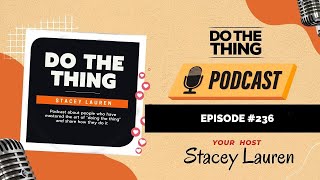
YouTube video transcript of a Do the Thing podcast episode featuring host Stacey Lauren interviewing community member Ann Marie about starting her podcast 'About This Life.' The conversation covers Ann Marie’s background (former social marketer turned English teacher), a difficult 2023 that included knee surgery, finding community and coaching support, how launching the podcast helped her reclaim purpose and voice, practical podcasting advice (start messy, use community help), and distribution details for her show.
Chapters
Hey, everyone. Welcome to the do the Thing podcast. This is your host, Stacy Lauren. All right, guys. Well, I am so excited because I'm interviewing someone from the do the Thing community that started her podcast, and she's been a part of a lot of the do the Thing challenges, and it's been amazing just to get to see her growth and her journey as she's been doing the thing with the people in the community of. I wanted to bring her on so we could talk to her about her story and also be able to celebrate the things that she's been doing. So I am welcoming Ann Marie to the show. Hi, Anne Marie.
Oh, thank you so much, Stacy. I am so happy to be here.
I am so glad you're here. You're such a bright light in the community, and it's so cool because I think sometimes people will say they have community. Right. And I'm not bashing everyone else, but I think the thing that is different about the do the Thing community is that we are really getting to see each other with your podcast and with going live, we're literally interacting. Not just through typing. We're visually seeing each other and a part of each other's lives.
Absolutely. And one of the things, the comments that I made in terms of feedback is I found my tribe.
So, I mean, I'm with my tribe, and I started. I found you, Stacy Lauren, online, and it's interesting. I started with one challenge, and I ended up doing three or four. I lost out, and I'm just like, this is the last one I promised. And then you roped me in.
Have to keep going. And some of the people in the community I've had the pleasure of talking to and having conversations with, and they've been on my podcast, and I'm on theirs, so it's working wonderfully.
I'm so glad. And yeah, that's right, because you're in both groups, so you're getting all the do the things. You're getting the whole experience all to do the things.
And I'm just like, this is so great. It by divine appointment, Stacy. It was by divine appointment.
I'd love to start off. And so your podcast is about this life, and I'd love to start off and just hear where you were when you joined and what made you even want to start the podcast. What had you been going through? What had maybe even stopped you from starting it before and then got you to start it through the challenge?
What? Well, how much time do you have? And do you have a couch?
This might turn out to be a therapist.
And you'll find out why in a minute. By profession, I am an English teacher, but teaching was not my first career. I actually worked in something called social marketing, where I developed messages, used the techniques and the tools from public relations, print. But instead of marketing products, I marketed issues, things that people needed to be aware of. One of the things that I fell in love with in that career experience was something called qualitative. We did qualitative groups. So I would facilitate groups. I was a facilitator. We had focus groups, for heaven's sakes. So I would develop questions and ask follow up questions and I loved it. Then I became a teacher. Fast forward 20 something years, odd years. This particular year in 2023 was a rough year for me. I had to have total knee surgery that required me to be at home. I refused to have it in the summer because I was not going to be homebound during my summer. I was not giving up my summers. So I ended up being off during the fourth quarter, the last quarter of the school year, I was homebored.
Everybody else is at work. Who am I going to talk to? All my friends are working. And so I'm on Facebook and it says, start a podcast. And I said, I want to do this because it brought into remembrance how I like to facilitate conversations, how I like to find out about people and their inner workings. Right. And the second part to that, I'm an English teacher. So, you know, English teachers have a dozen books in their mind. Okay. And I do write, so let me point that out. But I have not fulfilled that purpose in terms of actually publishing a whole book. So that is my other goal. That's the other half to having a podcast.
Yeah. So I love that. I didn't realize that before you saw this online that you didn't have podcasts in your head. It just came. And then all of a sudden, your past experience with loving that idea of facilitating conversations came up. And then you were able to create it from there.
Absolutely, I created it from there. And how deep do you want to go? Deep.
We're going deep.
We're going deep. I think about it also comes during a time from November through February of this year. So a month before my surgery, I did some work. I'm going to call her a life coach. This whole thing about going back into your childhood, reclaiming, digging up those types of roots, and she called it. Melisi Crawford is my coach. So Malici had me unearthing or digging up memories from my childhood, many of them painful. Many of them with a lot of baggage attached to it. She held space for me in faith, until I reached a point where I was complaining, I was whining, I'm home alone. Nobody's here to help me, yada, yada, yada. And she said, anne Marie, you have to take control of your own life. You are responsible for your own life. And I'm like, where's my sympathy? That's my hat on the back. Where's the. Or maybe Melissa said to me, take responsibility for your own life. And I use the phrase divine appointment because.
The podcast came at a moment in time where I said, I'm going to manifest this in terms of I love language, I love words. I want to use it at this point. So, yes, absolutely.
Yeah. And when we said, how deep do you want to go? And I said, deep. I say that because there's literally someone listening to this right now.
That saying of, you are responsible for your life. That's gonna hit them like a punch in the gut by you being vulnerable and you being able to say that, and for those of us watching, be able to see it in your face. And what that statement did for you, I just feel like that's what I love about the podcast. Right. Because you don't realize how these experiences that you're going through and that you've come on the other side of how much they can help someone else when they need it the most.
Absolutely. And if I could be a light to others or to encourage others.
Stacy, you do a wonderful thing. You start off your dares, your challenges, with what am I afraid of? What obstacles or what excuses? I'm not a technology person. I struggle with it. And I said, that is the one thing that has kept me from progressing in my life.
So knowing that I had the community, the do the thing community, people like Madeline and Vicky, who just stepped forward, and anytime I had a question, how do I do this? They were there to answer the questions. And sometimes people in the community would jump onto a zoom, sometimes your experts that you brought in. And I said, I didn't have to do this alone. Then the other thing was, what pieces can I give away?
So if I like, for example, the conversation, and I like talking to people. Right now, as I think about season two of my podcast, I'm thinking, what pieces can I give to a high school student or a college student student who is a tech whiz that they can handle it for me? They can do the editing, they can add the music, they can upload so I can focus on the guest. So I'm trying to put that part of it together right now because even though I've learned some things about technology, my passion is really in the conversation.
And for anyone listening, I just want to point out. So we do encourage no editing, no music, no intros for a while until your momentum going. And then if you choose to, like Anne Marie just mentioned, she's going on season two now, if you choose to, then add all those things down the road, it's fine because you're already in momentum. We need it to be as simple as we can make it in the beginning until our fire is lit. Then once our fire is lit, then we can learn all these little intricacies if we want to or you don't have to.
Well, one of the things you say repeatedly is to do it messy. So like my first four episodes of on about this Life, it is messy. The sound quality isn't that great. And one of the conversations, I was talking to my hairstylist and we were in her basement. It was a very hollow sound that came through. So you have given us permission to do it messy. We don't have to be perfect. Doesn't have to be the perfect episode. And with that, it releases a block. If you would, once the block is released, the more and more that you do a thing, the better that you become at it. So by the time I finished season one at 17 episodes, I was like, okay, I didn't die.
Yeah.
And it's amazing. So you have 17 episodes right now, which is more. I don't know what the actual percentage is, but it's more than, I think, over 90% of the podcasts out there. So you're in the top 10% of podcasts right now by having 17.
Awesome.
Isn'T it? Yeah.
It shows that you stuck with it. I'd like to hear more about that. So you came in without knowing you wanted to start a podcast. You then decided that you wanted to. You realized your excuse or the fear was the technology. Right. How did you get over that technology hub? It sounds like you had the people in the community and the experts to help you through it. What was that little jump, though, that made you realize that you could.
I think Adam's willingness to help, because I've had many one on one conversations with Adam, who had the patience of Job to walk me through.
Began to transfer from something external to something internal. Internally. It goes back to my why I heard a woman, she's a public speaker, Cheryl Wood. I'm not sure if she's the originator of the quote. But I heard it from her when she says that your experience is about you, but it's not for you. Your experience is about you, but it's not for you. So I began to really internalize and feel a level of confidence as I was moving forward. Each time I did an episode, different things will come up. And for example, one of the earliest episodes is about my hair and those people who are around me. I've changed my hair just about every month for the last two years. Literally, I tell you, no lie.
I used to have what we call sisterlocks. My hair were locked. And two years ago, I cut my hair. And I realized, in terms of looking back, that I cut my hair around the time that my mother passed away. But I didn't make the connection at the time. So my hair was very short. I still had locks in the front, but then the gray was growing in, and I said, oh, wow.
That is another evolution in self in terms of how do we handle a different phase of our life, if you would. I have a big birthday coming up. I'm approaching 60. The next birthday will be 60. So I'm looking at the gray. So I said, well, maybe I need to have a buzz cut. I got the buzz cut, but I didn't like it.
So each month I've done different things, whether it's worn a lot of wigs or extensions. A clip on. Long story short, each episode reveals something about me. And I thought, if I'm going through this, there has to be someone else out there who's going through what I'm going through. So about this life is like, I've gone through menopause. They talk about the hot flashes and so on and so forth, but they don't talk about things like vitamins and how your joints change in terms of movement and inflammation and all of that. So we hear the stereotypes about mood swings, but no, really, my body, physically.
There'S so much pain. I have to learn about nutrients. I have to learn about food that causes inflammation. I have to learn. I've always been someone who moves and exercises. So I'm always doing something new and interesting. In terms of being active, I'm always moving. So the episodes are really tracking with a lot of the issues that I'm dealing with in life. And then I'm discovering how other people are thriving, because that's the piece. And you can interrupt me if I'm talking too long, but there's this piece, and it's something that I talk with my friends and the girlfriends get together is we're surviving day to day, going through the grind of work. Monday comes, we're hoping for Friday. I want to stop living my life like that. I want to be happy for each day. I'm a woman of faith, and I definitely understand gratitude and appreciation and prayer and meditation and all that, but it was like the daily grind. And I want to find out, how do people thrive?
How do people.
It's more than just finding your passion. It's having a purpose. Because when you have your purpose and you understand who you are, you, Joy flows from purpose, Energy flows from purpose. Compassion flows from purpose. So I suppose in a way, I was looking for purpose in a way back home to myself, looking for that energy to say that when I get up today, I'm going to be excited that I'm alive. I'm excited that I'm here.
So for me, as you can tell, because I've been talking for a minute, when I talk and I emit or I provide what I'm feeling on the inside, that seems to be my happy place. That seems to be one of the places where I'm able to experience a level of peace, a level of joy, and I want more of that. I want to be able to thrive. I want this part of my life to be excited. For women out there who I've raised the kids, the kids are adults, and some of us, we've given our entire lives to our children, which, by the way, that's a mistake. Don't do like I did. That's a mistake. We raised the kids. I'm divorced, so it's like, I want to design my life. I want to do the things I never got to do. And to make a full circle moment, There are many things I did not get to do as a child. I didn't get to go camping. I didn't get to go to my prom, my high school prom. I didn't do a lot of things, like girl Scouts, for example. But as an adult.
I'm able to forgive my parents because that's where they were in terms of their understanding of life as immigrants to this country.
I forgive myself for holding on to that sort of pain and loneliness Because I've been carrying loneliness for decades. And so now I'm doing the thing. I'm going camping in two weeks. I teach eighth grade, so every year when they have a dance at the end of the year, I say, that's my prom. So I don't get to go to the prom once. I get to go to the prom every year. That's how I rephrase it. That's how I reclaim it, and that is how I find joy.
How do you think you did that? You broke out of that monotony of that daily grind, and you're able to now see these moments of you finding yourself again, right, with going camping and then kind of owning that dance like it's the dance that you wanted to go to. And so how do you think you made that flip to be able to do that?
Well, there's two parts to that in terms of making the flip. When I divorced, I've been separated or divorced from my ex husband 10 years now. It happened when I was 50. When that major life occurrence happens, I would go to church and I would just volunteer for different things. I would try to be active, whether it's Zumba or the gym or Aquafit or things of that sort. But I never saw the commonality or the thread that connected. I didn't see the thread that was connecting all of these little things together. Melisi helped me see that again. She's my life coach in that I basically was looking for community, in search of community, in search of family, in search of a circle where I can be myself and be accepted for who I am. And that has a connection to when I was a child too. Because when I was a child, I was a bookworm. When being a bookworm wasn't popular, I wasn't a singer, I wasn't an athlete. As a child, I read books. And at the time I was growing up, that was not the thing to do. So when she challenged me with taking control of my life, I wanted to see what was the commonality. How I started to internalize it is one day I just kept saying, I love you.
And this is how we get deep. I was saying, I love you. And I said it for a few days and I'm like, who am I saying I love you too? Because there was no name attached to it. I would just like, I'm starting my car, getting ready to go to work. I say, I love you. I'm coming home. I love you. I wasn't thinking about my kids. I wasn't thinking about anyone in particular. And then my spirit said to me one day, I'm talking to myself, I am saying out loud, I love you to myself. And so when I made that connection that I was using the words that I would want somebody to tell me, but I was saying it to myself, that's when I got it.
That is so powerful. I Mean, and I'm thinking just even as, you know, with the singles community, we have the dating dare challenge, and one of the things they say every day is what they love about themselves. But I love just the.
And so.
So specifically saying what. But I actually just even love the statement, it doesn't even have to be a thing. It could just be like, I love you, and that could be enough.
That's was. And it was almost like. And the divine answered, God answered, because I kept saying, I love you. And a couple of weeks later, that's when the coach, she saw me on Facebook and she introduced herself. But I love you as a turning point as well, in terms of I have to find that thing within and not depend on a partner. I very much believe in marriage. I believe in it differently than what society does, though. Society, it's the companionship society. Society believes in, oh, I have somebody to do things with. I want that. But that's not all. I believe in marriage because I believe that in the union, that as a couple who are working together in purpose, that it manifests heaven on earth. I know that sounds pretty far out.
But it literally manifests heaven on earth. Because if we are working together on purpose, in our purpose, then that couple is a couple who are like the hands and feet of God and doing things and modeling for others and shining our light for others and helping each other fulfill purpose.
So I always say I'm looking for a purpose partner.
That's one of the things I really tried to do in the group, is help people build themselves up so when they meet someone, they're meeting someone where they are, and then you can then rise together, basically, you're not going to meet someone from that downward space. And I love that idea because I think whoever you're with, especially when you've been married before and you've already done it and you want to do it differently, you want someone that's going to build upon where you are now.
Absolutely. And you want different things in different decades of your Life. I'm not 20.
I'm not 30. So as I approach and I look at 60, yes, the companionship is important. But at this point, the key word for myself and whomever my purpose partner is, is legacy.
What is the legacy that we want to leave? Because when we leave this earth and years pass by, what are we going to be remembered for? Then that causes me to ask the question, should we be remembered? Should it be what will people remember that God did in our lives? Because everything should point back to God. So right now my focus is on legacy. And it's so much easier, as they say, for a three strand cord is much stronger. And that's husband, wife and God. So in terms of the Trinity, I'd.
Love to hear more. You were saying about how you activating your voice basically has opened up this other space for you. And I have that similar experience, which that's what I speak a lot to, because I don't think a lot of people realize that that activation of voice can do so much for you. And I'd love to just hear a little bit more about how that works for you. And that's maybe advice that you have for other people that may be like, what does that mean?
When I was younger, I was extremely shy, painfully shy. They have names for it now, they call it anxiety and they have medical terms for it now. But I was very shy. I also started college at 16 because I skipped two grades. I skipped the eighth grade, I skipped the 11th grade. This is in New York. So in College at 16, I didn't have the social skills. So I married young. I was married by 22 with no direction. No mentoring, no mentorship, no tutelage, no aunties telling you, watch for this. Wasn't groomed for any of that. Just got married and it ended up being like a 30 year relationship. But in so doing, what activated my voice inside is I was the one who left. It was against every single thing. People kept telling me, oh, he's a good guy. Oh, you have this beautiful house. We built our house from the ground up, obviously with contractors or, oh, you have status and, oh, you should go to counseling. Went to like seven different counselors. That's a whole different story. And at some point I had an epiphany and I woke up and it was the spirit and it says, I'm not doing this anymore. I was the one that walked away.
I walked away from most everything. He was trying to fight me because it was the idea that how could I, as a woman walk away? And the stereotype of that in terms of what it would make him look like. And I didn't care. I didn't care what people thought. I didn't care what our friends thought. I didn't feel I owe anybody an explanation. I didn't want anything from him. I didn't want the house that we built together. I didn't want anything. So, you know, like when the house was sold, we split the proceeds, but some people will fight to stay in the house. I didn't want any of that. I didn't want the remnants of anything. And I felt free. I was free. So once I went through that, and I went through what I would consider a valley because I didn't have enough income to afford an apartment. So for a couple of years, I rented a room from somebody's house. A grown woman rented a room. When I found my apartment, I had no furniture, so I slept on the floor. No mattress. There are many experiences, and I don't want to get too dark. I want to keep it light. But I've been through a lot. And I said, if I can go through that. For me, that transition into my singlehood was hell. And so I sort of said to myself, I survived that. I came out on the other side. I have forgiveness. I forgave myself for being there so long. So when I released that, I said, well, what is it that you can't do? You know? And whatever I can do. That's where my faith walk comes. That's where I rely on God to be with me.
How do you get through those valleys? What's the way that really helps the most when you're in that hard time and you're able to come out from it?
I could talk about something more recent, like when I had the knee surgery and I was home alone. I got through the valleys. I would put on music. Sometimes it was gospel music, sometimes it was happy music. That dance in my chair and just rock it out. Sometimes I wrote. I wrote in my journal. My church that I go to because of the pandemic, one of the remnants of that is we were meeting via Zoom once a week. So I can rely on Village is what we call ourselves, that weekly meeting. I have a best friend. She is wonderful. She would check on me and text me affirmations every single morning. So that's how I survived. That's how I came through. And on my podcast, I mentioned often how I like to hand dance. The simplest way to describe hand dance is that it's like salsa. So from that experience in terms of taking classes, I started classes like five years ago. There are people in the hand dance community that are my friends. Now we're friends. And so they stayed in contact with me. That is what helped me get through those valleys.
Being around community, community.
Community is something that I've always searched for and always wanted. Yes.
So what are your thoughts with your podcast now? Are you excited about what your next step is and what are you looking to do?
That's a great question.
And I say that I took the month of September off because opening School is a busy time, so one of the busiest times of the year. So I will be back with new episodes in October.
And I'm thinking about which direction do I want it to go in in terms of things about this life and the conversations. I can tell you that I'm in prayer about it because I want the Holy Spirit to lead me to the people that he would have me to speak to. But one of the things that surfaces often is the answer to this phrase, I used to believe, but now I believe. So how have people change? If I can think of an example, I used to believe that I was alone, but now I believe that I can make friends in a community. Okay. I used to believe that I was always, like, the slowest one in PE class and gym class, but now I believe I'm a great dancer, and so I can find joy in the things that I can do. And then we have to discard some of the things that our parents taught us, some of the things that we grew up, because they had their stuff, and they transfer that consciously or unconsciously to us. And the role of the woman, especially in the Caribbean culture, is we must always listen to the man. I used to believe that I had to do everything that a man tells me to do. Now I don't. Or I used to believe the way I was raised, you had to stay in one career your whole life. Now I'm looking at my sons who hop from job to job.
This generation, they are going where opportunity is. Or I used to believe one income. You work for 30 years and get your watch. But now I believe that one should have multiple streams of income. That's really important, especially as a woman, in order to support ourselves, to have multiple streams of income, not only to support ourselves, but to leave legacy.
Yeah. You could do one episode on each of those things.
Absolutely, son. I need spirit to lead these people. Yeah.
I think that's probably because, you know, sometimes we have that voice in our head that says something negative about ourselves. And I love that rephrasing. Because then at least you're not saying, oh, trying to get that to go away. You're rephrasing it in a way that's honoring the old belief, but then bringing in the new one.
Bringing in the new one and saying, it's okay to do things differently. It's okay. Give yourself permission to say it's okay.
Okay, I'm going to ask two pieces of advice, so I'm going to do them separately. So I'm going to ask one piece of advice for people on starting a podcast. And what do you think that they could. Especially you. Right. I think a lot of people when they're coming into starting a podcast, they've thought about it for years and they just have been held back and haven't wanted to. And I love the fact that you just saw it, you're. I'm going with it. And now you have a podcast. And so what advice would you give to someone that maybe either has no idea or even thought at this point in their life that they want to start a podcast or someone that's been wanting one for a while? What advice would you give to them?
I would say.
Have an idea of what you want to talk about. You are a unique person. Each person is unique. And even though we might have commonality in terms of our experiences, our voice is unique. So what is it that you would want to share with others to have that figured out, to give that some thought, Even if it evolves or changes as you go along, the second part of that, it really, really, really makes it easier if you have other people that you're doing it with, somebody to help you, somebody to answer questions, somebody who you can call up and say, hey, how do you do this? That sort of thing that's really important because when the hard stuff comes, you want to give up, but you don't give up because you know there's somebody that you can call and say, oh, I know who can help me do this.
And what do you think someone would gain from starting a podcast?
You gain a deeper understanding of yourself. Because when you talk, it's almost like talk therapy in a sense, because it becomes a moment in time. When the conversation between host and guest, when there are moments that are shared, there are ideas that are shared, there are thoughts that is bigger than the conversation that's being had. And if that sounds so esoterical or too wild out there to bring it down into practical terms, when two people come together and they're talking two or more people, ideas flow and come to the surface.
I actually think it's like co creating something.
Yeah, yeah, you're co creating something. It's about you, but not for you.
All right, Anne Marie, we've made it to the last biggest question. Are you ready?
Yes.
What is your number one piece of advice for people on doing the thing?
Just do the thing. You have to jump in and you have to do it. And if you're scared, do it scared. You will survive and you will surprise yourself at how much you can do.
And please share with everyone where they can find your podcast or anything about you that they can follow along with you as well.
You can find me on Apple Podcasts. You can also find me on Spotify. It is called about this Life with your host, Ann Marie, Changing Our Lives One Day at a Time.
Thank you so much for coming on. I just love and just think that everything about you is so great. So I really appreciate you being a part of the community, Stacy, and for the listeners, do the thing. Don't wait for opportunity, create it.
More from Stacey

From 262 Women to 8 Million Media Impressions: Deborah Drummond Built a Global Women’s Movement


From Notes App to Published Author: Avery Brenna Crumrine on Turning Intention Into Action


How Stacey Lauren's Billion Dollar Impact Marketplace Will Raise Billions for Charities and Causes

What Happened When Allison Maslan of the Pinnacle Global Network Ran a Challenge with Stacey Lauren




Leaders Share How Stacey Lauren Sparks Action, Clarity, and High-Impact Collaboration

Sandi Masori Announced as Emcee | The Billion Dollar Impact Event Returns to San Diego