Episode 237: Joe Fier Shares the Secrets to Podcast Influence and Connection
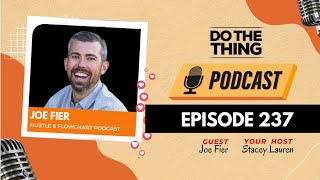
Transcript of a Do the Thing podcast episode (host Stacey Lauren) featuring guest Joe Fier. They discuss using podcasting as a central marketing ‘flywheel’ for networking, affiliate and sponsorship revenue, and audience growth strategies (guesting, Dream 100, SEO, paid ads). Joe describes his show Hustle and Flowchart, creative/intuitive business choices, and practical tactics for pitching, promoting episodes, and monetization.
Chapters
Hey, everyone. Welcome to the do the Thing podcast. This is your host, Stacy Lauren. Oh, my gosh, you guys. Okay, here's the thing. When you see something that you want to go to, you just need to go to it, because I just got reconnected with my next guest. We knew each other more than 10 years ago. We met at a marketing group that we were both involved with, one that actually has changed my life since being a part of it. And you guys have heard stories of all my Mastermind members on it, and here he's been part of that community as well. And we just recently got reconnected at a podcasters meetup in San Diego. And you just don't know what's going to come out of these things. And he's just someone that I've always admired for the work that he's been doing. He does so many amazing things in the space of podcasting and helping people with marketing and just so many amazing things. I can't wait to just have this opportunity to dive into his story and see what kinds of strategies he can share with you guys to help you grow whatever it is you're doing, or maybe even you have an idea for something that you want to do. And you'll get inspired by hearing him talk because he's so relatable and just really easy to inspire people. So I'm so excited to welcome Joe Fear to the show. Hi, Joe.
Yeah. Thank you, Stacy. This is super cool. Do the thing. I love it. I'm all about. I mean, there's a lot of things to do, so. Yeah. And it's crazy how long I guess we've known each other and through the Masterminds and, you know. Yeah. Previous guests. And it's changed my life. I mean, Masterminds. I'm in another one. Just last night I was just like, this is why I've been masterminds, why we get each other together. It's like doing deals, but even just supporting each other. Yeah. It's fun. And yeah, I've learned a lot over the years and it's been cool to see your shifts too, as well.
Thank you. Yeah, I'm glad you said that because I think a lot of people don't realize the power of being around people that want the same thing as you and just what that can do for you. Because, number one, it elevates you're thinking. Right. Like, you automatically are upgraded immediately.
Yeah. When you're in the room, I know it's like a listening and understanding, but it's like almost like, the vibe almost elevates you. It forces you to think a little higher, you know, a little more elevated, instead of just being in a bubble by yourself. Because we don't operate that way.
Yeah. That's such a good way to put it. I talk a lot about the vacuum that entrepreneurs can be in.
Yeah.
And we think that we have to be inside this one. So focused. I am going to work on this thing. But when you can surround yourself with community and other people, it just can exponentially rivet.
It's like. Yeah, yeah, it's. It's like this whole flywheel effect. I feel like we get in this momentum, and it's great to have a focus on one thing and, of course, know your core thing. But at the same time, I know I'm doing my core thing and at the same time have three other conversations happening at once. But it's all because there's momentum happening in all these places. But it's all kind of centered around the core thing. We can dive into more of that in a future. But it's exciting when. When you're not in a bubble or a vacuum.
Yeah.
Yeah. That's not a safe place to be. I don't think for business or just personally either.
Totally. Yeah. I'm actually excited to explore that flywheel concept for sure. Okay. So for people that are in the online world or podcasters, they probably know you are like, oh, my gosh, he's on your podcast. But for people that don't, can you share who you are and kind of what you're all about?
Definitely, yeah. So I have been doing podcasting and digital marketing almost about the same amount of time. So, what, almost 15 years in. In full. But the podcasting, was it 2013? I believe it was. That was, like, when it started. The show I have right now is called Hustle and Flowchart, and that's almost seven years old. So that's like, over 550 episodes. I think it's at now. Who's counting? It's insane. And it's pivoted a lot. And then we talked about the changes, and I've definitely pivoted over the years in multiple businesses, business partners, and it's been very interesting. But everything that I've done and what interests me the most is how to leverage our own creation, our expression. It's like, how do we put that out there, where ultimately that's our brand and what we put out into the world, and that's going to attract the right people into our world? I've Chosen podcasting as that thing that just, it's like the hub for everything I do. So talking about Flywheel, that podcast, it's like the ultimate networking machine. It's like what we're doing here on your show too. And there's just so many cool things you could do from that relationship you're building during what we're doing here. And that's where I've taken things into the affiliate marketing space and sold millions of dollars in a lot of software products that way, some training programs, but a lot of SaaS over the years on the back of content. There's a lot of partnerships, JVs that have come from that as well, business partners. Now I just got some equity in a Silicon Valley backed company that is in the AI space. It's all from just connecting and kind of being in the middle of things. And so that's where I like to be the connector, the co creator. And it's kind of, I've shapeshifted in a lot of forms and yeah, I mean you mentioned masterminds, that's why I love masterminds because it forces you into the bubble in a way with like minded people. So yeah, that's what I do. And then ultimately there's training. I consult with people, coach people on doing just that for themselves. Mainly coaches, experts, authors, because those are the folks that typically have some kind of thought that they want to express and attract similar minded people with that vision. So it's been fun.
Yeah, yeah. And I think that you're really speaking a lot to what I tell people. Cause I just recently helped a bunch of people start podcast through a challenge that I did and now I have just a workshop that they get on and I help them kind of break free from that idea of the tech just to be able to do the thing as they say. And something I remember from the very beginning, they're like, how do I get listeners? And in the beginning I'm like, it's not even about your listeners. And while you guys, I love you and you're amazing and I love when you comment that you like the show. It's really in the beginning it's about the people that you're connecting with because you get this intentional time and space with that person. I'd love to just hear more about that because you mentioned all these things are getting co created, you're getting affiliate offers, things like that. Can you kind of just explain a little bit more about what that process is like?
Yeah, so that's. And it's perfect. So you Framed it perfectly well. And the thing I like to say is for what you don't need a podcast to leverage podcasting and the power of it. It's nice to have your own because that's your own stage. It's a virtual stage. That's how I like to see it. And that gives you a little bit more leverage in terms of inviting people to your personal stage. So there's a lot of fun stuff you could do there. But at the same time it's. Yeah, it's finding your expression and knowing that there's a relationship happening between the guest, me right now and you as the host. But could go vice versa. And if you come in with the intention being that like, okay, so me as a guest, let's just say for whatever reason I chose okay. Stacy's show is a great show to be on because I know there are people listening to her that are like minded to people that I would love to get in front of. I want to be on her stage just speaking in person somewhere. And that's why I would say I'm like, I almost suggest people to just start guesting in a way because you can get that momentum out there. As long as you have some, you come prepared. There's a lot of things I would suggest to do prior to just start reaching out to everybody. I want to start talking, but have key things that you can bring of value and then know where you can extend that conversation outside of the podcast. And that can be a slew of different things. Offering to go speak on their workshops to their mastermind members or provide more value in some way. And in terms of. Let's see, go back to your question. I kind of went on a little tanto there, the whole flywheel concept, I guess it's the podcast, it can be that in the middle of your mark, it's essentially becomes your marketing if you do it right. And so I like to just kind of create content one time and figure out how do we make that everywhere. So like video, audio, text, with all the tools we have these days, there's so much you can automate as well with a smart workflow where it doesn't take a lot of team or tools or expenses really to do it. So just figuring out what's the flow to make sure you're doing it for the right reason too. So knowing your audience and where you want to show up. So that's where doing it for yourself. But also in other shows you can kind of cherry pick the audiences you want to curate for yourself. And as long as you're showing up giving good value and giving next steps for people to take to continue with you. I mean, that's how I found some of the best partners, customers, long term people that just from just talking like this, giving value and then just knowing that's a relationship in itself that we're creating here.
Yeah, I love that idea of if the podcast is too much for you right now, the idea of starting one and maintaining it, then just guest, because anyone can do that. You can literally reach out to someone tomorrow or today right now and just see if they're looking for a guest on their podcast. How would you suggest someone approach someone if they want to be a guest? Is there a good thing that you recommend?
A few ways. Yeah. A few ways I would suggest is, you know, definitely starting with your network is start with the people that know like and trust you. Of course, that's always great. There's definitely services. Everybody knows of the PR folks that you can hire a site that I've heard because as I'm coaching, there's a lot of people telling me what works for them. Podcast guests with an s@theend.com is great and supposedly really, really high quality opportunities. I'll tell you what I think is way more leveraged is creating a, and this is a what a Chet holmes thing is dream 100. Creating a dream 100 list for yourself. And I'll just tell you how I've modified that concept for myself is the intention here is to be very deliberate with who your audience is, for one. So know your target listener, avatar. That's why I like to call it tla. And now you know who you want to speak to. And these people are going to be the ones that you can give the most value ultimately by your products and services down the line. But knowing that starts with the podcast and who you can connect with for either as a guest on their virtual stage or bringing them in, knowing they can now promote you to their people if you set it up right. So the Dream 100 concept, essentially just think of a Google sheet and I specifically a Google sheet is what works with this. If you list out the hundred people, could be 50 people to start if you want, of folks who have that ideal audience, who are the people that are quote unquote, controlling that audience and at least the narrative with those people and put them on that list. And I would say put some moonshots on there for me. I have like Elon Musk on there, Bill Gates and why not? Because I've Gotten close actually I've. I've. Yeah. Been connected to Elon's old roommate in college through just a random accountant that someone that. And I'll tell you how. But the point is put the names on there. You're probably more connected than you think. Probably a couple degrees of separation. And I would also put some kind of. Maybe the ones that you're maybe one off. You just know you have a connection or two that could open a door to a bigger name. Let's say someone with a bigger audience or more qualified audience. It doesn't even have to be a huge audience or person. Put all those names on the list and alphabetize them. And the whole thing is to. And I have a template for this. If anyone wants to get this I can let you know. But it's literally. Yeah, yeah, I think like if you go to hustleandflowchart.com dream100, you can see mine and literally you can just duplicate the thing. Just don't duplicate the names. Make it your own. So you can take a peek because there's a description on top. It says like, this is my dream 100. This is who I'd love to connect with for this reason. But the point is. So you have this list here. You're intentional now. And then what you can do is use that Google Sheet link. Let's assume you're using a Google based email. A lot of people are, Gmail or Workspace or whatever. Even if you're not, just do it anyway because at least use the Google Sheet thing. Because what you could do is put out your email signature or put it anywhere in an email. And what it does is it creates this little preview attachment looking thing in that email. But if you put in your signatures, every email that you send is now a link to. And what I would say in the email signature is, here's my dream 100. Know anybody? Whoa. Literally as simple, open, loopy as that. And then with the preview, people are like, what's this attachment thing? It's not really attachment, it's just a link that's a preview. And so many people have been referred to me through that alone without having asking. It's just showing up at every email I'm sending to anyone. And usually it's someone either on the list or if they don't know someone on the list. Now they have a sense of who I would like to get connected with for either guesting or for them to be a guest on my podcast in my scenario. And then it usually comes with a warm Intro or a warm intro to three other people that they're like, you know what? I don't know anybody there, but I know these three people that would be great for your show. Or you should know them. Want me to connect you? Yeah. So that's how I do it. Where you're not doing the cold pitching. It's all warm, it's inbound. Rather than you outreaching, you can of course share the same link for people who have been on your podcast and say, hey, a guest or anyone else. Follow up and say, hey, do you know anybody on my list? I'd love to connect with more people like you. And here's a list of folks that I'm looking to. Maybe you know anybody. And social. You can put it everywhere. But I love the email part.
Yeah, it's great. Cause you're implanting it in their mind and everyone naturally wants to help people. And like you said, even if it's not one of those people, they're gonna think of someone amazing that may be similar in those ranges and then introduce you that way. But if you don't ask, then it won't ever go in their mind to even think. Cause you're implanting the idea.
Yeah, that's it. And that's why I'm like, the cold pitches, let's be honest, they're tough. And with AI and all these things that are generating, everyone's kind of pitching the same way. No one's really leading with value. I mean, it's very rare that someone. If you're going to pitch cold, it's like, you better come in with giving and being open to providing a lot of value to a show. You don't know that person. I mean, I get like almost 10 per day and I'm like, I can't filter and look at every single person who's being pitched my way from a. It's usually a PR admin or someone that's. It's more annoying than anything, to be honest, because it's like, get creative. Send a video or a loom or something.
I was just about to say that is the one cold pitch that I did was he sent a video and it was amazing. And it was such a good interview. He sent like a personalized video saying why he wanted to be on my podcast. I loved it.
Looms are great. And that's what I was going to suggest. I'm like, if you're going cold or anything, do something personal like that. And video's great for that loom specifically.
Yeah, I'm So excited.
I saw you taking notes.
I was like, yeah, no, I'm literally like, okay, don't forget. I don't know. I'm gonna listen back, but I don't wanna wait till I listen. Cause I'm taking action on some of this stuff right now.
Yeah, yeah.
I'd love to also hear when you have a guest on your show. So now that you're coming on my show, right. How would you want me to promote you to the world? What would be a way and what would get you to share me with your audience? That would be a good example too. What could I do?
Yeah. So I think it starts with me as a guest and to be honest, and because we knew each other, it was all kind of like didn't do all this. But at the same time, ideally, in a perfect world, what I would suggest is you're giving the podcast host as a guest. You're giving them basically a one sheet of who you are and all the achievements or things you love to talk about. You can even go as far, and this is how I coach folks, is you can give like a three pager, two to three pager of some example topics based around maybe, let's call it two or three core themes that you like to talk about or maybe different audiences. This is my. If I wanted to, I could go to let's say a real estate based podcast to realtors and talk about podcasting. But it's going to be slightly different in the questions. Maybe I put three questions prompts that would help the podcast host. So prepping anyone for that interview is just gonna help to start the thing. I've done this before where I take our ass for the interview and maybe publish it on my podcast. So then it's kind of like a co thing. So it's like, hey, I would love to put what I'm talking about here on my show and then kind of like mind sharing that with your folks and you know, so it gets more exposure there. Even as far with all the AI stuff. Now you can ask for the video, get a transcript done really quickly using an assortment of tools. And one of the tools I use is called Cast Magic and that one is great because it will immediately crank out. Actually I won't even need the transcript. I would just ask for say the video recording of this, put it into there and then, then it's going to spit out all these different outputs like social media posts that are written, pulling the key points or things written in your voice or our voices here and provide that to the show and say, hey, here's a bunch of social media posts that I just wrote up for you mind using any of these to promote the episode? Or, you know, I can do the same. It goes both ways. Yeah, so that's one option. I mean, ChatGPT can do some of this stuff. It's just a little bit more manual. Mm. But yeah, thinking of. All right, so I want this episode to really get shared around and leverage, maybe even suggest to write an email for them. Almost like a swipe copy for. Instead of a product. It's the episode you just did anything that. And you can go take it to graphics as well. You have Canva is great for this. If you maybe create a template for something in the episode, you can now offer that, like, hey, I don't mind creating some graphics for you for the episode we did. This is definitely going above and beyond that. Most people never ever do. But yeah, showing that I think will incentivize the host or the guest. If you go that way, you're doing the work for them. And it's more of a yes, like almost a hell yes rather than a.
Well, yeah, anything done for you. Like, even when someone wants you to write a testimonial or something, you know, if they could just give you a baseline of what they're looking for you to say, it helps. Right. And so I think there is just something really cool about that because like you said, you're leveraging not only your network, you're leveraging your flywheel. You're actually leveraging your time now because you hear with this one episode, you're amplifying your audience. You're connecting with a new person that you can now collaborate, co create with, share products. There's just so much about that that is really incredible.
Yeah, I'm happy to see it because that's where I see it as a flywheel. And how if you do it correctly, if you're a guest or a podcast host yourself or both, it's like you can put the podcast right in the middle of all of your marketing. And with the right intentions, you're like, okay, I'm going to grow my brand if I'm showing up in the right places using smart workflows and tools. And then also you're giving a call to action within the episode. So it could be giving something like I did the dream 100, like a link, something valuable could be a custom link, like a call to action. Let's call it a cheat sheet or checklist or something that people are going to want to go to. If they're connecting with your message, you can do that on your own show or on as a guest. So, yeah, those are all things where I would extend the conversation. And then I think the real gold, though, happens after the show, like after recording stops is. All right, so now let's chat about how else can we collab together? How else can I help you, Stacy? And if you have a workshop coming up or mastermind just thinking about what's the next natural thing that we can collab on together.
Yeah. And for you guys listening, because what happens is when you're interviewing someone, there's this special just magic connection that happens because you're spending this intentional time together. And that's where like you want to do stuff together afterwards because you've already been in that space.
Yeah. Well, it's comfortable. Cause you think those podcasts are what, 30 minutes to an hour or so, and you've just spent that whole time typically smiling, nodding to each other. It's what we all do. And we're also telling stories that some of them can go really deep, some are just insightful. Yeah. Naturally you have a connection. It's like human behavior. I mean, this is why I think podcasting is the most ultimate networking tool to anybody and talk with anyone using Zoom or whatever platform you got. So it's really up to us or you listening to take the initiative and think what's the next natural progression? So I'll just tell you. Most people don't think this way. And it's such an opportunity that everyone has. You just gotta know, what do you want and then what can you offer and what's to do next? It's not rocket science and most people are just gonna say yes or at least like, let's have another call or talk about it, or I'll put you in touch with my team and we'll figure out how to get you in front of or on my PODC podcast or some other people. So, yeah, there's endless. This is where my mind goes.
Yeah, I feel like we can have a four hour conversation on this alone. Just this one topic, probably more. Yeah, it's amazing. And I love talking about podcasting, so we can definitely do that sometime. I would love to also hear in terms of growing your audience because I know you have experience with Facebook and using different Facebook avenues as well, and I just love to hear maybe how you've been doing with that as well.
Yeah, you can do it all sorts of ways. So with the podcasting, it can be A very honestly should be kind of a longer term thing that you commit to because the audience that listens to a podcast is way more engaged than let's call it YouTube videos. So the engagement rate on my episodes, it ranges around I think it's 70 to 80% to completion which a YouTube video is nowhere near that on average. So just thinking that you're having this intimate conversation, a listener is just listening, usually alone. I doubt it's like a whole room of people hanging out and listening to a podcast together typically. So knowing that that is your ideal audience, honestly you don't need a ton of people. And I think this is where people get hung up on growing the show is I think want to preface and say you don't need everyone. You just need the right people to listen and to make sure they're. They're going on that journey with you. So I don't know, you look at it organic traffic, there's referral traffic, there's paid traffic. Those are kind of like the three buckets I like to think in. And when it comes to organic traffic ways that I grow the show, this is more long term but SEO really leveraging the content that is created here. Creating show notes or a blog post on your website and ideally on your own website that you own. Some people use these third party podcast host sites but it's like you're not going to get any SEO love that way for your brand. And so like right now our. I still say R sometimes because previous co host Matt. But the website which I've migrated from a whole old domain to hustleandflowchart.com I rank for a lot of the guest names that I've had on and their brands and a lot of times it's over their own companies or. Or even social media links or at least right next to them. And I was looking up. I had the founder of Twitch on last year. His name's Justin Kahn or he founded it. He's exited the bought by Amazon. I was like, what's. What's going on? I was getting an alert. The most growing page was him. I was like. And I looked down, I was like, oh yeah. I'm like pretty damn close to the front. It's infinite scroll now in Google basically. But I'm like, it's pretty close to where the front page would be or right around there right below some mega sites like VentureBeat and stuff like that. I'm like holy moly. So over time that's the snowball effect. That takes time. Yeah. But that's traffic, that's Evergreen. I'm not paying for it. And it's super targeted. And again, this goes back to the point of cherry picking the right people to be on your podcast.
Yeah, that's amazing because you're just basically just by their name, it's ranking you in a certain way.
Yep. And there's a lot of cool things you could do. It's like, okay, well, now that could. If I wanted to. And this is where just time and resources basically is. Okay, well, maybe that's working. Let's spin out more podcasts or at least posts about that person, that brand, whatever, to really capitalize on that referral traffic. So honestly, it's organic and Referral are my 2 favorite because they're the warmest leads and people coming in. So guesting is great. You're not going to get a massive bump unless it's like a huge show, but it's probably where some of your most qualified leads and clients can come from. Our listeners, even. So doing the whole guesting route. We already talked about referral traffic. I mean, getting featured in places. I like to do that too. So you can get on top lists. They Always rank top 10 podcasts in the marketing space, top 10 podcasts in the dating space or whatever. And these people are always wanting to update their lists or maybe they're open to just modifying it or writing a new one for the next year that's coming. So what we've done for years and years when Matt and I were working together is just reaching out to some of these. Be like, hey, would you mind featuring us? Or at least extending the reach out to someone who's already ranked in Google. So, like going to somewhere where it's already getting visible and getting traffic. And then now what I've found is you get on a couple of those and then they all start to kind of copy each other. So now you're getting kind of free PR for your brand and you're ranked. I've seen myself ranked next to Tim Ferriss and his podcast. I'm like, are you kidding me? But I'm like, I didn't. I didn't tell him to do that. But okay. But the thing is, you're putting yourself on your rate, on their radars. You're looking for posts that are already ranking, and you're just like, hey, I want to be in that conversation. How about me? And it's just asking.
Really amazing. I love that.
I'm all about doing that. And I think that's the biggest thing I love referral stuff. It's asking to be in front of someone's audience. So maybe it's a. Almost like a podcast swap or an ad swap in a way. It's like, hey, I want to get in front of your email list. How can I present some really good value? And I'm always dropping the podcast as the thing, the easiest way to follow along. So, yeah, I mean, there's a million strategies there, but basically figuring out how someone with an audience can shout you out or put you on their website as this co branded thing, I mean, you get instant credibility that way. Yeah.
Have you had a couple other examples on that and how you were able to do that?
I've done that. Where? I mean, let's see, I'm thinking of. Well, James Schramko is a really good one. He's a buddy of mine, business coach, and he's a mentor of mine out in Australia. I point backwards. I don't know, I guess Australia is that way, maybe below because of Earth. But yeah, I've gotten actually a lot of my best audience from him, and that was from just doing podcasts. We do these things where we both publish the same episode on each other's feeds, which is pretty cool. He gets an email out to it, I get an email out. I do social media. It's a very intentional collab. And by no means do I have the audience that he has in terms of. He just has a thriving paid community primarily. But the point is I was giving a ton of value to him and his folks, so he's willing to put me in front of all of them. And I mean, I think that's some of the best way I've done that with digital marketer Roland Frazier, Ryan Dice and them. So on his podcast, Roland's podcast, maybe twice, at least once, but featured in multiple places on some of their stages as well. War room. So it's like now I got to get in front of their highest value people and shout my stuff out.
Yeah. And it. Right. Because once you get on one, then it's like, okay, now you can use that in your reaching out where it's so much easier to do it at that point.
Oh, my God. Yeah. It's like once you knock over one or two, then. Yeah. And that's ultimately. Haven't really publicly announced it yet, but it's coming very soon. But joined HubSpot, their podcast network. They accepted me there. Thank you. And that goes to like 10 million people.
And so, yeah, yeah, that's my first million and all those ones, yeah. That's awesome.
Amy Porterfield's on there. It's only like 30 shows. So I was like, huh. So figured out how to make myself look valuable to them. And I mean, I was like, I weaseled my way. No, seriously. But it's forcing me to level up things and I wanting to grow. And now going video forward with my show is key. So in terms of organic and discoverable traffic, it's like being on YouTube is going to be a massive lever pretty soon for me. Has been over the years. But now YouTube's really pushing the podcast thing. So Spotify, that's another platform that's more and more catering to podcasters with custom pages, landing pages for a show and stuff like that, so. And video.
Very cool. And then I know you've been doing some or at least have experience with the paid ads, and I think I heard something about the dollar ad or something.
Is the dollar a day. Yeah, yeah, yeah. That's one that I had to actually turn it back on. But we did it for a long time. And essentially it's a Dennis Yu strategy. I think he runs. His company is still called Blitz Metrics, and I've had him on the podcast as well. So it's actually essentially the strategy. And if you look it up, it's public knowledge. You can just look up dollar a day strategy. So it's. It's not my strategy. I definitely credit it to Dennis, but the idea is that you're targeting someone's audience on Facebook is where you can primarily do this. You might be able to adapt it to other audiences, but let's say I have Dennis Yu on my podcast, or Roland Frazier. You can now go to Facebook and target their audience. Or if they're not a targetable person, maybe it's their brand or the industry. That's where it gets a little bit wider, though. But the more targeted you can. And then essentially, if you put a dollar a day, you're essentially telling Facebook, hey, go show this thing to his audience or people that are interested in his stuff. And now I'm just showing, basically, it's like, hey, go check out this thing I've did with Dennis or Roland on my show on my podcast. So it's kind of is hijacking the attention that Facebook controls. And you can just do that and just perpetually run this thing. So you're always being top of mind to the people looking who follow them.
Hmm. That's so smart. Yeah.
And again, knowing your audience, if you just pick the right people, then you can really do some cool stuff on the back end.
And do you do stuff with Facebook groups too?
I have a group. Honestly, I'm horrible on social. I'm not a big fan. I really should do more. I do have a Facebook group and it's been great. Those are core people. I probably should kick it up a notch again. Yeah, I will. I like LinkedIn. Lately, I know there's groups there as well. I've just found. I mean, it's figuring out. It's like, where are the quality people? Where are the folks that really matter? And like, what you're doing? And I don't know, it's tough. That's. That's why I'm conflicted. To be very honest, Stacey, I like LinkedIn because I feel like those are a lot more intentional people coming in and talking about the show. Discovering Facebook could be a little, I don't know, little lesser that. I could be totally wrong, though.
I feel like you're really good about kind of figuring out what makes you feel alive and then you're following that aliveness in a way. I'd love to just kind of hear more about that. How have you been able to do that?
I think it's more like I've tapped into my intuition a lot more than before. I think before I was kind of just more or less following what I thought the trends were or slash what I should be doing. And honestly, with a business partner, it's easy to be swayed by someone else's thoughts, but also there's great feedback there. But, yeah, I feel like I have a decent intuitiveness now that I've let go of I gotta be everywhere kind of feeling, because I think that can paralyze us. It has for me, where I'm like, I gotta be on this platform. I gotta be over here, I gotta engage over here. I gotta check in every day. I'm like, oh, my God. And I feel like it. It takes me away from like, all right, so what are the core things that I can really control? And for me, it's figuring out the people. Honestly, it comes down to, again, the Dream 100. Who are the people that I want to bring into my inner circle and stay connected with? Because I know at least I feel like it's a lot more leverage doing that and figure out how to co create something cool with others. The partnership with podcasts like this, and then from there, have some smart systems set up so I can at least show up in the places on Facebook, Instagram, LinkedIn, using automations or tools AI is awesome. And, yeah, I mean, that's how I see it now is all right. I want to get to the core of the thing and then kind of get out there, but then show up where I feel like the momentum is the most.
Yeah, I feel like so many things are popping up for me right now from this conversation. I'm loving it. And that whole idea of following your intuition and now you're not held. And not to say you were held back, but you're not held to something else. Right. There's not something outside of you. You get to really just follow your own instincts and what really makes you light up. But there's also this thing. When I think of podcasting as your flywheel, that's the image I keep having of your activating of the voice and being able to speak out loud to these things. And it almost kind of compounds this momentum in another way.
Yeah, I think so. And I think it's a lot more leverage than if you were to just put all your attention and put it on Instagram or in a post over here. I think that's the thing, is we all have the same amount of time as how are we going to use it? And I like to think of time and energy. It's like, how do I want to invest my energy as well? Sure, time, you can time block play in your time, all that, and track your time. But it's like. And was Dan Martell, I had him on the podcast recently, and he's just incredible. And he has a book called buy back your time. And we talked about this, and he talks about tracking for about like a week or two all the things you're doing. Put the time to it, but also rate your energy. Is it going up, is it down, or is it sideways? So is it light energy, dark energy? What are you putting towards the things you're doing? And I feel like if it's dark energy and maybe even consuming your time, you can put a number of value to all that as well. And now you can start to see. It's like, why am I on Facebook all the time doing all these posts and all and feeling obligated to do certain things? But for me, I just noticed, I'm like, that's kind of dark energy for me when I know that there's other stuff. I'm like, I would love to much rather reach out to five people today if I don't already have five conversations or so going of potential partners or deals I want to do or collaborations or a podcast I want to get on way more leverage of my time. And I'd much enjoy that more than anything than trying to hustle on social and do that whole thing, even though I still want to show up. That's more automated than anything.
Yeah. I think that happens to so many people, and it gets exhausting. Right where you think you have to do all these things because everyone else is doing it, but then instead you are losing sight of why you even started in the first place.
Yeah. So I guess the human connection is. I feel like you can get a lot more out of humans and actually figuring that out, rather than, I guess, trying to figure out what's the algorithm. Yeah. I mean, yeah, paid ads and all that. That's great. But I feel like you gotta really establish the core thing of what you're doing, consistently find the humans around you that are there to support you, because they're there. You just gotta express it. And like you said, with your voice comes across. If you're not into it or not. Some people just gotta ramp it up. Anyway, I was one of those people. Sometimes I am still. But, yeah, I feel like it's. I don't know, you get a lot more leverage out of even mentioned loom videos. That's another thing, to totally cut through the noise in so many places, and that's expressing your voice and your video, and it's another personable touch. Kind of like podcasting is.
Yeah. Okay, so in terms of monetizing. So as someone's building their audience and they're getting more engaged, I got this new word yesterday that I'll play around with. I interviewed the women of Pinpoint Collective. They do a design thinking, and they talked about the listener going from a 1D to 3D, where once you can make them three dimensional, it really kind of just adds more value. And I really like that idea. But as you're adding all this amazing stuff to your audience, what's kind of your thoughts on monetization? Obviously, this is a really loaded question. It's all over the board. But just curious on what you.
Yeah, I think it's a layered thing. So a lot of people with podcasts, they think of sponsorships right out the gate, and it's like. Well, I mean, the first thing the thought on that is, don't go for the CPM route, which is cost per thousand, because when you start doing the math, you got to have a lot of people to actually make it worth it to you. So you can run the math. Cpm. And it's all based off of downloads, essentially. Per episode. And the way that I would approach sponsorship, just to call it the obvious sponsorship thing, is to bundle all the different platforms or media that you control. So your email list, your podcast, YouTube channel, if you have one, social media platforms or groups, it's like where do you have that reach and where you can essentially sprinkle in sponsorship or slash partnership. Because I would kind of approach it with that mindset and what I've done and just sold another one yesterday actually is you package it up and put a flat fee to it instead of a CPM thing so you get out of that whole mindset of cpm. I mean this might not always fly, especially with an agency that's hard nosed. No, a lot of these people will be repped by. For instance, I had LinkedIn as a sponsor and they're represented by some agency. And I think I approached it with the. No, they still took the flat rate now that I think about it. Yeah, they wanted a cpm, but I was like, well here's what I got or what we have. And it takes them out of the thinking of just the podcast. So it's like, what else again, Flywheel. What are the other things that you can lump into the deal to make it more worth it for them? I think you get way more leverage out of that. That's what I found. And I think for even a new show there's partnerships or people, industry folks that want to be attached to a show, even if it's kind of newer. Just imagine if you're getting guests in on the show. Well now that brand might want to be associated with the type of people that you're going to be talking with. So you can almost represent a brand. This is if you go the sponsorship route, you can kind of think of it that way and almost like pre sell a little bit if you have those relationships. So sponsorships are one of them. That's the obvious thing, I would say. I like to control revenue as much as possible. So if you have your own products and services, make sure that you're giving them a next call to action on the podcast, to join your email list or to reach out for a free coaching call or something like that. And AKA could be a sales call or at least pre qualifying them for something that you offer. And if you do that enough, you have the pre roll, mid roll, post roll, all the roles, emails that go out. I mean that's the thing is always have a next step and I think the internal product things. At least that way you can grow an email list and follow up with folks. Whereas podcasts you can get in front of them, not necessarily follow up unless it's them hit and play. So definitely the intention from the podcast is grow an email list and then direct them however that looks like to your products and services using a funnel. That's good. Affiliates is another one. So I've done that a lot. That's almost called a mock sponsorship, but you can call it out. It's like, hey, I'm affiliate of this instead of being sponsored by that company and frame it as is a tool I love to use. And be honest, there's probably some tools that we love using already, so might as well, if you are an affiliate, can get paid what you feel like is worth for the deal. Well, that can be an ad or something you put in there or maybe just mention in some of these episodes you create. That's a way to monetize. Yeah, I think those are some of the obvious ones and I mean you can go crazy with all those.
Yeah, yeah. Could you share with everyone about your podcast and who you get to meet and talk to?
Yeah, yeah, for sure. So Hustle and Flowchart's the name of it. Thank you. By the way, Stacey. Yeah, Hustle and Flowchart, you can find it everywhere very soon on YouTube. That's literally a newer thing I'm bringing back now with the right people in workflow. I think it's like 550 something episodes now, which is insane. Yeah. Mainly interviews with subject matter experts, thought leaders, authors. Had all sorts of legends. I feel like in my eyes, like Robert Cialdini who wrote Influence at. Yeah. Justin Kahn from Twitch, founder of. I think it was. I don't know what it was. Hundreds of millions. They sold for a billion. I don't know what it was. But Guy was super cool. Also had the founder, his business partner now he was the founder of Google Drive. So he was on as well. David Wirtz is his name. Guy Kawasaki, who is the evangelist for Apple for a long time. There's so many names that lend together.
Have you noticed anything in common with the people that you have been interviewing that they all seem to have?
Ah, let's see. Common things. Well, I think they're attracted to the idea that the human side to business. That's what I like to hit on. It used to be very tactical because the show's changed. It's evolved over seven years and especially now that I'm the one hosting it without a co host. I've always been interested in the mindset or the human side of business and then how you can kind of pull out your superpowers to be the best in business. Basically, where the shoe is at, and this is partially my own personal growth is business should be a fuel for your life, not draining or burning out your life. And I think that's the big thing. The common theme I like to put in all these episodes and the guests kind of know that how do we sustain this and be in the game longer rather than just sprint, sprint, sprint. Do all the tactics, do all the things, do all the hype. And then it's like, oh, then what are you left with? Probably mad and pissed off and burnt out.
Yeah, it's so great. I actually had kind of a similar experience with do the Thing because I started it kind of like, I'm going to show people how to do the thing and I'm going to rah rah the whole thing. And then I realized it was so much more than that. It was really wanting them to follow their life's passion and be able to follow their intuition and not just do it because everyone else is doing it or that's what they think they're supposed to do. And so it's interesting how. Same thing, you're evolving as you get to talk to people, you're getting to really see what you care about the most and you're tapping into your deepest desire.
And I think it came from sharing a lot of the deep stuff I was working through too. And I've always. We've always done that on the podcast. When I had Matt as a co host, at least I felt like I was opening up a lot. I mean, deepest parts of I'm trying to have kids. I lost my dad to suicide. And at the same time, it's crazy, deep, dark stuff. And how that would affect me in business and life and how I see things, patterns in myself and how I don't want to pass this to my kids. And it's like. But all of that and then relationship with my wife, she's an entrepreneur, Heather. And we've done episodes together and how we copreneur together, then fostering, talked about that and had all these wacky things. I'm like, you know what? The more I put out there, I'm not going to just say every intimate little detail, but it's like at the same time, shoot. It bonds me with the listeners a lot more.
Yeah.
Because I've heard that from people just telling me about it and I feel like this makes the conversation way more easier too.
Yeah.
I'M like, nothing's off the table. It's all good.
Doesn't it Almost. Not to get too deep, but maybe I am. Doesn't it almost reconnect you to yourself, too, because you're getting to say these things out loud and then talk to them, to other people.
It's therapeutic for sure. Let's be honest. It's. It's helping me first as I'm talking it through. Not expecting the other person to be a therapist or anything. But, I mean, if they are cool, all the better for you. Therapy. So. But yeah, I think there's just a lot of perspectives that are learned. I know I've learned a lot about myself from speaking it. I got a lot more comfortable speaking about it. And then I get different ahas. And then it connects me with the other person, most likely the audience as well, because everyone's gone through their own deep stuff, and I don't think that's something that should be off the table. There's nothing wrong. It's being human.
Yeah.
I think it just makes life easier for everyone if we just connect on that level, too, and know that we're all fighting our own little battle. But we don't have to. It doesn't have to be so bad. Be that bit of hope that we can for ourselves and then hope to extend that to others in the process.
Yeah. You're just making me think. We were talking right before we recorded about. You were asking about the exit of my business and if I have any recordings. And I mentioned I had one with my coach. It's funny, that episode, I was being coached by her in that episode also. And I'm diving into it and I decided to use it as a podcast because I felt like I was able to go deeper by it being a podcast than if it was just a coaching session. So it's kind of weird how podcasting is this magic tool of just transformation.
Yeah. And it just reminded me that I used to have these therapy sessions, is what we call them, between Matt co host and I. And it would just be these solo. Well, two. Two of us just in a room, just talking about all the stuff that's going on. And we would get super real. And it felt great. And now I feel like I get a lot of that out in episodes or I have some solo episodes, which I want to do more of consistently because those are more of a therapeutic outlet or a lesson I learned from journaling or whatever. Cause I do a lot of writing and stuff like that too. So, yeah, I feel like that all forms my thoughts a little more so.
Yeah. And that's when you hear from the person and they're connected in such a deep way, because that was the exact thing they needed to hear.
Yeah. Yeah. That's what people want, I feel like. Yeah. And we're all seeking that deeper connection because I feel like we're in a world of lesser connection in a lot of ways. A lot of separation. For whatever reason. There's a bunch of them. But, yeah, I'm like, I'd like to at least do my part. I know it'll make me feel good. I'll grow from it and might as well express it and know that people. There's like a ripple that can happen there.
I would love to hear, now that you're going in with HubSpot, I mean, this is going to open you up to all kinds of. Who knows?
Yeah.
That's so exciting. Do you have any thoughts on what you're going to be excited about now that you're kind of reaching this new place?
Yeah, I've been thinking about it, because I think in a year from now, what can happen. And there's some mutual friends of ours, which I won't name right now, that are wanting to collaborate and go deeper, that are very scalable things. And I wouldn't say it's totally related to what that is, but it's all wrapped around. It's going to bring more awareness to all the stuff that we've been talking about. So starting with expressing myself, because I have creative freedom with everything in the show still, which is great. There's definitely ads and placements, so I'm like, you know what? That's fine. And I know that will serve. And at the same time, it's. It's got this bigger, expansive reach that I'm really after. And it's not like I want. I want to be everywhere and be a big. It's like I don't really care about that. I honestly want to give the. Like, express this and know that I can curate episodes. Everyone's like, this was an aha for me, is I get to choose the people that come into my podcast. I've always. Even with Matt, I was always the one that kind of chose who was going to be booked. We'd have a discussion. But let's be honest, I really. I made the decision. I made it happen. And I don't take that lightly because I know people are investing their time with me on the show, and they're gonna also have their life changed in some way from that conversation. And ideally, it's a positive ripple that affects them. It affects their family, maybe their clients, their team. It's like, holy moly. I have a lot of responsibility to curate now the best people knowing that there's this ripple that comes from the show. So HubSpot. Yeah, that's going to be amplified. So there's that. But then also thinking of. Because I'm starting a mastermind, kind of like a curated business podcast or mastermind thing. So that'll I'm sure help out. Got a cool connection with Chris Kremitzos over at podfest, actually. Yeah, you know Chris, that's where. That's the podcast. I was just chatting with him earlier. I'm doing a mastermind there, actually. It's a room integrated with PodFest, so stuff like that. And there's some equity stuff. I like I mentioned in an AI company that it's all through partnerships and just connecting people and having a lot of conversations like that. So I think more and more it's more partnerships and amplifying some of these things. I've been doing probably less coaching, because coaching, it's a lot of time and I want to leverage that a little more with the right people.
Totally. What you're really showing, though, is that by you following your own guidance and what makes you light up now, look at all these new things that get to open up for you because you're not being fun. Yeah, it feels fun, right? Yeah.
Yeah. It's kind of like a game. And I think that's what pumps me up. And I mean, it was a mastermind last night. Got home at 11:30 and I was up 5:30 this morning, worked out and I was like, I know I'm going to have a packed day today and that's okay. I'm not stressed about it. It's fun because it's something I'm creating and I know it's something that I wish I had a year ago, 10 years ago.
Yeah.
Pretty cool.
I'd love to hear your number one piece of advice for people on doing the thing.
Do the thing. Record an episode with someone. Literally just do the guest thing. Or you know what if the guest thing is too much, if you feel like that's too much of a barrier, start expressing yourself on Instagram or something. Do some stories, maybe commit to it for a week. Because consistency is going to be the thing to express what you have and don't feel like it's anything lesser. That's your thing. So jot some notes, whatever you gotta do. But just express it, publish it, don't overthink it, just do it. Do it consistently and I guarantee you're going to get some feedback, especially if you ask for it.
And please share with everyone how they can get on your journey, your website, all that good stuff.
Cool. Thank you. Yeah. Hustleandflowchart.com will get you to the podcast website. You'll see a whole bunch of stuff there. I'll shout out a resource. I always forget about this one, but I made an AI bot that essentially is trained on all the content from the podcast. And now you can interface with it and ask it any question. It'll remember your conversation. You can ask it maybe a specific guest I had on a topic, a problem you're going through. Keep in mind it's mindset business, all that stuff in there. So hustleandflowchart.com bot b o t. It's free, no cost or anything. I guess the last thing I'll shout out is if you want to join the email list and there's a checklist I give that's about more podcasting focused. So if that interested you. And there's this whole five day kind of training that's totally free over@hustleheadflowchart.com checklist. So that'll that'll get you all hooked up.
Yay. Thank you so much for coming on. Oh my gosh. This was really good. I love spending time with you. It's great.
Oh, of course. I'm happy we reconnected. And it's crazy. It's been so long too. I know that you're still in the mastermind too.
I know.
Tell everybody hi for me.
Yeah, I will. And for the listeners, do the thing. Don't wait for opportunity, create it.
More from Stacey

From 262 Women to 8 Million Media Impressions: Deborah Drummond Built a Global Women’s Movement


From Notes App to Published Author: Avery Brenna Crumrine on Turning Intention Into Action


How Stacey Lauren's Billion Dollar Impact Marketplace Will Raise Billions for Charities and Causes

What Happened When Allison Maslan of the Pinnacle Global Network Ran a Challenge with Stacey Lauren




Leaders Share How Stacey Lauren Sparks Action, Clarity, and High-Impact Collaboration

Sandi Masori Announced as Emcee | The Billion Dollar Impact Event Returns to San Diego