Episode 242: Ann Sommer: The Resilient Spark of a Dairy Farm Dreamer Turns Entrepreneur
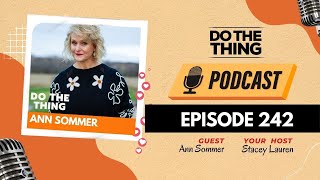
This is Episode 242 of the "Do the Thing" podcast (host Stacey Lauren), released Feb 17, 2024, featuring guest Ann Sommer. Ann describes her upbringing on a Wisconsin dairy farm, discovery of the physician assistant (PA) role while travelling in Europe, and a long clinical career (25 years practicing medicine; 14 years in women's health as a PA) culminating in burnout and voluntary resignation. Since leaving clinical work she has moved into entrepreneurship as a speaker, coach and author-in-contribution (mentions a forthcoming book with Jack Canfield), created a coaching/movement called Daytime Diamonds for women (approximate audience age 30–70), and emphasizes overcoming fear, building supportive communities, and ‘‘figuring things out’’ as drivers of her transition.
Questions this video answers
Episode 242
February 17, 2024
25 years
14 years
Daytime Diamonds
Chapters
Hey, everyone. Welcome to the do the Thing podcast. This is your host, Stacy Lauren. All right, guys. Well, another glimpse of my do the Thing adventures is here today with my next guest, because I met her at a recent workshop that I did in Texas, and she is the person that, literally, I feel like I want to say, takes your breath away when you meet her, but just so funny and warm and just so true to who she is at her core that you could feel it oozing out of her, and you just want to be near her energy and her space. And I just felt so gravitated to her, and I'm just so excited about what she's doing and the things she's done that I had to bring her on to introduce her to you guys. So I am welcoming Ann to the show. Hey, Anne. Hey, Stacy.
Oh, my God. That was a great oozing. I ooze. I love that. I kind of was like, oh, I want to meet her, too. I don't want to ooze into somebody.
It's so true, though. I feel like you're just radiating this confidence and just fun playfulness that, I don't know, it just gravitated so many people to you, and I feel like you probably felt that also.
Yes, yes, yes. I felt that with you. I was so grateful that are oozing. Oozed together. We just gelled. And when we started talking, it was so fun. So fun. So fun. We even started our own little comedy club. You, me, and then Tim, our other friend, because we decided we were the funniest ones right there. But we were the only three in the conversation, which is the best part. Like, sure, you can have a. You can make a group of us three.
No, it was so fun. We were having our own experience inside this other cool experience, so. And we just all got along so well. Well, okay. I can't wait to just. We talked a little bit about your story that night, and I really am excited to dive even deeper into it because now we're on the podcast. And is it okay if I share what you told me right before we went on?
Yes.
Yes. So this is your first time being on a podcast?
It is. I'm so excited that it's with you. Your first. Yes.
I love being the first because I feel like it's such a great way to be able to just tap into what you're doing. And I think that once you do it once, then, I mean, it's like other things that you do once for the first time, you're going to Keep doing them.
Right? Yeah. We're talking about podcasting yet, right? No talking about podcasting.
Oh, my God, I love it.
So where should I start?
Yes. So thank you. So please share with the listeners all about you. So what is your story?
Oh, Stacy, I have a lot of stories. My life is story after story after story. And I think that's why I have such a good sense of humor, because life lessons. I've said this for a long time. I learned most of life lessons one of three ways, the wrong way, the hard way, or through my friends. And that goes for all of the life lessons that we don't learn that continue to today. So I've worked in women's health as a medical provider, a physician assistant for the past 14 years, and I've practiced medicine for the past 25 years. And that is just my heart and my soul. I was meant to be a physician assistant. So I get asked often, why aren't you a doctor? Why didn't you go to medical school? Why weren't you a doctor? And I just say, I wasn't called. That would have been too easy. I think of a path because everyone knows what a doctor is and what they do. But a physician assistant, I was kind of handed a machete and sent into the jungle and said, go and make a path. And all of the trees are doctors, and you figure it out. But I have. I've done great. I've done great as a pa. I love it. But I have recently left. And that is probably really what we talked about when we met. Right? Yeah. So do you want me to tell you that story? I do.
And I first want to hear more about the jungle. So what did that look like for you? So being sent into the jungle, and how did you wave through that? Muddiness.
Yeah. So let me give you a little back. Back backstory. So I grew up in Wisconsin, four of five kids, and we grew up dairy farming. So we grew up working really, really hard manually. And it was all of us. So, for example, if you're like, what's hard work, Ann? It was my mom and dad marching into the house and saying, get on your clothes. You're bailing clothes on the hottest day of the year. And that meant jeans and long sleeve shirts and leather gloves. And there were seven of us total. My dad would be down loading the hay bales, and they would go up this elevator and then they would drop from the ceiling of the barn, and then we would have like a little human chain where we would throw the bales to Each other. And then you had to stack them a very certain way. Because if you. If you've ever been in a barn, in the top, it's probably like two, two, three stories. And you pat. You stack these bales that high. So manual labor in our house was just mandatory, something we did all the time, which helps me now, because anything compared to bailing hay or picking rocks is kind of easy. Even if it's hard, it's easy. So how did I get out of farming? My oldest sister was in the military. She called one day, she had a baby, and she's like, do you want to be my nanny? And I said, yeah, I do. And so I flew over to Spain at the age of 19, left everything I knew, my family, my friends, my boyfriend. At the time, at a year of college, I didn't know what I wanted to do. And I got on this plane. Did I tell you about the crying spell, Stacy?
No.
Oh, this is so good. So I knew I wanted to leave. I just didn't know how it was going to happen. So I just knew this was my opportunity. My sister was six years older than me, so at 19, she's like 25, 26. I didn't really know her at that point, you know? But I get on a plane. It was my second time on an airplane, Stacy. And I start to cry. Like, what am I doing? What am I doing?
What?
I. I didn't even like this girl when I was a little girl, because she was mean. She was an older sister, right? She was great, but she was an older sister. I'd want Kleenex. And I started to cry so hard that the Kleenex disintegrated in my hand. The stewardess kept walking by me, concerned, and she kept saying, are you okay? I'm like, I'm okay. I'm. I'm okay. She's like, I don't have any more Kleenex. And I was like, thinking, of course you don't have any more. Anyway, I lived in Spain for six months. I lived in Holland for six months with my sister. I raised my niece. She was two months old at the time I got there. And in Spain, we had no car, no phone. I knew a little Spanish. I would walk to get water with some pesos every day and hand them to the guy, because I knew a little Spanish, but we had a great time. She took such good care of me. We had. We're so close, so bonded. And we traveled. I saw all of Western Europe. But the biggest thing is I met a PA I met a pa. That's where I met a pa. She ran the dental clinic. And I was outside walking around, and this guy came out to walk around. We were talking, and he's like, well, I'm a pa. And I said, well, what's that? He's like, you don't know what a pa? I'm like, no. Never heard of one. And there was a voice right here that said, that's what you were meant to be. And I. Yeah, I knew from that moment, and I never questioned it. So what did we do? We called my mom and I said, I'm going to be a PA. Can you find some information? And this is a 1991. So there's no Internet. There's no cell phones. There's still mail and mail and the phone. Those were the two points of communication, which makes me sound old. But it's not that long ago.
It doesn't feel like that long ago.
It doesn't feel like that long ago. So my mom did send this big packet of information from University of Wisconsin, Madison, and she wrote on it looks hard. Consider something else. Oh, thank you for laughing. True story. It's such a true story. Mm. And so we were in Holland, and I got kicked out of Holland. They tell you that story? This is my whole life.
Did I tell you that?
So in the Netherlands, you could be a guest for six months before you had, I don't know, get some other permission. And the two worlds were, I couldn't take a job off their economy, and I couldn't be employed by a family member. So at six months, I got a letter from Renz Vaude, Netherlands, where we lived. And it basically was from, I don't know, the country or the state or something that said, the country or the city that said, you have been in our country for six months and you must leave by this date. It was like a Friday, but I think I got the letter on, like, a Wednesday. We couldn't get a flight. All right, now this is a little scary. This is how close Holland was in informing the townspeople who shouldn't be there. And so that Friday, my sister, myself, and my niece went to this little vegetable cart that was outside. And I see the guy every day. I would buy some fruit from him. And I leaned over and I said, it's my last day here, and thanks for being so nice. And he leaned over and he said this. I know my sister who is in the. She was in the Air Force, right? She grabs me and she's like, aunt, we gotta hide. We Gotta go back home. We shouldn't be out because they could arrest you and throw you in their prison, which the Netherlands is a nicer place than maybe some other countries. That would be really scary. So we went into our apartment, closed all the drape, lock the doors, and I flew out on Monday.
Wow. Yeah. So I love how this even started. And I feel like you hear these stories of just this one thing changes everything, right? So, first of all, you're traveling with your sister, and it's great you guys reconnected or connected. Like, got a greater connection since you didn't have one growing up. Closeness. Now you're close. And then all of a sudden, by you traveling and having this experience, you then meet a pa and now your whole life changes because you realize that's what you were meant to do. And your mom is hilarious. That is the funniest story. And so you had this farming background, right, where you're used to hard work and all of that. But then how was that helping you through this forest you were waving through? Yeah.
Well, because when you grow up, dairy farming, there's always work that you have to do, right? You have to milk the cows in the morning, you have to milk the cows in the evening, and then you have to take care of that, all the animals. And man, that's you. You have to do it. There isn't a computer or a robot or you could hire other people, but we didn't because we had seven people to do the work. So there wasn't ever a question of, can we get out of it. The answer was always no. There's no getting out of it. So I guess in my head I just formulated this thing of, okay, I'm eight and I'm driving a tractor, pulling a hay baler, pulling a wagon with my two brothers on the back, and the three of us are out on a field getting it done at 8, 10, and 12. And so I think my parents just ingrained. You're just going to do it. You're just going to do it. And my dad was not great at instruction, Stacy. So I figured out how to kind of take the pieces. I could hear from them and figure it out.
Yeah.
So I think that has just kind of led into the me that's me today, where I do the things that I think most people are like, why are you fixing the cracks in the wall and re spackling and then sanding it and then painting it and trimming out windows and doing art and leaving a job and starting entrepreneurship and.
Yeah, yeah, okay. Let's talk about that. So then you have this career and then you left. Yes, I had the moments where you.
Like at the moment. I love medicine, Love it. Love, love, love. Every day I've been in medicine, taking care of people. I lived all over the country. I've practiced all of these different specialties. But what happened was my last employer, which is the demise of medicine these days, I think is that the providers no longer have a voice in running the business. Not run by providers. And we're not even seen as the quality of the business in my opinion. We have business people running a business that don't know the business and we have healthcare of today. Unfortunately, I was doing the job of four people, a full time medical practice, my medical assistant because she had retired, and then a part time trish nurse, a part time scheduler, which I could handle that until they wanted me to do the job of six people. And that is when really my burnout became overwhelming to the point of I walked into my office one day and the MA said and you have to sign the lab orders because now I had to put in all of the orders myself, which is stupidest thing in the world. Why would you have the medical provider put in the lab orders, put in the radiology orders, put in the follow up appointments. Like we don't have enough time to even take care of the patients. But now I couldn't take care of the patient and my little brain broke. Stacy, it broke. I was staring at this computer just thinking, I don't even know how to get in the computer. They have a new electronic medical record. I don't know how to get to these labs. I, I just was completely shut down. And thankfully one of the physicians, Tom is his first name, I'll give him credit because he was really the only person who came to my aid. My health aide and I emailed him and I said, I'm quitting, we can't lose you. I'm like, I'm quitting, I'm quitting. There's no way. I can't do this. Anyway, I went out on FMLA for four weeks. It took me three weeks to not feel numb anymore. Week four, my boyfriend said, you got your smile back. And I remember thinking I lost it. I didn't even know I lost it. And I think that's the definition of burnout. You just don't know you're, you're there. Anyway, I decided I'm not going to go back and I take another four weeks. My dad went on hospice and he was in my parents home. And I luckily was there with them all the time and went to the hospital and this and that. And he passed away in three weeks. And it was gorgeous. It was lovely. Had his funeral. And then I get a letter from a human resources that said, you're at risk of involuntary resignation. Because I hadn't updated a date for them. And I got on my bicycle, Stacy, because I do better when I'm like doing something and I'm thinking, I don't know that I want to go back. I don't have to go back. I'm not going back. So I got home, I called hr, called my manager and said, here's the thing. You've presented me with an option that isn't going to happen. You're not going to involuntarily resign me because I've given you everything and I've done an amazing job, but it doesn't align with my morals or ethics or respect anymore for this facility. And so I'm voluntarily resigning. And they were like, no, you're not. I was like, yes, I am. But then, Yeah, so that's where you come into play in. And then I thought, I've always wanted to be a speaker. I can be an entrepreneur. And I've been in my basement learning how to be an entrepreneur, how to be a coach, how to be a speaker. But great things have happened. I got to meet you. Great things. I have a book coming out with Jack Canfield. It's in publication right now. I think it's going to be hitting the shelves pretty soon. Broadcast. They just broadcast my interview with Lisa Nichols on abc, NBC, cbs. So they're amazing. Yes. That's so exciting. Monday, I was interviewed for the marquee who's who in America and offered inclusion. So that's brand new. I'll be in the Marquis who's who, which is the one that Warren Buffett's in. There's a lot of who's who. This is the one that was the first and foremost created in 1869, I believe, something like that. So that's huge. I'm so excited. And I have a coaching program coming which is called Are you ready for this?
Yes, I'm ready.
Daytime diamonds, coaching and movement, Right?
Yeah.
Every woman has a jewel, some precious that we put in a box. And we have some precious inside of us that we cover up. And so I help women get rid of the blame and the shame and the punishment and get unstuck. And we're going to take all of those diamonds and jewels out of the box and out of ourselves. And we're going to wear them during the day.
That's so good. How exciting.
It is exciting. It is exciting.
So you left that job, which was hard because you were there a long time. They helped a little. But you realized that by that pause happening, that's what got you to be like, wait, what am I even doing? I don't even want this. Which is great. Great. But then since you left, you kind of been moving at this lightning speed. What do you think's been helping you tap in so hard so fast that has gotten your momentum to get kicked off in the way it has?
I think I always run at that speed, Stacy. But definitely I'm not one to just not have an option. I never not have an option that I create in the sense of when bad things happen to us, how do you react? Do you just go home and mope and cry and. And worry about what you're going to do? Because a lot of people do. It's debilitating sometimes, but I guess I've always had to make everything happen for myself. And so I just figure I just. I'm like, that's what I'm going to do. I'm going to figure this out. Out. I don't know. And I don't sleep well, so I have a lot of hours during the day that I'm going at lightning speed. I guess I'm not sure I answered your question. Yeah, you did.
But I'm also thinking, because just having knowing you, even just for the. I think it's only been a month. It's weird. I think, like I've known you for a long time, but I agree. I think some of the things I've noticed that's really cool about you and could also be adding to that. If you don't mind, I can share.
Yes, I would love to.
Yeah. I think it's that figure things out thing from your dad where you were trying to figure out those instructions and you're taking the pieces and you just got used to that. I'm going to figure it out. Right. So you're not needing to know every step before you start. You're starting and then you're figuring it out as you go. Yeah.
And then you're right.
The other thing I've noticed is, and I do this too, and that's, I think, why we bond so well, is that desire to be around people who are doing the same thing as you that want the same thing. And then you're open, giving help, asking for help contributing back and forth and that value. So that adds to that synergy and the momentum also.
Yes, you just hit the nail on the head. You really did. And I'm going to share this with you because this is hot off the press. I believe it becomes more important as we mature. And it's not an age thing. It's really, some people get to a point quicker than others where you realize what it is you want and you don't want in your life. And then that phrase, you're the sum of the five people you hang around with really becomes more important. Because as you change, as you change things that seem erratic to the norm, that makes that herd mentality, if the herd mentality is you get this job and you stay in this job, and you should be happy to do that. And then I've strayed away from the herd, and that makes them uncomfortable. So the beautiful thing is I'm going towards you and groups of people that are doing exactly what I'm doing. But in that transition, I've been called crazy. Crazy. And recently somebody said, but you're crazy. And I was like, yeah, I'm kind of crazy, but not pathologic. And they're like, I don't know. There's like, maybe I am crazy. Maybe I'm not seeing it. Am I not seeing something? Do I not? But really, the truth is, my crazy is because I've changed my trajectory towards my dreams, and I know it's going to happen, and I'm taking the action. And just like you, you're doing this podcast and you have the one thing and all of the amazing things you did. Have you ever been called crazy in that transition?
Oh, a hundred percent. I want to pause here for a minute for the listeners, because this is really important, and it's something I've been really uncovering a lot through the podcast. So when I started this podcast, I was basically uncovering a formula for how people do the thing. And I had all these pieces that had come out that every person does every time they're doing something. And my favorite piece of the formula, it's an acronym. It's I'm game. So the M in game is my people. And so my people is actually different than the five people you're around all the time, because sometimes it's hard for people to change those people or they're not always going to do the same thing as you. So you still, like, I have supportive and encouraging friends. So I love that I'm the average of the five people I'm around, but not all of them are doing podcasts or doing offers and different things like that. And so my people is when you surround yourself with people that are doing the same thing as you, that want the same thing, you share this common purpose and goal, and that's what really gives you that connectedness and the momentum to be able to keep going. And so I love that you've really exemplified this. And it also shows just stemming back to that woman that you met when you were traveling and how just you don't even know something's possible until you meet someone that's already doing it.
You're right. You're right. Thank you for clarifying that. Because, yes, you don't leave your friends support people that love you, and you love them because you have to have them, and there's bonds there that you can't replace. And then to walk away from that normalcy that you've established and that they know and you know them is a little unnerving to a lot of people. And then you find. Yeah, I. You know, you make such a good point. Have you ever discussed you're the average of five people, but how many groups can you have? Because they make it sound like you only get one group. But why can't we have 30 groups? Right?
It's so true. When I got divorced, I actually majority of my friends, like, I still have my best friend that I'm really close to and a couple friends that I still stay in touch with, but I changed most of my friends because it was just too different for what they were going through. We no longer were able to relate anymore. And so through that, I've met some extraordinary people. But also on top of that, it's like, if you're going to run a marathon and I'm not doing that, I'm not announcing that. But if you're going to run a marathon and you have really cool friends that you're hanging out with, but none of them are runners, it's really hard to get motivated to run the marathon. Yes. So that's where the my people comes in. And so you're right. Have something for the offer group. Like I do. I have a podcast group I'm in. I have an offer group I'm in. I just joined another group. Anyway, it's like that. It's like. Because you want to be around those people that are wanting the same thing. Yeah.
Because they're not the ones calling you crazy.
Yeah, exactly.
And crazy. I don't mean it as a derogatory connotation. You know, let's just put that out there. Yeah. Seeing it in any. But it's just. It's just that term of if this is normal and now you're going off of normal, it doesn't make sense sometimes. Except to you, right? Yeah.
And it's so important, especially when you're doing something new, because it's scary. You're buying into the belief sometimes that people have for you or your own belief. And so if you're with someone that doesn't get what you're doing, they're constantly questioning you, and you have to defend yourself versus the group that some people are doing it, some of them are learning, and you're in the middle, maybe somewhere. You're almost catching the wave of that.
Yes. Yes. And thankfully, people have done it before us. Like Walt Disney. Think of Walt Disney. I brought this up this morning in conversation, and I was like, just think of the day Walt Disney, the man not the happiest place on earth, said to somebody, I'm going to build the happiest place on earth. In an era of unhappy. I would have looked at him like, what, did you not take your medicine? Today, however, he created a world of people that have a creative bone and probably didn't have a place to express it. Cartoonists, illustration, storytellers, movie makers, all of these people didn't have a place. Place before Walt Disney was brave enough and, quote, crazy enough to say, I've got a vision. I'm going to build the happiest place on Earth. And a mouse is going to be the mascot.
Yeah. When you think about what he's had to overcome or even just. I mean, I think it's when you feel guided, like you said, where you feel called to do something, and it's like almost no one can stop you at that point because you're already on your path.
No, no. And I teach people the three voices. You know, I believe we have three voices. Our head, our shoulder, and our gut. And don't you agree, Stacy, that you're taught how to diminish the voices to stay safe, but we're not really taught how to follow the right voice. Like, the little voice I heard was very distinct. When it said, you need to be a PA or you will be a pa, I was like, okay, then that's that. It wasn't up here, wasn't in. My God. It was like, I remember turning around thinking, oh, okay, God has spoken.
Yeah. It's amazing, too, because you have to be settled down enough to hear it sometimes.
Yes. For sure. And that I have to give my sister credit to because we grew up Catholic. Did you grow up in a religion, Stacy?
No.
Okay, well, if you want to talk about good story, we can talk about Catholic school. But in Catholic church, you're quiet, boring. You stand, you sit, you kneel, you stand, you sit, you kneel. It's very conservative and controlled. So when I lived with my sister, she found this church in the middle of a forest. A forest. And I remember we drove there and we pull in this woods and I was like, what is happening? I've seen movies like this. It never ends well for the new girl that's in the passenger car. And it looked like a little hobbit hole. And we go in and it's a church. It's like a non denominational and people are cheering and hooting and hollering and singing and there's a live band. And I was so uncomfortable, so terribly uncomfortable. I mean, to just stand and people are dancing and I was just like, heart was beating, my head was spinning. I was like, oh, where's the misalignment? Why are people being. Why are they loud? Right. However, let me tell you, after several months, I loved it. Loved it, loved it, got it. I understood what it meant to have faith. I understood on a different level. And I'd been in Catholic green school up until seventh grade and then we always went to church every Sunday as a family and. But I felt like I learned more in the hooting and hollering and the singing than I did in mass because the guy that was talking was talking about real life stuff.
Yeah.
Like, hey, this is a challenge, so why don't you try this? And this is why. And I remember implementing it. And life was fantastic. It was fantastic. Yeah.
And you also learned it in a way that wasn't so controlled. It was more open and expressive, which probably gave you the freedom to really explore what you liked about it too.
Yes. Yeah. Give me an example of what made you uncomfortable, that shaped who you are.
I mean, I think for me, it's funny, I wouldn't say uncomfortable, but the thing that shaped me completely was when I had to pay for school and I took a job. I was deciding between a fish scaling job in Alaska or going door to door in Iowa and Michigan. And her suburb was Michigan. And so I chose the door to door option. And that literally is what shaped my whole life. Because like you with the farming, that's what gave me my persistence and positive thinking and goal setting. And it's really, especially now that I'm doing a podcast. I'm still writing this book. And it's like all the dots are starting to connect back to let things start and all that. So it's like so many things track back to that.
Yes, yes. And I bet you have not forgotten that first door you knocked on.
Oh, yeah. It's also just even. And I don't know if you noticed this too, because you're such a fun kind of where you make the fun when you're in a space. But that was my strategy for each thing, was I would just make it fun and I would sing Akuna Matata at the doors and I'm dancing. It was totally just a fun thing. I mean, I'm sure the days that it was raining and there were tornadoes coming through and the right ringing. But anyway, those were the things that were a little harder, but actually they were harder, but they were even more fun because people felt bad. So they brought you to your house. Yeah.
Yeah. That's good. The pity is always good. Always. You could have had a sign that was like, I'm up for adoption. Even though you're exactly an adult. Were you shy?
I was super shy.
Yeah, me too. That's what we talked about. This. We talked about this. Yeah. Yeah. And that now we're both overcorrected, outgoing adults. So that alone, that transformation.
Yeah.
Makes you feel better.
Yeah. For people listening, what do you think helped you get out of the shyness and be able to open up in that way?
The decision that I realized, it's hard to be shy. It's really, really hard to be shy. And there's nobody that tells you how to become un shy. And I had four siblings who were not shy, and I was excessively shy. You said my name, I blushed. And I just remember maybe my junior year thinking, it's so hard to be this shy, because inside I wanted to raise my hand and answer. I wanted to talk to people. I wanted to be. You know, once I got in my herd, I was me. But I remember the decision, Stacey, of thinking, I'm going to figure out how to become un shy. And then just formulating that plot and observing and really observing people. How do they interact? What is their body language? What is their facial expressions? What are they saying? And then putting it into practice. And the first time I did that, it went horribly wrong. But it was a good lesson. I thought I was being funny talking to just a classmate, and he was like, don't get so mad. And I was like, oh, I thought I was being cute. I must have been like, yeah, what about you?
It was sales. I stopped being shy when I started doing sales because it gave me a reason to talk to people. And then I almost learned how to talk to people, and I got more comfortable through that. And so it kind of happened again, because I still am introverted, I need a reason to do something, but once I'm there, I'm good. I think the podcast is a great tool for introverts because it gives you a reason. And then you get to go so much deeper when you talk to people because it gives you this intentional space and time. I think you're ready for a podcast. Are we going to start a podcast?
Yes, let's do it. I was going to start one right off the bat called Kittens and Cougars.
Oh, my God.
Talking about all of the life lessons that, you know, we help.
Yeah, well, I have. I don't remember if I told you I have a podcast workshop I can send you so you could start it tomorrow.
Okay.
We're marking the moment here. We're marking it here. When you see Anne's podcast, and it's.
Because of Stacy Lawrence stems from this.
Well, okay. So for the listeners and for me, I would actually love to hear this. What would be your number one piece of advice for people on doing the thing?
My number one piece of advice is learn to conquer fear. And the way you do that is it's just a slower process, in my opinion. But fear isn't ever going to go away. And that's why we say you conquer it, meaning you figure out what it means. And fear is spelled F E A R F future E. Experiences A appearing are real. That's how fear is. It's future experiences appearing real. It's the unknown. So don't be scared of what you don't know. That's all fear is. And then once you understand that and you take little steps and prove fear is, it doesn't really exist. Something we make up. It's an emotion to save us, or obviously in dangerous situations, we have to have fear. But then you grow your confidence. And once your confidence grows and you understand you're deserving of anything your little head desires and why you're here and what makes you you, then. I mean, sky's the limit, baby. Right, Stacy?
Yeah, it is. It's truly unstoppable. Please share with everyone where they can learn about you. And for those people that are interested in learning more about your program, I'd love to have you share that, too.
Yes, please. So my website is EA and summerall small caps PA for physician assistant and Ann. So P a n n S O m m e r.com and probably my Facebook page is where I'm the most active, which is also PA and summer.
That makes it easy. And who should reach out. So who is that person? And let's call them into your world.
Yes. So my people are women starting really from the age probably about 30 to 70. And it's that person who did all the things they were supposed to do to get where you are today. But you wake up thinking, is this as good as it gets? Or you have self blame, shame, something's holding you back and some embarrassment, some punishment. That is what I work people through to become themselves. And my company is called Daytime Diamond Coaching and a movement. We're starting a movement, Stacy. We're just going to free every woman from everything that's holding them back, which is usually a thought, a blame, shame, embarrassment, punishment to be their best thing. And it's called Daytime Diamonds because we put our diamonds, our precious jewels in a box and we cover it and we let dust settle on it and we're waiting for that day that we have this amazing date or event where no, every day is an amazing day and event, especially when you unbox your treasures of you and your jewelry, you put them all together and you just get a sparkle and be radiant and brilliant every single day.
Thank you so much for coming on.
Oh my God, this is so fun. I'm so excited to see you again.
And we got the first episode done. And for the listeners, thanks for joining and do the thing. Don't wait for opportunity, create it.
More from Stacey

From 262 Women to 8 Million Media Impressions: Deborah Drummond Built a Global Women’s Movement


From Notes App to Published Author: Avery Brenna Crumrine on Turning Intention Into Action


How Stacey Lauren's Billion Dollar Impact Marketplace Will Raise Billions for Charities and Causes

What Happened When Allison Maslan of the Pinnacle Global Network Ran a Challenge with Stacey Lauren




Leaders Share How Stacey Lauren Sparks Action, Clarity, and High-Impact Collaboration

Sandi Masori Announced as Emcee | The Billion Dollar Impact Event Returns to San Diego