Episode 244: Dr. Sarae Sager: Redefining Women's Health Beyond the Prescription Pad
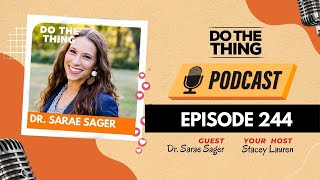
Dr. Sarae Sager left academic medicine to build a wellness coaching practice for women and families. She talks about the imposter syndrome that followed her out, how mentors helped her make the shift, and her plans to teach nutrition, fitness, and gardening through online and in-person programs.
Chapters
Hey, everyone. Welcome to the do the Thing podcast. This is your host, Stacy Lauren. All right, guys, well, you are continuing on with my adventures again. I went to Texas and went to this incredible event through Eileen Wilder and Harrison Wilder's Million Dollar Master class. And I met the most incredible person there. And actually it's even funny we didn't really get to meet meet at the event, but I got to hear her talk a lot during it. And I was just so moved by her story, the parts that I heard about it, that I really wanted to be able to sit down with her one on one and get a chance to hear about her do the Thing story. Officially on the record on do the Thing. And it is also true that this is her first podcast interview. So I'm excited to be able to just have this opportunity to do it with her and sort of see where this goes. So I am welcoming Saray to the show. Hey, Saray.
Hey, Stacy. How are you?
I am good. How are you doing?
I'm doing great. Thanks for having me.
You know, it's cool. Cause I tell people that a podcast is kind of like having a business card on steroids. And I think you're kind of proof of that. Because there were so many people at that event, we didn't get a chance to talk one on one. And now because I have a podcast, it's almost a reason for us to be able to take this intentional time out of both of our lives and have this conversation.
Absolutely. What a great way to connect with one another and. And like you said, get our stories out there.
Totally. Well, I'd love to start off and just have you share more about you and your story and your background.
Sure. So My name is Dr. Suri Sager. I am a physician still undergoing a little bit of training. I graduated in 2021 and like I said, still finishing up training, but also looking to move my career in a different direction. I joined the academics of medicine, really just trying to learn how to keep people healthy. And it may not come to surprise to many of you that medicine isn't exactly about keeping people healthy. Medicine has a lot of triaging and making sure that people don't get more sick or pass away. I got a little frustrated through my training that a lot of people would come in with things that could have been prevented by lifestyle measures and things that I was really passionate about learning about and also teaching people. So part of where I am right now is really figuring out where I want the rest of my career to go and how do I help people get there in an effective way. We know that our healthcare system also has some issues with how effective we are at helping people with those behavior change, even though they're our number one treatment option for a lot of diseases. And we fall short oftentimes. So while thinking about this future of my career and trying to figure out, how am I going to make this happen, I ran into some mentors over the last six months that really helped change the trajectory of my career, showing me that a career in wellness coaching and making these lifestyle changes for people is possible, and it doesn't necessarily have to be within the realm of traditional medicine. I think we get very pigeonholed in academics that everything has to be done a certain way within the system, work for a healthcare system, and then we're pretty limited on how we can help people. And I got curious because I was seeing people coach in other spaces and being very successful, not just for their clients, but also financially, and then they were able to philanthropically give back. And so I got inspired and curious and said, what if that's something that I can do? So I signed up to join this masterclass, like Stacy and some of our friends that you might have heard from last week. And I was just blown away at the amazing people who showed up to this conference. People from all kinds of different types of businesses and different stages of their entrepreneurial journey. And what really struck me the most was how encouraging everyone was, how supportive of each other's strengths we all were. And it really gave me a great look from outside into. They saw strengths that I didn't know I had. And I think they spoke to a lot of those areas that I was really insecure about. I know a lot of people don't think that doctors have imposter syndrome. I will tell you. We most certainly do. We are surrounded by smart people all day, every day. And it's really hard to get outside that box to think that you have what it takes to make a difference sometimes, even though you want to. So I'm really glad that I got to meet Stacy at the conference and some of our friends to reframe how I thought about what I can bring to the table and how I want to help people moving on in the future. So I feel like this is really a launching point, Stacy, to do the thing so that we can make this career happen and have the impact on people's lives that I really hope to have.
I love that we're memorializing this moment. Right. Because you're really at the beginning of just Kind of doing this restart that you were.
I want to say, feeling pained by having gone to medical school and thinking this was it and getting excited because you really want to help people that's in your heart to be able to make an impact. And then as you get in there, that you realize that you're really just getting in there and preventing something from happen and you're not stopping it before it happens. And so then you got inspired by the people around you and said, there's got to be another way. And I love what you said. You said you saw what they were doing and they were doing something different. And you're like, what if this is something I can do?
Absolutely.
And I love that because so many people can see other people and look at it with envy or like, what are they doing? I don't have that, or I can't do that, or that's not possible for me. But you didn't do that. Instead, you said, I'm in this pain because I just went through all of this schooling, went to the top of where I thought I wanted to be. It's like, oh, yeah, I'm done. I've reached this pinnacle. And then you realize it. It wasn't for you. And that's when you asked yourself the question. I really think that's admirable.
Yeah. And that's not to say that I got there on my own. Stacy. You know that life is hard, and we all have friends and mentors that help steer us in the right direction. And I've certainly had mentors, particularly in the last year or so, that have really helped me to reframe the way I think to say, if somebody else can do it, then I can do it too. We're all human. We all have that inside. And so not to use that as envy, but to use that as proof that I can do that if somebody else can. And I can do it in my own way, in a way that makes me special. So really leaning into how do I make that happen for myself, it's gonna look a little different, and that's perfectly fine. But knowing that it is something that I can make happen and to stop listening to that inner critic or even my colleagues, sometimes I think there's a lot of fear mongering that goes on when we're surrounded by a bunch of people who are all stuck in that same direction and nothing against them. Right. They're trying to keep themselves safe and keep in line with what they know for their training. And I really had to battle that a lot And I still do to overcome that, to say, nope, it is possible. We're going to keep taking steps forward every day. So it's a lot of staying in tune with this community. That's really uplifting. That helps moving that needle forward really possible. Yeah.
It's all about just surrounding yourself with the right people. So then you're constantly wanting more and you see there's more and then you're able to uplift level from there.
Absolutely. Yeah.
So you mentioned the imposter syndrome and I know that was something that really hit me when I heard you say that at the conference. Because I think so many times we have this assumption of someone that's a doctor that is all, no insecurities. Right. As far as that. And I can imagine hearing you say that, it makes total sense why that would happen. I would love to just hear you just kind of walk us through that a little bit more.
Yeah. It's interesting because I think the, the further I got into my academic studies, through undergraduate college, to medical school and residency training, like you said, the more that you feel the pressure from your colleagues, your teachers and the patients that you're treating, your family members, your friends, that you know everything about the body and how it works and how every medicine on the market works. And I think people lose sight of the fact that we are all human and there's only so much information that our brains can retain or work with at one period of time. But then also there's that human component, there's that emotional component. And I think people expect us to be brick walls, but also feel at appropriate times. And I find myself numb to some of the emotionally traumatizing things that we see on a day to day basis because we still have to move forward and see the next patient even when something tragic happens. And so that takes a big toll on your mental well being, but also your ability to learn the vast amount of information that you need to know. And of course it's academic, so it's very competitive. Right. You're competing to get into best medical schools, you're competing to get into the best residency spots. And there's a lot of competition between peers. And that constant proof of I'm better, I'm good enough, I know enough. And I think that takes a big toll on a lot of physicians psyche as they go through training, even if they don't show it. There's a lot of feeling like you're never quite good because you don't remember everything. And at some point I was like, this isn't good for me. I need to step back and say, no matter where I am, no matter how much I know I'm good enough. Right. That doesn't mean I won't keep learning, because I will, and that's something I want to do. But I need to feel like it's okay to be wherever I am now, and that what I have learned so far and what I do know how to share is valuable, too. So it's a very fine balance. And some days it swings more in one direction than the other. Some days I feel completely confident in it, and some days I'm like, man, this is hard. I should know better. But then you just go back to the resources, the books, whatever, and brush up on it. Talk to a colleague. That's why we work in groups. Right. That's why there's so many specialists across medicine and why we have the resources that we do, because we're all human, after all.
I'd love to also hear more about that kind of fork in the road where you decided to go to the event, because it was a big investment. Right. For us. It's definitely not cheap, but I guess if you compare it to medical school, maybe it's okay, but it's like the time that you're going and it's doing something new and being able to jump in like that. And I'd love to just hear how you got the courage to be able to just say, okay, this has been great, medical school and being a doctor, and I know you're still doing it. You're doing the thing as a doctor right now, but how did you get the courage to say, let me check this new thing out? What was it that got you to say yes to that?
Yeah. So, like I mentioned, just knowing that I needed to go a different direction with my career, knowing that I needed to work with the people who could mentor me in that direction to bring the impact that I want to have to people. And so, like I said, I'm constantly learning new things, and that's really important to me, that I'm continuing to work on skills that can better myself as a person, but also as a person who gives back and has that impact. So when I heard about these mentors, started learning more from them, and heard there was an event to go and network, I know that through my training that networking with the right individuals is critical for helping you move forward. Having that continuous mentorship and opening the doors to new opportunities that can make you even more successful. I knew that I needed to get in the room and like you said, the cost to entry was high, but lower than it was for my entire years of training. And so it was one of those things where I was like, is this cost worth what the outcome is going to be? And I knew that this was going to be a huge potential stepping stone to my future. I actually had a day that I was quite broken up about it and was talking with my partner and I was like, I don't know what to do. I feel like I really need to do this. I don't know if it's the right move. And then the next day I slept on it and I was like, I can make this happen. And if I don't make it happen, I'm going to wait another couple of years before I get the opportunity to do something like this again, probably. And so I said, it's now or never. Are we going to make this impact in the world or not? Are we going to start this journey now or not? And then I put my ticket down and I said, we're going, we're doing it no matter what. We're doing the thing.
Where do you think the impact in the world comes from, where that's been a driving force through everything you've done?
Yeah, I really think it stemmed from my childhood. I watched my grandparents struggle with their health. I watched people in my community, very small community, struggle with health. And as we grew up, I saw how difficult it was for people to maintain that healthy lifestyle that they had when they were going through school or changes in their family members. And I kind of would scratch my head and say, something's not right here. I knew something was wrong and that we could have been doing a better job because I watched all these people suffer throughout their journey. And I was like, I know we can prevent some of that, right? We know how to do better as far as nutrition and exercise. And I always thought that I would be a healthy person because I was an athlete growing up and then going into college and med school and succumbing to the stress of career and academics. And I saw my own lifestyle behavior start to slip, even though I knew better. So I took a really hard hit to my, well being. Seeing myself go through that, seeing my friends and family go through that. And I always had that pull. Like I knew I was meant to do something more but didn't know how or what that was going to be. And the further along in my career I got, and I was like, this is the thing that I'm meant to help people with. I know I need to do it for myself first. But I need to help my family. I need to help my community and as many people as I can possibly help with maintaining that well being so that they can live as much of their life with as best quality of life as possible.
Incredible. And I love that when you're feeling that pull and you're meant to do something more. I've been calling that, I think you saw that day, the harping where it's easy to ignore it, but when you can actually ease into it and welcome it and then follow it, it's just so beautiful because you start to see all these things open up.
Yeah. And it's helps me to meet some of the most amazing people who are also following their own calling to have an impact. And it's amazing that when we work together it seems like that becomes exponential and builds this really beautiful community around it.
I'd love to hear what your plans are now. So we went to the event and what do you have in mind?
Yeah. So right now I am building my audience like you said, I'm right at the beginning. So working on getting some traction of gathering the people that I really can help the most right now. Building up my repertoire of how I'm going to communicate this message, what the coaching is going to look like in the future. Planning some events for the spring and probably we'll do some online teaching but also an in person event sometime late spring. So really just getting stuff started from the ground up and getting ready to welcome a bunch of people into this community.
I love that we're right at the beginning of it. It's so exciting to me. So, so let's future pace it for a minute. So a few years from now you've left your residency training or your practice and you've now got this audience following you. Maybe it's a good group of people that's giving you feedback and you're able to help them. What does that look like? What are you helping them with and what do you think they'll get from being in that community?
Yeah, I think that's a great question. What I envision is helping predominantly women is something I identify with, with making their healthy lifestyle easy. I know it's really easy to get burnt out and to feel like you're stressed and overwhelmed and that it's really hard to work activity into your day or eating well, maintaining that mental wellness. Right. We can be really hard on ourselves. So helping women to reframe how they think about health and their to integrate those behaviors in A way that feels easy and seamless and it actually fits who they're meant to be. And then I picture that flowing over into families as well. I think a big part of how we can help our future generations be healthy is to help women to help their parents and to teach children from a young age how to be well throughout their lifespan. So picturing some components of online coaching with groups, but also a lot of in person events and get togethers, that way we can really build that healthy community. I know we do better together. And I would love to teach some classes in the community of how to build a vegetable garden, how to tend to that through the season, make it a real big community event. They have teaching kitchens now where you can learn how to prepare healthy food. And my background is also with exercise science. So I'm a certified strength conditioning specialist. Fancy way to say. I'm a personal trainer. That was my undergraduate degree. So I also have a passion for teaching fitness and I would love to teach beginning fitness classes and to help people learn how to move their body safely and in a way that's really fun for them. Especially if it's families. Right. You can make play both physical activity that's good for your body and great for family bonding. So there's so much with fitness and nutrition and just that whole person well being for families and communities that I'm really looking forward to give back. And I'm excited to see what that's going to look like when we've got a bunch of people who are interested and want that same future for themselves. Yeah.
I love this so much because I'm just thinking of what you can relate to just even having gone well, the experience that you have from your childhood. Number one. Right. So you have that, that's at the core of what you're wanting to do. And then you having gone through medical school and just that high achiever mindset that you have with being able to do what you did to get through that and just how that could lead to burnout because you're constantly pushing. Right. To reach this goal. And there's so many people that have that hustler high achiever mindset and then they're left last. And so to be able to help people while they're going through it and it's almost like they're still going through the fire, but you're able to help simmer the fire a bit and balance all those pieces out.
Yeah. And burnout is Florida in our culture. Like you said, hustler culture is a thing Right now. And it's not unique to physicians who go through medical school, right. Any college student, any working mom, any high level entrepreneur, somebody who's even in corporate. I've heard from a lot of people lately, just especially post Covid. Right. Express those feelings of burnout. And we know we're not taking good care of ourselves, but we're so tired and exhausted, it's like, how could we possibly. Those are the people that I want to give hope. It is possible, right? You might have to start one small step at a time. And we know it's really hard to flip our whole life over from where we are right now to where we want to be. But if we keep taking those little steps, even if it's something small, right, like get a good night's sleep tonight, sometimes that's the best step forward. But partnering with people to find what's their best next step forward, to get them to where they want to go, to get out of this hole of burnout. Because we know, like you said, it's everywhere right now and it's really isolating. So.
And the other thing on that, especially since you're wanting to help families, I think especially when moms are working moms and they're taking care of their kids, to have someone that's giving them permission to balance the family out and to be able to take that intentional time from someone like you who's knowledgeable and all those things. Right. And all this experience between even having undergrad degree and that, it's like you've been training for this your whole life essentially by being able to help people just take this time for themselves, their family and give them. I mean, I love the idea of the vegetable garden. All these things that you're going to be able to bring into it. It's really exciting.
Yeah, I agree. I have been trading my whole life for this. And it's funny that, like we were talking about earlier, despite that I still have the imposter syndrome and have to fight it, like, no, I actually do know things that can help people. And the cliche of you can't pour from an empty cup, I think I heard that so much and I was like, yeah, yeah, I know, I know. But just, I gotta stay up a couple more hours to get this thing done for work or to do this for a patient, to do this for somebody else, do this for somebody else. And I was like, oh, wait, I'm really depleted. And then like you said, having the permission or giving myself the permission that I need to start filling My own cup, because I really do serve my people better when I make sure I take care of myself. Whether that's five minutes, 30 minutes, an hour, but carving out that time whenever I can to really do that thing and making that a priority. Because nobody's gonna take care of myself if I don't do it right. Just like nobody's gonna take care of you. Even if your partner loves you more than anything in the world, they can't do those things for you. And so realizing that and taking that ownership of, okay, I need to put myself first, I need to do this health behavior for me, and then I can serve the impact that I want to have. But if I don't take care of my first, that's. It's not going to come true.
Yeah, you just reminded me of something that's really important that I want the listeners to hear is whatever that thing is that's hard for you. That's the thing you're going to be able to help people with the most because you understand how to get through it more than anyone else. I remember I had this happen when I exited my business. I had owned a business for 20 years, CEO, the whole thing, big deal. And then when I exited, I totally fell into imposter syndrome, where I was starting to do the thing and I was like, I'm not a podcast or whatever, all the stuff. And so I kept wanting to think of I needed to do the thing story, even though I had already had one. What I ended up doing was I wrote, a coach had told me to do this, and I had to write down a hundred things that I've done over the course of my life that were great and that actually helped me see myself, skills that I could then transfer into what I was doing. And so it's weird, though. I don't think people realize that thing that's so hard for you to get through is the reason why you're able to help people. Because if you had no problems with taking care of yourself, you wouldn't be able to relate to anyone, if that makes sense.
Yeah. And I think over my journey, that's why it was so hard when I was feeling burnt out and reached out to coaches, to mentors, to people to talk to about my experience of struggling through academics was that, oh, these people haven't been through my journey. They don't know what it's like outside looking in or sorry to say, but folks that were working 40 hours just didn't know what it was like to work 70 to 90 hours and to be sleep deprived and working in very emotionally demanding situations, and to be away from friends and family, completely isolated, and not have time to go to the grocery store or do your laundry. And so they were like, well, why don't you just work out for an hour a day, six days a week, and then prep all your meals and cook for two hours a day? And I was like, I don't think I can do that right now. And just try to say, maybe your approach doesn't work for me. And that was fine. But I needed to get to the point where I was speaking up for myself and saying, I think I need to move in a different direction or being more flexible. So when I did find a mentor who was willing to meet me, where I was at and to help me really address more of the root of the problem is what I believed about my own health and fitness and what I felt like was in my control. Right. We started there, and it wasn't based off of their ideas of what my wellness should look like, but it was based off mine. And they just helped me find that. And so I realized that there are other ways to help people that are more effective. And that is other reasons why it inspired me that I was like, oh, I can teach people from that point of view too, so that I'm not forcing my ideas on somebody else, but that I'm helping them find what's right for them.
And I just wanted to mention what you said earlier, too, because I think this is related to right now, when you went to the training that we went to together, and people saw the strengths that you didn't know you had and just how important that is to be around people that are wanting the same thing as you. Because that's how you're going to get out of imposter syndrome. It's how you're going to get past the belief so then, you know, you're able to power through and do whatever it is you want to do.
Yeah. And I didn't realize that my current colleagues aren't the best people to support me, to get through my goals necessarily. Right. They have their role and they help me in certain ways, which is beautiful. But I needed that outside perspective to really see the new direction where I was going and what skills and strengths I had to move in that direction. And that people who believed in me that I could do it and that it was okay and that it was safe to move in that direction outside of this box of the norm that my current colleagues are like, oh, wait, no, no, we need to stay in the box. We're safe. And now I have all these new friends who are like, wow, this is amazing. Let's do this together. And I was like, oh, we really can do this. Okay, let's go. That fueled me with so much excitement and passion and really belief in myself that it was possible. And now I have all these new friends who are good at the skills that I don't have yet. And now we're all working together to help each other make our progress and impact faster. And I just think that's such an amazing thing.
I'd love to hear your number one piece of advice for people on doing the thing.
Oh, okay. I think you guys chatted about this the other day, but the. The do it now I think, has become a big mantra for me. And also, like you mentioned, often the hard thing for you is the thing that you're meant to do and you're meant to help other people with. So sometimes the big, icky, scary thing is the one that you know you need to do most, and sometimes you just need to do it now. You need to do it messy, you need to do it imperfect. You need to give yourself the grace to take a little tiny bit of progress toward it. Even if it's. You need to do this thing. It's gonna take you three hours. And you set a five minute timer. He's like, I'm gonna work on it for five minutes and see where that gets you. And once you do it and you do it right away, it feels far less scary, far less stressful, and you're dang proud of yourselves that you made progress on that big, scary thing. I've taken a lot more courageous action since I've learned that lesson lately from all you guys. So just. Just do the thing. Give yourself five minutes of courage, and if you make just a little bit of progress, celebrate it.
I especially love that if you make even a little bit of progress to celebrate it, because I think that's the piece that a lot of people leave out.
Yeah, like we mentioned, everybody's life is chaotic and busy. And often when I'm working 60, 80 hours a week, sometimes all I have is 30 minutes or less a day of brain space, and also time before I want to get to sleep to make progress on something. So even if my progress is slower, it's like I did something toward my goal today, something that was important to me. And so celebrating that, even if it wasn't the big plans I had, I made a small step forward. And I'm going to celebrate it.
Please share with everyone where they can follow along with you in your journey.
Sure. So my new business handle is Dr. Saray Sager. So D R.saray S A R A E S A G E R I'm mostly on Instagram and also have a page on Facebook if you want to follow along with me there.
Yay. Thank you so much for coming on and doing this with me.
Yeah, thank you for having me, Stacy. It's a pleasure and I look forward to us working more in the future. Yay.
And we should celebrate. So first podcast episode dance part for.
Them.
And for the listeners. Do the thing. Don't wait for opportunity. Create it.
More from Stacey

From 262 Women to 8 Million Media Impressions: Deborah Drummond Built a Global Women’s Movement


From Notes App to Published Author: Avery Brenna Crumrine on Turning Intention Into Action


How Stacey Lauren's Billion Dollar Impact Marketplace Will Raise Billions for Charities and Causes

What Happened When Allison Maslan of the Pinnacle Global Network Ran a Challenge with Stacey Lauren




Leaders Share How Stacey Lauren Sparks Action, Clarity, and High-Impact Collaboration

Sandi Masori Announced as Emcee | The Billion Dollar Impact Event Returns to San Diego