Episode 259: Chris Bodnar: Navigating the Emotional Landscape of Business Exits
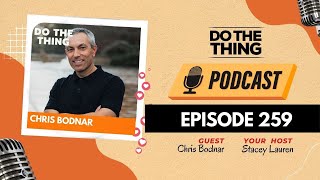
Chris Bodnar spent years in private equity and M&A before shifting to help small business owners sell. He talks about the emotional toll of exits: identity loss, stress, family conflict. Planning the transition early and talking about it openly can soften the blow.
Chapters
Hey, everyone. Welcome to the do the Thing podcast. This is your host, Stacy Lauren. Well, you guys, another great example of why I love having my podcast, because I get to meet the coolest people that I never would have had a chance to meet without having a podcast. I was referred to my next guest from Alicia Reynoso, who is actually the spark plug that helped me even start the do the Thing community. We had a conversation before I ran my first challenge and she helped give me some guidance that helped that get started. And then she helped me facilitate the next few challenges. And I will be eternally grateful for her doing the thing because that helped me really stay in action. And so since then, she's actually rebranded her business and she has a business called Of Impact and she connected me to my next guest and they're working together through a strategic development joint venture. And he's actually the one that's gonna help the businesses that they build and scale and then he's going to help sell them. And so it's just an amazing chance to be able to talk to him about what he's doing and his story. And I'm so excited to get into all the stuff. So I am welcoming Chris to the show. Hey, Chris.
Hey, Stacy. Yeah, it's great to be here. Thanks a lot. Been looking forward to it very much.
Hey, I'm so excited. And rainstorm at all. You mentioned you have some stuff going on and you're like, no, I'm coming. I'm good.
That's right. We're dodging tornadoes over here in Charlotte. Wow.
Well, I'd love to just start off and hear just more about you and your story.
Okay, yeah, I'd be glad to. I have a business background, largely Wall street is kind of how you can think of it. When I was in the first part of my career, worked for firms that were investing either in venture capital, using venture capital funds or private equity in companies that would grow into, honestly, the next Amazon. I worked for a business at one point that did finance some of Amazon's distribution centers at the time and some of the developing technologies that we use today in the wireless sector and working with the likes of Vulcan Ventures. And at that time it was the wired home. And the things that they envisioned really didn't come to pass through the dot com boom, but they have now fully, I would say, come to pass in how we're like this connected world and we have our homes that are all wired and we can control our garage doors from anywhere on the planet. But working in private equity and venture capital. Eventually I went to business school and when I came out of B school I worked for a publicly traded insurance company up in Connecticut and ran its mergers and acquisitions there. So that was a pretty high profile, high intensity job where I was really working with all the major business lines. The CEO of the company, the CFO, it was a $28 billion publicly traded company. And so these are big numbers, big deals. Thinking of shareholder value, how that always impacts the shareholder that nobody ever really sees unless you own some personally. So that's what I did for a number of years, getting my feet wet in M and A. And then I would say the mid part to the second part of my career was doing that and also being an investor in companies. Eventually left the Hartford to make a family move down to Charlotte and worked for a business that was investing in some of the largest companies and some of the largest deals. And actually I had the privilege of working on two of the largest deals that were ever done in US history, the purchase of the Hospital Corp. Of America and First Data Corp. Those were two of the biggest transactions that were ever done in US history. So it was fun to be part of all of that. Big numbers, big deals. But when we sold that business to Apollo back in 2012, it was my first kind of time to take a look around and take inventory of my life and what I wanted to do. And I think when I had worked up until that point, it was always in this impersonal working for board of directors, CEOs, big names, big companies. And what I found was as I started to, after that transaction was done in 2012, I started to work with small business owners, be it through people I met through my dad's golf group, through my church, through other contacts around town. And I found that there were people that now I was able to impact in this type of work. And it kind of brought it home to a real personal level. And found that whereas I was working before for these large publicly traded companies and working on these large transactions, now I'm working for people and I'm impacting the lives of people. So what I found was when you're working now with founders of companies, entrepreneurs, people who are making their living at what they're doing and they have teams of people there as well. They could be husband and wife teams, they could be solopreneurs. It could be a guy who has a business that he's run for 30 years, or in some cases only five. But I found that as I was able to help them in the transactional engagements that they needed, be it raise money, prepare to sell, or actually transact and sell their companies. It was really satisfying to find that I was actually changing people's lives in the process. That's really, I think, why I do what I do and where I found a lot of fulfillment now, over time.
I love this so much, and this is such a great do the thing story because I think it's so easy to get caught up with the flashy lights and the excitement of all the things you're making such big moves and all the things you're doing, and then to realize, okay, wait, I don't know if this is what I want to do. And then you actually are able to transition. What do you think helped you make that decision?
It kind of found me, I would say, I think the. When you go through transitions in your own personal life, you do a lot of soul searching. And to take inventory of the things that I knew that I did well, but then I didn't necessarily have to do them for someone else. I could do them in my own way and have it be an expression of my own talents and thoughts and life and then have that actually now impact other people in a very direct way. And it took a little risk to believe that you can do that. But over time I've found that that kind of becomes you. And that doing work well, having a high ethics and really just trying to help people, that reputation then is what will follow you. And I've been blessed to be able to, I guess, continue to find new business and help people based on a lot of cases, just word of mouth.
And so I'd love to also go back to just the other part of the big numbers, big deals, just for a minute, because I feel like people sometimes hear that and it's almost hard to relate. Right. Because it's so outside of what someone's done. And I'm just wondering, when you were doing those deals and you were doing those numbers and you were kind of getting on that level, how did you even do that? How does that start? I'm just curious.
Well, you're always part of a team at that level. And with those companies, no one person is really able to affect a transaction of that magnitude by themselves. And there's different participants that are involved in that. So when you have a company that is publicly traded and you have a large private equity firm that wants to take them private, for example, there's going to be all types of parties involved from the investor, which may have several different constituents that make up that private equity consortium, you'll have the target company and all of its team on that side. They'll both have their own teams of attorneys and financial advisors. And then they can't really do that entirely by just stroking a check. They'll also be debt capital partners and other investors involved as well. And so at the table, I've really sat in every seat over my career, from investor to lender to M and a advisor. And so that's really, I think, where I've cut my teeth a lot on these transactions because I've had a chance to see it all.
I love that answer, having a team, because I think a lot of people think they have to go at it alone and they don't realize just how many people you can get to support you when you're doing something.
Yeah. Yep, that's right. Yeah. And especially for those large transactions now, I think on a smaller scale, with these transactions that I work on, they can be anything from most recently anywhere from 5 million up to really kind of like 75 million to 100 million. I do more transactions on the smaller end. And I found that those are typically in the 5 to 25 million dollars of enterprise value range. But that's what that is. Those are people who've seen started businesses, grown them, run them for years, paid for their kids college, bought and sold homes. They lived their lives through these companies. But I found that in that range, it's a lot easier for me to kind of bring all that's needed to bear to help those parties, with the exception of, say, legal and some regulatory factors in transactions.
And let's talk about now your new partnership that you're in and how we met our mutual friends. So how did that come about?
Well, that was a joy. I met them, it was June of 2019 and they were looking to exit their company. They weren't ready just yet. And they're kind of the perfect example of what we do today. Honestly, they weren't exactly certain how to go about it, what they needed to do. They had goals in mind. So we talked about all of that and understanding. I mean, I think that's really the biggest thing is just being willing to listen and understand what people's objectives are and so understanding what their objectives were. We were able to put in place a plan and really step through it over the ensuing 12 months or so before they were ready to finally put the business on the market to sell it. And so that just led to a lot of great conversations. It led to a developing of rapport. It really stoked that sense of teamwork and camaraderie to help them accomplish that, those objectives, to grow to the point that they were ready to exit. And then, of course, we went through the process of selling the company. You spend so much time together, so much time on the phone, so much time talking about just everything, the business. What are you looking to do next? How do we get there? It really does encompass all of your interests and thoughts as you go through it. So having them as a success story is tremendous. And we stayed in touch. I think one of the benefits that I have and real things that I enjoy a lot about my work is I kind of get to work with all of the success stories, all of the people that had a chance to get to that point and be successful in that way. I mean, success is measured in lots of ways, but if you can ultimately sell your company, it's a nice testament to something that you've built. So we stayed in touch, and over time, it just became clear that they had taken some time off, they had done things that they wanted to do. They were looking to get back in the game. I had had some transition in my career, and I was looking to kind of stay steadfast to the things that I enjoyed doing, which is what we're talking about today. And so it just came about, I would say, mid last year, that the timing just worked out that we were able to kind of put this joint venture in place and then take that and formalize it and bring it now out to the market and the public.
So cool. And I'd love to hear more about Of Impact and what you guys are doing just from the full scope.
Yeah. Of Impact is a purposeful name. I think the spirit behind it is we care very much about the impact that we have on others through our work. And our desire, really is to help other people live lives of impact. If it's in a career setting, to develop businesses that can. Can have an impact on those around you. If you have a transaction in this, to be able to have that transaction be extremely of impact to your life and to those that you might come into contact with through that, but then also beyond it. And so the idea is really just a purposeful one. It's a philosophical idea of being able to just bring our skills, our talents to bear in this way to help people really have lives, businesses, futures of impact.
It's so cool that they partnered with you, because I feel like a lot of people can hear the name even of Impact, and they're like, well, where's the money in that. Right. You're just focusing on impact. And I think the idea of, yeah, guys, you can build a business that's of impact and create the impact while you're building it. And then also when you sell it, you're able to then have that be a whole nother level of impact. And so I just love that you guys have partnered together. Cause I think it's brilliant just even from that perspective to that visual, to people.
Yeah. There's a whole side of this, Stacy, that, as I was thinking about just being on this show with you, doing the thing in my work means a lot just in terms of how I help others. But then also, it's also helping them do the thing in their lives. And a lot of times where I come into the picture is they have a vision for what that thing is in their life. And. And it's a transition between two things. So going from place one that they are today, and in a lot of cases, it's because they have this company and they need to do something with this asset so that they can move on to do the thing that they really care about beyond that. And, I mean, that's a privilege, because I think in every case, people who live that way and who I've had the chance to serve and help that way, they realized that life's about these bigger things. And while there's business and assets and money involved, it's really just a conduit to help them either live lives of impact in their own families, in their own circles, or to then take those resources and go do something else with it that's even more profound.
Yeah, I feel that so deeply because we were just talking right before we hit record, and you were asking me about my exit, and I was like, oh, it wasn't the sexy exit I wanted wanted. I just sold my half to my partner. And part of it was I exited because it wouldn't have been good if I had stayed. And I was in a mastermind. And they kept telling me the opportunity cost of me staying was gonna cost me more than me taking what I was gonna take to be able to exit the business. And so, man, was that true. Because now I'm literally living by life's work, and it is so deep in what I'm doing. And even though I ran the staffing company and there were so many people that I helped and companies that I helped remove bottlenecks and all that stuff, and it felt purposeful at the time, it's not nearly as purposeful as what I'm doing now. And so it's just interesting that you said that because I haven't heard it in that way before. I don't think people realize that sometimes, whether you're at the job, if you're listening and you're at that job for 20 years, or you don't like your boss, or maybe you're keeping a company too long, because like in my case, I was staying there for the employees. I thought that they needed me. It was my ex husband. We tried to keep the business for a few years working together, and we realized it didn't work. So one of us was going to have to leave just to give more context. And so I was staying for the employees and I noticed a lot of people do. I don't know if you ever watch that show the Profit.
Oh, yeah.
But all those family businesses, that's what they're doing. They feel like those employees are dependent.
On them and yeah, it's like it's their kids. Yeah.
Yeah. And I felt like that until I left and I realized, well, they're good. Okay. They figured it out. And so anyway, the point is, is, yeah. Following your own freedom in that way, it's that.
It is that and a lot more. And look at what you've been able to accomplish since. Look at how your perspective has changed since. Look at the way the world has opened up to you and all the people that you've met and the ways that you now have the ability to impact others. And in some cases, we don't have the full knowledge of the ways that we do impact others in that way. But you know that what you're doing right now is the right thing and you had to make that transition to get there, right? Yeah.
I just remember how emotional that time was. Do you deal with a lot of emotions with. With different people that you're selling?
Yeah, I mean, people are. Are all different. And there definitely is a business therapist aspect to this job that you're dealing with people's emotions. A transaction can be very uncertain until it's finally closed. And it can be constantly in flux. There's just changing terms or preferences or discussions. You're constantly interpreting, well, what do they mean by that? What does that mean? Because we're talking about these things. And so, yeah, just to. Keeping people steady and helping them understand what's really happening, but not let their emotions run away is a challenge.
Yeah. I could just imagine how much experience you have with that now after dealing with people.
Yeah. And it all changes because I think back to transactions where there were three partners and the reason why they were selling the company was because they didn't like each other. And so. So there's that dynamic. Yeah, there's husband and wife teams, there's the solo guy, but he also has a team of 25 employees. And like you said, he very much wants to make sure they're all good through the deal. So, yeah, it's all these different scenarios.
So what do you suggest for someone listening that maybe they've got that business and it's at a certain revenue point and they're kind of getting just burnt out because that happens. Right. Just kind of get over it. What do you. For them in terms of next steps?
Right. Yeah. And it's kind of cliche, but the right time to think about selling your business is the day you start it. And it's really just always having the end in mind as you go through your different phases and stages. It never hurts to just have a discussion. And I think that's one of our core values of impact, is we just always want to be helpful. It doesn't mean that it's always a perfect fit from an engagement perspective, but it's helpful to have people reach out to be in touch, to try and have those discussions. If you're an entrepreneur and you're just thinking about making a transition, well, what does that look like? I may not have all the right answers for you, but I can certainly talk to you about it. We can talk about what your company looks like, what your goals are, if you have dreams to sell it for a certain amount. And realistically, it doesn't look like that today. Well, maybe that's where you might need to grow it or get help scaling it a little bit into that. Or if you really don't care and it's just time to be done, there's options there, too. But until you kind of unlock the door and open it up and just kind of take a look around, you're going to always be resting on what I read on the Internet or what your own sort of biases and thoughts are about everything. And I would say just reach out and start a dialogue. It doesn't mean that you're committing to anything, but I think just the information could be helpful.
Yeah, I love what you just said, too, with the unlocking the door and opening it. That's such a great visual.
Yeah, it's that how to get from point A to point B. And if you just kind of. I think sometimes people, me included, we're afraid of change. We don't always embrace it. And when you're talking about a thing, you know, I call a business a thing. But to people, it's so many things. It's their identity, it's the way that they provide for their families. It's what they spend all their time on. And they constantly think about, maybe lay awake at night thinking about. There's a lot tied to that. And so it's not a light thing, but to believe that maybe life's just going to continue the way that it always has for the next X number of years, it might. But it's also good to consider, well, what do I want to do with this? And what would it take?
I actually did a full episode on the identity that happens after you exit the business because I don't think a lot of people realize, and it's hard to understand because they're like, what do you mean? You just got a bunch of money, Aren't you happy? But actually, that almost makes it worse because you're like, why am I not happy? And it is. It's an identity thing from so many levels because you have that. In my case, it was 20 years. Sorry, we're doing therapy now, right?
We're talking.
But yeah, it was 20 years with that business. And it was like I went through the biggest crash after, and it was the way I. The way the exit had to happen, the way with the employees after. You know, I thought we'd all be still friends. It was just like a whole thing that was so hard. And I think that happens to other people too, maybe in different situations. Like, I had another friend, he had a really great exit with even more money, and he had a crash too. And it was just. You have all these people just kind of dependent on you, and you're responsible for them and their success. And then all of a sudden it's gone and it just feels so empty.
Yeah, it's a huge. It's almost like a cliff. And the transition, depending on how that goes, can affect people in a lot of different ways. It's one thing if you are kind of being retained by the buyer and they need your expertise for a while. And there's a way to kind of work yourself out of that job, per se, over time. And then sometimes, like you said, there's just a hard stop. And when you've had so much of your days, you wake up every day and this was your routine and this is how you. How you did it, and those are the people you saw, and this is what they meant to you. And then that just ends. It's why I think the transition is so necessary to, in your mind, start to play out over time. To be thinking in that way. It doesn't mean that you have to do anything about it today. But to think that life's always going to continue the way that it always has might be a little bit naive. And I think the people that I've seen be the most successful in doing the next thing are the ones that have given some thought to what that is ahead of time.
Yeah, you're really right, because. And if you guys are listening, just kind of think about this with anything in life. Because when you're in the middle of the fire, it's really hard to think about the way out of the fire. But if you've already decided how you're going to handle it before, then it's so much easier to have a plan. Plan afterwards.
Because sometimes that's right.
Like, yeah, your mind could be spinning. And then if you already had the plan, you're good. But if you don't, then you'd have no idea what to do. And you're just crawling through water at that point.
Right? Yeah, that's a good word picture right there. Chad and Alicia, for example, they work their tails off in the business that they had before. They opted to do a lot of the work themselves rather than pay for that to be done by others. And they retained a lot of the profit for it. But it was still a lot of blood, sweat and tears when they were up every day and working together. And one of the upshots of that is they were partners in life, but they were also business partners. And they kind of. It brought them together. But they also started to think, hey, and maybe she shared this already with your audience. But they wanted freedom and they wanted freedom to live this life. The name of their prior company was Live Infinitely. That was a sort of something that was born in her heart just to live with no bounds. So they thought about just this idea of location independence and wanting the freedom to see the country and to visit family and to not be tied down to the warehouse anymore. So that's a driving force when it became the goal. And the money wasn't just the goal. It was that the money made it possible, though.
Yeah, I wrote this down earlier. And it's funny, I just wasn't gonna say anything. Cause I wrote it down wrong. A lot of times I take little random notes. Cause that helps me kind of dial in. But you had said connected world. I think you were talking about phones and how the houses are wired. I wrote down what I heard you say until I realized you said connected. I wrote down Disconnected World. And it feels like. I don't know, I feel like I should say it because I feel like that's what you're doing is you're helping connect the world through this business by explaining what you can actually do when you can start a business and you can create something of impact and then be able to sell it.
Yeah, you really can. And the world, from my perspective, maybe from you, too. I mean, you're probably reaching people through the do the Thing podcast and show all over the world, and the world just feels like it keeps getting smaller. I've had the privilege of working with clients in Australia. I've had the privilege of working with clients, partners and clients in Ireland and the uk, and that's just tremendous. And they are. It's just a great aspect of what I do, and it's something else that I find a lot of satisfaction in. So the world is more connected now than it's ever been before. Our lives become kind of meshed, even though there's different time zones. A lot of times you're on one coast, I'm talking to somebody in Ireland or in the uk, and that's a different time zone. Australia has several time zones, but, yeah, business and life has really changed a lot.
What would be your biggest piece of advice for people on doing the thing?
The biggest piece is a little bit of what we've been talking about already. It's really searching your heart and figuring out what you'd like out of life. If you're fortunate enough to already have this great asset that you're growing, that you're working on a business, I'm sure you potentially find a lot of satisfaction in it. There's always stress and challenges in that as well. But if it's growing the company and there's some aspiration to really see this become something, well, that's worth paying attention to, and there's ways to focus on that. And potentially there could be different things that people need to achieve that. It could be expertise, it could be capital. And, I mean, you've been part of masterminds. I think those can be incredibly helpful. Community can be incredibly supportive and helpful to achieving goals like that. If it's. You're searching your heart, if you will, and your thoughts about the future, and you find that there's other things in life that you want that really don't have anything to do with this business that I'm working on. I think that's the inflection point at which it's important to start having some discussions about how to get there. Because as you know, not every business is run by partners. A lot of times you have people that are working on their own, and it's nice to just have somebody there that can be part of your team to kind of work through those things and talk through them and help you in an objective way.
And please share with the listeners that are like, wait, what is this of impact and how do I get involved and what happens when I do? If you can share more about that.
Yeah. We have two distinct but related businesses. One is called Of Impact, and really it's a strategic sales and marketing organization that helps omnichannel growth companies achieve that. And it works across all different types of industries. And that's of impact. That's where Shad and Alicia spend the majority of their time. And then there's Impact Advisors, which is what I head up. And we're really the strategic business development on the corporate finance CFO and largely sales business transaction, selling businesses side of things. And so the best way to reach out and to get in touch is through either of our websites. It's of impactofimpact.com for the digital marketing and sales and marketing organization. And then of Impact Advisors is where I reside on the web.
I just really enjoyed having you on the show. I'm so glad you were able to join me.
Yeah. Thank you, Stacy. It's been a pleasure.
And for the listeners, do the thing. Don't wait for opportunity. Create it. And hey, guys, did you check out my Facebook group? Go to do the thing community dot com.
More from Stacey

From 262 Women to 8 Million Media Impressions: Deborah Drummond Built a Global Women’s Movement


From Notes App to Published Author: Avery Brenna Crumrine on Turning Intention Into Action


How Stacey Lauren's Billion Dollar Impact Marketplace Will Raise Billions for Charities and Causes

What Happened When Allison Maslan of the Pinnacle Global Network Ran a Challenge with Stacey Lauren




Leaders Share How Stacey Lauren Sparks Action, Clarity, and High-Impact Collaboration

Sandi Masori Announced as Emcee | The Billion Dollar Impact Event Returns to San Diego