Episode 265: Mo Fathelbab: Bridging Finance and Fellowship in the Pursuit of Personal Triumph
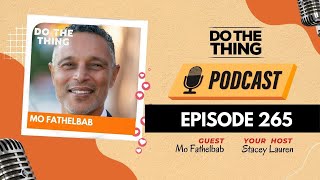
This is a transcript of Episode 265 of the Do the Thing podcast (posted May 4, 2024) featuring host Stacey Lauren and guest Mo Fathelbab. The conversation traces Mo’s path from studying finance to joining EO (hired as associate director in January 1990), learning peer-group Forum methods from YPO trainers (early 1990s), running hundreds of moderator trainings (~300 trainings in the first three years), and founding a business focused on peer-group facilitation (from 1997 onward). Mo explains why vulnerability and safe spaces matter, gives examples of peer-group outcomes (improved relationships, business results, reconciliations), and introduces the International Facilitators Organization (IFO) — a membership, marketplace and certification body aiming to scale peer groups (Mo’s stated goal: 1 billion people in peer groups by 2053). Practical details include facilitator certification structure (dinner + two full days; cohorts kept to ~10), a how-to book for no-budget starts, and contact: internationalfacilitatorsorganization.com and Mo’s LinkedIn profile.
Questions this video answers
January 1990.
About 300 trainings.
By 1997.
A billion people in peer groups by 2053.
internationalfacilitatorsorganization.com
Chapters
Hey, everyone. Welcome to the do the Thing podcast. This is your host, Stacy Lauren. Well, guys, this is another one of those really pivotal moments and do the Thing history, because you just never know how you're going to meet people and what is the catalyst between things potentially even changing in your life and what is going to come from it. And I met my next guest because I was in the middle of auditioning for this TEDx talk about peer mentorship. As you guys know, my people is a piece of the do the Thing formula, which basically is peer mentorship when you look at it. And so that's what the talk is potentially going to be about. And I decided to reach out to Vern, who's the founder of eo, to see what his take was on peer mentorship, because he built this incredible organization and emailed him. And then he connected me to my guest Mo, who he said pretty much is the guru of peer mentorship. And he's the one that even helped build EO and was part of that whole process. And now he's doing this whole other amazing thing with helping people basically create the space for people to connect in such a meaningful way. And so, I mean, this is so close to my heart because I just am obsessed with this work of giving people safe space to be able to be themselves and to really not be alone in what they're doing. And so I'm just so excited to talk to Mo and dive into his story and talk to him more. So. Hi, Mo.
Hi, Stacy.
I am so excited. I told you before, I'm like, oh, my gosh, I cannot believe we're here. And I get to really sit here and just have this conversation with you.
I'm so excited to be with you, and thank you for this lovely introduction. I have been blessed to have found this work. I was actually a finance major in college, but then I took Verne's class and entrepreneurship, and it changed my life. So unexpected turns and twists, but all good.
Yeah, that's what's amazing, and that's kind of what I was alluding to in the beginning with this introduction, is I had no idea me auditioning for TEDx Talk would lead me to even reaching out and then us connecting. And that's what I want to point out for the listeners is just by you doing the thing and by you just not being afraid of what a person's going to say, all these things could open up for you.
Absolutely, Absolutely. I often REVERT Back to Dr. Seuss. Just put one foot in front of the other.
Oh, My gosh. Okay, I'm feeling that one.
I stole it too.
Well, I'd love to start off and we could just start off with your story and how you even got into this work.
Yeah. So after taking a class in entrepreneurship with Vern, who had started the Young Entrepreneurs Organization, it's now just the Entrepreneurs Organization. They're not holding to a criteria of youth any longer. But after taking that class with him, he hired me as associate director of EO back in January of 1990. Wow. And you know, at the time we had a hundred members perhaps, and we were just getting started, but it was, he was so impressive. He was the best teacher I ever had. He had me at hello.
And I started working there. And quickly we started forming an alliance with YPO, the Young President's Organization. And YPO, which was started in 1950, I believe, has had this program called Forum. And Forum is a peer group program for their members who are CEOs. And in 1991, they finally allowed a bunch of us from EO to go get moderator trained by their trainers to learn this process. And I fell in love with it and I thought it was life changing and I thought there's no way we're going to get this on the map with our membership unless we actually take it to them and start peer groups in their cities. And I went to the board and I said, look, I've now attended a couple of these moderator trainings that are two and a half days and multi thousand dollars each and I can create our own one day program and we'll put the show on the road, so to speak. And 30 plus countries later, we had a lot of peer groups all around the world. I think I did 300 or so trainings in the first three years and then I, by 97, I decided this is my passion and I'm going to take my favorite part of my job and make it my business. And that's how I found this path. And of course a lot more has happened since 97, but I'll take a breath and hear what you have to say about all that.
Yeah, I love this so much because yeah, it's literally the Dr. Seuss quote, right, where you're taking one foot in front of the other. Not exactly sure what's happening, but you're following that. Well, now we'll go to wizard of Oz, the yellow Brick Road. But I'd love to hear. So you said you immediately fell in love with this work and it was life changing. I would love to hear more about that. What do you think it was that just really lit you up about it?
I think my story is not dissimilar from many people growing up.
I felt that it wasn't okay to cry. Maybe it wasn't okay to be myself. I had to be perfect. I had to achieve. And I think I didn't have a safe environment to be really open and honest and vulnerable, nor was I aware, actually of a need for such a place. And when I attended this very first program, I was given the opportunity to share things that I hadn't shared before, to get things off my chest. And what I witnessed is a profound connection amongst the participants, who also shared things that they hadn't shared before. And it was liberating, it was uplifting, it was moving, it was emotional. But I was very much hooked from the very first moment in realizing, you know what? This is humanity, and there's not enough of it.
I think that's what's so amazing about what you're doing. Because when I was researching for this TEDx talk, because I've been kind of experimenting with this, my people component for the last year and a half, and running challenges and putting people inside of a online group and basically creating the space for them to connect. And so when I started exploring it more and then I was really, I've heard of EO and I heard of ypo, but I didn't really ever research it in the level that I had to for this talk because I obviously wanted to find out, where else does this exist, right. And who else is doing it? Well, and that's when all of this came up. And as I'm looking through the website and you and I got an opportunity to talk before I did my audition, it was incredible to get a chance to talk to you. I realized this whole time I thought it was driven across or obsessed with doing it was because I really like helping people connect. And what came out from our conversation and from this podcast interview and from looking at online, it's really the safe space to connect. And you spoke to it so well. It's like when you were younger and not feeling safe to be able to, like, express your feelings, your thoughts, and just now having this chance to give people that space, I mean, how cool is that?
I feel like I hit the lottery. You know, some people find out what they want to do early in life. Some people never find out. And again, I studied finance. I was going to go work on Wall street. And had it not been for the chance meeting of this one person, this one teacher, I would be doing something very different right now. And the more I've learned about myself, because, you know, self awareness is one of those tools that helps us with our growth. As I'm sure you know, the more I learned about myself, the more I realized I would not be as happy in the world of finance. I mean, I get it, I studied it, I enjoyed it, but this fills my cup. This fills my cup because I know we're making a difference in people's lives.
I found that too, in terms of how it can fill your cup. And I think that's so important for you guys. Listening to realize is when you kind of tap into what lights you up and what's the deepest part of you. And you're right, Mo that self awareness piece, that's the piece that really drives it. That's when you're able to really impact people at the most because you're coming from this fire of something that drives you, which then helps people kind of come in droves. Right. Because they're feeling connected because you're so connected to yourself.
Thank you. Look, I mean, I know some people who can be in any business and they're just in love with the concept of business, or they're just great operators, or they're just great business people. And they're quite happy doing that. And I don't judge it. For me, I do have that conviction because to my core, I believe the world would be a better place if every human being was in a peer group where they had a safe space to talk about whatever and had support of their peers who help them see things they wouldn't otherwise see, see possibilities they may not otherwise be aware of. And it's simply eye opening and motivating and supportive.
And I'd love to talk about what we talked about offline. When I was researching this talk, I was asking you what really got you excited about it. And I think we share this common thing. And I realized that there's so many people out there that are shy or introverted or had trouble really connecting with people. And I love that we have in common. So I'd love to just talk about that a little bit more. What that journey was like for you and then being able to find the space now to be able to do that.
Well, I want to start with one of my favorite recent quotes, and it was a quote of Walter Isaacson as he had just completed the biography of Elon Musk. And Walter Isaacson is quoted saying, the job of a biographer is to find out what demons cause a man to create a rocket that goes to Mars. So to me, having worked in such intimate spaces for so long, I've met billionaires who still worry about money. I've met people that have sold their businesses for a hundred million dollars who still worry about pleasing their dads. And for me, on a very personal level, I was shy. I was very shy. And it took me years to get over my own shyness. And it took me years to really get myself comfortable in my own skin. And what's really amazing is I feel like my work right now is in some ways a manifestation of my own childhood wounds and working to overcome them. And it's the same thing as that billionaire still worrying about money. But hopefully I've put it to a good purpose and a good cause to make a difference and help other people. Yeah.
Something I've noticed is because you went through that experience as a kid, now you have this ability to, to be able to land deeply with someone else that might have gone through whatever it is at similar levels. Right. And this is part of the work you're doing. You're giving people the space to connect through some kind of common goal, but it actually helps you see them more, whereas someone else that maybe didn't experience that, it would be much harder. And I feel like that's part of really how people can be able to do the thing, especially the thing that lights them up the most, is because you've gone through it and so you're able to speak to it 100%.
I also think.
Tapping into my own vulnerability is essential in that process. When we talk about vulnerability, we talk about the safe space that's required and what comes with that, is we're creating a space for people to be able to take risks and to say things perhaps they haven't heard themselves say. It's not uncommon to hear people that go to a training, just the training to join one of these groups to say, wow, I've shared things with you guys I haven't shared with my best friends or with my family. And to create that space and to give people that opportunity to take that risk is really a gift. Because one of the things we're learning is vulnerability not only creates connection, but it gives you an opportunity to get things off your chest and to have relief. And if you read a lot of the literature that's out today, like the body keeps score, you also learn that pent up emotions and anxiety actually manifest in disease later on in life. And so I think vulnerability has been the core of our work since I started doing this work back in 1991. Thanks to Brene Brown, it's become much more, more popularized. And I don't even think we used the word vulnerability back then. But you know what, it was very much at the center of what we did. And I would simply say if there's something that I've learned is vulnerability is essential. But it's also essential to know when it's okay to be vulnerable and with whom. I'm not in any way suggesting to just do it anytime, all the time with everybody. We still have to use our, our faculties and be thoughtful about when and where.
So I'm really curious because looking at you now, right. Just so you guys know. So he's done a TEDx talk, written books, helped. I mean, I don't even know thousands, tens of thousands of people with the work that you're doing. And I'd love to hear about the work you're doing now with the International Facilitators Organization.
It's really exciting. And I have to first go back and tell you why we're starting this business and what we're doing and what it's all about. So you know, I belong to this incredible magical community of facilitators through one of our clients. And every year we got together and every year we got together to exchange best practices and to share. And as you could imagine, we're all very much nerding out on this stuff in a sense that we're all very open and vulnerable and real and transparent. And I've been meeting with these people since 1991, some of them, and imagine how close we've gotten, how much it's become such a meaningful and tight knit community and an important part of my life. So we just had our last meeting in Lisbon, Portugal. And one morning at 7:30 as I'm going to breakfast and grabbing for my first coffee to just wake up, one of the senior facilitators that's been A friend for 30 years says, Mo, you are just oozing with joy. And that night as I was going to bed, I was reflecting on my day and the things for which I'm grateful. It's been a gift of a practice that I've learned from positive psychology and I've been doing it for about 10 years now. And as I was reciting the things for which I'm grateful, I remembered she saying, you're oozing with joy. And what I realized is every year this event is probably the one event that I look forward to more than anything. And that is why I'm oozing with joy. And even more so, it's because this community, all of us believe in the importance of having every human being in a peer group. We all galvanized around that and started talking about that and what we could do as a community to promote that as far back as seven, eight years ago. And so ifo this brand new business is a membership organization to provide community support learning for facilitators. We also have a marketplace so people can book facilitators and we do certification to train facilitators on peer group facilitation specifically and on the very important component of vulnerability. That's part of that because that's what it takes to build the connections that are deep, that keep these groups together and glued for 30 years. I'm in my group since 1991. Do the math. So that's the reason for the organization is the deep belief that the world really can benefit for everybody. To have a peer group, you're just smarter. With a group of eight people, you have support that you wouldn't otherwise have, you have wisdom you wouldn't otherwise have, and you have a community that I would bet is going to be deeper and more meaningful than almost any other that you belong to.
What do you think got you to start this organization after having already done all these amazing things and then, and then all of a sudden you decided to create this organization?
Well, because I'm maxed out. I just can't do much more personally in terms of my own work with clients. And yet I still have this deep held belief and conviction that my role is to really help the world understand and see the value in this product.
I know you have a big goal for peer groups in terms of people.
A billion people. A billion people in peer groups by 2053. By the way, do you think we have even 1 million right now? I don't know. I could probably count about 200,000 if I add up the organizations that I know that offer this kind of stuff. So we have a long way to go. But I think it's a very worthy goal to bhag, in the words of Jim Collins, right? Big, hairy, audacious goal.
What does somebody get from a peer group for people that might not be familiar with it? What are the benefits of it?
One of the things that I always heard from the CEOs and entrepreneurs, which represent about 95% of the peer groups with whom I've worked and with whom we've worked, I always hear from them. It's Lonely at the top. But I don't think it's lonely just at the top. I think there's a loneliness pandemic going on, I'm sure you've heard on the news. So, you know, one benefit is just new meaningful relationships of people that have nothing of personal interest that can in any way conflict with your personal interest. So if you're in a peer group with your business partner or a board member or a boss or a subordinate or your mother in law, they may very well have a very different vested interests than yours and that would create a conflict of interest. But by being in a peer group of uninterested people, then you really have the foundation for a safe environment which then opens up the opportunities for learning and growth, vulnerability and connection.
And what are some of the things you've seen happen because people are in the peer group?
I've heard somebody say to me, it's changed all my relationships, it's deepened them because I've learned that I wasn't being vulnerable and I was just being surface and superficial. I heard from one of our clients that because we do peer groups and companies as well, sometimes for executive teams, I heard from one of our clients that had it not been for the peer group meetings that we've had, the company would not have had the big sale that they just had because the team was not getting along, the team was not on the same page and they didn't have transparency and openness and communication and tools for having difficult conversations around tough subjects. I've heard people saying they've caught up with their mother or their father that they haven't spoken to in 10 years. I personally reached out to my father and after not having spoken to him for 10 years as a result of my peer group.
How do you think that worked? Because you were able to talk to them about what was going on and then they gave you a sounding board, or did it come more indirectly?
You know, the guy wasn't. No, I got lucky. One of our members had the misfortune of losing his father. And because of that we have such an open relationship. I mean, after going to the funeral, he came to our subsequent meeting and said, I want to talk about it some more with you guys. And he read the eulogy just to us, seven of us, and then shared openly and painfully how he felt about this big loss in his life. And that was a moment of awakening for me. And it's because of that meeting that I picked up the phone and called my father.
Yeah, I'm affected. I just recently stopped talking to my dad. So I'm listening to you and I'm like, oh my gosh. So it's powerful. But yeah, I'm curious, what did you say when you called him?
Before I called him, I had to get ready because I just wasn't sure how it was going to go. And the first thing I did is I wrote a letter, not that I sent, but just to get my thoughts organized. And that was really helpful. And then I called and I just said, hey, I'm coming to, to visit. I'm from Egypt and so it's a big trip. So I said, I'm going to be in Egypt, I'm going to be in Cairo, I'm coming to visit. And that's all the conversation was. And when I went to see him, it was nice. And you know, at some point I said, look, I'm sorry I was young and immature.
Yeah, it's amazing for people listening, once you see someone else's experience, you're able to relate. Right. And even though it wasn't the same thing with estrangement, it was seeing his father pass away, then you're able to connect on this other level where you're able to see, okay, we have this one life. I want to reach out. So it almost takes the risk of you reaching out. Less aggressive, I don't know if that's the right word, but.
Well, here's the big point, Stacy. I think what we often miss and what I've learned in doing this work is the difference between learning something firsthand as an example I just shared with you versus being just told here some best practices because I promise you, for the 10 years that I didn't talk to him, I got plenty of advice from all sorts of well meaning people that I need to pick up the phone and call him. And none of that mattered. But when I heard it with my heart, it mattered.
So I would love to talk to you about this idea of finding your voice because when you were younger, being shy, right, you basically found your voice when you met Vern and then you kind of translated that into the EO organization. And then I know since then you've done a TEDx talk, you've written books, now you're running this amazing organization and so you've probably had to break out of this shell each time where you're expanding to a new level. And I'd love to just hear a little bit about what that process has been like for you.
Well, I love the question. And I love the question because it's Insightful and challenging at the same time. And I don't know that I've given it thought before. So let's work through this together.
I think I learned a long time ago that it was my best friend. It was really my best friend in high school who said something along the lines of, I don't like being part of the pack. It was his thing. And I remember when I first heard it, I thought, well, that's strange. It sounds like a taste of anarchy for the sake of it. And while I'm not that way in terms of how I'm wired, what I've realized is there was something about standing out, right. If you do what everybody else does, you blend in and you don't stand out. And why does it matter to stand out? Because a lot of what I do relies upon marketing and word of mouth and being effective in the work. And to the extent that you just keep doing the same thing that you're doing, you're going to get the same results you've always gotten. And I would say, really, in some ways, since I started down the path of working with peer groups, it's all been variations on really working towards the same goal of how do I get as many people as possible doing these kinds of things. Along the way we had a business, Alumni Forum Services, where we launched 80 groups for Harvard Business School alumni and a couple at Berkeley. And that business still goes on. I'm not in it. My ex business partner, Bob Halpern, still runs it. But for me, I'm just pursuing how to achieve this dream of getting every human being in one of these peer groups. And that just hasn't changed since 1997. I don't know if I answered your question.
Yeah, you did. I just want to add on it a little bit more. With all these new things you're doing and that have done over the course of your career, how do you constantly get yourself to go to a new level? Do you have a secret sauce for being able to stretch yourself and then keep inching forward?
Well, the first thing is I think I'm just not wired to rest on my laurels. And I don't know if that's a blessing or a curse, but I'm always wired to achieve more and more. And I'm aware of some of the downsides of that, but I think largely it drives me to do good things. The second thing I would say is, gosh, I gotta go back to my grandfather when I was a little kid, he would say, and I must have been a wimp at the time, as he died when I was seven. So I'm gonna go with, I must have been crying a lot about something silly. But he would say to me, you have to be brave and courageous. If you find yourself in the jungle and you come across a lion, reach in its throat and rip its guts out. And I think while metaphorically, that's been incredibly valuable, I know that literally, I'll never do that. But what it's done for me is it's inspired me to step into the courage. And so if something looks like it's going to be hard, if it looks like it's going to be challenging, I step into the fire. That's been my M.O. for a long time now.
And how do you think you do it? What do you tell yourself when you're stepping in?
I'm going to tell you something really funny, that this is embarrassing. I should not be saying this on a podcast, but this goes back to when I was a very young kid in college, maybe late high school. And if I met a girl that gave me her number and I wanted to call her to finally ask her out on a date, what I realized is the longer I waited, the more nervous I got. And so what I started to do is the moment I realized I had a fear, and I would pick up the phone then, before the fear escalated and debilitated me.
So it's pretty much. I mean, I have this thing from college that I did when I sold bookstore to Door, which is Action Cures Fear. Right. So it's basically just taking action in that moment rather than waiting.
Yeah.
And then the book you wrote, the Secret Advantage of Successful Leaders. So that's what it is, right? This whole idea of forums and peer groups, it's literally their secret advantage. I'd love to hear you talk about that for people that aren't familiar with it, because there's some people. The reason why I keep expanding on this is I know so many people out there that are living in the vacuum and their hustle culture, computers, their best friend. And they're like, I'm building this business and I need to do it. And then here you are talking about these forums and the peer mentorships, and you're creating this space for people with peer groups. And I think your book probably speaks to it. Right. Where this is literally your secret advantage. I'd just love to hear a little bit about that, too.
Yeah. So imagine for a Second there are two CEOs. Each of them is running a company that does 50 million in sales one of those CEOs is a lone wolf. He does not have a support group or she does not have a support group. A group of people with whom to talk about the biggest challenges in life, business or personal, and a group of people that have been through it, that can share their experiences in real life, examples versus textbook examples.
And that person is in a group of eight with seven other CEOs. Do you think that person has a slight advantage, if not a huge advantage over the other CEO who does not have access to seven peers who are equally as brilliant and perhaps more brilliant in other ways? I think not. And so to me, it's just not even a question. It's a game changer, you know, from sports, even the top of the top, the best of the best, like a Michael Jordan, A, still has a coach when he was in his prime, and B, still has to play with the team. And so having all that support absolutely has an impact on how you come out on the other side.
And you're right. This taps right back into the loneliness epidemic where you're literally showing people a reason why you want to connect around people because it's going to help you go so much further.
I'd love to hear the other thing that I said earlier, and I'll just say a different way. When you see your peers doing great things, it also expands your view of the possibilities. So, oh my God, this guy in my forum just sold this company for multimillion dollars. Maybe I could do it. It starts to open your eyes as to the possibilities, which also is profoundly impactful.
It's so true. I was in a. Actually, I'm not in it right now because we just ended the series, but I'm in a mastermind for the last four years. And it was probably one of the most instrumental things that I was able to do. And we all pretty much exited our businesses at the same time. And I think it is true. Once you see one person do it and then you see the freedom they're getting, then it opens you up. And whether it's exiting your business, starting a business, scaling a business, it's almost that thing where you get to see someone do it and then you're like, wait, why can't I do that? That's actually a really good thing.
Yeah.
What's the difference between a mastermind and a peer group? Is it kind of the same thing, other than maybe the advice portion of it?
My knowledge of the word mastermind goes all the way back to Napoleon Hill in his book Think and Grow Rich and In understanding it through his lens, it really is about a business support group. And the peer groups that we work with, the forums that we work with, are holistic, because if life is great at work and not great at home, you're not really in a good place, and vice versa, not to mention they often affect one another. And so when you join one of the peer groups that we work with, we're not just there to help you grow your business. We're here to help you grow as a person.
So here's what I'm wondering. When you take the concept of a peer group and then you put it for people that aren't doing business right, and they're doing like, for do the thing, for example, I've created kind of this idea, the my people concept around, I mean, from dating to starting a book, to helping people start a podcast. But a lot of them don't have businesses. And I'm just wondering, what's your thoughts with that? Even your organization being able to take the principles that you're doing with business, but then being able to apply it into people's everyday lives with some kind of common goal.
So, I mean, I think there are a bunch of examples that are worthy of going into. So one of our clients has peer groups for their children who are college age and above. One of our clients has peer groups for spouses of the members. And so in those contexts, they may very much be more about personal than about business at all. But in the context of business, even if you're not a business owner, we've started peer groups at Google in their public affairs division for underrepresented minorities. And it was incredibly profound and meaningful for them, I think, for a couple of reasons, because we started them just before the pandemic. But Google said, we want these to be virtual. And at the time, you know, we had done nothing virtually, if you recall. But the powerful things were, I think, threefold. Number one, people were locked up in their homes. If you remember the early days of the pandemic, and there was a lot of fear around that and people were isolated. Number two, it was during Black Lives Matters. And that also created a lot of emotional turmoil for a lot of these people. And number three, which was really an unexpected and beautiful benefit, is these groups, because they were virtual, could have a member from Nigeria and a member from Brazil and a member from Ireland and five from California. But, you know, but that's how it went. But it gave people an opportunity to connect across the globe in a meaningful way. So it isn't just for CEOs. I just have a lot more examples with CEOs because that's 30 years of my work. But certainly we've done it with many other audiences.
So now it looks like that's what the International Facilitators Organization. You're expanding this idea of peer groups to everyone.
Basically everyone. Everyone listen. We have a client called the Post. They are an organization that provides support groups for former athletes and it was started by a former NFL quarterback. But we work hand in hand with them to help them create their curriculum so that it's suitable for their audience, but also is grounded in our processes based on what we know for the decades that we've been doing this work for peer groups. So yes, I think again, it can be incredibly powerful for any group of peers.
So if there's someone listening and they want to start their own peer group, what could your organization help them do? Do you mind just kind of talking a little bit about that?
Yeah. And I'll tell you the very basics. If you don't have any budget whatsoever, grab my book. It's a how to you can go do it and start your own groups. It warms my heart when I meet people that tell me, oh my God, we just started 20 groups based upon your book. I'm like, yeehaw, wonderful. I'm excited, I'm happy for you. Alternatively, in the case of say, Google, they said, yes, we have the budget and we're going to pay for facilitators to get group started and we're going to pay for facilitators to facilitate every meeting. So look, I mean there's different ways to do it depending upon your budget level. The way that we've done it for decades now is we do a one day training with the actual group that you're going to be with, with a professional facilitator. During that day, you bond and you learn the important critical principles, how these groups run so that they are effective and meaningful and safe and profoundly impactful in your life. Funny thing is, many people think they know how to run meetings and they do. It doesn't mean they know how to run a peer group because it does not run like regular meetings. It is very much based on a very set of very specific principles and guidelines that make for the safe environment so people can be open and honest so that it can be meaningful, connecting and real and transformative.
So if someone comes to one of your trainings, your facilitator trainings, what does that mean for them? What will they be able to gain from that.
So at our certification, we have a two day program plus we start at dinner on day one, and then we have two more days after that. And during that training, we keep it to 10 facilitators because we want it to replicate the maximum size that we recommend for a peer group. And each facilitator gets to present a few times and they get feedback. So you get feedback not just from me, but from the other facilitators that are present because I don't see everything and I learn from everybody. I mean, back to one of your questions to me earlier. How do you keep it going? How do you keep going forward? And it's, I never assume. I know it all. I'm always learning, I'm always expanding. And that's part of the process. If you ever say to your audience, hey, I know it all and you don't, you're dead in the water. So every opportunity for me is a learning opportunity. And so the certification, then we require really three things. You have to be believer in our founding principles, not giving advice being one of them. You have to be a believer in vulnerability. You have to be self aware. You can't talk for seven out of the eight hours when you're in front of a client and be called the facilitator. And so you also have to give people this space to talk. It's not about you, you're just the instigator, so to speak.
So then when they go and they get the certification, what happens then? They get to.
Yeah. So assuming they get certified, they're then listed as one of our members and they are on our directory and they are eligible to be booked by our clients. We do not guarantee how much booking you will get, but you also are not precluded from getting your own clients. And we certainly are in the business of elevating this entire industry. And our goal is to give people all the business they could possibly handle so we could get more facilitators and more business for those facilitators and really reach our ultimate goal of a billion people in peer groups by 2053.
There's a reason I'm asking this question is I don't think people realize how much learning you can do when you're doing something new, whether it's coming to one of your trainings. Right. And getting certified or doing something else. But all those skills, I'm just kind of curious. Obviously one of the skills that people will learn by doing that would be speaking in front of people. If that's not Something they do all the time or just getting better at it and then obviously creating a space to connect. I'm just wondering if you just have some ideas of what skills someone gets from besides all of the stuff that you said that would help them in their life.
Yeah. So first of all, I mean, look, they learn a lot of tools. Tools about conflict resolution, tools about how to have deep vulnerable conversations, tools about how to create the safe environment, self awareness as to how they're showing up and how they're impacting the people in the room. And by the way, there are people that we don't certify because they're just not self aware enough. They thought they could do this work. They show up and they're disruptive or they're not leaning into what we're doing, they're not believing into what we're doing. And I say people, I mean, look, we've had one person that we've had to say, sorry, you're not going to be part of this program. But we're holding very steady to our values and our principles that drive our success and our processes that we've relied upon that have really made a difference in so many lives.
Okay, Mo, the time is here. What is your number one piece of advice for people on doing the thing?
You know, there's a quote that really lifted me. Just a couple years ago we went to the Van Gogh exhibit here in D.C. they had one of these moving exhibits which was just beautiful. And Van Gogh says, I dream my painting and then I paint my dream.
Wow, that is really powerful. Oh my gosh. Well, I'd love to have you share with everyone how they can learn more about you and then also who you like so specifically to come if they want to get certified with your organization.
Thank you, Stacy. So we can be found at international facilitators organization.com I know it's a mouthful, but it's international facilitators organization.com I am on LinkedIn Mo Fattelbad and as far as the facilitators, what we're looking for, we're looking for people who are wholehearted, for people who are willing to be vulnerable, for people who want to make a difference in people's lives and for people who want to hang out with other good people.
Thank you so much for doing this with me. This was just unbelievable.
Thank you, Stacy. Such a pleasure to be with you.
And for you guys, do the thing. Don't wait for opportunity, create it. And hey, have you checked out my Facebook group yet? Go to do the thingcommunity dot com.
More from Stacey

From 262 Women to 8 Million Media Impressions: Deborah Drummond Built a Global Women’s Movement


From Notes App to Published Author: Avery Brenna Crumrine on Turning Intention Into Action


How Stacey Lauren's Billion Dollar Impact Marketplace Will Raise Billions for Charities and Causes

What Happened When Allison Maslan of the Pinnacle Global Network Ran a Challenge with Stacey Lauren




Leaders Share How Stacey Lauren Sparks Action, Clarity, and High-Impact Collaboration

Sandi Masori Announced as Emcee | The Billion Dollar Impact Event Returns to San Diego