Episode 270: Dr. Tuby Akinlosotu: The Art of Setting Boundaries and Thriving
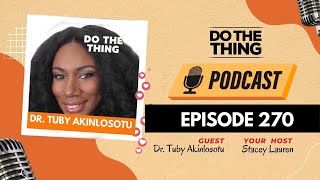
This is a podcast interview (Do The Thing, Episode 270) where Stacey Lauren interviews Dr. Tuby Akinlosotu about resilience, setting boundaries, and building sustainable businesses. Dr. Akinlosotu shares her immigrant and single‑mother origin story, explains why boundaries (including "value boundaries") are core to wellbeing and business success, and gives practical advice: write down boundaries, practice communicating them (tone/role‑play), separate work/personal channels, block calendar time, and implement systems (autoresponders, forms, SOPs). She promotes a four‑day Resilient Business Blueprint challenge and a community for ongoing support.
Chapters
Hey, everyone. Welcome to the do the Thing podcast. This is your host, Stacy Lauren. Well, you guys, this is an exciting day because when you get to know someone and who they are and what they're doing for the world, there's something so special about that process of doing it with someone that you're on the same path with. Right. And wanting to really impacts the world in such a meaningful way. And I've just gotten the privilege to spend a lot of time with her even more recently because we are working closely together on lots of things. And she's so inspirational and so good at speaking to the person that wants to do great things but gets exhausted in the process. Because if you don't set up good systems for yourself, you could be lost.
And.
And you could be wondering, how do I even get through this? And it speaks so much to me because that was definitely the old me and how I used to operate. And I see more recently how easy it is to fall back into those old patterns. And so I think the timing of her coming into my life was more perfect than I could have ever imagined because I've really been able to hear it and notice it quicker than I would have before. And so for that, I'm just so grateful. And I can't believe I get to introduce her to you guys. So I'm so excited. I welcoming Dr. Tooby to the show. Hi, Dr. Toobey.
Hi, Stacy. Thank you so much for having me on the do the Thing podcast. I'm really, really grateful.
Yay. I'm so glad you're here. It's funny that we haven't done a podcast interview yet. I'm so glad that. Yeah, I'm so glad this worked out. So let's start off. I'd love to get your do the Thing story. So really just kind of share how you're here doing what you're doing now.
Yeah. I think the reason why I'm so passionate about resilience is that that is my story. My story is just overcoming just from someone that came as an immigrant from the age of six that didn't speak English all the way to being bullied in the school system, then finding my way and going through all those other challenges as a teenager, almost getting killed, things like this, and being a single mom, having children, and then finding my way and having obstacles along the way. But even through all the obstacles, being able to overcome as they come to me, I overcome them as they come to me. And sometimes I would think that I couldn't overcome them. And then I was Able to. And that's why I'm so passionate about helping women to understand that there's challenges in life. But if they can hold onto that inner strength and that inner superpower of theirs and seek support and just really build that, that they could also get through those life challenges. So my do the things story is basically, I was able to overcome many challenges in life. I was able to beat the odds of that single mom that wouldn't make it kind of a thing. Had my first child at 18, and then I had my second child at 20. And I had businesses along the way, but it was really difficult finishing my first degree and then my second degree, and then I became a doctor. And that was definitely not the plan. And just being able to basically overcome and beat the odds of situations that's happened in my life and being able to still move forward. So that's what I represent, is I just represent that woman that has been through a lot, that has been through a lot of challenges in life, but still finds the strength to show up in the workplace, show up for her family, show up for herself, as difficult as it may be. And even though she has to cry sometimes in the bathroom or close the office door and just take a deep breath, and maybe she hasn't showered in a day or two, but she finds the strength to get into that shower the next day, and she finds the strength to show back up to the world as the warrior that she is, even though she's giving of herself to everybody else. So that's who I see. That's who I want to pull in and help, to know that they're not alone and know that although they're strong, the world sees them as strong. They also need a place where they can also let go. And they also need a place where they can be encouraged and supported and just be vulnerable and just be able to say, hey, I need help, and I need help, and I can't do everything by myself. So that's my story of resilience. And that is why I'm so passionate about helping women in that same situation.
Isn't it amazing when you are able to connect the dots with what you're doing now, to all the things that you've been through? And just even one of the things which is coming here and then not speaking English, right? And just imagining what that was like and how that probably set the pace for everything else? And it's just amazing. Now that you see, okay, this was all for what I'm doing now. This is literally it, right?
Absolutely. Yeah. Because from not speaking English to becoming an English teacher, which is weird, not only. Not only did I become an English teacher, I was like, the top English teacher in the district for many years. Started writing curriculums. And then when I look back, I'm like, this is someone that came, that didn't even speak English. They didn't even know how to teach me because all they had was ESL and I didn't speak Spanish. Right. And so having to figure myself along the way and being a teacher, being burnt out as a teacher, and just all of those things. So pretty much for every career, for everything that I've been through, is just setting me up for where I am right now and just giving me the compassion and the empathy for women that are in that journey, that journey along the way, whether they're just barely trying to make it in an unforeigned land or just opening a business and being all by themselves and having no support to now they have a business, but they have so much going on, and they just feel like collapsing and just giving it up just to that woman that is trying her best to be the band aid for everybody in her life, and then just definitely overwhelming herself with that. And so I've been that woman. I've been that woman throughout the journey with everything, and finally got to a place where I realized my triggers and my strengths and my weaknesses and how to put boundaries in my life and things. And so that's where I've been able to find that strength and that superpower. Now I'm like, wow, I. If I could figure this out, then I think that other women deserve to know about it and just deserve to have that conversation to say that, hey, you're not alone. These things happen, but there's solutions to them.
Yeah. I love what you're doing, and I see the women that you're impacting, just even when you're having a conversation with them or even in a group setting or however the spaces that you're in. And it's changing lives, you're changing beliefs, you're changing the way that people interact and the boundaries that they set and being able to help them leverage and do more things. Because you're able to help with the resilience piece and the systems piece.
Yeah, absolutely. Yeah. Because many people. I had a call yesterday. Many people don't understand how to set the boundaries and communicate the boundaries, or they're just used to just pleasing everybody and not hurt people's feelings, and they just keep putting themselves on the back burner and and this is affecting them not only in their personal life, it's affecting their business. And they find themselves sometimes going into wrong deals. They find themselves losing money. They find themselves doing a lot of things just because they haven't been able to figure out. This boundaries piece that you keep talking about, which is one of the main things, is first setting that boundaries within yourself and then setting those boundaries even with your loved ones, which is so difficult. And then that extends into the workplace, your business, your clients, and everywhere you go. But that experience of being able to say, okay, what are my boundaries? I think sometimes we don't even know what they are. And it's really hard to set boundaries. You don't have. Right. So when you're just all over the place and you're just like. And okay. And okay. And just. I really want to get women into the place of sitting down to understand what are their boundaries. And I think even at this point, so many women haven't even actually written them out or thought about them. It's just a word that's bounced around. But it's like, do I actually have them? Do I have boundaries? And I even have a thing called value boundaries. Right. That I'm teaching women. What are your value boundaries? Right. And what are your personal and professional boundaries? Have you sat down to think about that? So people can't enforce and communicate something that they haven't actually developed or put in stone, right?
Yeah. I literally have chills left now because it's so true. I do the find your voice challenge, which is really helping people get into awareness. Right. Cause it's so easy to go through that autopilot mode where you're not paying attention to what's around you. Because we're busy, right? We're working. We got families and all the stuff. And it's. Once you're aware, then everything opens up for you, and you're doing it from this boundary place, which is so important. I mean, it's everything, if you think about it, right? If you're not having good boundaries for yourself, you have no time for yourself. You're exhausted, you're depleted. I remember back in the old days when I wasn't aware, and thankfully, you came in right at the perfect time. But I would always say, everyone's walking over me. I remember saying that all the time. Like, I don't understand why everyone's walking over me. And I didn't realize. They're not walking over you, Stacy. You just have no boundaries. Right? And that's what's been great about Us reconnecting at this perfect time as I'm kind of growing in another place, because I didn't notice it, honestly, until we started talking. And then I was like, oh, okay, I've got to get back to this. And it was that awareness. You're right. It's that awareness that's everything.
And that's where we find ourselves undercharging, right? Find ourselves over committing ourselves, find ourselves doing everything for our adult children, our family members. And it actually bleeds into every area of our life when we don't set those boundaries. So when we finally say, oh, my gosh, I don't like how that feels, I don't want to do that. And then you start thinking, okay, when you start thinking of what the boundaries are and you start putting them in place, and then you start nicely communicating them to your loved ones, they start to respect you, they start to understand your boundaries, you start to feel better, and you start to be more productive. So it's a game changer when you can actually figure this thing out, amongst other things. But it's definitely one of the key things that helps you really break free. And especially with business too, because I talk about value boundaries, I talk about charging your worth and not undercharging. And clients can see when you have no boundaries too. So if you can practice that in your personal life, it will go into your business. So it's really a very important skill, especially for business women, is practicing that in their personal life and also so that they can do that in their business.
So how do you suggest people. I love the word practice. Practice boundaries. So first step is be aware, right? They're writing it down, they're figuring out what their boundaries even are, what's important to them. And then what would be kind of.
That practice step, after you write them down and you're aware, then you have to practice communicating them to loved ones and communicating them to your clients. One of the ways to communicate them is start implementing some simple things. Like for instance, in my business, I have an event business, and one of my boundaries is I don't work on Sundays. Well, I do have to work Sundays sometimes for events, but I typically don't wanna work on Sundays. Meeting clients and things. So one of the boundaries I put in place is making sure that they can't really reach me on Sunday. And when they do reach me on Sunday, I nicely let them know that I'll be back in touch with them on Monday. As I'm off on Sundays, I'm enjoying my time at church or Whatever, I communicate that. So the next time they want to contact me on a Sunday, they think twice. For instance, I'm the owner of a company, but I don't like them always calling my cell phone. They need to call the business line because I have somebody working. So when they call my cell phone, I nicely direct them to, oh, can you please call this number? I do have so and so working from so and so time. This is my personal cell. Is it easy to do that without having the confidence to do that? I mean, you just have to practice. You got to start from somewhere. Once you start actually communicating them and putting the boundaries in place. And then one of the exercises I say is first of all, for instance, example of the phone, if you separate your work and cell phone, then that's a boundary that you're actually implementing it. But if you just talk about boundaries but do nothing about it to implement them, it's really hard to have them because you're like, well, I don't want them calling my cell phone. But then I don't have any other number for them to call. Right. So I help them to actually think about the boundaries. Write em down and okay, what do we need to do to put the boundaries in place? So physically put them in place. Do we need to separate your thing? Do we need to block out your calendar, for instance? I don't like people just bouncing on me. Right. And so I have a calendar and so you wanna have a meeting with me? Here's my link. Right, but if you don't have that set up, people could just text you, call you, you find yourself over, committed, overbooked. But if you have a calendar that you stick to and say, okay, oh yes, I'd love to get together with you for that coffee chat. I'd love to get together with you for that meeting. Here's my calendar link. So having those resources quickly available helps us to enforce our boundaries.
Do you have kind of like a communication framework that someone can follow to be able to set the boundary?
Yeah, I mean I go into deep role playing in my program, but I just help women to kind of role play and just say, oh, I think that's a really great idea. I use situations, so I think it's a really great guide. Let me looking at my schedule, looks like the only days I have available are Tuesday, Wednesday. From this time to this time, which time works best for you? That's a simple one. But I guess I just really teach them to own their confidence, own their voice in the way they say it. So Let me give you an example. It's not necessarily what you say, but the way you say it. So if you said, oh, okay, yeah, that sounds like a. Looks like. Yeah. In your voice, you're communicating that you don't have boundaries and you're afraid to communicate those boundaries. So I help them more. This is something what people wouldn't think about. Just help them practice their confidence and their tone. And once they do that, we do that in the mirror. We do that practicing. You can now put in the words, give you a script. Okay. And now say that confidently with this tone versus this tone. Do you understand I'm saying?
Because totally.
Yeah.
Yeah. It's huge. Because you could be saying it, but then if the person's not feeling it, then they're not going to honor it. Right.
They can tell from your voice that you're like, no offense. They're like a pushover. They can tell. They're like, okay, she doesn't really mean that. And then you're just like feeling forced to say it or you're just kind of like. And then stuff. But if you're like, oh. And your tone is very. Not aggressive, but it's just like, oh, she has confidence in herself. She's not messing around. And I can't get it. I can't take advantage of her. So I think that that's the key is, is in between the lines. If you don't have the confidence, you can't communicate this. So you have to have the confidence to say, even if I give you a script, even if we roleplay, even if I give you the framework, if you don't have the confidence. So I start off by building your confidence. And these things help you build your confidence every day. And once you start to build the confidence and you start with just loved one practice and say, okay, I'm going to set my boundaries with a loved one, whether it's a child, whether it's a spouse, whether it's a parent. And as you begin to practice that, you become better and better and you practice your tone.
Yeah. I know what came up for me when I was back in my big people pleaser days, it was just this. I didn't even know it. It was like an unconscious feeling of wanting people to like me. Right. Or need to feel validated by it. And I went through a lot of work to get through that. And I'm just wondering, for people that are feeling like that right now, what would be a way they could get themselves out of it?
Do you have to let go it's easier said than done. I think it's something that you need to get in a support system in a community and work on it. First of all, this understanding that you have that and then saying, okay, why do I do that? Why do I feel the need to do that? Getting to the bottom of it. For me, words of affirmation is one of my love languages. And I found out that one of the reasons is because I didn't receive it a lot right. And so sometimes getting back to the root of it and saying, okay, what is the reason that you feel you want to be liked by everybody? What is the reason you feel like, difficult to say no. And once you start to find out the reasons why and start seeing that it's more of an internal thing, then you can adjust it from there. I mean, that's pretty much what I did in 2020 with some of my internal things I figured out about myself. I don't know if I have just an A to Z answer. I think it's just literally working on it day to day. Having accountability, having a mentor, doing self help, going into personal growth, building your personal resilience by telling yourself affirmations and doing things that put yourself first. I think the better you feel about yourself, you'll find yourself less in those situations. Yeah, you're trying to fulfill a void. You're trying to like, why do I want people to like me so much? Is it cause I don't like myself that much? What is it? So it's like a band aid thing. I think we talked about this. You're always trying to fix the symptom. Right? But not the issue. You need to fix the issue issue. What's the real issue that you seek? And if we can go into self reflection and really get into a space where we have that real conversation with yourself and reach out for accountability and support, get into a group where you can get support and work through breaking through these barriers. That's when you'll start to break free.
Wow. I get blown away by just how you're able to speak to it from a place that you could feel it. I could see what you walk through just from when you talk about it. It's not some. Sometimes when people talk about boundaries and things like that, it's hard to see that they've ever felt it right that they've been able to do it. And I definitely feel it with you. I'd love to also talk about the other parts of what you're helping people with and sorry, let me go Back for a minute. For anyone that has ever asked me about people pleasing and boundaries and wanting help, Dr. Tooby is here and we'll talk more about that. But I just want to make sure you guys know this is an amazing way, right, to support yourself. And it's so much different than just having a one on one mentor also. Right. You're also going to be with a community of people which as you guys know, I'm slightly obsessed with that as well. But yeah, I'd love to hear more about these other pieces that you help women with.
I help women to scale their businesses to put systems in place, to put some automations and hire a team. I help them to become a visionary leader. So visionary leadership is all about strategic planning and delegation. So many of the women that are burnt out and overwhelmed, one of the reasons is they don't know how to delegate tasks. They're doing everything by themselves. And so getting them to relinquish control and communicate in a way where they can say, okay, these are the things I need to have done. And we put the systems in place and we put repeatable things in place so that those things can run whether or not they show up, whether or not they're having a bad day or they have to travel or whatever the situation is. I just help them to basically create a resilient business. And so when you're creating a resilience in yourself, but then what about the business? Right? The business needs to be able to withstand all storms, needs to be able to withstand personal issues, financial issues, issues with clients, profitability issues. So we look at all of these areas to make sure that their businesses are set up in a way that is scalable and sustainable.
And the thing is, is a lot of times the people that are coming to you and needing help are the people that are even just, I don't want to say starting out because you're having people that are already super successful that are working with you, but it's also the people that are in this build phase, right. Because that's exhausting when you're doing something new. And so some people are in this program or that program and then they're coming to you because how do you do all the things? Right? And how you do all the things is by being able to put the systems in place. And I thought we could just kind of talk about that a little bit too.
So putting systems in place is very important from the beginning, but it's not too late. If it's not there, you can always fix it. But yeah, people that are in the building stage, that's the best because you're putting them in place so that you don't experience that kind of extreme burnout that's on the way if you don't put them in place. For instance, I like to give real life examples. Okay. So in my event business we don't answer the phone like a live company. So we have a voicemail. I have a system for checking the voicemails. I have a system for them to go on the website and fill out a form and then it goes into the queue and then there's an autoresponder to that and then builds a quote and they go on my calendar and I just have systems. So that's like if a customer comes in, this is what happens if this happens. So I have things written out and also have follow up systems and just different systems that you can think of so that everybody knows what to do, things are running and if I decide I don't want to work today, the systems are still there. So that's, I think it's important. I think a lot of people are just starting businesses without thinking about that. Just kind of going every day, just doing everything and do. And then it's like imagine someone goes oh, how did you do that? And then you're going, you don't know because there was no systems. You just did it, right?
Yeah.
But if these systems are in place, you can easily go back to the system and say, oh yeah, I did it like this and I did it like that and I did it like that so good.
And like imagine the person that is now implementing the systems and if you guys want to play around with this game, feel free. But what that does for the person's business, right? Is that where the 10x comes from? Because if you actually are able to set things up and you're not sucked out on your time and you're able to do more because you're able to leverage more. I mean, what does that actually do for someone?
It's all about releasing that time that you want to spend with your loved ones. The times that you can put into your self care. The times where you just want to. You want to be a couch potato today, fine. If you want to go shopping, if you want your health, right? I mean, what are we doing? We're working so much, we're not even keeping up with our doctor's appointments, our dentist appointments, our yearly exams, before you know what, the year goes by and you're like oh my gosh, I Need to schedule my yearly mammogram and my yearly this. Because you're constantly in your business, you're constantly working in your business that are on your business. So when you put the systems in place, making those systems work, right. While you're working on and working on growing and working on making connections and doing other things, those systems are working automatically in your business. So if you're the one doing all that, if you're the only system that makes your business work, you're going to be truly exhausted. You're going to be truly not having time for anything else.
Yeah, it's so true. And so what do you think could help someone listening that maybe wants to have more time for themselves and do more self care and be able to manage their tasks? What does someone like that do?
Yeah. So we talked about the setting boundaries. Planning with prioritization is a very key one too that I talk about. Because a lot of times people have this grandiose plan, they don't really prioritize. Right. I like this. I think somebody talked about it before too. Like this power hour, I call it my morning power hour. And I wake up a couple hours earlier than the rest of my family and I get some major things done within those times. And I have more time during the day. Right. I plan, I use a calendar, my checkoff list. Right. And I like to plan with the priorities of what is due today. Right. What is due in the next couple hours. Right. What can't be put off. But a lot of times what people find themselves doing is sometimes they're afraid to tackle that bigger task. So they might do a lot of mundane tasks and all the little ones in between. And then they're exhausted and then they're behind. Right? And then they're behind. They keep doing that. So they find out they do not have any time for themselves. Because the day that they probably said, oh, maybe Thursday, I'll go do this or hang out with so. And so now they have to play catch up for all of the things that they didn't plan properly in the beginning. So I like to start with planning with prioritization, prioritizing your week, prioritizing your day and chunking things out and saying this task, how long is it gonna take? And is this gonna be able to be done in a day? If not, which part of this are you doing Monday? Which part of this are you doing Tuesday? And then scheduling your time for yourself, scheduling your time for your self care. For instance, I don't like to schedule appointments in the morning. Because that's my time. I wake up in the morning, do my morning routine, do whatever I want. So if you ask me for an appointment, I'm usually gonna always schedule anytime between 12 and on. And so that's me knowing that this is my maximum performance time. So if I schedule meetings during that time, I won't have time for myself. So it's really about being proactive and knowing and just planning properly.
Yeah, you're in charge of your schedule, right. No one owns you. Why don't you just mark out the times that you want to be with yourself or do things for you?
Yes, absolutely.
So it's funny, when I started this podcast, before I even had the community or even, it wasn't even a thought in my mind, I thought it was all going to be about doing the thing, because I have always done the thing. But what had come out, I think by the 10th, 12th episode was that I have always done the thing, but I didn't always do the thing for myself and what I wanted. And so that's why the whole find your voice thing has been such a powerful thing. With everything I'm doing, it's kind of the through line through it. And so I feel like you're there too, where you've really tapped into who you are. And I'd love to just hear more about that and how that feels to be so connected to yourself and what you're doing.
Yeah, it wasn't always that way. I think I was always a high achieving woman doing a lot of stuff with all the obligations and all the expectations put in my life. But it wasn't until 2020 that I really had a self defining moment that I really understood some of my triggers and understood why I react to certain things, why relationships weren't working out for me and some of my close relationships finding out that and that realization really set me free. Once I figured that out, started working on myself, started having a better relationship with my adult children, with my family. So I think that that was the breakthrough moment for me was just self realization of even though I'm this strong woman and I'm out there and I'm achieving stuff, there's this part of me that's very triggered and very sensitive to certain things, emotional things and things. And once I figured out what it was and I realized that I was in control of only my reaction and response, I began to work on that. I realized that my environment can no longer control me. I couldn't control someone else's emotional response to me or someone else's lack of or interest emotionally. Right. But the only thing I can control is how that made me feel and how I reacted to that. And so when I spent a few years just working on that, just working on building myself up so that I was no longer triggered by certain things and I went backwards into why those things were there and I was able to discover that and say, oh, okay. So I think that's the breakthrough for me, to be honest with you. I've evolved even in my marriage, I've evolved in my sibling relationships, I've evolved in my relationship with my parents, all because of this. Just understanding. And I share this piece, it's very funny. It's called self talk. And I talk to myself a lot in social situations because I'll find myself sometimes wanting to go back to those. Sometimes because of lack of attention or lack of affirmation. You want to be affirmed like in a social place. Right. And so you begin to talk or this and that, and then I'll tell myself, oh, I'll talk to myself and say, no, don't do that, don't talk about that. It's not about that. And I find myself self regulating social situations. Yeah. And it's because you're going to always want to go back to your natural self.
That's what it is, right? Yes, I feel that. I totally know.
I.
Exactly. That is exactly. I didn't feel it until the new program I'm doing because I'm putting more time into it. All that old stuff comes back easily, right? What's up with that? That girl has been long gone, but.
She comes back, comes back sometimes. A lot of times it comes back in new situations when you're climbing the ladder because of new insecurities, new vulnerabilities, new challenges. And like you fall back into those patterns and then you're like, why did I do that? Why am I doing that? You question yourself and you're like, oh my gosh. And then if someone was looking at my brain, they'd be like, why is she talking to herself? Cause I'm just like, don't say that. No, why did you just say that? You only said that because you're looking for attention, aren't you? You only said that because this conversation's not about you. I'm literally talking to myself. And it's helped me because I've become my own self regulator. Right. And I might even mess up in a conversation, Right. Or I might even mess up and I'll come back and be like, I get back in my car or whatever and just reevaluate, why did I say that? Why did I do that? And then it helps me for the next time, right? And like, okay, I still have some work to do. And as I begin to do that every single time, I check myself every time after a conversation, after social outing, even a conversation with my husband or whatever. And then when I realized that I'm finally walking in, no need to please someone, no need to be affirmed, no need to have an emotional response, then I know I'm really getting to that place. I'm really getting to that place of healing, of I no longer am seeking for a response or seeking for something that's going to fulfill, something that I'm hurting inside. And so it's a work, it's a lot of work, but it can be done. And it's just a daily thing. It's just reminding yourself and being aware. Very, very aware.
Yeah. And it sounds like you're not beating yourself up when you notice it. You have the tools around it, right. Where you're able to almost honor it in a way by doing the self talk and things like that.
You definitely don't want to beat yourself up because then you go right back to that place where you're trying to come out of. So we don't want to beat ourself up or just like, okay, got some more work to do, okay, and so what do I need to do? Sometimes you say, you know what, I can tell that I've been so overwhelmed this week. Maybe that's the reason. But once I realize what the reason is and I'm like, okay, you know what, that's it. I'm getting up, I'm going to go do my nails, I'm going to go to Chick Fil a drive through whatever I've been doing just to get my mind off or whatever, I'm going to listen to music. I'm just not going to be available for the next couple hours just to recoup. You have to self monitor yourself. And you know the triggers, you know when you start to fall into that like, oh my God, why am I doing this again? Oh, yeah, because there's a lot of pressure. There's this, there's that. And so you begin to pull back and say, okay, I need to fix this. This is your conversation you're having with yourself.
Yeah, I love that you're constantly having.
This conversation with yourself. You're like, Stacy, Dr. Toobie, you're out of there. You need to fix this. Okay, what is the problem here? Okay. And then once you figure it out, you're like, all right, I'm not gonna beat you up for that. That's okay. You've been through a lot this week. I understand. All right, what do we gotta do? We need to pull away from social media. We need to pull away from these meetings. We need to. You know what? Maybe you don't need to have that masterclass next week. Whatever it is that you find that you need to just pull back and say, okay, recoup. Give yourself permission to not have to think.
Yeah. So it's interesting. I'm thinking about. We have similar mentor, Eileen Wilder. And I remember she was talking about how as you go to these new levels, right? This is your. If you're not feeling something strong, not wanting to do it, then maybe your calling's not big enough. And I almost feel like your program, the stuff that you're doing is like, the secret to that. Because when you are reaching this new thing and you're going to this level and you're like, oh, my gosh, can I even do this? Is it even possible to do this? There you are. You're like, yeah, and I'm going to help you create these systems to get there.
You said it, right? Yeah. I think she says, new levels, new devils. I know. I. Like, she says that because sometimes when you're just doing it by yourself, you're at a level, you don't need it. And then all of a sudden, when you get to the level, like, as you begin to grow. And that's why I call it scale without sacrifice. Because most of these things come in when you're trying to scale, Right. It's like, you probably didn't have this when you just had something simple. But as you begin to grow, you're like, but I can't do it the same way I used to do it. It's only one of me. Right? And that's when you start realizing that you need these systems, you need these boundaries, you need these things. Right. The more impact you have, the more you need these things in place.
Yeah. So true. Okay. I'd love to hear what your number one piece of advice is for people on doing the thing.
Don't regret what you're going to do. Just do it. I know a lot of people say, do it, do the thing, do it now. I honestly do believe that. I do believe that. Stop being a perfectionist. Just do it. And you can always fix the autocorrect, you can always go back and edit, but just do it anyways. Just put yourself out there, be proud of yourself and don't overthink everything. I think that's a huge thing. Holding people back is people are before you and doing a lot while you're still being so perfectionist and making sure everything is perfect before you launch and everything's perfect before your website is open and you have all this going on and then by the time you do it, it's like old news. So just get it done, don't worry about it and don't be hard on yourself. Okay? You made a mistake. Okay? Fix it. Big deal.
Okay. Please share how everyone can get into all the things that you're doing because you've got challenge, you've got an academy, an event. There's so many amazing things happening for you right now and for people that are going to it too.
So I have a four day challenge coming up. You can go to resilient businessblueprint.com to register. I also have a Facebook group. You can go to mentothrive community.com I hope I said that right. Meant to thrive with a two okay. And yeah, you can find out things I'm doing. I'm not going to drop any dates because I've learned I have to edit the dates out so I can reuse this. I'm like, so I do have a four day challenge coming up. Click the link or click whatever is available whenever you hear this. And the dates will be on that thing. Yeah. And then I'm on LinkedIn as well. Doctor2b@comsoutu. I'm on Instagram. It's so funny. My sister was like, you don't even have that much of an Instagram following. Because I only have like 54 people on my new Instagram. But I'm like, but when you go to help her thrive is the new one that I want people to follow. So. But I do have several other ones. But I'm going to promote help her thrive. And yeah, so I'm on the. I'm on the gram. So find me.
What can people expect when they come to your challenge? What is that like?
It's going to be a breakthrough experience. It's going to be four days together. Going to drop some limiting beliefs and we're going to look at how you can actually accelerate your business without burning yourself all the way to the ground. We're going to look at what are the most important things to put in your business to scale. We're going to talk about how to not undercharge, how to increase your Value how to work less and make more money, prioritize yourself. All the little secrets that a lot of people aren't saying out there, we're going to talk about them. The real true secrets to business success. I'm laying it all out in this four day challenge.
And what about people that aren't a business owner, but they want one someday? Is this something they can do too?
Absolutely. Yeah. Like I was telling the other, they said, you know, before you do something, you want to be in the room, you want to absorb it, you want to learn. I think that's the best thing. You don't just jump out there before you launch. Spend a few years, spend a few months, spend whatever time learning and absorbing and being like the people you want to be like. So if you want to own a business, get a business mentor, be in a room with business owners, start to soak it up, don't wait until you get a business and then start making mistakes. Get in the room. And like my resilient business blueprint is set up for people also to launch. So why not launch the right way? Right? Why not have systems in place first? Why not have automations in place and all that? So even if you don't even have a business idea, but these are all life principles as well. So just be in the room. That's the best advice I have for you.
Thank you so much for doing this with me. I just love what you're doing and I love what you're able to do for people in the world. I feel like it's so important because this is what gets you out of that autopilot and just kind of just following whatever comes at you. You're almost helping them play offense instead of just defense. Right?
Yeah.
Thank you guys for listening. And was there anything I didn't ask.
You that you wish I asked you after the podcast. I remember, but no, with this moment, I think, I think it was great. Unrehearsed, just doing the thing. I love doing the thing with you. So, yeah, thank you so much for this opportunity, for having me on your show.
Thank you. And for you guys, do the thing, don't wait for opportunity, create it.
More from Stacey

From 262 Women to 8 Million Media Impressions: Deborah Drummond Built a Global Women’s Movement


From Notes App to Published Author: Avery Brenna Crumrine on Turning Intention Into Action


How Stacey Lauren's Billion Dollar Impact Marketplace Will Raise Billions for Charities and Causes

What Happened When Allison Maslan of the Pinnacle Global Network Ran a Challenge with Stacey Lauren




Leaders Share How Stacey Lauren Sparks Action, Clarity, and High-Impact Collaboration

Sandi Masori Announced as Emcee | The Billion Dollar Impact Event Returns to San Diego