Episode 303: Jesse Tayler: Overcoming Fear and Embracing Responsibility
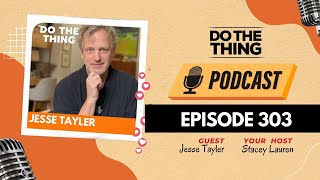
This content was created by Stacey Lauren. This content was uploaded by Stacey Lauren. This is a YouTube video titled "Episode 303: Jesse Tayler: Overcoming Fear and Embracing Responsibility" featuring a conversation between Stacey Lauren, the host of the "Do the Thing" podcast, and her guest Jesse Tayler. The episode, created on October 12, 2024, explores Jesse's journey as a startup entrepreneur, his experiences with Steve Jobs, and his current work on a digital identity verification project called Truanon.
Chapters
Hey, everyone. Welcome to the do the Thing podcast. This is your host, Stacy Lauren. Well, guys, I am excited to introduce you to my guest, Jesse. Hey, Jesse.
Hi, Stacy. Thank you for having me.
Yeah, thanks so much for coming on. I'm so excited to get a chance to talk to you.
Well, great. I appreciate it. And let's get going.
Yeah. So could you please share your story for the listeners? I'd love to hear all about you.
Oh, sure. Let's see if I can keep that short. I sort of stumbled into a career as a lifelong startup entrepreneur. You know that the short stories. I was going to be in the band, but you need a little more talent for that kind of thing. And it turns out that one of the only things that I was really good at was wiring chips and programming computers, which I did since childhood. Childhood. And I'm of the age that during that generation it was very hard to get access to that stuff. So by the time I was in my 20s, although I thought maybe the band could make it, it turns out that the only way I was ever paying any rent was writing and selling software. So I sort of slowly discovered that there was a vocation in that. I moved from the east coast, west coast to try my mettle with the Silicon Valley area. I made it as far as Seattle, but I was young and there I got to meet my first real business partner, Peggy Thompson, who probably was old enough to be my mom, and in a certain way probably was. And she and I worked extremely well together for a number of years. We developed a lot of interesting next software, which was Steve Jobs, sort of in between company. And we got to invent the first app store, which became iTunes, music and later iPhone App Store as well. So that brings you back to the early 1990s and the creation of the web and all of that good stuff. Then I kind of just grew up with it.
Yeah, it's incredible when you're before the time. Right. But you're able to see it before everyone else does and you're able to do it. It's rare, right, to have someone like that. I'm just wondering what that felt like to kind of already have this vision for what you're doing and then no one else is doing it.
Yeah, that's not necessarily a comfortable place to be. You have to understand that sort of in the time prior to the Microsoft of the world, software really wasn't worth anything. It was all open source. You just didn't treat it the same way. The hardware was what people bought and sold. And Microsoft came along and really taught the world the value of software. That it is the stuff that makes hardware do things right, it's the fuel, it's the stuff that turns hardware into something useful. And so the advent of apps and applications and Microsoft Office, Word and Excel, these things were just beginning to take off. And Microsoft was making hand over fist kind of money selling software in a box. So here we were trying to tell people at that exact moment where they were all just absolutely thrilled with their investments in Microsoft and trying to convince people that they should be delivering software electronically. This seemed like you were buying nothing, even a song. You expect to get a record or a tape, a cassette, something that you can handle, something physical. And we simply grew up in a world where things are physical and non physical things don't exist. So software really felt like it was nothing. And it was an extremely difficult thing to sell. So I wouldn't credit our vision. It was not hard to see as a small independent developer, the problems with the economy of software, the rapidity in which we're able to update software and get it into people's hands, is the economy of software. And the slower that goes, the slower it takes to get to that future that as a young person I was desperately crawling and climbing to try to get to. So I saw electronic distribution as an obvious thing, as did my partner and other people in the next world. But you have to think for a moment, what is Jesse doing at his Seattle startup showing this to Steve Jobs. This isn't not a success story. This is the Hail Mary pass that you do at the end of the Runway when your startup has spent some years creating something that was much more difficult than we had probably realized. And when we got it working, sales were not where our investors really wanted them to be, not by a long shot. However good it seemed, it really needed to be 10, 100 times more traction at that level. And we just couldn't bring in more money. So there came a point where I realized if I did not get this technology into the hands of somebody that could do something with, would be for naught. And so as a young startup person who had invested all my waking hours, the best looking I ever was during my life and I just didn't have any dates in Seattle during the years that it was singles in Seattle, so that monastic dedication needed to pay off. So it really was more like, who can you show this to that will understand that value? And I have to say, Steve Jobs, for whatever you may criticize him for, he's not always the nicest guy to demo to. He grasped it quite immediately. There's some debate as to how many questions went back and forth during this demo, but at the end, he simply said, I like it, and he turned around and walked away. So I thought, well, that went well. But sure enough, Monday morning, when we got back to our offices in Seattle, the phone rang and it was Steve. And he asked to speak to Peggy. And that was really the fire sale that has now become my calling card moniker. And I find it an irony that that is a failure story. Generally speaking, I let people believe what they will.
Yeah, it's amazing. Yeah, that's the way it went. So incredible. I have a lot of questions about that. But I'm really curious. When you said it was a lot harder than you thought it was going to be, how did you keep going during that time?
Well, that's an interesting question. And I think this really speaks a lot to entrepreneurship and the dedication that really is required to get these things done. First of all, I'm 20 now. I may have been good at soldering chips and writing code and things, but I did not know anything about encryption. In fact, nobody did. It was not pgp, which is sort of the backbone of encryption for many, many years, hadn't been written. It certainly wasn't working or finished. There was no coding examples that would do what we needed to do. And as an engineer, it's very hard to describe, but when you wanted your product on the app wrapper, you dialed a phone number that rang the phone on my desk. Every single app that was in there, I spoke to the creators. These were my friends. Now, when you're creating digital rights management for all of them, if someone were to break my encryption code, I could put all my friends out of business. I destroy their companies. The amount of pressure to get that right was insurmountable. And I thought to myself, surely there is someone who knows exactly what to do. They could come in and sit down and advise me or help me or do it. And then after some period, quite a long period, I'm afraid, I began to realize that person may be, but they are not on our team. And I look at Peggy and I say, well, Jess, you're the engineer. If you don't do this, no one will. And if it does not exist, our idea will not come to be. And once I understood that sobering reality, it overcame the fear that I had over creating this. Now, that doesn't mean I wasn't scared. I stayed up all night trying to make sure that this stuff was Impenetrable, or as impenetrable as I could make it. Software sold for thousands of dollars, sometimes tens of thousands of dollars. If I were to break the encryption, I would personally be devastated. So it's an interesting juxtaposition between, on the one hand, fearing the reality of the responsibility and understanding that this is something that you don't know how to do because nobody's done it, at least not correctly. And therefore there is something that you can see that needs to be done. And on the other hand, you just felt this, wait, if you don't do it, then this idea will not be which is more important. And so I found out in myself putting that art on the wall is more important than fear. And even though fear drives most of my life's decisions, I had to overcome that fear to get that done. And that is a very important, interesting story, I think, because it describes A, how difficult it really was, but also B, the kind of backbone that you need to do these things. There are points where you're alone. Nobody's telling you this is a good idea. In fact, people are generally telling you that it is impossible. Even if you did succeed, you would be selling nothing. So it's not a comfortable place to be. People are not cheering you on. There were no cameras following us around. It was an unglamorous kind of thing. It was a lot of late nights and a lot of code in a day where writing code was itself very difficult.
Yeah, it's so interesting. And then when you ended up going to that meeting with Steve Jobs, I can't remember timing and stuff. He wasn't doing Apple yet, or was he already doing Apple at that point? Or what was that kind of timeframe like?
Right. So Steve, of course, was one of the three founders of Apple and was unceremoniously fired shortly after releasing the Macintosh. This was his in between computer called the Next. Actually, it is the same computer in which the World Wide Web was invented at the very same time. Not the same computer that would be unsanitary and that guy was concerned, but the same model of NextCube computer. We both were trying to tackle what turned out to be probably the two most important issues built in the 20th century that we rely on here in the 21st century. Right. The Web is there to really transfer information between computers. Something that was not yet standard and has been standardized on those mechanisms and the URL ever since that time in the early 90s. And the app Store was there to protect the rights of artists. Right. Whether you've got A book or a song or an app, that the App Store was there to create a way to protect those rights. And these were both new concepts and they turn out to be sort of the legs on which today's mobile computing world stands.
So during that time, you had to have. I mean, I'm imagining how much you had to learn, right, and see and overcome and go through and exhaustion. What would just be a couple things that you would say would be key things for people to know or understand when they're tackling something huge like what you were doing. And without a lot of people even knowing that space. Did you have any takeaways for people that could help them if they've got something they're doing right now?
Well, I could tell you I wish that I were more fearless, although maybe that's not even true because the fear kept me honest. I think it is a short value mechanism, sort of a 1, 2, 3. And the fear ended up being, number three, the process and doing it, which involved buying books and bringing them home, reading about cryptography done and wars and things before computers and trying to understand what they were doing. But the number one, the number one put that art on the wall. Inventions are nothing if they don't change the world, if they don't get into the hands of people that need to use it. I fancy myself, I think on my LinkedIn profile, anyway, it says software inventor, a moniker that I don't think anyone else, but when I was a kid, I reveled in Thomas Edison's. I mean, these were my heroes, not rock stars. And I grew up with a sense that if you want to be immortal, what you need to do is invent software people use long after you're gone. They don't have to know my name, they don't have to know any of these things. That was my goal, I realized since I was a hero child. So by the time I was 20, in certain way, I had already had 10 years of trying learn and build and do. And I only then understood why. There was this drive. I had a little secret drawer of electronics in my bedroom and soldering irons, and I would open it up to solder chips late at night because I was skipping school. I was a terrible student as a kid. I gave up everything with this kind of passion. And it's not something that I would recommend people try to do. In fact, I think it's a bit of a disease if you have it, you may not even know, as I didn't. My parents are university professors. There couldn't be anything further from an entrepreneur. So I was on my own. And it was a lonely time in a certain way and I really probably needed more balance in my life. But the drivers were there. Immortality was before me and I saw this as my opportunity. So if you are lucky enough to have a talent for which you could put a dent in our universe and future generations, my understanding as human is that it will be very hard for you to put that down and simply walk away from it as a failure. You cannot accept it. So the drive within the drive was there. And in fact I had to go get Steve jobs as a 20 year old who was at that time very renowned for calling people software. Brain dead. People who had demoed to him had burst into tears and left the room. It was not something that people volunteered to do. And people ask, weren't you scared? Actually not. Luckily he agreed that he liked it. Had he not, he would have had an argument on his hands and perhaps he would have convinced me that I was wrong. But that's not why I was there. I was there because I knew exactly what I was doing. And it turned out that I need nothing more than explain it and show it to him. And he agreed, apparently so.
There's so much there that I love what you said because there's so many people. Well, number one, they think it's easy, right. And they don't realize that it's hard. And so the way you were talking about being consumed by this thing, right. And taking the books home and all of that, I relate to that. You're right. It's a curse and a benefit at the same time. And so there's that piece of it and then there's also the piece you being courageous enough or not even thinking maybe at that age. Right. Reaching out to him and doing that. I think that's really cool. There's so many people that are listening that they're wanting to do something. They're wanting to reach out to people. How did you even approach it? How did you even get the meeting to start?
Well, we were at a trade show Next World Expo where we had our booth and Steve came around and spent time at the important people's booths. He did not come by our booth, which made me upset. Oddly, this was also a time where Steve could walk around and be alone. So perhaps I took advantage of a bit of that in between time. But I recall quite distinctly seeing him throwing my mouse down on the table, walking into the middle of the floor and saying, hi, Steve, my name is Jesse and I Busted my ass on this software for the last year and a half. I want to show it to you. And he looks down at me and he pauses for a moment. He puts his hands together in that kind of guru thing and he says, okay. And I was like, oh, shit. So I guess. So I took him back to our booth, which was just a mere few yards away. And I could see my booth mates farting and pushing the mouths out for me to do. And I could see a tail of people forming behind Steve. So suddenly I had gone from an empty booth to a booth with Steve standing toe to toe and a mob of people from next, from looky Louis from the floor, all kinds of audience had found around. It was a huge crowd and again, I should have been nervous, but I think I was still pissed off that.
He didn't come to your table.
I had done that demo so many times. I did it at 10x speed and I assumed that he would follow and he watched with Hawkeyes and that was it. He had a capacity to understand the future without encumbrance on the now. These other things did not bother you, which actually makes him a very interesting person. He was able to see in it more than what we were able to see. And in fact, much of the success story of itunes, which we could talk about in their fight with Napster and how the App Store became a weapon, a tool of business to drive monopoly and to drive revenue and to drive a lot of interesting and important things, those were not part of our manifesto. We didn't review your software or reject it. We were glad to have you on there. We didn't sell anything that was free either. I mean, go FTP that on your own. But in general, if you wanted your product on the app wrapper, if it was a song or if it was a book, as long as it had something to do with the next in our audience, we were more than happy to digitize it and sell it for you. So we didn't really have a lot of those concepts about how to leverage it. Of course, we didn't have the position to run monopolies or any of that either. So hard to say if we had grown up into the startup that we had wanted to be versus the fire sale that really was, but that's what it was. We were out of time. And we had shown this to everybody. Everybody is companies that nobody's heard of, IBM and Digital and things were the big players at that time. And they all said the same thing, that this is very interesting and you've Certainly broken ground. We've tried these things before and we have failed, but we just don't see that that's the way the world is going. So again, Microsoft has taught us that software is best sold in a box drive to a store called Egghead. You'll like it. So that's the reality that we faced. And it was not an easy thing to pitch people like startups that have a pitch that has sizzle and people can get behind. Well, I don't know about other entrepreneurs, but most of my success stories have been pitches that people thought were terrible products that they did not understand, sometimes taking many years to mature into the kind of thing that began to make them work. So your question was really, what can people in your audience learn from all of this? I'm not sure if I know.
Yeah, I liked what you said. Fear keeps you honest, right? It's kind of not looking at fear like it's a enemy. You're befriending it, which has helped you move through these situations and then also realizing that it is hard work and it's not some easy pass that you're doing when you want to do something big. I'd love to also know what it feels like to know that you've been such an instrumental part in where we are now in society, just how that feels.
Oh gosh, I'm not sure I feel anything from it. I managed to be here in my mid-50s and still I am a software inventor and an early stage startup person. So I'm not sure. In fact, if you dial back a moment and you ask yourself, was that a success story at that time? It was not. It was a failure story. Come my moniker got through me, through other people who as the App Store began to kill Napster and then later dominate mobile computing and things. People would call me up and say, well, that's a really important invention. And I would say, geez, I agree, but it doesn't have anything to do with me. So I don't know. I think to some degree this is something that we do because we do. And of course I try to make successful things. I want things that people will use. Not to liken too many things to the band, but I'm a big Beatles fan and they had just the ethos that sure, we're a commercial pop band, but we want people to listen to our music. That's why we're making the music and we're not shy about it. We're great musicians, all of this stuff, but we are unabashedly here to sell records. And so when we write even the smallest song, we polish it, we practice it, we put everything into every bit of it. And we have this recording machine studio around us building these into great songs. And if you ever try to cover a Beatles song or something, you'll find that it's really hard to do it better than they did. And that's, I think, a testament to their capacity to take song an invention, something that didn't exist, and make it as beautiful and perfect as it could be, with the purpose that it should delight as many people as using it. And I really think that that's my natural inclination about software. Whether or not I am the famous person or whether or not even I'm the one that takes it to where it ultimately needs to be. I am very proud of that app store. And a friend just last week put out a YouTube video where he ran on an old Next computer. That very first app store, the same one that I showed to Steve. And I had not seen it since that day. It was already not the one that we were working on. Right. It was the one that was out. And so that might have been the last time I demoed it, I'm not sure. But it was a fleeting moment. And so to see that video was quite interesting. I have no idea what inspired him to record that, but it was a real dose of nostalgia and it was a crux in time. That's when the web was invented. That's when so many things in computing were invented. And honestly, that NEXT computer deserves a place as history's greatest computer. And yet very few people know. My watch here, an Apple watch boots the very same Mach Microkernel and the same operating system that was next.
Wow.
No Mac left in any of these Apple products. They run what we used to call NextStep. And so when Steve returned to Apple, he also took over the place and his technology took over the place. And for what we now refer to as the Mac was really sort of the Mac 2.0, the next, which has quietly been pushed aside during a merger from Next and Apple. And of course, Apple won't credit some other company for their system software. That's pretty much the heart of everything they do. But that's the truth of it. That was the greatest computer and it offered tools that nothing else had. I could not have built what I built on any other computer. And Sir Tim Berners Lee, because he has been knighted by the queen who invented the web, I don't think he could have created what he did on any other Computer either. It was really the development tools that enabled the creatives to make that next forward leap, one that we still rely on today. So I think that computer has an undeserved place in history. It should be reveled as history's greatest computer. And it certainly is not something that I could have created on other computers. And that speaks for itself.
Wow. Okay. I'd love to hear what you're working on now.
Well, what I'm working on now is called Truanon. It's not QAnon. Sounds the same, but it's the opposite. True. Anon is a way to verify identity online without loss of privacy. And it's actually very much like that first App Store in a certain way. We were taking something in the first App Store that was digital, right? We put it on floppy disks to put it on a shelf. The App Store was a purely digital solution for the digital world, and perhaps the last remaining bastion of physical things going into the digital world, being transmogrified. A word that I assure you I do not know the meaning of, but I think it means something to. To the loss of translation. And let me just describe the ID card that I have here in my pocket. I could take it downstairs to the bar here in New York. I never have any problem with it, right? It never violates my privacy. People don't try to steal it from me. But when I take that same ID card online to verify my own identity, whether or not I want to use a bank or LinkedIn or anything, when I verify identity, I take this card out and I digitize it, right? I take a picture of it, a movie of me holding it, something to this degree, whatever it is, it has taken something physical and tried to make it digital. But where did this card come from? This card memorializes an experience that I had at the dmv. A person of known integrity, the employee looked at my body and reviewed the papers that I brought and said, okay, I'm going to open up an account on our government database for you, and it's going to capture your driving record. By the way, here is your login password because we'd like you to pay for your parking tickets. Okay, so this is where you go to pay your parking tickets. Now, that same digital property curated on my behalf, that's where the card was printed from that data. The card doesn't represent a file in a cabinet. It's there so that I can show it to people when I don't have access to the digital world. That's its purpose. I'M driving along and the police want to see my driving license, I show it to them, but it obviously came from a digital place. So what Truanon does is it takes these pieces of your digital identity and instead of my surrendering a single document for you to review and decide if I am really who I am, I could confirm and connect together. Visible things, blogs, social profiles, my LinkedIn, my GitHub account. As an engineer, we have GitHub accounts. They have a profile. Not something I often show off on a dating site, but it has 15 years of my checking code in and out of other people's repositories. It is very unlikely that a fraudster has maintained this in order to masquerade on Twitter. Right?
Right.
So when I confirm and connect visibly a variety of these digital counterparts, I can actually tabulate a rank and score that defines how credible I am, how trusted I am. More digital footprints, more depth of interconnection means more confidence. And so Trunon is able to establish a credible identity right around the same confidence or a little higher than a single piece of physical id. But I can boost it much higher than that. Consider very simple digital properties. My MIT email address, my IBM.com email address. These are digital properties, things that I log into. But of course, these are not readily available to just anyone. You must be associated with the company. Right. You must be associated with the university. So we all have digital footprints that are quite confident building. And in fact, when it boils down to it, these are just the links and profiles that you want other people to know you by. So by confirming them and connecting them and showcasing them in a social setting, not only do I come across your profile and know that profile is truly owned by Stacy Lauren, but I can see the things that you want other people to know about you. You control how other people view and share your identity and that's the control that you want to control. Privacy, you can boil that down to just the rank and score. And this was created really through thought experiments of trying to figure how I met my wife 20 some years ago on a section of Craigslist that has since been censored by the government for human trafficking, rape, extortion, murder and that sort of thing. And it was an extremely dangerous place. To date, anonymous, relay, dated email, not often used because it's incredibly dangerous. But we understood that 99% of the responses that both of us were getting in this exchange were not just fakes, they were people trying to harm you. This was extremely dangerous. But in retrospect, I Understood. Something about anonymity, right? We kept our email anonymous through that email exchange as long as we wanted. That gave us control over what we call privacy. If you turn up privacy all the way online, it is anonymity. Now, in the real world, this sounds like you're faking who you are. A Charlotte at a masquerade online. This is you being safe. This is you protecting yourself. So both of us understood, as long as I do not reveal my identity, send through my real email, then I can make the decision as to whether I trust someone or not. And that alone was such a powerful thing that it made that site work. And in fact, I suppose I married this person and had children. So it must have been a successful dating site in some way. And that's an interesting story because my wife was later ripped off during COVID trying to get housing for the kids outside of the city. And it was on Craigslist. And I realized, gosh, all you need is that day when you are vulnerable, right? She was standing up to save the family, to find us a place to be safe, right? Children are involved. She was going to do this. She was going to be the one to figure this out. And she got online, she found a place, and she pressed go on that Venmo. And then she thought, gosh, it's almost too good to be. What is that word? True. And sure enough, it wasn't. So I think it's an interesting invention, true or not, because it is the first purely digital solution to this identity problem. And I think the identity problem has grown up from what I thought was pickpocket crimes during the time when I met my wife 20 years ago, to the point where it's rocking democracies around the globe, to the point where it is causing enormous transfers of wealth between people who are fraudsters driving around in Mercedes and those who are fleeced by it. And right now, you, your family, your friends are all under attack. We all are. And yet it's like our hair growing. One day, we just realize, this is too much. And I came to the point, at some point, probably because of politics or something, where I thought, this has gone too far. I am responsible. I created platforms for social networking. I promote computers. I was like a little Steve Wozniak. I thought, if you just give everyone a computer, they'll be smarter, they'll vote better, life will be better. And I did not realize that humanity remains the same. So I think true Anon is probably the most important invention at this phase of my life with children who I Want to inherit a safer world. And so I want to secure a better world for ourselves and our children. I want us to remain safe. True, but anonymous, where we require and where we don't, like on LinkedIn or somewhere else. I want to be able to show you the links and profiles that I want other people to know me by. It's really very simple.
Yeah, it's amazing when you. Again, it goes back to that you have this vision for something and then you're just not afraid to go after it. Right. Everyone else would want to do something, but then they might get stuck with the whole what if and all of that. And it sounds like you've really nailed that whole process is once you have this vision and then you're able to have the passion for it, you're able to go after and do the thing that you want to get it.
I don't know if I credit myself that much with it. That sounds an awful. More intentional than it really is. I realized that as this invention came to be, I had two choices. I could publish this as a scientific paper and say there's this problem in the world where we're trying to transmogrify physical ID and put it online. We should be using a purely digital solution. And here's how you could do it. Or I could surround my desk with food and begin to code and stay up 20 some days, all night long. And that's how long it took to get through even just the most central basic part. And when I say 20 days, I don't mean like 20 days where you wake up and you have breakfast and you look around, make a few. I mean, every waking hour. It was unstoppable. I had to know, does this work? Is it possible? And no matter how good you are as a computer scientist in your head, you cannot visualize all that logic. You must code it. So obviously that's when I knew that I had the disease. When in fact, here I am with kids. The last thing I want to do is start another startup.
Yeah.
But I was faced with a simple dilemma. Should I do this myself and make the mistakes, or shall I allow someone else to make the mistakes? Obviously the latter is unacceptable.
Yeah. You have such a strong why, right? Your why is the biggest that it could ever be, which is leaving this safe place for your kids. So there's nothing that's going to stop you when you have the solution based on prior experience, based on what you have been able to do, based on what you see, and there's nothing that can stop you. At that point.
Well, that does not mean that it will be a success. But yeah, it has done well. People have been using it for quite a while and we can see how the user behaviors react. And it's a very, very interesting thing. For a guy that has spent a lot of years in social networking as a creator and a platform creator, profiles themselves replaced avatars because profiles are test building. Before we had profiles, we had really outrageous behavior, Right?
That's true, yeah.
Profiles are now ubiquitous because they build trust. So in a way, all Truanon is doing is extending that trust building, amplifying. And when you think about what product people do on these social peer marketplaces and all these things, after you've done the basics of transacting and taking people's money, basically product people wake up every day and they try to figure out how to make up for this deficit of trust.
I'd love to hear what your number one piece of advice is for people on doing the thing.
Well, my advice is to myself, and that is to be fearless. I hesitate to lend advice to others because I'm not sure being an entrepreneur is a good idea. I'm not sure that software invention is a reliable means to feed your family. I've been rather lucky. So for me, it really was a hierarchy of fear and desire and the desire to put that art on the wall, to make it real, to make it so that people do it. It's all the difference. It's the difference between writing a little song for yourself and putting it on a demo and really standing up in front of the audience, right? Really pounding it out, really promoting it. That's hard. And especially if you're an introvert computer programmer, that might be one of the hardest things you have to train yourself to do. I hate promoting myself. I'm a rather private person, happy to talk one on one with you. And if we record it, that's great. But going up in front of audiences is something that I only do when I'm backing up something like my own software. It's the only thing that I believe in so strongly that it doesn't matter what Steve Jobs says now. He could convince me that I'm wrong, in which case I'll be happy to be wrong. It might even be a relief. But until I believe that I'm wrong, I cannot stop. Why did I end up with that kind of brain? I don't know. It's some tumor or something. As my mother, I think, believes that it was an alien abduction event of some sort. However it came to Be this apparently is a drive that existed in me since childhood and still is there. So perhaps my advice is to listen. Hear what your inner self tells you and if something and you know that it is important, disregard the naysayers because there's always more of them when you're right. In fact, I've almost come to the belief that when people really hate your invention. When I first demonstrated Pruanon in front of an audience as a venture pitch, I was kicked off the stage. The person running the event took the microphone from me, something I've never seen previously or since, and told the audience, no, no, it doesn't do that. The answer is the software doesn't work. They turned off the presentation, set me off. So I urge people to listen to yourself, to understand, to listen to other people and have their input. But know when you are right and if you are right, stick to it. This has been something that I simply cannot avoid. I consider it a bit of a disease, but it is the way I seem to be built. So that has been what's carried me through. I don't care, I just keep going.
Yeah, you have your deep why you're wanting to do it right and then you're so convicted that you're able to do it. So I would love to have you share just how people can get involved with True Anon and then anything else you'd like to share in terms of people following you?
Absolutely. Of course, this is the business part where I tell all of your audience that if they run a profile based business, a business that needs trust, if you have a cost of bad actors, or if you'd just like to learn what's next in identity, this is still the only purely digital solution and it's very interesting. So I am happy to meet with anyone. If you mention this podcast, you can just come to our website@True Anon.com, not QAnon T R U A N O N and our get page, which you'll find very easily has a little calendar. Go ahead and book yourself some time. I'll pick up the call personally. If you mention the podcast and if you'd like to just chat, that's fine. If you'd like to make this part of your service, we have a few ways to help you do that very quickly and easily. So let me know.
Thank you so much for coming on. This was incredible. Getting a chance to hear your story and what you're working on now and just has opened my eyes up to a lot of things. I appreciate it.
Ray Well, I thank you for your time. I hope we didn't lead any young people astray into this business, but if we did, then remember, fearlessness. Fearlessness.
And for the listeners, do the thing. Don't wait for opportunity. Create it. And hey, guys, have you checked out my Facebook group yet? Go to dothethingcommunity. Com. And I just started a new one. It's called dothingcollaboration. Com.
More from Stacey

From 262 Women to 8 Million Media Impressions: Deborah Drummond Built a Global Women’s Movement


From Notes App to Published Author: Avery Brenna Crumrine on Turning Intention Into Action


How Stacey Lauren's Billion Dollar Impact Marketplace Will Raise Billions for Charities and Causes

What Happened When Allison Maslan of the Pinnacle Global Network Ran a Challenge with Stacey Lauren




Leaders Share How Stacey Lauren Sparks Action, Clarity, and High-Impact Collaboration

Sandi Masori Announced as Emcee | The Billion Dollar Impact Event Returns to San Diego