Jane Stecyk: How to Build a Million-Dollar Community—Without Chasing Content or Followers
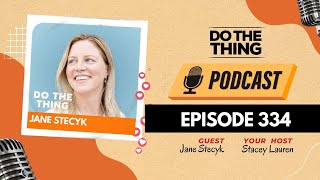
Jane Stecyk from Mighty Networks explains why communities built on member-to-member relationships outperform content subscriptions. The platform uses AI to match members and reduce friction in introductions. High-performing communities center on a shared transition, like going from employee to entrepreneur, rather than just a niche.
Chapters
Hey, everyone. Welcome to the do the Thing podcast. This is your host, Stacy Lauren. Well, you guys, this is exciting as doing community building and community activation for so many communities now. I've been able to really kind of see the companies that are out there that are doing it really well. And that's been one of the goals that I've had for the last few months. Now that I have my whole kind of community activation, comfort circle framework all dialed in. And I've decided that the challenges and these my people party that I do are the key to helping people connect online and in person. And one of the big things I've been looking for are people that are really aligned with that mission and that are helping people in really unique and different ways. And guess what? You're going to meet her today. So my guest has already been on a Do the Thing expert panel. We had a Find My People expert panel and she was one of the experts. So I've already gotten to see her Zone of Genius activated and also might have binged some of the videos that I've seen on her platform. And she just constantly is so good at being able to help you understand the importance of how community fits into business and then also from internal activation inside of people actually just getting to know each other in a really cool way. And I love how she talks about how AI can actually connect people and not replace them and really understanding the importance of that. And she is the VP of Lifecycle Marketing for Mighty Network. So I'm so excited to introduce Jane to the show. Hey.
Hello. Hi. Thanks for that intro, Stacey. I'm stoked to be here. I love to eat, sleep, breathe, talk about community and how we make it better, stronger, more resilient and just that more people have more communities that they're excited to be in and foster and party with. So let's talk about all of it. Yeah.
Because I think a lot of people get confused about community and what it is. Especially I wonder. Oh, sorry. I'm going to go on a rabbit hole right now because there's people that think their email list is their community or their Instagram is their community, and they don't understand that. It's. It's like private community is where the activation really happens.
Yeah. I would add to that. I think if that's what you love to do, go for it. There's lots of people who are like, I have a thing I need to put in the world and I want people to hear about it. To me, that's your email newsletter and it's great. And I'm not saying that you can't have connections kind of forming, but in general, I don't think me reading your incredible newsletter over here in Nova Scotia and then someone reading it in Oakland, California, I don't feel like we're in a community together, but I love all the ways that people are putting their thoughts out there. When I think about community, it's really. Sure, you may start it as the person who's bringing people together, but ultimately it's about those ties between your members, those interactions between your members. At Mighty, we call that people magic. And that not only makes community more fun and less work, because it's not about you producing something every week in the way an email newsletter is, but it also.
Is just a more valuable business because I can get content anywhere. The relationships I form in a community, that's priceless to me. So it's like you're able to help me have those relationships. That's in a different category of what I'm paying for in a private or paid community than a content subscription. Right. Which I think people sometimes equate those things and it gets a little murky, but once you really think about it that way, it's. It's a different ballgame.
Yeah. It's so good the way you're saying it, because there's so many people that think they just need to keep pouring out more and more content, and that's supposed to activate or engage. Again, like you said, there's a time and a place for that. But if you're specifically looking to engage people now, you want to create a safe space for them to connect, for them to become friends, for them to get to know each other, because that's when everything goes to a whole other place.
And I even think. I even think framing it as a safe space is limiting in some ways because I know people, myself included, I want a place where I'm challenged, right? I want a place where I'm pushed to be better in certain ways. And then I also want my cozy place that is safe, where it's not a source of making me better, but I have really strong relationships there in a different way. I think in all cases, we've all had some limiting views of community, maybe shaped by social media, right? So when I think about social media and the hellscape it has become for many today, pardon my French, I do think about, okay, so community would be a safe space, but I actually think there's expansion in what community can be again, it can challenge you, push you A new direction. It can really stretch you. It can be a place where you're not meeting people just like you, but you're meeting people who are different in the way you need to be challenged. Right. It can be kind of anything. It doesn't just have to exist as counterpoint to what social media has become. I got a lot of opinions about community, as you will find in this interview.
Yeah. So tell us about people. Magic and Mighty Networks too.
Yeah. So Mighty is a community platform. And our leadership team, specifically our CEO Gina Bianchini, has been obsessed with community for many, many years. She started a company called Ning, basically pre Facebook, that was allowing people to make their own social networks. So a really similar idea of you want to bring people together around something and you want to be the one who's kind of defining what that is and what the rules are and what you're going to do together and how you're going to play together and events and giving people that kind of customization and control. So I bring that up because Mighty Networks, in many ways is the natural evolution of that original company name. And we have incredible software that not only enables you to sure, have a place for your content, right. If you have a course or you do events or you post a blog, you can have it in a mighty network, but more importantly, have a place for your people and introduce them to each other. So we talk about this idea of people magic. It's both a philosophy of how we think about community. Community is about real people interacting with each other, but also how we built the software using advanced technology, using AI, which I know we're going to talk about, to help the most relevant people find each other. Right. So if I'm in a Mighty network and I'm browsing the members, I'm going to have a different experience than you are in the same Mighty network with the same members, because it's going to be saying, hey, Jane, you have this in common with Lisa. You guys could talk about this. Do you want me to help you break the ice? And you might have other things in common with Lisa or Tom or Jodi. Right. You're going to have a different experience and we're both going to come out of it with different connections that are going to be the most valuable to us. So it's really exciting to see where the technology can go from just a place to house content and sure bring people in to know it's about the people that might come for your content, but they're going to stay for the community.
So is that how you're using AI to help enhance the relationships?
Yeah. Yeah. I mean, of course we think about AI expansively because I think there's lots of applications. Right. When you think about how big of a technology that is. But I think where a lot of that conversation is today is how can AI replace people, for lack of a better word. Right. Or compliment them. But then you start to see that line encroaching. Right. And there's lots of places where I think AI can save people time. Right. If you want to create content, sure, it can give you a first draft, but ultimately, if you want to bring people together, maybe it's just me, but I don't really want to spend my time in a community talking to a robot. I want to talk to another real person. But if AI can help me find the right real person to talk to and make that first introduction a little less awkward and maybe say, hey, looks like there's a lot of people in this community, in this area. Do you guys want to host a meetup? Here's where you could do it. Here's a time that's kind of the work I'm really excited to have technology do, so I can just show up to the party and hang out with real people I'm interested in.
Wow, that's so exciting. And then one of the things that came out of the expert panel that you had shared, which I love, is you had mentioned how important it is as you're finding these spaces to connect, is finding people that even have gone through a similar transition. And I'd love to maybe have you talk more about that, too.
Yeah. This has been a breakthrough for us and in how we teach community. So not only we make community software, of course, but we're also deeply passionate about whatever software you're using. How are you successful in bringing people together, scaling your community and creating a great experience for people and getting your members talking? So there's a software, but then there's just a strategy of how you think about community, which is a pretty hot topic these days. Many people, community experts, talking about, well, you got to do this and you got to do that, and it can be confusing. Right. There's a lot of different frameworks or approaches.
So we took the time to think about, okay, how do we really distill this down and make it so simple based on all the data we have about successful communities and what makes some successful and some not? Because of all the hundreds of thousands of communities that have been on 90 and this idea of a transition was really a breakthrough for us because so many people think when you're starting a business, and I think a lot of this came from starting a content first business. It's like, what's my niche, right? If I'm going to make a lot of content, how do I make sure I'm making content for the right niche? And I think that makes sense in a content heavy business model, right? If your course is really specific or your newsletter is really for like a key Persona, you might have a better way of marketing it. The difference is when you're marketing a membership, it's not about a specific niche necessarily, because people are joining a community.
To go through a transition, to go from A to B, because that is what a community is best at. If I just want to hang out with people, I got my girlfriends, I can poke around on TikTok, I can entertain myself and hang out. I've seen, I can't even tell you how many WhatsApp groups, Discord communities that have totally flatlined because they're just like, this is a place for us to hang out. I'm like, well, what am I really getting out of this, right? So our breakthrough was actually if you really focus on the transition. So this is a community for first time female entrepreneurs who are looking to raise their first round. That's a really clear, okay, I'm here and I want to go here. First time parents of twins who want to someday sleep eight hours. Very clear transition somebody is in. And when you really start to think about it, there's infinite transitions that people go through. And it's those moments when, oh my gosh, you're up in the middle of the night and you don't even know what to Google. You're like, how do I navigate this? And that is when you're like, I really wish I had a community. And maybe there's some people who are a half step behind me and maybe there's some people who are a half step ahead that can kind of help me navigate this and get to the other side. And when you orient your community around a transition, it's much easier to explain and market and get people excited about because it's not just a place to hang out, it's really a place to navigate this transition they find themselves in.
It's so cool because one of the things I do with the communities that I'm helping build, it's like I have them do a challenge based on a goal and then I have this formula that is powered by but it's like the Challenge has a goal. But when I think about all the challenges that I've had, my dating challenge or my startup podcast challenge or whatever it was, there was always some kind of transition that was happening in the life, whether it was divorce or business change or whatever it was. And so I think it's a really powerful way to look at it because then you're connecting specific people to whatever goal you're wanting that activation to happen with.
Yeah. And can I just say, a transition can be. I don't have a podcast and I want to have a podcast. It doesn't have to be an earth shattering moment though. Those are great for communities. Oh my gosh. Yeah. It just has to be a clear, like I'm at A and I want to get to B. And when you start thinking about it as, again, as I said, there's infinite possibilities. And maybe if someone's listening to this, they're like, oh, I spent all this time defining my niche. I bet if you sat with it for an hour, you could think about 30 transitions that really relate to the work you've already done. So it's not that that work to niche down is useless. It's just take it that level further and dial in the transition if you want to add a community component because it really, we found it makes a huge difference in marketability and clarity for you as the host of the community of how you're going to kind of run this thing.
And so I don't remember the exact phrase that I've seen on the emails, but you guys are the home of a lot of different million dollar.
Yeah, the most $1 million communities. And it's funny because of course we have people who have large audiences. I'm thinking about Amel Robbins or a Marie Forleo. But when you look at how we have worked with them to set up their communities and the principles and the formula, it all comes back to this idea of people magic and these nine steps that can get you to a million dollar community. So there's not this secret sauce of hey, guess what? The secret to a million dollar community is to have 10 million followers. Wouldn't that be. That'd be a letdown. But it's just about how you create a community.
More from Stacey

From 262 Women to 8 Million Media Impressions: Deborah Drummond Built a Global Women’s Movement


From Notes App to Published Author: Avery Brenna Crumrine on Turning Intention Into Action


How Stacey Lauren's Billion Dollar Impact Marketplace Will Raise Billions for Charities and Causes

What Happened When Allison Maslan of the Pinnacle Global Network Ran a Challenge with Stacey Lauren




Leaders Share How Stacey Lauren Sparks Action, Clarity, and High-Impact Collaboration

Sandi Masori Announced as Emcee | The Billion Dollar Impact Event Returns to San Diego