YouTube Channel: @dothethingformula
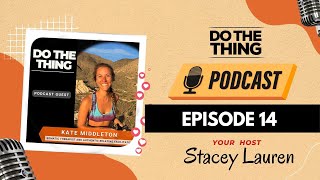
Somatic therapist Kate Middleton explains how your body naturally seeks balance and why noticing physical sensations matters more than thinking your way through problems. She shares practices like body-feel anchors, befriending your inner critic, and five-minute movement sessions to help you stay present and actually do the things you want to do.
Chapters
I do really believe 100% from every part of me that everyone has the.
Capacity to be able to do the.
Things that they want and not to be held back by the mental baggage that's in our head that we want to push through.
Welcome to the do the Thing podcast. In each episode, we get down and personal with people who go after the things they want to make all their wildest dreams come true. Join us as we unveil and dissect a formula for what it takes to do the thing. Here is your host, Stacy Lauren.
Hey, everyone, this is Stacey Lauren. Welcome to the do the Thing podcast. I'm so glad you guys are here today, so you're in for a really special treat. I have the third expert of her expert series, and it's been kind of interesting how this podcast has worked because it's been so natural and honestly effortless in terms of getting guests on the show because everyone's sort of just coming to me in the time that I need them to come. As you guys know, or if you're starting or if you're here new for the first time, I'll at least let you know. We've had 10 interviews so far, and through the 10 interviews, I've seen these parallels of the patterns of different things that people have said, help them do the thing. And I just felt moved to be able to have some of the people that I've been working with directly come on the show because I know they've helped me immensely in order for me to be able to do the thing. And I thought it would be really cool to have them be able to speak to you about different techniques that they use to help you do the thing. And so it's been fascinating because I've been working with the three experts that I've had on, and I didn't even realize this until I interviewed the one yesterday. And each person I'm working with has a different strength. So the one that I interviewed, the first one I interviewed, Dr. Dan Drote, she got a PhD in clinical psychology, and her emphasis was in spirituality, so she was the spirit. And then Yesterday I interviewed Dr. Case, who specialized in the brain, and so she was the mind. And then today I'm interviewing Kate Middleton, who is a somatic therapist, and she's the body. And so that was like, really, it was really weird when I realized, like, oh, wow, I did that, not even on purpose in my own life, that I actually interviewed. I'm interviewed. Like, I'm working with people that have. Are helping me with each of these different areas in my life. So, anyway, I just think that's really cool, and I'm excited that you're going to be able to meet them all. And I'm really excited about you guys being able to meet Kate. She's actually the missing piece to my puzzle in my life, to really be able to do the thing, just feel better in my body and be able to work through different things. I met her at an authentic relating training. For those of you that don't know, authentic relating basically helps you get deeper connections with people, and they give so many different amazing strategies. And she was the practitioner at the training, and she was unbelievable, or is unbelievably gifted, but that she created the space for all of these people to connect on such a deep level that had just met, and it was really amazing, especially when you can get people from all different walks of life together to be able to really get to know each other on another level. So it turned out that she's also a somatic therapist. So we got a special treat by being able to also do somatic therapy while we were at the training. And for those of you that don't know, we'll get into what that is when Kate's talking. So I'm so excited. And so, Kate, hi.
Hi. Thank you for that intro. And I love hearing about the parallels and the synchronicities of the guests on your podcast so far.
So for everyone listening, can you just start off and tell us about your background and a little bit about your story?
Yes, absolutely. So I. I got into these realms of self inquiry and human connection and personal development a very long time ago. But my introduction was through yoga meditation, and I went into that in a very deep way and studied with many teachers. And then I even started my own center in Indonesia. And at some point I realized that I was good at the solo journey. I could do the self practice, the seated meditation. I was good at being on my own and applying these spiritual teachings that I was learning. But as soon as I was in relationship, then I didn't have the tools and I couldn't really translate my personal practice into relational practices. So I realized I needed some extra help. And that's when I found authentic relating. And in the authentic relating, I realized that that was kind of the yoga of communication or the yoga of relationship to a degree. And as I was studying authentic relating, I realized that in order to be in relationship to yourself and to another, you really have to be in your body and be able to feel your body and express and articulate those feelings. And.
I thought that I was deeply connected to my body because I was a competitive athlete, But I actually had just learned to override a lot of sensation. And my relationship to my body was based more on endurance and determination and grit. And it didn't leave a lot of room for sensing more deeply into myself.
And so then I went seeking in the somatic sense. I went to study somatic therapy and I found all of these parallels between authentic relating and somatic therapy. And another way to say that is embodiment practices. And since then I've been figuring out ways to tie the two together and to create some sort of a practice and a process that helps you to land more deeply into yourself and bring that out and forward in your relationships and the world.
Yeah, and I think that's one of the most amazing things that I've noticed with our work together is I was originally when I asked to work with you, like after the training, and you were the practitioner for it, and I was thinking we were going to work a lot on authentic relating, but it turned out we sort of started with the somatic first because it, it was needed in order for me to be able to authentic relate even better.
Yeah, absolutely. Absolutely.
So for people that are brand new to just even concept of just therapy or yoga or somatic and all that stuff, can you give, and you did give like a high level explanation, but can you give like a, like a really descriptive explanation of what somatic therapy or embodiment experiences and what that looks like?
Yes. So I'll start with the word somatics because that's often unfamiliar for people. And somatics comes from the Greek word soma, which means living body. And the work of somatic therapy was born from humanistic psychology. And there were certain psychologists who realized, like, I keep talking to my patients and noticing these things happening in the body as we're talking, as if the body's wanting to speak that the patient maybe wasn't even aware of. And then they started to get really curious and go into those movements and into those sensations and found that the, that's where the, the story lived and the healing. And so essentially what somatic therapy does is it allows you to feel into what is already happening in your body and it creates the environment so that your body can find its way back to balance or homostasis. And in somatics, we believe that in the right environment, the body, our bodies will always want to return to balance and that there's this concept called organicity in Somatics, that means that we are born to know how to get back to the place where we live most efficiently, most optimally, and. And to a place that actually feels good inside of us. And in Somatics, there is no split between mind, body, and spirit. There's a belief or an understanding that there is as much intelligence and awareness in your little toe as there is in your prefrontal cortex. And that if we spread more and more of our awareness into the whole of our body, we can connect to deeper layers of our intelligence, of our authenticity, and essentially of our pleasure and joy of being in the world.
That doesn't mean we're just doing interpretive dance or pantomiming a whole session. There is talk therapy woven in there because we are humans and we love to learn from stories. So I do believe in the importance of talking about, but I believe in the importance of talking about experiences that include the language of the body. And so, essentially, Somatics is bringing the body to the forefront and turning attention to the places that often get ignored and often hold the deepest truths.
And what would be an example of someone that's not in balance? You mentioned somatics helps you return to balance.
Yeah. So a sign of being out of balance might be feeling that you're always in your head, you're always thinking and not feeling so much, or you feel disconnected from your body. And that. That, to me, is not wrong or bad. It's simply an adaptation to life. And life these days requires more headiness than in the past. But it is a limitation because. Because your feelings are your intuition, and intuition is life affirming. So if we go by what the body wants, the body will always lead us in a direction that is life affirming. But it is a practice to slow down and learn to feel and learn to trust that, because it's a very different style of it's feeling into rather than thinking about, let's say, in terms of decision making. And it takes some practice, but that's an example of. Of being out of balance and then using the intelligence of your body to come back into inner and outer alignment.
Yeah, I think that's a really great example. Definitely. And especially people listening to this podcast. I mean, potentially I'm making an assumption, but potentially, you know, it's the high achiever types that are just, you know, go, go, go, go, go. And that's kind of where I was at. It just sort of got me into this thing of just being really disconnected from my body, because I was constantly just going Achieving, you know, and doing all these things until I finally slowed down for a minute and I was like, whoa, what's going on here?
Mm. Mm. Yeah. And there is a way that living like that allows you to get a lot done, but it's at the expense of burning out or losing connection to yourself and your needs. And.
I believe in having access to both. So I think there's a lot of talk about as if being a thinker or a doer is a bad thing and that you should just be more in flow and more in touch with your emotions, which is great. But if we are one sided, then it creates challenges in the other areas of our life. So I think having access to both is ideal. But for most of us, we're raised in a way and in a society that really values being in your head or thinking and not feeling. And so there is remembering or a learning process that has to happen in order to come back down and into yourself.
Yeah.
And so what would be a couple of good ways that someone could use somatic therapy to help them, you know, embody that?
Well, the beautiful thing about somatic therapy is it's based on what we do naturally, given the right environment. So it's all really simple. It's not complex technique. And so, for example, something that I like to get clients to do is write out a list of places where they feel in their body or connected to themselves and people who they feel connected when they're with or connected to when they're with. And then to use that, it's like you're gathering data points to recognize, like, okay, when am I in my body? What does it actually feel like to be in my body? How can I start to do more of that and become more aware of those moments? And then naturally you'll become aware of what takes you out, and then just that awareness will give you more choice. So that would be one way. Another way is changing, is making a commitment to change your self talk and to cold turkey your inner critic and self shaming about your body and body image. Because it's really hard to be in your body when you shame your body. So that's another way. It's like, okay, how can we shift the relationship so that you're coming from a place of compassion and acceptance? And that might take some time, but I do believe that that is an absolutely necessary foundation to the somatic process. And the great thing about that is it ripples out into the whole of your life once you start to think of yourself more highly or speak to Yourself more compassionately that transmits and other people feel more relaxed and accepted around you.
Okay, so with the first thing that you said, making a list of the places where you feel the most in your body. Sorry if I'm having you repeat certain things, but I just want to make sure it connects with people that are brand new to the language. And I know you just explained you know what being in your body means, but can you give just another, just an example of how does someone know they're in their body versus their head? Like, what does that mean?
Yeah, it's a great question and a great starting place. So I. Most of the time when we're very relaxed and present.
You can just assume.
You'Re in your body.
Let's say you are having a nice bath, listening to some music that you like, and you have that deep sigh, that feeling of, oh, this feels good. Chances are you're in your body because that's your natural resting place and there's nothing in that moment that's taking you out. So if you do consider the places where you feel most you, or you feel relaxed and awake, relaxed and aware, then you're probably in your body. That is an assumption and it might not be true, but most of the time it is. Another way you can think of is when you're in some sort of movement where you can feel the movement happening and you feel the circulation. Maybe you're sweating and breathing heavily and it feels good. Those are ways to really get in your body. One of my go to ways is running because I love to feel the stomping of my feet. Hopefully it's not stomping, it's more light strides. But I can feel my foot strike on the ground which ripples through my body. And I can really feel myself when I run. That's one of the reasons I love it so much. For other people, it might be when they're gardening or they're dancing or cuddling their dog or something. But there are things that we do where we move our body and can become more aware of ourselves in doing so. I think being in the body will feel different for everyone and we all have our own resting place inside of our body. Like if I were to say, if you feel into your body what feels most like you, or how do you know, what do you feel that makes you know you're in your body? So I like to take these somewhat abstract concepts and bring them into the tangible, into the physical. There's a lot of ways we talk about being ourselves and being authentic in Order to be more yourself, you have to feel more of yourself. And so the somatic process is much about that. And my starting place would be like a meditation where you pause and feel inwards into the sensation in your body and you notice what feels like home, what feels like you, what place or part in you can you just rest into. So for some it's their heart that seems to be an access point for a lot of people. For others it's more their, their core. For some it's their spine, or maybe it's more energetic and it's the third eye. But I believe we all have these parts and places within ourselves that feel like home. And, and the more we connect to them, the more we want to and the more we can start to be guided by the wisdom within.
So now they have an idea of what it feels like to be in their body. So they're going to make the list of the places where they feel most in their body and then the people connections that make them feel most in their body. And then is that just so then they can do more of that or is there something else that that helps too?
Yeah. So by bringing awareness to it, it's sure you can do more of it, but you can also start to notice the more subtle nuances of. Okay, what does it actually feel like when I'm in these places and when I'm with these people, what in me lights up? What in me is turned on or activated by this experience? What in me opens to life and what in me closes? And essentially at the core, if we're to way simplify, at the core of the sensations themselves there is oscillation, which is contraction and expansion. And that can become a deeper inquiry or question of what opens me up and what closes me down. And that's essentially what you're becoming aware of in your relationships and the things that you do so that you can move towards more of what opens you up than what shuts you down.
Yeah. So just that idea of being able to acknowledge of when you're doing certain things or with certain people feels good. It sort of just brings awareness to that concept. So then you're, it just makes you live a more embodied life.
Exactly. And I, I believe that that's where flow state happens. That's where our creative genius lives. That's where we can do the thing from is this place of inner alignment.
Yeah. And that's great. You use do the thing. So I love that.
And I wanted to ask you, I.
Wanted to talk more about the inner critic, but Now I'm like, oh, man, now I want to stay on, do the thing.
So we'll go back to that.
But I love that idea. And that's exactly why I wanted you on, because I know that that's exactly how, like, this is the key to do the thing, because you don't want to do the thing that doesn't come from within you. Right. And so fall into that mistake, especially with all the access we have with social media and different pressures, you know, and it's easy to fall into someone else's thing and not our own thing. I've noticed three or four people that I've interviewed so far have mentioned the inner critic. And so I love that you mentioned that too, because that's a piece of the formula is getting to know that dude.
And it sounds like from what you were saying earlier, a big way to overcome that is doing something self talk. Can you kind of go into a little bit more about what would be helpful with that?
Yeah, absolutely. So I think it's important to learn how to be with all parts of yourself or all aspects of yourself and get all of these very different parts on board so that it's a lot easier to do the thing. And one of the parts that makes it or that kicks up the most fuss when we're going to do things is the inner critic. In ifs, or internal family systems therapy, it's called the protector or a protector part. And so the idea is that the inner critic is really just trying to protect you from extreme experiencing something painful or.
Hurtful.
So it's on your side. It's actually trying to help in a bit of a roundabout way. And the way inner critics or protector parts respond, the way in my experience of working with them myself and with clients, is through respect and recognition. They want to be validated and respected. Or this part, this voice, needs to be heard, needs to be heard. Not taken literally, but it needs to. It needs time and attention. And so the practice is turning towards this voice and getting to know it, having a conversation with it, so that it's not an inner argument, but it's a curiosity and an inquiry of, oh, okay, so you're pretty loud right now. What is it you're trying to say? What is it you want me to know? What is it you're protecting me from? And then you can let that part know that your now adult self is pretty capable of handling the things that it's afraid for you to experience. And in a way, you soothe that part so that it can calm down doesn't have to protect so much and get on with doing the thing. So it's, it's really working with these voices and these parts and reassuring essentially that. Reassuring these parts of you that you're going to be okay. That it's going to be okay.
Yeah. I actually love that outlook because I think it's so normal to want to just turn it off and say go away. And then I think that makes it louder or it gets it to go away, but it's still in your body somewhere and you haven't gotten rid of it. So I think it's. It's cool that you're almost befriending. Befriending it in a way and then asking yourself those questions. And I love that term of what it. What are you protecting me from? Because that's not being judgmental, you know, to it. It's like you're kind of like almost thanking them, you know.
Yeah.
For doing it. And so then, you know, it sort of gets you to. To hear more what. What you're saying, essentially.
Mm. Mm. Absolutely. Absolutely. And I think that the, the practice of like just a pattern interrupt or let's say working with affirmations that say the opposite of what your inner critic does, it doesn't really get to the root. It doesn't get to the core of that. The heart of that voice. And something that can help is a check in of. Is this really my voice? Because usually they're beliefs that we've taken on at a young age from primary caregivers or maybe teachers or culture at our school or just in general. And it's not really our truth. And if we sit with it and try it on, those things that we say to ourselves, they, oof. They feel pretty harsh and not that true.
Yeah. I think that's interesting that a lot of times that voice isn't coming from you. It's something that you've heard or believed about yourself in the past. And so by you connecting more to it, you're getting to see where it came from, essentially. So what do you think? And I give. I gave my. My thoughts on why. I think somatic therapy helps you do the thing. I'd love to hear it from you. Like, what do you think are the biggest benefits to, you know, taking this on? And you. We could talk about authentic relating too, because I do think they're both connected, but I just wanted to kind of get your thoughts on it as well.
Yeah. So.
I believe that doing the thing is a lot easier and a lot more fun. When your body's on board and you can think your way through things and will yourself through things, but that's not where you tap into flow or into the well of creativity that feels nourishing and exciting and enlivening. I do believe that it comes from bringing your body and the whole of yourself into the experience.
For example.
We are living, breathing, moving beings. We need to move, we need to breathe, we need to circulate. And when we are circulating freely physically and mentally and emotionally, there's a lot of room for ideas to come through, for.
Creative projects to gestate and for us to create. And if there's not, the opposite of that is stagnation, which results in. In exhaustion, in pain and doubt, and in procrastination, actually. So I see bringing the body in as. As imperative for longevity in any creative endeavor.
And.
It seems hard, or it can seem hard because it's often the opposite of what we've been trained to do. But once you start to tune in more, to check in more with yourself and with your body, and bring more movement into.
Your thing that you are doing, I think that that in itself will be the reward. It creates more flow and more productivity and more pleasure, essentially. Without that, without that loop, then it's like there's no bidirectional flow and we burn out. So I think there has to be a tuning into your body, feeling into your body, moving your body. And the creative act or the doing the thing is just expressing from there. Yeah.
So what do you think would be something like a good. Let's say someone only has three minutes. Maybe we can give it five minutes. I think everyone can swear five minutes. Just a good five minute everyday practice that someone could do to be able to really embody these practices that you're talking about.
So my favorite one is using music, because music invokes feeling and you can go with a theme based on what you want to do and how you want to feel that day. But playing a song and just letting yourself move to it without thinking, without making up a move, without trying to match the beat, you just allow yourself to be moved by the music and therefore to move. And you're creating a clear pathway for life to flow in and out of you by doing that.
The premise of Somatics is that every sensation comes with an action. And when the action is stifled or the movement that goes with the sensation is stifled, it gets stuck in our body, gets lodged in our tissues, and that leads to build up of that energy, which is stress or is pain and so by just playing a song and letting yourself move to it, you're remembering how to allow for that flow of stimulus comes in, expression moves out.
You know, I think it's so, it's so powerful when you can do something like that because sometimes like you think you only have five minutes, but when you start to do something like that, I mean, sometimes that's all you'll do and then you're done. But other times that kind of leads into a whole nother level of things because you're, you're feeling more open to whatever's next.
Mm, yeah, absolutely. Absolutely. And it usually feels pretty good. So you tend to want a little more of it than you think you do before you start.
Yeah, definitely. So, okay. The other thing I wanted to talk.
About, and it's funny, I didn't even.
Know I wanted to talk about it until we're talking now because as we talked earlier I was like, I don't really have a direction on where this is going other than I know what you're. The work that you've done with me has helped me so immensely. And like I mentioned in the beginning, it was literally the missing piece to all this work that I've been doing because of that body connection. So that's been incredible. But I'm remembering, as we're talking today, I'm remembering at the, at the authentic relating training you had said at the very end it was like a two day training and what is it, like.
12 hours or so? I don't know.
It was a long day, it was.
A long 10 hour stay.
And it.
Was the end of the training and you had asked us to get into these groups of a nourishment pod and you called it a nourishment pod and it was like a group of six and everyone basically had to like say something that would help that the other people had to do to help nourish them. So I was in a group of six and one person asked for a gratitude circle and she wanted everyone to go around and say, this is what I'm grateful for and this is why I'm grateful for it.
And it was amazing because most people.
If you do something with gratitude, it's usually, you know, like, this is what I'm grateful for. But I think the why really like just added another level and then another person. We did like an appreciation kind of thing where we went to the person next to us and we got to say, you know, this is what I really appreciated you about being here at the training with me. And it was really cool because, like, you don't know these people and you've only spent two days with them, but you're already able to think, oh, wow, like, this is what I really learned from you. And so each person had something they said. And I remember I like, couldn't think of anything, you know, and so it was like I didn't know what nourished me, you know, like, I couldn't, I couldn't access that. And so I think that's been. And I. And I think that's a lot of.
People, you know, I think to take.
The time and actually. Okay, so let me reframe that. I know I knew it nourished me. I've done enough work to know it nourished me. But I couldn't think of what another person could do to nourish me. And that was, that was a big shift for me, realizing, like, you know, I could have some help, you know.
So I thought we could just talk.
A little bit more about that. And I don't know, like, where that idea came from and how you knew to do that. Because I went from being really tired, you know, by the end of the training was amazing and beautiful and wonderful. But that last hour I was like, okay, I'm tired, you know, and then that completely just brought up a whole nother level of energy. So I just thought we could talk a little bit more about that concept.
Yeah, yeah, I love that you bring that up. And it was also a huge learning for me. And I think one of the reasons I came to authentic relating was because.
I had lost touch with my desires and needs and really forgotten how to speak them or request, make requests essentially and let someone else in on the experience of meeting the need. And so I think that we are all needy. We all have needs. And so many of us have been raised to not be needy, don't be needy. As if it's some shameful, horrible, low thing. And I think it's just a human thing. We all have needs, we all have desires. And the more explicit we can get with them, the more we can actually bring them out into the open and give others an opportunity to meet us in the meeting of our needs. The more room we have to be in relationship, because relationship is reciprocal. And if you're only ever giving and pleasing and catering to other people's needs, that's not really relationship. That's one directional, which is not relationship. To me, relationship is a back and forth. And so I think it's imperative and.
Especially for those of Us who have been in, say, nurturing, in a nurturing role in a relational dynamic, be it family or otherwise. The familiar way is to make sure other people's needs are met. And we lose touch with what we're even needing or wanting. And we lose touch with the possibility of other people wanting to support us in the meeting of our own. And I'm all for putting out there what you want without the expectation that it's going to get met. It's like you just plant the seed and then maybe it's you who waters it and maybe it's another. But it doesn't really matter as long as you're speaking to it.
What do you think? Because I want to be able to bring this nourishment pod to real life.
What do you think are some ways. Yeah, what do you think are some ways to do that?
Yeah, I encourage that. And I would set it up like an experience or a game of sorts. And you can be really explicit and say something like, hey, I did this thing on a training I was on recently and it really impacted me. Do you want to try it out? Maybe you need to give them some more information.
It's about nourishing ourselves by speaking our needs and inviting another into an experience.
And I want to do this. I would start with your why? The reason I want to do this is to feel more connected to you, to feel like we can support each other in more and more ways. And so you know that I'm here to help you in your nourishment too, or something like that. And then you lay out the rules of the game of. So let's each take. Let's say we have 15 minutes each for this and think of what you really, really want, go for what you most want, and then we'll have a conversation about it and see if we're available for that. And if not, we'll negotiate to a degree and see where we can meet in the middle. How does that sound? So I would set that up. If it's like date night with your partner or if you're hanging out on a Sunday with your kids or with your friends another time, I think you can use it pretty much anywhere with anyone.
Yeah. And I think the thing that I really like about this is especially for the people like you mentioned that are the givers, you know, and.
And don't.
And aren't used to asking people for things. It really lets you use the muscle to practice asking it. And so eventually you might not even need it in a game format. You Know, the game is really just the tool to help you learn how to use that muscle, but it does create the space. So I think it has a lot of benefits, but I think it has even more benefits once you're, you're getting used to that practice.
Absolutely. And it's probably too much to go into right now, but it really relates to attachment styles as well and is a great way of.
Working with anxious attachment styles and learning to speak your needs more in relationship. I'll just drop that in.
That's a good nugget.
That's really good.
Okay, so was there anything that I didn't ask you that you wish I asked you?
Hmm.
Let'S see.
I'm thinking it's something around how being more authentic or even being more in your body allows you to do the thing or to really do what you set out to do. And I'm thinking specifically around authenticity because I know that there are some big names in the world, big creatives in the world who say like, you can either be professional or you can be authentic. And I.
I like to take a stand for you can be both. And in order to be professional, it has to be authentic. That's my belief. But authenticity doesn't mean lacking integrity. I think that authenticity by nature is integral. That's something I just like to bring into.
What do you think gets in the way of people doing the thing?
I think it is self doubt that has been taken on, internalized from other past experiences. And I think the antidote to that is getting on your own side, being on your own team, and really getting to know what the doubt, the hesitation, the fear, the procrastination is all about. So you have ways of working with yourself and supporting yourself through that. So that's the main one is recognizing, okay, what comes up in the face of challenge and how to be with that and move through it. And then the other one is that we are communal beings, we are wired for connection and it's too hard to do it alone. So what support can you bring in to help you in times of need? Not to build dependency on others, but because by nature we are, we are built for being in it together and we are built to regulate through another, through connection to another. So those would be my two things of being on your own team and then also having people on your team.
Yeah, that is really great. So for those people that really want to learn more about you and what you're doing, what's the best way for them to find you?
I am most active on instagram under Kate Middleton Yoga at Kate Middleton Yoga. And I have a website too. People can reach out to me if you're listening. You are so welcome to reach out and I I genuinely love to get to know the human behind the pixels. So if you are curious or you do want to say hi, or you have a question or a comment, please reach out and say hello. And it warms my heart to connect with other humans through these mediums.
Well, thank you so much for your time today. I am really grateful for you and the work that we've done together and really thankful that you were able to come on today to talk to me and have everyone be able to learn more about this.
Absolutely. This has been a lot of fun and thank you for bringing this out into the world. I'm. I'm glad you're doing the thing.
Thank you.
Thanks for listening to the do the Thing podcast. We hope you enjoyed the show. But even more, we hope you'll be inspired to do the thing. Do you have a burning question on Doing the Thing that you'd like answered? How about an inspiring do the Thing story of your own that you'd like to share? We'd love to hear all about it. Just leave us a voice message at dothothing callcast. Co or email us at hello at dothethingpodcast. Com.
More from Stacey

From 262 Women to 8 Million Media Impressions: Deborah Drummond Built a Global Women’s Movement


From Notes App to Published Author: Avery Brenna Crumrine on Turning Intention Into Action


How Stacey Lauren's Billion Dollar Impact Marketplace Will Raise Billions for Charities and Causes

What Happened When Allison Maslan of the Pinnacle Global Network Ran a Challenge with Stacey Lauren




Leaders Share How Stacey Lauren Sparks Action, Clarity, and High-Impact Collaboration

Sandi Masori Announced as Emcee | The Billion Dollar Impact Event Returns to San Diego