Boldin Your Wealth with Jackie Cummings Koski from Catching Up to Fi (ep. 89)
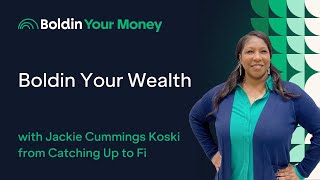
Jackie Cummings Koski reached financial independence in her 40s after divorce and single motherhood. She started Catching Up to FI, a podcast and Facebook community for late starters, Gen X, divorcees, and immigrants. The focus: mindset, basic saving through 401ks and Roth IRAs, investment clubs, and index funds like VOO.
Chapters
Welcome to Bolden your money. Today we have, well, we were supposed to have two guests, both Bill Yount and Jackie Cummings Koski, who are co hosts of Catching up to Fi, which is a podcast dedicated to helping late starters take control of their money and build towards Fi. So unfortunately, Bill, who's an emergency room physician, had a last minute cancellation, so he can't join us, but he'll get to watch this after the fact. So. But super happy to have Jackie here who has kind of gone through her own journey. She reached financial independence in your 40s, it sounds like. And I'm sure we're going to hear this story after overcoming poverty, divorce and single motherhood, which I appreciate being raised by a single mom and they've both, you know, gone through their own challenges, but kind of, you know, reached Fi. And so. And with that, Jackie, really happy to welcome the show and glad you're here.
Well, hey, Steve, I'm honored to be here and on behalf of my co host, Bill, we are glad to be a part of the show and thank you for shining the spotlight on the what we're doing with late starters in catching up to Fi.
Yeah, no, it's great to have you here. I mean, I know that your podcast has gone through kind of really significant growth. So in the preamble we were talking about how you're filling a niche. We'd love to hear more about, kind of like why you started the show and kind of how you found that, that audience.
Yeah. So Bill Yount, like you said, he's an ER physician and he got a late start. So did I. Now Bill was the one that actually founded the show, but he was already starting on his transition from towards like waking up to five, you know, I guess there's another show name, but he started waking up around 50 years old. And even as an ER physician, you know, it's, it's a high income role and all of that, but it's not just about what you make, it's what you do with it. So he's been very transparent and very open about sharing his story, how, you know, he was a single digit saver, knew he was behind and it was, he was 50 years old, finally decided to do something different. For me, it was very similar. I was a little bit younger, So I was 38, but it happened after a divorce, so, so it was a situation that happened that actually woke me up. So we've been friends for a long time and he decided, he, we both knew that there was a big hole, a big gap when it came to Gen Xers, people in their 40s and 50s, but also people going through a circumstance like divorce, death of a spouse, maybe even immigrants. There was this big group of people that weren't being served in the FI community because most of the stories you hear are what, like people retiring at 35 or people retiring at 30. So he decided to do something about it and that's when he started the podcast. But along with that, he started a Facebook group, a Facebook community, a place where late starters can come together and start supporting each other and actually making a difference on their journey, even though they started late. So that was sort of the beginning of the show and the reason why it was created in the first place.
Got it. So when, when did your show officially start?
It's, you know what, celebrating exactly two years. It started February of 2023. So yeah, we're at two years in February 2025.
Yeah. I think, you know, what you're sharing about kind of the generations definitely resonates. I mean, I'm Gen X, right? And I feel like the boomers, some of them have pensions. Gen X, we were the first 401ks and it wasn't necessarily there was like no financial literacy from our first job. Like Fidelity was in there, like, hey, there's a thing called a 401k you can save for retirement. And you know, it was like a very quick session and you didn't get any insight into like how much to save, where to save, and you kind of threw it in there and then, you know, and then you look later and it's like it doesn't grow that much in the beginning, especially depending on the choices you make, which especially early was like, defaults were terrible. And so I think a lot of people in Gen X kind of like, this is dumb. And they did things like took their money out to buy houses and stuff like that. But younger generations or the following generations have gotten progressively more educated. And I would say like the Gen Z's and, and the Alphas are better off than the millennials. Right. Because they're just more educated.
Yeah. Such a big shift. And even though our community, it includes 30 year olds and plenty of millennials, so I would say between the Millennials and Gen Xers, we got caught in that transition from pensions to 401 s and employer sponsored plans, except there really wasn't a lot of education to go along with it. So you were kind of on your own. Now today, you know, I follow, you know, financial literacy trends and personal finance in high schools. So there's 26 states now that require personal finance in order to graduate from high school. I think that's going to start to change it for the younger generation going through high school right now. But what about us in the middle? And so we're having to. So what used to be the job of CFAs, financial professionals, investing experts with a pension. What used to be their job, now they're saying, oh Joe on the assembly line now that's your job with your 401k, you gotta do this. So it's a big shift and I don't believe there, there's been enough support, certainly not at workplaces. And they barely know what to do and they don't want to give advice, you know, to their employees and be responsible for something if it goes wrong. So we're in kind of awkward spot right now trying to figure this stuff out. You're pretty much on your own.
Yeah, no, I remember talking to, you know, some of the experts in the space and you know, when we shifted from pensions. Right. To individuals with 401ks, we said, hey everybody. So before with pensions, you know, you had actuaries and like CFOs that were in charge of financial professionals managing all the money for lots of people. And then we said, guess what, everybody gets to be their own cfo. You get to like make your own decisions and everyone has to be their own expert. And, and that has unfortunately gone badly, at least in the beginning for older, you know, generations that didn't get enough education. I mean, it's still a challenge. Right. You're big chunks of this country don't have even, don't even have access to a, to a 401k or any kind of like retirement savings vehicle for people that do. Many of them don't save enough or they're not well educated. And as you're saying, I do think the workplace, I mean, schools, we should educate and like what you were commenting on, it is starting to happen. We've actually had Tim Ranzette on here from Next Generation Personal Finance. We're big supporters there. You know, he's trained up tons of teachers. Like 50,000 teachers are training 5 million kids a year or teaching them, which is great. And it's going to start being taught in all schools. But then in the workplace it's still early days and there's a whole mix of solutions and, and it's, the outcomes are still not as good as they need to be. You know, I mean, as evidenced by everyone worrying about this.
Yeah. And I work with a Lot of companies, organizations, employers, and for the ones that bring me on, I do financial education. It's great, you know, and I'm always happy to do my part. But typically most of them, what they have is the, whoever is the custodian for the 401k, they once a year they're required to come in and do some type of education which is grossly inadequate. So employees aren't getting, you know, what they really need to try to just even start with the basics. You know, some people are well off enough where they can get a financial professional. That's wonderful, but not everyone is. And so providing some type of education is the only thing to kind of equip people with. What do I do here? And the majority of Americans with the 401k, 403 or even if they're a savings plan, they basically stick with the default that their employer puts them in. So hoping that that's okay. But as we know, that's not always the right fit because it's just the, it's just the default. And you hope that it's right, but it's not necessarily always right.
Yep. No, it's, it's very true. Are you seeing when you're doing education in the workplace that more people are leaning into it? Is there more interest or is it because we talked, we're starting to kind of talk to in the workplace and there's financial wellness. But what we hear a lot is, eh, you know, a lot of people don't have time for this and aren't really engaged.
Well, I would agree that is kind of the attitude and it really depends on the workplace. For instance, if it's a primarily a blue collar workplace, let's say it's GM or Ford and it's on the, you know, a lot of blue collar where they're working on the assembly line and things like that, there seems to be less interest. But even, you know, in other workplaces, if it's a very young population, that might have something to do with it. But I definitely acknowledge that most people's interests don't lie with personal finance. Right. So when I go in to speak, whether it's in person or it's on zoom doing it virtual, I have to come with something a little different. And that's why I get asked to come back again and again. And generally I will start with my personal story because people love stories. They are voyeurs. They want to see inside your life and what happened. And I talk about the good, the bad and the ugly and all I do is wrap the education around my story. And that's usually like the first 30 minutes or so. And then the second half is, okay, you know enough about me. And you've probably picked out a few nuggets now, let me be clear about some things that you can do so that you can get there. And so I have to go through great lengths to create something that waves people in. And even if they didn't attend it live, my hope is that they will go back and they will watch it. Maybe they get good feedback from people that attended it. So I always make sure the video is available, you know, the slides are available, things like that. And then I end up often, you know, going back again and again, which is the biggest compliment. But that's what I love to do. And to hang with some of these employees year after year, it's kind of cool that they are now interested. They're asking questions, which a lot of times it's the most important part of the whole thing is to get them asking questions.
Yeah, no, 100%. It's. I mean, you know, just from the. When we were kind of prepping, you said, hey, you sounds like you got started at 38 after divorce. And then I know you were financially independent in your 40s. So that sounds one, fast. Mainly fast. You know, it's pretty. So I am actually super interested. What was that light bulb moment where you're like, okay, I guess I need to really lean into this. And then two, how did you affect change so quickly? Because from my perspective, anybody can achieve financial independence, which is good if you know how to save and you have 15 to 20 years, like, and you can save 10 to 20% of your income, which is not an immaterial amount, but it's not. There's really. Usually there's. I don't see. I haven't found too many people where there's shortcuts. So I'd love to hear kind of how you achieve this.
Yeah. And I always like to say that I. I really don't feel like I did anything extraordinary. Like you said, you got the formula there. Now there is a certain minimum level of income that you kind of have to have. And to me, the biggest piece, Steve, is the mindset, like, there is nothing that's going to happen. Like, even though, you know all you have to do is contribute to your 401k and invest, if your mind is not there yet. Let's say, for instance, like, I was feeling this way when I was in my 20s. I'm like, why Would I want to put all that money in there? And it's not even. My money is locked away. It didn't feel like my money. So mentally I just, it just made no sense to me. But when I started realizing that I don't have to wait until I'm 65, there are some things that I can do differently and this money actually does belong to me. So the mindset is a really important part. And for me, my real big wake up call was at the time of my divorce. So I was married for about 12 years and I ended up getting a divorce. And one thing that stuck with me was this huge disparity between my 401k, my retirement account with my employer and my husband. We're making similar salaries, we were making similar contributions, which at that time we're just doing the match, but we're doing something well. I had $20,000 in my 401k and he had $120,000 in his 401k. So he had $120,000 more than I did. And that just blew my mind. I mean, I felt financially ignorant. I felt like, how could I not know this? I mean, it all got equalized, you know, during the divorce. But I was so curious. What was the difference, Steve? Right. What was the difference? The main thing was that he was invested in different things than I was. Typically, women are a little bit more conservative with their investments. At the time, this was around 2004, something like that, he was working for a very large bank, one of the top three. And at the time, banks were very good, was a very good segment to be in. Right. They performed really, really well. Okay. Way before 2008. Right. They were doing really good. So that made a huge difference. That was inside of his 401k. That was one of the things. And then he was investing in more aggressive things. So when you take a 10 year period and the gap just grew and grew and grew. And that is what caused the disparity because I knew we were so close to what we were doing because we, we talked about it. We didn't talk about our investments or anything like that, but we did talk about how much we were contributing. That made me shift my mind because, you know, growing up in poverty, it's a mindset too. And so my mind went back to how I grew up in poverty and I never wanted to go back there again. So I'm like, so at the time of my divorce, I'm like, I never, I still, I want to make sure that I will never, ever Live like that again. So I started asking myself, okay, how do I make sure I'm going to be okay? And how do I make sure my daughter is going to be okay? Because what I thought was a shared journey was now a single. You know, you were raised by a single mom, so it's hard. It is really hard. So one of the first things I started doing is I was talking to a friend of mine at work. She lives in Boston. I was in Ohio, and we were talking about stocks and. And she told me about an organization called Better Investing that supported investment clubs. And she was like, yeah, you should Google it. There's probably one in your area. So I googled it and I found it. I found one in my area. I started attending the meeting. I was fascinating, but one of the main reasons I was attracted to it was from what happened with my divorce. And I had this curiosity about the stock market and probably a little bit of fear, too. And I didn't want to be afraid of the stock market anymore. So. So that was. That was what really made the differ. And here's a key part. When I look back, it does seem like I did it quickly, right? I go from 38 to 46. At 46 was when I reached my financial independence number. And I just calculated that by looking at 25 times my annual expenses. But I didn't start at zero. That was really, really important. I was always doing the company match. Things got equalized during my divorce. And even afterwards, before I started learning about investing, I was still saving something. So for late starters that are hard on themselves, they're like, I haven't saved enough. And I'll ask the question, have you saved anything? You know, do you get an employer match? And they'll say, well, yeah, I just been doing the match, but that's not near enough. I said, you know what? You're doing something. So I didn't start at zero. I didn't start at zero. So that was. Turned out to be extremely helpful. And most of my heavy lifting with Investing started in 2008. So I got a lot of help from the market. And again, I'm no genius over here, but that just happens to be the time that I started. I could have still hesitated. My mind couldn't have been. Might have, like, not been ready to invest. But it was, and it made a huge difference because I'm like, you know, I'm learning about all this investing stuff with my investment club. So I started circling back and saying, why am I not investing in my. Or why am I Now maxing out my 401k, I was doing the match. I'm like, why am I not maxing that out? Not only do I get to invest, but I get a tax advantage. Same thing with my Roth IRA and my health savings account. I learned that you can invest in that. So all of those things together really made the difference.
Yeah. It's interesting. With your former partner, so it sounds like you talked about what you were doing, the practices you were following, but you weren't comparing the numbers. So, like, you didn't have visibility to, like, his savings amount. But you, like, you were like, we make similar incomes, we're saving someone. That's kind of interesting.
Yeah. And I wouldn't say I didn't have visibility. I probably could have if I wanted to. So I wouldn't even blame him because he. He probably didn't look at mine. So. But we did share checking account, savings accounts. You know, both of our names was on everything, so we had access. Now, obviously, the employer sponsored plans, those are individual, which is probably why we weren't looking at shows. And again, it probably goes back to. It didn't even feel like our money. We did. We got the quarterly statements in the mail, maybe the annual statement, and never paid attention them. To be honest. As far as the investment, I probably wouldn't even know what I was looking at anyway.
Interesting. And then you joined this investment club, so that's pretty interesting. And what was that like? Like, did you feel welcome? Did you feel like, okay? I mean, that's like a move to kind of okay, hey, newly single mom. I'm not really, like, financially savvy, but I'm gonna go join some random investment club and kind of show up. I mean, what was that like?
Right? It's funny. So it was something that I was interested in because I had to ask myself that hard question. Okay. Now that I'm divorced and, you know, we had shared. Shared parenting and all that, it's like, so what do I want to do? Because before then, it was pretty much all about the family. And I'm like, I was always interested in the stock market. So when a friend of mine told me about the investment club, you could actually visit the club and see what they do. You didn't have to join. You know, you could visit as many times as you want. So they were all so smart. They were all very, very inviting, like this investment club. And like the better investing organization that supported it, their nonprofit organization, it really changed the trajectory for me because they're talking about increasing revenues, you Know, increasing profits, evaluating management. I mean, I vote my profile proxy. And now, and to this day, I still have an individual stock portfolio is small, but I enjoy being an individual owner. And they were all inviting. They would go to lunch afterwards. Many of them are still very good friends of mine. I stayed in the club for about 12 years, and I Even for the nonprofit organization, I now serve on the board. So that's how much I really benefited from that organization and still want to be a part of it. So that helped me out a lot because it took away the fear of investing. And that's what I see with a lot of late starters. The investing part can get them stuck. And that a lot of times, that is the most intimidating and the hardest part for this whole thing. And the fact that I learned, I guess you could call it early, but I guess at the beginning of my awakening, I was. It impacted me in a really powerful way, mainly because of the timing of, you know, what was going on with the stock market for the next 10 years. So. So, yeah, that investment club helped me out a lot.
All right, well, we'll definitely link to it in the show notes. So I think it's interesting that. Did you consider going to, like, a financial advisor? I mean, I like, by the way, like, we're all about the community, too. So we're like, hey, you know, we have a Facebook group, and people can come in and ask each other questions because we want it to be. I also think the dynamic of, like, you can start with listening to podcasts, reading articles, talking to people in a community, using, you know, I think not many people are like, I just have to talk to a financial advisor. And I think that is one part of the solution. But, like, you pursued, like, let's just find a club and see what. What I can learn there. It's. Did you actively, like, say, no, I don't want to go to the advisor? Or did you know, like, how did you think about that?
So at the time, to be honest, I didn't know anyone that had a financial advisor. I don't think I knew what a financial advisor was. In my mind, it was an individual that required half a million dollars to even work with them, which I didn't have. So it was never a serious consideration for me. Now, as time goes on, I understand what they are, which, again, it was still, they were heavily focused on investing, which was a part that I was interested in myself. So I didn't want to turn over my investment. So probably the first education I got about financial planners was probably with people in my investment and they were all do it yourselfers, you know, so they weren't out looking, you know, for a financial advisor. And I myself, you know, I have my CFP now. You know, I'm very in tune with the financial professionals. CFP professionals, financial planners. And before I earned my cfp, I really didn't have the most positive perception of financial planners. Now anyone can call themselves a financial planner. So I'm not saying that these were CFPs. I'm just saying generally what was out there was that they get 1% of your money and everything was like focused on the investment piece. And as you know, there's so many other parts. You know, going through my, my CFP program and studying for the exam. There's like six or seven primary domains and only one of them are investing. What about estate planning? What about insurance? What about taxes? What about, what about retirement? What about all these other things? So, you know, I could be critical of the industry and stay on the outside or I could go get my csp, become part of the planning world and be a part of the change. So those are the choices that I had. And now I, you know, I have changed my thinking about certain things. But financial planning I can see is already starting to change. It doesn't need to be centered around investments like it has been. Now that's a slow go, changing. But I never used a financial planner. Not that I wouldn't use a professional. You know, I had an attorney for my divorce. So when the appropriate profession, when I have a need, then I will go fill it with the appropriate professional. And just still today I'm not using a planner, but I get a lot of education and perhaps one day I will.
Yeah, it's interesting and I think, you know, you become a planner, right? So you've become a cfp. There is value, I think in having sometimes a third party, whatever it is. I mean you can be a club or family friend or someone that you trust that knows what they're doing can be useful. But I actually, just to circle up real quick, you said you have some individual stocks, but are you mostly like an index and passive investor type of person or how do you, how do you approach your own investing?
Yeah, I am primarily in index funds now from my time of being at the, in the investment club. I still have an individual stock portfolio. So as far as my investable assets, about 15% is my individual stock portfolio. And the other 85% would be, would be like a stock index fund, maybe some fixed income because obviously I need to pull off the money when I need it because I'm retired at this point. But yeah, I primarily do index funds, but in the fire community, the one that's beloved is vtsax. I don't do vtsax. My go to fund, maybe it's from being an investor investment club. And my go to fund is a growth stock index fund. So it's just a Vanguard growth fund. I don't do the S&P 500 or the total stock market. Those are great funds and they get the job done. But you know, I have to do my own research and see what works best for me. Yeah, about 80, 85, 80 to 85% is in a stock index fund. Passive.
Nice. Have you had JL Collins on the podcast?
We have. We've had him twice. I got to interview him the second time. He's total the, you know, V and, and here's the thing. When I'm working with individuals, mostly around education, I don't even call myself a financial planner. I'm a financial educator that holds the CFP credential. I also hold a credential called an AFC accredited financial counselor. So when I'm working with people, I'm really talking. I want it simple for them because they're not into this investing stuff like me. So I just try to think about, you know, common things that's easy to remember. So one of the things is the Vanguard S&P 500. It is Voo and then the way I help people remember it is like I'm like, just remember Voo and 5O. That is just the S&P 500. So that's an easy way for them to remember they want something. You know, if they're working at a job, they only get so many choices that they can choose from. I'm like, normally it will show you a benchmark. So if you see The S&P 500, that is a stock index fund, that's to going probably good enough for you. If you are looking at an IRA and you want, you want to do The S&P 500, there's one by Vanguard. Just remember S&P 500. V O O and that will. That will get it done for you.
No, it's awesome. I mean it was pretty interesting listening to J.L. collins. In fact. Yeah, I had him on the podcast and I remember.
So awesome.
Yeah, no, he won. He's awesome on podcasts and like he's just awesome. People love listening to him. I think he has like the most. He was at Google, like Google University or something.
He did a Google Talks.
Yeah. And it has had like a million, probably a couple million views at this point.
And I'm one of them, 100.
But I remember asking like, he was talking about VTSEX. He's just like, there's just one move you need to make. And I was also like, for my own journey, it was like, well, as an entrepreneur, I was a good saver and I just had a bunch of cash and then I had a bunch of risk. And I was like, well, I should have a bunch of cash because I got all this risk in this company, which is actually a total wrong move. And then it's like, really, you should just invest it, right? And then we had this whole discussion about should we just put it out? Like, if you have a bunch of cash, which is a common question, should you just throw it in or not? And the answer is, you should just throw it in. And it took me like, then another couple few years before I finally was like, okay. And that time cost me a lot of money. But these basic lessons, they work. It's like, save money, invest, keep dollar cost averaging. Don't pull it out at the last minute or whatever. Don't react. Manage your own emotions and just hang out for a while and you'll, you'll be fine. Do work. It's just getting people to do it right.
It's just that simple, Steve. It is just that. Some. And, and you know, what we both try to do is try to simplify some of this stuff where at least in the beginning you can understand enough to let it be, to digest it. And if you want to move to some more advanced things a little bit later on, then that's totally fine. But the average person probably gets turned off in the first five minutes. So how can you just do exactly what you did? You know, how can you give people step by step in five minutes? Here's what you do. And it could be just that simple. J.L. collins, he is a genius. I was reading his stuff for the longest and when he came out with the book, I got the book too. So everything that he says, if you want to get started, that book is probably about all you need, you know, but at some point people might say, hey, I might want to do a little something different, or maybe you're a little more beyond that and you want to throw in some extra, it's like, that's fine. But for the average person that just wants 1, 2, 3, 4, 5. J.L. collins. And what you just mentioned will probably get it done.
Well, I think it's interesting, your story too, and I want to kind of pivot back to who you're helping and why you're doing it. But getting people who are. There are so many, you know, either you're on the path, like, like, I've taken the red pill or whatever, and I'm like, figured out I need to start, I'm going to save and invest. I've learned some of these lessons. Or you're kind of like, not there yet. And I think making this approachable and relatable, which is like something you're obviously really good at and people can see themselves like, okay, that's similar to my story. Or that resonates with me. Who are the kind you mentioned you talked a little bit, but, like, can you share just a little bit more about, like, the kinds of people that you're that are coming to your podcast and engaging with you, what they're looking for and how you kind of get them started?
Yeah, I think most people find our podcast when they say something like this. I know I'm behind. I don't have saved what I should have saved, and I still have debt. I'm not the 30 year old that had it all figured out right after college. So what do I do? I don't have 40 years. For a compound group that's typically who listens to the podcast, joins the Facebook group or sometimes will leave a review and tell us that, wow, this is the only podcast I feel like is catering to me as an individual that has been doing this for a while, or I'm a little bit older or I had something happen in my life where I had to start over. So the first thing we tell them is give yourself grace. Because this stuff is not taught in schools, not when we were in high school. Typically we're not learning about it at home. And the way that we typically learn about it is when we've made a mistake and we've done something wrong. So take a moment and give yourself the grace to say, I'm in this place right now, but they've already done one thing right, and that's to say, hey, I'm ready to do something different. So it may take a month, it may take weeks. You know, who knows, for every person it's different, but you got to kind of let that sit for just a moment. Okay. Before you start, because it's natural for all of us that, you know, we're ready to. We're waking up. And typically the first thing that people are asking is what should I invest in? What should I do now? I need to get going. Right, right, right away, Right away. They want to just move fast because they don't have much time and they really got to catch up. They got to be the hare and not the turtle. You know, I also authored a book called Fire for Dummies and that broke everything down. Regardless of when you were starting your age or whatever, it's the psychological part that has to come first. So that part about, you know, give yourself grace and all that, that's got to come first because nothing happens until your mind is right. And then after that, before you start saying, oh, I'm ready to change my allocation, I'm ready to do this and that, it's like, okay, let's first of all look at where you're starting. You got to know where you're starting because that's going to help determine or it'll help you figure out what your gaps are, what your superpowers are, and what is going to be the most efficient way for you to sort of start this journey. For instance, so Bill, you know, my co host, he's a high income earner, so his earnings piece can help him a lot. But if you're restarting or starting late and you got a moderate income, that might not be the place to start. Maybe you're really great at controlling your expenses. Maybe the kids just left the house and you don't need this big house anymore and you're ready to move. So looking at where you're at can be taking the time to do that can be the best way to like move faster. But naturally people want to just start doing something and then you get to the, you know, it could be you have a lot of debt, so that could be a big piece of what you need to do. Or you could, there's just so many, I guess, case studies that will help you determine what area should you really be focusing on or what area have you been deficient in? And then you go from there. Now you can start doing these things. Just like you mentioned, I always, you know, break it into two main pieces and sort of a subsection under three subsections under each. So you want to increase these things. You want to increase your income, your savings and your investing. And then you want to decrease your debt, your expenses and your taxes. So that's what you want to work on. Which one of these pieces is the issue? And most people have no idea what they're paying in taxes. All they know is if they got a refund or not. So. So that piece can be really important, and some people think they don't have any control of that, but you absolutely have control over your taxes. You know, once you start learning this stuff, and I guess the education piece, that is where that would be infused throughout the entire time. You know, certain things you might not even be interested in until you are presented with that issue or that fork in the road. And then you're like, okay, I need to learn about this. It was the same thing when I retired early. I had all these little roadblocks, like, what am I going to do about health insurance? Well, now I became an expert on health insurance before 65. Or I asked myself, oh, how am I going to get money out of these retirement accounts? I won't be 59 and a half. Well, then I became an expert on how to get money out of your retirement accounts early. So. So that starts to happen. And that is sort of the journey we walk through with our listeners and our community members. And it's pretty gratifying. We enjoy doing that.
No, it's awesome. I think the. The mindset thing really resonates. We had Morgan Housel on a couple times, and I remember, you know, the whole psychology of money, which has been passed around our company as well, and obviously is a huge. I mean, it's like, right, it's going to be right up there with, or maybe surpassed, you know, simple path to wealth from J.L. collins, but, like, getting kind of like, understanding yourself and your relationship with money and, you know, the emotional side of it. So it feels like you guys really start there, right, that give yourself some grace and some acceptance of kind of, where are you today? But then do you have, like, a formal, like, a methodology where it's like, okay, first mindset, correct. And orientation, like, hey, we are where we are. And then we talk about, like, see where. Yeah, see where you stand. See what's possible, and then make good decisions kind of broadly. But we don't have, like, one of the things we're thinking about is having a methodology. But it sounds like you. You do have, like, a path that people follow.
Yeah, we do have a path. And, you know, we're up to about 130 episodes for the podcast, but at podcast 100, decided to put all of it together, like you said, the methodology and the steps. And probably we need to write a book on it. Probably we need to have it in some more of a formalized way, because again, people's attention span is short, and it'd be nice to have it in a concise platform or some type of, you know, memorialized way. So we do, you know, have this methodology, but, you know, we don't really have it, the steps listed out, you know, anywhere we. We probably should. But our. That podcast episode 100 pretty much does that. So. Yeah, we probably. Yeah, we probably need to do that though, and somehow make that methodology easily accessible for anybody that's in a written form, as well as the audio. We got the audio. We probably need to write it down somewhere.
Yeah, I think it'd be cool. By the way, just as a totally separate thing. This is going to maybe seem odd. A friend of mine is a recovering alcoholic, or I guess he's. And you're not really. You're like, I'm an alcoholic, right. And he goes to aa and he was just telling. I was like, I just find this fascinating. Just kind of telling me about how these meetings go. People come in, they kind of have a check in, they kind of talk about their situation. And, you know, he's been sober for a long time, but he still goes because he finds the support and the community awesome. And I was like, there should be like that for money, where it's just like people can go in and talk about. I mean, you provide that community, but. But I think it would help a lot of people or anything. Right? It sounds like it's interesting.
I'm retired, you know, reach financial independence, retired early. But I still go to all the community, a lot of the community events. You know, I'll be going to Bali later this year. I do a lot of speaking, mostly one to many. I love community. I enjoy community, which, you know, the podcast does, and the things that we have. Even though I've reached fire, I enjoy being around the community because here's how I've always looked at it. Okay. Once you feel like, you know, just about everything you need to know and you sort of made it, if you will, in my mind, that means it's time to give back. And I never know it all. I'm a lifelong learner, so I'm always getting something back, even though I may be helping out other people that are coming behind me or hasn't quite made it to where I'm at, You know, I'm more than I. I'm happy to do that. And it lights me up to see people on the path or curious enough to be trying to do some things right, and they just want to pick the brain of someone that maybe has been there. So. So I love the analogy with the AA and him Going back, because he still gets something out of it. But probably he's helping a lot of other people, too.
No, for sure. And it's been a good influence in his life, so. Interesting. By the way, I'm just super curious, like, for your career, what was your. Like, how did you meet Bill? Or were you in the medical profession or.
Oh, that's funny. I don't get that story very much, but Bill and I has been friends for over five years. I met him, I spoke at the very first economy conference, because I live in southwest Ohio, right near Cincinnati, and I was one of the speakers. And it so happens that this first economy was March 2020. You know, what happened then? So this conference almost didn't happen. It was Covid, but I had just retired in December 2019. So this was the first time I was publicly sharing my story. When I was working. I didn't feel comfortable sharing my story out of respect for my employer. So now that I was retired, I was everything open. I, you know, I talk about my income, my expenses, my investments, what I made, all of that on this big stage. And so I met Bill right after I spoke, and we, you know, it was a few of us together, so we went to lunch together. We became friends because he was already on his journey, and he had a separate Facebook group called Financial Literacy Project, I think it was. So he was already doing something in that space. Not near as close. Not close to what, you know, catching up to Fi has done. But we stayed in touch, and he has gone to every economy conference. We always hang out. So we were good friends for a very. And honestly, Steve, I didn't even know what he did. I didn't know he was an ER doctor. I thought he was an engineer like all the other fire people. So it just. It just shows that that wasn't even a topic of conversation. Like, what do you do? We just, you know, we're talking about all kinds of other things. And I think the first time I really knew what he did, he finally shared his story on Humble Dollar. Jonathan Clements. I don't know if you've had him on the podcast, but, you know, he's made some extraordinary contributions to the personal finance world. And when I was reading some of this stuff, I'm like, oh, I didn't know that was. And even now, when I hear him on a different podcast sharing his story, I'm like, I didn't know that. I didn't know that. So we'. But no matter what, I have a tremendous amount of respect for him for Being so open, sharing his story, being an ER physician. Cause I always like to say when Bill is not saving lives at the hospital, he's podcasting with me. So I feel honored to be doing this with him. He's a great guy. Ultimate respect for him. He's so genuinely loves the entire community that we serve. He's close to full time now, but he did pull back just a little bit, and now the gap is filled with this podcast and it lights him up and we have so much fun doing it. So. So that's kind of the backstory of how we got together. Originally, he had Becky Heptic. She was the co host. And it was only supposed to be a 10 episode project and about 50 episodes in. Becky's like, Bill, I remember what we said. And Bill was wanting to keep it going. So, you know, we had. We had been chatting, and when he asked me if I would consider being his co host, I'm. That would be great. And I was just finishing up the book. I'm like, when do you want me to start? And the timing lined up and it worked out great. And so we've been going strong for a little over a year, and I enjoy every day that we podcast together.
That's awesome. And are you physically. You're in separate locations, right? I don't know.
Yeah. Bill is in Tennessee and I'm in Ohio, so we. We only see each other at conferences and things like that, which is maybe two or three times a year, but 90% of the we are video and audio, and that's with our guests, and that's about it.
No, it's awesome. I mean, it's pretty amazing. I think, like this whole podcasting and zoom, whatever, you know, video stuff, like where we can bounce around and see each other, it's amazing. All right, well, look, I'm actually. Maybe you can share a couple stories from people you've helped. Both. I'd love to hear, like, great comeback stories or people that have, like, done great, like yourself. Right. And I don't know if there's any ones that where it's like, oh, you know, and here's someone that made a mistake or maybe most people get on track, but is there anything you can share on those?
Oh, gosh. Well, we have a whole lot of guests that we have on the podcast, so we don't just have professionals and experts. We have some real life stories. And I think one of the most fun ones was Krista and Ed. They're a younger couple. I think they're like in their 30s. Maybe early 40s with four boys. And they were actually the case study at economy and we did a follow up with them. So it was just interesting how they shared their story and through working with them, one of the most important things we saw was their love and connection with each other because she was a single mom for a long time and they met after she had two kids already and the way that they worked together to figure this stuff out. They had student loans that they had to deal with. They had, you know, trying to put the boys through school. And even though they haven't reached financial independence or retired early, they have so much clarity now. Like she had a luxury vehicle and I drive a luxury vehicle, so there's nothing wrong with that. And I wanted to make, I didn't want anybody to shame her over that. But she recently posted that she sold the vehicle. But at the time when we were working with her, it was something that, that we didn't need to be judgmental about. But after taking a really close look at everything, she came to that decision herself. And that's the beauty of it. Like we can't be the ones to come in and say, oh, you need to cut this, this and that when you don't even know their values. You don't know the backstory of why they made this decision or what it means to them. Your my job and any financial professional that's trying to help somebody is to help people arrive at their own decisions and for them to set up their own value system. And we support it and we could be a better professional by just listening to what they're saying and then we actually can get more buy in when we understand what a certain item or something means that on the surface might look like they're not being responsible. So even though she hasn't made it to financial independence or retire early, I love her realization that she came to on her own.
I think it's powerful when people at least have a plan and kind of vision for one, they understand what's happening and they're taking action and they can see some progress. I think that's. And then to know that like they're okay because it's like if you're starting to save money and you start to have some reserves, then it takes a lot of the pressure off of like if you're versus being like, I'm a paycheck to paycheck person. And like, you know, there's not a lot of financial shock absorbers to kind of pick up the slack if something goes sideways, which Invariably it does in our lives. It's like nothing's ever perfect.
Yeah. And here's what. So I can say that every day we get feedback from our listeners and our community via the Facebook page. We have a speak pipe where they can leave a voice message and they can leave a message on any of the social media platforms or on the podcast player. So it just warms our hearts some of the messages that we get. We just had a 30 year old woman, she was an immigrant that came to the US she's 38 and she's been binge. She said, I have just listened to all 120 episodes of your podcast. Yeah. And she's like, this is where people should start. Like this. Everything has been so helpful and you could just, it was just hearing her voice and the excitement that is like, wow, I'm finally making sense of it. And I guess, and I guess one I'll mention an individual, but I do this all the time. But you know, we have media people sometime that we talk to that you talk to. Obviously they're asking us something about finances or investing or something like that. Well, in my mind they're regular people just like me and you, and they need to get their finances together too. So I always end up with a side conversation with the journalist or the writer or the interviewer. And there was one producer, I was lucky enough a few years ago where I had a segment on the Rachel Ray show and their producer, I helped her craft the segment and she wanted it to be about 401ks and where people start investing and she wanted to focus on target date funds. And I told her, I said, you know, the average person have no, has no idea what they're invested in and that's something they want to look at. And some of these target date funds, they're not all created equal. So probably one extra click will get you a one pager that will show you everything that's in there. So if your intention at let's say 26 is to be in an all stock index fund and you go to your target date fund and it says you're only 80% in the stock stock market, that's not consistent with what you want. And so I said, I said, hey, have you, I think your name was Cathy. And I said, have you looked at your 401k? Like do you know what you have in there? She goes, actually, I haven't. Well, the very next day she sends me an email. She goes, oh, I finally went into my 401k and I saw What I had and I took all your advice. So I'm always happy when it happens sort of organically. Everyone needs a little financial education.
100%. Yeah. It's interesting. We were actually lucky enough like the Wall Street Journal covered us and it was this guy, Jeremy Olshin, who's the, the kind of personal finance main kind of editor guy there. And he, you know, himself was getting into planning because he had just turned 50 and he turned into a 401k millionaire. And he was sharing like, okay, this is interesting. Like, this is most of our users, they're like these, you know, they, they've been working and saving, kind of building some wealth and now they're like, okay, I gotta really start paying attention because how I'm gonna turn this money into these assets, into income and make sure it lasts the rest of my life and be tax smart, benefits smart, think about healthcare and all the rest of it. But yeah, no, everybody, even if they're in the business, there's always lessons on how we can, how we can do better. All right, well, look, Jackie, this has been fantastic. So I definitely. Catching up to fi podcast and community and stuff. We'll send folks there. Any other resources that you, you know, have found really helpful for your community that, that you think folks should know about?
Yeah, I think the biggest things, we've talked a lot about community. So we have a Facebook group that's very active. We've got 17,000 people in there now growing, and that's what's kicking the spammers and the scammers out of there every single day. But yeah, it's a warm, welcoming community and we often will have events, maybe we'll do a webinar on a topic or maybe we'll have an in person event at a conference like at Economy, we always do a little side get together. So that community partners part has been huge. And that is aside from the podcast, perhaps they listen to the podcast. We told them about the Facebook group. That's where all the interaction, the activity, the education, we even have a lot of experts that were prior guests on our podcast that's in that Facebook group answering questions. So that is probably the second most valuable resource I could turn them to. And of course, you know, I wrote that little book called Fire for Dummies that if you want sort of a prescriptive type of thing or a guide, a lot of what I talk about on the show, it is in that book. And it takes you through step by step, starting with the psychological part, knowing where you're at and then hitting all those basic. That basic formula of building wealth to the point where you don't have to be tied to a job and you reach that financial independence.
Awesome. All right, well, look, Jackie, appreciate this. It's awesome to hear your story and also kind of hear how you're helping folks that feel like they didn't get started on time. And I think that's true for everybody now. Everyone wishes they could have started saving earlier and investing earlier, but it's great that people are seeing success. So, Jackie, thanks for your time and the work that you're doing. It's great to hear your story and kind of hear about the impact.
All right, Steve, this has been great. So nice to talk to you.
Yeah, likewise. Okay. And then for folks listening, definitely check out the podcast mentioned. All feedback is welcome, all comments back are welcome. And if you want to leave either of us a review that also is super helpful for us podcasters that are trying to grow the audience. All right, thank you.
More from Steve

When Should You Claim Social Security? #personalfinance #financialplanning #socialsecurity

Social Security & Medicare: What's Changing and What It Means for You with Mark Miller (ep. 109)





Retirement Savings Waterfall: Where Your Next $$$ Should Go (401k, HSA, IRA, Brokerage)



