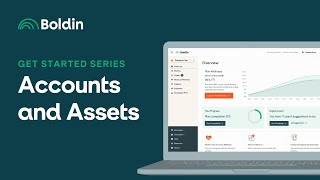
Nancy from Bolden walks through setting up accounts and assets in a financial planner, covering retirement accounts, brokerage accounts, and other holdings you need to track for an accurate financial plan.
Chapters
Hi everybody, this is Nancy from Bolden.
And I want to welcome you to.
Day six of our Get Started series designed to guide you in accurately setting up your plan. In today's video, I'll discuss the Accounts and assets section of the Planner.
I want to stress the importance of entering unique names for each account so.
That you'll be able to easily identify them in charts in pull down menu.
In this plan, the retirement accounts include.
A 529 plan, an HSA 2 401ks, two Roth IRAs, and a rollover IRA.
Each account has a descriptive name, current balance, and optimistic and pessimistic rates of return to represent the asset allocation and expected return. Within each account you have the ability to model a rate change in the future.
This can be helpful if you plan.
To move to more conservative allocation as.
You approach or enter RET retirement.
You also have the ability to exclude.
Accounts from your withdrawal strategy, which can be useful to protect an emergency fund.
There are two types of after tax.
Accounts in the planner and here we.
Have a brokerage account with the capital gains tax treatment.
Along with the account balance, we have.
The cost basis, which is the total.
Amount paid for the holdings in the account.
You may also enter turnover rate, which.
Is the percentage of your account that gets traded on an annual basis resulting.
In realized gain events.
If you're a passive investor holding index.
Funds, the turnover rate will be low or negligible.
If you have a managed portfolio, managed.
Fund or trade frequently, the turnover rate will be higher.
We also allow for optimistic and pessimistic.
Rates of return to represent the asset allocation and you have the ability to enter a dividend yield which is the percentage of the stock's price paid annually as dividends. The dividend yield should be included in.
Your total return for the account and.
Dividends by default are reinvested in the model.
The next account is a savings account.
This has the ordinary income tax treatment.
And I've excluded the account from the.
Withdrawal strategy as well as entered low.
Optimistic and pessimistic rates of return to represent the historical returns on cash.
The planner has a section for other.
Assets where you may want to account for a business vehicle or the cash.
Value of an insurance policy.
And in this plan we have a.
Recreational vehicle and an auto.
This area of the planner allows for depreciation.
Note that you don't have the ability.
To sell the other assets. So if you own a business or.
Other asset and you want to add.
A sale, it may be better to.
Include that as an account.
Thank you so much for joining me in today's video. And I'll see you in Get Started Series seven, where I discuss how to account for home real estate and debts.