Millionaire Milestones Building Wealth on Your Terms with Sam Dogen (ep.94)
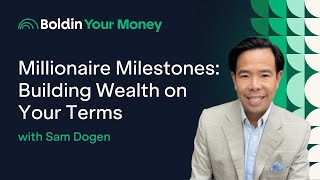
Sam Dogen left Wall Street to build wealth through real estate, stocks, and his site Financial Samurai. He argues $250,000 in investable assets is the inflection point where compounding accelerates, and shares his asset allocation: 25-35% equities, 30-60% real estate, with the rest in alternatives and cash.
Questions this video answers
July 2009.
Early 2012.
About $3 million.
$250,000 (investable assets).
$23,500.
Chapters
So welcome to Bold in youn Money, the podcast that emboldens you to take control of your finances and build wealth on your terms. I'm your host, Steve Chen. And today we have Sam Dojan joining us. He's the financial samurai, and he's written a book, Millionaire Milestones. And so we're going to get into the book, kind of what's been what's new with Sam, hopefully pass on some good nuggets of wisdom about how to get wealthier and also stay wealthier. So with that, Sam, welcome to our show.
Hey, thanks for having me on again, Steve.
Yeah, it's great to see you. Are you in San Francisco right now?
In San Francisco.
Nice. So, yeah, I would love to kind of just have you kind of recap, you know, a little bit about your journey and kind of how you got here for the. For folks that aren't as familiar with, you know, your. Your path to financial independence and also kind of how that led you to and why that led you to write this book.
Yeah. So I grew up overseas, I think six different countries because my parents were in the foreign service. Came to high school in Virginia, and then I went to the College of William and Mary. And then I went to work on Wall street from 1999 to 2012. And it was a great time, pretty exhilarating. Lots of highs, but also lots of lows. Where in 2008, 2009, you know, things went to the crapper, right. And so I lost about 35 to 40% of my net worth in six months. That took 10 years to build. And I was pretty despondent, disillusioned. And I was thinking to myself, well, if you're working on Wall street and you're not making money, do you really. Are you really doing anything? And at that point, it had been 10 years, and, you know, those nine, 11 happened and all this stuff, and I just really started questioning what did I want to do with my life? And so ultimately, I started writing about financial independence and retiring early in 2009, when Financial Samurai was born. July 2009. And two years, about eight, nine months later, I found an escape. And I decided to leave Wall street behind in early 2012. And I haven't returned to a day job since.
And are you happy with that decision? Do you feel like that was the totally right decision?
You know, it's interesting because 2012 was the cusp of things going gangbusters again, right? Stock market, housing market. And so I basically left after we had rebounded from the lows of July 2009. And I was thinking to myself, okay, we covered almost all of our losses. Thank goodness. We're not going to. Going to fall into the abyss. It's kind of like in 2025, a little bit where we were down 20% in, you know, like 30, 45 days. And then we recovered about half, a little bit over half of the losses. Now we're thinking, oh, we're not hopefully going to retest the lows and go into the abyss. And so at that point, I was thinking to myself, okay, I'm back to even. I was able to negotiate a severance package that paid for at least five years of living expenses. And my wife, who is three years younger than me, was continuing to work. And I said, well, I got a severance package. We recovered from the lows, and I have something to do, which is right on Financial Samurai, which I really, really enjoyed. Every single morning I wake up and see who commented and what people's thoughts are. So I had something to do after in my retirement. So I was like, okay, let's give it a go. Worst case, things don't work out. I go back to working in finance, and worst case never happened.
Yep. And Financial Samurai, I know is you've had a long history there. It sounds like it's producing some level of income for you as well. Has that kind of ebbed and flowed, or has it been growing the whole time?
You know, like, for the first couple of years, it just made nothing right. It was a cathartic way to make sense of all the chaos. And it was just a scary time, especially global financial crisis, because a lot of people lost a lot of money and a lot of people lost their jobs. We went through seven rounds of layoffs, and so it was just. It was kind of like a hobby. It was a journal. But when you open yourself up, people also share their experiences, their fears, their victories, their losses. And it feels good to go through a difficult time together and get out of a difficult time. And then, you know, over time, I realized, wow, okay. I remember it was October 2011, and my wife and I were in Santorini, Greece, and someone emailed me and this and said, hey, I would like to put an advertisement up on Financial Samurai. And I was on my iPhone and there was WI fi access at the top of the crater. It was like 78 degrees, sunny, beautiful. And I was going to buy a Mythos beer. It was like $8, $9. But I was like, ah. And then. And then this guy said, oh, I'll pay you $1,000 to put a link up on Financial Samurai.
And.
And I was like, all right, so I did that and it took about 20 minutes and he's paid within 30 minutes. And I said, give me a couple beers, let's bring it on. And so that was a moment, a light bulb moment for me where I said, wow, okay, I built a site, it was more of a journal, but I could actually make some money, some side income to supplement the passive income that I was generating from CD income, dividend income and semi passive rental income. And so I had something to do. And so yes, it's grown as I've dedicated more time to Financial Samurai and it's ebbed and flowed and it is just such a great, great hobby, great passion of mine to do after full time work.
Nice. And did you change? So it sounds like, hey, you know, you're working in Wall street, you're fully invested, probably in the stock market because it, you could lose 35%. Right. And that's part of what happens. You know, there's ups and downs. Did you change how you invested dramatically after that? Cause it sounds like the emotional impact, that sense of like, ugh, I've lost a lot of my net worth really strikes you deeply.
Oh yeah. I think because if your career is in money making money, when you lose money, you feel way more pain, I think, than the average person who gets to, let's say, save children and people off the streets. You know, that's like something purposeful and meaningful. Right. And then you don't really have to think about the money. But when you're sitting on the trading desk and you see, you have two monitors, Bloomberg and all, and you see things collapsing, it's a very visceral experience. So my goal for during my 13 years on wall street was to diversify as much of my income and my bonus away from equities and into real estate. Because I was already leveraged to the stock market through my career, my bonus and having a job afterwards. I think I tried to be more conservative because I tried to sell our house that was a little bit too big. It was meant to be a house to raise children, but our children didn't come until later. And so I tried to downgrade, downsize and reduce my expenses like any logical person would do if they lost or gave up their day job income. But I think in general, because I've been scarred so much by equities from 1997 Asian financial crisis to the dot com bubble in 2000 to the global financial crisis, that I've Always tried to keep equities to no more than 35% of my total net worth and it's gone as low as 25%. So that's the range, 25%, 35%. Whereas real estate has always done me a good amount of good over the years that I've owned it, very stable income generating. I don't see the daily price movements every day. And so real estate, I've fluctuated between 30 and to 60% of my net worth.
Got it. And what's the rest?
Cash and equities, venture capital, venture debt, so alternative investments and make 2%, 3% treasury bonds and money markets, especially since they're yielding over 4.3% now. It's pretty nice. But since I left in 2012, as I look back, about 98% of my net worth has been invested or risk exposed to risk assets. So it actually hasn't been as conservative as, let's say a traditional retiree who might do like a 60, 40 portfolio or maybe even 40% equity. 60% bonds and real estate and cash.
Yeah, it's interesting. So do you see that changing? I mean, I would consider the real estate more like a. I mean, it's an alternative, more conservative asset and it spits off income, which is nice or spins off income. But do you see that evolving as time goes by? Are you going to take down the equities over time or change your portfolio another way?
I only have about 30% of my net worth in equities, but it's interesting. So the latest 20% decline in the stock market with Liberation Day and all that didn't feel good. Obviously losing all that money so quickly felt horrible. But I was, I wasn't fearful as I was maybe more. I was more fearful in March 2020, down 32% in one month, because I also had a newborn. And I think I was probably more fearful of how do I protect my newborn four month old. But this time I felt a little bit more moody. You know, I was like, this didn't have to be. It didn't have to be this way.
Why?
Why? And, and so I had to really kind of protect my mood from my wife and my children, who are innocent.
Right.
They have nothing to do with this. I'm the one responsible for making sure the ship stays afloat so they can live their lives as happily and peacefully as they can. I think over time I will probably get a little bit less aggressive. But at the same time, I don't want to own more physical real estate because, you know, managing tenants and issues is a pain as you get older. And also it's interesting that equities are so volatile now. They snap down and snap up so quickly that I feel maybe more of my money will go into venture capital, which is highly risky and illiquid. But you don't see, it's like a duck in the water. The duck is calm, the legs are like that.
Right.
But I'm so bullish and optimistic about private AI companies here in San Francisco that I want to gain more and more exposure.
How are you getting exposure to these venture companies?
So I invest in closed end funds like the traditional venture capital funds, through friends and family rounds, through connections. I've invested about 150,000 so far in an open ended venture fund. It's called Funrise, the Innovation fund, which is also a sponsor. But I feel that I'm just trying to get as much reasonable exposure to private AI companies living in San Francisco because, hey, I don't want my kids 15 to 20 years from now saying, hey, dad, why didn't you work at an AI company or invest in private AI companies near the beginning? You could be so wealthy today. And meanwhile I wouldn't have to worry about not finding a job because AI has taken away millions and millions of jobs.
Yeah, it's interesting. Yeah. No, I think San Francisco is unique in that part of it's regional. The fact that you're here and if you know the right people, you can get into some of these deals. I mean, they are super risky, but you know, you will meet people here or in this ecosystem that I interviewed, you know, a someone in the space, he's a financial influencer and he got access to Perplexity. He was like, yeah, I ended up investing in Perplexity like whatever, months ago. And you're like, you know, and a bunch of other deals and you're like, wow, that's amazing. So, but part of it's luck too. And there's also just such a risk. So if you did go back before we move on to the book, if you had to go back and do it all over again, would you do anything different? Or you're like, you think you nailed it in terms of the life path?
I think I nailed it perfectly. No, I'm just kidding. I think I would have done a couple things. One, I would have retired a little later instead of 34. I think in retrospect, 34 is way too young. Giving up all that income and the career upside, I would have tried to work for three to five more years. It would have been amazing to get parental leave and get paid while having children. That is one of the big regrets. But also, I might not have ever had children because I was so focused and stressed on making money and climbing up the corporate ladder. Two, I would have inquired about maybe relocating to a different office, perhaps Hong Kong, Taiwan, China, somewhere in Asia where it was booming. And then finally, I think I would have started financial samurai sooner. 2006. I had come up with the idea in 2006, but I had just graduated from Berkeley part time for their business school program. And, you know, I was 60 hours a week, 20 hours of studying. I was like, okay, let's, let's focus on the job at hand now. I'll do this Financial Samurai later. I didn't know how to start a website back then anyway. But then finally when the recession, global financial crisis came, I said, no more excuses. Let's stop putting it off. So those are the three things I would have done differently.
Got it. Yeah. It's super interesting to kind of look back and think about it. I mean, do you. Do. I mean, I guess I have one actual final question here. Like, for your kids and they're watching you kind of the way you're living your life, it's so different than probably most of their friends. Are they aware of it? Do you think it affects them and how they're gonna think about their own lives?
Yeah. So all they see is all they know. So they know nothing different. What's interesting is that so in 2022, I wrote, I came out with buy this, not that. And Bolden was a supporter. I appreciate that. And I was, at that time, I was like, okay, I'm done. Bucket list is done. Wall Street Journal, bestseller. It was so hard to write, especially during the pandemic, but it gave me focus. It was kind of like a salvation to focus on something intellectually challenging to do during lockdowns. Right. And then due to the success of the book, my publisher portfolio, Penguin, said, here, how about another two book deal? And I was saying to myself, oh man, that's a lot of work. Let me get back to you. But when I was thinking about it, I was just chilling in the hot tub and thinking. I was like, okay, my kids are three and five at the time. I think it's important to show daddy doing work and creating something from nothing. They're in academics. Writing is highly academic. Creating is academic. So I said, you know what? Okay, I'm going to give it a go. So that at least over the next two to three years, they can see me writing, creating, editing, and then marketing so that, hey, I'm not just some guy sitting around or playing pickleball all day. I'm actually creating something from nothing, you know, because how many jobs are there that your parents do that? Create something from nothing and then you can feel it tangibly and go to the bookstore and see it.
Right.
And so I said, you know what? I'm gonna take this challenge on two book deal. It's gonna take four to six years. Let's give it a go. And I think they appreciate it, especially as a dad who can spend a lot of time with them now.
Yeah, no, that's awesome. So let's jump into the Millionaire milestones book. And was it quicker to write this time than buy this? Not that just because of technology and stuff.
It was quicker because I'm more experienced. And two, I purposely fit within the writing guidelines of about 55,000 words with buy this. Not that I went to 100,000 words because I thought, well, more is better. And this is my one and only book. I wanted to get as much of the information out there as possible. I realized over time that people's attention spans are shorter nowadays. A lot of video, TikTok, whatever. And I wanted to write a very punchy book that was very actionable, that could help people achieve more wealth than 93 plus percent of the American population and 99% of the world's population. So they could be more free sooner.
Yep, got it. So it's a million dollars. You have to have a million bucks to be in the top 7%.
A million dollars? Yep. I think it's 6.5% of households in America have a million dollar net worth.
Including the house or just investable assets?
It's including the house.
Including the house. Oh, interesting.
So the median home price is about 400,000. And if you think about how much equity there is, let's say half, 200,000.
Or something like that.
Yeah. And then the rest you can think about 800,000 plus is in investments.
Okay. Yeah. One of the things you call the book is like the first $250,000. Is that $250,000 of investable assets or net worth.
Investable assets. So I talk about in my book, one of the key milestones before getting to a million, you know, obviously I got to save first. 1,000, 10,000, 50,000, 100,000. But 250,000 is. Is really, I believe, the magical number where once you get to that in terms of investable assets, that's where really the Compounding starts growing. And why is that? Well, in 2025, the maximum 401k employee contribution limit is 23,500. We also know that about 75% of the time, a stock market investor will make money. We also know that historically, since 1926, the media, the average return, total return for the s and P500, is about 10%. Now, a lot of houses are saying it's gonna go lower, but let's just stick with 10%. So therefore, if you get to $250,000, you could make more from your $250,000 portfolio than you can contribute in 401k. Right. So when you start compounding in terms of your portfolio making more than what you can contribute to your 401, and you double that, that's where really the momentum, the magic really comes. And so it's almost an inevitability. Once you get to 250,000, if you have the proper asset allocation, that you will get to a million. But the problem is too many people wing it when it comes to their personal finances. They don't create a budget, they don't have specific goals with specific amounts and dates and ages to get there. And therefore, they wake up 5, 10, 15 years later and they wonder, where did all my money go? It's kind of like going out to the city, San Francisco, New York City. And like, by the time you get home, you say, where did all my money go? It's like, what happened?
Yeah, I do think a lot of people don't appreciate the power of compounding until they get older and start to experience it more and more for themselves. And it's kind of unfortunate. Like, when you're young is when you have more time and it will make a huge difference for you. But it's very hard for folks to kind of get into that mindset and really see how powerful it is.
It is so powerful. So here's the problem. And people don't do this. Also, you go to a compound interest calculator, compounding calculator. You type in, what if you have 250,000 at a 6% return and you contribute 20,000 a year, 30,000 a year for 10, 20, 30. And you get to huge numbers. And people look at that and they think, there's no way I'm going to get there. But I'm telling you, as someone who's done this since 1999, very diligently, because I wanted to escape finance Wall street asap, that compounding is crazy. So just give you an example. In 2012, when I left with about a 3 million net worth, 98% of it was invest in risk assets. So if you put just a 6. 7%, 7% compound rate, no contributions, that 3 million turns to 8.5 million 13 years later. And if you actually saved and contributed and had a 10% return, you're talking eight figures easily.
Has that happened for you?
I'm just doing the math here. And the stock market has returned much greater than 10% a year on average. So we can do the math there.
Yeah. Well, I know that I don't want to be too direct, but I know sometimes you do publish what's going on with your net worth and stuff like that.
I've always just talked about 3 million in 2012. But just run the numbers, folks. Once you get that nut, 250,000, it's an inevitability. It'll go to a million. You just need several good years. Just think about 2023 and 2024. Right? 23%, 22% back to back. If you had a million that goes to 1.25 million, and then it goes to 1.45 million, you're halfway to 2 million. And that first million could have taken you 10 years.
Yeah, no. I had this experience myself before Liberation Day. I had, you know, adopted the index and chill motion. We. I logged into our Schwab account, and I was like, holy smokes, we're up 40%. And I'm like, that's a real. I'm like, that is real money. I'm like, in two years. In two years. I was like, that is way more than we have ever saved or contributed. We couldn't do it. You know, so you're kind of like, okay. And then, of course, things came back on 20%. I'm like, oh, well, we're up now. We're up 25% or whatever. So.
And. And that's. And that's the other keys. Once you got that money, you got to find ways to asset allocate appropriately based on your risk tolerance and goals. Because one of the first rules. Not one of the first rule of financial independence is actually to not lose money. And the second rule is actually not to not forget the first rule. Like Fight Club. The second rule is if you want to retire early and achieve fire early, you cannot quit your job. You can't just say, see you later. You have to figure out a way to negotiate a severance package to give you that further financial buffer to live your life.
You.
Because it actually. It's interesting, doesn't matter how much money you have, you will always feel a little bit of strain when there's a recession, a bear market or a correction. And you're going to worry, okay, oh, am I going to lose everything that I've worked so hard for? It always feels that way. It always feels that way. But then the good thing is recessions. Average recession lasts about 10 months and it's not forever.
Yep. I definitely, I think one of the big. I want to, I want to ask you about your mindset, you know, thinking here, but I think one thing that shifted for me was I was like, you know, is it better for me to save money in the bank, or is it better to bet on everybody else in this country working really hard and getting more productive and creating value? And I was like, you know, this is, I should put all my money behind these other people. And that's the stock market. And that has totally worked out. And it's just kind of like starting to do that efficiently as early as possible is what makes a big difference. But what are some of the money mindset things that you think are super important for folks as they're building towards real wealth?
So in terms of money mindset, I got one that's very important, and that is if the amount of money you're saving and investing each month doesn't hurt, you're not saving and investing enough. And this goes back to being intentional with why you're making money in the first place and what you're doing with your free cash flow and your savings. So if you're not changing your habits after every month because you're saving a little bit more, investing a little bit more, you're not saving enough. The average saving rate in America is about 5%. So in other words, that takes 20 years of work to save one year of freedom. That's crazy. That's ridiculous. No wonder why people are going to have to retire at 65 or actually never retire at all. However, if you start saving 20%, for example, that's five years of work to save one year of freedom. And with some returns, you could get that even quicker. And the thing is, there are no more excuses now because during COVID we saw the national saving rate go from sub 5% all the way up to like 30 plus percent in a matter of two months.
Right.
So in other words, it tells us we can save if we want to. We're just choosing not to because we decided, you know, we want to yolo, which is totally rational and fine, but you can't Go up to yourself, you know, 20 years from now and say, hey, what are you doing? Why don't you save and invest? Because, hey, you YOLO'd. So it is what it is. Everything is long term, rational, everything. And we make decisions based on what we think is best.
Yeah. One caveat I would say about COVID we had two things happen. One is we're all locked inside and couldn't go spend any money. And two, they started shoveling money out the door to some folks as well and people. And so, yeah, it was incredible. Essentially everyone paid down their credit card debt. The savings rate went through the roof. But what was also equally incredible is as Covid kind of ended, those things reversed. Like we went back to our habits of spending money. You know, credit card debt is right back up there. So I kind of, I wonder. I don't. We should pull the data after this. But like, was there any long term impact? Yes, we can do it, but can we do it on our own with good habits?
Yeah, we can't. The long term impact is we can't. We know we can, but we can't. So you look at the data now that the saving rate is back to 5%. And that's why investing in real estate, as I talk in millionaire milestones for the typical person, is super powerful. You get neutral real estate, so you go up and down with rent and inflation. You're not a price taker of rents as a renter and you have forced savings. You're forced to pay your mortgage or otherwise you're going to pay penalties and lose your house. And you get to ride the inflation wave because living cost is part of the inflation index. So how inflation rises, home prices rise, you're paying down your mortgage over time, and then you wake up 10, 20 years later and you say, wow, I've got a lot more home equity and my home is worth a lot more. And all I did was enjoy my life, raise my kids and have good memories. Are you kidding me? This is amazing. And thanks to the leverage, it builds way more wealth. So being neutral real estate by owning your primary residence is a key fundamental to becoming a millionaire. I believe in America at least. And if you want to get long real estate, you need to own more than one property.
Yeah, I think that I agree with you on this. It's interesting. A lot of fire people disagree. They're like, you should rent and it's better to invest. But you know, if you look at the data, the correlation between people that have real wealth in this country and homeownership is massive. And, and the opposite is true too. If you don't own a house very often you have a lot less money. And I just think it is a lot of this built in, you know, forced savings, you know, and, and you also, to buy a house, you have to have good credit, you have to have saved up a down payment. It enforces habits before you even buy the house, like you have to get really intention it. So I do think it ends up being a net good thing. I mean, unless if you're like some fire superstar and you're like, I'm just going to like Andre Nader. Shout out to Andre, he's done this. I think he's like, he's renting and. But building huge amount of wealth. Go for it. But for a lot of folks, it's, it's way better on the house.
You know, it's, there's different, it's a spectrum, right? The fire spectrum. There's Lean fire Barista, Fire Coast Fire, Fat Fire. There's even wife fire where you just. Wife fire is amazing because of equality in America, because of women having more college degrees than men, more women are becoming the breadwinners in the family. And so if you encourage your wife to work harder, save more, invest more, you can retire sooner. And so we see that huge proliferation of wife fire where men are saying, I'm retiring early. Well, they can do whatever they want because their wives are working and making big bucks. And so this is a huge shift since I started writing about fire in 2009. And it's whatever your flavor is. If you want to live in a van and just chill and never have kids and go be free, that's amazing. It's awesome to go and travel, but for me, after you see one gothic church, they all look the same after a while, right? And it's just something new. And I choose. We choose right? If we're not changing, we're choosing right? So I choose to live in San Francisco and I will choose to relocate to Honolulu in my traditional retirement years because these are the places I like and I have friends and family. And so if you choose a different path, that's great. But just know that one path isn't better than the other. It's what you are rational. What is what you rationally believe is the best path for you.
Yeah, well, yeah. To kind of dive into a bit further, one of the things in your book you talk about is aligning your financial goals with your personal values to avoid burning out. Do you have any examples of how you've seen that materialize for folks that you know or stuff you put in the book.
Oh yeah, for example, my personal value. Well, I worked in finance, but the idea to make money was to help institutional money managers build more wealth for their clients. And after a while that didn't feel very meaningful. This is like institution, you know, big hedge fund or money manager. And then I started telling myself, well, okay, I'm trying to help the teachers retirement fund build more wealth. So that would be great, right, to help the teachers. Because I believe teachers are the most valuable people in our society. Right. Because they raise our children and they teach them right and wrong and so forth. Afterwards, I've spoken to many people in the tech community and let's say you work at one of those huge tech companies, social media companies, and we all know that social media has been kind of harmful for children. And so one person I talked to said, you know, I'm making 500,000 to 800,000 a year, but I just don't feel good spending my life optimizing users to click on ads and, and watch these videos that are full of negativity to get them hooked. Right. I think fundamentally we know that's not good. And even if you make tons of money, at some point you're going to make enough money to say, me doing this for society is probably not a net positive. We can justify like, you know, our, our social network brings people together. But what is the ultimate goal? To try to generate revenue for the business through all this negativity. So, you know, they've changed and they said, you know, I want to do something else more meaningful. I won't make as much money, but my soul will feel better.
Yep, for sure. We see this a lot in our community where people are, they really want to move on to the next stage of their life where they can kind of use their human capital, their non renewing, non renewable resource that we have into things that really matter for them. So let's talk about some of the mechanics that you bring up in your book. So what are the like, you know, you talk about building multiple income streams. I think specifically you call out there's seven revenue streams that millionaires have in common. Can you kind of give a quick overview?
Well, there's not necessarily seven, but there's definitely more than one. And the idea is if you're flying a plane and your engine starts burning up, you're probably gonna go down and die.
Right.
And then we see this all the time. The longer you're around the longer you're investing, the longer you're working, the more good and bad things happen. So I've seen plenty of bad, plenty of good, but plenty of hubris. And the one mistake people made make and I made this was thinking their good times, the good times, their good income, their good promotion tracks continues to go up linearly or exponentially. Got rid of it. But it never happens. The good times never last forever. And one of the keys is you need to forecast your misery. When will you be miserable and at risk in your job? And by that time, hopefully you have multiple income streams to have many engines on your plane to keep you alive and flying just in case your main engine goes down. And I think people understand this, but people do not actively pursue those multiple income streams. But the easiest way obviously is savings money market account 4% amazing. Huge right now. Other easy ways, obviously stock market dividend paying stocks, S&P 500 yields, probably like 1.5% dividend yield. You got that? Or you can go into dividend aristocrat stocks. Another way obviously REITs, physical rental properties and a whole bunch of other ways to make income while you're making active income. Because the idea is hopefully, hopefully your passive or semi passive income streams can eventually match your active income streams. It's probably not going to happen. But the whole idea is at some point when there's that crossover, wow, you are totally free. But it's even before that crossover when you're semi passive and passive income can cover your basic living expenses.
Wow.
That is when you're technically financially independent.
Yeah. It's so interesting to hear you two things. I love that you're. I don't forecasting your misery. I do think anticipating, you know, that things are not going to keep going is a super important idea. And one thing that I've definitely seen out there is many people index their spending to like their high points in life. And that is a fast way to mess yourself up. And many people. This is something that's really interesting. If you look at people's career very often they'll have a couple years that just crush it. This happened in my life. I had a couple years. I was like, wow, I'm making like twice to three times as much money as I've ever made in my life. And that was weird. Like, it definitely changed my mindset. I was like, I didn't think it was possible to make this much money. And this was like I had my own business. And I was like, this is pretty. And by the way, small business in America Best way to go, like if you're, if you're, if you're thinking about it, super tax efficient and stuff like that. But, but it didn't persist. And thankfully we didn't adjust our life. But I, and then I read later that this actually happens in many people's lives, but it's something to watch out for.
Oh, I will tell you, in 2007, I was a VP. I was on top of the world. I made the most money I had ever made in my, then I guess, eight, nine years on Wall Street. And, and so I did something really stupid. I decided I'm going to buy a vacation property in Lake Tahoe in 2007. Okay. It was originally going for 815,000 in 2006. So I said, oh, if I can get it for under 8, 7 50, I was able to get it for 715,000. What a steal. You know, I love Palisades Tahoe. It used to be called Squaw. That's where I took my then girlfriend, now wife, on our first date in California. What a magical place. And then of course, the global financial crisis hit and values for these properties went down at one point about 50%. So suddenly, just like that, I lost $355,000, which is a crap load of money for me at the time. And I had this albatross on my neck for 10 years thinking what an idiot I was.
Okay.
And so the lesson there for me, it was like, oh, okay, don't extrapolate your high income good times forever, because the good times never last forever.
Yeah, it's so interesting. And then. Yeah. And then don't, don't get tired. Be thoughtful about how you get tied into assets. And if assets move very quickly, I think that's another big lesson because they. Yeah, A friend of mine, he bought a place up there in 2008. I remember saying, yeah, I got this house for 300 grand. I was like, wow. And then this was later. Right. And things that kind of jump back. But yeah, eventually it does come back. I mean, I know when Covid hit Tahoe, prices doubled, right. And people that are bought pre Covid at some point are like, oh, I'm great. So. But they might. We'll see what happens.
It's been a long time of waiting for that price point to get back to where I purchased it. And it was a long time to really feel okay about it. So the good thing over time is even your worst mistakes, they become a smaller percentage of your overall net worth over time. Right. The memories sting. A little bit less and the percentage bad becomes smaller and smaller to the point hopefully where you're like, okay, I can live with it. That was a life lesson. Let's move on. And so these are some of the life lessons that I've put in Millionaire milestones to help people avoid that trap. Because the easiest way to say if I. To never say if I knew then what I know now is to simply read that book by someone who's been there before or who's where you're going to go. Right. If someone has been there before and has gone through these mistakes and is honest about all the landmines they've stepped on, I think you're going to be really appreciative.
Yep. I think that books are highly undervalued, unfortunately, in our society. I mean, one thing you see with people that are pretty successful is they read a lot. And one of the reasons books are so valuable is that people put a lot of energy and a lot of bring a lot of their experience into this thing that they're creating. And I don't have the exact data, but like, it's like, hey, an article might be worth X, but a book is worth 10 to like 100x that in terms of like what you can get into it and how it's been well constructed and brings a kind of cohesive narrative to the table. So there is so much value there.
Well, anybody who wants to write a book, give it a go because you'll soon realize how difficult it is from the idea to the formalization of order of events, to the 50 plus edits you have to do and polish and polish and polish. But that's the thing though. Anybody who reads a book will realize and consume information from an author who spent at least two years, I think, writing and editing it and gain that collective wisdom that that author has and given. I think most people don't read at least books, especially nowadays with all this short form videos. It's a huge competitive advantage. It's not even funny. And that's kind of the reason why I wrote this book. If you don't want to read it, it's okay. I want my children to read it when they grow up because I want them to be financially independent and financially wise so they can make their own decision greedily, so I don't have to take care of them and have them come home when they're 25 years old, as I see so many, at least young adult men here in San Francisco do, where they're just living at home. And they're trying to figure things out. So, you know, it's interesting. I do believe we have the power to become wealthier than the vast majority of people if we want to. But I think most of us, you know, very rationally will just do what most people do and then we'll have most people results.
Yep. Yeah, for sure. By the way, I wanted to circle back to the other thing I was going to say that I thought was really interesting, which is your orientation around income when you measure how you're doing income versus assets, right? So you're kind of like, hey, here's what it costs to live my life. I am building passive income towards that level. Most people aren't doing that. Like most people are focused on the assets, myself included. It's like kind of what's my net worth? Right. Not really thinking what is a spin in terms of dividends and da da, da, da. So I think this intention is really interesting. And do you measure yourself? Do you have your own tools or spreadsheets or whatever to say, hey, I'm watching my passive income? You probably do because you have, you know, rental properties and stuff like that. But yeah, how do you frame that up?
You know, it's interesting your, your thesis is, I think I disagree with that thesis. I think most people just look at income and they don't think about building net worth to generate passive income. And I know here's one data point, this is very, very fascinating. So Bloomberg came out with an article saying the middle class earning $300,000 a year is getting squeezed by the cost of private universities and the whole analysis, and they had like five authors on it. Okay, is okay. At what income level do families no longer qualify for free money? Grants and scholarships? And that income level was $400,000, $200,000. The schools are expecting you to pay about half the tuition, but up to 400,000. So sorry, you're too wealthy to earn any free money. Okay, this is just for the free money, not so much for like merit aid stuff. And so I kept on reading it, trying to figure out, okay, well, where is the asset component to that? Because when you apply for FAFSA and the CSS Pro, there's a huge asset component to it where if you have X amount of assets, you also are expected to pay more of that tuition. And so I feel like in America at least, the focus too much is on income and less so on assets to generate income. Okay, and so your question to me was, do I, do I track it? Yes, I track it. I have specific age goals to get to for passive income, net worth and income. When I had a day job income, then no more day job net worth. Now I have passive income. But I think it's very easy in the beginning because you just calculate what your base living expenses are, then you need to survive, right? And for me, that in 2012 was about $60,000. If I could live off $60,000, I'm eating, I'm sleeping, I'm sheltered, I'm not living large. But I can be free and survive, right? So once I got to $80,000 passive or semi passive income amount, which was off of about $3 million net worth, I said, you know what, there is no excuse not to live my life and take a risk and do what I want. And so that's what I did. And so as time went on, so I had my first child in 2017, my second child at the end of 2019, and with inflation, school, healthcare expenses, which we all pay for, I don't have subsidized health insurance. I had to come up with a new number. But it's based on the budget, right? So the budget is what you want your ideal life to be. And, and then you go seek and invest in those investments that can hopefully generate that passive income.
Got it. Can you talk a little bit more about, I mean for you it's real estate and I guess private investing. Is there anything else that you're doing that and you get some income from Financial Samurai, but you put effort into that.
Financial Samurai is definitely not passive income. The articles, the newsletters, the podcasts don't write and record themselves. But I look at, you know, one thing you have to do as an investor is always compare any investment to the risk free rate of return. And that risk free rate of return is traditionally the 10 year bond yield, which is at about 4 to 4.3%. Right. You would never invest a single dollar in any other asset if you did not believe it would generate a greater return than the risk free rate of return. And so I'm constantly looking out for that. So as interest rates rise, rose, that risk free rate of return increased. And actually it made living and generating passive income easier. But we all are a little bit greedy. We want more, more, more, and we have to take that risk to get more. So in terms of just investing and looking at things, I'm always, this is a curse and a blessing. As a personal finance writer, I'm always looking at the markets, always looking at every single investment, and always in my brain thinking is this Good investment, bad investment, and how do I figure things out? But it's bad because when things are rocky and volatile, you mentally get stung over and over again. You can't help yourself. You're like a moth to a flame, always looking at the markets, futures, everything. So there's pros and cons there.
Nice. So let's. I want to ask a couple more questions before I wrap up, but just one is on inflation. You talk about stopping, fearing inflation, and the other is like ways to kind of recession proof your portfolio. Any commentary?
Sure. So the key to combating inflation is to ride inflation. You want to own assets that inflate with inflation or that are part of the inflation index. So those assets clearly are real estate, stocks and. Yeah, real estate and stocks, that's bread and butter right there. If you think about stocks, they are valued based on a discounted free cash flow model. How much the companies are generating in the future, their profits, their revenue, whatever the multiple is. At the end of the day, it's about income, cash flow, earnings, generation. And so this income, the component earnings generally rise because prices they charge, companies charge increase over time to not only cover the cost of inflation, but to make a profit above the rate of inflation. You can't do it too much, or you might be seen as price gouging or whatever. But investing in companies is by definition, you're riding inflation. Okay. Real estate by definition is, is part of the inflation component. Real estate inflates with inflation. So you want to get neutral or ride inflation. You don't want to rent forever because just like shorting the stock market forever is a bad idea, renting forever is a bad idea. Very equal logical analysis, but a lot of people fight me on that and whatever, you can do whatever you want. So that's mainly it in terms of inflation where I see inflation going. Inflation has been coming down since the late 1980s. If you look at the long term chart, for the past 40 years it's been going down, there's been blips up, but it generally goes down. And I believe that we will continue to, to be in a long term downward or low inflation environment.
Why?
Because the world is smaller thanks to technology. The central banks around the world are more coordinated. They talk to each other, hey, what are we going to do? And the technology is really. And there's lessons learned from previous periods of inflation that central bankers can use to make it become more manageable. So I don't believe we're going through this permanently. Higher inflation and high interest rate environment for the Future.
Yeah, and I mean rates have also been, you know, the yields on Treasuries and stuff have generally been declining as well. I mean now they're back elevated. But so do you think that they'll also come back down?
I won't say absolutely. I'll say with 80% probability we'll have short term spikes, but it's long term. 10 year bond yield at 4% or lower is definitely in the cards. And so for people worried about crazy inflation, hyperinflation, interest rates, jacking up the value of your real estate, or your stocks for that matter, I'm not too concerned about it. We went through the most extraordinary period during COVID 19 with 2 trillion, I don't know, multiple trillions getting pumped into the economy. That takes time to weed itself out. And it's happening because the saving rate is only 5%.
Right.
So what's happening just takes time. But we're going to get back to long term trend.
Got it. And how about for at times like this, what are you doing yourself and what would you advise listeners for kind of recession proofing and maybe volatility insulating their portfolios or just accept it and like deal with it.
You have to diversify. You can't be, you can, you can be 100% stocks and you can go up, down 20%. You can see your stock values disappear overnight. If you're good with that, you're good with that. But you need to, what I say is you need to understand the history of bear markets. Okay? So the bear market averaged down, downturn, drawdown, whatever you want to call IT, is about 35%. Okay? So if you are investing in stocks, 100% stock portfolio, you should expect a 35% drawdown every five to seven years. And if you're okay with that, great. But if you're not okay with that, then you have to diversify into more stable assets. And one way to measure your true risk tolerance is to calculate your hopefully paper money losses divided by your gross monthly income. And you'll come up with a number. And that number is how many months of work you need to work to make up for your hopefully temporary paper losses. And then you. I formulated this chart in one of my articles. You can Google it. But the idea is, I believe if you are willing to spend more than 36 months of your life trying to make up for your losses, you have a high risk tolerance. But if you aren't, and then you do the calculations on what if you did lose 35% and it's way More than what your number is like. For me, my maximum number limit is like 12 to 18. Every single month is so precious, then I would adjust accordingly.
That's interesting. That's a really interesting way to do that. We'll have to think about surfacing that kind of metric inside of our software, because this.
This is very important. Because what's more valuable, time or money? When you have no money, money is more valuable. But as you get older and older, that value of time increases and it becomes priceless at the end. Right. So you. I feel you should always equate to your potential loss to how much time you must give up to grind back to get those losses back. And that number should get lower over time since you have less time and hopefully more money.
Right? No, it's a great way to look at it, and it's great framing to kind of help people think through that. All right, so look, as we got to wrap up, any final thoughts that you want to share for our audience? And also, I'd be curious just if you have thoughts about. I mean, you mentioned AI earlier. Given AI, and given that you're a content creator and you run Financial Samurai, are you seeing an. A positive and negative impact? Because I know there's AI SEO and stuff like that. That's like people are getting their questions answered at Perplexity or wherever it is. What's the impact that you're seeing for your business?
I think there's definitely pros and cons. For me, I like to think about the end is near. I think, again, nothing good lasts forever. So I can see a world where there's no more Financial Samurai. There's no more people wanting to find knowledge from someone who has the experience, the lived experience. And there's a desire to just get quick answers from a robot. Right, AI?
Right.
And so when I think about that, I think it's actually quite relieving. Kind of peaceful. It's like, it's not easy writing three times a week for 15 years in a row.
Right.
And if AI can do that, that's pretty cool. AI has supplanted my dad's job as the editor in chief of Financial Summari Samurai for the past year. Now I can quickly come up with my thoughts, and AI will edit it for me, which is amazing. So it saved him time, but he's lost some purpose. But I hope he's okay in finding different purposes. It saved my wife time, which is great. So we can spend more time with our children. And then I think about AI as okay. Maybe I can just have the Financial Samurai AI chatbot that uses the archive of 2,500 plus articles to answer the questions that people have based on my experiences and my expertise and wisdom. And I think that's going to be obvious where I'm going to put that chatbot at the top of Financial Samurai one day once it's easily and freely available. And I think it is in some cases. And I will just go from there because in terms of, I guess, writing about personal finance, what's interesting about Financial Samurai is that everything I write, it's about first hand experience, right? There's stories involved. This is not SEO stuff. I don't think about SEO, I don't hire staff writers. But if I can get an AI agent to be me and help me write and share these experiences and customize it, I mean, I think that would be incredible. Now whether the business will make money or not, it's kind of a secondary thing. I just wanted to live long enough to help enough people make enough money so they can do more of what they want.
Yeah, I think it's interesting that, I mean AI is definitely impacting companies that rely on traffic because it's sucking up the data and digesting it and spitting it out for people. And I use tools like Perplexity all the time myself and it's like amazing. It goes out and searches, you know, the web and compiles stuff and references things. All that stuff's amazing. But what you're describing, AI can't do. Like AI is not going to have your lived experience and like your innovative thoughts and whatnot and then create that. That's you now you can write that down quicker and share it. But like I don't think like this is where I don't think humans are going away because we're still having experiences that other people can learn from, bring our own innovation. I do think it's going to be way more efficient, but I think humans are going to stay in the loop. But an AI will be a tool, it'll help us go faster and hopefully people won't have to work as hard and will have a better standard of living.
It's a derivative agent, right? So you can go to the source, Sam Dogan at Financial Samurai or you can go through AI which draws from the source and comes up. So it's whatever you want to do. And the funny thing again as an investor is the more AI destroys Financial Samurai. Let's just call it absolute destruction, right? Steals the content, doesn't attribute all that amazing stuff. OpenAI goes from nonprofit raise a lot of money to profit to making a lot of money money. Haha. I got you guys. You know, it's amazing world, right? The more it destroys creators actually the better in the sense if you're an investor, right? And that's how you hedge. So I'm investing, I'm investing in my destruction and I'm going to hedge, right? So like in 15, 20 years, if AI causes millions of people who spend hundreds of thousands of dollars on college educations become unemployed or just, you know, just work in the trades, which is great, then AI investments today will be very, very profitable. And if AI turns out to be overhyped, hopefully most of our children will be able to find jobs and have dignity and be financially independent on their own. So it's a win win. But you have to invest.
It's a diversification risk play for you. I totally get that. I just feel like, I mean like what you're describing, it'll be interesting to see. Like if you shut yourself, if you're like, okay, guess what? I'm not writing, I'm just slapping an AI chatbot. It's going to rag up everything about. It'll know everything till today. And then it kind of stops there. And you already see this in the AI chatbots. It's like, well, some of them are real time now, but for a while they were like, oh, it only knows up until 2021 and then it doesn't know anything else past that. So it'll be interesting to see. But it's definitely playing out. All right, well, look, Sam, this was great. People should definitely go check out the Millionaire Milestones book and Financial Samurai. We will link to that stuff and appreciate you coming on our show. Any final thoughts for our audience? No.
At the end of the day, everything is rational. Long term. If you want to build wealth, you're going to take action to do so. And if you don't want to build wealth and have a great life now and spend your money, do that as well. Just rationally don't complain why you aren't wealthier while you lived an amazing life. So I think at the end of the day, it's about what you want and go after what you want because nobody cares more about your money and your life than you. So go for it.
Yeah, I think it's so interesting as I get older too. It's like I was like, I like working, you know, I think I'll. I don't care if I have to keep working for a long time. But now I'm like, you know, if I had made smarter choices when I was younger, I'd probably be, I mean, I could be financially independent also if I decided to leave the barrier. But, you know, I do think that you should anticipate that your life will change. Like how you think about your life now is not going to be how you think about your life in the future. And you can get that perspective from books or talking to people that are older than you that have this lived experience. And hopefully you appreciate that. Okay, well, look, Sam, this was great. Appreciate your time. It's great to see you. And I hope Millionaire Milestones does great as well as by this, not that. And I hope you keep writing at the Financial Samurai. So thanks for coming on the show.
All right, thanks, Steve. I will see you all later. And if you want to get in touch, just go to Financial Samurai and you can just leave a comment on any one of the 2,000 plus articles and I'll check it out and I'll respond.
That's awesome.
All right, take care.
More from Steve

When Should You Claim Social Security? #personalfinance #financialplanning #socialsecurity

Social Security & Medicare: What's Changing and What It Means for You with Mark Miller (ep. 109)





Retirement Savings Waterfall: Where Your Next $$$ Should Go (401k, HSA, IRA, Brokerage)



