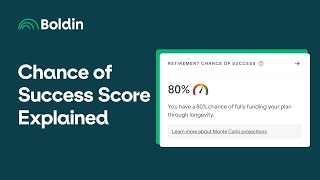
Mike Pavis at Bolden explains how the platform's Monte Carlo retirement score works: it runs 1,000 market simulations and counts success if you end with at least $0. A 73% score doesn't mean failure, it means you have room to adjust spending. John and Linda's plan jumped from 73% to 95% by cutting dining from $1,000 to $750 monthly and travel from $25,000 to $17,500 yearly.
Questions this video answers
1,000 simulations.
Ending plan wealth of at least $0 (≥ $0).
73%.
95%.
$10,000 per month.
Chapters
Hi everyone. My name is Mike Pavis, a certified financial planner, professional and support manager at Bolden. Today I want to discuss the interpretation of a score that gets a lot of attention from our users and plays a key role in your retirement planning. Your retirement chance of Success it might look like a test score, but it's not about passing or failing it. It's all about planning for flexibility. Whether you are years away from retirement or already enjoying it, understanding this score helps you make smarter, more confident decisions about your future retirement. Chance of success comes from Bowen's Monte Carlo analysis. It runs 1,000 simulations, each representing a different market scenario, some strong, some weak, and everything in between. At the end of each simulation, Bowdoin checks where your savings lands. If your plan ends with at least $0, it counts as a success. So if 900 out of a thousand scenarios ends up with $0 or more, you have a 90% chance of success. But here's the important part. This isn't a prediction. It's about helping you understand how your plan holds up under different possible future scenarios. So what does success really mean in this context? If your plan has a 70% chance of success, does that mean there's a 30% chance of total failure? Not at all. Instead, think of this percentage as a measure of flexibility. For example, a 60% success score could mean a 40% chance that you'll need to adjust your plan down the road, maybe by cutting back on travel for a couple years or skipping a cost of living increase on your spending for a while during a market downturn. If you're open to those types of adjustments in your planning, your plan can very well still be on track. Your ideal success rate depends on your goals, and a 99% success rate might sound great, but it could mean you're being too cautious, maybe saving more than you need or underspending on things that matter to you. It's important to think about your goals. Ask yourself, do you want to maximize spending in retirement? Do you plan to leave a legacy for your family? Are your expenses mostly essential, like housing and groceries? Or discretionary, like travel? Given this, how flexible are you in making spending adjustments to stay on track with your goals? Let's go to the Bolden Planner now and see what this looks like in practice. Here in the Bolden Planner, we have John and Linda, a couple in their 60s who are newly retired and are running a plan with a 73% retirement chance of success. As we see here. At first, that number made them nervous as it didn't feel high enough. But after revisiting their plan this year, they recognized a key assumption in their planning. They were previously using the basic budgeter in Boldit, which we can see by going to my plan Expenses in Healthcare Recurring Expenses Basic Budgeter they were assuming $10,000 a month in spending throughout their lifetime, increasing at the general inflation rate in their plan. It had been a while since they had revisited their spending and they had read that spending in retirement may not look as linear as they have currently set in their plan. With that in mind, John and Linda took a few smart actions. They started using Bolden's detailed budgeter which can be found here. By toggling over to the detailed budgeter, if we click the edit pencil icon, we can see that John filled out a must spend budget as well as a like to spend budget. This was really an eye opening conversation for John and Linda as they hadn't revisited their spending in a while like I said earlier and they were able to have a conversation on what their future spending may look like in the different categories that the detailed budgeter has. They realized during this conversation that discretionary expenses like extra travel and dining out make up a large percentage of their budget. If we scroll down we can see under food and dining, they're assuming $1,000 a month in going out to eat and if we scroll down on the travel and entertainment, they're assuming a $25,000 per year budget for vacations and trips. If things really felt dire, like a severe market downturn, for example, John and Linda know they can cut back in certain areas like those discretionary expenses of travel and dining out. If we toggle over to their must spend budget, we see they are Assuming less travel $17,500 a year versus $25,000 a year as well as less for going out to eat each month. $750 a month versus $1,000 a month with their must spend budget which we are now toggled onto. If we go back to their overview page, we see that their chance of Success is now 95% versus 73% on their like to spend budget. So they felt really good about their flexibility and spending. Also, if we go back to their detailed buzzer, we see that John and Linda are assuming all of their spending will last throughout their lifetime for most categories. Here they realize they can also lower spending expectations in later retirement years if needed where they are likely to travel less for example versus their early retirement years by adding additional phases of spending. So for example, maybe they only assume $25,000 a year and travel through 75. And then they can add another expense for travel from 75 through 85, for example. That is less than $25,000 a year. So maybe it's $20,000 a year. As an example, they committed to reviewing their plan every six to 12 months, especially after major market shifts where they can revisit their budget and other planning variables and reassess their chance of success. The result Here John and Linda felt comfortable keeping their current spending plan because they knew where they could flex if needed. That low to mid-70s chance of success score that they see in their life to spend detailed budgeter before became a planning tool Opportunity not a Warning Sign as you can see, your retirement chance of success is a tool that helps guide your decisions. So ask yourself, are my assumptions too optimistic or too conservative? Have I separated essential from discretionary spending? Am I open to making adjustments if things don't go as expected? The goal of financial planning is balance. It's about building the life you want while staying adaptable as life changes. Thank you for watching. And don't forget to subscribe to Bolden's YouTube channel for more education and guidance on the many areas within the Bolden Planner. You can also sign up to use the Bold and Planner for free and see for yourself how small adjustments can make a big impact on the long term success of your financial plan. Happy planning everyone.