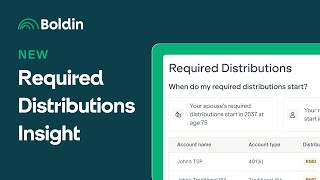
Erin from Bolden walks through a new Required Distributions Insight page that shows you which accounts need RMDs, when they start, and how much you owe annually. The tool covers inherited accounts and the 10-year rule, estimates your tax hit, and suggests strategies like Roth conversions to cut penalties.
Chapters
Hi everybody, my name is Erin. I'm here from the design team here at Bolden to walk you through a brand new Insight page that we built to help you understand IRS regulations and rules around very specific account types. So on this screen I'm going to walk you through a demo of our user Michelle today. And the first thing Michelle wants to do when she lands on this overview page is to make sure that her account information is as accurate as possible. So she goes and does that by going into my plan accounts and Assets savings and she does a quick scan to make sure that not only her balances are her balances accurate, but also the account type as well. For this user, I have put in four different accounts. She has an inherited IRA from her father who passed in 2020. She has a 401k. Her spouse John has a traditional IRA and then they also have an investment savings checkings account labeled Other Savings. So these first three accounts here are really what we want to cover today in our new Insight page. After Michelle checks that all her information is correct, she goes and navigates to our Insight section. And scrolling near the bottom you see a new page here called Required Distributions. When she goes and selects that page, you can see at a high level glance that this Insight Page addresses both RMDs Required Minimum Distributions for retirement accounts as well as other distribution rules for inherited accounts. So really, like what are required distributions? You can always access our educational panel here by clicking Learn more about Required Distributions, which will open up a drawer and give you just the answer to that question. So Required Distributions are the amount of money that you must withdraw from certain account types every year to avoid IRS penalties. So this report will address two types of required distributions, RMDs from retirement accounts as well as any inherited IRA. Specific rules like the 10 year rule, required Minimum distributions are based on your account balance and your age for traditional retirement accounts. And the 10 year rule is a rule that requires beneficiaries of inherited accounts to completely empty those accounts by the 10th year after the original account owner's death. Now this rule gets a little bit complex and that is what Bolden helps to understand. So depending on the original account owner's information, either that account may or may not be subject to this 10 year rule. Now let's exit out of this help drawer and move down the page. The first question we hope to answer is when do my required distributions start? In the case for Michelle and John, John's required distributions start a little bit earlier in 2037 because he is a couple years older than his spouse Michelle. And those start at age 75 for him, and then Michelle's start in 2045 when she turns 75 as well. Knowing what time your RMDs start or your required distribution start is key in making financial plans for those years. Scrolling down the page, our second question addresses which of my accounts have required distributions. So we all know how complex IRS rules and different account types can be. And so what this section really aims to do is list out any of your accounts that have required distributions over your lifetime. So if you remember, Michelle And John had four different accounts in their Bolden plan, and three out of those four have required distributions. Two of them are traditional retirement accounts, Michelle's 401k as well as John's IRA. And you can see that they have RMDs from these accounts and their rule or distribution start date starts in 2045 and 2037, just like we talked about up here. Now Michelle also has an inherited account, Dad's inherited IRA, and mom. Based on the original account owner's date of birth, age, date of death, Bolden calculates that she is subject to both RMDs as well as the 10 year rule. RMDs start the year after the original account holder passes in 2021. And then because of the 10 year rule, Michelle has to fully distribute this account by year 10 after inheriting it. So in her case that is 2030. So now we know when my required distributions start, and we also know which accounts are subject to required distributions. Scrolling down to the third section, what are my annual required distribution amounts? This is when we start to get a little bit more detailed around how much you are required to distribute from which accounts. So if you take a look at this chart, you see two colors. This is split into your required distributions and your spouse's required distributions. Here in green, this is Michelle's required distributions. And you can see here that they start a little bit earlier because she has an inherited account. So here you see that Michelle has to withdraw about $4,000 every year after she inherited the account. And then in 2030, in year 10, she has to fully distribute the account. So she has a huge withdrawal of $117,000 in year 2030. And then as we move down the years again, her spouse John's rmd start in 2037. And you can see that her start in 2045. Like most of our tables, we also have or most of our graphs, we also have it in table view here where you can open it and see the distributions a little bit more in detail and we have also included your estimated income tax for any given year as well as your general projected savings balances. Now this is quite a lot of information and you might be wondering what am I supposed to do with this information? And that is where our last step comes in or our last section called Next Steps for Managing Required Distributions. We have split these up into RMDs and the 10 year rule for RMDs. Something that is top of mind for a lot of people is if they are required to withdraw a certain amount from a certain account, they are taxed on that account and so that withdrawal might push them from one tax bracket to the next. Here you can learn more about your tax bracket by going to view Tax Insights and then you can also learn about different strategies to help you mitigate that task tax risk, for example something like a Roth conversion. Additionally, we have make sure to avoid RMD penalties because if you fail to withdraw or abide by the IRS rules, you can pay a penalty of up to 25% of the amount not withdrawn. Now moving on to the 10 year rule, the next steps are largely the same. The only difference is that we encourage you to explore the best distribution strategy for your situation. So going back up to the chart, you can see that Michelle has small RMDs and then all of a sudden she has a big tax burden because she has to withdraw $120,000 all at once. Different distribution strategies allows Michelle to withdraw more consistently over those 10 years so that in the 10th year she doesn't have a very, very large distribution that she has to manage. Thanks so much for joining me today to explore Bolden's required Distribution Insight feature. We are really excited to continue bringing you new features that will help you take control of your financial journey. And if you found this demo helpful, please give it a thumbs up and subscribe to our channel for updates on our latest features and tips to make most of the Bolden plan there. If you have any questions, please feel free to leave a comment down below. We would really love to hear from you. Thanks.