The One Number That Can Make or Break Your Retirement | Spending Plan in Boldin
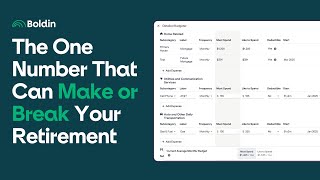
Mike Pappas argues that planned spending, not account balance, determines retirement success. He breaks down how spending changes through retirement phases and shows a couple whose success rate jumped from 67% to 77% after accounting for healthcare costs and one-time expenses.
Questions this video answers
Mark is 60, Elena is 58; planned retirement ages are 62 for Mark and 60 for Elena.
$11,000 per month.
Essentials: $8,000/month; Go-go: $10,500/month; Slow-go: $9,500/month; No-go: $7,500/month.
Two car purchases at Mark ages 65 and 75 of about $35,000 each (today's dollars); a future roof; additional long-term care one-time adjustments (timing tied to longevity ages).
About $12,000 per year for each of them until age 65.
Chapters
You. Most retirement advice, honestly, a lot of it gets it wrong. You've probably heard that you need a million dollars or two or three to retire, or that your investment returns will make or break your plan. But here's the truth. Your total investment account balance is not the number that defines success. The real number, that one that can truly make or break your retirement, is how much you plan to spend. Hi everyone. Mike Pappas here, a certified financial planner professional and the head of support at Bolden. Today we're talking about spending. Because whether you're still working or already retired, your expenses drive your outcomes more than almost anything else. And here's the good news. Unlike the markets, unlike tax law or inflation, spending is something you can actually control. Most people focus on investments or they look at their net worth and think that's the total story. But it's not. It's your lifestyle costs that determine how long your money lasts, how much flexibility you have, and what success even means for you. Creating a spending plan isn't just about tracking dollars. It's about making sure your money lines up with your values and priorities. Put simply, spending is the key driver of your retirement success. And this is where a lot of people can go off track. First, you may have a feeling for what you spend every month. Eh, 7,000amonth sounds about right, for example. But once you revisit it, that number may very well be off. Second, have you thought about one time or irregular expenses? These aren't monthly bills. They're the big ticket items that sneak up if you don't plan for them. Like buying a car every seven to 10 years, fixing a roof, or helping your children or grandchildren, these one time expenses can add up so they can't be forgotten. Third, many people treat spending as a flat monthly number, increasing at inflation for the next several decades. But life doesn't work that way. Early in retirement, many people spend more, whether it's through traveling, checking off bucket list items, or just going out with friends and family. More. Given the increase in time later on, spending often slows down and eventually it's likely to shift upwards again as health care becomes a bigger focus in the later retirement years. And this isn't just theory. Retirement spending research shows that spending isn't so linear. It comes in these phases, often referred to as the go go years, when you're most active, the slow go years when you're easing back a bit, and the no go years, when spending is mostly essentials like food and healthcare. And finally, many people's budgets don't split Essentials from Nice to Haves what are your must spend expenses or costs you can't cut, like housing, food and healthcare? And what are your discretionary expenses like travel, eating out, personal care and hobbies? The things you'd love to keep but could scale back if you had to. So how do we actually bring this all to life in the Bold and Planner? Let's open up the Bold and Planner, specifically the expenses and healthcare section under my plan, because this is where everything comes together inside the planner. You essentially have a choice between two budgets to work with, the basic budgeter or the detailing budgeter. Let's start with the basic budgeter first. This gives you a straightforward way to set your spending, but you don't want it just to be one flat number like we see here. The basic budgeter allows you to tier your spending across the different spending phases we mentioned earlier, so your plan reflects real life. Second, there is the detailed budgeter. This allows you to dig into the weeds a little more with your spending. You can break things into categories. You can say whether an expense is monthly, quarterly or annual. You can mark certain expenses as tax deductible, like property taxes, for example. You can create a must spend and like to spend budget. And you can even add phases to specific expenses like traveling more in the early retirement years than the later years, for example. Let's walk through an example. Meet Mark and Elena. He's 60, she's 58 and they're planning to retire at 62 and 60. Respectfully, when they first onboarded and created their Bold and plan four years ago, they used the basic budgeter and as we see here, they set their spending at $11,000 a month, increasing each year with inflation at the time. That felt about right to them given a mix of how they felt about their current spending, but plus everything they would like to do in the future in retirement. But the thing is, they hadn't really revisited that number in years and with retirement around the corner, they felt it was the right time to give it a closer look. So one night recently they created another scenario in their bolden plan, which is now their baseline plan, and sat down and went through the detailed budgeter, walking through the categories together and talking it through in detail one by one. Home related expenses, utilities, food and dining, personal care and more. That exercise gave them a much clearer picture of both their current spending and what it might look like throughout retirement. And what they found was eye opening. Around $8,000 a month lined up with their essentials like housing, utilities, groceries, some minimal travel and other must haves. This was essentially their current spending while working, but they realized the spending they would like in their early retirement years was closer to $10,500 a month. That included the essentials in their must spend budget plus additional discretionary expenses like travel, dining out, hobbies, family gifts and more. The difference wasn't just about the number, but also understanding what flexibility they had if they ever needed to adjust. They also came to the realization that they won't be spending around $10,500 a month, rising with inflation for the rest of their lives. Early on they might spend more, but as retirement goes on, a lot of those discretionary expenses are likely to taper off. With that clearer picture, they went back to the basic budgeter. But this time instead of sticking with one spending figure, they used it to build out a tiered spending plan like you see here, adding spending phases, one time costs and other adjustments that reflect how retirement really works. The first thing Mark and Elena tackled were one time any irregular costs. These are the big ticket items that can sneak up if you don't plan ahead. They included two car purchases, one at Mark's age 65 and another at Mark's age 75 of about $35,000 each in today's dollars. A new roof in the future and since they live in California, they built in more conservative long term care cost assumptions than Bolden's defaults. An additional $3,000 a month in the 28 months leading up to each of their longevity ages. Then they set up the spending phases we referenced earlier. Current working expenses of $8,000 a month taken from their must spend budget as they don't plan on traveling a ton while they are still working for the next couple of years. Go go years they decided were ages 62 to 75 of about $10,500 a month for lots of travel, going out to eat and hobby time. Slow go years they decided were Mark's ages 75 to 85 of about $9,500 a month. The idea that there would be fewer trips or less adventurous traveling around the world and maybe slowing down with their more expensive hobbies. The no go years or marks age 85 through their longevity ages they decided were about $7,500 a month. This is mostly essentials a little under their original must spend baseline, knowing the travel for them would likely be very minimal if at all at this stage of their retirement journey. Outside of the recurring expenses section, they also built in medical, Medicare and long term care assumptions before 65, Mark and Elena will need private health insurance through the California Marketplace without employer sponsored coverage. They're estimating that it will run them about $12,000 a year for each of them until they are on Medicare. When Medicare kicks in at age 65 for both Mark and Elena, they are assuming the default comprehensive option in bolden of original Medicare with a Medigap policy and a drug plan adding median premium. This assumes total lifetime costs for mark of about $156,000 and for Elena of $178,000 for long term care. Mark and Elena are choosing to self insure by selecting plan to use up savings and then try to qualify for baseline care through Medicaid. This assumes average cost for assisted living care based on Genworth data for both Mark and alaina in the 28 months leading up to their respective longevity ages. Thinking through these additional costs gave Mark and Alaina an extra boost of confidence that their spending plan now reflected real life. Once they updated the Expenses in Healthcare section, they they can now see how they are doing by revisiting their retirement chance of success. Here we are again on Mark and Alaina's original spending plan assuming a flat $11,000 a month expense which if we scroll down we see that this plan has a 67% retirement chance of success, which always made Mark and Elena feel very uneasy about their retirement plan. If we go back to their baseline plan, updating their plan with spending tiers one time costs and additional long term care assumptions actually increased their chance of success to a 77% score which we see here. This is mainly due to the go go, slow go and no go years that Mark and Alaina now reflect in their plan. After listening to many podcasts and reading many articles on on this retirement spending research like our bolding users love to do. And here's what really gave them confidence. With the phases built in, they could see room for adjustment if needed. If a severe market downturn hits, they could trim travel for a couple of years if necessary in future phases of retirement for example, and the plan will get back on track. So by starting with a flat number, revisiting their assumptions and then using the basic budgeter in bolden to build out spending tiers and additional one time costs, Mark and Elena went from guessing to actually knowing what their retirement could potentially look like throughout their retirement journey. And that shift gave them confidence. With a 77% chance of success, they now saw just a 23% likelihood of of needing spending adjustments in the Future, down from 33% before this exercise. So here's what we want you to think about. Do you know what your lifestyle really costs today? Have you accounted for one time or irregular expenses? Have you built in go go, slow go and no go years into your bolded plan? Have you revisited your medical, Medicare and long term care assumptions? And most importantly, do you revisit your spending regularly as life changes or with retirement around the corner? At the end of the day, spending isn't just another detail in your financial plan, it is the number that can make or break your retirement. Get it wrong and the plan falls apart. Get it right and everything else starts to click into place. That's why Bolden turns that number into more than a guess. So you can see the trade offs, build in flexibility and move forward knowing that your retirement is built on one of the few assumptions you do have control over your spending. Thanks for watching and don't forget to subscribe to Bolden's YouTube channel for more tips and guidance on building your retirement plan. And if you haven't already pleased, you can try the Bold and Planner for free and see for yourself why spending really is the number that has the potential to make or break your retirement plan. Happy planning everyone.
More from Steve

When Should You Claim Social Security? #personalfinance #financialplanning #socialsecurity

Social Security & Medicare: What's Changing and What It Means for You with Mark Miller (ep. 109)





Retirement Savings Waterfall: Where Your Next $$$ Should Go (401k, HSA, IRA, Brokerage)



