You Can Afford Anything but Not Everything with Paula Pant (ep.105)
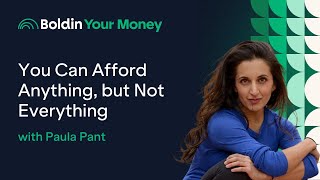
Paula Pant, founder of Afford Anything, talks about her sabbatical for an economics degree and how she weaves macroeconomics into personal finance. She covers housing decisions, remote work tradeoffs, and her five-pillar framework for building wealth: financial psychology, income growth, investing, real estate, and entrepreneurship.
Chapters
You.
Hi, folks. Welcome to Bold in youn Money, where we talk with bold thinkers who are reshaping how we live, work, and build financial independence. I'm your host, Steve Chen, and today I'm excited to welcome back Paula Pant. She's the founder of Afford Anything, a personal finance platform and podcast built around a simple but powerful idea that you can afford anything, but not everything. So Paula has helped millions of people think about their money and their time and their attention and how to design a more authentic life. So last time Paula was on our show, we talked a lot about financial independence, real estate, and how to build a safety net as an entrepreneur. And today we're going to talk a little bit about kind of what's happened since then, kind of where Paula is today, what's changed with her life and business, and how her thinking has evolved around personal finance, how AI is affecting the world of influence, influencers and personal finance. And so with that, Paula, welcome to our show. I appreciate your time.
Thank you. Thank you so much for inviting me on.
No, it's great to have you back on, and I kind of wanted to just open up with a little bit of, like, what's happened recently. You know, I know that you've continued to build a pretty big media empire here and just kind of how your. Your life and work has evolved the last few years.
Yeah, absolutely. So a couple of years ago, I took a sabbatical for a year to go to grad school, and I got a degree in economic journalism. And that really helped round out, you know, I'd been talking a lot about, per the personal element of personal finance, but doing a formal study in economics gave me some. Some good background in how to tie in what's happening in the broader economy into what I talk about. And so on the podcast, on the Afford Anything podcast, I've started integrating a lot more economic news into what we discuss. So I'm layering in inflation, I'm layering in unemployment. You know, like that. You know, how do we manage our money in the context of the bigger picture?
Nice. And do. Do you think your audience, I guess, do they appreciate this?
They do, yeah. So we dedicate one episode a month. On the first Friday of every month, we have an episode that entirely focuses on purely economics. And I anecdotally, I hear from people that that's their favorite episode of the month. I've heard that from a lot of people. Normally, our format on the Afford Anything podcast is that every typically once a week, we. We air two episodes a week. And Typically once a week we'll interview a guest, but then once a week we answer questions that come directly from our listeners. And I have noticed, you know, the, paying attention to those questions, you get a good sense of what are people worried about right now? What are people thinking about? And lately a lot of the questions have been around the, the broader theme of how do I balance all of these conflicting priorities. You know, there are a lot of people who, they have elderly parents and they also have young children. So they want to make sure mom and dad are okay for their retirement, but they also want to make sure their kids are, you know, have the money that they need to, to grow up and go to school and eventually go to college. Maybe they've got a small house and, and they want to move to a different house, but they've already locked in a low interest rate during the low interest and they don't want to get rid of that old interest rate. So what do they do there? Or maybe they're a renter and they want to get into their first home, but they feel priced out. So there are a lot of people who just have very, you know, a lot of different priorities that they're juggling and, and that's always true, but I feel like I, I get more questions about that now than ever.
Yeah, I think it's very real. I mean, for what it's worth, I see this in our employees and in my own life where people are living much longer. You know, we talk about this, but like, you can start to see it in people's lives where, you know, people are in their 90s. It's common to have relatives in your 90s. And I think people over 100 are the fastest growing demographic, which is kind of, I mean, it's from a small number for a small base. But you know, you, so now you have these generations where, you know, you've got whatever great grandparents grant, like, so having a great grandparent is possible, you know, but like you've got four, easily four. But you could have, you know, more generations going. And I think that we're also so much more self aware about these or work. There's growing awareness about these obligations. Like, oh, I might have to be, you know, before it was like, raise my kids, help them get through daycare, get into college, pay for college, and then they're on their own. Now it's like, well, you're supporting these young adults and then maybe you're supporting your aging parents at the same time. And like it feels like the obligations never end. Do you see that in your audience then? They're really.
Yeah, yeah, yeah, I see a lot of that. I don't see as much of supporting kids into their 20s. There's, I think to the extent that I hear about that from my audience, it's like, oh, our kids still lives with us, but it's more about like you're providing housing and accommodation rather than actually paying money. So from a cash flow perspective, there's no real cash flow impact.
Yeah, fair enough. But I still think it, I, I have to imagine there's little, I don't know, like when I graduated college, I went off and got a job and I had my own insurance or, you know, whatever and paid for my own car and had an apartment and stuff like that. I feel like now a lot of, you know, a lot of young adults are, you know, they're on their parents health insurance, right? That's possible till they're 26. And maybe cell phones are being picked up from the family plan, stuff like that. There's kind of like this persistent drag that's still out there and it's, it's not nothing. So what are some of the things that your audience does to juggle these, these conflicting or these competitive needs?
So one of the things that I often tell my audience, because, you know, we get audience members who call in to about, about half of our shows are these call in episodes. And a lot of times what we will do is sort of unpack the timeline, the amount of money that that goal might require and the level of importance. Those are sort of the three vectors that we're looking at. And so if you score everything along those three vectors, you know, what is your timeline, how much do you think that this is going to cost and how essential is it relative to all of these other priorities? When you, you first map that out in a perfect world where you're fulfilling all of these goals and you quickly realize that you're not going to be able to reach the full goal by the intended timeline. And so at that point you've got a couple of options. You either extend out the timeline, you reduce the amount of money associated with the goal, or you eliminate a few of the goals entirely or defer a few of the goals entirely. So a lot of it is a practice of thinking through those three vectors.
You know, as we kind of run our own business here and think about the growth, where do we do this annual planning where we're like, hey, what are the things that we want to do in the next coming year? And what's the expected value for each one? Right. What is it? What's a cost? What's the investment required? What's the expected roi? What, you know, so. And then stack rank those things and then make trade offs. I feel like there's such a, you know, it's the same process essentially for personal financial planning. Do you find families having discussions like, hey, we're going to trade off state school versus private school versus caregiving for our parents? Are discussions like that happening?
You know, I think it tends to happen, if it happens at all, which I think is relatively rare in a lot of families because there's a lot of communication breakdown around particularly money. Most of us are not taught to talk about money. In fact, most of us are taught that conversations about money are impolite. And so it's rare that a family will be able to have healthy money conversations. And typically when I see that happen, it will happen between couples, but it won't necessarily. People don't necessarily loop the kids in and get them involved. So there's a lot of training that needs to be done and a lot of unlearning. Some of the, some of the things that we've been taught, you know, lessons that we've been taught about not talking about money, about it being a taboo subject, you know, there's a lot of unlearning that has to happen in order for these healthy money conversations to take place.
Yeah. Do you think this is changing across generations? So one thing we've seen with our employees is, and a change we made is, you know, younger generations were like, hey, my expectation is that, and I think it's the law now, like salaries would be published on job requirements. And I know there's also kind of a much more open dialogue about employers and what they pay and what it's like to work there. Do you see that happening in your audience too?
You know, it's state by state in terms of the requirements as to whether or not salaries need to be published. And there are certain. And salary ranges are published in job ads, but some job ads have ranges that are so insane. I actually took a couple of screenshots. This just came up the other day and I took a few screenshots of a job posting that I saw in which the salary range was, it was like 60,000 to 400,000. It was this wild range, you know, like that range is virtually meaningless. And granted that's rare. You know, I screenshotted it because it was such an anomaly. And I do think it's a very Positive development that salary ranges are required to be published because it, it gives everyone a solid sense of, you know, what ballpark is this in? And for younger people who are thinking about what careers do they want to go into, you can easily look at some of the job availability and say, hey, what would this pay if I were to go into it? That being said, jobs are changing so rapidly, especially now with the advent of AI, that there's also this uncertainty. You know, this is what these jobs, this is, these are the jobs available now and this is what they pay right now. But how true is that going to be five years from now? And so I think what a lot of people are feeling is not just uncertainty around present day salary, but there's this level of uncertainty around how long is this going to last. You know, how much security do I have? Am I, you know, am I one pink slip away from some type of a calamity?
Yeah. Do you feel like uncertainty is climbing in your audience?
I think the perception of uncertainty is certainly climbing. I mean, we can see this in the data. The University of Michigan tracks a consumer sentiment index and right now the consumer sentiment index as of November of 2025 is the lowest that it's been since July of 2022. We just went over this in our last one of our recent episodes, which is why I know the stats off the top of my head. But so we see that consumer sentiment is at a two and a half year low or three year low. We see that many people feel as though their wages have not kept up with inflation. We see that in the jobs market, we do have historically low unemployment, which is great, but we also have low job creation, slash net job losses in many months, which means that people by and large are staying in their jobs. There's not a ton of turnover. So while unemployment is still low, a feeling of mobility is also quite low. And then when you stack lack of new job creation and the lack of mobility associated with that, when you layer that on top of a lot of people feeling, you know, existing homeowners, feeling the lock in effect and feeling like they can't move, while people who are not yet homeowners feeling as though they're priced out. I think when you put all of those factors together, you get a population that largely feels a lack of mobility, lack of geographic or housing mobility, plus a lack of job mobility. And when you feel lack of mobility on multiple fronts, you feel stuck. That's what lack of mobility is. And so I think there's a lot of economic frustration coming from that.
I think that's very real. It's definitely tough. I mean, you've got like folks that locked in to these 3% mortgages. They don't want to give them up. It's too expensive. And yeah, I don't know how, you know, families are doing it in a kind of a 6 to 7% mortgage environment. I do know, I feel like it's coming down a little bit, but I don't know if it's going to come back. I was actually talking to my wife about this. Like, will we see 3% mortgages again? I don't know. The U.S. debt is pretty high. We have to be competitive to get people to refinance our debt. We've got whatever trillions of dollars of debt rolling over.
Yeah, well, and, and if the, if the increase had been slower, you know, if it had taken many, many years to very slowly rise from 2 to 3% mortgage interest rates up to 6 to 7%, we wouldn't have such a severe lock in effect. So much of the lock in effect that we're seeing comes from the fact that we had a period of many years in which people could lock in 2 to 3% mortgages, 4, 4% mortgages at worst. And then there was a very sudden and very steep increase up to seven. And, and now it's like, you know, down to a six handle. But it's still, as of the time that we're taping this, it's around 6.3%, 6.2 to 6.3% on a 30 year fixed. And, and it was, it was the fact that that increase was not just so severe but so rapid that created such a stark impact.
Yeah, yeah, for sure. Yeah. It's interesting. And also we've got, you know, a lot of boomers and older generations that have built a lot of home equity, but it's locked up. I think it's one of the opportunities in our economy is if people can figure out a way to unlock this home equity. But people have been talking about it for a long time and you know, the common way is sell your house and move and downsize or whatever, but if it'll cost you just as much to sell and move, then, you know, to get a smaller house. Are you going to do it? And most people will say, no, I'll just stay where I am, you know, but then, then you've got like, you've raised your family, then you're living in this big house with no, no more kids, but you're just sitting in it because it doesn't cost. There's no value to kind of getting out or there's not as much value to getting out, so you don't do it right.
And, and that challenges a lot of people's retirement assumptions because so many people pay planned that, oh, in retirement I'm going to downsize. And then you get to, you know, the, the where we are today and you say, wait a second. This assumption, which was a key part of my plan now no longer plays out. So if I can't downsize in retirement, then, you know, one of the foundational, one of the foundational assumptions on which I built this whole plan is now shaky.
Yeah, for sure. It's interesting. I think like the whole remote work was a unlock for a while, but now it feels like return to offices is coming back and there's definitely value to being back in the office. But I think the geographic arbitrage like moving. I was visiting someone in our family, they live in Colorado, I live in California. And their burn rate is a couple thousand dollars a month basically. And compared to California, that's their spend now they have their house paid off. They're very efficient in how they live. This is a retired couple and relative to someone like in my town, I was just at a CFP on in my town and they're like the average person where we live is spending on the order of $15,000 a month, which is insane. I say that's a negative, right? That it costs so much money. But there's still that wild disparity. Or if you went to Mexico or you move to certain places in Europe or wherever, like, or Southeast Asia, like you can live. And I was actually talking to a YouTuber that went to Thailand. He was saying what it costs to live there and the same thing, it was like a couple thousand dollars a month, but to live like an incredible lifestyle. So that's all out there.
Yeah, yeah, there are, if you can, if you can be fully remote, there are incredible geo arbitrage opportunities. And with geo arbitraging in Asia, what I have found, because I have, I've done that, I've done long stints overseas in the past in Asia. The big challenge is time zones because if you, you know, even if, even if you are working remotely, you want to be working during hours when you can have zoom calls and meetings and send slack messages with people in the United States. And so the time zones, the time zone alignment can be really challenging. But there are plenty of opportunities to geo arbitrage from Latin America where you can you could be in a Western hemisphere time zone and still have a very reduced cost of living.
Are you seeing people in your community do that? Or they're moving to Mexico City or they're moving to Buenos Aires or something like that?
I mean, some. But it's quite niche, you know, because it requires a very specific type of person, type of personality, set of life circumstances. I mean, I think there are a lot of people who are a little interested in doing it, but they have elderly relatives, maybe they have the type of work. One spouse is fully remote, but the other spouse is hybrid. And they, they have to come into the office one day a week. Right. So it's just enough that they can live out in the suburbs or even the exurbs, and they can do a mini Geo arbitrage in that regard. They don't have to live in Manhattan per se. They can live in central New Jersey and commute into Manhattan one day a week. So they can do sort of a mini Geo arbitrage in that regard. But if they still have to come in one day a week, then they can't go as far as Mexico City.
Yeah, right. For sure. It does feel like it's this great idea. And what I've seen is maybe people in their 20s. I mean, when Covid was happening, right, this whole digital Nomad thing was real. And yeah, if you're in your 20s, yeah, that's the window to do it. But then if you, especially if you start having kids, then you're like, okay, you have to make this real decision where you want to raise your kids, and then your kids are getting older, and then suddenly you're right up against elderly parents. And I think your window for doing this shrinks.
Yeah, I'd say that the elderly parents are in some ways an even a bigger consideration. Like kids, at least you've got the flexibility of. You know, I, I know plenty of people who have geo arbitraged with their kids. And the kids pick up languages so fast. So then the kids are like, correcting the parents. They're like, well, mom, dad, why are you so slow at picking up this language? You know, kids pick up the languages super fast. They, like, fit in with the new set of friends really fast. They learn how to play cricket, they learn how to play soccer, which over there is called football, you know, and so, like, they, they have this level of adaptability that is actually quite inspiring to, to the grownups. And so I've. I've seen my, my sister do that with my niece. Like, she. Man the way that my niece can, she's six years old. And the way that she has been able to adapt country to country to country is just incredible. The challenge, though, is that, you know, elderly parents and grandparents, they can't. They're more rooted. Right. They need medical care, they've got to see their doctors. It's difficult for them to change. You know, it's difficult to, for them to travel. And it creates a lot of stress on the body.
Yeah, yeah, 100%. What's your sister been doing? Where is she going from place to place?
So she is a film producer based out of Kathmandu. And so much of her work involves picking up and going to somewhere for five months, six months at a stretch, you know, doing a film shoot there, coming back to Kathmandu to process video, and then going elsewhere for, you know, four months and then coming back and so.
Yeah, how did she pick? I mean, was she living in Kathmandu or. She went there.
Yeah, yeah, yeah. So we, we were both born in Kathmandu.
Okay, that's very cool. All right. Well, I guess the last thing I would just. On this topic, in terms of AI and your audience, you know, you talked about how people feel like they have less visibility. Any particular stories that jump out or anecdotes from you in terms of how people are, I guess, adapting and thinking about how it could affect their careers?
Yeah, I think the biggest one is that human. If you think about what is uniquely human, most of our technical skills can be automated, but the things that cannot be automated are relationships. And so I think as we enter this new era, the, the quote unquote soft skills become increasingly important. Empathy, listening, you know, responsiveness, just everything involved in maintaining strong relationships becomes increasingly important. And here actually is sort of a plug for face to face work. Because one of the things you really lose when you have fully remote work are, is some of that relationship building. Right. Like having FaceTime with somebody, you know, sharing a meal with them, having drinks with them, that is really essential to relationship building. And you can do that with frequent, frequent business travel. But there's also. But those are sort of like annual check ins. There's something very different about forming these face to face relationships with a set of colleagues or a set of clients that are in your actual hometown. I think that as we move towards AI, I think in person, work becomes even more important than before.
Yeah, I was talking with our CTO about this today. He was saying, you know, we were just talking about how there's more AI generated to everything. Content, music, videos. And as that becomes more Prevalent, it's potentially going to get less valued. Although the counterpoint would be that if it gets more personalized, maybe it gets more valued. So I think tbd. But then either way, yeah, the scarcer thing is going to be humans and their attention and the relationships you build there. So that will become more valuable. So I think that makes a lot of sense. Yeah, it'll be interesting to see if we can do it. I mean we have an all remote company and so we interact a lot like this over zoom. It's not the same as being in. We've also seen the value of like bring everyone together and get in person, which is fantastic. But it's, you know, anyway, the way we've come up is just to do it in a distributed way. So we're, it's, it's, you know, we're going to see how it goes as we, as we work to scale the company. Okay, cool. Well, look, I wanted to like, I wanted to kind of keep to chat a little bit about kind of like how things have evolved for you as you've kind of built your YouTube channel, you know, and built your podcast, I think your podcast at 40 million downloads, you've got 64,000 people on YouTube and obviously got a kind of pretty big operation here. Any big lessons that you've learned and I know you started with blogging originally so you kind of, you're one of the winners and evolving here. Any huge insights as you kind of. And like anything as you look forward to. Do you see more changes on the horizon?
Yeah. You know, so if you think about how you are connecting with an audience and how you're, you know, the goal is to, to educate and entertain, be entertaining enough that you can put forth this financial education. Right. And there are a few key things that stand out to me. One is that you need something that makes you unique or different or special and it doesn't have to be the same thing for every creator. I think that part of my value is that I bring depth and nuance and intellectual rigorous to a lot of subjects. So I, I don't stick with the tactical or the surface level or the cookie cutter. I really, I unpack a lot of things. I don't like to be prescriptive. I like to instead take an issue and look through a prism and say, all right, here is the issue. How do we look through this from multiple lenses? How do we think about how to think that that metacognition so that we can become better thinkers and better decision makers. And I think that has been a big part for me of how I've, I've set afford anything apart. But it doesn't have to be. Not everybody has to follow that same playbook. I know other people who, you know, their skill set is that they're just really funny. You know, they're just, they're natural comedians and that's what they're great at. I know other people who are, you know, just, they're, they're witty at one liners. So everyone's got their thing, but you've gotta, you have to have your thing that makes you stand out. Some people are abrasive, you know, and, and that's, but it's like that's their personality and it plays on, plays well on video. So yeah, everyone's got their thing, so that, that's part of it. I would say also that there is a distinction between what is short form that you short form and scrollable that you know, what is short form content that people find when they're scrolling versus what is more long form in depth content that people actually search for. And where I have always, where afford anything has always stood out is in long form searchable content. We have actually never been very good at, at the short form scroll behavior. We've always, you know, our bread and butter, our unique skill set has always been long form loyalty, you know, and that's why we excel in audio podcasting, which is, that's a platform that, that is not a platform where anybody scrolls. Nobody opens up Apple podcasts and absentmindedly scrolls through podcasts. Right. If you're going to Apple podcasts, it's because you are searching for a particular type of podcast. And if you're the type of person who's searching for a personal finance podcast, then you're likely to find us, you know, but what that means is the audio podcasting is for people who are searching out this information. It's not people who are absent mindedly, you know, in the waiting room of their doctor's office, scrolling through Instagram and then they stumble across something.
Right. Do you feel, I mean, so blogging is kind of the most, I mean, it's in depth, but you have a less of a sense of somebody. And a podcast is much more personal. It's also in depth, but it is super long form. And then with video you can see them, how they behave. You get all these other cues. Do you feel like you're building stronger relationships with YouTube or does it not matter?
I do think that, that YouTube and video in general has the potential for building very strong relationships because of the fact that now you see what they look like, now you have a whole visual in your head. What I don't know is how that's going to change as more AI created video becomes ubiquitous. I think one of the, the big question marks is, you know, what happens when it becomes difficult to tell what's real and what's AI generated? You know, right now, things, videos that are AI generated, they don't quite pass the Turing test. Like you still get a sense that this is AI generated. You know, that that's the current condition of video as of, you know, the time that we're recording this. But a year from now that likely will have improved by some exponential factor.
Would you ever. You said you're doing call in shows and I know that AI voice is pretty good now. Like there's very little latency. You can have conversations with these, you know, voice agents that will answer phones and do things like that and do support. Would you ever see training up a AI palapant that could take Collins and just answer like you?
Jeez, I don't know. We had a listener once who went into ChatGPT and asked ChatGPT. She had some, I forget what her question was, but she had some sort of a, a personal question that she wanted to ask. So she asked ChatGPT to answer in the Paula pants style. She I and I, I frequently answer questions with a recurring guest, co host, Joe Salsihai. So she said, hey, give me the answer that you think Paula and Joe would give. And ChatGPT predicted what our answer would be. And then she called into the podcast, she asked us the same question, but she didn't tell us what ChatGPT had predicted we would say so that she could test whether or not our answer was aligned with what ChatGPT thought our answer would be. So this is a long answer to your question, but I wouldn't want to be the person doing that. I would want people in my audience, my listeners, I'd want other people to organically create a gentic Paula GPT, but then come to me, ask me the question and then you, then you're ab split testing. You know, what did I say? What did Paula GPT say? And how closely aligned are the two and which one, which one's better?
You know, how close, how close was the answer?
Yeah, exactly, exactly. So she did, she called back. I'm trying to remember if she called back. I'd have to look back again at the, at the episode. It's. I don't remember the details of if she called back to tell us.
Yeah, that's pretty interesting. I mean, we definitely see people doing this with our software. They are taking plans and then dumping the. You can create a PDF version of your plan. You can get the data out of it, pushing the data into different LLMs like ChatGPT and then asking questions. So we're actually going to be rolling this out as a feature in our platform. Just let people do this. And what's interesting is just the underlying models are getting better and better. I was listening to Hard Fork the other day, and they were talking about how Claude Opus 4.5 just came out, and for the first time, one of the hosts was saying this thing generated written content that I felt was very close to what I would have written myself. So stylistically, because I did this before too, I said, hey, write an article in the style of Bolden, you know, and go read a bunch of articles and make an article about this topic. And I thought it was decent, but it's, it's every day these things are getting better, you know?
Right.
And so that's the, that's the interesting part.
Yeah, yeah, exactly, exactly. We are. We are very quickly about to create agents that are more intelligent than us. And it's. It's going to be such an interesting turning point in human history, you know, to not be the smartest creatures on the planet anymore.
That is it. You know, I think it's a question. Are they going to be. They're going to have better memories and they're going to be able to produce stuff way faster. That's already true. Because these things can bring the Internet to you and answer your question in a way that, like, searching never could. Are they going to be more innovative? I don't know. Like, let's see. Because if they are, then whatever, then game over, right? The next evolution. But we'll see. I don't know there, I guess. Do you believe that? Do you think that they will be smarter than we are in every way? I guess, I guess there's lots of ways to be intelligent.
So I think the delineating line between them and us will start to blur as. As there are more AI human integrations, until eventually the line between what is what is human and what is AI is, you know, what is what is organic matter versus what is algorithmic matter. That line is going to get fuzzier and fuzzier.
Yeah. I think an analogy is I talk to people that run businesses, they might get an assistant and they get a smart assistant. An executive assistant and they train that person to like level one is okay, just kind of pre process stuff and tell me what I need to pay attention to. Then they learn about you and then it start to take action and be an agent. Right. Like you would know what I would do in this scenario. Right. You've seen me do this a lot, so go do that. I feel like this is the exact same thing that's happening. I mean, I've got like in Gmail, 40,000 emails or something. I don't know, some ungodly amount that's sitting there. Right. So it knows a lot about what I think, how I write, you know, how I've responded before to different kinds of people and organizations. It does feel plausible that you could be like, all right, Steve, you got 100 emails today. This is how I apply to them. You can scan like, do you approve, you disapprove, whatever. And then it would start actually doing stuff.
Exactly. Yeah. But I imagine the next evolution or the next iteration of this is going to be human AI integration in which AI becomes part of our bodies, it becomes integrated in with us. So that, you know, where do we end and where does the AI begin? Yeah, I guess, I guess. Really, where does it. Where. Maybe it's not a anymore. Maybe it's just I. Right. Maybe it is no longer artificial if it becomes incorporated into us.
So your long neuralink.
Yeah, exactly, exactly.
Yeah. I mean, it's crazy that we're having these conversations that like that could be a plausible idea, but my son's girlfriend works at this company in San Francisco that they basically put skull caps on people and they're going to try to use external energy to change your. I think it's to address things like anxiety and depression and stuff like that basically affect your brain remotely. So it's not going to be wired in like neuralink. But people are pursuing these things in a very real way. So all the stuff that we felt like was science fiction a few years ago is like fully funded things that people are working on.
Yeah, that's incredible. It's a really interesting time to be alive. The next 10 years are going to be incredible.
I agree with that. I definitely have the sense that it is an incredible time to be alive and don't die, you know, like, hang on because like, who knows what's gonna happen, right? Like one, it'll be interesting to see and two, maybe we'll live longer if we start figuring out a lot of the healthcare stuff, Right?
Yeah, exactly, exactly, exactly. You know, it's. It's entirely possible that the first person who's going to live to be 150 has already been born. You know, and think about the Social Security implications. I mean, what are the retirement planning implications of living to 150?
Well, hey, I think if you're doing neuralink, do you think you're going to upload your brain into a computer and then live there forever? Well, look, let's shift back from the realm of what is possible to how this is affecting personal finance, how people should think about their future. I think it really is interesting that it's both a world where it's like incredible things could happen and it's really uncertain. Our jobs could get replaced. People are worried about defending against that and then they're like, oh, is there this abundant future? Like, how do you think about that? How does, how does your community think about this and, and, and address it or hedge it?
Yeah, so there, there are a couple of things. So I, when I talk to my community, I, I emphasize what I call the, the five pillars financial psychology, which is like getting your money mindset right, increasing your income. Because earning more is the single most effective lever to increasing that delta between what you earn and what you spend. Because when we talk about savings, the word savings has a connotation of frugality. But what, you know, it isn't what, we're not chasing frugality for its own sake. We're chasing the delta between income and expense. And sure, you can pick the low hanging fruit, but at a certain point you can't shrink your way to greatness. So increasing that delta, your, your most powerful lever is increasing your income. So the five pillars, pillar number one is financial psychology. You know, pillar number two is increasing your income. Pillar number three is investing. Pillar four is real estate. And I mean that in the context of buy and hold real estate investing. Whether or not it's worth it to buy a primary residence is going to depend largely on where you live. But, but I do think there's value for everyone to buy and hold some rental real estate. So that's pillar number four. And then pillar number five is entrepreneurship of some form or other. And for some people who are happy having a W2 job, it might be side hustle, you know, something fun that you do that brings in a little bit of extra money. Maybe it boosts your income by an extra 5%. It doesn't even have to be like a big thing. It can be sort of a, an income producing hobby. But I think everyone should have some type of entrepreneurial Venture, whether large or small, because you have autonomy, you diversify your income sources and you know, if you do lose your job, if the worst were to happen, then if you've already taken the time in a low stakes manner to test drive a handful of ideas and see what works and then build a little bit of momentum in this fun little side quest that's working, then in the event that you do get laid off, okay, now you already have that side quest that you can lean further into. So those are the five pillars. The acronym is the word fire with two eyes. Double I fire.
So financial psychology, increasing income, investing, real estate and entrepreneurship.
Yes, Double I fire.
Double I fire makes sense. Yeah. And I agree with all that stuff. I think it's all core. I guess I'd be curious about real estate. And also, I mean, and by the way, entrepreneurship I completely agree with. I feel like that is something that everybody has to learn now. And in fact, I mean, just one color commentary. Like a lot of my friends have kids that are graduating college now or the oldest ones are starting to graduate college. And you know, it's a tough job market for new college grads. For many of them, they're finding jobs, but maybe not the perfect job they want. And I think the ones that will be more successful will have a more entrepreneurial perspective and say, look, I'm probably going to have to. I think many more people are going to have to create their own careers going forward, you know, because more stuff, more traditional stuff will get automated. You know, the stuff that takes lots of people is going to get automated first.
Right.
So that's where the cost savings are for companies. So then you have to create new things. But on the real estate side, it feels like it's a lift. You know, it feels cool and like it'd be great to own a bunch of real estate and. But it also feels like you got to learn about buying it, managing it, renting it out, maintaining it, all that stuff. And it feels like there's a whole lot of. It feels like a niche thing that a lot of traditional fire people got fi. People got into. But I don't know about a lot of other people. But I'm curious what you see.
Whether or not it's worth it to own your primary residence is going to depend largely on where you live. So if you live in a location where owning a primary residence doesn't make sense, then I think there's a lot of value in buying a rental property that's out of state so that you can still have real Estate as a diversified portion of your portfolio, particularly in an instance in which you yourself are a renter. So I'll use myself as an example. I live in Manhattan. In Manhattan, the average price to rent ratio is 55,0 in a place like that. So price to rent ratio is the price of the home divided by the annualized rent. Right. And so if you are in an environment where the price to rent ratio is 15 or under, then absolutely that's a great place to buy a home, to buy a primary residence. But if you're in a place where the price to rent ratio is over 30, then it just, it doesn't make sense to buy. And a lot of high cost cities, you have these extraordinarily high price to rent ratios where owning a primary residence just, you know, you could do so much better renting. And then putting the differential into a broad market index fund.
Is there like a good public resource for the like where they publish all the price to rent ratios across the.
What I would do is just start with wherever you yourself are living, look up the fair market value of your current home. And then if you're a renter, obviously you know what the rent is because it's what you pay. And so the value of your home divided by the annual 12 month rent, that is the price to rent ratio of the place where you live. So you can calculate that for your own home. You can calculate it for your ideal home. Yeah, but I would just. Or if you want to get a kind of a sample of what's around your city, you can calculate it for a variety of neighborhoods across your city. But yeah, just do, do a handful of case study samples and see how it shakes out.
So you think it's, is it, is it like 20, is there a cutoff point where it's like what's the ratio?
So if it is, if it's 15 or under, buy, you know, that's a great place to buy, it's a great place to own. If it's 25 or over, then rent, you're in a place where you should rent. And if it's between 15 to 25, you're in a gray zone. I'd say even between 15 to 20 you're like light gray leaning by and between 20 to 25 you're like dark gray leaning rent. But between 15 to 25 is a gray zone. And that's where factors like how long do you plan to live there? You know, factors like that, those more personalized data points come into effect.
And do you, do you Counsel people on the other side if they're owners, that, oh, if you're in a really high price to rent ratio, you should sell and start renting.
I mean, you could. A lot of people are reluctant. Sunk cost fallacy. Once people are owners, they're reluctant to sell unless they get into some type of a financial hardship that precludes them from being able to continue making their mortgage payments or they have aspirations of early retirement and they realize that selling will unlock a lot of equity that can fuel some alternate goal.
Yeah, I think one of the plays people out here in California, if they have a lot of home equity do is they'll try to make their property a commercial real estate thing. They'll basically start renting it and then they'll 1031 it, you know, they'll sell it and then try to put it in other rental properties and maybe even divide that up across the kids, especially if they have a ton of home equity, and then use that as a way to kind of get around taxes and stuff like that and move assets into their, you know, into their kids.
Right, right. But if it's, if it's a primary residence, there's a capital gains exemption.
If you find a grand.
Yeah, 500,000.
Yeah, you see people out here and it depends where you live, but like they'll be walking around with like millions of dollars of wow.
Of capital gains. Wow. Yeah, it's a different, it's like champagne problems.
Yeah. Okay, interesting. So. So basically it's like, hey, think about your price to rent ratio rent, if it's more efficient and then. But still buy real estate where it's more efficient essentially, and rent it out.
Exactly. Buy real estate because I think it's, it's useful to have some real estate in your portfolio. I would be very reluctant to have a portfolio that was entirely index funds and nothing else. And so I think that, that, that diversification into some tangible real estate, it, it just, it provides good portfolio diversification. Tangible assets tend to be great inflation hedges. Rental income tends to bias towards the dividend or the income stream. And so even if the total, the unleveraged total returns are comparable to index funds, you know, if you're, let's say you've got an s and P500 index fund and a piece of rental real estate and the unleveraged total return on both over the long term aggregate average is maybe 8 or 9%, you still are in a situation where the, those unleveraged returns on that broad market index fund are largely capital appreciation and only a small sliver of that is the dividend. Whereas with that rental property, the, if you're thinking about unleveraged returns, the bulk, even if it's the same total return, the bulk of that return biases towards that dividend. And so even if the total return is similar, the characteristic of how that return is produced is different. And so when you have the differentiation of, you know, with, with rental real estate, you've got a tangible asset which gives you a different level of inflation protection, then you know, something like an index fund. So you've got the inflation protection component, you've got the different return characteristics component. I think for all of those reasons that diversification is very valuable.
Do you. That makes sense. Are there other ways to get this, like REITs and stuff like that that are efficient or is it like, you know, REITs are out there, but. And they, I think they produce higher dividends, but I also feel like some of the fees on them and stuff like that, there's a drag on the returns that aren't necessarily that great.
You know, the reason that I'm not in love with REITs is if you think about this, this fire, this double I fire framework, right. The letter R, the reason part of the, the beauty of it falling in between that letter I and the letter E is I is investing, E is entrepreneurship. And R is kind of the meeting ground between the two. Real estate that you directly own is a bit of a hybrid between an investment in the index fund sense of the word, and, and an entrepreneurial venture. It's a smidge of both. Because when you directly own real estate, you can directly influence the returns that it gets for good or for better or worse. Like, you know, your own mismanagement can create suboptimal returns, or your own great management can create, you know, highly optimal, optimal returns. And so you have this. You know, that's another kind of unique characteristic about directly owned real estate is that it isn't, you know, with, with a share of Coca Cola stock, there is nothing that you can do unless you are an executive at Coca Cola, there is nothing that you can do to improve the returns of that share of stock. You know, Coca Cola and Nike and Nvidia and Tesla, they're, they're going to do how they do. Yeah. And there's nothing that you as an individual can do about it. Whereas with real estate, you do have that direct control.
What do you think a good portfolio to shoot for is in terms of real estate index also asset location? Well, so I guess fixed Income, equities, real estate, cash is the portfolio across a whole household and then where you locate those assets too. Qualified versus taxable, all that stuff.
Yeah, yeah, yeah. I mean, cash you'd put in just a high yield savings account. I don't consider that as part of the portfolio. Right. That's going to be your cash reserves. It's going to be your emergency savings in Roth accounts or tax exempt accounts. You want to put anything that you think is going to be a runaway winner. So more speculative assets, you know, more volatile assets. Anything that you think short. If you invest in small cap. Right. Small cap, I think is a great, you know, Roth accounts for small cap is a great location because small cap does have, over the long term the potential to be a bit of, a bit more of a runaway winner. That isn't what we've seen in the past couple of years, but that is if you expand that, that view out to a 40 or 50 year view. So I would put small caps or volatile assets or anything that you expect might be the superstars of the portfolio into your tax exempt accounts. I would put, you know, as much as possible into tax deferred accounts. And as far as taxable brokerage goes, you know, remember that you yourself are going to be directly paying for, you're going to be directly paying taxes on a yearly basis for any dividend or interest income, even if you reinvest that dividend or interest income. So I would put the types of investments that, that do not kick off a whole lot of dividend or interest income into your taxable brokerage accounts.
Yep, that makes sense. And then how about in terms of like the percentages? I mean, when you think about this, you're like, oh, 25% in real estate, 10% fixed income. I don't know, like depends on how old you are and your needs and stuff like that. Right?
Yeah, it's going to differ for people depending on their, their age, their goals, their timeline, their risk tolerance. I mean, for myself, I'm about 50, 50 real estate versus index funds. I don't, that's pretty extreme. I would not recommend that for the average person. So I will fully, you know, my, my 50, 50 split is, I think it reflects just certain, a certain risk profile that just doesn't fit a whole lot of people. Well, and I say, you know what, and I say that it's 50, 50, but I'm not counting the value of the business that I directly own.
I was going to ask, right. So that's it.
And I'm not counting that in my portfolio at all.
And why not? Like why, why do you not. I mean, it produces income for you. I mean, it's more like a real estate. I mean, well, it's got both. It has, you can control it. It spits off income and it might have a high equity value.
Yeah, yeah, I think, I think because it is so illiquid in every sense of the word. Like it is not only. It's illiquid in that it's, it's difficult to sell, it's difficult to borrow against, it's difficult to even know the valuation. Like what, what is the valuation of my business? I have no idea. So, you know, given, given lack of liquidity and ambiguity in valuation, the easiest thing is to just kind of mentally ignore it when I'm trying to. When I'm calculating the value of my portfolio.
Okay, got it. Yeah.
Yeah.
I mostly do the same things, although in my own financial plan I started thinking about it a little bit more. Okay, well look, we're kind of coming to the end of this. I want to. So I guess a couple things. So one, one question and then one follow up. So one is, do you see individuals getting more empowered now with the age of influencers like yourself and education, but also AI, do you, do you think that power is shifting from. Because when I look at it, I feel like historically in financial services and money, the power has been with the companies and less with the people. Yeah. You know, I'm curious, what if you think that is changing?
I absolutely do. And I actually think that this trend started all the way back in the 90s. I mean, think about just the advent of index funds, right? It used to be that most people who wanted to diversify their investments had to buy actively managed mutual funds. If you look at the history of index funds and how they've grown in popularity, you know, over the past several decades, I think that that by itself really highlights how, you know the story of people saying we don't want gatekeepers and we don't want decision makers. We want, you know, what is an index fund? An index fund is functionally, you know, in a sense, it's a direct access to the market. It's, it's removing the decision making middleman so that you can just mirror an underlying index. And, and that by itself, I think is really an act of taking power back from this class of financial managers who said, trust us to make the decisions. You're saying, no, we don't want to trust you to make the decisions. We trust ourselves and we trust the market. And we're just going to, we ourselves are going to trust the market. We are choosing to trust the market and not have your thumb on the scale. And so, yeah, I think that the empowerment goes all the way back to then.
Yeah, no, I'd agree. It's a key starting point. I mean, Vanguard. Right. Jack Bogle with index funds and aligning individuals with Vanguard and driving fees down. Change the industry. Schwab changed it with you can trade. Robinhood changed it with free trade. It's not totally free, but it's. Things changed. I think AI is going to be material for people. Like, I think it's gonna really empower them. All right, well, look, as we wrap up here, Paula, anything you wanna share with our audience as in terms of like, good resources they can go to and kind of things they should look into as they try to further their own personal finance journey?
Oh, I, I, I have a free handout for anyone who's interested. It's affordanything.com F I I R E. F I I R E. It walks through the five pillars of financial, you know, the Double Eye Fire. And there are kind of boxes where you can, there's sort of prompts that invite reflection and boxes where you can reflect on some of the, you know, the ideas that are in there, reflect on how you want to apply it to your own life.
Awesome. So that's afford anything forward slash, affordanything.com F I I R E. Yes, they can find it. Okay, cool. Well, look, Paula, thanks for joining us. This has been really good conversation. You know, I love hearing about how you've kind of evolved from block to podcasts and to YouTube. And I also love diving into AI and how it's affecting kind of personal finance and the economy overall. So for everyone listening, thanks for listening. All reviews are welcome. Hopefully you check us out at Bolden and also check out what Paul is doing at Afford Anything. So with that, thank you and Paula, and thanks for, thanks for taking the time.
Oh, thank you so much.
More from Steve

When Should You Claim Social Security? #personalfinance #financialplanning #socialsecurity

Social Security & Medicare: What's Changing and What It Means for You with Mark Miller (ep. 109)





Retirement Savings Waterfall: Where Your Next $$$ Should Go (401k, HSA, IRA, Brokerage)



