Leadership Live - Raising the Bar: Creating a Culture of Accountability
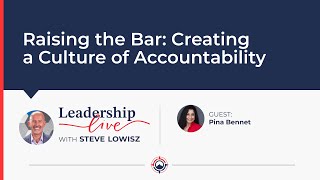
This is a YouTube video titled "Leadership Live - Raising the Bar: Creating a Culture of Accountability" recorded in 2025. It features a leadership-focused conversation between Steve Lowisz, the host, and Peta Bennett (also referred to as Pina), a marketing and strategy professional with extensive leadership experience. The discussion centers on leadership challenges related to accountability, responsibility, ownership, and organizational culture, including how leaders can foster a positive environment that encourages ownership and discretionary effort among team members. The conversation also touches on practical leadership advice, handling mistakes, and balancing expectations with team well-being.
Foreign.
Welcome to another Leadership Live. My name is Steve Loewes, and I will be your host. You know, the whole purpose of what we do here in Leadership Live is to get us to think as leaders differently about what we do and how we do it and sometimes ask questions that we don't want to answer as leaders. And that's the whole purpose of what we do here. And there's always a topic that is a focus for each of our conversations. And today we've got one of those topics that we keep getting pinged about, I keep getting emails about that is important to understand. And in order to do that, I've got a special guest with me, somebody that I haven't known that long, but I've had a couple of conversations with, and I've got Pina with me today. Peter, thank you for joining us.
Very nice to be here.
Now, before we get into this, give the audience who don't know you a little bit about your background, just so they get some perspective of where you're coming from. And as we have this conversation, they'll get an idea of the context.
So my name is PETA Bennett. I've been in the professional industry in marketing and strategy for about 25, 30 years now.
I lost count about the same.
Same length there.
So most of my career has been in marketing. And then I. I want to say I dabbled in. I dabbled in the chief of staff role, so more of the strategy role. For about a decade of the two, three decades that I've been at work and have had lots of responsibilities all the way from launching a range of 11 skincare products in 11 months across the nation. This was in India.
Yep.
To in working in the energy industry, where I worked for about 17 years, and in the energy industry was where I kind of had both responsibilities of marketing and strategy. And then it kind of, you know, as you. As you move into leadership, it kind of becomes a little bit of a blend.
Yeah.
I've also been a professor for three and a half years, and I taught all the marketing subjects. Advertising was my most favorite, and I love teaching.
We talked about that. Actually, the one time we did chat about it.
The most fulfilling role, I'd say, was that that was teaching.
Teaching.
And I'd love to go back to it.
I was gonna say, is there an interest. Are you gonna. Are you gonna do it at some point?
I am actually in conversations with a couple of colleges and universities right now, and I'm hoping to be able to start teaching at least a couple of semesters by the fall.
Wonderful.
Of this year.
So you've got international experience. You've got extensive leadership experience, extensive strategy experience, and then specifically marketing and all the other things he talked about. Before we jump into this though, on the personal side, tell me about these dogs.
So I have three gorgeous dogs. One's an Alaskan malamute. He is. He's the second one, actually. He's the middle one. The oldest one is Sir Nigel.
Sir Nigel.
He is an English black lamb. He's about. He's about four and a half years old now. The middle one is Major Nelson and his name is actually an interesting one. So we had to give him a title because Sir Nigel had a title because Sir Nigel's dad is Sir Barkley, who was a field trial grand champion.
Got it.
And so he. We had to give him a title. So we did. And so then when Major Nelson came along two months later, we're like, we. He has to have a title. And just so you know, Nelson's name, Nelson is a city in Alaska.
Okay.
And that's how we got his name. And we wanted it to be from N because we wanted them both to have N. N name starting from the letter M or N. And so Mater Nelson. And then in August of last year, we suddenly. No decision. It wasn't pre decided. All of a sudden woke up one morning and went and got Dame Nikki. So we now have a girl in the family and her name is Dame Nikki Bennett.
Awesome. So now we've got three.
We've got three.
Which I have not seen. So at some point I'm going to have to see pictures of it.
I have pictures on my phone, but.
It'S, you know, why do I ask the question? Because it's good for the audience to have a kind of a personal connection to everybody that they're watching as well. Right. So if you're a dog lover. Well, here you go. We've got. Obviously we have a dog lover.
Dog lover. I have a huge library at home. I'm an avid reader. I'm a chef. We are actually just talking about Jack of all trades. We're actually just talking about me wanting to do my own cooking show. My mom's here for a few months and I want to set up. Set up all the cameras in the kitchen to film her making authentic Indian food.
My daughter would. That's my, My daughter's favorite is. Is Indian food and she's also vegan, so it's perfect.
But there you go.
But. So let, let's. Let's get back to this, this top. You and I have had this conversation, but the topic that I keep getting requests about is this. From a leadership context is this idea of accountability, responsibility, ownership. And. And it's usually when it's brought to my attention, it's in the context of a leader saying, well, my job is to hold my team accountable and they're just not owning the thing. I mean, how many times have you heard that? How many times have you guys heard that? I know, it's been a gazillion for me. Why does this thing around accountability, ownership, and responsibility from your perspective, Pina, keep coming up. What's the challenge here?
I think the challenge, if you take a really big step back, the challenge.
Is the culture of the organization. Because that the culture of the organization, the environment in which you're in, just kind of creates the. I use the word environment. It kind of creates the environment around which all of this percolates. Okay, so whether or not a person feels responsible and there's a difference between responsibility and accountability, right? What is it, a racy matrix, for example?
Yeah.
Responsible person is the doer. Is a person responsible for doing the task. When you talk about accountability, accountability is the buck stops here, okay? At the end of the day, no matter what happens, whether it was good or bad, hopefully, if it's good, it's the good is shared. But if it's bad, typically the accountability then rests with that one person, one team, two people. However you decide or however the structure of the organization is right, who's going to quote, unquote. And this again depends upon the culture of the organization. Who's going to take the fall, if you will, or who's going to.
And.
And that there, there. Therein lies. And I want to come back to a couple of things you said, but who's going to take the fall? Exactly how many of you defer back to that thought when you hear the term accountability, responsibility, ownership, it's like, I don't want any of that because somebody's got to take the fall. How does that. You're talking about culture that's obviously got to be focused on the culture of the organization.
And so there are a lot of.
Organizations that will say that they have a continuous improvement mindset. So when you talk about a continuous. So let's just talk about the continuous improvement mindset. In a continuous improvement organization or in a continuous improvement mindset, there is no taking the fall. It's all a learning opportunity. Good is good and bad is good. And why is bad good? Because you learn from it. Right. And you're never going to go through any project, any task, or maybe a.
Task, but you're not going to go.
Through a long term project without missteps.
Some mistake somewhere, there's something that's going.
To go awry, there's something that's going to go off plan. And depending upon the culture of the organization, the continuous improvement mindset, you use that opportunity to say, okay, how can we prevent this from happening again? What can we learn from this to apply to a different project in a culture, in an organization where the culture is what we just talked about taking a fall.
Yeah.
That is viewed as, that's where I think we people. This people fall back and say, okay, well, because I've actually heard this said to me and this is interesting. And I was a little taken aback because I've actually heard this said to me from a team member who I worked with. And this was. There was something that went wrong. There was a misunderstanding, something that went wrong. Instead of the mindset of coming forward and saying, hey, let's fix this or let's talk about what are we going to do next? Well, you're the director, you need to kind of figure this out. It was almost like, don't look at me, I'm not even here at this moment. And that really brought home to me the culture of the organization and perhaps.
My role in it was that a company you had just recently joined that you've picked up on that or what happened.
This is an organization. I'm not going to name names.
I don't want you to name the name.
No, this is an organization that I was working for. And it's an interesting dynamic where when you work for a large organization, any larger organization, you'll find there's this, there's this stated culture.
Sure.
But then there's this actuality. Exactly. The reality.
Everybody's shaking their head, who's watching, saying, yeah, I know that one.
And this is where it hit me where. Because I always believed in and I always subscribed to and lived the culture as it was stated. Stated.
Yeah.
And then to hear this person say this to me really brought home the fact that that's not what they felt.
So the culture stated was we learned from our mistakes. The culture in reality was, oh crap, we better not make a mistake.
Exactly.
Okay, Exactly. So what happened?
And that's, that's a part place to be in the moment. I don't think I did anything. I just kind of, like I said, I was taken aback, but I processed that information. And then I approached the conversation differently because at the time I realized that the team was more concerned about whether or not they were going to get blamed for this and whether or not the senior leadership was going to view them differently as a result of it. Which was kind of interesting and shocking to me at the same time. Because to have that kind of a culture is, is scary. You're not going to deliver your best because what does that do when you're not. When you're, when you're afraid of taking the blame and when you're afraid of being blamed of something, you're never going to take a risk either.
That's true.
And so what have we done to the culture? What have we done to the team? When you've created an environment where the team is unwilling to take a risk, the team is unwilling to put forth an idea for fear of, oh, if it's my idea, I own it. And you've created an environment where everyone is simply going to do what they're told and that's not a place that.
You want to be and you're actually talking about the symptoms of it. So if you're a leader watching this, think about this for a second. Because I've gone through this myself, where I created exactly. What you're describing, right, Is, oh, yeah, mistakes are great. We love to have mistakes. Now there's a limit to that too, because there's mistake, there's learning and then stupidity. I'm just gonna throw it out there, right? I mean, come on, we've got to be careful with that. But if you're a leader and you're wondering, why is your team not taking risks? Why are they so afraid of this idea of ownership? There's a high probability that you're doing something or not doing something to create it in the first place. Would you agree?
I would agree, yeah.
And it's never, the team learns from the environment they're in. The team learns from, or they take their cues from what they see happening in leaders. So if they feel like the senior most leadership of the company is viewing this as a serious error, they're going to step back and say, oh, I'm just a peon, don't look at me. I'm not the one who makes these decisions. I was told what to do. Now you do that enough and you've created a culture. You've created an environment where no one is willing to take a risk no matter what level they're at. Because this was actually a pretty senior level manager that said These words, oh.
Not just a doer, it was an actual leader.
Yes. This was a leader who said these words. And so that was even more shocking to me because now if you as a leader are exhibiting these types of behaviors, you're setting the stage for the people that report to you. You're setting the stage for the people that look up to you and saying, okay, well, this is not the behavior that I want to undertake. I don't want accountability. I'll be responsible for doing what I'm told. Being accountable also means caring to me. If you're accountable, maybe this is just how I'm wired. Maybe this is not the definition everyone would take or accept of accountability.
But for me, your perspective is important.
For me, accountability also means ownership. When we talk about ownership, Right. It's taking ownership. And when are you willing to take ownership of something? When you truly care. When you feel invested. Right. And when you feel invested it. That's also partly the meaning of ownership.
The question is, how do you get people to feel more invested? Again, thinking about from a leadership perspective, because I look at similar to you, you can. There's accountability, there's a responsibility, accountability and ownership. And I view them as tiers.
I totally agree.
Right. So as a leader, I can actually assign you responsibility. It's in your job description. You need to do this thing right. Accountability, I can hold you accountable if you don't do it. And unfortunately, it can be viewed very negative. Ownership is the pinnacle. But it can't be assigned.
No, you have to. It has to come from within.
Exactly.
And that depends upon the culture that you're in on whether or not. And I have seen degrees of this. Where I have seen. And I've experienced this myself, where I have. I always talk about this. It's like I always feel like at some point in my past life, I must have been a Christian because I live with Christian guilt.
I will take on responsibility and ownership for things that aren't even my fault. Of, like, I must have done it. It was that the lions. It was that blazer that I wore.
I'm. I'm sorry.
You're the reason they lost.
I'm the reason they lost.
But. So, but, but sometimes in cultures, you'll see people coming in enthusiastic and for a long time. And I. I'll say this about myself too. For a long time, you stay at a level where you're. You're vested, you're. You. You start at a level where you have ownership because. Because you want to do more. You want to be more. And you feel like if I take ownership and if I feel like I'm part of the, you know, part of the dynamic or part of the fabric of this organization, it'll not only help the organization, it'll help me. And some people are just wired that way.
Sure.
And some people. I've also had the experience where, you know, in my. In my role, when as a chief of staff, I've also had the experience where I've gone up to directors and vice presidents who were three, four, or five levels above me at the time, trying to explain the cascade of a strategy and their role in it. And I've been told, just tell me what to do.
Really?
And I look at them going, but you're a director.
Do you want to know why?
You want. Why is this as important? Just tell me what to do and I'll do it. And so there's different levels. Even at different levels, you see different levels of ownership. And a lot of times I've seen that people start with ownership and they get disillusioned.
That's an interest. I've never thought about it in reverse like that. But you're right on this. You get a new job, you're excited about it, you want to own it. And eventually, if the culture is not supportive of it, that ownership naturally erodes. It's like you're taking withdrawals out of the piggy bank. You're starting with the piggy bank full, but you're pulling out of the piggy bank.
Right.
I feel like that. I feel like I've seen that happen.
More than people coming in just wanting to do a job. I feel like I've seen it more where people come in wanting to be part of something bigger than themselves, wanting to feel ownership, wanting to feel belonging. Right. Yeah.
That's a big one, actually.
Part of this, and then slowly feeling like, well, maybe I'm not. And then. And then you see. And that's when you start to see people leaving an organization when it gets to the point where it's too much, and you. You can't feel a connectivity with anything. And it's just a job. I'm not saying just a job is bad, because sometimes that's what we need for sure.
A lot of people, this is my job needs to get done. I don't want to get up this morning, but I got to pay my bill. Yeah. It's a practical thing.
Right. And sometimes that is. That's the level you're at. And you have way too much going on in your personal life. And that's okay. But I feel like most people don't start there. I feel like most people do start at the ownership level, they start at the belonging level and then it slowly erodes or it stays. It just totally depends on the culture of the organization and the difference between what is said and what is done.
Well, that, that's a huge thing. What, what we talk about aspirational and what we actually do again. And I've, I have inadvertently found myself there, as I said earlier that some years ago. But, but it's easy to get caught up in that.
So it is.
So from a. If you're giving advice, since you've, you've led teams, you've served as chief of staff and so on, and given what you just said, the perspective that, you know, you start off with ownership and then it kind of erodes. If you're giving advice to a leader from your perspective, what advice do you give them when they find themselves in a situation? Because I guarantee you, a lot of the people watching are either in a situation where their boss is created. The environment where mistakes are bad.
Right.
And let's not say they're too good.
They're not too good, but they're not bad either. There's an opportunity to learn.
There is. And I want to come back to that. But then what advice do you give that leader to undo what's going on? How do they actually make a shift? So let's assume what's happening is they state this, but they're doing this. It's created that environment.
Now, what I think for the leader, it's more important for the leader to.
Be seen as responsible, for the leader to be seen as being accountable.
To.
Be seen having ownership. It can look like different things in different situations, but primarily it depends on the way you're asking questions. So think about what happens when something we're not talking about run of the mill things. Let's think about what happens when something severe goes wrong. Something that's not entirely cataclysmic, but a significant issue. But it's a significant issue, what happens? Typically there's questions asked, right? The manner in which those questions asked will signal the organization whether these questions are being asked to place blame or whether these questions are being asked to.
Solve a problem, for example.
So it. So let's take an actual real example maybe of something and kind of role play the how those questions were asked.
I didn't. You gave me a project. Pina. I report to you. You gave me a project. I finished it, but I Finished it wrong, and it's causing issues with a client. Let's use that scenario.
Okay, so in that scenario, if you come in. So now. So let's say if it's very. Let's just assume it's an extremely important client.
It is.
The client is very. It's very, very upset. So now the leader is upset because this is a client that really should have been taken care of before you even get to questions. I'd actually say, okay, well, how did we have a setup where. So this is where you start to problem solve? So first of all, how did you even have a setup where you get to the end and then you realize something's wrong?
There's already an inherent issue there.
There's an inherent issue that needs to be fixed. But now you're talking to this individual who's already, mind you, who already knows that something's wrong, whether or not they have a recognition of whether I messed up. Because bear in mind, they could believe that they did the right thing.
They can.
They could believe that they followed orders, that they did exactly what they were told to do.
My perspective in this situation is I did exactly what I needed to do, Bina.
Exactly. So now the question is trying to get to the root of where did the divide happen, right? Not asking questions in a manner that elicits blame or kind of puts blame on a person, but asking a question on, hey, do we know? Do we understand? First of all, trying to get to a common understanding, right? Because if there is an acceptance, if I don't even accept that, what I.
There's an issue.
There's an issue.
You caused it. Or in this case, I caused it.
Well, but maybe. Or maybe not, right? Maybe. Or maybe not. You could have been going off of something that I had said, regardless of what the client had said. You could be going off of something what I had said and took that as, okay, this is what I'm supposed to do. The client said this, but we know better.
Sure.
Right, sure. And so I think, first, getting to the bottom of, hey, can we agree that this project didn't quite go the way it should have gone, Right? Having a conversation versus an interview.
Tell me what you mean by that.
So a lot of times, if you're in the situation where you're a leader, there's always this hierarchical element that is always in people's minds, and it should be, and it has to be. There's hierarchy for a reason.
There is.
But in that situation, if you're approaching it from a hierarchical standpoint and if you're approaching it where you're the one that made the mistake and do you know what you did wrong? Your immediate reaction is going to be fear, of course, of whatever. And it's going to be, don't talk to me.
You're going in with the I'm right, you're wrong. Right off the bat. That never starts a conversation about mistakes or issues in a positive light.
No. So if it was me, I'd come to you and say, hey, this client is really mad. What are we going to do? How are we going to fix this? Let's put our heads together. Let's solve this. Let's make sure the client gets what they want, and then let's try to think about how we can do this better the next time. We're not placing blame. We're solving problems. You're not focusing on the person. You're focusing on what needs to be done.
There's a. There's what I call the four Fs.
Okay?
They're not bad words, but the four Fs, facts, feelings, focus, fruit. Okay, so you were talking about getting to the facts of what's going on. Do we all agree that something happened that upset the client?
Right.
Okay, what caused that? Let's get to the facts of it. Take the feelings out for a second in the beginning. Let's get to the facts. Do we have the same perspective as you were talking about it? Can we agree that these are the facts of the situation? No, I view it like this. No, I view it like this, having that dialogue. So that's the first thing. Now you can't avoid feelings.
You can't avoid feelings.
What happens when we bottle up and avoid feelings?
At the very least, I would say.
An explosion at some point, right?
It's like a volcano. It starts to erupt. So we can't avoid this person's now feeling upset, that they upset the customer. The customer's upset. So we've got to at least acknowledge. Right. So we've got the facts now. Let's acknowledge how the customer feels, how we feel. So just to get it out of the way so it's not percolating.
I agree.
So that's facts, feelings. But now we've got focus and fruit. The focus is, what are we here together for? What are we trying to do? We have a. The fact is there's an upset customer. The fact is we may or may not have done something to do that we agree that we have. None of us are happy about it. What do we want?
Right.
We Want to take care of the customer. What does that mean?
Right?
And then the fruit. How are we going to do it? How do we. So that's why I always use this facts feed, leaks, focus, fruit, so that it doesn't become the blame game, it becomes what do we want out of this conversation?
And one thing to remember too is, and this is sometimes quite often forgotten in you asked me earlier, like, what in this situation, kind of, you know, how would you deal with this? One thing to remember is, and I, you know, don't kill me for this. The customer isn't always right.
I'm sorry, say it again.
Right here. Look at this camera and say that again.
The customer is not always right.
She's right.
You need to at all times.
The primary aim of a leader needs.
To be to protect their people. You, if you're putting the customer above your people, you're never going to create an environment in which your people feel safe.
The people start to resent the customer.
They resent the customer, they resent you, they resent being there, they resent everything. And at that point, you're never going to get the best out of them that you need for them to be able to do right. That's the customer. And so I'm not saying in this situation, the customer was wrong. Maybe we did mess up, maybe we did do something that shouldn't have been done. And the customer is now super upset. And I think, you know the first to use your four apps, right? The first thing is to focus on the customer.
Get one thing to remember is, and I know, don't kill me for this, the customer isn't always right.
I'm sorry, say it again.
Right here, look at this camera and say that again.
The customer is not always right.
She's right.
You need to at all times.
The primary aim of a leader needs.
To be to protect their people. You, if you're putting the customer above your people, you're never going to create an environment in which your people feel safe.
The people start to resent the customer.
They resent the customer, they resent you, they resent being there, they resent everything. And at that point, you're never going to get the best out of them that you need for them to be able to do right by the customer. And so I'm not saying in this situation, the customer was wrong. Maybe we did mess up, maybe we did do something that shouldn't have been done. And the customer is now super upset. And I think the first to use your four apps, the first thing is to focus on the customer, get the customer what they need and then try to internally problem solve on thinking about, okay, where in the process did something somewhere go awry? Where did we get mixed messages? Maybe the mixed messages came from the customer and you didn't understand. I mean, you think about different kinds of jobs and different kinds of, you know, environments, things happen, you get, you think you understand what is said. You know, I always, like I did a small stint in the nuclear industry and at first I used to find it really, really silly because they have the three way communication. You say something, I repeat it, and then you repeat it back to me just to make sure we're on the same page, that we're 100% aligned on what was said and understood. And I found that really silly at first, but I think I totally get it because a lot of times you think you've heard what you said and I've actually experienced this. I've left a meeting where the executive and I had talked about something and we were going to cascade it to all of the leadership, the executive's leadership. And then I was supposed to meet with them one on one afterwards to make sure that they had the correct understanding that they knew the timeline that they were going to do what they were supposed to.
Clarity skiing.
And then you meet with all five of them and all five of them have a completely different interpretation of what was said.
Yeah.
How did that happen? But that's where you know you can't. And that's why it's so. I'll say it. It's so stupid to blame anyone for anything because there's so many things. We live in such a complex world. You talk about a task, a project. Nothing is simple.
Right.
And so, you know, even talking about accountability or a leader wanting to hold somebody accountable, it's farcical. You're not. No one's in it alone. No one makes decisions on their own. No one.
That is true on their own. So how. But let's go down that path of accountability a little bit because I agree with, I think we're on the same page on all of this for the most part. But there's still a responsibility of every leader to have some level or to, I hate to even use the term because this is what scares people, to hold their people accountable. If somebody's not doing their job, it's still our responsibility to hold them accountable. So how as a leader do we do it in that situation where we don't scare the person? We still have a bar, we still have to do our jobs, but we don't want to completely make it all negative.
Yeah, that's an interesting one. And I think it starts with setting expectations and making sure that your expectations are extremely clear. I actually have a funny example of this I was in. So when we. When we first become leaders, we go through the leadership training, and there's, you know, every. There's multiple levels of leadership training that you go through. And when these. This was one of these leadership training classes that I was in, and there was a team of us and one leader, we were talking about something. I can't remember what the topic was, but one leader said, my team doesn't go above and beyond.
And we're like, okay, wait a minute. How many of you. You've either said that to yourself or you've heard that. My team does not go above and beyond. Okay, back to you.
Thanks. So we kind of probed a little bit. What is above and beyond? This was like this class discussion, and the instructor was just kind of encouraging the conversation. We're like, what do you mean? Well, you know, they don't go above and beyond. They just do what they're supposed to. They don't do anything more. Well, is the expectation that they do more? No, the expectation is this. But I need them to do this. Then why isn't the expectation this?
Exactly. Exactly.
So to me, you know, and I get the meaning of above and beyond. It's like, you know, going. Doing something that perhaps wasn't expected or coming up with an idea that wasn't expected. And I get that. But that doesn't come from. That's discretionary energy. And that depends upon the environment that you've. Again, the environment that you've created that allows people to want to give you their discretionary energy.
Not everybody has discretionary effort. There are certain people, behaviorally, they're wired a certain way that you give them that bar and they'll go exactly to the bar. But they're not naturally wired. They're not predisposed to going above and beyond, if you want to call it. They think they're doing exactly what they're supposed to be doing, as you were actually saying. And discretionary effort isn't even something they understand.
No.
So we've got to get that clear. There are people that are like that.
There are people like that, and there are people also, because then you get into the wifim, Right. What's in it for me? Why should I do more than I. What? More than what I've been told to do? Because I see. And this is, this also happens when you have a team and you have a team dynamic.
You have all sorts of people.
You have people where this is the bar and they're way below the bar and nothing's done to them.
They're allowed to, they're allowed to float. And this comes back to answering your question on accountability. So what do you do? So we'll come back to that. There are people who meet the bar and there are people who regularly exceed the bar. Now, if the reward for exceeding the bar isn't that much, or, and sometimes it isn't even about the reward, sometimes if I have enough, and I've seen this too, if I have enough outside of work that I'm doing, that keeps me creatively occupied. Sometimes work is just work and I'm doing my best in my mind. You set the bar here, I'm meeting the bar. I'm giving you everything that I think you need from me. So at that point, from, as a leader, if you want more, you need to set the bar higher. And then let's talk about why sometimes the culture becomes of where people don't want to do more because they see others getting away by not even doing what they're supposed to.
Yes. And nothing happens.
And nothing happens.
There's no positive reinforcement. There's no additional training. There's no. Whatever the case is, it's. Or something happens, but nothing is shown that it's happening. It's so far removed because we, you know, we're cautious about. I don't want anybody to know that I'm having a conversation with this person. But you could still do things to say, we're investing in this person to show at least we care.
I agree.
No communication. Nothing happens. People make the assumption, well, nothing was said, nothing was done, nothing. So I don't have to do my job.
Right.
And they're coasting. I've got two team members who aren't even doing what they're supposed to.
And, and then there becomes, even if.
It'S not true, there becomes the sense.
Of I'm picking up the slack. Yes, I'm. My bar gets raised. Exactly. I'm, I'm. My bar gets continually raised. Because let's face it, if we talk about a rating system, if you're meeting expectations and you're exceeding expectations, let's say you've exceeded expectations this year, guess what's going to happen next year? That bar is going to get raised even more.
Because it can.
Right.
But now for these other folks, so what the Perception of this person. Let's just say me, the person. My perception now is I'm picking up the slack for these people who aren't even meeting expectations. And why should I do that? And that's where you start to get that. Erosion of ownership, erosion of accountability, erosion of responsibility, erosion of just feeling like you belong because you don't. Because you haven't created a sense of a family. You haven't created a sense of. And family's the wrong word. Community to use. Community.
Community.
Community. Community, yeah. Community is a better word.
You can't pick your family, you can pick your community.
I would agree. And so you. But you haven't created that sense of we're all in this together. You've created a sense of it's each one for yourself.
What about the fear of leaders? You were talking about the bar earlier. If you have, you know, if you want, if this is your expectation, set the bar here. But a leader who says, I'm afraid to set it too high because I might burn my people out, what do you think?
That's, that's usually an assessment of. That's an interesting one. And I'll come back to why I laughed. But that, that's an actually an assessment the leader needs to undertake. On. Is there true. Is the team truly burning out? Because I've been in both situations where we have had a team that people left and they weren't replaced, but the work never went away. And so now you do potentially have a situation of burnout. In that case, the leader needs to either assess on, hey, what work needs to get cut. I ran in one of my previous roles, I ran a program called Stop it. Take a look at the work that you're doing. And we literally call it Stop it. Take a look at the work that you're doing and stop doing work that's low value or no value or work that you're doing simply because somebody said you should do it. You inherited a role from somebody. They told you, I do X, Y, Z, abc. And you just keep doing it, so.
You must have to do it too. Exactly, yeah.
And without taking a look at, okay, can I streamline something? And if you need to ask permission, and that's why we had a Stop it Program, because we people would submit their Stop it ideas, we would evaluate it and then say, yeah, you can stop it because there's no upstream or downstream impact. And so go ahead, stop it. And so, but coming back to why I laughed and when I talked about the role I had, where this was straight out of business school. And we were the team of three and we had to launch 11 skincare range of 11 skincare products in 11 months across the nation. This was in India. And I used to work really long hours. I'd come home at 8 or 9 or 10 sometimes and my dad would say, you either don't know what you're doing or they need to hire more people. That's an assessment that the leader needs to make. Right? Because I've had teams where I've had a person on the team who didn't want to use technology, who was taught Excel a million times, but didn't want to use Excel the way, use the tools in Excel and use Excel the way to help her reduce the time.
Burden of her role efficiencies.
So this person didn't want to do that. So they'd work weekends and on their vacations to get the work done, to catch up on the work, because they couldn't do it. Now in that situation, you need to think about. And I actually did have this conundrum on. This person's been with the company 40 years and actually when I came into the role, this person was being actively managed to be managed out. Yeah, but then you take a step back and go, okay, they're getting the job done. Okay. They're slightly slower than perhaps, you know, somebody else, but is that, is that, you know, you get into this whole ageism and I don't know if I made the right decision or not. I still don't know if it was the right decision to have made, but I made the decision. I talked to the leader, this person reported to them, say, okay, they're getting the job done. Is that so bad? Like, do we really want to performance manage a person out who's this close to retirement? Because you're, you're, you've introduced tools that they're learning, they're trying, they're using the tools, they're just using them as efficiently as perhaps you or I would. And it was, you know, and in the end we ended up not performance managing this person out. This person became the most engaged person on the team. This person during when we had to then go home for Covid, would send motivational messages to us every morning and you could see a turnaround. So once you stopped, and so this is the other face of accountability, right? It's like once you stop trying to hold somebody accountable, but you actually show them that you care. You actually show them that you're interested in ensuring that they have everything they need to do their job well and that it's okay if they don't do things exactly the way I would do it.
Style and capability are two very different things.
I would do it, I do it this way. She's doing it this way. Okay, is that bad? It takes a little longer. So you account for that. But how do you account for that? So you say, okay, you have X amount of time this needs to get done. Believe it or not, she get it done. She worked evenings, weekends, she got it done. Now is that healthy? Is that long term acceptable? No. And so in the psi, while you let her do her job, you still continue to provide the training and coaching to help her do it better. But you don't chastise her for it. You don't make her feel like she's useless. You don't make her, you don't make her go through the performance management program and you get a turnaround so phenomenal that you're shocked. I was shocked. I didn't expect that person to turn around that quickly or that much.
I want to go back to something that you said though, because I think we've got to draw a line differentiation between the bar and workload.
Yes.
Right. Because you're right. If there's too much of a workload. The example you used where a few people are out of the department now and everybody just had to split the workload, that's not really fair. You want a great environment. But the original question around can you have too high of a bar? And I want to make this comment in the differences between of them. Think about it from a term. And I use this example often. Anybody who's on my team will hear this, this, but the Navy Seals, let's think about this. The bar to become a SEAL is very high. Very few people actually make it. Yet people bust their tails because they want to meet the bar. And the reason that the bar is so high, because the work they do either kill or retrieve room for error is very low. Because we're talking life or death. But yet people flock to that high bar. To me, that's very different than the workload keeps going up and we're just going to keep throwing. I believe as a leader, if you set the bar high for the right reasons, not everybody will hit the bar. But you're going to have some people that are going to go to that extreme bar. Just like a Navy seal.
Right. But to me, as a leader, when you're talking about setting the bar, that's setting the bar for that to me, would Be an example of setting the bar for admission. Right. So that to me is making sure that you're hiring the right person, hiring for the right skill. Once you know that. But let's. So I'll come back to that. But if you know that this. So for example, let's talk about if you're at a certain level, there's certain, certain expectations that you're able to do certain things for sure when you're hiring. And this is where I feel like leaders too sometimes. So let's. It's not. Leaders are not all bad. Right? So sometimes leaders get stuck and how does this happen? And I've seen this happen to. I've seen this happen to, to leaders. I've seen. I've had it happen to me. You don't always get to pick your team. You inherit a team.
Yeah.
So you could have inherited a team where the person was elevated to a position that they are not capable of.
Sure. It happens way too often. We both know too often.
And a lot of times promotions are given because the person's.
And I've actually heard other leaders say.
This, but they've been here 40 years. Okay. That's not a reason for them to get promoted.
Or they're the number one producer in that function, yet their leadership skills are non existent.
No. And that doesn't mean they get promoted. But a lot of times promotions are given because the person's been here, they've been doing this for six years, they deserve a promotion. But if they've only been if they've been doing this for six years, but they've only been doing it at the level that they've been doing it and they haven't raised the level, why do they deserve a promotion? And I always tell people when you get promoted, you have to do more than what you were doing. You can't get promoted for doing what you were doing.
And keep doing the same thing.
And keep doing the same thing. But a lot of times leaders find that they have now inherited a person that is at a level that they're incapable of meeting. Going back to your.
They can't hit the bar.
They can't hit the bar. They are never ever going to hit that bar because they're not. Their capabilities don't match that. So now what do you do? So do you now demote them? Is that an option? Sometimes the organization that you're in doesn't give you that option. Do you demote them?
Do you?
Or do you provide them with the skills needed to meet the bar? And that's a conundrum sometimes leaders face. Because you can tell me, Pina, you're not meeting this expectation. And I've all. And I've been a stellar.
I got promoted at that lower expectation.
I got promoted. I mean, I'm awesome. What the heck are you talking about? But now you've come in and you don't see that I'm meeting the bar because you know what the expectations are.
My bar is higher.
Or the expectations for the role are here. We're always here. But it was overlooked, and my performance was overlooked. And now you're at the point where, what am I going to do with Pina?
Well, and I just want to mention one thing on that. That is the challenge you create. If you're a leader and you're overlooking somebody else's performance, you do nothing about it. You're not going to be around forever.
No.
And when you leave, think of the disservice that you have just done that person.
Exactly.
Because of the conundrum you're creating for the next leader coming in. So.
So, yeah.
No. And that's absolutely right.
So now I thought I was awesome because I got promoted and this person loved me. And now you've come in and you were like, what the heck? You're not doing what you're. You're not doing your job. And now all of a sudden, sudden.
To your point, I'm lost.
Yeah, I want to do a good job. I've clearly been doing a good job all of all this time. I just don't know that the bar is now here. I was never told the bar got raised. I was never given the tools to raise my performance to that bar. So now, as a new leader, now you have the question of how do I hold Pina accountable? Pina thinks she's awesome. Right. So how do you hold Pina accountable? And that's where I think radical candor. And I'm a huge fan of that book, by the way, if anyone's.
It's good.
Huge fan.
And that's where, to your point, not giving feedback, not giving the correct feedback to the individual is not doing them a favor. It's doing them a disservice. And a lot of times I've seen leaders where they coddle their employees or they're afraid. I've seen it both ways. I've seen it where they coddle their employees, and they feel like if I just say good things to everybody and I think I say everyone's awesome, somehow they'll just rise to the occasion and it doesn't happen.
And it never happens.
Never happens.
Because you tell me I'm awesome, I'm.
More than likely going to believe it, whether I am or not.
I used to say it's kind of like your kids.
Right?
Do you? I know you don't, but let's think about it. I don't have kids. Yeah, because that's why I said that. But think about it. If you're a parent and all you do is coddle your kids, how are those kids likely to turn out?
Right?
They want everything. They want it now. Right. So as part of developing the clarity of a parent is sometimes to say no.
Right.
Sometimes to say, you're falling short here. Let's, let's figure out what we need to do to get you. It's the same conversation.
Same conversation. I totally agree. It's the same conversation. And a lot of times I have had this conversation with my leaders where you almost have to think of yourself as parents and you have to be able to deliver the bad messages. You have to be able to write intent with the right intent, but you have to be able to. And a lot of times, and let's.
Face it, a lot of times there are certain higher level policies that you as a leader may not agree with, but you're beholden to uphold them. You are. And at that point passing the buck as a leader. And that's where I talked about right at the beginning. The leader needs to be able to. The leader needs to be able to believe that. My responsibility at this point is to uphold this policy. Whether I believe it or not is immaterial. This is my job and I need to be at, at that point. How you say this now matters. If I say, oh, they're making me do it, so you got to do it, how. How do you think that is going to be received? So now the person you're saying this to understands that you don't believe it. They now know that if they don't do something, you're not going to do anything because you, because you don't believe it anyway. But if you say it with conviction and you tell them the reason back to the intent. Why is it important for you to do something versus just do it because I said so. It makes such a huge difference. And I'm not a huge fan of Simon Sinek, but the why is sometimes I'm not.
I'm sorry, we won't go there today because I like the idea. The practical nature of a lot of what he says in the workplace does.
Not work does not work.
There's not enough.
No, there's not enough.
Yeah, that's a topic for another day.
But the intent behind why something needs to be done is so important to explain because. And the question behind it is not it. Sometimes it doesn't even have to do with a bigger purpose or an intent or anything. It simply has to do with if do you believe it? If you believe it, they'll believe it. If you don't believe it, you will never be able to communicate that to anyone else.
Going right off your point, I was on a conversation too actually in the last two weeks. Family owned businesses. And the family is not involved in the business from an oversight perspective. So each one has a CEO.
Okay.
And in one particular instance, the leadership team was together. I was there and the CEO says, well, the family made this decision. Now what does that do to accountability, responsibility, ownership, going above and beyond, all.
Of it all out the window.
And I said to him right after the conversation, I said, you're trying to get this behavior and think about the impact of what you just said when you're trying to get them to do what you don't believe in. And you blamed it on the family. Why would they do it?
Right. All you did as a leader, all they saw in that moment is the leader is refusing to take responsibility for something. So you refuse to take responsibility or accountability or ownership of a task that you're asking your team to do.
Why would they ever do it?
You've set the example that they should.
Exactly, exactly.
I use the analogy a lot of, you know, when you said it earlier, the leaders who say, well, my team never goes above and beyond, look in the mirror. That's a hard pill to swallow. But all of us as leaders, every one of us, when our team is constantly challenged, constantly showing the same behavior instead of always looking at the team and we need to look in the damn. Sorry, the dang mirror sometimes, right? There's books, man in the mirror and all this other stuff. Because often we're the ones setting the tone. And you just said it so eloquently.
Yeah, the leaders are the ones setting the tone. They really are. And in that moment, even when we were talking about inheriting, you inherited. So going back to that example, you've inherited an employee that isn't perhaps capable of living up to that expectations. You then need to make the hard decision of what do I do with this person? Am I able to one, give this person this necessary skills and train them to the level that they need to be to fill the role and to do the role that they're in. Well, or do I need to then make certain within the confines of the policies that you work within, have them.
Be successful in a role that they're going to be successful in. Is it better to have somebody feel successful or is it better to simply shirk your responsibilities as a leader and constantly have that person feel like they're.
Failing once you're clear with that person and you've given that person? Because sometimes they blossom once they know the bar is something different. And you've talked about clarity earlier. We both did. And sometimes they just naturally all of a sudden blossom to that if they're not able to and you give them that training and they're still not able to. There is nothing wrong. Nothing wrong with A, either moving them into a different role or something and B, sometimes letting them go for the right reason so they can take their skill and be successful somewhere else.
Somewhere else.
Think about it as a parent. You're not going to keep having your kid do the same thing over and over and over that they hate, they're not good at and so on. At least I hope you're not. Otherwise you're putting your own child in jail. Sometimes you need to separate them from that circumstance. If they suck at soccer, don't make them play soccer all the time.
Right. Well, I'll give you an example with. Because you know, with children, sometimes with people, people feel like we can teach them anything. But let's talk about dogs.
Well, of course, you have three.
I have three and I have three. Well, two of kind of the same breed and one is a different breed. I am not ever going to teach a malamute the same skills as I'm going to teach a lab. It's not an Alaskan retriever, it's an Alaskan malamute. It's a Labrador retriever completely. So I'm not saying you can't, you know, but there's a reason. There's.
You can get them both to sit, you can get them both to do basic things.
There's basic things they're both going to do. But then there's certain breed related characteristics that. For example, my 75 pound lab is not going to pull a sled across Alaska at any time. Which malamute might, but the malamute. Will you give him that job? That's his job. He knows that job and he will do it. So sometimes that's also part of understanding that when you're doing the skills assessment, understanding, am I going to be able, even if I teach this person this skill. Do I feel like they're inherently going to be able to do this and not. And I don't also believe in making the decision yourself. Have an honest and open conversation with the person. Ask the person, like, if maybe I asked my lap, he'd be like, hell, yeah, hook me up to that sled.
You never know, right?
So talk to the person and say, this is what I need you to do. This is what this role is. This is what this role requires you to do. I can give you all the skills. Would you rather. Would you be happy learning and being able to do this job, or would you be happier if I tried to give you a job elsewhere?
And then there's natural work styles and you can do assessments for all this stuff if they're completely. You need an A and they're a B. Yeah, they could try to do it for a period of time and some people could do. But that's the issue. It takes so much energy that they're gonna hate it over time anyway. Why would we put him in that. In that position and then say, well, now I gotta hold him accountable.
Exactly.
So it's fascinating the way we've kind of come up full circle on this. Right? It's like. It's not just about holding other people accountable. There's so much more to the story as you've eloquently put out here, but we're running out of time. We could have gone on for another hour, I'm guessing. And then I do wanna. At some point you're gonna come back on, because I want to talk Simon Sinek. Not that he's a bad guy. No, But. But there's. It's just. Again, it's practical application. I tend to approach leadership and everything else, at least in my life, from a. How do I apply it practically. And sometimes it's tough. I love the ideas. It gets me to think different. Maybe that's his goal and.
Maybe that's his goal and. And, you know. And I know we had, you know, that whole. That circle chart that he draws.
I love that circle.
I love that circle chart.
And it. It's quick.
But then when I tried to read some of his books later, I'm like, wait a minute.
What?
The circle, the power of Y, which is where the circle comes from, is. Is it. Whys have gotten taken out of context. I think sometimes why is something very simple. You said, I just got to make money to feed my family. Maybe that's why.
That's my why.
Let's not make everything so altruistic and big picture that we have to save the world. That's not everybody's job anyways. But we'll. We'll come back on to that. But, Peanut, thank you because you brought up some things that made me think a little bit differently. I know the people that are watching, they're going to look at this and say, oh, my gosh, I didn't think about accountability, responsibility and ownership in that particular perspective. What I really value is people start with. Most people probably start with that high level of ownership, and then they're taking withdrawals. And we don't even realize that we're creating the environment where they take those withdrawals. But thank you for all the time today.
Thank you.
If you're watching this, I hope this was. It hits a nerve. It hits something to get you to think a little bit different as a leader. If you are an individual watching this and you're not leading, you want to share it, please hit share, send it to that person so they have an opportunity as well. The whole point around Leadership Live, as I said at the beginning of the session, is to talk about things in a way that's different than everybody else is talking, to get our minds thinking a little bit differently. If you've got such a topic that you want us to address, please let me know. You can connect with me on social media or you can send me a text directly. This is my cell. 734-837-8500. If you want to be on the show, if you're as eloquent as Peanut and you want to be here, please reach out as well, because we'd love to have you. If you got something specific on your mind that you want to share. We have been talking about this accountability thing a couple of times, but again, thank you for watching. Pina, thank you for being here. Thank you very much. And make sure you join us on the next episode of Leadership Live.










