Leadership Live - Raw Leadership: Earn Trust. Own Mistakes. Lead Better
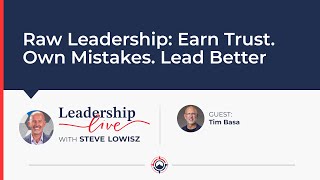
This is a YouTube video titled "Leadership Live - Raw Leadership: Earn Trust. Own Mistakes. Lead Better" recorded in June 2025. It features a candid leadership discussion between Steve Lowisz, the host, and Tim Basa, senior vice president of sales at Telaris. The conversation covers authentic leadership, overcoming challenges, hiring practices, building trust, and learning from mistakes, emphasizing real-world leadership insights without corporate jargon.
Foreign.
Welcome to another edition of Leadership Live. I'm Steve Low as your host. If you're watching this for the first time, this is not your typical leadership podcast or videocast here. We're going to skip all of the corporate buzzwords and get right to the straight stuff that matters. The real challenges, the raw truths and tough conversations that most people really don't want to pay attention to when it comes to leadership. This isn't about patting ourselves on the back or pretend. You're going to love today's guest. I've got with me Tim Basa, senior vice president of sales of Telaris. And he's going to share his thoughts, his insights, his stories, and he has no idea what questions I'm going to ask him today. But let's get. Let's dive in and get to the heart of this. Tim, welcome to the show.
Hey, Steve, thanks for having me. So, no buzzwords. So, so much for my. My New Year's resolution was to use more buzzwords.
Well, then we're going to shut this dang thing off right now. Tip. No.
All right, little buzzword. I got it.
You. You and I have had this conversation. Everybody uses these buzzwords that want. Everybody wants to sound really intelligent about this whole idea of leadership. But. But I'd rather get to the heart of some of these things if you're okay with that before we get started. Because I know you, maybe some of the people watching know you, but not everybody does. Give. Give us a little bit of your background from running your own business to selling it to. To running sales. Now give us a little bit of that background.
Yeah, sure. So the, the quick and dirty is I answered a newspaper ad in 1994 to sell long distance phone service door to door. Steve. It wasn't what I spent four years in college to do, but it led me down a path to discover what I think is a magic industry, which is this technology advisory, technology brokerage business, which, you know, we're not going to get into the details of that, but what it did is it made me really start to invest in personal development. And I learned that the more I learned, the more I could earn. And the more I learned, the better I could lead. And the more I surrounded myself with mentors, the faster that I could achieve my goals. And what I found was by just being a great collaborator, being committed to the craft of leadership and sales and marketing, I found myself a very young leader in my early days with companies where I was the youngest guy in the boardroom. And what that forces you to do, as you know, is you have to learn really, really fast. And you also see a lot of the habits and rituals and routines that at the time is, you know, sort of the kind of young hotshot, know it all right in my 20s and 30s that I didn't know as much as I thought, but also that there were these ingrained habits and routines that really needed to be challenged a bit. So my career path was really about challenging the status quo, working with frameworks that work. Approaching business more like a coach, because I was a. I was a college basketball player. So everything I learned about leadership initially was from being coached by other leaders. So really being more of a servant leader and a coach. And I just navigated my way into entrepreneurship, really thinking about. And you know, some people might take this the wrong way, but you talked about hard truths and you get paid for the value you bring to the marketplace. And what I found in my career is in some cases, I felt like I was being taken advantage of. So entrepreneurship was a way for me to unlock more value by delivering value to the marketplace. And what I found was that was great, but also very risky. And I was putting a lot of things on the line to do that. So I leaned into being an intrapreneur, right? Working hard in a company that allowed me to be an entrepreneur, to build great teams, to expand based on the value we were bringing. And that fostered, you know, me leading very large national sales teams and today a global sales team, and learn a lot of life lessons along the way. I also, because the nature of my business, we work with entrepreneurs around the globe. So I get to see the unique field of play of lots of people just like us, Steve, that are in the trenches every day. They're starting up, they're scaling up, they're protecting what they've built. And they have to be mentored and coached. They're looking for masterminds and places where they can share knowledge. So maybe not exactly what you wanted there, but that's sort of the twists and turns out. Learned a lot from growing businesses, learned a lot from exiting businesses. And in our space, the technology space, it's always growing. Seems like there's never a down market. Whether it was a dot com bubble or the financial collapse, 0809 or Covid. People always need what we have. Internet access, cybersecurity, AI. So our business is constantly changing. So we have to be constantly adaptable to change.
Well, I think that's a perfect way to get started. And it was exactly what I was looking for. Because Tim, it's the truth. And we don't want all the BS fluffy stuff. We want, like where does your experience come from? Who's this guy that we're all looking at giving, who's eventually going to give us some advice and some of their learnings? Where's the credibility come from? And I think you just got it there. But go back to your younger self for a second. As we grow up in leadership, right, we people are, as you said you had coaches, people are kind of teaching you the ropes around leadership. And now fast forward 20 some years later. Go back though. But what's that one piece or two pieces of advice that you received as you were growing as a leader that now you look back on it and go, that was garbage. That made no sense.
That took a turn. Steve, I thought you were going to ask me a different question. So the that was garbage is, you know, I got a lot of this kind of old school leadership, like it's better to be respected than liked, you know, that I had to be sort of this tough, you know, autocratic boss versus nurturing and coaching, which was more my style. I think that there was a lot of discipline in areas or busy work that was created. I think what's interesting about work in general is once you get in a good framework and you're having some success, if you're being coached by somebody who just wants you to produce more and more, and I say the word produce more and more, sometimes that productivity doesn't lead to productivity. It's just more work. You're working to fill the time versus to create impact or create leverage in your business. So a lot of the advice I got frankly was busy work. It was, it was bad advice. It was to do more stuff to sort of prove what I was doing versus add value to the business. Steve.
Tim, do you got a, you got an example of some of that busy work crap that you were taught that was just. It ended up being busy work?
Yeah, yeah. I think some of the things like just reporting, doing reports and, and memos that oftentimes my bosses wouldn't read or producing slide decks that were very in depth. And then I'd get asked questions about the decks and they weren't even read or reviewed. So as a, as a, as I grew into leadership, I tried to eliminate as much busy work or things that weren't really valuable to the business to really get down to sort of the critical few. The critical few metrics. The critical few goals versus you overwhelm people with goals and KPIs they can't keep track of all that stuff.
That's true. Now go back to something you said when you first started on that and you said the lie or you were taught that it's better to be respected than liked. Tell me more about that. Because do you really need to be liked about everybody that you lead?
No, I don't think you need to be liked, but I think there needs to be a balance between respect and like, liking or being liked. Because if, if a leader is not respected and has some sense of traction with their team, where they want to work hard for a leader, they know the leader's working hard for them and they're willing to work hard for the leader. You know, you've heard this before. You're in this business, people don't leave companies, they don't leave jobs, they leave bosses. Right? Yeah. If you're bossy and you're not willing to roll up your sleeves, you're not willing to put in the work, you're not willing to create connection with your team, then there's no connection and there's no loyalty. Right. Where I think when there is loyalty, there is connection, there is mutual respect, two way respect, two way admiration. Now you have something that's special when you have two way can, you know, radical candor, clear transparency. I talk about high performance teams and you know this, we all know this. I think everyone watching this high performance teams are going to bicker and argue a little bit, for sure. I don't care about who's right. I care about what's right. So when we align on what's right in advance, that's a good thing. But if I dictate things, if it's always my way or the highway, then maybe sometimes I'm going to hit home runs and be respected because hey, Tim's a pretty smart guy. But I'm going to push people away who might have awesome ideas and they don't get a chance to explore them or run an experiment, they're going to go run an experiment someplace else. And I could miss out on that talent.
Yeah, I look, I look at that type of respect as forced respect. And it actually borders here, in my opinion, not true respect, because true respect, like, like, I think what you have, you and I have right, is, is, is built off of some level of relationship. And we have an understanding of what the other person brings to the table. Doesn't mean we necessarily dislike or like each other. It's just we have this understanding. And I think too many people take this idea, too many leaders, especially young leaders, and I'd love your. Your thoughts on this. Take this idea of being like, too far and it actually ends up hurting them because they're more worried about being accepted as a leader by their team as opposed to developing that relationship where they can provide real value through the candor, through all those things that you just mentioned.
Very true. I mean, think about this foxhole mentality. When you go through something challenging with someone in your personal life, in athletics, maybe you go on a hike with a group of people and you all conquer a challenge together. It creates this bond. You have this sort of kinetic bond, you know, from the. From the shared experience. I think young leaders wanting to be like, avoid the difficult conversation. They avoid rolling up their sleeves and getting in the trenches and creating a mutual respect. That last moment much longer than you just dictating something, forced respect, or you're shiny happy people all the time, then that's just fake. Some one day that. That tar. It's going to tarnish and that come that backfire in.
In with your best friend, whoever that person is. Tim, you don't need to mention the name. I assume that you and your best friend have gone through periods where you've seen things differently, you've argued, and I would be willing to bet that you've called each other out because you actually care about the person, not because you're trying to exert force and that forced leadership over that person.
Sorry. Well, you were saying that I had an actual visual of a day in time when he actually pushed me against the wall and threatened to punch me in the face. But still, did you deserve it? You know, I might have deserved it, but he also might have deserved it at that time. And if he ever watches this, he'll know the exact moment that I'm talking about. But you're exactly right. And by the way, some of the closest coworkers, collaborators, colleagues I've had over 31 years in my business have been people where we didn't always see eye to eye, but we were working towards a common goal. We were fighting a shared enemy. We were doing something that aligned us and it brought out our better selves, where we created a connection. So all that baggage that we had from maybe a little bit of dislike or distrust before we bonded all got put to the side. It was shrunk down to almost nothing because now we were focused on the. The common bond that we had and the mission. We were up.
But Tim, you're the boss. I have to see it. Your way, don't I? If I, If I go against the way you see things, as my leader, isn't that going to get me in a bunch of trouble?
No. In fact, what I hope. What I hope is that there is enough candor when I bring on a new person to my organization, especially Frontline. I talk about things that I expect, and I expect candor. And candor means we're going to tell it like it is. The same way you started this podcast, which is, hey, we got to tell the truth so we know the truth and we can deal with, I say good news, bad news. Needs to travel fast. You're never going to fire. It's like your kids, right? You're never going to get in serious trouble for telling me the truth. You get in serious trouble when you lie. You. I can help somebody with everything if they tell me the truth, but if they hide the truth, I can't help them with anything. Right? So we want the truth. I'll never, you know, get on someone for running an experiment. You know, they're probably not going to burn down the building. They're not going to ruin the business like we have to as leaders. We have to trust people to run, to run their share of the business and not second guess everything they're doing and then not overreact if they do make a critical mistake. I think there's a JP Morgan quote, you might know it better than me, where a guy cost JP Morgan like 5 million bucks and he came in and tendered his resignation and he said, well, you can't leave now. I just paid 5. $5 million to teach you or $5 million to educate? I might mess that up. Might have been 5 million, might have been 1 million. But the point is, mistakes are the way we learn. And we're taught in school not to make mistakes, but in business, iteration is how you grow.
So, so let's, let's drill in on that a little bit. Right? So from a leader's perspective, in particular mistakes, we all, we all have them. Doesn't matter what level of role you're in if you're the top person, if you're the person just coming in the door, it doesn't matter. Authenticity. And that's a buzzword. We got to strike that.
Yeah.
Honest about. Being honest about is. Is. Is critical. So what if you look back at your career? What's the biggest screw up that you don't mind sharing as a leader? And how did you end up owning it with your team when you realized that that screw up happened yeah, Steve.
So I'm, I'm dyslexic. I was a special ed student.
Okay.
I've, you know, I have challenges with certain things like anyone with those learning disabilities do. And when I was younger, I tried to. I, I hit them and I, if I make, if I made a mistake, I would sort of pre. Either blow it off and pretend like it didn't happen. So maybe I flipped two words around in a p. In a piece of marketing material, or I was a sort of an avoider of the truth versus Although authenticity is a buzzword versus just saying, hey, I got weaknesses, right? And leaning into my one with those learning disabilities do. And when I was younger, I tried to. I hit them and if I made a mistake, I would sort of either blow it off and pretend like it didn't happen. So maybe I flipped two words around in a piece of marketing material or I was sort of team to have things that are proofread more that, you know, I'll get. I'll give you a real, I'll give you a real example. We were doing a big marketing campaign and back. Back in the day, Steve, we used to mail things to people, right? We did. First holders, an avoider of the truth versus Although authenticity is a buzzword versus just saying, hey, I got weaknesses, right? And leaning into my team to have things that are proofread more that, you know, I'll get. I'll give you a real. I'll give you a real example. We were doing a big marketing campaign and back. Back in the day, Steve, we used to mail things to people, right? We did folders and, and we spent about $50,000 on printing something and it was done by our marketing company and I had to sign off on before it went to print. Well, boxes of stuff start showing up for our field sales team. And one of our admin came in my office and brought it to me and said, hey, there's a typo. Customers is spelled tormers. That was on me. But instead of raising my hand and saying, hey, could someone else get eyes on this? I skipped. Skimmed it really quick. I trusted the marketing company and that bit me in the butt. So after that, I get a lot of eyes on things when I write, but there are lots of little examples like that, I think just raising your hand and saying, hey, my bad or not covering up your weaknesses. I was a bit of a know it all in my younger years, and I thought that I had to be the guy that solved the problem. And that also slowed me down, slowed us down, slowed My teams down.
We sounded like we have some similarities in our background. Trying to be the know it all, all that stuff. This is going back 15 years ago, but I had somebody who I had hired as a leader in one of my, in one of our, of one of our departments who eventually became my coo and because of my ego I let that COO go and because there was some. She questioned me on some things and I took that as a hit to the ego and I used that later to actually end up terminating her. Huge mistake. Huge mistake. Few years later when I realized how big of a mistake that actually was. Most of the team was still intact from that time and had to go back to the team and say team, I screwed up. That was not a termination that should have happened. It was all because of my own ego. And I think some people looked at that and went what? You're going to actually admit to that? And that was a big mistake, big mistake. But, but it somehow clicks something on in everybody else to say man, they're all human. It doesn't matter the level of position or if there's what being real. If you want to call it using another frickin buzzword, it right, but, but that's what real is about. Admit that you don't know everything and when you screwed up, what happened? What'd you learn and how are you going to fix it?
For sure. I think that getting comfortable with saying it's my fault as a leader because as a leader the buck stops with you, right? Getting comfortable getting your team comfortable saying hey, my bad, my fault. That's great because then you just focus on a solution. I have these little isms, you know, you and I have talked a lot and I told you I repeat a lot of things like a coach, right? But one of the things that I talk about all the time is answer first. Like have a solution first. Not the, just the problem. So give me the problem and the solution. It's not always going to be right, but let's have an answer first. If it doesn't work, say my bad and that's okay, bring more people in to solve it. But I was the guy probably like you that I had to solve and I wanted the credit. It was more about I, that and me than we and the team. And although in some ways that served me, being a little bit selfish did serve me. I'm keeping it real. It did help. But it also I hit a wall, Steve, where I wasn't going to go further in my career with teams as a leader unless I learned how to serve my people and, like, they were working hard for me.
On that train of thought, though, when people brought problems to you, Tim, as you were going, as you were growing up through your leadership career, and your team was saying, hey, Tim, I got this problem, Tim, I got this problem. Back then, as you were just describing, were you the guy like myself? So I'm not passing judgment here. That would be like, I'll fix it. It was, take care of it. That guy.
Totally, totally. By the way, I still fight that today. My instinct is to say, hey, Steve, no worries. I got it. Give me 48 hours. I can help you through it. Let's get on a call tomorrow, and I'll give you some versus help them find their own answer. I had. I had a great person very close to me, my wife, who once heard me on a conference call, and after I hung up, she said, you're only hurting. I won't say the person's name. You're only hurting the person. And I said, what do you mean? And she said, you got to make people figure it out on their own. You just give the answer. And by the way, your answer might not be the best answer. So some tough love for my bride. And I thought, oh, wow, that was like, 15 years ago. Ish. So my instinct is still to try to solve, but I think the only way we learn, the only way our teams get better is we get better together. We solve together.
Yeah, it's this. It's one of the things that I've. And I'm like you, right? My tendency is to want to say, I got the answer. You know, it may not be the best answer, but I got the answer, and I'm gonna. I'm gonna help you solve it. But it creates a scenario where people are now dependent on you and they're not thinking through it themselves. But there's a. There's a flip side that I realized too, where if that somebody brings a problem to us, you bring a problem to me, and for some reason, we're working together and you're working for me, and. And. And I say, well, thanks for bringing the problem to me, Tim. What would you do Now? How does that sit? Because that doesn't sit right. You're coming to me for help, but I'm. I'm just get around and saying, well, what would you do? My guess is most people are thinking, well, hell, I brought it to you because I can't figure it out. Don't ask me what I would do.
So.
So what? I have found is if you ask a series of questions to get them, teach them to think through it. Don't just ask that open question. Hey, Tim, what's working in this scenario? What's not working? Why do you think it's not working? What's in your way? How have you tried to get over that thing that. That clicks something in their minds where they start, teach a man to fish or a woman to fish instead of doing it for them.
Exactly. Well, I like to do that because I can hear their thought process. So very similar line of questions. I'll ask and then I'll say something like, hey, Steve, if it was your decision and your decision alone and we had to make it in 30 seconds, what would you do? And sometimes their instinct is right. So I want to try to see if they have the right instincts. And now if they don't, that's a different scenario. Now I know what I'm. I know the raw materials I have. So they answered some of the questions right. But the outcome wasn't exactly the way I want it. And by the way, sometimes the outcome is within the margin of error. It's probably okay. Sure. And for sure, sometimes. And sometimes I want to encourage confidence. So maybe it's not exactly what I would do. It's not blue shirt. It's, you know, baby blue shirt. Right. And I'm like, it doesn't make a difference. No, go with the baby blue. Now, it builds confidence in their decision making. So I like the line of questioning. I like to put them on the spot to answer. I also think that most people, at least high performers, have a urgency switch. You know, they're an overdrive all the time. Yeah. When. Sometimes an extra day isn't going to make a bit of difference. Sometimes an extra week isn't going to make a bit of difference. And I get it. The longer you wait, the longer you wait. But I think if you let things marinate a little bit. And again, going back in my. In my early years, I was, you know, I had this coaching that said, you got to develop your decision muscle, Tim. You got to be quicker. You. You get. You make a decision either way anyway. A lot of the decisions you make aren't as impactful as you think. Don't overanalyze it. Well, what I've learned is sometimes taking a beat and let your team give them a break, give them a little bit longer deadline, they come up with a better solution than you would have come up with anyway. Because they collaborate, they do better with less pressure. Their. Their servo and their brain keeps spinning overnight or over two or three days, and they wake up one morning with an aha moment and it's orders of magnitude better than if you would have made a decision in two days.
But. But Tim, if you wait too long, that situation may get worse. I'm playing deficit. That's true.
Yeah, look, that's true. You have to, you have to weigh things on the right scales. Right. If there's. I. I'm a big believer that things involving people and money, you got to move pretty quick because those problems, if they're problems, they don't age well. You know, we just came. We just came into a new year. So as a sales leader, what. What am I doing right? Quotas and comp plans. Well, I like have a preview of that to my team before their kids go trick or treating. So I kind of give them a preview based on where we're at in the year, in 2024. Hey, here's kind of where we're at. Here's what I'm thinking. So our, our sales kickoff is the end of this month versus giving them quotas and comp plans right now. And then everyone comes into sales kickoff grumpy. Sales kickoff should be great. It should be focused on kicking off the new year. So I want to prepare them. So if it's money things, if it's people things, I think you got to be decisive and then you have to have a good plan to execute.
Yeah, I agree with you 100%. I noticed not making the decision too fast can be an issue, but making the decision and the wrong one even faster can create even bigger problems. And like you said earlier, I found is the more I ask questions and kind of teach somebody how to think through problems, their perspective is different. So their solution is different. It might be better, might not, but it's different. And it's usually one I hadn't thought of because I don't have the perspective of the shoes that they're in.
Sure, I agree. And they see the world through their eyes. That perspective lens is really. And we have to do our best as leaders to see the world through their eyes. And that means spending time with our team in the field. For me, at least as a sales leader, being in the field, being with our customers, being with our advisors, see what they go through in their day to day. At my view, in my home office, it's okay. But it's not the same view as if I get out in the field and I customer appointments, I'm reviewing proposals and look, I Can't do that every single day. But it changes my lens really quick when I get to get a chance to see the world through our team's eyes.
Let's switch gears a little bit. Because you're running a large sales team, you've done it a number of times. Right. And as sales leaders, one of the most important things that we have to do is hire people. Yeah, agreed. As a leader, Right. So when you interview people, is there something that you look for in that interview where it tells you this person's either going to crush it or no way in hell am I going to hire them?
Because.
And I'm. I'm putting in the context of sales, Tim. But the reality is all of us as leaders have to do that for all of our roles. So is there something that's a deal breaker or a gotta have this person with you?
So it's a complicated question for me because probably, like you, my style has changed iteratively over the years. I've interviewed thousands of people, hired a lot of people personally. My interview style is multiple stages and very conversational. So I don't put people on trial in an interview. But what I'm looking for, especially with salespeople, is key characteristics that make a salesperson great. So typically at the very front end, depending on the role, I'll give you a cadence. It doesn't. You don't have to use these words, and we don't always use these words. I don't always use these words. But I stole it from Tony Robbins, who I had a chance to do a mastermind session with. I know you and I both share a little affinity for Tony, but has the cadence. You'll know it when you hear it. That is, if you're the best and can prove it. So the first thing I want is people to raise their hand and say, I'm good enough to take this sales role where it requires me to achieve very ambitious goals. So confidence is important. Overconfidence can be a bad thing. The next thing is, I tend to have a long interview process. And this could be controversial. And you could say, hey, well, short versus long. But I tend to have a long interview process. And I stole this from John Beeline, basketball coach, who basically said, hey, I want people that want to play for the University of Michigan, but I want them to earn the spot. So I want someone to raise their hand and say, I want to work in the organization. I'm good enough. I want to have challenges. I want to do the things, but then they're not Just looking for a place to hang their hat. They're looking to work with us. So they're willing to go through multiple interviews. They're willing to interview with different members of the team to do a culture interview where it's a group interview, maybe do some. Some work, some. Some pre planning, you know, 30, 60, 90 plan, jump through. I call it a triple hoop jump. Jump through some hoops to show that they really want to earn the spot on our roster. And during that time, I'm looking for all the skills that will make them a great salesperson in our organization. Communication skills, persuasion skills, grit, all that, you know, we can list them all out, all those things I'm looking for during that process. So I don't know that there's a magic wand to hiring salespeople. I've hired a lot of them, and sometimes the ones you think will won't, and the ones you think won't will again, back to letting somebody. Steve, if you worked in my organization, sometimes we might not agree on the person you really want to hire, and I'm surprised by that. But the process, having a process. I like the slow to hire, slow to hire, quick to fire. Sounds harsh, but slow to hire. And then if they're a bad fit, you cannot change people sometimes. So you gotta just move them out of the org because, as you know, one bad apple can spoil the bunch.
Well, I put it in the realm of sales, but the reality of it is the question is much broader than that. What are the key things that you're looking for? But, but because you brought it up, I am going to challenge you a little bit on what you. Something you just said and that the too slow to hire. I love the analogy. Want people to come work. You want them to earn the spot, they want to play for you. They want. You want them to earn a spot. But in. In. In markets where I'm the top player somewhere else and somebody reached out to me on your behalf to say, hey, Tim, this is a guy you want to talk to. Steve, this is an organization you want to talk to. I'm a free agent at that point.
Yep.
Taking them through too long of a process. When we've got to sell that person as much as we want that person to earn the spot, there's a good chance you could lose them. How do you handle that?
Yeah. So again, like you, we've been doing this a long time, so my style might not be for everybody. I. I call it push pull. So I do a little like sort of push. So top Performer. I do a little push, I will pull them in, recruit, right, Sell them on the opportunity, make sure there's some strategic alignment. They're kicking down the door, they want to come in and then I'll push a little bit and say something like, hey, Steve, you have a great reputation, you're a top performer, you're looking to make a career change. You're going to land on your feet wherever you go and you're going to succeed. Wild. My intuition is that you could be a difference maker here, but our process takes a about 30 days. Is 30 days acceptable to you to get to the right company where you can really accelerate your career and make a difference or something like that? Right. Might not be those work and then I want to see the reaction. And they might say, hey, I was really hoping for something much quicker than that. They might say, yeah, no worries. I'm totally comfortable in my job. I just, you came highly recommended to me. So now I get a feel for where they're at in their career. And based on that, I'm going to, I have another playbook, right? So if they zig, I got a zach, right? And they might say, hey, I have pretty, I have pretty good urgency. My comp plans change and we're going into a new year. I really like to have something done by the end of January, in which case I'd have to accelerate my time frame if I really want something. So I'm flexible. But I want to sound silly, but I want to be wanted, right? And I want to know that they're going to be up for the challenge when they come in. And the other thing that we see in our business, in your business, is people who change careers every 18 months, every 20 months. And they're just looking for a raise. They're not looking to build a career, they're not looking to expand their expertise, they're not working on their craft. And I really want someone who wants all of those things. Right. And I'm looking for, I tell a lot of people, I don't make you sign a four year commitment, but I'm looking for someone who's willing to come in and think about this like college 4 year and see then how that plays. Right.
Well, the key that you said though is you set the expectation. And whoever's watching this as a leader, I don't want them to get the wrong idea here and that, yeah, I just want everybody to want me. And I know that's not what you said, but I now sometimes that's the only thing People hear is, yes, I'm with Tim. I just want people that want to come here and if they don't want to come here and won't go. That's not what you said. But you did set the expectation up front that this is process, that it's going to be. That's what so many leaders. Tim, you and I both know this. You've experienced this. They don't do it. They string somebody along and then they lose that person. And it's the role of all of us as leaders to make sure we're bringing on the right people to our organization. We don't put enough emphasis on that in most organizations.
Yeah. And just to back up, I don't want them to want me necessarily. Right. To make to your point, I want them to want to be part of a championship organization and to really know what's required when they come into especially our business at Telaris. There's high expectations coming in. We have a great reputation or number one in our. In our practice globally. And that's something that you don't get if you just bring in everybody in all the time. Right. So we're selective and they should be selective in picking the company. But that goes back beyond Telaris because when you're trying to build a championship team, again, use sports analogies, you have to set those expectations. Look what's going on with the Lions right now. Look what's going on with teams that have been dynasties, the. The Bulls or the Lakers or the Celtics or the Patriots. You want a place where the expectations are hot. You don't want to run with a crowd where the expectations are low. We've all heard the quote, you're the average of your five best friends. That's the same thing at work. If you're not with A's, how can you be better? You'll actually go down.
Sometimes people want to be on teams that win. That's the issue. We want to create a team that ends and people gravitate to teams that win and are willing to go to do the extra work to get on that team where they think they can win along with that team.
Yeah, it's interesting just about the hiring best practices. One thing I do look for is people who have overcome challenges or have been coached. So ex athletes, mountain climbers, marathon runners, crossfitters, championship chess players, like people who have just been so focused and committed to a craft that they were willing to be coached, be pushed, put some blood, sweat and tears into whatever it was, because usually they have a lot of Great characteristics in their personality, and they're going to come out a winner in whatever they do. They're going to be successful at whatever they do.
It's, it's one of, it's actually one of the interview questions I asked just about everybody as it doesn't matter what role I'm hiring for, not only tell me what you accomplished, but the challenges that you had to work through in order to get there. And if somebody says, well, there were no challenges, I immediately start questioning that. Come on, give me an example where there was a challenge because you learn about somebody and how they deal with the issues than just somebody who's having success all day long. Good for them. But it's not the reality of life. And we both know that.
Yeah. One of the things that I say to people is, and I've said this for years, it's sort of a canned thing. People watching this will be like, oh, boss has used that for 20 years is. I'll, I'll say, hey, something like this. I'll say, steve, you know, if we decide there's a fit, there's going to be days when you go home to your, to your wife and say, man, how did I get myself into this? And there's going to be days when you go home to your wife and you say, man, how did I get myself into this? There's two different meanings. One is, man, how did I get, like, caught up in this thing? It's hard. And the other day is a gratitude like, oh, my gosh, this is the greatest place ever. And the in the truth is, if you're in a great career with a great team, it's a sine wave. You're going to have ups and downs and it's okay. It's not always going to be no challenges, no obstacles. Life's. Life's a, you know, pocket full of roses. It's going to be challenging. You're going to be test. Someone's going to test your mettle. And that just makes us better. Back to our earlier comment about, you know, foxhole mentality. It also builds bonds with your team that are unbreakable. You probably have people in your career that they become friends of yours because you've been in those environments over time. And, you know, you can call them, even though they're maybe not in your organization today, you can call them and they'll give you the straight truth on anything because you've built that trust.
We look fortunate to have a number of those folks with what one of the, the phrases that You've said you use all the time. I've got a guy about a friend of mine that's a CEO of a manufacturing company and he was talking to one of the, one of the guys that he just promoted on this team had been there for 15 or 16 years and it's the first time he's gotten promoted. The CEO now sees something in him. He's only been CEO there for about eight years and he, and he went, when he promoted the guy, he says, here's the deal. You're going to like me for the next month, you're going to hate me for the following three and then it's that fourth month that you'll start to appreciate the position. In about month two, he went to the guy and said, do you hate me now? And he said, I hate your explain. But he set the expectation. He, he showed this what's going to happen. He wanted the guy to want the role and not to get burned out about the down that he knew he was going to experience in the new role. And that's why those two have such a tight bond at this point. Had he not done that as the leader, high probability and I talked to the guy that he promoted that he would have been gone in that second 30 day mark because the expectation was up there. Yeah, yeah, no doubt about it.
Makes a lot, makes a lot of sense. I think it's important to set those expectations. Even some of the, you know, your isms as a leader, whether it's, whether it's you or me or the folks watching, let people know, hey, it's okay to, it's okay I think to share with your team, even pre hire some of your strengths and weaknesses. Right. And hey, some, some days I'm just going to frustrate you and the next, the next day we'll work through it. But the business is challenging or seasons. Think about retail during the holiday season when it's chaotic, maybe you just say, hey, during the retail season this place spins out of control and you got to be up for it, whatever the case may be. Right. I know my business runs in cycles like that where sometimes it's just intense and you got to be able to manage through the intensity to level off later.
And what you just said is so incredibly important. What do most of us want to do when we're bringing somebody on? We want to paint this picture of everything is awesome. It's the best place in the world to work. I'm the best leader to work for. And then that person shows up and one Blip happens and it. And that expectation is thrown out the window. Every leader needs to be honest about what's going on. We have challenges. I need you to help me fix the challenge. We have tough things going on. You need to be aware of that. We have a big mission, but it's, we have to work through the crap to get to the big mission. Not enough of that is happening from what I can tell.
Look, Steve, you just triggered, you know, we, we both have these brains full of files, right? And you trigger a file and I recall it. You talked about mistakes I made young in my career. I was building a region, I had to expand. There's a board requirement to add three sales teams pretty quick. And I was in full on recruiter mode. So I was selling people on the job. Right? Great company, great team, you're going to work for a great manager in some cases. I was recruiting the manager and you just triggered a thought which is the words you do not want to hear after 90 days or six months is, Steve, this is not what I signed up for. You didn't tell me this, you didn't tell me that. Now look, there's going to be things that are unexpected, but it's better. Sure, tell them, tell them the things before the things happen so they're mentally prepared to take that work on. And in this case, I was building out new markets. That's really challenge. So if you're not up for that challenge and you're used to being more of an account manager than a hunter, or you're used to places where there wasn't a real drive to hit quota and now you're going into a place where there's a Friday report back then where you're either above the line or below the line. Some people didn't want that pressure. And when I learned, hey, just this is how it is. It's a, it's, it's a team environment. We, we work really hard, we celebrate all the wins. When I told them the good, the bad and the ugly, we had better people, better retention. We were making a lot of mistakes by selling people on the job back then. We're selling them to take the job it's in.
When you don't set that expectation, they end up making a mountain out of a molehill potentially. Or that mountain looks even frickin bigger because they weren't expecting it. Whereas when what you're doing now and saying here's the challenges we have, that mountain seems smaller, easier to overcome. And when those issues happen, it's like I expected it. It's, it's no big fricking deal.
Also not a. I don't want to go too far down a rabbit trail and detract you from the questions you're going to ask that I don't know about. But this prompted an else which is during that period of time incentives are really important. I was incentivized and so was my team. The managers I hired in those markets to fill their teams to get to full headcount. So there was a monetary reward for butts and seats versus the right butts and seats versus hitting strategic goals versus just filling up, filling up the sales team, filling up the pipeline. And that caused an unnatural motion that we had to pay the price for. We had to rebuild those teams in some cases two or three times because the incentives were misaligned with what we really wanted to build. And that was a big mistake.
And I'm not going to get into that too far on this one. But that's a fascinating comment and I put it into the. One of the industries that we're in, one of our businesses is in the recruiting space and, and because of what you just said, we won't take a commission because then it's the only financial incentive we have is to put a butt in the seat. Our model is completely different in that particular business for that reason. So I don't want to make it self serving and go there too far. But at some point in the future we need to dig in on that one a little bit. It's a great topic.
Well and I think it's just a good lesson for us all as leaders, whether you're an experienced leader or your mid career or early career is to really think about what you're incentivizing, the behavior, incentivizing rituals, patterns and behaviors you incentivize because sometimes there's sort of a perverse incentive that you don't understand and you have to think it through. That's why it's good to have an advisory group on whether it's comp plans or bonuses, promotions, you know, career advancement because you don't want to incentivize the wrong behavior. You don't want to incentivize distrust or siloing. You want to incentivize collaboration and joint, joint goals versus separate goals or individual goals. And again lots on pack there. But yeah, I've. I've had a lot of experience like you probably making mistakes with what I thought was right for the business at the time and realizing that I was actually Pulling people apart versus pushing them together.
It's so easy to do that. Now we may get to that question. I don't know if we'll do that today, Tim. But that, that, that individual goal versus team goal thinking. Think about if everybody on the Lions was only paid and only successful based upon their individual position, how many yards I ran, how much. Right. As opposed to the team wins. When everybody comes together and does their job, that's when something great happens. Not you track the individual things. But that's not the overwhelming thing that they're getting compensated on expectations on and so on. It's the frickin team has got to win for sure.
Totally.
So switch gears for a second. They're all related, but all of us as leaders, as leaders have a responsibility to. I'm going to use it that buzzword that I said I wouldn't use in the beginning, Tim. Right. But to motivate our teams. Right? That's our job as leaders, is to motivate our teams. And I get you want to hire people that are hungry. Doesn't matter the role, whether it's sales or anything else. But how do you as a leader push your team to perform at, let's call it at their best, but without going across the line and manipulating them to do their best and what's the difference in your mind?
So I think that the big thing is getting as close as you can to the team. Right. So Simon Sinek wrote the book about, you know, finding your why. And I think even before that, what I learned is, you know, we talked about hiring salespeople or hiring people. They'll tell you what they're motivated by, maybe in the interview, but sometimes that's not how they're really motivated. Right. Most people generically are motivated to provide for their family, to create security, maybe to achieve different levels of success in their career. But most people aren't purely motivated by financial things. So what I'm looking for are with in an ethical way. Right. The ways that they, they. The team can be persuaded and motivated based on what their core beliefs are, what they're working for. In some cases it's more time off. In some cases it's education. They want to. They want to go back to school. So I'm looking for things that are their triggers. Salespeople are sometimes a little bit different, but also the same. But I'm trying to look for one or two things that I can align with them on. And then they also agree that I can coach them or if, if there's a Leader working for me that they can be coached by their leader to achieve whatever it is that they say. So it's their idea, not mine. Does that make sense? I want it to their idea that they're working for. You can't rah rah. And I'm a rah rah guy. Like, if you ever see me on stage, I'm a rah rah guy. My team knows what to expect. Our advisors that come to, you know, our big events where there's thousands of them, they know that they're going to get on their feet and clap every once in a while and they're going to say silly things back to me on stage. I like rah rah. I like to get into what makes people tick and try to push them a little bit. But you can't get someone to exercise if they don't want to exercise. Right. There has to have. They have to have a strong enough. Why I still fight that today. My instinct is to say, hey, Steve, no worries. I got it. Give me 48 hours. I can help you through it. Let's get on a call tomorrow and I'll give you some versus help them find their own answer. I had. I had a great person very close to me, my wife, who once heard me on a conference call. And after I hung up, she said, you're only hurting. I won't say the person's name. You're only hurting the person. And I said, what do you mean? And she said, you got to make people figure it out on their own. You just give the answer. And by the way, your answer might not be the best answer. So some tough love for my bride. And I thought, oh, wow, that was like 15 years ago. Ish. So my instinct is still to try to solve, but I think the only way we learn, the only way our teams get better is. Is we get better together. We solve together.
Yeah, it's this. It's one of the things that I've. And I'm like you, right? I. My tendency is to want to say, I got the answer. You know, it may not be the best answer, but I got the answer and I'm going to. I'm going to help you solve it. But it creates a scenario where people are now dependent on you and they're not thinking through it themselves.
But there's a.
There's a flip side that I realized too, where if that somebody brings a problem to us, you bring a problem to me. And for some reason we're working together and you're working for me. And I say, well, thanks for bringing the problem to me, Tim. What would you do now? How does that sit? Because that doesn't sit right. You're coming to me for help, but I'm just get around and saying, well, what would you do? My guess is most people are thinking, well, hell, I brought it to you because I can't figure it out. Ask me what I would do.
So.
So what I have found is if you ask a series of questions to get them, teach them to think through it, don't just ask that open question, hey, Tim, what's working in this scenario? What's not working? Why do you think it's not working? What's in your way? How have you tried to get over that thing that. That clicks something in their minds where they start, teach a man to fish or a woman to fish instead of doing it for them.
Exactly. Well, I like to do that because I can hear their thought process. So very similar line of questions. I'll ask and then I'll say something like, hey, Steve, if it was your decision and your decision alone and we had to make it in 30 seconds, what would you do? And sometimes their instinct is right. So I want to try to see if they have the right instincts. And now if they don't, that's a different scenario. Now I know what I'm. I know the raw materials I have. So they answered some of the questions right, but the outcome wasn't exactly the way I wanted. And by the way, sometimes the outcome is within the margin of error. It's probably okay for sure sometimes. And sometimes I want to encourage confidence. So maybe it's not exactly what I would do. It's not blue shirt. It's, you know, baby blue shirt. Right. And I'm like, it doesn't make a difference. No, go with the baby blue. Now, it builds confidence in their decision making. So I like the line of questioning. I like to put them on the spot to answer. I also think that most people, at least high performers, have a urgency switch. You know, they're an overdrive all the time. Yeah. When. Sometimes an extra day isn't going to make a bit of difference. Sometimes an extra week isn't going to make a bit of difference. And I get it. The longer you wait, the longer you wait. But I think if you let things marinate a little bit. And again, going back in my, in my early years, I was, you know, I had this coaching that said, you got to develop your decision muscle, Tim. You got to be quicker. You, you get, you make a decision either way, anyway, a lot of the decisions you make aren't as impactful as you think. Don't overanalyze it. Well, what I've learned is sometimes taking a beat and let your team give them a break, give them a little bit longer deadline, they come up with a better solution than you would have come up with anyway, because they collaborate, they do better with less pressure. Their. Their servo, and their brain keeps spinning overnight or over two or three days, and they wake up one morning with an aha moment, and it's orders of magnitude better than if you would have made a decision in two days.
But. But, Tim, if you wait too long, that situation may get worse. I'm playing deficit. That's true.
Yeah, look, that's true. You have to. You have to weigh things on the right scales. Right. If there's. I'm a big believer that things involving people and money, you got to move pretty quick, because those problems, if they're problems, they don't age well. You know, we just came. We just came into a new year. So as a sales leader, what. What am I doing right? Quotas and comp plans. Well, I like, have a preview of that to my team before their kids go trick or treating. So I kind of give them a preview based on where we're at in the year in 2024. Hey, here's kind of where we're at. Here's what I'm thinking. So our. Our sales kickoff is the end of this month versus giving them quotas and comp plans right now. And then everyone comes into sales kickoff grumpy. Sales kickoff should be great. It should be focused on kicking off the new year. So I want to prepare them. So if it's money things, if it's people things, I think you got to be decisive, and then you have to have a good plan to execute.
Yeah, I agree with you 100%. Not making the decision too fast can be an issue, but making the decision and the wrong one even faster can create even bigger problems. And like you said earlier, I found is the more I ask questions and kind of teach somebody how to think through problems, their perspective is different. So their solution is. Is different. It might be better, might not, but it's different. And it's usually one I hadn't thought of because I don't have the perspective of the shoes that they're in.
Sure, I agree. And they see the world through their eyes. That perspective lens is really. And we have to do our best as leaders to see the world through their eyes. And that means spending time with our team in the field. For me, at least as a sales leader, being in the field, being with our customers, being with our advisors, see what they go through in their day to day. At my view, in my home office, it's okay. But it's not the same view as if I get out in the field and I customer appointments, I'm reviewing proposals and look, I can't do that every single day. But it changes my lens really quick when I get to get a chance to see the world through our team's eyes.
Let's switch gears a little bit because you're running a large sales team, you've done it a number of times, right. And as sales leaders, one of the most important things that we have to do is hire people. Agree. As a leader, right. So when you interview people, is there something that you look for in that interview where it tells you this person's either going to crush it or no way in hell am I going to hire them because. And I'm putting in the context of sales, Tim, but the reality is all of us as leaders have to do that for all of our roles. So is there something that's a deal breaker or a gotta have this person with you?
So it's a complicated question for me because probably like you, my style has changed iteratively over the years. I've interviewed thousands of people, hired a lot of people personally. My interview style is multiple stages and very conversational. So I don't put people on trial in the interview. But what I'm looking for, especially with salespeople, is key characteristics that make a salesperson great. So typically at the very front end, depending on the role, I'll give you a cadence. It doesn't. You don't have to use these words and we don't always use these words. I don't always use these words. But I stole it from Tony Robbins, who I had a chance to do a mastermind session with. I know you and I both share a little affinity for Tony, but he has the cadence. You'll know it when you hear it. That is if you're the best and can prove it. So the first thing I want is people to raise their hand and say, I'm good enough to take this sales role where it requires me to achieve very ambitious goals. So confidence is important. Overconfidence can be a bad thing. The next thing is I tend to have a long interview process and this could be controversial. And you could say, hey, well, short versus long. But I tend to have a Long interview process. And I, and I stole this from John Beeline, basketball coach, who basically said, hey, I want people that want to play for the University of Michigan, but I want them to earn the spot. So I want someone to raise their hand and say, I want to work in the organization. I'm good enough, I want to have challenges, I want to do the things. But then they're not just looking for a place to hang their hat, they're looking to work with us. So they're willing to go through multiple interviews. They're willing to interview with different members of the team to do a culture interview where it's a group interview, maybe do some. Some work, some. Some pre planning, you know, 30, 60, 90 plan, jump through. I call it a triple hoop jump through some hoops to show that they really want to earn the spot on our roster. And during that time, I'm looking for all the skills that will make them a great salesperson in our organization. Communication skills, persuasion skills, grit, all that, you know, we can list them all out, all those things I'm looking for during that process. So I don't know that there's a magic wand to hiring salespeople. I've hired a lot of them, and sometimes the ones you think will, won't, and the ones you think won't, will again. Back to letting somebody, Steve, if you worked in my organization, sometimes we might not agree on the person you really want to hire. And I'm surprised by that. But the process, having a process. I like the slow to hire, slow to hire, quick to fire. Sounds harsh, but slow to hire. And then if they're a bad fit, you cannot change people sometimes. So you gotta just remove them out of the org because, as you know, one bad apple can spoil the bunch.
Well, I put it in the realm of sales, but the reality of it is the question is much broader than that. What are the key things that you're looking for? But because you brought it up, I am going to challenge you a little.
Bit on what you.
Something you just said and that the too slow to hire. I love the analog. What people to come work. You want them to earn the spot they want to play for. U of M. They want. You want them to earn a spot. But in a. In. In markets where I'm the top player somewhere else and. And somebody reached out to me on your behalf to say, hey, Tim, this is a guy you want to talk to. Steve, this is an organization you want to talk to. I'm a free agent at that point.
Yep.
Taking them through too long of a process when we've got to sell that person as much as we want that person to earn the spot, there's a good chance you could lose them. How do you handle that?
Yeah. So again, like you, we've, we've been doing this a long time. So my style might not be for everybody. I, I call it push pull. So I do a little like sort of push. So top performer, I do a little push. Oh, I, I will pull them in, recruit, right. Sell them on the opportunity. Make sure there's some strategic alignment. They're kicking down the door, they want to come in. And then I'll push a little bit and say something like, hey, Steve, you have a great reputation. You're a top performer. You're looking to make a career change. You're going to land on your feet wherever you go and you're going to, you're going to succeed Wild. My intuition is that you could be a difference maker here, but our process takes about 30 days. Is 30 days acceptable to you to get to the right company where you can really accelerate your career and make a difference or something like that? Right. Might not be those work. And then I want to see the reaction. And they might say, hey, I was really hoping for something much quicker than that. They might say, yeah, no worries. I'm totally comfortable in my job. I just, you came highly recommended to me. So now I get a feel for where they're at in their career. And based on that, I'm going to, I have another playbook, right? So if they zig, I got a zag, right? And they might say, hey, I have pretty, I have pretty good urgency. My comp plans change and we're going into a new year. I'd really like to have something done by the end of January, in which case I'd have to accelerate my time frame if I really want something. So I'm flexible, but I want. It sounds silly, but I want to be wanted, right? And I want to know that they're going to be up for the challenge when they come in. And the other thing that we see in our business and your business is people who change careers every 18 months, every 20 months. And they're just looking for a raise. They're not looking to build a career, they're not looking to expand their expertise, they're not working on their craft. And I really want someone who wants all of those things, right? And I'm looking for. So I tell a lot of people, I don't make you sign a four year Commitment. But I'm looking for someone who's willing to come in and think about this like college for you and. And see then how that plays. Right.
Well, the. The key that you said, though, is you set the expectation. And whoever's watching this as a leader, I don't want them to get the wrong idea here and that, yeah, I just want everybody to want me. And I know that's not what you said, but I. Sometimes that's the only thing people hear is, yes, I'm with Tim. I just want people that want to come here, and if they don't want to come here and won't go. That's not what you said. But you did set the expectation up front that this is process, that it's going to be. That's what so many leaders. Tim, you and I both know this. You've experienced this. They don't do it. They string somebody along and then they lose that person. And it's the role of all of us as leaders to make sure we're bringing on the right people to our organization. We don't put enough emphasis on that in most organizations.
Yeah. And just to back up, I don't want them to want me necessarily. Right. To make to your point, I want them to want to be part of a championship organization and to really know what's required when they come into. Especially our business at Telaris. There's high expectations coming in. We have a great reputation or number one in our. In our practice globally. And that's something that you don't get if you just bring in everybody in all the time. Right. So we're selective, and they should be selective in picking the company. But that goes back beyond Telaris because when you're trying to build a championship team, again, use sports analogies, you have to set those expectations. Look what's going on with the Lions right now. Look what's going on with teams that have been dynasties, the Bulls or the Lakers or the Celtics or the Patriots. You want a place where the expectations are hot. You don't want to run with a crowd where the expectations are low. We've all heard the quote. You're the average of your five best friends. That's the same thing at work. If you're not with A's, how can you be better? You'll actually go down.
Sometimes people want to be on teams that win. That's the issue. We want to create a team that ends and people gravitate to teams that win and are willing to go to do the extra work to get on that team where they think they can win along with that team.
Yeah, it's interesting just about the hiring best practices. One thing I do look for is people who have overcome challenges or have been coached. So ex athletes, mountain climbers, marathon runners, crossfitters, championship chess players, like people who have just been so focused and committed to a craft that they were willing to be coached, be pushed, put some blood, sweat and tears into whatever it was, because usually they have a lot of great characteristics in their personality and they're going to come out a winner in whatever they do. They're going to be successful at whatever they do. It's.
It's one of, it's actually one of the interview questions I ask just about everybody, as it doesn't matter what role I'm hiring for, you know, not only tell me what you accomplish, but the challenges that you had to work through in order to get there. And if somebody says, well, there were no challenges, I immediately start questioning that. Come on, then, give me an example where there was a challenge. Yeah, because you learn about somebody and how they deal with the issues than just somebody who's having success all day long, good for them. But it's not the reality of life. And we, we both know that.
Yeah. One of, one of the things that I say to people is, and I've said this for years, it's sort of a canned thing. People watching this will be like, oh, boss has used that for 20 years is. I'll, I'll say, hey, something like this. I'll say, steve, you know, if we decide there's a fit, there's going to be days when you go home to your, to your wife and say, man, how did I get myself into this? And there's going to be days when you go home to your wife and you say, man, how did I get myself into this? There's two different meanings. One is, man, how did I get, like, caught up in this thing? It's hard. And the other day is a gratitude like, oh, my gosh, this is the greatest place ever. And the truth is, if you're in a great career with a great team, it's a sign. Wait, you're going to have ups and downs, and it's okay. It's not always going to be no challenges, no obstacles, life. So life's, you know, pocket full of roses. It's going to be challenging. You're going to be testing. Someone's going to test your mettle. And that just makes us better. Back to our earlier comment about foxhole mentality. It also builds bonds with your team that are unbreakable. You probably have people in your career that they become friends of yours because you've been in those environments over time. And you know you can call them even though they're maybe not in your organization today, you can call them and they'll give you the straight truth on anything because you've built that trust.
We look fortunate to have a number of those folks who want one of the, the phrases that you said you use all the time. I've got a guy about a friend of mine that's a CEO of a manufacturing company and he was talking to one of the, one of the guys that he just promoted on his team had been there for 15 or 16 years and it's the first time he's gotten promoted. The CEO now sees something in him. He's only been CEO there for about eight years and he, and he went, when he promoted the guy, he says, here's the deal. You're going to like me for the next month, you're going to hate me for the following three and then it's that fourth month that you'll start to appreciate the position. In about month two, he went to the guy and said do you hate me now? And he said I hate your explain. But he set the expectation. He, he kind of showed this what's going to happen. He wanted the guy to want the role and not to get burned out about the down that he knew he was going to experience in the new role. And that's why those two have such a tight bond at this point. Had he not done that as the leader, high probability and I talked to the guy that he promoted that he would have been gone in that second 30 day mark because the expectation was up there. Yeah, yeah, no doubt about.
Makes a lot, makes a lot of sense. I think it's important to set those expectations. Even some of the, you know, your isms as a leader, whether it's, whether it's you or me or the folks watching, let people know, hey, it's okay to, it's okay I think to share with your team, even pre hire some of your strengths and weaknesses. Right. And hey, some days I'm just going to frustrate you and the next day we'll work through it. But the business is challenging or seasons. Think about retail during the holiday season when it's chaotic, maybe you just say hey, during the retail season this place spins out of control and you got to be up for it, whatever the case may be. Right. I know my business Runs in cycles like that where sometimes it's just intense and you got to be able to manage through the intensity to level off later.
And what you just said is so incredibly important. What do most of us want to do when we're bringing somebody on? We want to paint this picture of everything is awesome. It's the best place in the world to work. I'm the best leader to work for. And then that person shows up and one blip happens and it. And that expectation is thrown out the window. Every leader needs to be honest about what's going on. We have challenges. I need you to help me fix the challenge. We have tough things going on. You need to be aware of that. We have a big mission, but it's. We have to work through the crap to get to the big mission. Not enough of that is happening, from what I can tell.
Look, Steve, you just triggered, you know, we. We both have these brains full of files, right? And you trigger a file, and I recall it. You talked about mistakes I made young in my career. I was building a region, I had to expand. There's a board requirement to add three sales teams pretty quick. And I was in full on recruiter mode, so I was selling people on the job. Right. Great company, a team. You're going to work for a great manager. In some cases, I was recruiting the manager and you just triggered a thought, which is the words you do not want to hear after 90 days or six months is, Steve, this is not what I signed up for. You didn't tell me this. You didn't tell me that. Look, there's going to be things that are unexpected, but it's better.
Sure.
Tell them. Tell them the things before the things happen so they're mentally prepared to take that work on. And in this case, I was building out new markets. That's really challenge. So if you're not up for that challenge and you're used to being more of an account manager than a hunter, or you're used to places where there wasn't a real drive to hit quota, and now you're going into a place where there's a Friday report back then where you're either above the line or below the line. Some people didn't want that pressure. And when I learned, hey, just this is how it is. It's. It's. It's a team environment. We. We work really hard, we celebrate all the wins. When I told them the good, the bad and the ugly, we had better people, better retention. We were making a lot of mistakes by selling people on the job back then we're selling them to take the job.
It's even when you don't set that expectation, they end up making a mountain out of a molehill potentially. Or that mountain looks even fricking bigger because they weren't expecting it. Whereas when what you're doing now and saying here's the challenges we have, that mountain seems smaller, easier to overcome. And when those issues happen it's like that I expected it. It's it's no big frickin deal.
Also not a I don't want to go too far down a rabbit trail and detract you from the questions you're going to ask that I don't know about. But this prompted an else which is during that period of time incentives are really important. I was incentivized and so was my team. The managers I hired in those markets to fill their teams to get to full headcount. So there was a monetary reward for butts and seats versus the right butts and seats versus hitting strategic goals versus just filling up, filling up the sales team, filling up the pipeline. And that caused an unnatural motion that we had to pay the price for. We had to rebuild those teams in some cases two or three times because the incentives were misaligned with what we really wanted to build. And that was a big mistake.
And I'm not going to get into that too far on this one but that's a fascinating comment and I put it into the One of the industries that we're in, one of our businesses is in the recruiting space and because of what you just said, we won't take a commission because then it's the only financial incentive we have is to put a butt in the seat. Our model is completely different in that particular business for that reason. So I don't want to make it self serving and go there too far. But at some point in the future we need to dig in on that one a little bit. It's a great topic.
Well and I think it's just a good lesson for us all as leaders, whether you're an experienced leader or your mid career or early career is to really think about what you're incentivizing the behavior, incentivizing rituals, patterns and behaviors. You incentivize because sometimes there's sort of a perverse incentive that you don't understand and you have to think it through. That's why it's good to have an advisory group on whether it's comp plans or bonuses, promotions, you know, career advancement because you don't want to incentivize the wrong behavior. You don't want to incentivize distrust or siloing. You want to incentivize collaboration and joint. Joint goals versus separate goals or individual goals. And again, lots unpack there. But I've had a lot of experience like you probably making mistakes with what I thought was right for the business at the time and realizing that I was actually pulling people apart versus pushing them together.
It's so easy to do that now. We may get to that question. I don't know if we'll do that today, Tim. But that, that, that individual goal versus team goal. Think, think about if everybody on the Lions was only paid and only successful based upon their individual position, how many yards I ran, how much. Right. As opposed to the team wins. When everybody comes together and does their job, that's when something great happens. Not you track the individual things. But that's not the overwhelming thing that they're getting compensated on expectations on and so on. It's the frickin team has got to win for sure.
Totally.
So switch gears for a second. They're all, they're all related, but all of us as leaders, as leaders have a. Have a responsibility to. I'm going to use it that buzzword that, that I said I wouldn't use in the beginning, Tim. Right. But to motivate our teams. Right. That's our job as leaders is to motivate our teams. And I get. You want to hire people that are hungry. Doesn't matter the role, whether it's sales or anything else. But how do you as a leader push your team to perform at, let's call it at their best, but without going across the line and manipulating them to do their best. And what's the difference in your mind?
So I think that the big thing is getting as close as you can to the team. Right. So Simon Sinek wrote the book about, you know, finding your why. And I think even before that what I learned is, you know, we talked about hiring salespeople or hiring people. They'll tell you what they're motivated by, maybe in the interview, but sometimes that's not how they're really motivated. Right. Most people generically are motivated to provide for their family, to create security, maybe to achieve different levels of success in their career. But most people aren't purely motivated by financial things. So what I'm looking for are with in an ethical way. Right. The ways that they, they. The team can be persuaded and motivated based on what their core beliefs are, what they're working for. In some cases it's more time off. In some cases it's education. They want to go back to school. So I'm looking for things that are their triggers. Salespeople are sometimes a little bit different, but also the same. But I'm trying to look for one or two things that I can align with them on. And then they also agree that I can coach them or if there's a leader working for me, that they can be coached by their leader to achieve whatever it is that they say. So it's their idea, not mine. Does that make sense? I want it to their idea that they're working for. You can't rah rah and I'm a rah rah guy. Like, if you ever see me on stage, I'm a rah rah guy. My team knows what to expect. Our advisors that come to, you know, our big events where there's thousands of them, they know that they're going to get on their feet and clap every once in a while and they're going to say silly things back to me on stage. I like rara. I like to get into what makes people tick and try to push them a little bit. But you can't get someone to exercise if they don't want to exercise. Right there has to have. They have to have a strong enough. Why? And as you know, people are motivated by inspiration or desperation. So hopefully, hopefully it's not a desperation thing. And with my team, but I'm looking for the triggers that are going to make them jump out of bed in the morning and get excited to take on the day. And I think that's a little art and science. Steve, how do you.
How do you get to that trigger in a meaningful way, especially for somebody who's relatively new to your organization? How do you get to that point of knowing that it's not just money that's driving Tim or Steve or Leah or whoever, it's something else and what that something else truly is. Do you just wait for it to come to you or what do you do now?
Conversational. So I'll give you a real life example because as you were talking, I was thinking of a couple that were. Are memorable. So I had a young person who came into our business, this is several years ago now, and I had, I had just bought a house and he said, oh, I can't wait to buy my first house. Bing. So then what I did is I went to his leader and his leader at the time was Derek. And I said, hey, Derek, look, this guy wants to buy a house, so let's structure his whole. Everything you talk to him about is instead of talking to him about his commissions or his goals or hitting his quota, just talk about the steps to get a house. And that your goal for him is that by our sales kickoff, he'll be in his first home. And great story. The guy did it. And I had him stand up in front of the whole crowd. And, you know, we recognize him for it, but that's one example. So there's, but there's many of those examples. When I hear people, I had somebody on my team whose daughter was getting married, he was talking about the financial burden and some of the things that he wanted to do to prepare for the wedding. And it was before a meeting, so we were thinking, everyone's around a conference table. And he was just chatting it up with everybody. But I locked onto those things in the same thing. I pulled them aside, had a one on one and said, hey, I want to help you fulfill the dream that you. I said, you, you talked about the burden, but I think it's your dream to provide your daughter with this great experience. And you also talked a little bit about you. You wanted to get fit, you wanted to change some things for you. I don't want to get in your personal life, but if you can, I'll be, I'll be. If you, if you're willing, I'll be your accountability partner on both fronts. I want to help you hit your numbers so you have the commission check to fund it. But I also want to help you personally, if you're okay with. Because I know it's a little bit of an overstep. And he signed up for it and we reframed a bunch of things around that.
But is it really an overstep?
I don't know. For me, I don't feel like it is. But I also want to give people their personal space, Steve, of course, because I care about the people that I work with. You know, you spend more time with your colleagues at work than you do with your family sometimes, right? And see you, you develop affection for them and you want to see them do well. You want their families to do well. So I don't know, maybe, maybe, maybe I'm oversensitive because the world's become a bit oversensitive. So I'm cautious of that.
Well, and that's where I was going with it. I think the world has become exceptionally over sensitive to it. And it's like, oh, you can't ask a personal Question about why money's important to them. You can't ask about buying that house. Bs. There is no law that says you can't do that. Doesn't exist.
I'll tell you again. You know, you know, a lot of my background is sales, and, you know, part of sales is incentives contests. And at one point I just stopped doing contests altogether. I didn't think they were really moving the needle. And then I had another similar situation. I had a lady who worked for me, top performer, and she made. She. She mentioned, why don't we have contests anymore? And I said, ah, they don't really move the needle. And she gave me a great idea, Steve, which is, what if I pick a prize that's really meaningful for me, and if I overperform, the company doesn't just give me money, they buy me the prize. And I said, oh, that's interesting. Why would you want it that way? And she said, because if you give me money, my husband tells me what to do with, or we agree as a couple on what to do with it. But if you buy me a handbag that I want or a watch that I want, or make me take a vacation, then it's something I won, and I get to go celebrate that with my husband or my family. So one of the most successful things I ever did with a sales team is we did a pick your prize. And we gave them three different levels, sort of a low tier, a mid tier, and a bucket list here. And people crushed it, like, way overperformed. We remodeled kitchens, we built, gave people home offices. Steve, this is way too much for this call, but my CFO came my office and said, tim, what are we doing? We put a new roof on someone's house. I said, yeah, but like, look at the results. He's like, I guess as long as it's working, you can keep doing it. So when you really tie an incentive that's good for the company and personally attached to the. To the human, I think that's where the magic is. But if you just run a. Run a contest and say first, second, third prize for a thing, not so good.
Well, you mentioned a couple of things that I don't want to skip by. I want to make sure that we kind of recap them is the approach that you're taking is not just about getting the best from people, but for people.
Totally 100.
And that's a misunderstood thing where I, you know, I talk about it. A lot of others talk about that whole different. That whole idea of getting four people and they're like, well, bs. They got a job to do. It's got to be for us. But if you create the environment where people choose to give their best because they know you're looking out for their best interest, or is the. That is the thing that makes a difference. That's 1, 2. Is the clarity around what drives them. And I'm talking about going deeper. So, for example, the house that you. That you described, his answer or her answer could have been, tim, money is just the most important thing to me.
Right.
You know any better? But if you ask the question, well, why? What does that mean? What are you trying to accomplish? Well, it's really important for us to buy our first house. That's a lot more important. Important, deeper information about what drives that person than just money. Another example I get all the time is, well, career advancement's important to me. Well, what, Tim, what's your definition of career advancement? Yes, it's gonna be different than mine. It's different than Leah's. It's different than David's. It's different than everybody else's. Would I do this in a crowd? It'll be, well, money, title, location. You can't just say, well, career advancement. There it is. You didn't do that.
Well, I think it's. Anything specifics matter, because if you're. If you. If you have vague questions, you get vague results or no result at all. When you're specific about a goal, when you can. Again, we're going to get a little wavy gravy here, Steve, but when you can visualize what you're going to achieve, when you can see it, you can believe it. You don't need to believe it to see it. You need to see it first and then believe, and then you strive for it. So one of the most successful things I ever did with a sales team is we did a pick your prize, and we gave them three different levels, sort of a low tier, a mid tier, and a bucket list here. And people crushed it, like, way over performed. We remodeled kitchens, we built, gave people home offices. So in the same situation with the house, I said, great. Where? What neighborhood are you? Think you'll know exactly what I'm doing when I tell you this? What neighborhood are you thinking about? What price range are you thinking about when you visualize moving in? When are you moving in? Are you moving in as soon as possible? Are you moving in in the spring? I wanted him to feel a connection to that goal. And then we can put. You don't have to put. I say push Hard. We can push really hard because it's his vision and I don't want him to disappoint himself. Doesn't matter if he disappoints me. He wants to work hard for him. People work harder on themselves for themselves than they will for you. Right. And you just have to help them get that vision sometimes.
Again, that's you perfectly summarized what you just said. It's. That's how you get the best for them, not just focus on getting the.
Steve, I. This is way too much for this call, but my CFO came my office and said, tim, what are we doing? We put a new roof on someone's house. I said, yeah, but like, look at the results. He's like, I guess as long as it's working, you can keep doing it. So when you really tie an incentive that's good for the company the best.
From them, because you're right, people are going to work more for what they want than more from what you need from them. There's a big difference between the two. Could it end up in the same result? Yes. But I think there's a right way to achieve it and there's a wrong way to achieve it. And that manipulation just to get what you want as the leader is the wrong way. Your approach and, and getting the specifics of what drives them, that's what most leaders don't do. Those that even ask questions stop at money, stop at career. They don't get into neighborhood, address, cost, all of that stuff that you just talked about. And that is such difference maker.
Yeah. Money for what? And personally attached to the, to the human. I think that's where the magic, you know, career advancement. Fast forward five years and tell me, tell me what role you're in. Tell me. But if you just run a, run a contest and say first, second, third prize for a thing, not so good.
Well, you, you mentioned a couple of things that I don't want to skip by. I want to make sure that we kind of recap them is the approach that you're taking is not just about what you're doing.
One of the things I hear all the time is I want to be in management. Well, really, like, do you really want to be in manager? Like, let's, let's talk through what management means. Do you want to manage a team of 5 or 14 or 15? Because sometimes what I find out is they want what you said. What they want is career advantage. They want a new title. They do want to earn more so they can do a thing, buy a New house, put their kids through private school, buy a condo in Florida. There's things that they want to do. So career advancement for career advancement sake is not exactly the answer. Leadership for leadership's sake is not exactly the answer. Let's figure out, let's dig into what the, what the.
Getting the best from people but for people.
Totally 100.
And that's a misunderstood thing where I, you know, I talk about it. A lot of others talk about that whole different, that whole idea of getting for people and they're like well bs they got a job to do, it's got to be for us. But if you create the environment, why is.
And then we can road map it out. Like I can provide you with the path, the stair steps to success if.
You so choose to go down that path. Right. So but, but knowing the path is, is a whole, is a whole nother piece.
Well, how many people have you seen in your career who asked for management and then begged to go back to being an individual contributor.
Once they realize, wait a minute, it's not about me, it's about everybody else? Yeah, look, not everybody's wired that way. And that's okay because you need a whole slew of individual contributors that are really good, really passionate and want to do that job well. Doesn't make them any better or any less for sure.
Look, I have a very close friend.
Who has been where people choose to give their best because they know you're looking out for their best interest. Or is the. That is the thing that makes a difference. That's one, two is the clarity around what drives them. And I'm talking about going deeper. So for example, the house that you, that you described his answer or her answer could have been Tim with a.
Company for a long 20 years, fast growing company and gets offered promotions, has been offered leadership roles and turns them down because that's not her priority. Her priorities are family and having some flexibility as an individual contributor. Now the truth is she gets pulled into really cool, interesting projects because she's been there a long time. She knows her way around, she knows the politics, just trust of her senior leadership team. But she never takes the promotion. And that's another thing actually career wise where a lot of people are taught that hey, if you don't take the promotion, they'll never ask again. And I don't know that that's true. I think you got to test that and see because money is just the.
Most important thing to me.
Right.
You wouldn't known any better. But if you ask the question well, why? What does that mean? What are you trying to accomplish? Well, it's really important for us to buy our first house. That's a lot more important, deeper information about what drives that person than just money.
Another example, like if you're really high, highly valued member of a team, people want great people on the team. You need great roller skirts. You need great contributors. You need awesome individual contributors, people who don't care about the spotlight that just want to come in and do great work and get a great result.
Since you'd mentioned that, I. So earlier this morning, this is going to be recorded when we send it out, potentially. But earlier this morning, I got reminded that I've got a guy that is celebrating his 19th anniversary with a awesome. He has never been in a leadership role. He loves the role he's in. He doesn't want additional responsibility from a leadership perspective. He's taken on a lot more to get all the time is. Well, career advancement's important to me. Well, Tim, what's your definition of career advancement? Yes, it's going to be different than mine. It's different than Leah's, it's different than David's, it's different than everybody else's. Additional responsibility in that individual role. There is such an important. When I do this in a crowd, it'll be, well, money, title, location, role for him. He does things that nobody else does, and we can't look down on that because he doesn't want to have the leadership responsibility. What he does know is himself well enough to know that's not where he brings value, nor does that is that the thing that keeps that motor run. What he's doing keeps the motor running for sure.
You know, you keep making me flash back because you. The way you started our conversation today about early years, when I was younger, I thought everybody wanted my job. Everyone. And everyone wanted to be a leader. Every.
You can't just say, well, career advancement, there it is. You didn't do that well.
And I think it's. Anything specifics matter because if you're, if you, if you have vague questions, you get vague results or no results. Anyone wanted to, you know, be a. Be a championship performer. And when you're specific about a goal, when you convince again, we're going to get a. I had a mentor who said it's. You have like the Larry Bird syndrome. You know, Larry Bird went from being a great player, all star player, and then when he became a coach, he couldn't figure out why everybody didn't want to be as good as Larry Bird was. Or as good as they could be. These guys are professional athletes. They're the best of the best. Why didn't they want to be better? So some people, they just reach again. Little things that I say about quitters, campers, climbers. Right. People quit. We don't talk about them a lot. Campers, camp. And sometimes that's okay. Like you have a great place in life. You have a great lifestyle, great job. You can enhance your lifestyle. You're not going to keep climbing. Little wavy gravy here, Steve. But when you can visualize what you're going to achieve, when you can see it, you can believe it. You don't need to believe it to see it. You need to see it first and then believe and then you strive for it. So in the same situation with the house, I said, great. What neighbor? You just embrace someone like you have on your team who's been there for 19 years. They have a superpower. Embrace their superpower. Let them have a fantastic career. Fan the flames of their ambition in that role. For them.
There'S actually an opposite. That's true as well. Right. You know, you don't have to want to be a leader and sometimes you, you won't be a good one because you. You want to be an individual contributor. But now think of the reverse. Think of our Detroit Lions for a second look at our head coach, right? We're both here in Michigan, so that's why. Yeah, but by all stats, he wasn't a phenomenal player when he played.
Totally.
But look at what he done to the team in the last couple of years. He wasn't a super hood or.
You think you'll know exactly what I'm doing when I tell you this? What neighborhood are you thinking about? What price range are you thinking about when you visualize moving in? When are you moving in? Are you moving in as soon as possible? Are you moving in in the spring? I wanted him to feel a connection to that goal. And then we can put. You don't have to put star.
He wasn't the Larry Bird or the Michael Jordan or. Or the Barry Sanders, but yet he somehow figured out how to lead this team to potentially on their way to their first super bowl directory. And when. Hopefully I didn't just jinx him by.
Saying that you did. I don't think you jinxed them. You're okay. We'll put. We'll sprinkle anti jinx. There we go.
All right, Fair enough.
No, look, I think you're right. And you see that in lots of organizations whether it's sports or organizations you and I have worked in where leadership can happen in. In unique ways. People get put. They get put in sort of the pressure. I say push hard. We can push really hard because it's his vision and I don't want him to disappoint himself. It doesn't matter if he disappoints me. He wants to work hard for him. Sure. Cooker. They emerge, they're committed again Climber. They're committed. People work harder on themselves for themselves than they will for you. Right. And you just have to help them get that vision sometimes. Again that's you perfectly summed to learning and personal development. And. And that's one thing that I think is a true difference maker. And we talked about this earlier that that learners are leaders or learners have the potential to be leaders. Leaders. Some people just stop learning and they're comfortable with the role they have. They only learn in that role. I had someone who worked in a sales organization I had that was sales admin work work the front back when we answered the phones at the front desk and did a lot of paper sales admin for the team and what was really interesting is they became the surrogate manager when the field manager was out of the office because they knew the way around the office. They knew policies and procedures they could.
Help with the eyes. What you just said, it's. That's how you get the best for them, not just focus on getting the best from them because you're right, people are going to work more for what they want and than more from what you need from them. There's a big difference between the two. Could it end up in the same result? Yes. But I think there's a right way to achieve it and there's a wrong way to achieve it things.
But what this person was doing was really learning how to lead the team through experience and ended up taking it over and doing a heck of a job. So leadership can come from all sorts of unexpected places and as leaders we have to be on the lookout for that talent we can nurture again. Back, back to you know, doing drop down one on ones and talking to people and getting a little personal with them to see are there any thread you can pull to move somebody up the ladder and you end up with an amazing leader that, that maybe you just didn't have your eye on for sure.
Hey Tim, we've got time for one more that I want to ask you a question about. And if you're open to it at some point we got to do this again because we only got through about 6 of my pre planned questions, you know, and I had 18. So we're nowhere near where, where I want to go with this. But this just an interesting one. So whether it's you or me or anybody else, we love to put our wins online, right? Social media today I post prolifically, I see some of the stuff you put up there. We it's natural to put the wins up there. But go back to the when I opened the second up and it was we want to talk about kind of real stuff, the ugly messy stuff of leadership that people don't like to talk about. What's that one item that we haven't addressed today that is that ugly thing, that messy thing about leadership that you think we should talk about that that nobody's really talking about.
Maybe it's a bit repetitive, but I think it's just you gotta have hard conversations sometimes. You have to be willing to traverse uncomfortable thing. We have to be willing to unpack and go a little deeper to get to the core. Be willing to ask questions and listen to understand, not to just respond. Show some empathy. Develop empathy where you can really create connections with people. I think it's a fast paced world. We're constantly distracted. No one has an attention span anymore. So getting someone's attention is also important. Having drop down one on ones. I think in some cases people ignore the benefit of just going down into your team and spending. We talked a little bit about this, spending time in the field. I think the other thing that we touched on that we didn't unpack and it may be controversial, which may be a way you started it and maybe we end it the same way, which is people are overly sensitive in some ways so people hold back on the truth or going deep into a personal situation. Like you don't need to get into someone's personal lives but sometimes getting to know them as a person is important. There's all sorts of, you know, political correctness, say this, not that. And I think it stops people from developing real connections. It can become fake. So yeah, I think just having to have good, having good conversations, having difficult conversations, unpacking the things that need to be unpacked to create good candor, good trust in your organization is really important. Creating clarity through systems people, systems, business systems, those are all just critical things and sometimes they get ignored by the busyness of the day. Steve?
Yeah, I agree with all of that and the one that I really want to address again and hopefully you'll come on. And it'd be cool to have three or four of us talking about it is political correctness is killing teams. It is killing teams, and by that it is killing organizations. And that is something I think we've got to unpack a little bit more.
Well, I think there's two things, and you're right, there's two things. There's the political correctness, and then you talked about the fear of doing the wrong thing. So now you have these two things. The fear of doing the wrong thing's been there since the beginning of time, but this system being politically correct has gained heat. So now you have both these things, and those are blockers to open communication. They're blockers to success.
Without question. So we need to have you back on. But there's. I want to let you have a little bit of a plug here too, Tim, at the end, because I know you do a lot of speaking, you do a lot of these things and so on. If somebody wants to get a hold of you and invite you to do something, whether it's a talk or what have you, how do they get a hold of you?
Yeah, the quickest way to get a hold of me is LinkedIn. So just go to Tim Basa on LinkedIn. You find my profile, you can direct message me. That's. That's probably the quickest and easiest way. I'm on all the socials at Timbasa. I don't post as much as I used to, but I'm going to start posting a little bit more in the new year here. But the quickest way to get a hold of me is LinkedIn. I love to do stuff just like this, Steve. If there's any way I can add value to someone's business, to their career, I'm open to the conversation.
And I love what you do post, even though it's not as much as it used to be because you're always highlighting somebody else's success. And I looked at it this morning and that's pretty true. You're always pointing that out, which, which I applaud you for. And instead of highlighting our own success, we need to do more of that, especially as leaders highlighting somebody else's success.
Totally, I agree.
But thanks, Tim. Thank you for being honest. Thank you for taking the questions that out of left field because you didn't see any of them up front. And these are things that leaders, we've got to be talking about more often. And in this particular case, I think you've set the bar pretty darn high. So if you're listening and you're not questioning how you lead, based off some of the things that Tim has shared today, I would encourage you to go through the recording this over and over and over, take the notes on it and start applying some of these things, because there's a sauce here that. That I think Tim has shared that is dead on the money. Tim, thanks again for taking the time to meet with us to have this conversation.
Thank you, Steve. I appreciate you having me on. Be great. Keep doing great things for your team and for your community and everybody else watching.
This has been another Leadership Live. Stay tuned. We'll be throwing this out pretty quick, and we'll be introducing another guest in a couple of weeks. So thank you, and we'll see you at the next episode of Leadership Live.
Sa.










