Quiet Cracking at Work: How Standards Slip, Ownership Shrinks, and Teams Go Silent
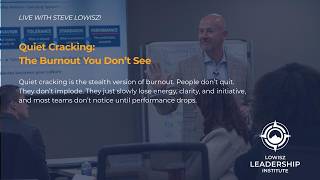
Leadership coach Steve Lowisz describes quiet cracking: when teams slowly drift toward lower standards, slower decisions, and silenced problems under pressure. He identifies five warning signs and offers a four-step fix: notice the drift, name it plainly, reset standards, and push ownership back to where the work happens.
Chapters
All right, welcome back to another LinkedIn Live. If you haven't seen this before, my name is Steve Lowisz, and I'll be chatting with you for the next 20 or 30 minutes. The idea behind everything we do on LinkedIn Live, on these sessions, is to talk about and really kind of dig into some topics that might be a little controversial, that people may disagree with, that may take a different view of leadership in and of itself. 'Cause let's face it, most leadership systems, most leadership training works when things are calm. The things that I was taught over the last 30 years going all the way back to my college days, all kinds of training I've received since then, in a perfect world, A lot of those ideas have a tendency to work when deadlines are manageable, when all of our clients are happy, and when the team actually has time to execute on the things that need to be executed on. And that's when these moments in leadership feel really easy. All your meetings run smooth, decisions have a tendency to move quickly through the process, and standards hold. But here's the issue. We don't live in a world as leaders, in the perfect world, let's call it. We live in a world where we are under constant pressure. I talked about this in the last Leadership Live or the last LinkedIn Live, that when we get to work on Monday morning and the crap hits the fan, all of that stuff that we've learned kind of goes out the door. I'm just kind of setting the context. For what we're going to talk about today, right? The client issue escalates, the revenue slipping, somebody calls off sick, the next person quits. All this stuff happens. And as leaders, we may not respond in the best way because we feel the pressure. And we've got to realize that this impacts our teams. And I know theoretically you'd say, yep, I get it. There's nothing new here. But what we have to understand is that a lot of the drift that our teams feel isn't loud. It doesn't all come on at the same time. If you're a leader, you've experienced this. If you're a team member, you've experienced this. Look, if you're one of my team members, I know that you have experienced this. And eventually we start asking ourselves, Dang it, what happened to our team? Why does it feel like there's no energy? Why does it feel like there's no accountability? And here's the thing, apparently the leadership or the world has a new name for this. And it's actually the title of this session called Quiet Cracking. You know, we've had quiet quitting, we've had all of these different titles for all of these things that have really gone on for a long time. So let's hone in on this thing that we're calling quiet cracking today, right? And again, I don't know who comes up with these phrases, but the pattern behind them is real. Even quiet quitting, which was real popular for a couple of years, the term actually took over. But if you peel the layers back, the pattern behind quiet quitting, The pattern behind quiet cracking is real. People don't necessarily drift in a loud way. They start getting a little bit quieter. The team doesn't collapse all of a sudden one day. Usually it's over a period of time. And it's the phenomenon I've already referred to. And I keep saying this over and over and over. The team, the individual, starts to drift. And it's quiet. It's subtle at first. Look, in your organization, if you really pay attention to this, you experience this as well. But here's the thing, from a leadership perspective, I put a lot of emphasis on things that are our responsibility, my responsibility as a leader. And this drift that creates this phenomenon of quiet cracking, I think, is really our responsibility as leaders. Let me— if you're watching this, whether it's while it's live or sometime later on, I want you to think through this. Let me ask you a question. Have you, as a leader, have you ever kind of looked up and realized that you're carrying more of the load than you have previously? Meaning people are coming to you for more for approvals because they're not making them anymore. They're coming to you to solve more of their problems because they're not solving them anymore. Have you ever experienced that? And if you're a leader and you say no, you're lying to me because we've all experienced this as leaders. That's a result of the drift. Now, if you have experienced that, if you've got the chat box up in front of you, I can see it up here on my screen. I just want you to put in ownership drift. Just type in that comment, ownership drift. Again, whether it's now, whether it's later, because it's that drift that we create. It's the environment that we create as leaders that shows up in ways that we're often not paying attention to. That actually matters. And here's what I hear in most leadership circles. It's burnout that creates this drift. It's a lack of engagement that creates this drift. Or it's a lack of employee resilience that creates this drift. I think it's the other way around. I think it's the environment when what we are not paying attention to as leaders that creates the drift, that creates the disengagement, that creates what looks like a lack of resiliency, that creates a lack of engagement. Now, I am not taking personal responsibility out of this. If you're a leader, I'm not blaming you. I'm not blaming me for 100% of this. But we set the tone. And I think 80, probably 85% of the time, It's what we're doing or not paying attention to that starts to create the majority of the drift that goes on. And it's really about how we change as leaders under pressure, the way that we get stretched in some of these things. And then what happens as a result of that, the standards that we used to hold to begin to soften. Accountability now becomes something that is viewed as negative. That creates the environment of quiet cracking. That drift that starts off really quiet from our team members. That drift that starts off almost unnoticeable if we're not paying attention and then eventually catches steam. And we go back to that earlier question I asked, what the hell happened to our team? What the heck happened to our team? It's we don't realize it soon enough. And when we do realize it as leaders, unfortunately, too often we do nothing to create the drift that's actually there. Now, this is all really good and sounds great. Some of you are thinking, you know what, it's— that's not true. Some of you are thinking, oh my gosh, that is so true. Evaluate yourself as a leader. Now, here's what I want to go through. There's at least 5 kind of subtle signs from a leadership perspective that you can see in your team that's starting to predict this idea of drift, that drift that leads to quiet cracking. In essence, They're being very quiet. They're not leaving the organization, but they're not as engaged as they were before. They're not making the decisions that they used to make. All those things that I actually described, that's really the definition today of quiet cracking. But let's go through each of these things and the signs that as leaders we have got to be paying attention to. And then I'll give you a couple of steps, a couple of thoughts that you can apply tomorrow, that you could apply today, that we all as leaders need to take heed of. But number 1, and I've already referenced this a couple of times, if you're experiencing as a leader a circumstance where decisions throughout your team are slowing down, it's potential that they're already starting to drift, right? You start hearing, It doesn't sound like a major issue, but when you start hearing things like, hey, I just wanted to check with you. That's what your team is saying to you. I thought you might want to weigh in on this. Those sound like harmless phrases that they're just getting you involved. But I want to take the flip side of that. If these are newer phrases that are starting to come up, even though it sounds respectful, What it's really showing is that the ownership for whatever needs to happen is moving up. Now think about this for a second. Our role as leaders is to take ownership and guide it down, to give that autonomy to our teams closest to the scenario to make the final decision. But if they're starting to feel, if your team is starting to feel like they can't make the decision and they start getting you involved in everything, hey, just wanted to check with you, thought you might wanna weigh in. We've gotta pay attention to those phrases that sound like positive things because they ultimately become not so positive. They're starting the signs, that subtle sign of drift that's happening where ownership gets pushed up to the highest level. They're not willing to make the decisions anymore. And if as leaders we don't correct it, All the decisions are on us. And then on the flip side of that, we start complaining that there's more on our plate, that our teams are not making decisions, our teams are disengaged. You can start to see the connection here. So we've got to pay attention to some of these subtle things that seem to be positive, that seem to be respectful, but are often signs. They're signals for your team, my team, starting to drift. Now, there's a second thing. And we've really got to pay attention to this because it's just as subtle as the first one. It's the actual language that we start to pay attention to that we hear from our teams. The language starts to soften quite a bit. And you've experienced this. You've probably been in it. But you start hearing things like, well, maybe we should do this, or I think I think we might want to try this. Those subtle things, again, it sounds like, it sounds like everything we've heard before, right? But what we really need to understand is that confidence doesn't actually fail overnight. Confidence fails through drift. And when your team starts showing a lack of confidence, it's not necessarily on them. It's probably in the way that we're leading, or in this case, not correcting certain things as we're continuing to lead. Because that, that confidence fades over time, not overnight. We've got to pay attention to these subtle sounds. But there's a third thing that we absolutely have to pay attention, and that's that the standards that we operate under begin to soften. And again, this isn't an overnight thing where our standards change, but you start hearing exceptions to the rule. And this isn't all about being perfect. This is not what I'm talking about. But we've got to pay attention to these things. When your team starts saying things or you start saying things as a leader, "Mm, I'm going to let this go just this one time. Let's not really make a big deal." about this. But here's what we need to understand, what that usually leads to. When that fade around things like that happens over a period of time, we get to the point of saying, man, I just can't keep my team accountable. They're not owning the things that they're supposed to own. But let's think about what we've created in a drift like this that I'm describing. Hey, you know what? I'm not going to make a big deal about this, or don't make a big deal about that one thing that that person didn't do or didn't do correctly. They'll take care of it. Let's not make a big deal about it. We're teaching them in the little things that they don't matter, that that standard of delivery, that standard of communication with a client, that standard of respectfulness to each other, it's not that big of a deal. And then we wonder on the big issues why they're not accountable. And we create this drift throughout the organization, which again leads to this idea of quiet cracking. They tolerate softer standards because we've shown them as leaders that it's okay to have softer standards. And again, you can hear it through some of the terminology that's used, but we're sending the message standards really don't matter here. And you've got to remember this rule. If anybody— if you watch anything that I put out on social media, there's something that I say over and over and over, and it's a misconception that I try to correct. See, culture is created by what leaders tolerate. Let me say this again. Culture is created by what leaders tolerate. So we can do the pizza parties and do all the great things and have our values up on the wall. All that are really important, but we're showing what our culture should be. We're actually creating the culture that often leads to this drift, to this quiet cracking by what we tolerate. When we let that thing go and the other people see that we're letting it go, we're showing that we're going to tolerate that. And that bleeds over into the actual culture. So number 3, again, standards start to quietly soften within the organization. And when that continues to happen, we create an environment of drift and we are sabotaging ourselves by creating this idea of quiet cracking. But there's a 4th thing that starts to happen that we've got to pay attention to. And this is 100% on us as leaders, everything starts routing back to us. The simple decisions, the simple approvals, the problem solving that our team is more than capable of doing. When we start paying attention to that and we become the bottleneck where we're actually making decisions that we shouldn't be, decisions that previously we haven't, that people were willing to make it and now they're not. The problem is this happens gradually as well. And if we're not paying attention to it, that gradual shift all of a sudden seems to be this big issue because we haven't addressed it. See, the moment we step in way too early as leaders, ownership moves back up the organizational chart. And we often do it with the right intent of helping, but what we end up doing is perpetuating the drift of our teams. We allow it to actually occur. And here's the thing, once that bottleneck moves up to us as the leader, it's very difficult to get back down within our teams. And then that drift creates the quiet cracking. That's number 4. But there's a 5th one. And I've seen this happen in my own organizations. Look, leadership, just so we're all on the same page, and you know this, I hope, leadership is not perfect. Just because I talk about these things, just because I'm pointing out these 5 things that I want you to really reevaluate in yourself as a leader in your organization does not mean I'm not doing the same thing. In fact, usually these are reminders of what I have to do, what my leaders need to do, in our own organizations. And if we're struggling with it, and I see it across so many organizations who are struggling with this stuff, it's a reminder for you as much as it's a reminder for me. I make the same mistakes. But let's talk about this fifth one. This idea that we've got to pay attention to where problems begin surfacing in our organizations later and later and later. They're not addressed when they first come up. And again, this is something that happens subtle. And if we're not paying attention to it as leaders, we don't even realize it's planting the seed of drift within our organizations. And the more drift, the more reasons for drift we create, the more that quiet cracking is actually occurring in our own organizations. So the issues that used to come up early with a client, with a fellow team member, really anything, they start— they used to come up early. They start coming up later and later in the process. It's like people are hiding from them. They show up last minute and now there's all this urgency to deal with the problem because it wasn't dealt with sooner. It's, you know, people didn't say anything at first. And it's usually not that they're not capable of seeing the problem earlier. It's really more of a leadership response and how we've responded when the issues have come up previously. This is an interesting thing. People bring up problems early or issues, I won't even call them problems, early when they know others will listen and help them solve. When they trust they're not going to get slammed when they bring that problem. It's the old saying of, you know, don't kill the messenger. I guarantee you if you're a leader, at some point in your previous, whatever, how many years you've been leading, you've killed the messenger. And you sent the message that you killed the messenger. And you're sending the message not to surface problems early because you're going to kill the messenger. And there's different levels and there's different degrees of this. I get that completely. But what we have to understand is that these are all leadership behaviors. These 5 things that I just mentioned are leadership behaviors sometimes unintentional, sometimes because we just don't know, that creates drift. That drift in our team is the cause of the disengagement, is the cause of a lack of resiliency, is the cause of that disengagement or that lack of ownership that we see. We've got it backwards. We don't need to, create more ownership in our team, we need to first start looking at the behaviors that we are showing as leaders. And if we don't pay attention to these 5 subtle things, and now all of a sudden it starts to blow up and the drift is there, we missed the opportunity. Now, it doesn't mean we can't come back from it, but it's sure a heck of a lot harder when all this comes into play and your people actually start cracking. It's moved from quiet cracking to literal cracking. They're giving up. They're not taking ownership. They're doing just enough to get by. Call it quiet quitting, call it quiet cracking. It doesn't really matter. But those are at least the 5 signs. So here's a question for you. Again, if you're watching this, I would encourage you to think through this for your own group. Which of these show up in your organization? If you're a team member, you're not leading people, I still want you to think about this. If you're a leader, I want you to really pay attention. But which of these are actually showing up consistently in your organization? Decisions are slowing down. The standards have been softening over a long period of time. As the leader, you or your leader, becomes the bottleneck and they are making decisions they shouldn't be making, or problems in your organization, issues show up late and it's almost when they're about ready to blow up. Which of those shows up in your organization? Be honest about it. You don't have to put it in the comments. If you have, if you want to, please do so. But I just want you to think about this in your organization. And here's my experience. Almost every organization that I work with, including my own, one or more of these shows up. And it's usually more than one, which is indicative of drift that has not been addressed, which is indicative of a leader who hasn't paid attention to the drift or didn't know that we should be paying attention to the drift. But then here's what happens when we finally realize. So think about it here for just a second. You identify the drift. One or more of those 5 things are actually happening. What do you usually do as a leader? Or what does your leader usually do? I want you to really think this through because in my observation, in my experience, a couple of things happens for most of us as leaders. We push harder. We want more accountability. We push harder. We want— we're going to force engagement. The leader gets more involved in the day-to-day of the operations. Look, I've done this a gazillion times, right? Things aren't going the way I want them to. Instead of leading, I get involved more operationally. I try to motivate the team. You've done the exact same thing. Your leader has tried to do the same exact thing. But it's like putting lipstick on a pig. It's a great saying for this, right? We're trying to address the symptom instead of addressing the root cause. And none of those things actually fixes the problem. In fact, the pressure that we often put on through our own involvement as leaders creates even more drift. And we've got to get our arms around this because the issue isn't actually motivation. The issue continues to be what I called out earlier, leadership drift. This is something that is real. This is something that we have to pay attention to. And this is the exact pattern of leadership that I see in almost every single organization. Now, it's different for different levels and it's different for different people. I completely know that. But this is why we built out Guide, Don't Drive and the operating system that sits around it. Because here's what we know. When we're under pressure as leaders, it reveals who we really are. It reveals who we default back to. It reveals whether we're creating more drift in our organizations. So what do we do? I think we would all agree that in some form or another, if we're a leader, we are causing some of the drift that's occurring. I would be willing to bet, if you're honest with yourself, some of those subtle signs of drift you're experiencing right now in your organization. I know this stuff and I know I experience it in my own organization. Again, this is a reminder for you as much as it's a reminder for me and the leaders that I have within my organization. This drift is real. So what do we do? Well, a couple of things. Based on those 5 subtle signs, we've got to start paying attention to drift and catching it earlier in the process. All right? If performance in your organization has already dropped, it's late in the drift stage. So we've got to start paying attention to it actually right now before the numbers change, before the results start start to fall off. That's easy step number 1. Step 2 is a little harder though. Step 2 is calling it out, actually naming the drift that you see without drama, without accusation. But instead of asking a question like, hey, why is everybody slowing down in the organization? Change the approach to this. Look, as the leader, I'm noticing that decisions are taking longer than they used to. That's making it a factual statement. Call out what's happening in your organization. Look, I'm not— team, I'm noticing that decisions are taking longer than they used to. They can't avoid that direct conversation. You as the leader can't avoid that clarity in actually naming what's going on because clarity resets the room. Clarity resets where you're coming from. That's step number 2. Step number 3 gets a little more difficult, right? We went from paying attention to calling it out to number 3 is actually resetting the standard within your organization. And this is the one thing that leaders have a real hard time with because so many of us do not like confrontation. We don't like to feel uncomfortable. But here's what we need to realize. Standards are not punishment. Let me say that again. Standards and resetting them for you and your team That is not punishment. Working in ambiguity, letting it go, letting your team continue to drift is creating punishment for your team. It's creating a drift environment, an environment where people are quietly cracking. What we've got to be able to do is say, look, team, here's what good looks like in our organization. Here's the standard that we hold to. We reinforce it. Because here's what we've got to go back to, what I've said earlier. Culture is what we tolerate. And if we continue to tolerate less than that standard, we're continuing to perpetuate the drift. That is not fair to your team. It creates drift, that creates disengagement, that creates cracking, that creates turnover once they get through the quiet cracking. We have got to reset the standards in our organization. And then there's a fourth step. We're just building on it. We're making things more difficult. But this, this is another one of those areas where I think leaders struggle. If you're a problem solver, and most leaders are, we already talked about this, you step in to actually solve the problem. But instead of solving it, we need to step back as leaders and start asking, some questions. What's your plan to solve the problem? What decision are you making? When should I check back in with you to see how that process is actually going? See, ownership stays, should stay where the work actually lives. I had the same situation in one of my teams in the past week. It was really a, a client issue that needed to be addressed. And in most cases in years gone by, I would have jumped in and said, okay, Team A, you're doing this, Team B, you're doing this. And I really had to push back on the team and say, this is yours to solve. I trust you to be able to solve it. What's the next steps that you're going to take? When are you going to take them by? And when should I follow up? That is putting ownership back at the level that it should be. We do it with the right intent as leaders. We see the problem. We solve the problem. We think we're helping the other person. But all we're doing is showing that we will do that, that we will start to make decisions that we shouldn't because we don't trust them to actually make decisions. That's how it feels when it's one of your team members. So here's the thing. Let me just kind of ask you a quick question, right? How many of you have caught yourself stepping in when you shouldn't? Be honest with yourself for a second. You don't need to put anything online, but be honest with yourself. Like, it's— I've been there. You've been there as a leader. But yet we continue to do this stuff. We've got to take these 4 steps. But here's the deeper truth, and I'm going to end with this thought process on this whole idea of quiet cracking. A training doesn't fix this type of drift. Drift stops when, as leaders, we create an ongoing rhythm that reinforces the 4 steps that I just talked about. Right, we've got to pay attention, right? We've got to call it what it is. We've got to make sure that we address the behavior, that the decision-making is at the appropriate level and we're not taking control of that, and that we're resetting the standard for the organization, for that department, for whatever it might be. And that, that's why this idea of Monday morning implementation, you've heard me say MMI before, is so incredibly important because We drift very quickly. We have the right intentions to address these 4 things, to pay attention to those 5 things I mentioned in the beginning, right? Paying attention to the subtle drift. But we have our jobs to do. We have the pressure of every day as a leader that we have to pay attention to, which is why we need to be in a rhythm. And all Monday morning implementation is, is not a taskless conversation. It is a behavioral-based check-in that as leaders we should be doing every single week. Not once a month, not every other week, but every week. We inspect the behavior that's going on, our own and others. We reset standards for ourselves and for our teams. We protect the ownership at the right level and don't take over when we shouldn't. Because here's the reality. If nothing changes Monday morning, nothing changes in your organization. The drift gets worse. The quiet cracking gets worst. The disengagement gets worse. And guess what? The performance in your organization gets worse. See, insight through training is really great, but it's the behaviors that as leaders, we choose that actually makes the difference. So if you take nothing else out of this, just pay attention to these two things. Number one, drift doesn't happen overnight. Number two, we need to focus on our behaviors and our team's behaviors. We need to reset the standard, and we need to make sure that we push ownership down to the right level. We start doing those things intentionally, the drift starts to go away. The engagement comes back. The results remain consistent. That's the beauty of guiding instead of driving and reinforcing that every week with ourselves as leaders and our team through Monday morning implementation. Like, I know this is a heavy subject, but we gotta call it for what it is, leaders. We have the control, at least 80% of it, 85% of it, by changing how we approach things. We are often the cause, even with the best intent, because of what we miss in the things, the behaviors that we show that we think are solving the problem when in fact they're perpetuating the problem. You want to change your organization, you want to change your culture, Change what you tolerate, change how you behave, and your organization will follow suit. Don't, and your organization will follow suit. Look, if you've got questions on any of this, if you got comments, if you got thoughts while it's either live or afterwards, just put them in underneath the video that you're actually watching. I respond to everything directly. If you want to reach out to me directly on one of these issues because You don't want it publicly known that you're struggling with the same thing, feel free to reach out to me directly. You could text me at 734-837-8500. You can get— you can direct message me here on social media. Yes, that is my real cell number. You can find it all over. I respond to everything myself. I don't let anybody else do that. That's the level of ownership I need when responding to people like you. Team, leaders, non-leaders, this is your opportunity to change your behavior, to change the drift in your organization, because I guarantee you one thing: drift is happening in yours. It's happening in mine. But we have an opportunity to change that and we can stop quiet cracking. See you at the next LinkedIn Live when we're going to talk about another deep-rooted topic that is probably going to be uncomfortable for some. Pay attention. The communication will come out soon, as soon as we confirm the date of our next LinkedIn Live. Again, my name is Steve Lowisz. I hope you got something out of this. If you've got questions, reach out to me, and I'll see you at the next LinkedIn Live.










