The Branch is the Brand - Linkedin Live
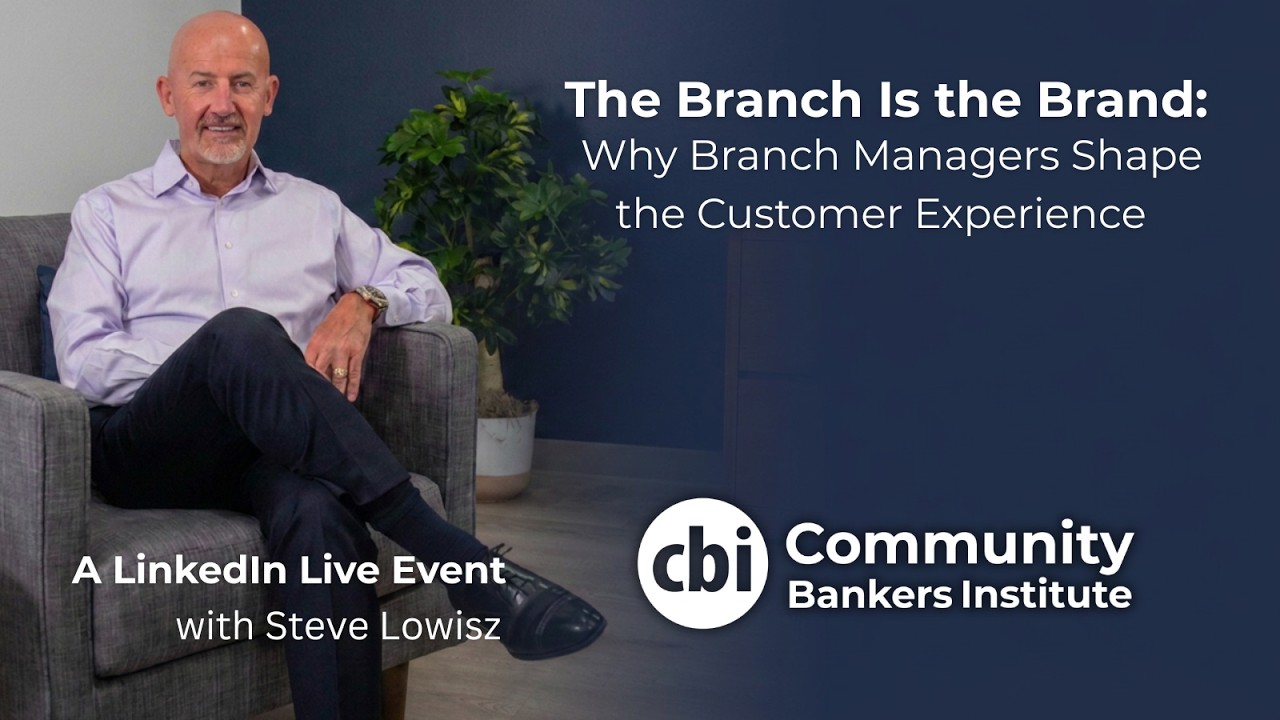
In this LinkedIn Live session, Steve Lowisz argues that the physical bank branch remains a critical brand touch‑point for community banks, even as digital channels have siphoned away most routine transactions. He outlines why branch traffic, though lower, is now higher‑value, and he identifies five (plus) systemic issues that prevent banks from capitalising on that value: (1) a lack of clarity on the branch’s relevance; (2) an over‑reliance on transaction volume as a performance metric instead of measuring relationship depth; (3) insufficiently deep customer questioning (Level 1‑3 questions) that limits opportunity discovery; (4) excessive control and approval layers that strip branch staff of judgment and authority; and (5) misaligned incentives that reward activity and product pushes rather than relationship‑building behaviours. Lowisz provides concrete recommendations – establishing guardrails, redefining winning criteria, coaching judgment, freeing branch managers to lead, and auditing reinforcement patterns. He also offers free “drift‑check” tools for retail and leadership teams. The talk is a blend of diagnostic analysis, anecdotal evidence, and actionable guidance aimed at CEOs, branch managers, and anyone involved in community‑bank retail operations.
Chapters
The branch is the brand. I actually took the time earlier to write a book about this, and it was received well, but it was interesting, the comments on both sides of the discussion. So those that are in retail banking actually read the book and said, hey, this is great, this is what we need. Those outside of retail banking, I got a lot of comments around why are you wasting your time with an antiquated system of branches in the retail space. Thank you for joining. If you're a CEO, if you run retail, if you're a branch manager, this is going to be for you. But I'm going to give you a warning. This is— give you— gives you some context, because if you follow anything that I post online specifically about community banking, and if you're here, chances are You've seen some of those posts. Some people ask me if I'm a little schizophrenic around banking. In some instances, I'm so pro-community banking. And then in other instances, I call out some of the challenges with community banking. And I need to start by explaining that, and then I'll get into the discussion for today. The reason that I'm so hard on community banking is because I think it can make a bigger impact than it does now, specifically the branches within community banking. And I think way too many banks, not because of ill intent or anything along those lines, they haven't taken advantage of where we are in the branch today. And that makes people's lives in the branches very, very difficult at times. Broad brush, it's not all community banks, it's not even all banks. But that's the focus here is, is I'm going to address 3 or 4, maybe up to 5, depending on how much time we have here, specific things within the branch system, the retail system within community banks. And if you're watching this live right now, feel free to put in your questions, comment. I can see them up on the screen that I have here in front of me. If you want to text me, feel free to do that. I make my number publicly known. It's 734- 837-8500. If it fits, I'll make sure that I comment on it. If it doesn't fit, I may defer a comment to something later. So let me kind of give you the context for today with that backdrop, right? I think community banking, in particular the retail bank, is not viewed in the way that it should be. Traffic is down. There is no question. But the importance of the traffic coming into the branches, in my opinion, and with all the studies that I've seen, is way up. The importance of those conversations is through the roof compared to before. I mean, let's think about it. Some of the stats that I've seen is branch traffic is down by 90%. And in some markets, I think that's probably pretty true. But in other markets, it's actually reversing. Branch traffic is up. But in totality, let's face it, technology has taken the transaction primarily out of the branch. So the real simple things that we used to do, a quick deposit, a balance transfer that you had to go up, stand in line, talk to the wonderful teller on the other side, sometimes with glass, sometimes not. We don't have to use the bank for that any longer. We have our phones and I do about 90% of my transactions on my phone just like so many people do. But it begs the question, if life has been replaced with technology, and let's face it, it has, I'm not going to argue that point, what's happening with the people still coming into the branch? Now you've got a small percentage of that population, let's just say they haven't embraced technology the way that some of us have, and they just want to come in. Sometimes they're lonely, let's face it, and they want to have a good experience and talk to the teller. Or the customer service person or whatever title we use today, right? They just want somebody to talk to. And that's a small percentage. But when people come in because of death in the family, because they're starting a business, they got a large deposit for a business, they have questions around wealth and they wanna actually talk to somebody. The level of the importance, the level of the discernment that needs to happen with those types of transactions or non-transactions, let's call them more relationships, is completely different. So the majority of the people walking into a retail branch need something more than a transaction. And sometimes we miss that. We think, oh crap, volume is down. The branches aren't— we shouldn't invest in our branches. Or we're just going to put a bunch of autotellers in these branches and people will just talk to the screen instead of an actual person. And again, there's a time and a place for some of those transactions behind it. But I think we're missing in community banking in particular a huge opportunity because I think in some instances we're leading our branches from the years gone by, but we're operating them with technology of today. And I'll explain that in a second. Our mentality as bank leaders has got to change in general on our branches themselves. So that's, that's kind of the background, and I'm not going to defend every branch model. I'm not going to defend every structure within branches, and I'm not going to defend and say technology hasn't made a big difference. I just talked about all that. But there's also an interesting trend. In the first 2 quarters of 2026, there is actually more branches than there was last year. Now, it's not a huge number more, but you hear these banks that are closing branches all the time. But what we don't think about is why are they opening new locations? Now, they may be in a different location, a different market for all kinds of reasons that we won't cover today. But they see something. I see community banks doing this and I see the big banks doing this. And there's a correlation between that. It's not just to get more foot traffic. But it's to take care of the customer that does happen to come in on foot. And we can't forget that, and I think we actually do. Where do branch leaders unintentionally— oh, I can't see that whole screen. David, if you can make that screen a little bigger. Unintentionally create dependence. Good, great question. I'm actually going to come back to that in just a second. So here's, if we have the time, here's the 5 things. That I'm hoping that we get to. Number 1, and we just talked a little bit about it, I'm going to go in a little deeper around the relevancy of the branch because we can't forget it. I know if you're sitting in a branch, you're thinking, damn right, right? There's lots of relevancy in my branch. But I think we've got to have a broader conversation. Number 2, in particular, community banks talk all about relationships. And it's true if we're actually addressing it the right way. I wonder if sometimes we talk about relationships, but we measure things that are 100% transactional. And I've seen this within banks, both community banks as well as some of the larger banks. So there's a bit of a disconnect that we need to be able to address. Number 3, if we're going to truly operate our branches in a way where when people come in, they feel confident with the service that they're getting, they feel engaged, they want to have more relationships with that bank. They're just not saying it out loud. We've got to make sure that the people in the branch have sound judgment of what they can do and what they can't do. I'll come back to that in just a second. Number 4, I'm going to address you guys that are the branch— you guys and gals, plural— that are the branch leaders and some of your responsibility for actually upping the game within the branch. Now, some of it I get is out of your control. One, I've said this to CEOs, they don't always like it. In fact, none of them like it when I actually say this is, The branch manager is the most difficult job in retail. And the reason I say that is they have all the responsibility, they have all the accountability, but unfortunately in many instances you have zero control. So you're responsible for A, B, C, and D, but realistically you're not making the decisions on A, B, C, and D. Now again, broad brush, but that's the way things used to work in a transactional environment. Not if we're going to go down this relationship environment. And then number 5, what are we actually reinforcing within our branches? Because that determines if we're going to take advantage of this particular opportunity that I believe that community banks have specifically because of their branches. Now let's jump into some of this. Again, I'll get back to the question when it makes sense for that particular question. So just pay— hold Hold for a second on that. So lower traffic, as I've mentioned, doesn't mean lower relevancy. And as I've described it, I think it's quite the opposite. Those coming in, I believe, have a greater relevancy. But unfortunately, what I've seen way too many times is I go into community banks and I observe what happens. Customer comes in, how they're attended to. And I will tell you, 99% of the time, those on the other side of the counter, the desk, just depending on how your bank is actually structured, are exceptionally polite. Even if they're having a bad day, usually I've seen the experiences is pretty good. The problem is, is they're not taking advantage of the opportunity to truly service that customer. What we still continue to do in way too many instances is focus on the transaction. Somebody comes in, brings in that large deposit. We ask them, where do they want it? Do they want it split between accounts? Some really great customer service focused things. And we give them a great experience. They turn around, they walk out. Now, to many people, it's like, that's what we want. We want them to have a great experience. I think we've missed a ton of opportunities with that customer who just came in and did that. And a lot of the times, we don't even realize that that's churning into an opportunity. So the first kind of change, everybody, if you're in a branch, if you're running the branches, if you're the CEO, we need to think differently. Volume down, yup. Quality, need potential, opportunity is actually higher. Because again, most people that come into a branch, they're coming in for a reason. I wrote this down earlier this morning, and I'm going to be a little snarky here, but here's the quote that I wrote down. Don't celebrate that digital has reduced branch traffic and then at the same time fill that time with more internal reports and other busywork. Let me say that again. I'm just going to paraphrase it, right? Don't celebrate that digital reduced brand traffic and created more time for people that work in the branch And then we fill that time with garbage. Again, that's my opportunity to be a little snarky. If you've seen any of my posts, I tend to get a little snarky because I care. It's not because I'm trying to beat anybody up. I actually care because of the missed opportunity. AI, everything else that we're trying to push into our banks, which makes a ton of sense. We absolutely wanna be able to do that. But what are we doing with that extra time? So instead of processing those 10 deposits, we've got mobile deposits. That's time that the folks at the front of the bank, the folks at the teller line, they don't have to do a lot of those randomized transactions any longer. And I get we have less staff now in some of our branches as well. But because of this, there's also idle time. When I sit and watch inside of a bank branch, the amount of idle time so many locations have, and that time is not being used to do something else to call that customer, to follow back up, to develop that relationship, to create that engagement, that is a loss of opportunity. That is a leaking of opportunity within the branch. And I see it so often. Right, did the team call the customers? Did we do the follow-up? So if it's more important that the group coming in has a higher potential to serve more of their needs beyond the transaction. Again, knowing there's a small piece. What do banks do? How do we shift to take care of that opportunity when we think about this just in terms of volume? And there's just a couple of thoughts that I want to share with you. Do you know, and some of you do, those that come into the bank, why they come in? Do you actually track it? Is it truly just a simple transaction, or are you doing the old school way of just looking at volume? Volume coming through the doors. Almost every bank has tracked foot traffic into their branches. It's one of the reasons that we build a branch in a certain area. We think we're going to have a certain amount of foot traffic. But do you actually know why? Do you track the types of things they're asking for as an entry point? There's probably other needs there, which we'll get back to in just a second. But do we actually know? That's the first thing that I would start looking at if I was a CEO. Of a bank or sitting on your board, I'd be asking you as the CEO, why do people come into our branches? What types of things are they actually doing? It's easy to pull, but do we actually pay attention to it? Right, that's, that's number 1. Number 2, if there is opportunity for follow-up or a handoff, which branch managers, those that are in the retail branch are supposed to be asking questions, which we'll get to in a second. On what other needs that customer may have, we've got to make sure that that handoff to commercial, to wealth management, there's a defined next step. Not just, hey, this person might be interested, and then it goes into the CRM and they never know what happens to it before. Those banks that are paying attention, making a clear handoff, and defining what the next step and who owns it, are taking advantage of the opportunity they have with those people walking into the branch. The capacity that digital has created for the most part, I get certain branches are understaffed, especially where there's still heavy foot traffic. I get that. I'm not immune to that, right? I'm not going to throw that off to the side. But in most cases, based on real observation, there is a ton of downtime that we can be using to actually create that relationship and that connection that community banks talk about all of the time. There's another question. When we say the branch is the brand, what are customers actually noticing that leaders may not realize they are noticing? What are customers actually noticing? The questions that are being asked, not just, hey, they were polite on the other side. But customers are actually noticing how they serve. What follow-up questions do they have? Are they just polite, which is great, or are they looking for other opportunities to identify areas, not to sell product, we'll get to that in just a second, but to actually serve them better. And they keep coming into the branch over and over and over and paying attention to that because when you survey these folks, This is one of the top things that they actually say. So that's the whole idea behind number 1. Lower traffic. Yup. Those coming into the bank, we've got to pay more attention to. Number 2, I've already referenced this a little bit. We talk about all this relationship matters stuff in community banking. And I think that is the hallmark of community banking when done correctly. And again, I'm tying this specifically to the branch itself, but talking about it and the things that we do to reinforce it or not are two completely different things. And we see this all the time. If, if leaders praise activity, whether it's the branch manager, the regional manager, the CEO, but we talk all day about relationships and we don't praise the depth of relationships because we don't have a way to measure it. We've never measured it. We don't pay attention to it. All we measure is activity. What are we going to get in our branches? More activity. It doesn't mean the quality of the activity is better. It doesn't mean that the relationship is actually being built. And this is a huge disconnect. Relationship, relationship, relationship. And then as leaders, we praise all the people with the high activity. Hey, I can't believe you called 50 people. Yeah, they may have left 50 messages or they called and as soon as they picked up, they hung up, but they said they got their call in. Right? What we measure, what we praise, what we reinforce is what we're going to get. And it's not that we're doing the wrong thing intentionally. I think way too many retail leaders are still thinking in the past. We gotta have activity, activity. Yes, we need to have activity. But if that's the only thing we're praising, that's the only thing you're going to get. And then all of our talk about relationships and community banking is nothing more than just talk. And I see this way too much. And again, I get snarky about these things. I push on these things. It's not because I look down on community banking. It's the exact opposite. I care so much. About our industry of community banking that I see where we're bleeding in some of these areas or we're leaking in some of these areas and there's an opportunity here that we absolutely have to change. Now, this relationship thing, what I get all the time from those within the retail system itself is, or from the community bank CEO and driving the relationship is we're not salespeople, we're service people. Let's think that through for a second. You don't want to be— and please don't take offense if any of you come out of the used car industry, because there's some really great used car guys and gals out there right now— but there's a connotation, right, of we don't want to be the used car selling of banking. We don't want to just push products. And I agree with that. I don't think that's ever the way to sell anything, whether it's selling services, whether it's selling products. We should never be selling. Ice cream to an Eskimo, as the saying goes, right? We don't want to be doing that. If you're doing that, it's the wrong intention. You're not— you're trying to get your commission, you're not trying to solve. So I get all of that. But when I sit there and I listen to those within the retail branch, branch manager, regionals, I even heard this from CEOs across the country of community banks, it becomes very non- understanding questions. So let me, let me explain what I mean. I think there's at least 3 levels of questions, right? Again, we don't want to sell product. Driving is selling product. Guiding is uncovering what's really going on. And this is not just a semantics thing. This is an intentional thing. But if we're truly going to understand what's going on, we've got to think about the questions that we actually ask. Let me give you an example of it. A level 1 question, as I call it, will ask the customer what they want to do. So they bring in a huge deposit. Oh, great, David, thanks for bringing in that $50,000. What do you want me to do with it? Okay, level 1 question. It's not really uncovering the scenario that's going on. Level 2 would ask a little bit more about what's happening with that request. David, you brought in $50,000. Is that from a business transaction? You know, help me a little bit understand what's happening to see if there's some additional opportunity. Level 3 goes way deeper into the decision-making, the risk associated with it, any changes in their business or personal. Maybe it's a life insurance disbursement. Something majorly changed in their life. Level 3 people within a retail branch focus on level 3 questions. Now, this is an unscientific observation that I will give you based on the time I spend in community banks, which is very often, at least every other week, sometimes every week, I'm watching what's going on in, in a community bank. And it's probably less than 3% that go to level 2 or level 3 questions. And then internally we have the conversation, why isn't the branch performing as well as as it should. Why aren't they referring commercial? Why aren't they referring small business, wealth management, trust and deposit, all kinds of other services outside of their purview? Because in most cases, they've never actually been taught how to go from where they are to truly understanding what's going on in the life of that customer. Not to sell them something, but to truly understand where the need is because they may not have even thought about it at that given time. That's the difference between selling a product that some of the banks do and really understanding the customer and not losing the customer because you didn't ask the deeper level questions. So I got a couple of examples I'll quickly run through. Customer asks about a CD rate. A level 1 question would be, hey, how much are you looking to deposit? What term do you want? A level 2 question What might you need to— when might you need to access the money? What matters more, rate or flexibility? And then a level 3, what is the money intended to do for you now? What decision are you trying to make? And would you regret locking it up for an extended period of time? I got a ton of those examples, but I think you get my point. We have got to think about serving our customers in a way that we're truly asking questions that ultimately build that relationship if we care. But it takes a few minutes to have this conversation. But we absolutely do not want to push product. The sales comes naturally when you truly understand what's going on. And again, less than 3% of those that I observe in any bank, any bank in particular, no bank in particular, all banks that I'm in, primarily community banks. But I also pay attention to the large banks when I walk in. In full transparency, and I posted this online, I have banks that— I have accounts at community banks and I have accounts at regional banks, super regional, and the national players for multiple reasons. Sometimes I just like to do the research to see what goes on as I'm describing right now. But that's number 2. We've got to make sure that if we're going to play the relationship game, we're measuring not activity, but we're measuring the depth of those relationships, new relationships that have been built. We are not selling, but we understand the difference between a level 1, a level 2, and a level 3 question because it's the level 3s that unlock opportunity, that help the customer, and as a byproduct of that, they absolutely increase the performance of the bank with additional fee income, greater deposits. I had a situation— not I, but I had this happen not too long ago where a young man walked into a community bank branch He had been into another branch. They hadn't actually treated him very well. I think he was 18, 17 or 18 years old. He actually has a landscaping company. He either is a senior or just graduated from high school. And some of the banks treated him poorly, really, really poorly. One particular bank treated him exceptionally, exceptionally well. And he happens to live with his grandfather, not his parents. He lives with his grandfather. And he went home and told his grandfather how well this particular community bank —this is here in Metro Detroit—treated him, that grandfather visited that branch, got the same treatment, and moved $11 million in investments over to that bank because of the experience in the branch. And there are hundreds, if not thousands, of those examples that I hear from branch leaders and within the branch and from customers on a weekly basis. Now, real customer situations are rarely clean. How do strong branch leaders help team members use good judgment without creating unnecessary risk. This is what we're talking about is actually real customer situations. We're going to get to the branch manager in step 4. Let me finish step 3 and I'll actually answer that. Got another comment. We need to know our clients financially, not just personally. Absolutely. That's the questions that I was just talking about, right? We've got to have that personal connection that gives us when we have a little bit of rapport and a little bit of that trust that actually gives us the right to ask some of those deeper questions, those level 3 questions. And they're not intrusive, they're caring. As long as our intent is not just to sell the next CD that our leadership told us to sell. We've got to be really careful about those things because that undoes the whole idea of relationship banking, especially in a community bank. If you're just trying to sell the next CD. When it's appropriate and that person has money, they don't care if it's tied up and you've asked the right questions, and the next natural thing is you can get this higher rate in a CD because it's in the best interest of that person. That's not selling, that's servicing. And that's what we should be doing as community banks. But I want to move forward to number 3. Chris, thank you for that question. That's actually a really, really great one. Number 3, issue of judgment that I mentioned in the beginning of this, right? We say we want our people to show good judgment, to have good judgment, but too many times we punish our people for exercising that judgment within banks in particular, specifically within community banks. I mean, we, we tell our people that we want ownership. Branch manager, you got to own this. You got to own the customer. You got to own the deposit growth. You got to— which is all fine. But then what we do is add all kinds of layers of stuff, layers of approvals, layers of reporting. And I'm not saying we shouldn't have some of those things. We absolutely should. But I've seen so many situations that we give the branch all kinds of accountability and responsibility, but we give them zero authority. And we are moving it further and further and further away from the customer. So when we sit there and say, I want people that take accountability and have great judgment in dealing with the customer, But everything that has to be approved to take care of the customer goes up 3 channels, waits 3 days, and then comes back down. Now how the heck does that make sense? I actually wanted to say a different word, but I caught myself. How the heck does that actually make sense? And it seems minor. Hey, this thing— wait, there's got to— it's got to go to the regional person for approval. I'm going to ask the question why most of the time. I get there's a certain amount of credit authority for a branch manager for a consumer loan, whatever the case is, then it has to go to regional, then it goes to— the CEO maybe, and then maybe even the loan committee. Usually that's on the commercial side, not on the retail side. But are we just saying that because we don't trust our team and then we tell them we want better judgment out of them? So think of that mixed message. And this happens a ton in banking, especially again in community banking, right? We never give them the opportunity to exercise the judgment because we have too many boxes around them that dictate how they should make that judgment. Judgment is not something that you can put a box around. You could put guardrails around it, but we oftentimes don't even do that. It's like a longtime customer, they always carry a high deposit balance, and then all of a sudden something happens, the deposit balance is gone, and now they've got an overdraft fee. A customer comes in and says, hey, I'd like to get this overdraft fee taken care of. This is a real true— this is a true story, by the way. And of course, the customer service person, the teller says, well, I can't approve that. That has to go to the branch manager. The branch manager isn't around. So what do they do? Well, we can't approve anything like that. I'll talk to the branch manager. I get it. We want independence outside of the branch manager being in the actual branch. But then it took 3 or 4 days to get an answer about a $20 or $25 overdraft. Now think of that experience, right? They were a longtime depositor. They ended up purchasing something for cash. They took all that money out with the intention of putting money in. They have multiple accounts. It was only on one account, by the way, and it took 3 days to get an approval for a $25 overdraft. How is that teaching anybody in the branch good judgment? I'm not telling you not to put controls and guardrails. I like the term guardrails. I don't like the term controls. Can't troll— control people. You can give them parameters in which to operate in. That actually, they usually take much better because the intent is a little bit different than controlling them. But we have got to be able to coach judgment within our retail groups if we expect them to actually show judgment, which leads directly to accountability. So how do we do that? Define the guardrails, right? And make sure that we're giving them the right things to have judgment on. We just, we have sucked so much out of the branches instead of pushing more into the branches. Because remember, every one of those relationships coming in matters. And the more we pull and make the guardrails 5 layers up for approval when they're coming into the branch, again, within reason, doesn't make sense. The other thing that I've challenged leadership teams within community banks, especially here recently, is we've got to remove these approvals that are there because nobody's ever challenged them. They're just there. They've always been there. We've always done it this way. If we're truly going to make the branches different, more powerful, create more opportunities than they've ever before, we have to relook at all of these rules that we've placed on the branches. Give them guardrails at the appropriate level. Teach them to have judgment within it. And that goes all the way to the tellers. And most people would say it goes all the way down to the tellers. If you're a customer service teller, you know who I'm talking about, and you're watching this for a second, you have a tough job. Let's just face it, right? You are the— when I say the branch is the brand, the teller is the first piece of that brand because it's the first experience when they get in there, whether you're greeting them, taking care of the transaction, asking the questions and so forth. And dang it, Your job is hard when you're not given judgmental authority with guardrails. So number 1, give some guardrails. Number 2, make sure you remove the crap that's just there because it's always been there. And number 3, don't pull authority back because somebody makes a mistake. This is such a prevalent problem within community banking. They made the wrong call. Okay, that's a teaching moment. And what I often see happen, and you've experienced this, we're gonna move approval authority over here, or in order to do that thing again, you gotta have 9 signatures from 3 different departments and the CEO and the chairman. Obviously, I'm exaggerating, right? This is just kind of how I do this. Stop doing that. Use that as a coaching moment. Why did you choose to make that particular decision? What were the other alternatives at the given time? That's not happening enough. And as a result of that, we're not creating enough of opportunity. Here's the reality. Control creates nothing more than compliance. Let me say it again. Control creates nothing more than compliance. But when we teach our team judgment, real judgment, all the way down to that frontline person, that creates confidence. And when a customer comes in and senses the confidence, the customer has greater confidence. And when they're asked those questions, the customer feels more comfortable giving that information to that person. This is all tied together. If we want to create real relationships, We have got to train judgment in all of our people in the branches and not keep sucking it out of the retail branches. And I'm not talking about one branch or one position. I'm talking about the trends, the patterns that we see. Number 4. What does it look like for a branch manager to guide the team while still allowing employees to take ownership of the customer experience? That's actually what I'm just talking about. If you define what winning means with each of the branch people, with their customer, what winning looks like, and provide guardrails around which they can make decisions, and then teach them what judgment really is and how to make those decisions. Not, you can either make this decision or that decision, and this is the only— the two parameters as to why. That's not judgment. That's compliance. That's control. We don't want to do that. But teach them, look, you're going to have multiple options in each of these situations. Here's the process of how we judge which is the right one. Here's how we look at the evidence. Here's how we look at the facts and so forth. What's the one behavior a branch leader can change this week to create more ownership? If I was going to name one, number— I'm going to name two, actually. Create clarity. What does winning look like for each of the positions that ties up to what does winning look like for the branch? And how does that actually tie up to the overall organization? That's number one. Number two, you have to have guardrails around it. In order to achieve deposit growth, we're not going to sell CDs to people who don't need it. That's a guardrail. Both of those have to be there in order to instill judgment, but to create the kind of clarity where those team members can actually perform. But number four, This is topic number 4 in this whole thing. My experience, and this is from talking to hundreds of branch managers, watching this with branch managers, we tell our branch managers to lead and then we have them doing a bunch of administrative tasks. Again, they're kind of caught in the middle. They're responsible for the outcomes, but they don't have a lot of authority. And it's interesting, I've seen branch managers who just absolutely work a ton nonstop and they still do almost no leading in the branch. Now, I was in recently in a small community bank here in Michigan. I'm not going to say where because anyways, I just won't say where. But I was talking to a branch manager and it's a branch manager I've met with a number of times. Over the past, call it 18 months. And there's this particular thing that I was asking about. I said, let me see your calendar. He had his calendar up on his computer screen. And I said, let me see your calendar. And it was all red, blue, all the colors of the different meetings that he set up. It's Outlook is what he uses. And I'm like, tell me where's the time in all of these where you're actually leading and developing your team? And he looks at the calendar, he's like, there isn't any. They have a training class that they're going to be doing in 2 weeks or something like that, he says. I'm like, no, you're the leader of the branch. He says, I don't have the time because of all these other things that the branch has me do, or that, that the bank actually has me doing. If we truly believe that the branch is the brand, and I believe it is, the person holding the keys to that is the branch leader, not the CEO. The branch lead CEO is too far removed. Nothing against you as a CEO. I mean, banks are doing— a lot of banks are doing really well right now, but we have to give them the ability to actually lead. That's why you have a branch manager there. I'm not saying to, to, you know, not have them calling and not— I'm not getting into that type of structure, but there's a big difference in somebody who actually spends time with their team because they understand the impact it has on the relationship with their customers. And now we're not just talking relationship, we're actually making sure it actually happens. Here's the test, and I want you to think about this. Again, I don't care if you're the CEO, the branch manager, the regional, doesn't really make a difference. Here's the test. It's not about how well the branch runs when the branch manager's there. It's how well the branch runs when the branch leader is not there that determines how successful that branch manager is actually being. And here's what I've realized: in the vast majority of the branches that I walk into and ask the question, the branches always run better when the branch manager or the branch leader is there. And that's a significant problem because they're not leading. They're probably managing tasks or managing transactions or filling out a report or something along those lines. CEOs, regional leaders, if you want your branch to truly be your brand, you want what we talk about in community banking about relationships, let your branch managers do their damn jobs. And that's not just doing the calling and so on. That's leading, that's developing people, and make sure there's governance that follows up to ensure that they do it. Because a lot of you are probably saying, you know what, it's not me. I've told them that they need to do that. They're just not doing that. Then you need to have a governance mechanism inside there. So a couple of thoughts on what to actually do. Actually define what winning looks like for a branch manager. And part of that winning should be the development of their team in a measurable way, not You know, we have a development class every week for 15 minutes or 30 minutes. I could care less about the action. What I care about is the outcome. What is the outcome that's expected? That's number one. Protect two blocks at least during the week where the branch leader can actually spend time talking to the people in the branch, developing the people in the branch by observation and feedback. Create a block that's just for community interaction. And some of you are already doing these things, but we have got to make sure that we make this crystal clear for those in the branch. We can't just assume they know they got to drive deposits. Okay. If I ask them if what their definition of winning is, would they say it's to drive deposits and by how much? And do they have a plan of how they're going to do that? That's where we need to get to. With all of our branch managers. One last one that I want to measure. What has to change structurally, not just behaviorally, if we truly expect branch managers to lead? Great question that ties to what I was just talking about. Every organization, including every community bank, has two engines. There's a structural engine, there's a behavioral engine. The structural engine is goals, KPIs, and so forth. Problem with most people in their structural engine, they don't have a scoreboard, they have a scorecard. There's 19 different measurements on the scorecard. There's no priorities. It confuses the hell out of people. What every branch— what every bank needs to do for the branches is be very clear. Here's what winning means in your branch. Here's what winning means for your specific opportunity. What are the behaviors that actually support achieving that? You tie those two together and you create significant opportunity within your branches. You don't tie those two together and you only do one or the other, it doesn't work. It's really that simple. But the last one that I want to talk about and I'll let— then I'll let everybody go. Again, if you have comments, if this is helpful for you, if you disagree, definitely put it in the chat, comment on it underneath. I'll be looking at the comments later and I'll respond to all of them, even if you don't like what I'm sharing with you today. Number 5, though, banks talk about the customer experience all the time, but this is similar to something that I mentioned earlier. We actually reinforce the wrong behavior. And we want our teams to have relationships and judgment and all those things that we've talked about to provide great service. But we've got to realize that just talking about it, just the intent, doesn't matter. It doesn't make a hill of beans. And I'll give you an example. Again, these are all— usually these are all real. This one is real as well. A particular branch 2 of their in-branch professionals— they don't really call them tellers, they don't call them customer service, they're not really a personal banker, it's kind of a combination of all of those— one of those individuals sold 3 particular, um, annuity accounts, and the other one didn't sell those 3 but uncovered different opportunities from a business perspective. The guy had just bought a business, the guy was also looking to buy a truck for his business, there was all kinds of other opportunities. The branch manager in the the regional manager come in and they followed up and, and they praised the 3 annuities that were just sold. They didn't praise the information the other one uncovered for future opportunity because it wasn't an immediate sell. Now let's think about the impact of that for a second. There's nothing wrong with praising that as long as we praise the other one, but we have to remember this. And this is incredibly important within the branch system. What we praise will get done. People see it. People analyze it. I need to do X. And then they start pushing product. And we start this circle of we want relationships, we want judgment, we want— but our actions, our reinforcement, what we say and what we expect and what we praise with the right intent even, shows the wrong thing. And then they revert back to, it's not about the customer, it's about the product I can sell the customer. That is a killer in community banks. And it seems to just, the drift starts happening. And I've, it's not that any, usually, usually people aren't doing this intentionally, but by what they do, they're reinforcing the exact behavior they don't want, that we don't want in community banks. So you've got to check Check yourself. What is actually happening? Now we understand there's going to be drift. We completely get that. But what we reinforce is what's going to happen. What we praise, it's what is actually going to happen. So if we're not auditing this on a weekly basis, when you think, if you're leading a branch, you're a regional leader, you're the CEO, think about what you're rewarding, what you're praising. Are you praising just that they sold 3? Or would you rather praise the behavior that the other individual showed? Again, not at an exclusion of the one of really spending the time to understand the needs and the potential opportunity. The behavior was to ask the questions, which is going all the way back to number 2 or number 3 that I talked about in building relationships, the level of questions that we ask. So we're either reinforcing it or we're not reinforcing it. Recognize as you go through the branch specific examples of curiosity. When somebody makes a judgment call, even if it's not the exact judgment call that you've made, you're reinforcing those things. But unfortunately, we say we want one thing and then we continue to do something else. Let me bring all this together. What time are we? We're at 11:45. We'll end it here in about 2 minutes. But let me bring all this together. Traffic is down. But the moments that remain matter more now than they did before. Banks say relationships matter, but unfortunately we continue to drive transactions. We say that we want people with judgment, but then we punish people either intentionally or non, for actually showing it. Branch managers are told to lead, but then they're buried in a bunch of admin work and potentially rescue work. This is why I'm doing this. I'm challenging you in the branch. I'm challenging you that provide direction to the branch. The branch is not dead unless you allow it to die. The branch is not dead unless you allow it to die. There's a lot more than these 5 simple things. But if you can't do these 5 simple things, you won't be able to do the other things. To truly make your branch the brand. Here's the thing. Your branch is the brand no matter if it's a good brand or a bad brand. Because those people that walk in there need something. And if they're not treated the way that they should be, they're telling a ton of people, just like restaurant reviews, right? You know, horrible experience. That goes to a lot more people than the great experience does. But the great experience travels as well. You want your branch to be the brand and be the business development arm for all the pieces in your organization, which it can be if we teach our people, reinforce it, to ask the right questions and allow the people to express judgment. Now you have opportunity within your branch, probably more than you have ever realized. Some bankers are doing this. See, some CEOs I know are aligned with this, and I see it in their branches. And so many others don't know. They're so enamored with The transactions are gone. Good. Let them go and be automated because you're better off paying your people to build relationships the right way than just develop a transaction that can be done through technology in 13 seconds or less. Now, if you think your branch system, your branch in particular, is feeling some of this that I described and some of something that I said, created an emotional response in you, here's what I'm going to offer. This is— it's value. It's not— I'm not going to ask you to pay a dime for this thing. If you go to www.communitybankersedu.com/drift-check, there is a free drift check. There's actually two of them that you're able to take. One, is specifically for retail. The questions are all about the retail side of your bank, whether you're a branch manager, whether you're a teller, whether you're CEO, doesn't matter. You can take that and you can get a sense of where some of the drift is occurring and where you have opportunity to turn things around to really make the branch your brand. If you want it broader from a leadership perspective, you're not just in retail and you're still watching this. You can choose the second one, which will take you outside of the community banker's website to another one of our websites, which is GuideDontDriveOS.com. They're both free. You get the results instantly with recommendations of what you can do. That's my gift back to community banking and branches because you have such an opportunity to crush the bigger banks in your communities. But we can't keep allowing the drift, these 5 items that I talked about. There's, there's a couple of others that I'm not going to address today. We can't continue to allow it. And here's the thing, you don't have to. These are— I'm not going to say they're easy fixes, but they're simple things that you can address with the right approach. The right governance behind it will change the behavior of your team, will change the outlook of your branch. If you're in the retail branch, thank you, you deserve to be thanked for what you do, for the challenges that you have to address, for the service that you do provide. But even you can raise your game. And that's what I hope you do. Thanks for watching. Thanks for some of the comments. We'll probably do another one in this particular series because I am so passionate about community banking. If you're in community banking, you have specific questions you want to ask, you can text me 734-837-8500. Follow me here on LinkedIn. Or send me an email, steve@communitybankersedu.com, and I'm happy to respond to you and talk one-on-one. See you guys at the next live event that we do next week, unrelated to banking, but related to leadership. See you guys.










