Dr. Steve Tippins, with 35 years of academic experience and 300+ dissertation committees, shares seven rules for a literature review. Use mostly recent sources but keep foundational works. Synthesize across studies instead of summarizing each one. Skim abstracts and methods first to triage quickly, then structure everything to reveal what gap your research will fill.
Chapters
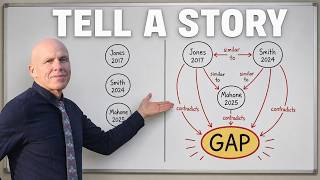
The literature review stalls more candidates than any other chapter, and almost never for the reason that they think. I'm Dr. Steve Tippins Ph.D. I've been in academia for over 35 years and sat on over 300 dissertation committees. Today I'm going to go through 7 tips for writing a literature review that your committee will accept without losing time or getting lost in all of the resources. So the first tip, or first thing I've seen people get slowed down with, is the— what I'm going to call the age of their resources. It's become very, very common for universities to want a majority of your references to be in the last 5 years. You know, some I've seen even say we're looking for at least 80% of references in the last 5 years. Now, first, that doesn't mean all references in the last 5 years.. You're going to have to have some references— foundational theoretical type references to lay the foundation for what you're doing. But don't try to submit a dissertation or a literature review that has a majority of the literature coming before 2010 because schools want to know the relevancy, the recency of what you're doing. So that's important. Second, you want to be synthesizing material, not reporting material. Reporting material looks like Jones 2017 said, and you go through a whole bunch of stuff, and Smith 2024 said, and you go through a whole bunch of stuff, and you start listing the references you're calling on, as opposed to saying Jones 2017 said X, Y, and Z, which is similar to the findings of Smith . However, the work of Mahone seems to contradict some of this by showing by being able to synthesize, by being able to integrate the information together, it gives your committee the confidence to know that you understand the material as opposed to just listing the material. Which pretty much anyone can do, and I've heard a lot of people refer to this as a string of pearls where you're just stringing things together, you aren't showing the committee that you understand it. When you're— third, when you're doing a literature review, you're going to look at a lot of documents, a lot of articles, and you want to learn to quickly look at an abstract. Oh yeah, there's— look, could be something in this. Let me go to the results section. Okay, there's more. Let me look at the methodology. But if the abstract shows you that there's nothing that's going to possibly be helpful to you, go on to another article. And, you know, learn to pick the parts of an article that can help you and then read more. But if it's not going to help you, move on quickly. That'll help you move forward. If you are looking for support while you're in this process, please feel free to join our Dissertation Support Community by clicking the link in the description. Fourth, you want to define the scope of what you're looking at quickly and in the beginning, and if there's something that's not part of your literature review, ignore it. Now, this can be difficult because you're going to be working on this, and our brain is such that when you find something new after you've been working on something for a while, we want to go after that. Write that stuff down. I call this putting it in a safe deposit box. Let your brain know you've put it somewhere you can get to later, as opposed to following on, on it right now and just say, "Well, I'll just take a quick look at it." We all know we can't take a quick look at things. You know, that quick look becomes 4, 5, 6 hours, and we're experts in something we never even were thinking of after 6 hours that has nothing to do with your dissertation. So ignore, put aside in a safe place things that aren't going to help you move forward on this endeavor. 5, keeping an annotated bibliography, meaning write notes down about the articles that you're using so you can quickly go back. Oh, they use this type of data. They did this type of analysis. Their population came from this area. So if you need to go back to it quickly, you've got it there and available instead of having to go back to the entire document again. Let me just give my own personal caveat on annotated bibliographies. They are great, but I've seen too many people start with annotated bibliographies and then have problems synthesizing from there. So if you're aware that you're synthesizing and if you're using an annotated bibliography just for your purposes to jog your mind, get you back involved in something, that can be a great tip to help you move forward quickly. I like to think of the purpose of an annotated bibliography is for you and for you to keep track of what paper said what. You know, there's going to be a lot of papers in there, so if you have a little bit more written about them, you're going to be able to jog your memory quickly. The sixth point I want to make is the goal of your literature review is to get to the gap, to come up with what hasn't been done, to show that you understand all the material and know what has not been done yet and what needs to be done. With that in mind, all of your literature should be leading towards that, building up to getting to the gap. And that leads quite nicely into my seventh point. I like to think of the literature review as a story. It's a story you're telling constructed from the literature —so that the reader, when they get to the end, will say basically two things: I see that a gap has been created, and I see that the writer understands the material that leads us to this gap. And if you tell that story well, you're going to have a literature review that gets accepted. If you're looking for support in this journey, anywhere along the way, join our free Dissertation Help Community by clicking the link in the description.