Chapter 1 Essentials Most Dissertations Get Wrong
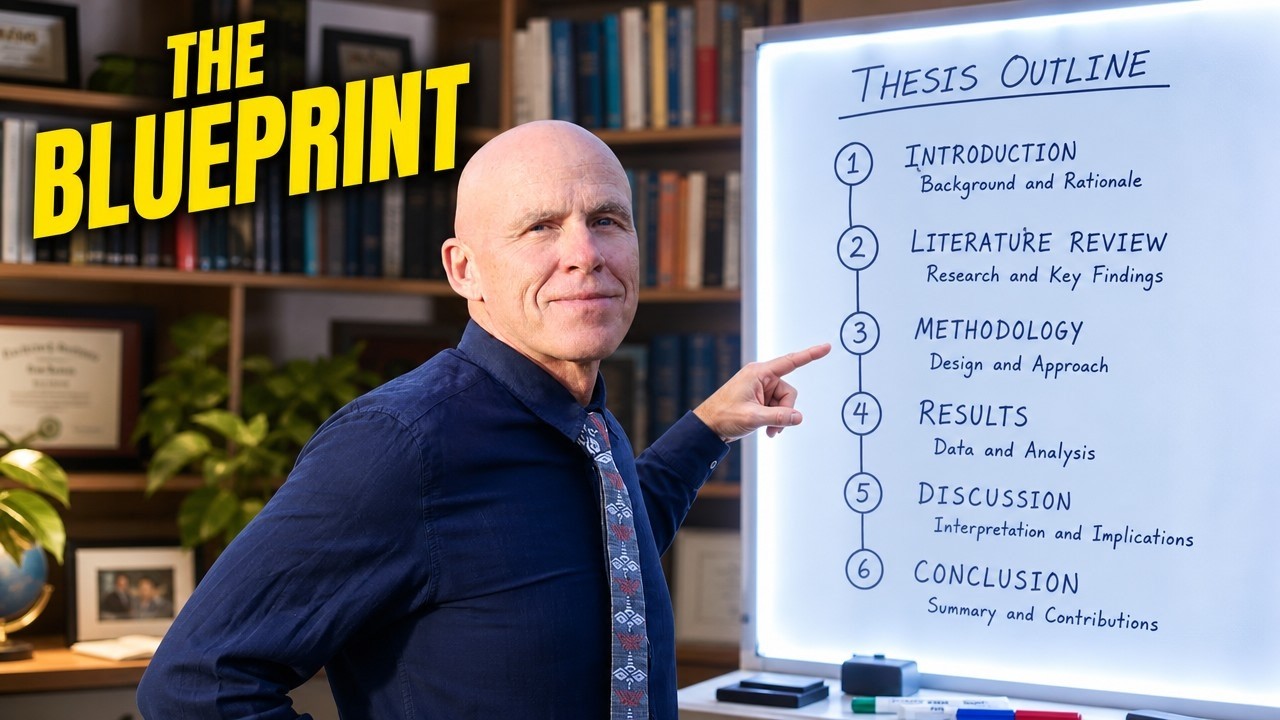
Dr. Steve Tippins breaks down Chapter 1 as a mini-proposal that must align problem, purpose, and research questions tightly. Common mistakes include vague problem statements, mismatched terminology, and unrealistic timelines. Build it piece by piece using university templates, keep literature recent (about 80% from the last five years), and avoid loading Chapter 1 with deep dives that belong in Chapter 2.
Chapters
This is somewhat informal, but we're going to talk about a clear or defined list of required elements in Chapter 1. Incredibly confusing getting to Chapter 1 and say, "What do I put in here?" I think of Chapter 1 as a mini proposal because your proposal typically is Chapters 1, 2, and 3. 1 being your introduction, 2 being your lit review, and 3 being your methodology. But your, your Chapter 1 frequently includes a little bit of literature, background of the study, a little bit about the methodology, which is your Chapter 3, as well as some other components. So, it really— when you have Chapter 1 finished, you have the basis for Chapters 2 and for Chapter 3 as well. Just talking about sections that tend to go into Chapter 1 include an introduction, typically a couple of paragraphs, then maybe a background of the study, which is gonna be 2 or 3 pages of literature, basically where you show there is a gap in the literature. There then becomes a problem statement. Problem statement can be anywhere from a paragraph to 2 or 3 paragraphs where you're just converting your gap in the literature to now here's the problem that will be studied. Many schools like to follow with the purpose. It can also be in other places, but the purpose, which is a rephrasing of your problem statement, is from a problem. Here's the problem. Now here is the purpose. And many times we add in the purpose of this methodology, qualitative, quantitative, whatever approach, is to— and then use the wording you used in your problem statement. Some schools also like to include the population. That you're going to use in your purpose. If you're including a theoretical or framework or conceptual framework, this is typically introduced here, maybe a couple of paragraphs, no more than a page, because you're going to flush that out in your literature review. I'm going to have research question or questions. Typically schools want more than one. If it's a quantitative study, you're going to include hypotheses, null and alternative hypotheses for each research question. I'm going to then include a little bit on the methodology. Yes, this qualitative phenomenological study or quantitative correlational study, and you're gonna have really just a little bit, will be conducted using this population, this sample, etc. But you got a whole chapter later to expand on this. Maybe a page or two here for your methodology. And then we get to what, you know, varies dramatically with schools, but you can have limitations of your study, which is basically like I like to think of as boundaries. This is, we won't do this, we won't do that, or we'll only include this. And definitions is typically found in Chapter 1 of key terms One of the things that slows people down in definitions is they just make up a definition on their own. Most schools like to see citations supporting those definitions, and they don't have to be long, but there could be 8, 12 terms in there that are important to your study that you want to define. And many times, if there are questions that may come up, having a definition means your committee is going to know, oh, they're using this term this way throughout the study, so there won't be confusion coming up after that. Then we have a conclusion, and that conclusion— where people get slowed down in their conclusion is you need some sort of transition, segue to the next chapter. Brief: the following chapter will include— just so that the reader knows this is what's coming. So that's a really brief overview of what goes into these chapters. And once you know that, now I— oh, okay, I need methodology. Here's what I'm going to put in. I need limitations. I need delimitations. I need definitions. Once I have these sections, I can work on them piece by piece instead of just trying to sit down and think, I need to write 15 pages for Chapter 1. I wonder what goes in there. I wonder what I'm going to write. I'll just start writing. This gives you a format. Look at your university. You look at if there's a template. Great, you've got the format. If there's not a template, you look at recently published dissertations in your field, hopefully with your chair as the chair, or at least on the committee, and you'll see, oh, they wanted these types of things in Chapter 1. This is what I'm going to do. So the job to be done is what is coming. Reader, what can you expect to happen in this study?— and then, oh, it's going to be this problem, this purpose, they're going to use this methodology, here's basically the boundaries of the study, the definitions. The reader is then prepared for what you're going to do. Introduction. But what's it introducing? It's introducing the fact that, hey, there is a problem or there is a gap, and how are you going to go about answering the gap, and is there support for that to do that gap. A very quick. I mean, it might take 12 to 18 pages, but it's relatively quick, saying there's a problem, here's how we're going to go about going after this problem, both methodologically and the literature to back it up. A committee member is going to know it's achieved the purpose first if the required sections are there, but second, if you develop, demonstrate the gap and and then tie everything into that gap/problem statement to support it so that there is foundation to say, "Yeah, let's go forward. Let's go deeper without gaps." So in Chapter 1, we've got, like I said, the foundation of Chapters 2 and 3. So now when I get to 2, I want to say 2 is the story I tell to support everything I said I'm going to do in Chapter 1. So I gave you a little literature review. Now I've got to really show you what it is. I've got to really develop, yeah, there's a real reason there. I go to chapter 3. I told you what the methodology is. Now I'm going to say why this is the appropriate methodology. I've looked at lots of methodologies. This is the right way to do it. And I'm going to go through and tell you every single step of how I'm going to do this. So there's no questions about how I'm going to proceed moving forward. I think the first thing I'm going to look for is alignment. Do they have the problem? Do they have the purpose? Do they have the research questions? Are they all going in the same direction? That's primarily important in Chapter 1. A number of people cannibalize Chapter 2 because they want to show everything in Chapter 1. So they give me or you 10, 12 pages of background. But really, in an introduction, you don't want to go that deep. You want to show it's here. Here's some highlights of it, but there's more coming to really support this. So limiting yourself to, you know, 4 or 5 pages means hit the high points. You're going to go deeper in if you've got variables, things like that. You're going to justify all of those in Chapter 2. But at the beginning, it— here's what's coming, and I'm going to show you a lot more later, but here's what's coming. And if I hit the key pieces of literature, the key writers on it. That's going to tell the reader in the committee, okay, they're hitting those key people, that means they've got some basis for this, and I'm really interested in moving forward. A lot of schools are saying we want approximately 80% of our references to be in the last 5 years. Okay, but there's a lot of research that's been done. So in my background as well as later on, I would go back to original thought on things, especially with the theoretical framework or conceptual framework. I would go back to original thought, but I want to add, update it with new people so that I'm showing that there's, you know, it wasn't just in 1947 that this is done. There's recent material on it too, because the committee wants that recency as well. And then you really go into the recency as you really dive into it in Chapter 2. Well, the step before a flawless problem statement is to have a gap in the literature. Now, if I found that gap in the literature, then I say the problem to be studied. So, and this is something I see missed in a lot of dissertations, is the problem is insinuated, it's implied, but the reader could say, well, is this the problem? Or is this what they're saying the problem? Take the time, stop, just say, "The problem is," hit them over the head. So, the problem to be studied is, and then it's the gap in the literature. It is unknown whether XYZ happens. We do not know. The perceptions of middle school teachers regarding, you know, staying after school are not known. So, it's, what did the gap show? So, the problem is the gap. That is a basic, simple problem statement. So many times I see people come and say, "Hey, here's a problem." People are underfed somewhere, or businesses aren't making enough profit, or whatever. And I say, "Yeah, it is a problem. However, you're writing a dissertation in an academic setting, and if you want to do that, your problem has to come out of the literature." While you might think something else is a problem, in order to play by the rules of academia, we have to show a gap in the literature and then base our problem upon that. I think the primary stumble is the problem that says, basically, I want to show that X is the answer to Y, which means I know that X is the answer to Y, which means your committee is going to say, if you already know the answer, why are you doing the research? So it's coming up with a problem that you, you don't personally think you know the answer to. You're just looking for an answer, not that you know the answer. You're looking for an answer to this. So that's a big issue with problems. Another issue is you haven't really come up with the literature or the gap in the literature to come up with a problem. Another issue is you define a problem that that when you think about it, it's going to take incredible resources, a long time, you won't have access to the right people to do it. You need a problem that is actually measurable, doable. You know, we don't want you writing your dissertation for 37 years. So you want to have a problem that can be answered in a certain way relatively quickly. Perfect alignment would be include the, the purpose of this methodology and then your problem and then maybe the population or sample. Perfect alignment would be basically use identical wording as your problem statement. Wording that gets off is when you, well, the purpose of this quantitative blah blah blah is to look at the perceptions of, and the problem says, you know, we don't know what teachers think about. Well, your purpose says perceptions and your problem says think. And I'm gonna say, well, what's the difference between think and perception? And you know, it's using the same wording because every time there's different wording, it's different connotations that come up. And that's a big area where alignment comes off when you use different wording. And I tell people frequently, your goal is not to be interesting here. Your goal is to get it accepted. So be boring by using the same wording every time you say the problem, every time you say the purpose, and with from problem to purpose, use, if I'm looking at perceptions in my problem, I'm looking at perceptions in my purpose. You can explore, you can look at perceptions. That's qualitative because they're, think of them as broad, whereas relationship is quantitative, meaning, okay, I wanna know how A and B work together. So I'm looking at, you know, what is the relationship between, what is the degree of correlation, exploring the correlation. Well, those are terms that mean I'm going to do math or statistics of some sort. There's going to be numbers involved. But if I say perception, I'm not measuring, oh yeah, you're a 9 on the perception scale. It's just, it's words explaining. So, the first thing with research questions is, you know, are they going to get you to your problem? A research problem that's too narrow is a research problem that can be answered yes or no. Can such and such happen? Yes or no. Is there a relationship between? Yes or no. And ultimately, this shows up much later in your dissertation. If you have a yes or no research question, then the answer is yes or no. You don't get to talk about much. Later on, you just say, "Yep, yep, it is." And your committee's saying, "Well, give me more." And you say, "Well, I answered the research question." So you want to design them in such a way that they're not too narrow. Now, if your research question on the other hand is, and I find this more often in quantitative studies, is I've set the study up and say, "What's the impact of school lunch programs for middle schoolers on their SAT scores?" Well, not a lot of middle schoolers are taking SAT or GREs, so we're talking 4 or 5 years down the line before— so I've got to follow people for 4 or 5 years and have a huge population because some are going to drop out and some are not going to take the test and all this other stuff that we're now pushing the boundaries of doability, or we've gone beyond the boundary of doability because of the time period you're just going to be sitting waiting for your group to mature into where you can study them. So when there's a time period between an intervention and an ending or a measurement, the longer that time period is, the harder it is to actually do a real doable study for a dissertation. These might be great research for someone who's funded for long-term studies and great, but for a dissertation where you're paying tuition, you're taking time. You don't want to set up something like that. Now let me just add one more thing. If you're doing something, you know, the life cycle of a certain type of fly whose life is only 4 days, yeah, you can have, you know, multiple generations in a week or 2 weeks or 3 weeks. Great. But if we're dealing with people, it's harder.










