Don't Pick a Dissertation Topic Until You've Done This
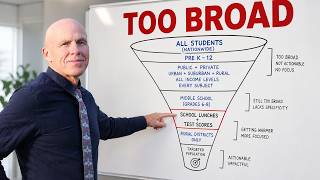
Dr. Steve Tippins walks through how to narrow a broad research question into an actual dissertation topic. Start with a literature search to find gaps, then systematically specify your population, setting, and variables. Check that data exist, your methods fit your skills, and the scope is doable within your timeline.
Chapters
I'm Dr. Steve Tippins Ph.D. I've been in academia for over 35 years, and I've served on hundreds of dissertation committees and helped hundreds of people complete their dissertation and move forward to graduation. So, turning a broad interest into a narrow, researchable topic. We all come to research— let me back that up— many times we come to research with a broad idea. Wow, I wonder if. "Wouldn't it be interesting if we looked at it this way?" Or, "I just read this paper and it piques my interest." Or, "I've always, you know, had this thought about..." and pick a specific topic, you know. So, we start there, but starting there just doesn't mean we can then do the research, okay? That's like, "Yeah, I wonder what the relation is between school lunch programs and test scores." Or, "I wonder what the relationship is between leadership and stock price." And those are Interesting questions, but pretty broad. So, you know, school lunches and test scores. Okay, what type of lunches? At what level of lunch? Test scores by— what do you mean by test scores? Do you mean, of course, test scores on standardized tests? Do you mean test scores within specific classes? It's just not doable, these ideas, in a reasonable time frame. And we always want to be thinking about a reasonable timeframe. Because, you know, the goal is to finish, to get your dissertation finished, to get any research project finished. If you're looking for help developing and defining your— the scope and research that you want to do in your dissertation, or just help in general along the way, join our free dissertation help community. The link is in the description below. So, these broad ideas that may strike you while doing research. They may strike you while taking a walk. They're great, and they're the beginning, but they aren't the spot where you then dig deep into, like, doing the actual research. Like, I'll go survey teachers. You need to narrow this down. You need to have your idea narrow enough that it's actually doable. If we're talking about the school lunches, And we're talking about test scores, like I said before. What type of tests are we looking at? What type of school lunches? What type of— what level of school are we— elementary school, middle school, high school? You know, where are we concentrating? So this is where we start going into the literature to find out, first of all, what's known about this. What do we already know? You may find that this has already been done. Great, here's the answer to my question. Super, I can go on and have a great day. You may also find that it hasn't been done, and then if it hasn't been done, is it then doable? Can I collect the data? So I'm trying to narrow and narrow and narrow my interest and my topic down in such a way that I can come up with a plan as to how to do a study and answer the question. That's what intrigues other researchers as well. That's what gets your material read by others, is when you have narrowed things down to where people can say, "Okay, I get it," as opposed to that broad topic, and you come up with an answer, and there's a lot of holes there. Well, why didn't you look at this? Or, you know, great, you did test scores, But you did test scores from kindergarten through high school. And does, you know, what did they eat the school lunch? What was on the school lunch? All kinds of questions come up. You, you probably don't want to do a study that ends up with more questions than you've answered. So the more defined your scope can be, then also the easier it's going to be to actually do a study. And actually come up with a methodology that will allow you to answer the questions. So if I want to look at a topic and a question, and let's go back to the school lunch thing. I read something about it. I learn something about it. Something reveals itself to me about it. So I've got now an interest. Oh, this is kind of interesting. I want to look at it. Well, the first thing I want to do is just a literature search. What is known about school lunches and test results? Because what's gonna happen is it's gonna start narrowing things down for me because I'll start seeing studies that say middle school lunches and testing at, you know, standardized testing on math. And so I'll start to see, wow, people have been pretty specific with this. And then I'll start to see elementary school and testing on history or, you know, whatever results start coming up. That's then gonna allow me to spend some time thinking, okay, there is some material that's been presented on this. What of those materials really piques my interest? Because I may find out that, you know, high school lunches and math test scores has been done a lot. And I'd read it and say, I'm not that interested in math test scores. Or, okay, you know, high school, maybe that's not intriguing me. So by starting off by exploring the literature and the breadth of the literature, I can start to see where things are intriguing me in addition to the methodologies that have been used. For example, I might find out that the middle school lunches and history or math test scores has been done a lot, but it's only been done at certain areas. And that's really interesting to me. Wow. Okay, this has been done and I'm starting to find where it hasn't. Been done. And so I start broad and then I just start following things down through that logical trail that it leads me. And one conclusion might be it's been done. Another conclusion might be, okay, well, I got an answer now pretty much, but it wasn't intriguing me that much. So I can stop or yeah, okay, this has piqued my interest. Is there— now let me go further as I've narrowed things and see if it really keeps my interest. Because you're gonna be doing a study that's gonna take a while. So you want to have enough interest in it that it's gonna keep you involved and answer the, you know, so what? Okay, I do this, so what? What type of results could come out? How meaningful are the potential results? You know, so what? So it's a continuing process of narrowing down, coupling that, or in parallel, I guess, with what are my methodological interests slash capabilities? Perhaps I've never done a quantitative study before, and it's most of these things are leading towards quantitative approaches or vice versa. I've never done qualitative and it looks like it's qualitative. Okay, maybe my interest you know, wanes because of the methodological approach. But if I tackle these things in tandem and start working my way down, I can start coming up with the next step. Okay, I need to know something about this, about school lunches. I need to know something about what types of tests are given and what types of test scores, and are they the same everywhere? So I'm really focusing in. You know, you can think of it as a funnel. And I'm just narrowing and narrowing that funnel till I get to the bottom of like, there it is, there's my research. So I've come up with a research idea. Is it a dissertation research idea? I'm going to want to know, is data available? Am I going to be able to get information and get it without too much external factors that might get in the way? For example, middle school test scores. I don't want to have to be interviewing middle schoolers because they're a protected class and it makes IRB more difficult. But if it's middle school test scores that are public information or easily available, okay. So the doability of it and also the complexity of it. If I want to— if I'm ultimately comes up with the question of, you know, do middle schoolers like lunch? Yes or no? There's not much to it. There's very little research you can do on it. Or if it's a it's already been done. But if it hasn't been done and it's, okay, middle school lunches at a rural level, and I can look at multiple factors— is it, does it have males versus females, or 7th grade versus 6th grade, or when they started a lunch program— so I can have a number of variables, because committees don't like things that are too simple. So you want to be able to explore a number of variables in this. Then it's going to start filling in as, yeah, it's a dissertation topic. There's a strong methodology I can use. There's data available, and there's research questions that are meaningful that help lead to getting to the problem.










