From Drowning in My Dissertation to Earning My Doctorate!
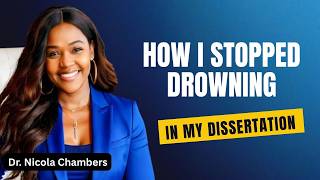
Dr. Nicola Chambers-Hulda nearly quit her PhD program under imposter syndrome and financial pressure until a mentor called Dr. T helped her simplify her research, narrow her scope, and rehearse relentlessly. She finished, published her dissertation, made a documentary, and now runs community health and outdoor wellness programs.
Chapters
just you're doing something, it's like taking a path that you've never done before, and I didn't feel like I had enough guidance to do it. I guess the only word I can describe was really overwhelming. I didn't know where to go. I didn't know what I needed to do, what I was expected to do. I didn't want to drop out of the program because I've seen so many students that were actually either taking time off or dropping out of the programs. So at that point I'm like, okay, so I need to get someone else's input. I think I saw the advertisement or something. I don't remember specifically how I got in touch with Dr. T. Like someone threw me the rope. I was drowning. You know, it was just like I told him what I was going through and I felt really, really comfortable with him. He was just really, really down to earth. He was kind of like, you know, I get what you're saying. I've been there, I've done that. Let's start here. So he was like, you know, what is it you're overwhelmed with? I sent it to him. I think there was a chapter I was struggling with. And then he asked me some questions and stuff. And just by the end of our conversations, I was like, oh, okay. I think it was maybe about like an hour we were talking and the light bulb just went on. And I'm like, okay, I think I want to work for you. I'm broke, but I want to work with you. So I think for me, honestly, it was a lot of empathy because, you know, I've spoken to a few people and it was just like, nah, they knew the stuff, but they didn't have the empathy. And for me, I love authenticity. And he was very, very authentic from, you know, the beginning. And that really got me. I was out of financial aid. So at that point it was kind of like I was really, really struggling because I wasn't working and I was just doing this working full-time and I was also taking care of two of my grandkids and my other kids. I have four kids as well. So everything was really on my husband. So, you know, I'm kind of like, oh my God, like I can't really afford this. I need the help, but I can't afford this. Also researched and saw what other people were charging. And at that point I'm like, okay, you know what? I know I had to make the sacrifice. So that's how, you know, my husband was like, okay, I'll help you out. And that was it. He was reasonable. He was way actually below a lot of the other people that were charging way more for this program. And I've recommended him to other people as well. I even talked about him on Facebook. He was really helpful, honestly, with the program that I was in. It's not that I couldn't do the work. There's two pieces of this, and I think a lot of people miss the other side of it, the emotional aspect of it. Because even now, you know, when I talk to other friends that's doing their Ph.D., they're losing their mind. And, you know, they're talking to people that's trying to help, but they're missing the emotional aspect of it. And it's one of those things where it's like you feel stupid. One of my biggest issue was imposter syndrome and just talking to someone who can say, ah, So I think you're having some imposter syndrome there, Nicola. I don't think it has anything to do with that. So I want you to take a break away from that, and I want you to look at the bigger picture. So those things for me was huge. Like, really was huge. It wasn't even the not knowing the work, really. It was he was my cheerleader, and I needed that. And again, as I said, the emotional piece was my biggest struggle, because when you have no directions and you start feeling like shit, and then everyone around you is depending on you, so you can't really complain to them. He created a therapeutic space. So that's the technical term I would use. He created a therapeutic space where I was— I felt comfortable enough where he could say, hey, snap out of it. Hey, that's not where you want to go. Or, you know, you'll give me a few minutes, listen, and then he's like, okay, I hear that. So it seemed like this is the issue, so let's go back here. So for me, I didn't know for anyone else, but for me it was having that sort of space where I could vent for a few minutes and then we can get to the work. And I'm like, oh, okay. So this is what was missing, right? And he did it in such a kind sort of way. Yeah, he did in a very, very kind way. I think that's one of the reasons I recommended him. He would reroute me. It's not like my GPS screaming, right, reroute, reroute. He was just kind of like, okay, I hear you, I see what you're saying, but let's focus on the bigger picture. For me, it was, I was all over the place, and he helped me to realize that again, some of the questions that they were asking, they were like really simple questions, but they were structured in such a way that were really, really confusing. So he could actually put the question like in layman's terms, and he's like, okay, so this is what they're really asking. I'm like, oh, okay, that makes sense. There was a point that I already passed my topic and I kept going back. He said, he's like, you know, you could stay here and you could go back and forth with this for the next 6 or 7 years. That's what you want to do? And I'm like, no. He's like, okay. So he's like, you know, just narrow this down. Let's get this out of the way. When you're finished, you can do bazillion different research, whatever you want to do, but right now you just need to do this. So we're gonna focus in on this because there are lots of times, you know, it's like you keep thinking, okay, that doesn't make sense, I need to change this, or I was thinking about this and I found some of the research, I need to add this. No, we're not going back there. I know you're excited about that, but we already went over that. That page is closed. Leave that alone. Yeah. So he did have to draw me in like, yeah, a lot of times. Because then you get so excited, you see something you're so excited about, it's I have to add that. Oh my gosh, how come I didn't see this? Like, no, we're done there. You graduate, you could go back, you could do whatever you choose to, but let's just finish this. So, you know, of course they give you like a PowerPoint, it's kind of like a template, and by the time you finish, you're supposed to have like around 11 slides. I am a speaker, but I just couldn't speak. I couldn't do it. And, you know, I kept going back and forth. I'm like, okay, the same thing. Oh, this is not going in properly. This doesn't sound right. This doesn't have a flow. Go back the same He was like, you only need 12 slides. These are the 12 slides that you need. I know you want to put everything in, but this is not the space. So this is what's needed. And then he told me, he's like, this is going to be like a full-time job. You're going to get up every day. You're going to set aside these hours and you're going to practice. It's like record yourself, practice, record yourself, practice, record yourself. And I'm so glad I did that because by the time my defense, it was kind of like I was just running through slides. Like, yeah. So that really helped. I'm a doctor. Yeah. During that dissertation, into a manuscript that's published and say, published by Dr. Nicola Chambers-Hulda. And it happened. My doctorate is a community doctorate. It was never for Nicola. It's changed everything about my life. I think it's also changed my family's life, my kids' life, the people around me, my parents. I was told when I was younger that I would never be anything. So for me, that's everything, each accomplishment. And now no matter who you are, you can be anything you want to be. And yeah, I got that. I think your dad joined Gratitude Choice Project, which is my give back to the world. I'm like, that's my way of paying rent, and I do free workshops, I do free hikes, free meditation, free walking meditation, just to get people who would never really hang out together together. So I really want to do research on gratitude, communal gratitude, because I've seen how it's changed my life and how it's changed other people's lives. So that's the research right now that I'm working on. I also did a documentary about the community that I created, and I think just having the doctorate also gives you the, you know, the credibility where maybe maybe someone else wouldn't. My vision is a world that's inclusive where everyone can just stand up and be themselves and it's okay to be that way. It won't be strange or it won't be awkward or it won't be different. So I'm hoping that I'll be able to use my doctorate to continue to do that. Me, honestly, it's really about community health and well-being. It really, really is. I'm like, when I'm gone, I'm gonna be known for the person that put the unity back in the community. That's my tagline and I know it sounds corny, right? But that's really from my heart. That's what I want to see. I want to put the unity back in community because we no longer have that. So lots of health and wellness programs, lots of nature stuff. Everything I'm doing, I really want to do a lot of stuff like outdoors. We need to get people back outdoors. I want to see my community heal. If he didn't help, I don't know, I don't know, maybe I would have graduated, maybe I wouldn't, but he really, really helped. Just the fact that he's a white man, right? This old white man because, you know, the old white boys club, right? So just to have a white man look at me and say, "I see you." You have no idea how important that is. Just to have someone— Yeah. "I see you. I haven't been where you are as a Black woman, but I've been where you are academically, struggling and needed the help. Now as a Black woman, it's harder for you, but I'm going to help you." That's not understanding. For me, that's compassion. Him helping one person, he's actually helped an entire community. And I'm sure he never looked at it that way, huh? Just one person, but an entire community.










