How a Dissertation Coach Helped Me Stay on Track and Reduce Anxiety
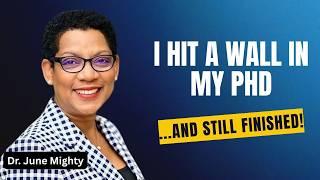
A doctoral candidate credits dissertation coach Dr. Steve Tippins with transforming an overwhelming process into something manageable while working a demanding government job during the pandemic. Tippins demystified the dissertation, reframed roadblocks, and kept the candidate on track. The result: completed dissertation, a promotion, and new speaking engagements.
Chapters
Before meeting Dr. Tippins, I can't remember exactly where I was. It was, life was so chaotic, right? I don't think I had actually started working on the actual dissertation at the time. He was referred to me by Dr. Terry Ransom, who had already completed his coursework. And I think I was talking to Terry about just my journey and he made the recommendation. So I think I was just, I think I was just about finishing up on some of the coursework, getting ready to head into just writing the dissertation. And I was having just some problems, just getting over the hump. So that is sort of where I was, if I remember correctly. That space was sort of like a whirlwind. And then moving into just the whole dissertation phase, it was really helpful having his insight. And, you know, as I have said to you before, insight, yes, related to the dissertation process. It— he took some of the mystery out of it. And I had an excellent dissertation coach that my experience was very positive with my dissertation chair, I should say, excellent dissertation chair. But Still, it was like Dr. Tippins Ph.D. helped me to think through and to know what to expect. Okay, don't worry about it here. Stay calm. No, you don't want to go too far here. Like say for instance, you know how we're going through all the coursework and we think that we know exactly what it is that we're going to write about. And then he can help you to sort of manage that. Maybe you want to think about this. And once you start working with the chair, you're going to refine that. Oh, I can take a look at this. So it was just helpful in terms of keeping you calm through the process. He was also, I find for me in my process, was an expert an excellent complement to my dissertation chair. Also being able for him to take a look at some of the things that I was doing. But in addition to that, it's just the mental journey. There is a mental journey to this. There's a dynamic to this process, and they always talk about the dissertation journey. It's not about just the writing. It's not just about the research. It's about when you hit the wall. It's about when you feel like, "You know what? I don't know why I started this to begin with. What was I thinking? Why am I investing all this time?" You're not with family. You're missing out on different things that's going on. Many people are like me. I was working doing this simultaneously with a very demanding job. So you start to question, and when you start to run into roadblocks and headwinds, that's where I think his genius shines, helping you to think through in terms of the way that you're looking at this. Okay, if you see a roadblock, and I could share what it is, and he'd be like, let's look at it this way. And he would start to re— what I call the reframing, the whole reframing process. And by the time he's through, I'm like, well, yeah, okay, yeah, that'll work. Yeah, I never looked at it like that. And so you feel that sort of— I would go into Most of the time, just feeling like, can't wait till I talk to Dr. Steve Tippins Ph.D. I know what I'm gonna do, blah, blah, blah, blah, blah. And by the time I get through with him, I'm like, okay, all right. Yeah, yeah, yeah. We can, we can do this. We can do this. It's that type of thing. So it's not just about the writing. It's not just about the coursework. It's also about the mental agility and helping you to navigate that space in between where you are and where you're trying to get to. And most people know this is, well, those of us who've gone through it, it's a, it's a race more of endure. It's not a sprint, it's a marathon. And sometimes I don't think when we started, really understand that it's more of a marathon. And so he helps you to keep time and cadence so you can get to the end of that successfully. Some of my most challenging moments were the intersection of work and dissertation. That's where the reframing really works, really comes into play. How do you stay connected? How do you keep your head in the dissertation game when everything else in your life seems topsy-turvy? You have to remember I was going through this process through COVID, so my work life was just— I was working, there was There was a lot of demands that were placed on us at the time because I work in local government. So trying to keep pace with what's happening in COVID, trying to keep my mental, my personal frame of mind intact, and then trying to navigate the dissertation. And even at that point, that's when I was really trying to do the survey, conduct my survey. And it was so challenging because of everything that was going on. And disenchanted, disappointed, response rates are low, you know, having to go back out again each time to try to get more people to participate. And you You have to and you need someone to be able to say, you know what, you can do this, keep at it. Okay, have you tried this? Have you looked into this particular space? And that's where that's critical. So everyone is not going to have a COVID experience, but mine was critical on top of the work because it was COVID and then just trying to do the research and survey at that point. And it was extremely challenging. I'll say it again, that reframing skills, I don't know how he does it. I don't know how he does it. No matter what challenge you present to him, the way he looks at it, he has great listening skills and then helping you to explore. He doesn't always tell you what to do. He listens and gives you guidance and shares varying perspectives that helps you to see things from a totally different angle. And that is one of the things that I greatly appreciated. So much so that I would— I still do, you know, when I meet people who are going through this whole dissertation process, I am like, "Oh, I know a dissertation coach who can help you." And my first thing that I will say is that he is an excellent reframer. When you get stuck, he will be able to you get out of it. So if you're in the thick of it, you know, he's that lifeline that you need. So his listening skills, but his ability to look at situations and circumstances and be able to find that window of opportunity that you can sort of just climb through, just like, get yourself out of it. If I hadn't met Dr. Tippins Ph.D. to help me navigate my dissertation journey, I would have finished because I have the grit to finish. I would have finished, but it would have been really grueling. Ruling, it would have been difficult. It would have been difficult, especially in COVID. It would have been difficult, more difficult than what it was. I think you probably— I'm not a sports person, so I think it would be almost like when you are— look like you're not going to win the game, and I would be stuck thinking maybe that I would not win the game. And again, I want to balance it because I, like I said, I had an excellent dissertation chair, but when I spoke to my chair, I focused on my work, on my dissertation work and my deliverables. Whereas with Dr. Steve Tippins Ph.D., I was able to speak to both aspects of what was taking place in my life, the journey, the full journey. And so I probably would have decided to park and take out, you know, one of those chairs when you go to the game and you just take it out and you just want to watch the game. I probably would have found a chair somewhere along the dissertation journey and park for a while and say, okay, I got to take a break. But with him on board as the coach, I didn't need to do that. It would've been extremely What I can say that was even most helpful for me as it relates to this would be the committee's feedback. He helps to prepare you for what may happen with the committee. He helps to guide you in terms of, again, that effective relationship that you need to keep with your dissertation chair. He helps you to understand what the role of the chair is, what the role of the committee is. And then he will, you know, what school are you affiliated with? If he knows of them personally, he'll speak to that. If not, he'll do a little bit of research to understand where you're coming from. He'll ask you different questions about the committee How are things going? What have they said? What is structure? What is the feedback that they have actually given you so far? What do you think about it? It also helped me in the discussions that I had with him, helped me to think about questions that I also may need to follow up with my dissertation chair. He demystifies things because you hear so many stories about the dissertation chair or the committee. Everything's just coming out. A lot of times you have all this negativity swirling in your head, and he sort of demystifies the process. Just recently, someone had said it took them 7 years to complete their Ph.D. That was not my story. But if you're working with Dr. Tippins Ph.D. and you say to him, oh, I heard this and I heard that. Okay, but that's not the norm. And there may be other extenuating circumstances as to why that situation occurred. That doesn't necessarily mean it's going to be your story. Here's how we stay on track. What do you want to accomplish? When do you want to be finished with this? What are some of the things that are a roadblock? Help you to think through, you know, a lot of folks, it's just you have to balance your family and friends and all these relationships with this journey. When you hit maybe a roadblock, or things may be interfering with the process, he helps you to think through in terms of, okay, what are some of those obstacles? What are some of the ways that you could look at, you know, addressing them? So yeah, help with the coursework, taking a look at the documents, but I think it was really helpful in terms of demystifying the role of the subcommittee. So when I was doing my presentation to my dissertation chair and the committee, I wasn't as fearful because he had already helped me to to think through that process and what to expect. So I didn't go in as apprehensive. One of the things I could say is that the guidance that he provided aligned with what my chair, with what my dissertation chair was telling me. So that in itself is like, okay, I'm on the right track because he's not telling me something that's way off. It was in alignment. And so that makes it even more powerful, so to speak. After meeting with him and while working with him, he keeps anxiety, helps to keep anxiety at bay. So it's just a more peaceful journey. And I'm a person who likes to just have peace as I'm moving through the space. So he helps you to stay in that sweet spot. At least for me, it helped to reduce the anxiety. After the dissertation, I was looking for another career opportunity, which I was actually able to obtain. And so I was promoted into a higher role. It also opened up, I think, some doors for some speaking engagements in the area of education as well. And it's going to, I think, open up some additional doors because I have some things that I want to work on in particular in the next year, not only just for work, but also consulting projects for 2026. And so I believe that this dissertation journey and the focus that I have in terms of, you know, the Doctor of Education related to organizational leadership— leadership has always been the space where— that I'm passionate about, along with some other things in terms of, you know, change management and innovation. But leadership has been a staple for me. So I think it helps— it helped to deepen my knowledge in that area, as it should, and then to be able to present more options to customers, clients, and the individuals that I work with. So I think those are some of the things that have occurred so far. I don't think you have to wait until you get into an issue. I would still use him as part of the coursework journey. What I would say is while you're in the coursework, you may need to meet with him once a month. When you start writing that dissertation, at least twice a month, if not more. You may have to get an extra time in during that month to make it 3 times. That's what I would say. So I think it's a matter of pacing. No, I wouldn't wait until you hit a stumbling block because again, he's able to demystify the whole process. So it just helps to reduce anxiety. Having him on board helps to reduce anxiety through the process. Whenever I'm having a conversation with anyone who tells me that they're in this process, one of the first things I ask them is like, do you have a dissertation coach? They said, no, I don't know anything about a dissertation coach. Well, let me tell you, and I have a dissertation coach for you, and let me help you understand how a dissertation coach a dissertation coach can help you through the process in addition to your dissertation chair. And again, I try to explain to them that it's not just about writing the dissertation and conducting your research, but it's that balance in the journey between life and the actual work on the dissertation and how he helps you to maintain that cadence. So I look at it, I always presented it from a holistic view, never just from the writing of the dissertation because that journey is not just about the research or the writing. And I think important for folks to know that it's not just about technicality. It's not about someone just looking at your document or saying, or giving you just that information about the research. It's more than that. And you're gonna need more than that to be successful. And that's where he comes in. It's worth the investment because you're already putting out so much money. You're going to be reluctant to pay anything extra. You just are. And it's worth the investment if you want to be successful without loss of hair, may want to consider that. Less stress, not overeating when you don't have to. If you want to be able to sleep a little bit better at night, better mental health, mental clarity, it's worth the investment. You don't want to have to be up just thinking about this dissertation because, you know, it does— it's a big part of your life. It's an investment in your life and your future. I have no regrets. I'm glad I did what I did. So you want to make sure that you have the right folks with you on that journey. I would say you would want Dr. Steve. He's the companion that you need to take this journey. So choose your companion before you choose your road. Thank you.










