How to Build a Problem Statement Your Committee Can't Reject
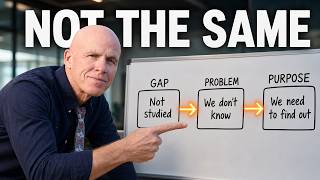
Dr. Steve Tippins, who has guided over 300 dissertation committees, shows how to turn a literature gap into a problem statement committees will approve. The problem must be phrased as a concrete "we do not know" statement, not a vague reference to the gap. Keep language consistent across chapters and use prior approved dissertations as models when literature is sparse.
Chapters
Today my goal is to help you understand how to move from the gap in the literature that you have developed on to translating that into the problem statement and the purpose for your research. Because the gap becomes your foundation upon which your problem is built and then the rest of the dissertation. My name is Dr. Steve Tippins Ph.D. I've been in academia for 35 years and served on over 300 dissertation committees. You know what hasn't been done. You got a good handle on, like I said, what hasn't been done, but how narrowly it hasn't been done. Now you gotta come up with the, the research problem and then the purpose. So we have to define— committees don't like when you say the gap in the literature is, because that could be huge, it could be small. So you want to talk about the problem. Is, and the problem is a direct reflection of the gap in the literature. So if your gap in the literature is there hasn't been research done on teacher perceptions of new curriculum at the middle school level, something like that, then your— the problem is that we do not have a strong understanding, do not know, do not know teacher perceptions. You can word it in a number of ways, but ways we don't know what the teacher's perceptions of adopting a new curriculum at the middle school level in math, for example. So the problem is the gap, but you have to phrase it in such a way that it's a problem itself and not just here's a gap, and that gives a more urgency to it. So it should be not a hard lift to get to the problem once you have your gap. Now, if you're moving to your purpose from here, and this is where a lot of people have issues. So, I've— in getting to the problem, you, you might even have identified a gap and might not even have highlighted it too much. It's always good to tell the reader the gap, but once you have found your gap, then you need to be able to put it in words as a problem. So take the guts of your gap. Here's what we don't know. Well, now I want to rephrase that. Well, the problem to be studied is, or the problem is, meaning we don't know this, and there's a rationale for knowing it, for going after it, because your gap has been developed and supported by the literature. So you have all kinds of background information showing the gap, which now you translate into, "The problem is that we are not aware of," or, you know, "It's not known," and using teachers' perceptions of curriculum changes in math level at the middle school, something like that. So it's taking your gap and changing it from a, just a, what hasn't been done, to, "Well, our problem is we don't know this." So it's a subtle change, but it should not be difficult to do that. Now, one of the big things I see in problem statement sections of dissertations is not really stating the problem. Kind of beating around the bush with some literature. And then maybe having a purpose section where you say a purpose and then the reader has to go back and look and say, "Do they really say something like that in the problem?" So, I find it's best to just directly state it. Don't imply it. Don't beat around the bush. Just say the problem to be studied here is— the problem is that we do not know. And then we do not know, you know, it could be teachers' perceptions. It could be the relationship between certain variables that we've developed and shown are important in our literature review. So now the problem becomes we don't know this. You're just stating it, and this is the foundation for the rest of your study, is this problem. So you want to make sure you've got your gap, you've identified it, and now you've been able to bring it into words and explicitly state it. So some schools ask for a general problem and then a specific problem, and that's okay. It's fine if they want to do that, but it's the specific problem that we want. That's the one you're going to be researching. That's the one that's going to be the foundation for the rest of your study. I haven't— I've seen a lot of schools using this. It's because I think they've evolved to the point of, look, it's the specific problem that's interesting. It's a specific problem that's based on the gap in literature. It's the specific problem that's the foundation for the rest of the study. Where we need to go after the problem statement is the purpose. To some people, this seems like overkill. I already said the problem. Well, yeah, but in the traditional model, they want to also move to the purpose. And it's good to remember that you have to have alignment. I've seen too many problems. I was looking at one today, and the problem had something about blankety blankety blank blankety blank, and the purpose was blankety blankety blank were blankety blankety blank. Every other word was basically the same, but are means now and ongoing, were means it was in the past. So it was, I had a comment saying, you know, which one is it? Let's be consistent. So going back to what the problem I was using about, we're not aware of middle school teachers' perceptions of curriculum changes in math at the junior high level. Your purpose is going to be the purpose of this, and insert in here the methodology you're gonna use. Many schools like to know, of this qualitative case study, or this qualitative phenomenological study, or this quantitative correlational study, or, you know, talk about very briefly what your methodology is going to be. So you're letting the reader know, oh, this is going to be a qualitative, oh, it's going to be a quantitative, and here's what's going to happen. It's going to be phenomenological, it's going to be a correlational study, whatever it's going to be, that's very simply stated at the beginning of your purpose because My purpose is I'm going to use a methodology to get at the problem. So the purpose of this qualitative phenomenological study is to determine middle school teacher perceptions, or better yet, the purpose of this qualitative case study is to determine middle school teacher perceptions of changes in a math curriculum, something like that. So I've used very similar words to the problem. I've talked about the methodology, and at some schools they also want you to put in something about the data. The purpose of this qualitative case study is to determine middle school teacher perceptions, et cetera, et cetera, in middle school teachers in central Oklahoma, or something like that. So now I've bounded the study by— the reader can know qualitative teacher perceptions where it's done, all within that purpose section. Providing that information— committees like that— providing that information that is in alignment, says the same thing as your problem statement, is what's gonna move you forward. When your purpose goes in a different direction or uses different terminology, or, you know, please don't just try to make it interesting to use different words, use the same words over and over again. I tell people frequently, just be boring. Use this— if you've started with a term, use it everywhere, because a slight change in wording can bring a different interpretation, which can mean your committee brings up more questions, which slows you down. So if your goal is to finish faster, you want your wording to be identical where possible. And that also means in many documents and dissertations, you're going to restate your problem in different chapter. You're going to restate your purpose in a different chapter. That means cut and paste it. Don't try to reword it to be interesting. That means I said it this way in Chapter 1, I'm going to say it this way in Chapter 3, I'm going to say it this way in Chapter 5. So in translating your gap to your problem, one thing that can stump people is saying, well, there hasn't been a lot of literature, so my gap is broader than I'd like or not as sufficiently defined as I'd like. So stepping back to your gap, what you want to do is if there isn't a lot of literature, you want to surround your gap with other literature. Let's say you want to look at middle school teachers, and it has— there's been nothing done about middle school teachers at all. I started to believe that would be the case, but if there had been nothing done about middle school teachers, but has there been some— something done about high school teachers? Has there been something done about elementary school teachers? Or has there been something done about teachers in general, but in Europe or in other places? So what you want to do is think of your gap as a hole in the literature. And there may not be a lot that approaches the hole specifically talking about middle school teachers, but there may be other things about high school or European teachers or, you know, South American teachers or, you know, just teachers in general. So your— the gap means a little leap away from what's been done. A little step away from what's been done. So you want to make sure the step is as small as possible for your reader. So if you can't get there directly with your stairs, make your stairs kind of circular that go around it, so it shows the hole. So now I've got my hole and I've defined it as best as possible. And I've said, this is the gap that now gives me the basis to go over and do my problem statement. So if you're having problems coming up with or saying my gap isn't, doesn't provide enough for my problem statement, it's go back to your gap. It's not reword your problem statement. It's go back to the foundation that the problem statement is built on. One of the great tools that you have available to you, unless you are the first person, is previous work that's been done and previous work that your committee has approved or members of your committee have approved. Approved. So if you look at a recent dissertation and say, oh, here's their gap, I've looked at their literature review, now here's their problem, okay. And if you get 3 or 4 of those, you start to get a feel as to how people moved from A to B or G to P, gap to problem statement. So it, you know, it may seem or feel a little logical how to do it on your own without nothing, without support, but You know, looking at what else has been done can give you a much better idea about what to do on your own.










