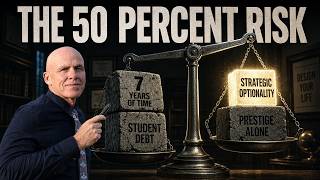
In this 35‑year veteran academic’s monologue, the speaker weighs the total return of a doctoral degree against its substantial costs. He outlines the tangible expenses—years of study, tuition, lost earnings, stress, and family sacrifices—as well as the risk that roughly half of entrants never finish. He then details the circumstances where a Ph.D. can be worthwhile: a deep love of learning, the development of critical‑thinking and research skills, enhanced credibility, career optionality in academia, consulting, policy, and thought‑leadership, and the personal identity boost that comes from completing a rare achievement. He warns against common pitfalls such as pursuing a doctorate to prove oneself to others, and stresses that the single most frequent mistake is entering a program without a clear, goal‑aligned plan. Throughout, he promotes a free Dissertation Help Community that offers guidance from early decision‑making through completion.
Chapters
Is a Ph.D. worth it? A Ph.D. is one of the most respected credentials in the world and potentially one of the worst financial decisions many people ever make. So the question isn't, is a Ph.D. impressive? The ultimate question is, do you get from a Ph.D. what you put into it? Is there a return to the costs you incur to get a Ph.D.? I've been in academia for 35 years. I've been tenured twice and coached hundreds of doctoral students to fulfilling careers, both inside and out of academia. I've seen who thrives, who regrets it, and who gets stuck in the middle. In this video, I'm going to break down when a Ph.D. is actually worth it, when it's almost never worth it, and the one decision most people skip before they enter a program and pay for it years later. If you're thinking about starting a Ph.D. program, or if you're in one now and want real guidance instead of guessing, join our free Dissertation Help Community. We support students through the entire Ph.D. process, from early decisions to finishing strong. Just click the link in the description to join. The real question is not, "Is a Ph.D. good or bad?" The real question is, the total return— intellectual, professional, and personal— worth the cost to you. So what are the costs to think of when getting a doctorate? Well, first is time. A Ph.D. can take 3 to 7 or more years to complete. And while you're doing that, you're also paying tuition, books, fees. And even if you get aid or support from a school, you're giving up income from some other area. Stress can be a big factor or cost in getting a doctorate, as well as it can have impact on your relationships and family. These are all costs to consider. So when is a Ph.D. worth it? Well, first, if you're someone who likes deep learning and mastery of a subject area, Ph.D. may be right for you. This is one of the most intense learning experiences anyone ever gets to go through. So if you're driven by curiosity, rigor, and depth, then maybe the Ph.D. route is right for you. Critical thinking and the power of information can be important things to think of when getting a Ph.D. as well. The ability to evaluate research and data and claims made by other comes through the critical research process and critical thought process of a doctoral program. These skills can lead to long-term advantages such as leadership, policy positions, consulting, and strategy roles. Obtaining a doctorate can also lead to credibility and social capital. Many think of having a degree as a credibility shortcut for things like getting grants and publishing, leadership positions, and even advisory roles. Having a doctorate can lead to career optionality— options within your career. For example, in academia, it's pretty much a requirement that you've completed your doctorate or your terminal degree. It can also be important in consulting and publishing, perhaps in nonprofits and in thought leadership type areas. All of this works best when it's part of a clear and concise career strategy, not just vague hopes. Another advantage of a doctorate is your identity. You have accomplished something that very few people have done. It can bring levels of confidence that may not have been there before. It can also build resilience because this is typically not a straight line through a program. There are ups and downs, and you learn that you're able to handle the ups and downs. Going through this process often changes people and what they believe that they're capable of doing. So, when is a Ph.D. not worth it? Well, first of all, there is risk involved in getting a Ph.D. The facts show that approximately 50% of people who start a program don't finish it. And those percentages vary by disciplines and types of universities. But half the people are not gonna make it. This can translate into lost time, But also debt. Took on student loans to get there, and now you didn't get there, but the student loans just don't go away. Just this risk alone has many people thinking, I'm not gonna do it. It's not worth it for me. There are, you know, relationship and family costs like I mentioned earlier. You're gonna be deeply involved and you might miss some things, and that can be stressful and have impact on your family. As well if you miss a birthday party, for example. There's a quote, famous quote from the 1950s somewhere of an executive, and insert doctoral student here, saying, "My kids remember every single birthday event and major event that I couldn't go to because of a meeting or a deadline. And for the life of me, I can't remember any of the meetings that were so important." So there are big costs involved in missing out on important events in your family members' lives. This can be a big toll for parents as well as caregivers. We're in a world now where there are many people who are helping take care of their children and/or grandchildren as well as their parents. And then trying to get a doctorate can be just too much. It may not be worth it in that situation. Foregone or delayed earnings. Look, if you've got 3 to 7 or more years of being a doctoral student, Even if you're working full-time, you're probably not going to be the superstar you were before because you have to say no to a number of things in order to complete your doctoral program, which means promotions don't show up. Or if you went full-time to a doctoral program, well, now you're getting the huge $24,000 a year, whatever it is, stipend as a doctoral student versus your 6, 7-figure income that you may have been able to generate outside of that. So There are costs, financial costs to this, and while you may be able to start making a good income after you've done this degree, after you've completed and you go back into academia or somewhere else, you have missed a certain number of years of income or a higher income, and that income lost is hard to make up over time. One of the costs also, or is it worth it to get a PhD, is the what I can call the proving yourself trap. I talk to people frequently and I say, so why get a doctorate? Oh, my third grade English teacher told me, you know, I'd be in prison for the rest of my life, or I'd never amount to anything, or my grandfather always wanted somebody in the family to get a doctorate. And yes, you go get a doctorate, it's a great accomplishment. It's never gonna change that third grade teacher's opinion of you. And even if it does, can you find that third grade teacher or are they still alive? And the same is with your grandparents or whomever else you're doing this because of, you're proving it. It has to have a reason for you to do it as, as opposed to external, 'cause external doesn't help you through many of those hard nights. And ultimately, is there a return on investment? Is there an economic reason to do this? If I'm in a position, I'm making a good salary, I'm— and the doctorate doesn't help me earn more money, and my goal is to earn more money, then a doctorate's not worth it. Ultimately, the degree has to give you non-financial returns as well in order to make it worth it. So, what's the decision that most people get wrong? The biggest mistake isn't starting a Ph.D. program. The mistake is starting it without a clear plan about how to get through it, and what it means to you and your life moving forward. Or when I talk to people, I frequently say, "So why get a doctorate?" And it's intriguing that many people say, "Wow, that's a good question. Nobody's ever asked me that." And that's something we need to be asking ourselves before we begin a journey or while we're on a journey like this. A Ph.D. can amplify a direction you're on. It rarely creates a new direction for for you. When you align a doctorate with your goals and values, that can be powerful. However, if your goals and values are different than what the doctorate can bring you, that can be an expensive waste of time. If you're trying to decide whether earning a doctorate is right for you and your career and your life, or how to best use the doctorate you already have, you don't have to figure that out alone. Join our free Dissertation Help Community. Where we support students through the entire doctoral process, from early decisions to finishing strong. Just click the link in the description to join for free.