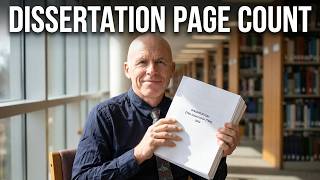
In this video, Steve Tippens, Ph.D., draws on over 35 years of academic experience and involvement with more than 300 dissertations to explain why there is no single correct page count for a dissertation. He emphasizes that length depends on the discipline, university style guidelines, and, most importantly, the expectations of the dissertation committee. Rather than chasing arbitrary page numbers, students should focus on telling a clear, complete research story that demonstrates mastery of the literature, a well‑described methodology, robust results, and thoughtful conclusions. Tippens provides practical, discipline‑agnostic page‑range suggestions for each chapter—Introduction (12‑20 pages), Literature Review (30‑50 pages), Methodology (≈15 pages), Results (20‑40 pages), and Conclusion (10‑20 pages)—while noting that these are only rough guidelines and committees may vary. He warns against the common pitfall of assuming a dissertation is finished once a target page count is reached, stressing that completeness and clarity of argument are the true measures of success. Finally, he invites viewers to join a free dissertation help program offering a five‑step process, weekly meetings, and coaching to finish their dissertation and make an impact.
Chapters
How long should my dissertation be? How many pages does it have to be? Really? There isn't a simple answer to that. My name is Steve Tippens and I've been in academia for over 35 years. I've been involved with over 300 dissertations and I've helped hundreds of students by coaching them to finish their dissertation through Beyond PhD coaching, let's talk about the length of a dissertation. There is no perfect number for your dissertation length. First of all, it's going to depend on your discipline. History might be a lot longer than mathematics. Heard of a mathematics dissertation that was one page? How does that possible? What I was told is that this person solved an intractable math problem that had never been solved before and was able to do it in one page. And if that's the criteria, great. They finish, they're done, they've completed a dissertation. However, for most of us, our dissertation is going to be more than a page. You can go online and go into Google or ChatGPT or anyone else and say, hey, what's the average length of a dissertation? And they'll give you a number. But it's kind of meaningless because ultimately your committee is going to be the answer. And when I tell you a number of pages, remember it may not all be written. There could be graphs or tables, also references. Remember, typically pages are double spaced. Most people follow a manual of style, whether that's APA or Chicago, Turabian or some other form of style. But your font size and your spacing are going to be based on that. But your university guidelines. Please stop chasing page counts. I've seen too many people say, oh, I got my 40 pages, I'm done. But they haven't fully explained things. Pages have to be there, but ultimately you have to be telling your story. And whatever is needed to tell your story is the appropriate number of pages. And that appropriate number of pages is there so that you can A show that you've done what you need to do. B show you understand your field, understand the literature, literature, how your work ties into all the work that's done before you. Work doesn't happen in a vacuum. You become part of generations of research. Word count is nowhere near as important as clarity. Explain every piece of literature that's ever been written on a topic to help the reader understand what has been done and what hasn't been done and why what hasn't been done needs to be done. So develop the gap in the literature. Chapter one, your introduction. 12 to 20 pages somewhere in there is typically sufficient to introduce Things. Chapter two, your literature review. I know of a school that says it must be between 30 and 50 pages. My bias is enough to explain things and show, like I said, what the literature is and how your ideas fit within it. And the gap. Thinking in the 40ish to 50 page range is typically going to be enough. Chapter three, your methodology. I like to think you can do this in around 15 pages. I also like to think of chapter three as a recipe. In chapter three, you're telling the reader every single step you went along the way so they can understand what you're going to do, but also replicate if need be. Chapter four, your results. This can vary widely. Okay, I think of 20 to 40 pages. Most likely going to have a number of charts, a number of figures in order to support the results you're showing. So to get to 30 or 40 pages may not be too difficult. When you start inserting figure seven and table number 18, your final chapter, chapter five, includes, you know, what does it all mean? How does my work fit within the literature and what else should be done? I've seen a lot of people get here and get tired and say, oh God, I'm done. Okay, here's four pages. Yeah, well, from a committee member's perspective, that says to me, you just spent a year or so of your life and all you got is four pages to say about it. There must be more, or did you actually do the work or you know, what else is going on. So you can think of chapter four again, or five. Excuse me, you can think of chapter five. I've seen some people say as low as 10, maybe up to 20 pages. This is where you get to say, hey, here's what it means, here's what else should be done. Here's how my work ties in with everything else. And you know, this is your chance to show how, what your work was and you know how important it is. So really take the time to come up with that. 14, 15, 16 pages. I've mentioned templates, I've mentioned committees. While I've given you broad numbers of pages, every committee and every university is going to have a little different take on it. But if you kind of think of those as a broad guideline, you're at least going to have an idea of what you're looking for. Sometimes you're going to get committee feedback that may not be important now. They might be just helping you for the future. And every once in a while you're going to get committee feedback that has nothing to do with your document. Nobody has ever failed in their doctoral research because it wasn't too long or it was too short. What they fail from is not complete and completion. Fully answering your research questions fully getting to the problem you stated is what's important, not whether it's 104 or 107 pages. If you want examples of what committees have approved. If you want to talk about what is needed in a dissertation, join our free dissertation help program and get support. Get our five step process to help finish your dissertation and get weekly meetings for support and accountability. I'd love to help you finish your dissertation so that you can go out and change the world.