Literature Review Tools That Actually Save Time
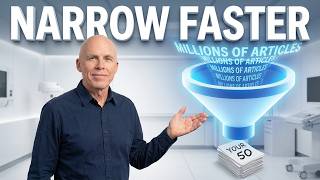
Steve Tippins Ph.D. walks through tools that speed up literature reviews: search engines like Elicit and ResearchRabbit narrow millions of articles down, citation managers like Mendeley keep references organized, and AI can help with writer's block but citations must be verified. He warns that chapters 1 and 2 carry most of the literature synthesis, and that tools work best when your institution supports them and you learn them first with dummy data.
Chapters
Today what I want to talk about is literature and research tools, things that you can use to help you move forward. And this is going to again come from a series of questions, observations we've made and had from clients over the years. Some people talk about, I'm spending way too much time and too long collecting sources. You know, currently there's a lot of tools available to help you collect, and by sources I'm just going to refer to literature. There's a lot of tools out there like Elicit or ResearchRabbit or Google Scholar or any search engines that'll go out and help you find articles that relate. They're not going to find every article. Also, every article they find may not be the best, but if they can help you narrow down from what in effect many times is millions of articles into hundreds or even fewer, that's gonna allow you to move forward faster. So these tools that are available can help you save time. And if you think about it, before these tools, it was go to the library, before Google even, you went to the library and there would be doc— books that had— you would look through the book to find out, oh, there's been an article on this, or there's been an article on this, and then you'd go to the actual journal, or many times people would just peruse journals to see, is there anything of interest I've missed? And they just pick 5 years' worth of journals off the shelves and go through them slowly. And every week they would go back to the library to see if anything has come out. Now you can do that in minutes from the comfort of your home, car, wherever you're doing these searches. And you're going to have to check just to make sure they're real articles. You know, that they actually do what you want to do. The other beauty of these is you can search to see who has cited articles. That was really difficult years ago. Now I can see who has cited certain articles, which means I can update my literature. So if my literature starts looking old, I now say, oh, who cited it in the last couple of years? And that gives me more recent citations to overwhelm any articles that have gotten quote-unquote old. And by old, most schools today say 5 years, which means 2022, 2023, 2024, 2025, and 2026. Anything before that is over 5 years old, and if your dissertation pushes you into a new year, you may need to be updating literature. So think about that as you're moving forward. Some people take lots of notes, lots of resources, but have difficulties compiling them, keeping them in order. And there's lots of software— EndNote, Mendeley, etc. I'm not— I'm just taking two to start with— that can help you keep things controlled. Or even Excel spreadsheet, where you create it by columns and you have certain columns that are of interest to you— the authors and the article title and the methodology and, you know, all the information that you might need to move forward. Putting it in that format and in Excel or using some of the prepackaged programs that do this for you can save lots and lots and lots of time. There can be programs that might be a little better than others in certain areas, but I like to say, does your school support one or maybe even allow you to use one for free? You know, if you're comfortable with it, it's going to work well for you. If you're not comfortable or if you're changing to something new, you might be spending more time on it than it's worth. So find a system that works for you. When there are tools, citation managers, AI, whatever you're using, learn to use them. They are tools to help you. So if you know how to use them, you can get help from them. If you don't know how to use them, Well, then it can actually be more work figuring out what they do, more work covering for what they've done for you. You know, there's a lot of debate about AI. I am certainly not going to say use AI to write your paper. I have said use AI to help you when you have writer's block and give you something to react to. Okay, but even if you're reacting to something, you want to make sure what AI has given you is actually real. Because when you get into a defense and they say, well, where's this article come from, because I can't find it, you can't say— well, you could say it, you could say, well, AI gave it to me. And that's not a good answer. It's your work. You have to— you're attesting that this is correct to the best of your knowledge. Well, if you haven't checked and AI just did it for you and found an article that didn't exist. That does not reflect well on you, and it makes it difficult for committees to move you forward. Some people are concerned, well, I didn't get all the literature, I might have missed something. And that's true, you might miss something. And this is where committees can be really helpful when they say, well, gosh, why didn't you cite Diamond 2024? And you say, well, that's, that's really interesting, I'm going to have to look into that. Because You as a person can do the best job you can, but at some point you have to stop and move forward. And when you have a committee, maybe they know a place or know a citation, or maybe they know the people and that's why they know it, and they can be helpful in this process too. That's not to say depend on them, "Hey, tell me all the literature I need." It's show them you have done an exhaustive research, and then if they know of something else, they can help you move forward. Ultimately, what I want to say is you write your dissertation, you write your thesis, depending on what we call it. It's your name on it. You can get help finding literature, doing statistical analysis, help coding things, and gathering material in a certain way, but it's just help. You have to be able to answer questions. When they say, "Well, why did you code in this manner?" You have to explain why the coding was done this way. You have to explain why statistical tests were used. So you, you've used SPSS or something like that to do the calculation. Well, why did you pick the test? You have to have justification for the statistical test you've used. So tools are great. Tools can be incredibly helpful, but it's you doing the work and your name on the document. So you have to be familiar with what the tools have done and be able to answer questions from your committee. Anybody here today have any questions? A lot of schools have— I'll call them rules— but saying a percentage of the literature must come from the last 5 years. There's an acknowledgement of the fact that there's literature out there that's been around a while that's really important, seminal type work, and they're saying in some cases 20% for articles that are over 5 years old, but most of the literature needs to be within the last 5 years, and the purpose is to show that you're doing research that is pertinent today. Okay, is that helpful?
Yeah, yeah, okay. So which, which of these sections do they normally emphasize this, like, so much in terms of the chapters?
Well, most of the new research you're going to present is typically found in chapters 1 and 2. 3 will have a little bit. 4 is, you know, your results, and the typical destination in 5. Is tying it back to previous literature as well as conclusions and things like that. But so the early chapters is where most of the emphasis seems to be on making sure that your literature— you cover, you know, groundbreaking seminal work, but also weave it into, synthesize it into the current work that's being done.
Okay, thank you.
You're welcome. Any other thoughts or questions? Okay, so where, where do I put the emphasis of my literature support for what I I want to do. I like to think of your literature as the story that you tell to support the research you want to do. So if that story needs support in a certain area, you draw from that area. If the story needs less support from another area— that's a somewhat simplistic way to look at it, but it seems to work. So you— that's a well-thought-out question. Submitting an article to a certain field, in a certain journal, they're going to have an emphasis, and you want to make sure that your work will fit within their emphasis and what their readers are looking for. So, you know, I've seen people take papers and have relatively similar results but use a different emphasis for a different journal to present that material.
Okay.
Are there any other questions today? That's a lot of questions. Start with what's known, what's available. To you through your institution or, you know, what they support. Because if you can have something that's supported, that's really good. Next, I would ask people within your field what they're using because there's certain software that seems to work better in certain fields than others. So ask those within your field what they are using. And then when you find something that you're going to use, spend some time just playing with it, I guess I'll call it. To try to figure out what it does, you know, with not real material, not real data, not real resources. Just play with it and figure out what goes where and when you do whatever, so there's less pressure on it when you have actual material. You then know how to use it. Well, you know, think about anything you purchase, okay? It's gonna— it's not until you actually start using it you understand what it actually does. I You know, I've seen people buy cars and they— this was a good car, and then within 3 months it's like, oh, it doesn't really do what I really need it to do. I need to get a different car. Okay. If the software will support what you need to do, you can learn it and adjust to it. If it won't, you know, there's a strong argument for saying stop and find something else now instead of, you know, not being supported and wasting a lot of time moving forward. But it's also a matter of investigating and finding out what works in your field.










