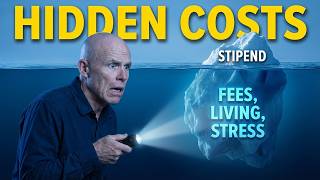
In this presentation, the speaker breaks down the true cost of earning a doctorate, moving beyond tuition to include time, lost income, reduced benefits, delayed life milestones, and the high dropout rate. He quantifies typical tuition ($30,000 per year) and illustrates how six years of study can amount to $180,000, while also highlighting hidden costs such as career pauses, family sacrifices, and lower retirement contributions. The speaker discusses the financial and non‑financial benefits of a PhD—tuition waivers, stipends, career pathways (tenure‑track academia, research scientist, school superintendent), personal identity, family legacy, and societal impact. He then offers a decision framework, urging viewers to assess whether a doctorate aligns with required career goals, personal motivations, and realistic cost‑benefit calculations, and warns against pursuing a PhD for the wrong reasons. The talk concludes with a call to join a free Dissertation Help community for those struggling with the process.
Chapters
How much does a PhD really cost? Most people think the cost of a PhD is just the tuition, but it's really not that simple. There's time, there's lost opportunities. There's many factors to consider in the cost of getting a doctorate. So what's the actual cost of a PhD? Just in dollars. If the average PhD time is five to seven years, I'm just going to use six to be right in the middle. And if tuition is around $30,000, that's, that's $180,000 to cover this. And if you finish fast, Even if it's three years, that's $90,000 of cost just to get a doctorate. This means that getting a doctorate may be one of the largest financial decisions you're ever going to make in your life. On top of dollars, there's other hidden costs to this endeavor. First, let's look at time. If we are taking six years, that's six years years of your life where you aren't doing other things. You're working on a doctorate. That six year time period could mean that some milestones in your life get delayed. Getting married, having kids, traveling and climbing Kilimanjaro. Many things may get to be delayed. If you're in a doctoral program. There can also be lost or delayed opportunities. For example, you might miss out on promotion opportunities at work sometimes. If you're going to school full time or even part time, it can pause your career or the slowing down can allow you to miss on opportunities. I talked to someone recently who actually took a demotion heading into a program because they were in a fairly responsible job and realized they couldn't do both. So again, setting back a career time away from family can be important. Countless people have told me, oh, I was at their soccer game doing work, or I was there physically, but maybe not mentally present. Or stories about kids saying, aren't you done yet? Come on, I want to go out and play or I want to do these other things. So you do have time away from family and missed opportunities there. You can also measure costs in income you didn't earn, perhaps smaller paychecks, less overtime, again missing out on those promotions which got you a higher paycheck. Another cost that a lot of people don't think think about is reduction in benefits. Well, I didn't earn as much, so my 401k wasn't as high. Or my retirement plan isn't going to provide me as much income. So that's another area which you want to factor into as a cost. One other thing to Think about is remember about 50% of doctoral students don't finish. So that means 50% of people get to a point where they paid 60, 70, $80,000 and don't finish. They don't get a degree. But guess what they do get. They get to still keep paying if they have student loans or they've paid out that money. So you can have incurred a big cost and not get the degree. I know several people who haven't finished their doctorates and haven't finished paying off their student loans. Now, some schools have gotten a little wiser on this and will, when you reach a certain point, give you a master's degree, maybe a master's in philosophy. But you didn't come into this to get a master's in philosophy. And a master's in philosophy isn't going to allow you to teach or do many of the other things that you went into a doctoral program for. Now there are benefits to getting a PhD, both monetary and otherwise. There are programs where you can get tuition reduction or maybe even tuition free school. That's great. It can reduce the dollars, maybe not some of those other costs. And there are programs that will give you a stipend to live on. But that $24,000 a year stipend may not go a long ways towards feeding your dog or paying rent or buying food or living to the lifestyle you were accustomed to. So be aware that even though there may give you a hey, free tuition and we're going to give you a stipend, it's not like you're going to be living like you were before you went into the program. Another benefit you can get is a career that you're looking for. You may want to become an academic. Getting the doctorate might be the path to get there, which gives you flexibility. Maybe summers free. I used to tell people every break that the undergraduates got, I got too. Now there was work to do, but you can have flexibility in your schedule and it can be very helpful for families in particular. I will say here we are in 2025. So the job market is much more competitive than it was for academic jobs. Let's say 100 years ago when I got into the field. Getting a doctorate can be your life goal. It can provide meaning for you. So this may be the path that allows you to get there. There are people who tell me, this is my life's work, I can't do anything else, or this is going to change my family's life. Letting everyone else in the family know it's doable. Many of our clients tell us I'm the first person in my family that to get a doctorate or maybe even go to college in the first place. But the first person to get a doctorate breaks it open for everyone else in the family. I'll let you know. In my family, I'm the first person to get a doctorate. I now have two nephews with doctorates. Another benefit is the impact you can have in the world. Your research can help change the world. You getting a doctorate gets you to the table where lots of discussions are had that you couldn't get to before. So we getting your doctorate can be very helpful to not only you, but to the world. So now we get to the point where I ask the pretty obvious question, is it worth it? The answer is I don't know. It's up to you. What do you want? Let's start with looking at what's right for you. So when is a PhD worth it? Well, obviously if you want a tenure track position at a major institution, they're going to require a doctorate. Your field might require a doctorate. Going to be a research scientist at a pharmaceutical company. Most of Those people have PhDs or I want to be a superintendent of a school system. Most superintendents now have doctorates. You might say, I value the identity of having a doctorate. I value what it shows the world I was able to accomplish. I've had a number of clients who said I'm getting a doctorate because my third grade teacher said I would never amount to anything or would never graduate from high school. And this is my way to show my third grade teacher, who unfortunately is probably dead by the time they did this, but show my third grade teacher that they were wrong. Now, there are some reasons that maybe getting a doctorate may not be worth it if you're getting a doctorate to get a raise. Let's balance the costs of getting a doctorate and all those economic another time, costs versus I'm going to get a raise. How long is that raise going to be for? How much is that going to add on to other things? And you can do the numbers and out figure, figure out whether it's worth it to you. I've seen a few people get a doctor because I don't know what else to do. I don't have any place else to go. That may not be a good reason to subject yourself to getting a doctorate. And don't go into a doctoral program until you've really determined what the costs are emotionally, physically and financially. So ultimately, should you get a doctorate? Well, I think you should start with two things. First of all, what will this degree give you? Second, what will it cost you if you don't finish? A PhD can open doors for you, transform families, and change your life, but only if you go in with your eyes open and understand what the potential costs are while you're in the process. If you're struggling with costs, expectations, and or the uncertainty of the PhD process, join our free Dissertation Help community by clicking the link below.