PhD to Career: What They Don't Tell You in Graduate School
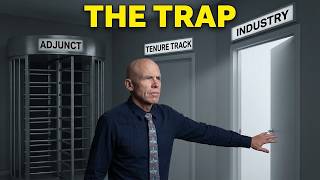
Dr. Steve Tippins, a tenured professor for 35+ years, tells new Ph.D. graduates the truth about the job market: tenure-track positions have shrunk while adjunct roles with low pay and no benefits have exploded. He outlines five career paths, from postdocs to industry, and warns that employers don't understand what a Ph.D. actually knows how to do.
Chapters
Once you finish your doctorate, whether it be Ph.D., Ed.D., etc., that's not an automatic that you know what's going to happen next. In this video, we're going to talk about things that come up after you've finished your degree and how to be prepared to use the degree you've just earned to your advantage. I'm Dr. Steve Tippins, and I've been in academia for over 35 years. I've earned tenure twice, and I've served on many different university committees. I've been on both sides of the hiring process, and I want to talk to you today about how to help you have a leg up moving forward after you've finished your degree. After graduation, or even more importantly, after you've defended your defense and turned in all the paperwork, because at some institutions this can happen and then it can be a week, a month, or months before you go to an actual graduation. So after you've defended, turned in all the paperwork, most people find out the system doesn't just stop. You've been running this way for years. You don't just stop and go, "Ah." In this situation, it's unfortunate, but many people panic and reach out for something. "I got to have something to do. I got to go. I got to have this." And they accept opportunities and/or jobs that may not be appropriate for them. I like to think that rest is not laziness at this point. It's— think of it as a recalibration, getting your system ready for the next challenges. If you have spent years replying to the unique demands of academia and of your committee, it can be hard to just stop. One of the things I've told people over the years is make a list of the things that you're I haven't been able to do, or I want to get to when I get done with my dissertation, or opportunities I want to explore. But don't act on any of them for a while. And the reason I say that is you are a different person when you finish your degree than you were when you started. Oh, I've got to get back involved with the baseball league oversight committee, or whatever it is. That was when you were maybe feeling guilty about ignoring something, but now you're different. Take the time to figure out what you want today instead of what you think you should have been doing 2, 3, 4, 5 years ago. Clarity comes after rest, not before it. So let's start with, uh, here with an academic reality check. If your goal is an academic job, you need to be aware that the academic marketplace may be a lot different than where you are in terms of the year. Most academic jobs, 80 to 90% of them, open up in the late summer, early fall for the next year, for jobs that start the next year. So if you're looking, starting to look at this in February, you've probably missed 85 to 90 plus percent of the opportunities for the next fall. That's not to say there won't be any. but most of them, because of the budget cycle that universities are on, come up much earlier, so you need to be aware this is an annual cycle. Over time, tenure-track roles have become more limited. Instructor roles have come up more, which is code for teach more, get paid less, and/or adjunct roles are now even more plentiful than they were 20 years ago. I just want to reiterate Let me rephrase that because I haven't iterated it, so I can't reiterate it. I just want you to know this is a change in the system. It is not a failure on your part. So if you entered a program thinking, I'm going for that tenure-track position, and that was 8 years ago, well, now the world is a lot different than it was 8 years ago. So we have to react to what's there today. Many people end up in what can be called the adjunct cycle. Trying to fill their day, fill their checkbook with compensation from adjunct jobs. This is easier if you're in a large area or an area with a large number of institutions, and you'll find people who teach 7 or 8 courses a, let's say, semester, and 3 at one institution and 2 at another and 3 at another institution. Most institutions have limits to the number of adjunct jobs you can have with them in any one semester or year, and that's tax reasons. If you get over a certain amount and benefit reasons, they have to give you benefits and have to pay more for supporting you, so they limit it, but you'll find you'll need more jobs in order to make ends meet. What does an adjunct faculty member make? Well, it can run a big range. I've seen it I've seen it as low as like $1,200 for a course. Sometimes at the online schools they pay less. And I've seen it as high as $10,000 to $12,000 for a class. That's much more rare. It's seemingly a good, really good adjunct pay is around the $5,000 range for a course. Well, if you're feeling pretty good about yourself and you've gotten 5 adjunct classes, that gets you to $50,000 a year teaching 2 semesters. So you're not getting rich as an adjunct, and you're not getting benefits. And if you've tried to buy health insurance on your own, it's expensive. So the adjunct trap is real. It's also— you are not going to get rich, and it's going to be difficult to pay off your student loan. So the way I see it, there are 3 broad paths to life after your doctorate, and that's 3 employment paths. We'll just say one is the traditional academic route with the tenure-track job, again limited number. The instructor level, more teaching, less pay. And then the adjunct level, again teaching but a lot less pay. So those are 3 paths there within the overall academic path, and I just want to mention one other path that's not usually talked about here, but that be a postdoc, you know, going to do research afterwards. A lot of people in sciences finish a degree, then go to a lab somewhere for a year or two to be a postdoc before they then move into a tenure-track job, so that is a path along the way to get to the tenure-track job. I don't see a lot of postdocs, again, getting rich, but it is a way to make your CV look stronger relative to other people. There is an administrative/educational leadership path. This can happen for those who are in educational administration, in education, like principals and superintendents and things like that, of people who find administrative and/or leadership roles based upon having a doctorate. And I guess the catch-all is industry/non-academic roles. You see a lot of science researchers going to work for drug companies, things like that. So, so they can just continue to do science and do research like that. One of the struggles with this category of jobs is you got a doctorate. Most people don't understand what a doctorate is, so it's hard for them to understand the skill sets that you have and how it can help them. They just think, oh, doctorate, they're overqualified, they're not going to stay here. But maybe you want to, you would love doing a job they have. It's incumbent upon you to help them understand, not that you have a degree, but that you you have skills that are going to help them. So you're going to have to market your skillset. And this is why outside of academia, people aren't rejecting you just because of a Ph.D. or anyone in general. They're thinking, like I said, oh, overqualified. What they aren't thinking is your ability to research, your ability to take on long-term goals, your ability to manage projects and people even, as well as writing and communication skills. You have very deep and strong skills you developed in your doctoral program. It's just programs don't help you understand how they can be translated outside of academia, and this is gonna be your challenge and things you are gonna need to do moving outside of academia into engagement/employment in those fields outside of academia. Is a Ph.D. worth it? Well, first thing I'm gonna say is the world has changed. It's not an automatic tenure-track job you're gonna get, It's not that there are, you know, 3 times the number of tenure-track jobs as there are candidates anymore. The number of candidates have increased and the number of positions have decreased, meaning it's harder. You have to position yourself better to get an academic job. I haven't seen many schools, and I don't think most people think of it this way, but a Ph.D. is not a shortcut to financial independence. If you look at the billionaires in the world, they haven't come, most of them, through the Ph.D. Root. However, there's a lot of other reasons to get a Ph.D., and first of all, in academia, you probably will never get rich, but hopefully you'll be comfortable. Hopefully you'll have a strong benefit package as well as a lifestyle that will support you and your family. In addition to the compensation, it can be an incredibly fulfilling and meaningful job when that undergraduate comes back to you 3 years after graduation and said, you know, I still remember what you talked about in class on a certain day, or the way you helped me improved my writing skills or critical thinking has changed my life, and now I am the senior vice president of critical thinking at my organization or something like that. You can change people's lives, and, and that's a really good feeling. To do all of this, though, you really want to have an intentional strategy about how you're moving forward and think about, I got a degree, what is the best path for me now? And I say now because it can change. You can go into industry. You can come back to academia or vice versa. Start your own business and, you know, use the concepts you learned in your degree to become a millionaire or billionaire and also help change the world. If you're a doctoral graduate and you want help planning your career and making a meaningful career and you want to move forward, join our free Scholar Career Network. We'll give you guidance and support to move forward with confidence to reach your career goals. I want you to remember you've worked hard on your degree. It should be an asset, so you want to make sure you can use your degree to help you in your future.










