Population vs. Sample: How to Justify Your Participant Choice (Chapter 3)
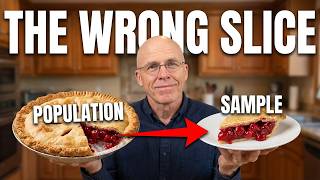
Dr. Steve Tippins explains why you need a sample instead of studying an entire population, and how to justify your choice to a dissertation committee. He covers random and purposive sampling, sources of bias, and tools like GPower for determining sample size.
Chapters
Let's talk about population versus sample. These are two words that tend to get mixed up frequently, and you don't want them mixed up. You want your committee to know you understand the difference between the two. If you get it right at the beginning, your committee is happy and you move forward. If not, there's another round of revision. In this video, I'm going to walk you through the key distinctions between population and sample so that you're ready to show your committee you know what's going on. I'm Dr. Steve Tippins, Ph.D., and I've spent 35 years as a professor and served on over 300 dissertation committees. I've also helped hundreds of people reach the end of this process and finish their dissertation. Population: everybody. Sample: small group of the population. Now let's be a little more specific. The population is the whole group you want to draw from. Teachers or middle school teachers. The sample is the subset of that group. You're not going to get access to all the teachers, but you may be able to get access and draw from the sample of middle school teachers in Central Oklahoma. I've heard it said that the population is the whole pie and the sample is the piece you get to eat. If that works for you, great, and hopefully it's a tasty pie. So why is it we're so concerned about samples, and why do we use samples? Well, first of all, to get access to an entire population takes a lot of time and a lot of money, and it's actually really hard to get an entire population. You can think about the United States Census data. In theory, they're getting the entire population, going door to door and finding homeless people, but they don't get everybody. So we go for a sample, or many times people say a representative sample. This means you can save a lot of time and a lot of money. Currently, the law in the United States says the census is the population, but every time it comes up, there are proposals for we need to sample because it costs a lot of money to hire all kinds of census workers and to go out and have them wander through neighborhoods, literally, and knock on doors. And a lot of people don't like to have their doors knocked on, so they don't answer, or they're rude, or, you know, who knows what. And now, but we do samples in research so that we can have representative samples and then infer or say, oh well, if this sample represents the population, then our results are such that we think this is the case. Sampling is done all the time. In fact, in workplaces, if they're in a production line and lots of bottles come down the line, you don't look at every bottle, but there may be a policy in place that we're going to look at every 20th bottle. If questions or topics such as population, sample, methodology, etc., in the dissertation process are slowing you down, click the link below and join our free dissertation help community. You'll get access to our 5-step process to finishing your dissertation. I've seen people say, look, the goal of sampling is representation. Do the people you're going to be including in your study represent adequately the population? Have you randomly sampled, or have you chosen 9 people you know, or 180 people you know to represent the population, and do they adequately represent the population? This is an area you're going to have to tell your committee and your IRB. The sample that I have chosen is X, and this is why they represent the population. When you have an adequate sample size and it represents the population, then the results that you have can be generalized, or they're generalizable, to the population. If your sample is not adequate, if it doesn't represent the population, then generalizing to the population is very difficult. And you'll see in marketing sometimes they'll say, "Well, 4 out of 5 people said something or other." Or in political campaigns, they come up with statistics based on a sample that they use, but they may only sample people who already said they like this candidate, and that doesn't represent the entire population of voters. So, you want to make sure in doing doctoral-level research that your samples are going to allow representation of the population so that we can generalize. And as an aside, qualitative studies are normally not generalizable to the population because the sample size just isn't huge. If I'm going to interview 5 teachers about their lived experience about curriculum curriculum changes and there are 12 million teachers or however big the population is, it's very difficult to generalize their experience to a population. So when we have quantitative versus qualitative studies, qualitatively, I'm going to look for a deep understanding of a phenomenon and it's going to provide information. And many times the results of qualitative studies become the foundation of future quantitative studies because we want to check and and see if these themes that were determined are present throughout the much larger sample and therefore generalized to a population. Whereas in a quantitative study, we are testing specific things, people's— whether the impact of A on B or something like that. So, I need a sample size that is going to be sufficient, and hence the G*Power test, in order to generalize to the entire population. What can ruin your study is bias or sampling errors. No sample perfectly measures the population, but we want to control for as much as possible. I mentioned political campaigns before, and they'll do, for example, a phone interview. Maybe they only called landlines. And how many people have landlines now, or maybe they only called cell phones and they missed landlines, or how many people are on do not call lists, so the population is harder to get to and the sample may not totally represent that. We could also be doing a study and our sample is in English, but our population might include people who don't speak English. Therefore, I've excluded a portion of the population, and it's going to be difficult to generalize my results to the entire population. So if part of your population can't be reached by the method you've chosen, you've put bias into your study. So what are some common sampling techniques? Well, there's random sampling or true random sampling where you can randomly access people who are part of the population. This is much easier if you're dealing with secondary data, with, you know, numbers that have already been collected, and you want to randomly sample from that. You can use a random number generator and randomly pull answers out. But if you're randomly sampling from the population and certain people don't actually respond who've been chosen, you might have a little bit of an issue with your random sampling. There's also purposive or purposive, depending how you want to pronounce it, sampling, meaning I'm going to select on purpose people that, you know, to respond. Now, this institutes me involved in choosing the sample a lot more, and that could bring about bias, but we want to understand that and explain that in the work you're doing so your committee understands it. And this is done very frequently because True random sampling is difficult. We also use something at times called snowball sampling, and just think of that as a little snowball rolling downhill, and it gathers more snow and becomes huge. Well, snowball sampling means I have found a person, they've participated in my study, and I say, "And are other people— do you know other people like you?" that I should talk to about this, and I recruit through them. I snowball the size of my sample from them. Ideally, you don't want to mix these methods of sampling. Ideally, you want to start with one and move forward with it. So when you're thinking about your population and your sample, when you're talking to your committee, writing things down, you want to be able to explain your population in one sentence. The population from which I am going to choose is all teachers in Oklahoma. The sample, also explained in one sentence. Sample for this study will be all teachers in Norman, Oklahoma. You're going to explain how I'm going to access these people, how it's going to come about. I'm going to get permission from the school system, or I'm going to use a Facebook group, or whatever methods you're going to use, and If there is a bias in, in the system, in the process, you want to explain that bias and explain how that bias is going to be handled so it doesn't impact the results of your study. If you're doing a quantitative study, you're going to justify your sample size using a G*Power test. If you're using a qualitative study, it's very common for people to say things like, I am going to survey 10 people. Or data saturation, whichever comes first. And data saturation means I'm hearing the same answers over and over again. You do not want to say, "I'm going to interview 10 people or data saturation," because that means a committee member said, "Well, you got 10, but I don't think you have data saturation, so keep going." But if you say, "10 or data saturation, whichever comes first," then it's— if you don't have data saturation, you stop at 10. Otherwise, theoretically, I guess it could be unlimited and take you a really long time. If you're struggling with population and sample size, if you want help trying to determine what's appropriate for you and your study in population and sample size, join our free dissertation help community and get our 5-step dissertation acceptance framework. You'll get live calls, and Q&A sessions, as well as one-on-one support from qualified and experienced dissertation chairs, and a free one-on-one call to help you move forward faster. You don't have to do this alone. Just click the link below and join thousands of doctoral students before you who have refused to stay stuck. I'll see you on the inside.










