Stop Making This Literature Gap Mistake on Your Dissertation
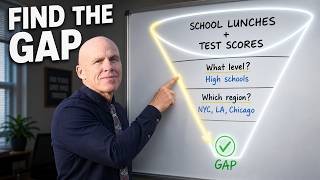
Dr. Steve Tippins shows dissertation students how to find a defensible literature gap by mining authors' future research statements, then narrowing by geography, demographics, methods, and time. He warns against gaps that lack theory or only allow trivial analyses, and stresses listing what's been done versus what remains unknown so committees see the relevance immediately.
Chapters
If you're stuck finding the gap in the literature, this video is going to fix that. I'm going to show you exactly how to find a defensible gap in the literature step by step so that your committee won't push back on it. I'm Dr. Steve Tippins, Ph.D., and I've been a professor for 35 years and served on over 300 dissertation committees and helped hundreds more people finish their dissertations Identifying a gap in the literature. This is the foundation of the work you're going to do. Once you have a gap, then you can have a problem and a purpose and research questions and everything else. But it all comes from the gap, or broadly, what hasn't been done before. So, how do you come up with a gap? Well, the simplest way to begin is if you're reading someone's research and they say, "Future research should be conducted in," and that gives you a great place to start, meaning, "Oh, well, here's someone who's done some research, and they say we should continue this by doing some— this other thing," and it obviously, it must be of interest to you. So, that is a beginning for your gap. It's not the gap itself, or it may end up being, but you have to explore to make sure, because one thing authors do a number of times is they will have an article, it'll get published, and in the future research, they will say X should be done. And it may be true that X should be done, but they may also be 80 to 90% finished with X or Y. So they're basically paving the way for themselves to publish another paper on it. So if you read this and see that someone has said X needs to be done, you then have to go to the literature to search for that in specifics to find out, you know, yeah, they said it should be done and they did it. Well, then it's done and you're not going to go do it on your own now. And if it's not done, great, you finish exploring the literature around it. But if you're working without that as a marker to move in, you're going to start from an idea. Gosh, I wonder if, or what happens if, or what's the impact of, and then you're going to start looking broadly at literature within your And start looking at the impact of school lunches, let's say. Okay, well, what has the impact been? And then where has it been done? So you're starting to cover the breadth of the literature. And you know they've talked about school lunches and they've talked about behavior and they've talked about school lunches and test scores and they've talked about school lunches and, and you figure out all of the areas they've talked about school lunches. And let's say your area was test scores. So now you find, okay, school lunches and test scores. Now, where has it been done? Oh, it's been done in high schools and test scores on blank, blank, blank, blank. It's been done in middle schools, blank, blank, blank, blank. It's been done in elementary schools, blank, blank, blank, blank. Great. But it's been done in high schools and we'll just start, stop there. Done on high schools and it's been done on urban high schools. Blank blank. It's been done on rural high schools blank blank. And we keep thinking, where have things been done? Where have they been done? Where have they done? And the circle gets smaller and smaller until you find out, you know, this has not been done on suburban high schools or private high schools or somewhere. So you're narrowing and narrowing and narrowing and narrowing to find out where this has not been done, and that becomes a gap in the literature. Now, that may not be sufficient. It's necessary to find this, but it may not be sufficient in that first, is it doable? Meaning it hasn't been done because, A, there aren't any high schools that fit this definition, and/or the data isn't collectible. So we want to know that it is doable and is not broad. So let's say you found out it hasn't been done on high schools in general. Well, there's a lot of different types of high schools. So we'd wanna narrow it down to types of high schools. Is it gonna be private high schools? Is it gonna be religious high schools? Is it gonna be urban, rural, etc.? Or urban private schools? So the narrower we can define it, the more doable the study becomes, assuming data is available. Available. So in the narrowing down, you also want to be looking at methodology. For example, there may have been a great number of qualitative studies done in a specific area, but no one's taken a quantitative approach. Well, then that begs the question, why? Is it doable? And can I— because I'm going to get a different perspective on the information by using different methodological approaches.. And even within a qualitative approach, there can be different types of qualitative approaches. And in quantitative, there can be different types of quantitative approaches. So you want to, you know, knowledge comes from surrounding a topic from different areas. So we use many different qualitative approaches and many different quantitative approaches. So if there are gaps methodologically, boom, go at it. Now, there are also, let's say it's been done with high school students and their test scores, but there is a new type of test score. Well, now it hasn't been done with a new type of test score. Or geographically. Yeah, we know about urban schools in large population centers, you know, country— states in the US. But what about an urban schools in North and South Dakota? Not large population centers and maybe a different type of student, different types of responses. Again, surround the gap and the material with answers from many different perspectives so that we can begin to think we know an answer. So geographically can matter. We might look at ages of students, if there can be variations in ages. Well, yeah, freshmen do different than seniors, or male students and female students. So, ways that we can demographically differentiate also become gaps. So, when you're looking for what has been done and/or future recommendations, recent articles are going to be probably the best place. Recent research articles. You can use recent dissertations. There are some faculty members who do not like dissertations as references, but if they can point you in a good direction, great. A meta-analysis or systematic analysis looking at all kinds of research might be able to help you be pointed in the right direction. But there are schools and faculty who don't like meta-analyses used for references because they want you to go to the actual research instead of looking at summaries, which is why just in general, when you say Jones 2024 in citing the work of Herzberg said such and such, well, you know, Jones 2024 might have gotten it wrong. Or might be citing it for an agenda. That's why committees are always saying, "Go back to the original work," so that you can see that it's— you're correct in the interpretation. How many sources to look at or feel confident? You know, I've never thought of it as a number, but you better have at least 4 or 5 surrounding it to show that it's— stuff has been done around it. And as, as well as recent work. If your gap is from 1974, your committee's most likely not going to accept it. If your gap shows in 2023, okay, then it's recent research. But if nobody's touched it since 1974, then maybe nobody's interested in it, and that means your committee's probably not going to support you moving forward. So you also should be looking at recency of information. I've seen people say, well, I've got my gap in my research, and they really haven't supported it with other research. They just think, well, I don't, I don't know the answer to this. And your gap isn't what you don't know. It's what the literature hasn't supported or hasn't done yet. So making sure you have research to support where you're going. Now, obviously you're going to start with an interest, otherwise you wouldn't be exploring this. But that interest needs to be informed by the literature and what has and hasn't been done in the recent past. Then you can find a gap. One thing we've seen over the years is people have said, well, look, this hasn't been done, and I've looked at the literature and nobody has done a study on maternity rates and baseball scores in the 9th inning or something like that. There's really no reason to believe there's any effect on one or the other. And just because something hasn't been done doesn't mean it needs to be done. So, there are studies that aren't supported by the literature but may need to be done. So there's a couple of things to that. You may be ahead of the research and it might need to catch up to you, or— and this is a big or— let's say it's been done in the United States, but no one's done it in Africa. Well, it needs to get to Africa eventually. So what I suggest to people is you start doing your gap by surrounding your gap with tangential research. Well, yeah, okay, you know, nobody's done work like this in Africa, but it's been done in the US and it's been done in Europe. So you're geographically moving it, but you don't have much support within the geography you're looking at. So you're looking for support elsewhere to say, okay, it's logical now to think we need to do this in Africa versus Europe and the US. So if you get pushback from a committee, it's either you haven't presented the gap well enough. So they're asking you for clarification. They're asking you for more material so you can answer this. So what, why should this be done? And now, oh, okay, I get it. Or, and if this is the one, typically they're going to say this, or this has been done, or no, this is way too big a gap. So they're either saying, I need more for you to, you know, for me to understand and believe that you know what you're doing and you understand this, or it's nope, it's gonna take you too long. It's, or this was done 20 years ago, or some rationale like that. And hopefully if they're in the no, they're telling you what the no is and why. So a gap needs to be sufficient for there to be testing done. So, if it is a gap, you are saying, you know, we don't know the correlation between X and Y. Well, correlation is a pretty simple test. Typically, committees like to see you doing deeper analysis than correlation on a quantitative study. So, if your gap can justify a deeper type of analysis, it is more likely to be accepted. As opposed to, you know, we don't know if men score higher than women on balance testing. Well, okay, then the answer is yes or no. There's very little that you can say about it other than yes or no. So your gap, while it may be a gap, it needs to be sufficient so there's something to talk about once you get your answer. I find it easiest for a committee to understand and accept a gap if you tell them the gap that you have found. A, B, C, D through J, K has been done, which means that P right here has not been done. Therefore, the gap in the literature is such that we do not know whatever it is the gap is, which then logically and easily leads to a problem and a purpose and a research question. The more direct you are, the less a committee has to go searching, saying, well, I, I think they're saying this is the— well, maybe it's this they're saying is the gap. The more you come out and say it, the easier it is for them to see it and accept it. One of the problems that people do in writing is in academic writing, and when they haven't done it a lot, is, well, it's implied, right? I mean, it's implied that this is it. You don't imply anything. You just say it.










