The Dissertation Process Broken Down Into 8 Clear Stages
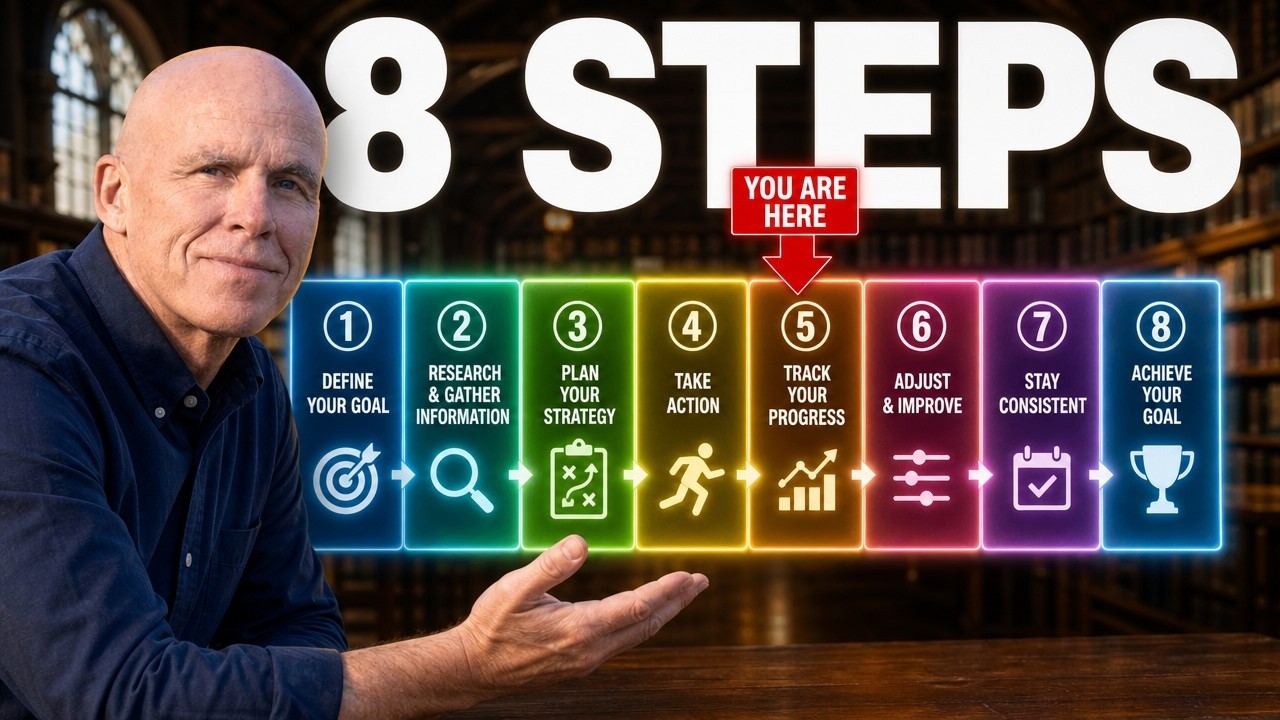
Dr. Steve Tippins, who has served on over 300 dissertation committees, breaks down the doctoral dissertation into nine concrete stages from choosing your committee through the final defense. He covers picking a feasible topic, structuring your proposal, navigating IRB approval, collecting data, and writing your analysis, with practical page-length guidelines and timing advice for each phase.
Chapters
Writing a dissertation feels impossible, especially when you look at it as one big project. But it's not one project. It's 8 specific steps. And every student who finishes has gone through all 8 of them. And that's whether they knew it or not. I'm Dr. Steve Tippins, Ph.D., and I've served on over 300 dissertation committees. Today I'm going to show you what those 8 steps are, and how to move through them without getting stuck. Let's jump right in. Step 1 is to find your chair, sponsor, advisor, whatever your school calls it, and your committee. These are the people you're going to be working with on this journey, and you want to choose them wisely. I've seen people choose members of their committee because of a good name they have or because they have specific expertise in a certain area without thinking about how those people relate to the other members on the committee. I had a friend in graduate school who chose two people to be on the committee. They happened to be married, but while he was working on his dissertation, they got divorced, and they were using some of his material— not his material, but time— to vent at each other, which slowed him down by probably 3 months. Because of the battle that arose during his process. So, yes, you want to choose your committee for support, but you also want to choose them for their ability to get along and move people forward. The second thing you're going to do once you have a committee is come up with and finalize your topic, and that's going to entail digging into the literature, finding a gap in the literature, and finding a gap in the literature that is needed to be done and also doable for a dissertation. I remember going to my dissertation chair with a topic, and he said, "You know, that's not a bad topic, and it probably needs to be done. However, it's going to take you 20 years to collect all your data." That topic got thrown out instantaneously. So yes, finding a topic is good, but also remember it has to be doable. The third thing you want to do is see if your school has a template for writing your dissertation. A template can give you outlines or headings for every chapter that's going to be involved in your dissertation. And that is immeasurably helpful because you can then break things down into small pieces and say, "Oh, I need an intro here," or, "Oh, I need the background of the study," or there's definitions, whatever. If your school does not have a template, don't get too concerned because what you can also do is look for and find a recent dissertation, preferably where your dissertation chair was the chair, and preferably using a similar methodology to yours. You're not going to be looking at it for what they found or anything else, but you're going to be looking at it as, okay, here's the type of information that they looked for, here's the type of information that got accepted or was deemed acceptable, because this is a completed dissertation. Now, if you don't want to spend a lot of time doing this search, you are paying tuition for whatever institution you're attending. Contract your librarian. Ask them to help you find something that meets your criteria. I've just seen too many people write without knowing what should be in an area. I talked to somebody recently and I said, "Oh, this is great. Do you have definitions?", and they said, "Oh no, I thought just everybody knew this stuff." And they— I said, "No, you're gonna need a definition section, not only so people know what you're talking about, but setting up the use of the term or terminology for the purpose of reading your document. You confine your reader to your definitions." So understanding what needs to go in there is a great step and very important. Now, the next step in your dissertation broadly is writing your first 3 chapters. Your intro, your lit review, and your methodology. This is usually considered your proposal. So after they've given you the okay to move forward with your topic, after you've figured out how it's supposed to be put together, now, okay, I'm going to read all the literature, I'm going to come up with my literature review that actually shows the gap, I'm going to do the introduction to what's happening,, and I'm going to talk about the methodology and put all that together to come up with a document written in the future tense. I've only seen one school over the hundreds of these I've looked at that allowed you to write your proposal in the past tense. And there's a, you know, logic to both sides. The future tense is written because you haven't done the research yet. However, it's never going to see the light of day until you've completed your research. So writing in the past tense saves you a step later on. More often than not, though, you're writing in the future tense because you haven't completed your research yet. So you wanna know what your committee thinks should be involved in a proposal. Roughly 15 pages for Chapter 1, roughly 40-ish pages for Chapter 2, and roughly, oh, 15 pages for Chapter 3. That's not including references. I once had a student turn to me literature review of 280 pages, and I sent it back rather quickly saying, I don't need all of the literature ever written on the top— a broad topic. I need to know that you have synthesized the material into something that leads us to our gap. On the other hand, I had someone turn in an 8-page literature review, and that just can't cover everything. So understand what is part of it and understand you're going to do about 70 pages for your proposal, but— and don't think of counting pages, but that's just a guideline. After that, you're going to defend your proposal. Now, this should be an easy step in that your committee should not let you get to defend your proposal until they have read your proposal and said, "Yes, let's move forward to the defense," meaning we are ready to pass them to move forward. What that doesn't mean is that you just blow it off and neglect preparing and just come in and say, okay, just pass it. I haven't seen a lot of these, but I've seen a couple of people who have not passed a defense because they didn't put the time in to put together a slide presentation that was professional looking. They weren't prepared to answer any questions. They just said, well, you've read it and, you know, think of your defense, any defense you have, as confirmatory. So you want to be ready and confirm that you know the material. But that is an important step. Now, after your committee approves your proposal, and they could approve, you know, needing some adjustments, and typically that can take a week or so to get those taken care of, then you typically go in your next step to your IRB, which is basically giving you the okay to move forward. The goal of an IRB is to make sure anybody who participates in your research will not be harmed by the process of participating. Now, one of the things you want to know when you're working on this whole process is how often does your school's IRB meet? I was talking to a client recently whose IRB does not meet at all in the summer. Meaning you've got to be prepared ahead of time and with your proposal to be ready to turn material into the IRB before the summer if you're planning on doing research over the summer. Some IRBs meet on a year-round basis. And there are some schools that have an IRB program where you can ask them questions ahead of time. Hey, how does this look? Is this going to be accepted? You know, while you're getting ready for the IRB, while you're maybe waiting for your committee to review documents, you're working ahead and getting the IRB input on what you've got. Because what happens to many people is the IRB application becomes an iterative process. Okay, we want to know this, and you submit it. Okay, now we want to know this, and you submit it again., and you don't wanna go through 3 or 4 rounds of submitting if you can get ready ahead of time and move forward with your research faster. The next step in the process, collect data. Whether it's secondary data, which you can just go to and pull off of a website, whether it's distributing surveys to individuals or lining up interviews with people for a qualitative study, you want to be ready to collect your data. And the biggest mistake I see people make is they get IRB approval and then they say, "Cool, now where am I going to get my data?" And they spend months looking for data when they could have been looking earlier and had it all ready to go ask people. You can't collect it till you get IRB approval, but you can know where you're going to get it from and then do it. I talked to someone recently who for the last 3 months has been trying to collect data after getting an IRB approval, but hadn't really thought it out how they were going to get it. They've tried a bunch of steps, but they've collected actually zero responses in 3 months. And when it comes to collecting data, are there third parties that can help you collect that data? There are some organizations that will help you collect survey data or even qualitative interview data. So be aware of who they are because data collection is huge. And once you've collected your data, obviously analysis is important. And I'm gonna go right back to be aware of what type of analysis you're going to do before you collect your data. And if you're gonna be using a piece of software, I always suggest that people make up some data, not for their dissertation, just to input into the software in order to play with the software ahead of time because it can be nerve-wracking to have data and then put it in and not quite know how the data works, and you want to move forward faster. So you want to be there where you're ready to collect data. Now, the 8th step in this process— and just to let you know, I'm going to give you a bonus 9th step— the 8th step is write Chapters 4 and 5, meaning what did I find, what are the conclusions, how do I answer, you know, what are the research questions, what future research should be done, what contribution this is. To the field, write that. The hardest part of your dissertation, in my mind, is the proposal, getting it accepted, because you're creating something out of nothing and getting a group of interesting people to approve it. Chapters 4 and 5, they've already said, "Go ahead and do this." So you're reporting and changing your first 3 chapters into the past tense. So you now have a document ready to put together and to give to a committee, and that's our bonus 9th step. You get to defend again, and it's just like your proposal defense. However, the emphasis now is on chapters 4 and 5. So the mistake I see people make when they put this defense together is, well, they go back through chapters 1, 2, and 3 for 20 minutes and then get to their chapters 4 and 5. Look, your committee's read it. They've already approved it, spend less than a third of your time on reminding them what you're doing, and two-thirds or more of your time on what I found, what it means, how important all of this is. Again, they've read it, but you want them to be paying attention to what you've done so that you can get to the end of your defense and they say, "Congratulations, Doctor." And if you're looking for support anywhere along the way on your journey, click the link below to join our free dissertation help community.










