The Doctorate Funding Mistake You're Making
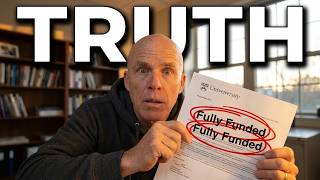
In this presentation Steve Tippins Ph.D., a veteran academic and founder of Beyond PhD Coaching, demystifies what “fully funded” actually means for doctoral students and outlines the financial realities they face. He explains that while tuition is typically covered, stipends are modest (median $28,000/year) and often insufficient to cover living costs, especially in high‑cost areas. Tippins breaks down stipend variability across disciplines, the hidden workload behind research/teaching assistantships, and the impact of taxes, health insurance, and payment schedules. He surveys alternative income sources—scholarships, student loans, consulting, summer grants, and faculty side projects—while warning against risky strategies like relying on credit‑card debt. He discusses practical considerations such as graduate housing, pet policies, inflation, and institutional restrictions on outside work. Finally, he offers a checklist for evaluating PhD offers, emphasizing program fit, funding length, cost‑of‑living, insurance, tax environment, advisor alignment, and strategies to finish faster to reduce financial burden. Throughout, he encourages prospective students to scrutinize offers, plan financially, and join his free dissertation support community.
Chapters
I want to talk about funding in doctoral programs. The cruel fact is that most doctoral students, if they're just living on their stipend from their university, are probably living below the poverty level. My name is Steve Tippins. I've worked on over 300 dissertation committees, been in academia for 35 years, and founded Beyond PhD Coaching to help people like you finish their dissertation. Today I want to pull back the curtain and talk about funding in doctoral programs and stipends and how you make ends meet to be able to finish your program. So what does fully funded really mean? Universities can put out material saying our doctoral students are fully funded. And that sounds really good, but let's really see what it means at a traditional university, not a distance learning entity, but at traditional universities with on campus doctoral students, many of them are fully funded. What that means is tuition is paid, hopefully and you get some sort of stipend. Now first, getting tuition paid is a big deal and it's great, but you can't eat paid tuition. So what's the stipend? What are stipends like? Because that's what you're going to live on while you're a doctoral student. You know, I love academia because of the freedom and hours. And what they said was you get to work 18 hours a day. You just get to choose which 18 hours you want to work. So you're going to be working hard and you're going to be working long hours in a doctoral program as a full time student. What does a stipend look like? According to the NSF, 82% of full time doctoral students are fully funded and get a stipend. And that stipend, the median is. Are you ready? $28,000. Now let's break that out. That's $28,000 a year, meaning just over $2,300 a month before taxes. 2,300 do dollars a month does not mean financially comfortable, does not mean independent wealth. It means you get something. But now we really have to think about does that $2,300 plus go far enough to allow you to continue with your studies. So in different disciplines, the stipends can be higher, bioengineering, things like that. You could be making $40,000 a year. However, history, you might be getting 18,000, maybe $20,000 a year. So it's really helpful to understand what you're getting yourself into financially if you break these stipends down per hour, because many institutions will say, oh, we're going to give you a stipend and you're going to work 10 hours a week. 10 hours a week is ideal for you. That's, you know, 40 hours in a month. Let's break 40 into $2,000 a month. That's $50 an hour. But you really are going to be working more than 10 hours, it turns out, normally. And if they say you're going to get $2,000 a month, but you're going to teach a course or two, you're going to be working more hours to be grading and preparing and doing your lectures. So you can't think of it as, oh, I've got 10 hours a week and I'll study. And then I got all this other time that I'm going to work out or have other jobs or things like that. So understanding reality is very important. If you're in the position of choosing between doctoral programs and trying to determine, you know, the financial impact them, as well as other ideas about them, join our free dissertation help group and we can help you consider ideas and what you want to think about moving forward. And just click the link below to join. So can you live on a PhD stipend? Well, the first thing you want to look at, am I looking at, oh, $25,000 a year in New York City or San Francisco, or am I looking at $25,000 a year in Little Rock, Arkansas? And we all know $25,000 a year in New York or San Francisco or other major metropolitan areas in the US isn't going to go as far as $25,000 in Little Rock is. So if I'm going to go to a doctoral program in New York and I'm going to get paid $25,000 a year, and, you know, rent is, I don't know, $2,500 a month. You don't have to be a math major to understand $2,500 a month times 10 is 25,000. So 10 months of rent is more than my gross stipend for a whole year. So financially, the stipend may not support you in certain places. Now, that assumes you have to pay ongoing rent rates. Many universities have graduate student housing. It's not luxury housing. You're not going pool and a cabana boy and all kinds of things like that. But it's a roof and it's a bedroom or two. Many students share, get two students to go in. Graduate student housing typically is not free, but it's a lot less expensive than ongoing rates at apartment complexes or houses that you rent in the area. But again, you're not going to be Living in luxury. But the goal of a doctoral program is not to live in luxury, it's to get the degree and move forward. So what you want to look at is how much money am I making now? What's that going to break down monthly for me, and what are my costs going to be? I had a friend in graduate school, and we were making huge stipends 100 years ago, and it was maybe $11,000 a year, $12,000 a year was our stipend, and he couldn't make ends meet on that. So what his goal was or what he did in order to to get by was he had six or seven credit cards and he just started piling up his credit card debt. And his philosophy was, look, if I make it, I'm going to have a good salary and I'll pay these off. And if I don't make it, well, I'm going to be digging ditches and I'll declare bankruptcy. So he actually made it. But there's a lot of time and effort and money that goes into this. While this individual graduated and got a good job and was able to pay off his debt, I wouldn't recommend his approach because, you know, credit card debt is some of the highest legal interest rates you can be charged. So if you're living off of credit card debt and paying 24 to 28% interest on this money, it's a pretty expensive way to get money. Now, that said, how do you get money in a doctoral program? Well, stipends to be a research assistant or teach. So those are two ways that that are there. There's also scholarships. You should be looking into scholarships. See what your university offers or what outside of the university offers. I once heard about a scholarship for a bagpipe player. Someone had endowed money to make sure that someone who played the bagpipes could go to school at a certain school. Now, there may not be bagpipe scholarships for your doctoral program, but there may be scholarships for returning women in accounting or people over 45 going after degrees or people under 27 going for degrees. You want to explore every possibility for scholarships. There's also student loans. Student loans are a way many, many, many, many people make it through graduate school because stipends just don't provide everything. Student loans are great. You can get good amount of money. It can help you buy your books or pay for your rent and pay any tuition extra you might need and live and eat and do all those things you might want to do every once in a while, but you got to pay them back. You don't pay them back while you're in school, but once you've been out six months, they start to come back and you have to pay them. And there's been all kinds of controversy as of late as to whether student loans should be eliminated or let go of your student loans. Just assume right now, if you take a student loan, you're going to have to pay it and you're going to have to pay it a long time. Declaring bankruptcy is an incredibly difficult route to get out of student loans. I have a friend who, for a lot of reasons, accumulated hundreds of thousands of dollars of student loans and was planning on declaring bankruptcy to try to get out of his student loans. Then years ago, they got rid of the said, look, no, you can't declare bankruptcy to get out of student loans. So he's had a long process. There's basically two ways out of student loans. Pay them off or die. Those are the two approaches. There are some careers you go into where they'll start to pay down your student loans or up, or they'll be eliminated faster. But ultimately it's pay them off either with money or service. Just be aware of that. Another way to come up with funds while you're in a doctoral program, I found, is consulting or projects of some kind. Getting to know your faculty members can be a great way to find this because they may be offered opportunities which they say, well, I can't afford to do that, or I don't have time to do that one. You know, why don't you take this on? And it could be something that only pays a few thousand dollars, but to you, a few thousand dollars may be huge amounts of money. So being open to opportunities now, that said, please don't follow money too much to the point where you're not able to actually do your work and it slows you down. Don't say, oh, I'll take on this project and I'll do this project and I'll do this project. But now you're not doing your schoolwork and you're spending more time in school and it's costing you more money. So you have to come up with a balance. Being able to eat, but also being able to complete. And I like how that rhymed. When I was in graduate school, there was a professor who was full professor and not putting in a lot of time, and he just wanted someone to grade his exams and do his grade book and all this other stuff, and he had a lot of money and he said to me, hey, would you do this and for me, it was great. I could come in an hour or two a week and do all of his stuff. And each month I got a check that allowed me to eat and do some other things. So there's lots of different opportunities out there, if you're just aware. I will also say I was offered one summer a grant opportunity to write something, and it was going to pay a bunch of money for me at that time. And I thought, this is wonderful, I'll do it. And I got offered another one and I thought, maybe I can do this because I'll make a lot of money this summer and I'll be able to. And then I eventually realized, you know, yeah, and I'll be here another year. So I actually turned to the person I was sharing my office with and said, I can't do this. Do you have time this summer to do it? And he did, and it allowed him to eat and do things. So it was great to have friends to be able to share opportunities with as well. Now, as in any job offer, any salary, you can be told, hey, you're making $100,000 or you're making $25,000. Now, we all know that $25,000 isn't what you're taking home. You want to understand, okay, is there going to be income tax on this? Is there a state income tax? There are some states where there's no state income tax. And that may make an offer look better after you consider things like, what is my take home pay going to be? Is there going to be health insurance costs in this? You know, what is rent in the area? So in addition to taxes, what are typical rents in an area? It's relatively simple now to get online and figure out what people are paying in rent in a local area, or to be writing to people or to contact a university and say, okay, what are students paying in rent? What options are out there for people? Because many schools have an office or an area where they're collecting information on that for students. I have yet to to hear about someone who went into a doctoral program and was there one year. So you're going to be in a doctoral program for three or four years, let's say. And there's something out in the real world called inflation. Prices go up. Don't expect stipends to go up at the same rate or even at all. In some cases, they may even go down if there's financial issues at the institution. So just be aware that prices may go up, but your compensation from the university, your fully funded doctoral Program is not going to be providing you more income. And just as an aside, yes, it is fully funded. There is tuition and there is income. But fully funded doesn't mean fully living, fully eating, things like that. Look at these things before you make decisions. Another thing to consider and to ask is, okay, I'm going to make my $25,000. How is it paid out? Oh, it's paid out during the two semesters where we have school. And you think, great, I'm going to get paid during when there's school. But you know what that means. It's not paid out in the summer. And in fact, there are some states where they cannot pay you if you're not working or in school. So be aware there can be gaps in the summer where you're not getting paid even though you may be in class. Your health insurance typically will continue then, but your income may not. Also, when do the stipends start being paid? You may have to show up at school in mid August. Well, that means if you're renting an apartment, you're probably renting starting at the beginning of August, and your stipend may get paid at the end the day of of September. Well, Now I've paid 2 months rent before I get any stipend in, so it's good to know about these things so you can prepare in advance. Oh, I'm going to be entering a doctoral program in 10 months. I better start saving up some money so I can pay that first and last month's rent and then the first month after that before the stipend even starts. I, I have to move to wherever I'm moving to. What's that going to cost? And if I am going to go into student housing, can I bring my cat, Mr. Foo Foo with me many times? Student housing won't allow pets, which then precludes you from being there. Unless Mr. Foo Foo wants to go on vacation with your parents for four years. While you can't outwork a low stipend, you might be able to outwork. Think it by doing things like hanging around with the faculty members, seeing what they don't want to do, that you might be able to do, looking for opportunities. But I talked to someone recently and their university would not let them do any other work than what their stipend, what they're being paid for. So they had to actually ask and petition their university to go into an opportunity and get permission. Permission to do so. They were able to do it, but be aware that they may limit your ability to do other Work. You're in a doctoral program, you're working along fine. And now it comes to the point of, hey, you've done this research. You should go to this conference and present your findings and get to know people in the field. And you're all excited and this is fantastic. And it's a $600 flight and it's. You'll get cheap doctoral student admission. $25 into the conference, and you're going to have four days there, and it's $400 minimum to have a hotel. And now I've got to have clothes that are maybe different than I go to class in. Where am I going to come up with the thousand to $1,500 to go to one of these conferences? Find out if your university has grants. Find out if your department has money for things like this. Many do. But you may have to ask because on $25,000 taking home $1,800 a month, it's going to be really hard to pay to go to this conference, which is needed to help you move forward in your academic career. And while side hustles are great and understanding ways to make more income are great, maybe you can enter Mr. Foo Foo and a Cat Beauty show and win $800. Or how about finishing faster? The faster you finish, the lower the tuition burden, the faster you're back out into the market as a real person making real money. So when you get an offer from a university, what should you be considering first? Is it a program you want to be in? Is the program going to help you move forward with your goals and with your interests? Is there funding? How much funding and how long? Talk to people relatively frequently saying, I'm in year X and my funding runs out in nine months, so I have to finish. And they knew that at the beginning, but they didn't really think about it. So find out how long the funding lasts. What's the cost of living where you're going? You know, what are rents? Like, what are food costs? What are you doing utility costs? It may be lower utility costs in certain areas. And, you know, 15, $20 a month can be a big difference when you're on very limited income. How about health insurance? Are you going to get it? How much is it? University provided health insurance is usually really good and it's typically relatively inexpensive, again, relative to what you can get out in the real world. So look at those options for health insurance. Are you going to have an advisor chair who has interests similar to yours and can help your career move forward? How about state and local income taxes. How about sales taxes? How do the states raise their money? And how do you pay to help the state raise their money? If there's no income tax, there might be a sales tax or there are some places where sales taxes are relatively high and there's an income tax. So be aware of all of those things that are going to, you know, impact your take home pay. Getting accepted to a doctoral program is a great feeling. Being told that you're going to be fully funded is fantastic. It can eliminate some financial concerns. Oh, I don't have to pay that tuition. That's great. And they're going to pay me. That's wonderful. But how wonderful is it? Really look into things before you just say fantastic. I'm jumping, I'm going. And all of what we've been talking about is pretty much assuming it's just you and maybe Mr. Foo Foo. What if you're married? What if you have kids? You really have to be thinking about things like this if you're looking for help evaluating PhD programs, thinking about funding, finishing things like a dissertation. Join our free dissertation help community and we'll provide as much support as possible. Just click the link below and come on in.










