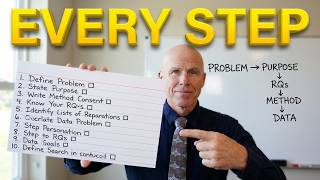
In this instructional monologue, Dr. Steve Tippins, Ph.D., draws on his experience serving on over 300 dissertation committees to guide viewers through the essential components of Chapter 3 (Methodology) of a dissertation. He emphasizes that a well‑structured methodology is the foundation for a smooth defense and faster completion. The talk proceeds step‑by‑step: restating the study’s purpose and ensuring alignment with research questions; selecting and justifying a research design (qualitative vs. quantitative) by contrasting approaches; formulating clear research questions and, where appropriate, hypotheses; defining the target population and sample, highlighting the importance of a GPower power analysis to justify minimum sample size; planning data‑collection procedures and confirming access to participants (including protected groups); choosing or validating measurement instruments; addressing IRB ethical considerations, data‑handling, and realistic timelines; outlining a pre‑planned data‑analysis strategy and checking statistical assumptions ahead of time; and finally summarizing the chapter and providing a transition to Chapter 4. Throughout, Dr. Tippins intersperses practical tips, common pitfalls, and resources (e.g., Qualitative.io, SurveyMonkey, Qualtrics) and repeatedly invites viewers to join his free dissertation‑help community for additional support.
Chapters
Chapter 3, some people consider the foundation of your dissertation. It's the methodology you're going to use to answer your questions. Get this right, everything else follows. If you don't take the time to set it up right in the beginning, you got a lot of struggles and adapting you have to make later on. I'm Dr. Steve Tippins, Ph.D. I've served on over 300 dissertation committees and helped hundreds of people make it to the end of their dissertation. I'm going to go through some sections of Chapter 3 talk about what's supposed to be there and maybe some challenges people face. So, as is the case with almost every chapter, we start with an introduction restating what's the purpose of my study and possibly restating what are my research questions or question. If your purpose and your research questions are not in alignment, they'll show up here again. So that's why alignment is a big thing, and we want to make sure it's the case that you are in alignment, that your research questions will allow you to get to your purpose and your problem. One thing that can cause people issues is when they vaguely say, "Well, I'm going to do a case study type thing, maybe." You want to be firm with what you're stating and then back that up as you move forward. This moves into research design, which is where you say, "I'm going to do a qualitative phenomenological study," or "I'm going to do a quantitative correlational study. You get to state what study or type of design you're going to use that will allow you to answer your research questions, and then you're going to explain this. Now, one of the ways I've seen that really works well is some people— let's say they're going to do a qualitative study— they start by saying quantitative approaches include, and they discuss quantitative, and then explain why quantitative approaches will not allow them to answer their questions. Then they move into qualitative, showing, oh, here's qualitative and here are the approaches. And this qualitative approach that I've chosen allows me to answer my questions because, and it may seem like overkill, but it really shows your committee that you understand methodology and you understand why you have chosen what you've chosen. And why it's appropriate, and they are much more likely to approve when that's the case. When you don't do things like that, that's when, oh wow, it doesn't look like your methodology matches your research questions. But if you have shown and explained it, you're all set. And if you're looking for help, click the link below to join our free dissertation help community. In the community, you'll get access to all of our assets that have been created, as well as free events and interactions with dissertation chairs who've served on hundreds of dissertations. All of this is designed to help you finish faster. The next section after we do this is typically research questions or question where you're saying this is the question or questions that I am going to be going about with my research and hypotheses if needed. Typically no hypotheses in a qualitative study, but there are in quantitative studies. Where you see problems is research questions that don't actually allow you to answer your problem and purpose. This should come up a lot earlier in the process, but boy, when your committee sees it here, they're going to say, hey, you can't do this. It will not allow you to get to what you're looking at. So you want to make sure And like I said at the beginning, take the time to set this up properly so that you're not months down the line with data collected that doesn't allow you to answer questions. I've seen people come in a qualitative study where they're saying, I'm going to interview 10 people, and they'll have 9 research questions. That's too many questions. You're not going to get enough information from 10 people to be able to answer 9 questions. So pare it down to where your data collection, the data you'll be able to gather, is going to be sufficient to answer the questions that you're asking. One area where some issues can come up is the population and the sample. Some people skip right to the sample. You want to say, this is the population from which I'm going to draw participants. Now, every once in a while, I maybe 3 times in doing all of this, I've seen someone who has access to the entire population. If you have access to the entire population and you're doing a quantitative study, there are no statistics you get to run because statistics are so that we can try to extrapolate from the sample to the entire population. When I have the entire population, I can calculate the mean, the mode, things like that, and I'm pretty much done. There's no regression or ANOVA or anything like that. So you want to make sure you've defined your population and then explained what your target sample is going to be. One of the times I was working with someone, they defined their population as I think it was all of the teachers in a certain school system, and they in fact were able to get responses from— they sampled and got responses from every teacher in the school system. No statistics are needed. It, I mean, it's great information, but it caused some issues in doing their dissertation. There was a workaround that we were able to help them with, but you want to make sure you have a sample that is part of your population and also an appropriately sized sample. You're going to do for quantitative work, most likely a G*Power test, which using all the parameters that you input will tell you, oh, you need a sample size of, and it'll tell you the minimum sample size you need in order to be able to have results that can be generalized to the population. If you eliminate the G*Power test or just don't do it, then you don't have the proper justification That's every once in a while we see that. Once I saw somebody, you know, trying to collect data from a group that really they hadn't defined as part of their group. And this can be an issue if you haven't thought about access to data. Because let's say you're again, qualitatively or quantitatively, let's use qualitative. You said you were going to get 12 respondents from a targeted sample size, sample group, and you got 7, but then you were able to find 5 more people from a tangentially related group, well, you've missed your target. So you then have to renegotiate not only with your committee, but you may even have to go back to the IRB. So that's why it's important to be thinking of things early and ahead of time so that you don't have problems after the fact. This gets us to data collection. One of the first questions I ask people, do you know you have access to this data? Invariably, people say yes without even thinking about it. And then I typically probe more. What type of data are you going to be collecting? Are you collecting from a protected group? Frequently, you'll find people who want to do some sort of study on members of the military and aren't quite aware how difficult it is to get permission to use members of the military in their study. So getting adequate data and data that is appropriate for your study is incredibly important. You're going to outline your collection procedures in Chapter 3. I'm going to access people through this LinkedIn group, and I'm going to send them an email, and it's every single step you want to do. I equate it to a recipe. When you're doing a recipe to make something, if you bake a cake or whatever, it's going to say add flour at this point, add sugar, or add oil or eggs, whatever, at each step. You're going to do that with your study. And it may seem, you know, oh God, this is hard, or this is ridiculous. Think about the fact that someone might want to replicate your study. And if you don't tell them exactly what you did, it's going to be very hard for them to replicate it. If they don't tell you to put eggs in the cake, it's going to be very hard for you to come up with a cake that's correct. So make sure you put every step in that you're going to use. And typically your IRB is going to be on top of that to make make sure, but if you're ahead of time, you do that before you submit things to the IRB, you just save time back and forth with your IRB. One of the things an IRB, and typically not part of your dissertation, but your committee will ask for is a timeline. Okay, when are you going to do this? How long are you going to do this? It's typical for people to be a little less than reasonable here, saying, oh, I'm going to collect all my data, I'm going to contact people next Thursday, "By the following Thursday, I'll have all the data collected, and I only need 192 responses. That'll be no problem," or, "I only need to interview 12 people." Getting 192 responses and/or interviewing 12 people and have it all done in a week is difficult. Okay, to find 12 people, get them on your schedule and their schedules to match up, and then interview everybody, that can be exceedingly difficult. I'll take a break here to just say there are sources that can help you collect data. Qualitative.io is one I'm familiar with on the qualitative side that, for a fee, can help you if they have access to the people you're looking for, do the interviews, which can speed things up. SurveyMonkey and Qualtrics on the quantitative side, for fees, are available if they have access to the group you're looking at to go out and do this, collect the data for you. This is— most committees will accept that as fine. They're not doing the analysis or anything else for you. They're just a conduit for you to get people to respond to the instruments that you're using. Now, speaking of instruments, many people in quantitative studies will send out a survey to people with a Likert scale or something like that. Your committee is going to say, is this a validated survey? Has it been used before? Does it actually answer the questions it says it's going to answer? So that's why it's much easier to find an existing survey in place that's already been approved, already been used, that your committee will accept instead of you saying, "No, I just invented this survey." Then they may make you go validate your survey, which can take more time. I've mentioned the IRB as part of Chapter 3. Ethical considerations are there. How are participants treated? How is their treated? How long is it going to be held on to? How are you going to dispose of data? I see people say, "I'll hold the data for 2 years," and then the IRB is going to come back and say, "And then what?" "Well, I'm going to dispose of it." "How are you going to dispose of it?" This is part of the every single step. It needs to be part of your entire methodology in Chapter 3. Once you collect data, how are you going to analyze the data? I have seen a number of cases where people did this years ago and said, "This is how I'll analyze the data," and then they got results and the data didn't match the tests they said they were going to use. When they started to say, okay, I'm going to use this test and it requires normally distributed data, and they looked at their data and it wasn't normally distributed. So they didn't think about this ahead of time. Then you then have to go back and dig and find appropriate tests for the data you have. It's a lot less stressful if you do this the front end. As an aside, I was one of those people. I collected all my data and got it all in and realized, wow, the test I said I was going to use wasn't appropriate. So I had to spend a week trying to find out the right test to get me, you know, to get the results. And unfortunately, that week delayed me to the point where I had a committee member going out of the country for the summer, and I missed him by about 6 days. Otherwise, I could have defended early. Then I had to wait for him to come back, and I had to wait to everything to get done, and it delayed my defense by about 3 and a half months. So being prepared early is really important. And just as a further to that study, I had taken a job at a university, and they said, here's your salary, but we're reducing it by several thousand dollars until you finish. So I lost out maybe $1,000 of income because I hadn't planned ahead on my methodology to know what the right test was going to be, so that then delayed it, and then the dominoes all kicked in. And I eventually passed, got my salary bumped back to where it should be, but it was from that date forward. So not only did it delay me, it cost me money as well. You're also going to end Chapter 3 with some sort of summary. Here's what we're going to do. Here's how I'm going to do it. And then have a transition to Chapter 4. Transitions to the next chapter seem to be the place that people leave out over time. And that's in just about every chapter. So make sure you have the transition there and make sure you remember Chapter 3 is a recipe. And that's going to help you understand you have to have every single step put in place and in line so that your committee and your IRB can be satisfied that you're ready to move forward. If you're looking for help with your methodology or any other part of your dissertation, click the link below and join our free dissertation help community. And good luck.