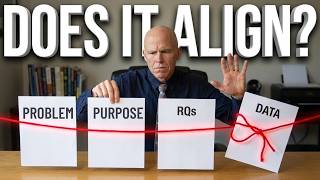
Chapter 4 derails dissertations when your problem statement, research questions, and data collection don't align. Practice your analysis software with fake data first, break the work into small pieces, and study how your chair's approved dissertations present results. This catches design gaps before real data arrives.
Chapters
Today I want to talk briefly about Chapter 4 and some of the questions we get about Chapter 4. Before I get to that, in my mind, Chapter 4 is probably the easiest chapter that you're going to write in your dissertation. Because in Chapter 3, you laid out what you're going to do, and in Chapter 4, you're reporting your results. Here are the themes I found, and here are the respondents who had quotes that match that theme. Or here, this variable, p-value is 0.04, significant or not significant. That one would probably be significant. And, you know, here's these other variables. It's not really talking about what they mean, but it's reporting. And Chapter 4 can range in page length dramatically because of the fact that many times there's charts and graphs, statistical tables that get put there to help the reader understand what you're doing. So I've seen chapter 4s as short as maybe 20 pages and as long as maybe 60 pages with follow-up material in an appendix. So just be aware though, you're reporting. So that's why I think chapter 4 can be the easiest. One of the things that can happen though, if you haven't done a good job at the beginning of aligning your problem, purpose, research questions, and then when you get to chapter 3 and your data sources, if that has not been done well, sometimes you get results that do not answer your research questions. This can be a big deal, which is why we spend a lot of time working with people on the beginning part of this process. Because when you get the results and if they don't answer your questions, then you've got some talking to do with your committee. It is technically not right to go back and change your research questions. I've seen it done, but it's technically, in the pure sense, I've got questions, oh, this data didn't answer those questions, I need new data, and I need to collect it in a different way, possibly, so that I can get to answer those research questions. But you're going to avoid that if you're thinking about this ahead of time. And one way that can help, if you're doing a qualitative study and you're going to be doing, using a software, NVivo, Dedoose, whatever, or if you're doing a quantitative study and you're going to be using SPSS or Stata or something like that, many, many, many times I recommend to people, when you have downtime, make up some data. And I don't mean that for your study, but just look at your collection technique and make up data 2 or 3 that, you know, if it's a survey, make up a bunch of survey answers, or if it's a questionnaire, make up a bunch of questionnaire answers that match what you're asking, and then plug that into the analysis tool you're using. And the reason I say that is these tools all have their own rules and techniques, so you've got to learn how to use them and get comfortable with them. If you can get comfortable with them with data that doesn't have any meaning, it's a lot easier because there's no pressure. So when you get real data, then you're going to be able to move forward much faster. But it's also going to help you determine, wow, the data I'm getting here isn't allowing me to answer these questions. So again, preparation, thinking about things ahead of time really helps you get— avoid this problem. It's easy to feel overwhelmed when you get all this data. I've got all this qualitative data. I've got all this quantitative data. Go back to Chapter 3. What did I say I was going to do? And then break it down into little pieces. And just like I said before, if you have taken that software you're gonna use and done trial runs with data that's not meaningful for your study, when you get the real data, you're not gonna have that statistic or software package anxiety that may come about with using a new piece of software. This is something you're already familiar with, so you can avoid other anxiety with doing this. And typically, I'm going to say also break things down in pieces. Do a little bit and do a little bit more. It will add up to completion. The other major question we get is, well, how do I present my results, or how do I present my results clearly? You know, one of the go-to answers on a lot of this is go to a dissertation that your chair has approved recently using a similar methodology. It's gonna be, you know, obviously different, but it will show they like these charts or they've accepted these charts or these tables so that you can be ready to start answering, you know, or providing, I guess is the better term, to your committee what they're going to need. And if you're thinking about how I'm gonna present things, go back to chapter 3. What did I say I was gonna do? Go back to your research questions. Do I provide enough information here so that in chapter 5 I can do a discussion and talk about meeting my research questions. In closing on this Chapter 4, reporting your results, being prepared to report your results, being prepared ahead of time, knowing that the data that's going to come in is going to allow you to do what you said you were going to do, because it's pretty, um, panic-inducing if you get data and you don't know how to analyze it or you don't know how it's going to answer your questions after the fact. You've invested a whole bunch of time and maybe even money. Think about this ahead ahead of time. Now, that said, I want to wish everybody a beautiful day and drop in tomorrow if you can. Take care.