The Word That Gets Your Chapter 3 Rejected (2026)
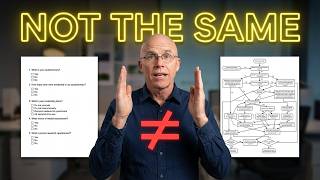
Dr. Steve Tippins explains why dissertation committees reject Chapter 3: students confuse survey (the method) with questionnaire (the tool). He breaks down what each term covers, why the distinction matters, and how to document your methods so another researcher could replicate your study.
Chapters
Survey versus questionnaire. What really is the difference? I see people tripped up on this frequently by saying, "Well, I'm going to do a questionnaire," or, "I'm going to do a survey," and not differentiating or explaining exactly what they mean by each term. And one of the things you find in this dissertation journey is being exact with your meanings and exacting with your words is something your committee is looking for. In other words, specificity is important. I'm Dr. Steve Steve Tippins Ph.D. and I've been an academic for well over 30 years. I've served on over 300 dissertation committees and I've helped hundreds of people reach the finish line in their dissertation. I'm here now to try to help you understand the difference between surveys and questionnaires. One of the reasons why committees or committee members have comments or even reject documents is not because the student isn't intelligent. It's not because they haven't done a good job. It's because they haven't explained things well. They haven't been specific with their wordings and their definitions. And if you can learn to do this early, you're going to save a lot of time going back and forth with committee members about becoming specific in your wording and how you're using words. One of the places where this happens is when students interchangeably use the words survey and questionnaire. This means the instrument and the method are being blurred or confused. When this happens, your committee can't tell what tool you used, which is the questionnaire, or what method you used, which is the survey, or ultimately how data was collected and analyzed. So even if you've got a fantastic study and you did a great job in it, if the wording gets confused, your committee can't understand it or can't fully appreciate what you've done. This is a reason why it's really important to be specific and know and explain a survey is a survey and a questionnaire is a questionnaire, so that they know you understand the difference. And a lot of a dissertation and a lot of questions you get are to help the committee understand what you know. If you help them with that understanding earlier, you move forward faster. So how do I differentiate between a survey and a questionnaire? If you're looking for help, join our free dissertation help community. You'll get our 5-step dissertation acceptance framework, real support from veteran committee chairs, live calls and Q&A sessions to start your journey. You don't have to do this alone. Just click the link below to join thousands of dissertation students who decided to stop being stuck. First thing I want to look at: are we trying to explain a tool or a process? A questionnaire is an instrument or a tool. The survey is the process, and that process can include sampling, distributing the questionnaires, collecting responses, analyzing responses. But the questionnaire is the instrument used to gather information. Your committee wants you to explain both of them clearly. So when I'm talking about a survey, which is the process, what are some risks that I face and need to talk about and explain in my document? Who had access to the survey? Who responded? What people or types of people or respondents didn't participate? Questionnaire-level risks become, "Was the wording ambiguous? Were the questions biased?" And we're in a continual election cycle in this country now, so we constantly get biased questions because political campaigns want to report that 92% of people agree with whatever the candidate is saying, because we get asked questions in a way that give us the answer answers they want. You don't want questions like that in pure research. We want to know the actual answer, not questions, answers that are programmed ahead of time. Have I used poor measurements or constructs as part of my questionnaire? Keep your survey design and your questionnaires separate in your mind, but also in what you're writing about, and you'll have a lot fewer problems. When we're doing a study, one of the things your committee wants to know is, can your study be replicated?. So much of that starts with the process or the survey. Can another researcher go through and do a similar process to evaluate what's going on? And these are done frequently. And many times we replicate studies and then try them with slightly different populations. Or I can replicate a study and use a different questionnaire that's designed to go after the same type of answer. So the the more material I have, the broader I've done this, the more often it's been done, the more we add little bits of information to the pile of knowledge and the more we think we understand a topic. When you're using questionnaires, one of the things you're going to get from your committee is, is this a valid instrument? Has it been shown to measure what it's measuring or what it's purported to measure? Meaning, has it been through testing to determine does this actually measure this? You're going to be be much better off if there's an instrument that already exists for your questionnaire that has been validated. That can answer a lot of questions for your committee. If you're making up questions on your own, even if they're based upon literature, you may have to pretest them to validate them, which takes more time. So if there is an instrument that's already validated, I can recommend using that if you're interested in moving forward quickly. A survey can answer things like who and how many. A questionnaire looks at how something is measured. A good dissertation understands that they are related, but they are distinctly different. By understanding the differences and reporting on each of them correctly, clarity comes to the forefront, and your committee members are happier and more likely to approve what you've done. After years of serving on committees, some of the things I have seen people people do is say, "I'm going to do a survey," and talk about the survey nicely, but never explain how they're actually going to gather the data, what the questionnaire is, or what the questions are that are going to be asked. Another thing that can happen in qualitative studies is, "Yep, I've got these research questions," and they think they're all set because they've got research questions. But in a qualitative study, you also need interview questions, and that's not the research question. Those are the things you're going to ask people to get data to come up with themes so that you can then get to and answer your research questions. So where people fall down in this process, quite frankly, becomes specificity. Are they explaining every step so that their committee or your mother Can understand what was done. The other measure is, can it be replicated? Can someone else replicate it? Which is why many times I like to think of people when they're looking at Chapter 3 as a recipe. Have you explained every single step in the process? Because if you've ever used a recipe to cook something and get to the end and the list of ingredients said 4 eggs and you get to the end, you followed every step and you still have 4 eggs. Where are these eggs from? What am I supposed to do with them? And you're not told, that's incredibly confusing. You don't want your committee left holding 4 eggs. Ultimately, good strong research doesn't have to be complicated, but it does have to be precise. When you are clear about your methods and clear in your writing, your committee understands that you understand. And what that leads to is them approving and letting you move forward and graduate and change the world.










