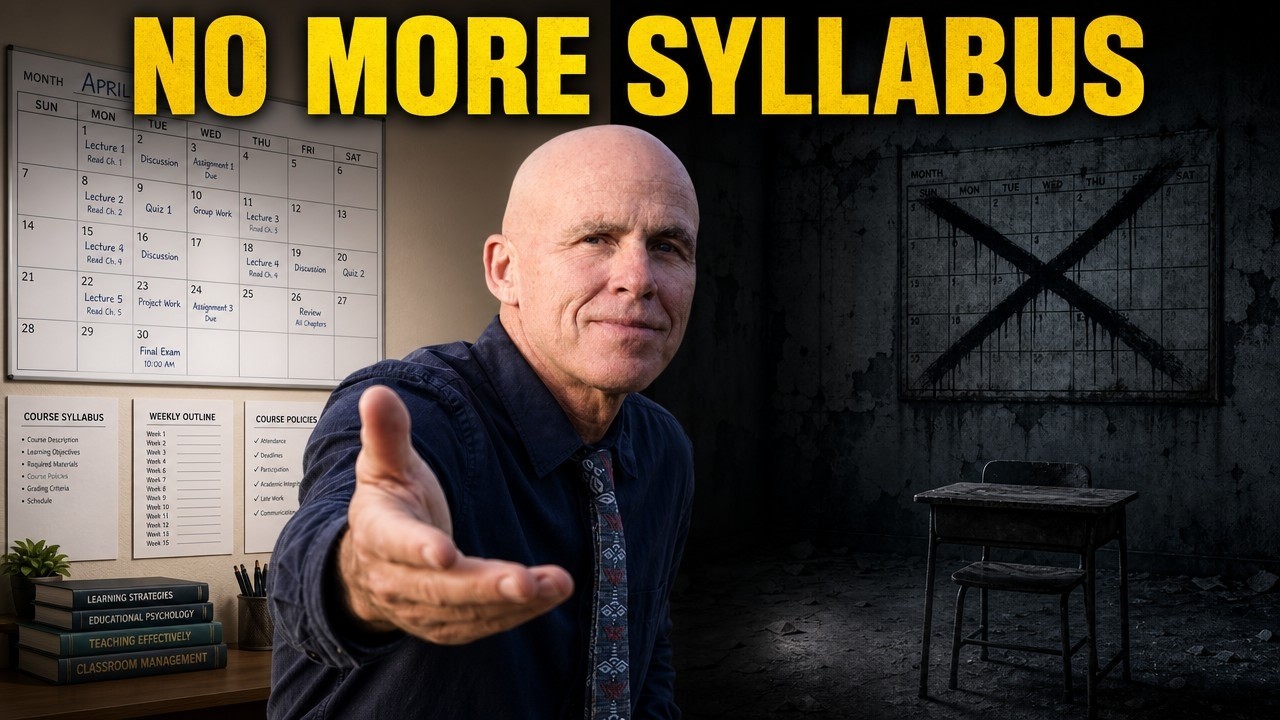
Dr. Steve Tippins, who has served on over 300 dissertation committees, explains why students stall after coursework ends: the shift from structured classes to unstructured dissertation work removes syllabi, deadlines, faculty check-ins, and peer support. He recommends creating your own syllabus, finding writing partners, and tracking institutional deadlines to stay on track.
Chapters
When your coursework ends, the rules change overnight. No more syllabus. No more due dates. No more classroom check-ins with your professors. Faculty stops following up with you. And suddenly, all of the progress in your dissertation is up to you. This is where many students stall, and a number don't recover from it. I'm Dr. Steve Tippins, Ph.D. I've been in academia for 35 years, and I've served on over 300 dissertation committees. And I've helped hundreds more students graduate as a coach. And I've watched hundreds of people hit this exact wall. Today I'm going to show you what's coming and how to prepare for it. So the first thing we're going to talk about today that happens when you transition from coursework to dissertation work— there's no more syllabus. In every course you were taking, they'd start the term handing out or providing electronically the syllabus, which had what you're expected to do during the term, the due dates, what exactly should go into assignments, what the assignments are, which is great and can be comforting and something you can depend upon. But when you reach the dissertation phase, there is no syllabus. You just go create what you need to move forward, but there's no due dates. Anymore. And that's the second thing. In your dissertation journey, there are rarely due dates. Yes, you can talk with your committee and say, "I would like to have this done by a certain day," but many times that's just kind of a target, whereas in your classes there are specific due dates because grades are due at the end of a term. Without having a syllabus, without having due dates, it's really easy to to just say, "Well, I'll get to it." The third thing I want to point out is there's lots of freedom now. You don't have the due dates. You don't have to show up in class. You don't have to be doing homework. So you have a lot of freedom to go pursue your interest in your dissertation. And with lots of freedom, many people can basically do nothing because they don't have direction. They don't know what they're doing. So, you know, they just don't do much. Part of that lots of freedom is there's limited accountability. Because there aren't due dates, because there's not a syllabus, because you're not, you know, seeing your faculty member multiple times a week in many situations, there's little accountability. People checking in with you, how are you doing, what questions do you have, things like that. So you better be prepared for that. The next thing about the dissertation phase it's lonelier. It's just you. If you're in an on-campus program, there may be other people going through their dissertations, but not in the same phase you are. Or if you're in a distance learning and you've got a cohort or something like that, they're also at a different phase than you are, and they're working on a different project than you are. So this is— can be a much lonelier part of the journey, especially if you aren't having a lot of contact with your faculty members, with your chair, with your committee members. The final thing that's coming is because of all this freedom, because of all the things that are pretty much disappearing, you really need to read your student handbook, whatever they call it at your school. You really need to read it so you can know there really aren't due dates, but there are dates like your dissertation has to be turned in by a certain date if you want to graduate at a certain time. Or you can't defend your proposal and your final document, your final dissertation, in the same term, a condition at many schools. So you need to know what is coming, and it's rare that your faculty members, your committee, are going to know these things. It's up to you to know them. I talked to someone recently whose chair had no idea what this was, the dates or anything like that, and they hadn't checked into the dates. After we talked, they checked into the dates, and it turned out they're spending an extra term at school because the chair didn't know and they didn't know. So they missed the date. Now they're going for another term. Really, it could have been done earlier if the chair had known, if the student had known to think about that. Could have been done and graduated, but now it looks like another term for graduation. So with all of this coming, first, don't be scared, but be prepared. Know that, okay, I've got some freedom. And I don't perhaps handle freedom well. So set up accountability, set up partnerships with people, set up a roadmap to move forward, your own syllabus, or work with someone who can help you set up your own syllabus, because that structure can be incredibly helpful to move forward. It can also help reduce the loneliness by working with people who have gone through it or are going through it. Have a writing group. Reach out to create the system that you know is going away. So, create your own system that's going to work for you. And as always, if you have questions anywhere along the line, please click the link below and join our free dissertation help community.