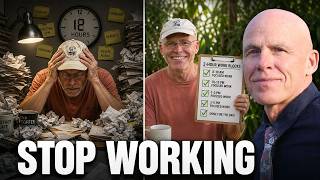
Dr. Steve Tippins explains why half of PhD students quit, pointing to burnout as the main culprit. He offers seven strategies: treat burnout like a physical injury that needs rest, prioritize sleep and breaks, let your mind wander, keep backup tasks ready, build community with other doctoral students, set boundaries against becoming your department's workhorse, and aim for a minimum viable dissertation instead of perfection.
Chapters
Hi, I'm Dr. Steve Tippins, Ph.D., and over my career, you know, I've seen that the statistics are true. About 50% of people who enter doctoral programs don't finish, and from what I've seen, many of them don't get there because of burnout. What I'm going to share with you today are my 7 favorite tips to help you avoid and/or recover from burnout. So the first thing is I want you to think of burnout as like a physical injury.. You just can't overpower a sprained or broken ankle. You just can't go out and run a marathon. So if you're burned out, just doing more work isn't going to do it for you. So you have to learn to stop and rest and take care of yourself, which moves us to the second point, and that is take care of yourself. Give yourself some space in this. It's not a 24-hour-a-day endeavor. You do have to sleep. There is this badge of honor in academia and places about how hard you're working, but really you also, to be able to work hard, you have to have like food and sleep and things like that. I just, as a story, I remember as an undergraduate there was a music school attached to my undergraduate school. There were all these music majors who were performance majors, and let's say they were playing the violin, and they would say, God, I spent 12 hours in the practice room today. And I just found that hard to believe that somebody could practice violin for 12 hours a day. So I spent some time not doing a study or anything, but I spent some time in the music school and would see all the practice rooms. And yes, they were diligent and they would go into the practice room and put their violin out and they'd start practicing and they might even practice for an hour or two, but then they'd put their violin down and walk around for an hour or so and talk to the other people who were practicing. And they'd come back and practice for a while, and then they'd put it down and go back out. So while, yes, they occupied a room for an hour or 12 hours, they weren't practicing for 12 hours, and they were taking breaks for their mental and physical health. The third point, and it's a variation on taking care of yourself, but it's okay to have space in your life. It's okay to have nothing planned, because what I have found, and many others as well, is when you have space, that's when the solutions pop up. That's when the ideas pop up. Working at it and working at it and working at it typically does not come up with the answers you're looking for. But giving your mind the time to just subconsciously process this will all of a sudden know, this is the way to go. So giving yourself some space can help you eliminate overworking. I've found, and this is the fourth point, is have alternatives to work on. By that I mean, if you only have one thing to work on, you can be stressed on it. But if, like, I can say, oh, well, I can work on some of Chapter 3, and when I run into a wall, I might be able to do some more literature searching. Or I've done some of my analysis, and maybe I can start preparing charts or graphs or have something else to work on. Because when I run into a wall, if that's the only thing, I have to keep going at that wall. And that's when burnout can happen more often., but having alternatives can allow you to do other things and allow you to feel like you're making progress, which then makes the first attempt you were working on easier to get through. The fifth point has to do with community. This is a long and many times lonely journey in a doctoral program. Having others in your community that are working on a doctorate, creating that somehow, can be very helpful because you can hear their stories, they can hear your stories, you can commiserate, and it makes feel a lot less daunting if you know, hey, there are other people going through it and they're making it through. So I know I can make it through. The sixth point I really like, and that's resign from the academic martyr club. It's— if you go into a department of a graduate program, there's always one or two doctoral students who are willing to take on everything. And I mean, oh, you need that course taught? Great, I'll sit in for you. Oh, someone needs to be on a committee? Great. You need a tour for someone who's coming to campus? Oh, you need— and they're always looking for approval in doing that and becoming a martyr, but their work comes last, and it's really easy to burn out if you're doing all of this for others. And eventually, when people do so much, then they can get resentful. So it's not your responsibility to make sure the department runs okay. It's not your responsibility that a class gets covered. Yes, every once in a while, great, but you can also have boundaries and barriers. And putting it in academic terms, it could be limitations and delimitations. You want to make sure that you are not the person who's making the department run, because they're not paying you for that. And the final thing that can help you with a burnout issue is what some people call the minimum viable product. And by that, I mean too many people get caught up in perfection. I gotta make this perfect. I gotta get this document perfect. Well, first of all, you don't know what perfect is because you don't make the decision. Your committee makes the decision. So I've long said good enough is good enough. Get it to your committee. Your goal is done. So if you can get something to them and it's— they say it's okay, great, move forward. You're not trying to make anything perfect. You want to pivot so you can— the minimum viable product means you're done, and done gets you the doctorate and gets you out to where you can change the world. And remember, very few people are going to read your document when it's finished, but you with a doctorate is what the goal is, and you with a doctorate is who can change the world. If you're ever looking for support anywhere along the line in your journey, click the link below to join our free dissertation help community.