3-13 "Lifewriting Hotseat" story analysis
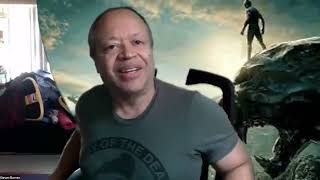
Steven Barnes, Tananarive Due, Tommy Barkley, and Nicole Scoggins analyze personal stories using the Hero's Journey framework, exploring how mortality and personal growth shape narrative structure in lifewriting.
Chapters
Great.
Interesting how Zoom has this set up so that it streams pretty efficiently directly to Facebook. What you do is, if you're streaming to your personal page, to a page that you're the admin of on, you start your webinar in Zoom. Then you make sure to check your audio and video. Then at the bottom of the screen where it says stuff like mute, stop video, security, participants, chat, share screen reactions, and apps, there's three dots and it says more. And if you click on the three dots, it says more, you'll be given the option to stream to Facebook, and apparently they have all of that handshaking done for you. So it used to be that you had to get a key and put it over here and do this, and that's not needed anymore. I mean, it makes sense because certainly Facebook is one of the primary destinations for something like Zoom. If you can stream from Zoom to Facebook Group, of course you can go directly in Facebook and just do a Facebook Live to a group. But I think that Zoom gives you some additional capabilities, perhaps since it's dedicated. You know, Facebook has some very, very powerful engines in it. But for people who are wanting to do seminars, lectures to a group, to be able to start a group on Facebook and either do a Facebook Live to them, or to do a Zoom group and be able to interact with people on Zoom, but also be able to interact with people on Facebook, all you have to do is put the two screens side by side. This should be. We should be getting people here in a couple minutes now. I told them to show up at least five minutes early, so that would be my estimation that we now are four minutes before things are going. I just checked in 10 minutes early, so I'm blathering here. So hopefully Tanan Reeve will show up in a minute. Ah, wait a minute. Nicole is entering the waiting room. Admit. Beep. Hello. Hello.
Hello.
Hi. You going to turn on your camera?
Oh, there we go.
Hi.
There you go. How are you?
I'm doing well. How are you?
I'm doing fine. I'm just kind of hanging out. I got here 10 minutes early because I had to go through some procedures to make sure I'm streaming to the Facebook Life writing group and stuff like that. And this is a little bit new. You know, the. The ability to stream to Facebook from Zoom is not something that I'd done before without an intermediate. There were a couple of, you know, a couple of services that did that. Very, very complicated. And it's now. Zoom has made it very easy. You know, if you ever If I already said how to do it. If you wanted to do it, you just open up your zoom webinar, and at the bottom of the screen, there are going to be. At the extreme right, they're gonna be three dots saying more. And you press on more. And it says, stream to Facebook. It's like, oh, okay. Boom. Oh, Tananarive due. There she is. There's. There she is. There's my baby. She's coming in. Where is she? There she is. There she is. That's great. That's great. So this is. Oh, boy. Our first one of the year.
Is this one of our authors?
Yes, it is. Nicole, meet Tananarive.
I'm fangirling. You can't see it because, you know, but underneath I'm like, ah.
Good to.
Meet you and good to read your story. Can't wait to talk about it.
Yep, yep, yep. So we're just gonna hang out here for a couple minutes, let people get in, you know, have some time to depressurize, then we'll kind of get into it. And it's very low key. Very low key.
Oh, yeah. Low pressure. Completely. No pressure for you.
No pressure. This is not an ambush in any way, shape, or form. And I do. I hate that crap. You can communicate any truth in a kind way. You know, there's no. There's nothing you need to be worried about in terms of your work. And if there were something to be worried about, it would be phrased to you kindly.
Actually, I like your story. So let's start with that.
There we go. So.
Makeup.
Not that I need for you to like it, but.
Oh, yeah, you need for me to like it.
I don't need for you to like it.
I've been in the hot seat. I know how important it is that at least people understand what we're trying to do, let's put it that way, with a somewhat experimental story, which this is, so I totally get what you're doing.
Yeah.
All right, well, I'm gonna turn my camera off. Well, no, I'm not. Only one more minute, actually.
Yeah, I am.
I'm gonna go grab something.
I'll be right back. Okay, no problem.
Am I off throughout the thing too, or.
No, we're gonna leave you on for the time being. We'll see. We're kind of. It will experiment a little bit, but I think it's all gonna be cool.
Going to mute myself for a second.
Okay.
Hunter.
Hi, Tom. Seeing Tom Barkley has shown up.
We'Ll.
Be getting started in a couple minutes. Just wanted to make sure that invites are out where they should be and that Tommy is in queue. So. Let me. I might need to make a phone call real here quick. It's like, what's going on?
Maybe it's a little nerve wracking.
Huh?
Might be a little nerve wracking.
Yeah, I can imagine it could be.
Especially such a personal. A personal essay.
Right, right, right, right. I would. I can understand that completely. Let me make sure. I've got. Let me make a call real quick to be absolutely certain that we are in business. I think we can afford to do that today.
Let me try to see if I can see it, if anybody's watching. On Facebook, on our Life writing page, 1200 members strong throughout the pandemic. We weren't really engaging with the Life Writing page as much as we could have. We're still in a pandemic, I should say, but now we're going to do a lot more. Yep, it's live. Hello, those of you who are here, skip Tom if you're still here. We'll be starting shortly. Thanks for jumping in. A new episode of the Life Writing Podcast should be live right now. I think daylight savings time kind of screwed up our provider platform. I kept saying noon. I kept saying one, I kept saying noon. So I published it manually. I don't know if it's actually shown up yet, but it's a conversation with Brian Fuller, which is why I'm bringing it. And it's such a good conversation that even though I was live with him while we interviewed him, when I was editing it, I just was hanging on every word because everything he said about writing and navigating gatekeepers and allyship. Such a good podcast. So after this hot seat, go to www.lifewritingpodcast.com and check it out or wherever you get your podcast. I'm trying to see if it's up on Apple right now. That's where I podcast is. Apple podcasts, These are not in any kind of order. Weirdly, why are the episodes so out of order? Okay, We're just checking on the second, the author of the second story. For those of you who have come in wondering, why is it so quiet here? I'm Tananarib Dill. This is Nicole Scoggins. She's one of the authors in the hot seat for being brave enough to submit her short story. And we have a second story called the Number. Right. Your story is called the Number. I'm going to ask you what that title refers to. That'll be one of My first questions. So that's the story. And then we have a second one that's more of a personal essay. Very personal essay about grappling with grief. So it's understandable that it's taking a little while for the second author to get.
Here we are.
Was it a daylight savings time thing?
Oh, I don't know, but it's all worked out great. Okay, so.
Okay, No fantasy here. Hey.
Ah, so we'll get going in just a minute. I'm heating up a little food for Jason. Tommy, are you gonna give us your camera?
I'm trying to do it. I. It's new. So try starting video right now. Is that going in? No, this is the one. You guys don't have a visual at all, right?
No, there's no. There's no visual.
I just installed it.
So you know, sometimes.
Sometimes your computer, you know, needs. You need to tell your computer which camera that you're using and stuff like that. We can work with just the audio. It's. It's not. No, no. Disaster.
Okay.
I can hear you perfectly fine, sweetheart.
Good. Thank you.
Yeah. So let me. Let me take some food out of the microwave for Jason and then I'll be right here and we'll get started.
Okay? Tell Jason hi from us.
I have to look up to say hi. I have to look up to say anything to Jason.
Camera access is on. All right. Oh, okay. Okay, so now everything's setting me allow cameras access. Should be all right. So just close it. That's weird. Okay, can we close that screen? I still don't have me. Oh, well, we can hear you, which.
Is at least that something.
We'll have it fixed by the next time she uses it. I cleaned my office and everything just for you.
Oh, wow.
Well, at least the office is clean.
There you go. Step one.
If you're watching on the life writing page, as Tom pointed out, if you just refresh the page, the live broadcast comes up.
So don't.
Although, why am I saying that? If they're not listening, how would they even hear my announcement? Oh, well, okay.
I don't see it. Share screen. Oh, no, no, no. We don't need to do that. We're not launching a meeting again. Okay? Yeah, it's just too confusing. It's getting too out of control here.
All right, that's fine. We'll just do audio if they can't get the video up. Hun.
Absolutely.
Okay, so you know, this is.
It's all. It's all just fine. What I want is zero stress. Zero stress. Absolutely. Because, you know, you're here and we're queer. Get used to it. Not necessarily. You're here. And we have these stories and we enjoyed reading them. And I see exactly what it is that I want to say about them. This is, as I said to Nicole, the last thing in the world this is is an ambush. That is not an ambush. That's the life writing approach. What did you say, sweetheart?
It's a support circle.
That's right. The life writing approach to analysis is to ask questions about what is story, you know, what was intent, what are we doing? Because there's a difference between just talking. Although we talk in story, if you. If you can, you can analyze a conversation, you can analyze any human action. And it's a miniature story in certain ways, and the more it obeys certain rules, the more people will tend to recognize it as a story or recognize it as a particular type of story. But story structure is just a representation of the way we think and live. So by looking at it that way, that's not the only way of looking at it, but by looking at it that way, it ties in with things that you already know and have known your whole life. So, in essence, you're already an expert at this. All we want to do is help you find that thread of expertise and bring it out so that you can then channel it through your skills of writing in a particular way. Extrapolation, research, you know, poetics and so forth, so on. But the primary thing to realize is you're already an expert storyteller. This is how we think. This is what we are. So when life writing says that we use the hero's journey approach, that is, it's more coming from my perspective on this. Tananarive will have her own way, and she does not have to agree with me on anything that I'm saying, because we think that the best thing is to give you two different perspectives. So before we actually get into the story specifically, is there anything you wanted to say, sweetie?
Yes, and I was about to not jump in, but when you finished, I wanted to just say, before we even get into the discussion of the stories, I would really, really like to thank Tommy and Nicole for their courage and stepping up for what sounds like the hot seat. It's not the hot seat. It's really the cool seat. It's what it is. But thank you for stepping up, sharing your work with us, Tommy in particular, since I know so many of the characters in your piece. It was really moving to read, and I feel privileged to have that window into your life. Thank you for sharing such a personal.
Is Tommy still here? Is Tommy dropped out. Okay, great. Great. I didn't understand how it was going to work for that. Thank goodness. Please stay with us, Tommy. Please stay with us.
Your story.
Good.
Your story is probably very personal too, but because it presents as fiction, you know, I don't know that it's as personal, but all writing is personal, especially when you're talking about sharing it with the world or even as a small zoom. So thank you. Thank you. Thank you to both of you. You're already winners. And this, this is the life. Having courage to. To put your work out there.
Yeah. And what this video is going to hopefully let other people understand what this process is so that they know there is nothing to be afraid of. Is the way. I wish that my early work had been analyzed so that I could have progressed more rapidly. So let's start. I'm going to start with Tommy's story.
Yeah, that was the first one. I think that was.
That was the first one. And so we're going to use the Hero's Journey. And it's not. It's not strictly Campbell's view of the hero's journey. The hero, you know, John Joseph Campbell was a cultural anthropologist, I believe, who studied myth patterns from mostly Europe, but. But. But around the world as well, and determined that there was a. A repetitive pattern that he kept seeing in these that he called the Hero's Journey. I made an adaptation of that so that it applied not just to. To myth, but, you know, movies and stories and television episodes, jokes, any number of different things, but also to the process of writing a story and the process of living your life. And the basic steps are you have a character is confronted with a challenge. Initially, they reject the challenge, usually because of stress or fear. They are allowed to or forced to accept the challenge. They set out on the road of trials. That's where they're doing the things they need to do to close the gap between where they were and where they need to be. They gather out or express allies and powers along the way. The qualities of mind and heart and body, or allies, friends, families, mentors, etc. Etc. Etc. Under certain circumstances, even your adversaries are your allies. They will eventually run into a problem that they cannot solve, being the person that they were before. In order to solve that issue. The general. The general solution is referred to as the leap of faith. And it's always faith in one of three things. Faith in yourself, faith in your companions, or faith in a Higher power somewhere. You have to. You feel like your ego runs out of. Out of room, but there's something inside you that says, I've got more. Okay. If you take that leap of faith and taken the other steps in general, you will have another confrontation with the evil, the problem in which you are victorious. And the last step is the student becomes the teacher. So before I go on any further, do you have any. Are there any questions about this stuff right here?
Not for me. I read your Life writing website, and it all worked really well in my mind, thank you very much.
Oh, you're so. You're so welcome. You were at the First Life writing workshop, weren't you?
I was indeed. I remember it well.
Yeah, that was a lot of fun. Well, that was a lifetime ago. How about you, Nicole?
I'm good.
Yeah. I liked from this week's character, the lesson on character development. I liked what Tananarive said about using it as a diagnostic tool, and that really spoke to me.
Yeah. One of the things I think is fun is that I'm hoping. What I hope is that between the two of us, we have sort of the yin and the yang of it. So it doesn't matter what your tendencies are, how you want to enter into the process, you're going to find something that speaks to you between the two of us, which is why there's no insistence that she and I agree on this stuff at all. I think that would actually diminish the value, so. Good. So, Tommy, I would like to ask you in terms of your piece of work, avoidance behavior, what would you say? And I will tell you what my answers are after we kind of go through this. And my answers. I am not dogmatic in the slightest. It's a perspective. It's not the truth. Okay, so what would you say is, you know, who is the lead character in your story from your point of view?
Well, see, that. That is an interesting question. As soon as I read about the Hero's Journey, I asked myself that very question. And the answer. I'm not sure I think it, dad, but maybe it's me. I mean, this is very autobiographical.
Yes, it is. And I would suggest that you could look at it either way. The choice of which way you look at it will determine some things about your rewriting process. So I would say, you know, I would then take you to the next question. Let's say, in trying to figure out the best way to do this, let's assume for the sake of argument that you are the lead character. Okay. That, yes, your dad has a journey too, and it is of critical importance. But in any good story, every character has their own journey. And you're picking the characters, the other characters in a story from. For how they amplify or reflect the lead characters, the central characters journey. And sometimes, you know, it's you, the person who writes the story, the perspective is not the hero of the story. For instance, Sherlock Holmes stories in all but one of them, the Adventure of the Lion's Mane. Watson is the viewpoint character, but Holmes is the protagonist in this. If, if, if we asked if we go along the. Do you mind, do you mind looking at it as if it's your story? Because we could say, simply say it's your dad's story and go that. So your intent matters here. Which would you prefer?
Yeah, I think, realistically, I think it is. I mean, I. The first thing I did before I would send this out, let tell you, to send this out to people was to give copies to both of my siblings. In fact, Tony's had it longer than anybody else because of course, it's their dad too. But I realized as I was giving it to them and getting their input, such as I got that it wasn't their story, it's my story. It's about how all of this happened and how it happened in me, what it developed in me.
I agree.
I think it is my story.
I agree.
I agree.
And once again, you. After you're finished with this process, it would be useful for you to think it through. Well, what if it was Dad's story? What if I was telling Dad's story, you know, because that would be another way of looking at it. But I think that it is your story. Absolutely. Okay, so what then? If it is your story, what is the challenge that you are being confronted with?
Okay. The opening challenge that sort of the Harry's Journey step one, is I'm being confronted with watching my father face his inevitable end.
Yes. So I would say that you have an external challenge, which is to help your father in an internal challenge, which is to deal with your own mortality as expressed through your relationship to your dad. You're watching the path of life right there. It doesn't get any realer than that. And so does that make sense, watching.
That barrier thin between our mortality and the mortality of the generation just before us?
Yeah. Well, and that's kind of how it ended working for me. I mean, I was starting by remembering his stories and eventually I got into my story.
Yes.
And put them all together with his story. So, yeah.
Now there are going to be multiple ways to deal with a story like this. First of all, it's an intensely personal journey that you. That you have given us the honor of sharing with us. It would be possible to. To structure this as a reminiscence. It would be possible to structure it as a fictional piece that would be. Have quite a literary feel to it because it.
It.
There aren't big artificial plot beats. Okay. But it would also be possible to make it more popular fictiony. And we'll talk about that a little bit in. In an approach that you could take. But I think that so far, so good. The discomfort, you don't really reject the challenge. You pretty much jump into it in terms of helping your father. But I kind of wonder, is there is. In terms of your own mortality, is there anything that. That prevented you from immediately grappling with that aspect of this? Is there any way that you retreated from the challenge of dealing with this as a way of looking at your own mortality?
I think so. I think originally, the whole experience of dad having moved into a nursing home and us visiting him every day, the hardest part of it, of course, was that it forced us to see him as this incredibly old guy who couldn't take care of himself. I mean, in a large sense, this is like shaking the foundations of my internal home.
Yes.
How on earth am I going to address the fact that now this pillar of my life is someone that I'm propping up as best I can?
That's right. That's right. Your challenge then, is to really grasp the circle of life. In that sense, then, your father was giving you the last gift he had to give, and it was one of the most important ones that he possibly could. And because of your courage in dealing with it on a daily basis, and you were able to get that gift. So you did accept the challenge. Accepting the challenge means going in there and grappling with the meat, grappling with the reality of aging and becoming the parent to your own parent and things like that. You did not shy away from that. You jumped on it. And that has to do with the fact that he clearly prepared you properly. He may not have prepared you explicitly, but he prepared you properly because you were able to immediately, bang, go do it. So you grappled with it. And what would you say was your road of trials in terms of the external journey, in terms of the internal journey? How do you see that?
It seems to me the hardest part is that he had become essentially the most intractable kind of kid could possibly be. I Mean, kids go through this when they're two, and they go through it again when they're about eight or ten or whatever, where they suddenly are totally in charge, except that you can't let them be in charge.
Right.
This is my dad. You know how on earth he had become that. That was very tough for me.
Yes. So in this particular sense, the road of trials would be what is the stuff you did? Not the internal. The internal journey is certainly as important. The external journey is connected to it. It is in general, the external journey that we can see and touch. So it would be things like, you drove there, you talked with him, you tried to logic with him, you, you talked to the other people. You, you know, you. You did this, you did this, you went here, you did that.
That's the.
The journey, the road of trials. It's just the stuff that you had to do to help him, and the stuff that you have to work through to get to wherever it is that you need to be internally. So it's. It's the journey internally and externally, that's the road of trials. It's. It's chop would carry water. It's the stuff that you do that makes sense.
Yeah. Yeah.
So talk to me about. About the stuff you did.
Yeah. So realistically, it was walking in there knowing that it was going to be this incredibly challenging moment. Dad was like, Stephen. You knew him. He was nothing but a strong guy.
Yes, absolutely. One of the strongest men I've ever known.
It was how he wanted to see, to be seen, and it was how he saw himself. I mean, there was so much of that that it made it very hard to walk in and see him. Anything else. And I knew I was going to. I mean, the number of times I walked in and he was either very upset or very confused or those things were very hard.
Yes.
Walking through the door, walking around, looking for him in a facility which was supposed to be a care facility, where I could not find one person to help me find him.
Oh, you remember the movie the Exorcist? Okay. Remember how every time you went up to Reagan's bedroom, you started feeling a deeper and deeper sense of dread because you knew it was just going to be worse and worse and worse?
Yeah.
Okay, so let's take. Let me take a little break from what I'm saying here. TANANARIF CHIME in Now, I just wanted.
To add, you know, Tommy, I had a similar experience. My mother was in a nursing home for probably two years before she passed away, and there are so many emotions that we have to stuff. And she, too, was the strongest person I knew. So similar situations, very, very strong people reduced to not only unable to take care of themselves, but kind of trapped in their heads a little bit. And I think of everything that was the most frightening to me, watching her experience that, but also thinking ahead to, oh, my gosh, one day I might be trapped in my head, trapped in either a fantasy or unable to express myself. Like the baby talk you were talking about, like, where I'm trying to express myself, but people can't understand me. Those two things are horrifying to me. So I was just thinking that if you're seeing yourself, and I also see you as the protagonist of this story. Just a couple more insertion points in terms of a. How you're stuffing the emotions or how those emotions are manifested. You know, if you can, try to remember. Was there a burning in your stomach? Was there.
Oh, that's great.
A flinch response. Like, one time we went. And my mom was in the group with all the other ones. Right. Like, we had passed that group day after day, but my mom was always in her room. One day she was in the group. We, you know, we used to call them kind of like the walking dead, I guess, kind of gallows humor. But there she was with them, and it was like, holy cow. So try to remember those personal reactions throughout so that it helps establish you a bit more as the protagonist throughout the story.
Wow. Honestly, I love that insight. I need to remember that in my own work. That's great. Okay, so the next thing is the question of allies and powers, because none of us. It takes a village. None of us get. Get through alone. Who were your allies in. In this journey?
Tommy, in this particular journey that's in this story, is definitely Tony and Patrick.
My siblings, absolutely 100%. And what are the powers? Because not everybody could do what you did. And you need to acknowledge yourself for that. What are the powers that you brought? Your. Your. The capacities that. That you brought? What was educed from you? What did you need to find within yourself in order to do this in. In. In a graceful way?
I think the interesting thing, as you mentioned that is that I needed to see as clearly as I could, and maybe I never had before, the particular roles of each of the three of us, his children, in terms of which part we played. I mean, Tony was to some extent, almost his mom. She'd come in and basically say, you know, you're being bad here. You need to behave. You need to straighten up and fly. Right. And I would Come in and be sort of the lawyer. As I said, I had been at some point higher in his establishment, but this was a point at which I was back being one of the girls. So I had to be distinguished from that by being the one who jumped in and said the practical things. He always thought I was a lot like him. And I think that word had helped sometimes. And then Patrick came in as sort of Superman.
So this is. This is good because the family dynamic is being shifted forever by what. By what happened in a devastating way. And to understand that then allows you to say, well, how much of that is going to inform this particular story? How much is going form it explicitly? How much implicitly, because it's ultimately your journey. And so acknowledging that your siblings are going from one role to another role in not only their lives, but your life is an area that you can draw from if you choose to. You can stay very close to your heart, or you could go wider. There clearly are entire books written about this, Incidents just like this. And they are of universal importance because we all go through it. There are fantastic stories that are told that deal with people going through just this. You've compressed that to, you know, 10 pages. And so one of the things that. That Tonon Raven I were both impressed by is the elegance of that. The choice of incident to create something that could be unpacked into a full novel or full screenplay if you chose to, but is very powerful in this form.
Yeah. Tommy, I love the framing mechanism of your father's fantasies. Dreams as a way to enter his story and your story and leading to your own memory of your own nightmare of heaven when you were five. And I want to just jump ahead a little bit that I think that that piece is what will help you solidify this as your story and you as the protagonist. Because the way you're reflecting on mortality at the end of the story. The only real suggestion I have to you. I have a question about the title. But the real suggestion I have for you is to end the story more on a visual symbol rather than sort of a declarative kind of sentence. Right. And I think you can take that dream imagery where you started talking about your father and his dream and his fantasy, and then it morphs into your dream and your fantasy. How that transition from nightmare to an image of heaven. Right. Not to get too churchy about it or whatever, but to find a way to use a visual symbol about how this experience helped reframe what aging and losses turn into when you try to imagine what is heaven. Right. Even if it's just fancy, even it's not like part of your belief system, but that visual symbol at the end I think could be very, very powerful.
Cool. Now, because it's your story, I would say that the confrontation with evil. Evil here is not evil in the usual sense. It is death itself. And the defeat is that your father died. No matter what you did to try to comfort him, you know, he passed. And so if you looked at that as that point of defeat, then, then that, that way of looking at the story structure works. So I would ask you, does that feel reasonable to you?
In a way, I think it was. It was sort of Grandma's story. I think it was the getting to a point where he was past being afraid and that. That sort of leap from being afraid to being past it.
So that's, that would be his leap of faith. But the dark night, the. The confrontation in which there is the greatest def. Feat in your story would be what. Because that is, that's the thing. Remember that. That a story reaches a pinch point, you know, if you want. If it's. It's a certain amount of pressure and then you put more pressure on at one point, that will break the ego of the. Of the character, forcing them to drop their. And become who they really are. Forcing them to find the deep strength within them or to. To be forced into a realization that they have been in the wrong. In this case, it was that natural progression through life. And there is going to be a point at which it was the worst. So what is the. What was the worst, most painful? Most, you know, oh my God, I can't handle this moment in the story. And it's going to be something within the last third of the story.
In the last third. See, the trouble is the. Really, the biggest shock in the story was when he said, I know. After I told him that mom had died.
At what point in the story is that. Is that about halfway through?
No, actually it's just in the middle of the argument when he finally decides he's going to tell me what he wants to go to King City for.
So at what point in the story is that? I'm sorry, I apologize. I'm not remembering about what.
Maybe the first third.
It's in maybe the first third. The fact is that that can work perfectly well. A story could start. The first line could be the confrontation with evil. I mean, you really can. The steps of the hero's journey are like scales on a piano. Okay. The music is in how you play them. As long as you understand the impact they have. You can make a conscious decision to do it any way you want. So I'm not going to be dogmatic about that at all. Structurally, it's the dynamics that matter. So if you see that as being the absolute low point of the story that will then trigger, you know, into the next thing, that's fine.
So I have to think about that. I'm not honest. You with sure that I do that?
You do what?
That I think of that as the absolute low point of the story.
Yeah. And it's. It's all of this stuff just like. There isn't necessarily a point of denial. There isn't necessarily a point that is the devastating low point. However, it is a useful thing to ask yourself.
I mean, just. Just a thought, because I have such. We were literally at my mother's bedside when she drew her last breath. And I come back to that a lot. I come back to driving to the hospital when we knew it was probably going to be that day, and how everything seemed to be in slow motion. So, I mean, something around and the anger you all must have felt and believing that it was the sedatives that contributed to his dying that.
See, that's where I was kind of going.
I think that's probably the low point because there's nowhere for that anger to go.
In the nursing center, when the aide turned to me and said, oh, no, he just wanted some water.
No.
I mean, I'd seen the way he was looking at me. I had seen everything that was going on, but he was absolutely pre. Verbal. He couldn't.
Trapped in his body.
Terrible moment.
Yeah. I think that your first drafts should be from your heart. It is when in the rewrite process that you look at structure and ask, well, what. What meaning do I want here? And how can I use the structure to choreograph that meaning? Because the next question. If. If that moment was. This is all up to you. This is not a suggestion. If that moment were the. The death. The moment. Death of your father, then the. Then the impact is obvious. And the Dartmouth Night of the Soul would be the grief and the sorrow, the personal impact. What you're suggesting about the medication, the shock might be the realization that the medical staff there are not your allies. Not his allies, as well as just getting hit with the impact of the situation, maybe for the first time, that there's. There's no way out of this.
Yeah. For them, there's no way to dress this up. They tell that lie to every family. Right.
Right.
This is just how they get families through. Well, trying to, like, so denial, you know, and. Yeah, there's no way to pretty it up. There's no way. Yeah. It's a helpless moment, really, for, I think everybody.
But the reason I say that. And you're going to have to find your own way. I want to be very careful that I'm not being dogmatic about this, to say that very clearly, because there is a moment in the story where you say, don't fear the. The inevitable. Greet it like a friend. That. That level of acceptance to the degree that you honestly feel that in your heart is the leap, is a perfectly fine leap of faith in terms of dealing with the meaning. Dealing with this event and extracting meaning from it, as well as allowing yourself to let your father's last actions be the gift of a lifetime to you. And it. By doing that, you win. You just won.
You.
You know, it's like life doesn't get any realer than that. And you won the game in the sense. In the sense that you found your place in the world despite this fantastic loss, and you found a new balance with your brother and sister, who you adore and who. And you are adored by. And by writing the story itself, the student has become the teacher. Yeah.
Yeah, I sort of see that. I. Yeah, it really. The progress through. From the moment that he. To me, the pivotal moment was the guy told me I could take mom to San Francisco and then I don't have to die.
Right.
That progress and what that did in my head through the rest of the story, that to me was. Was the real. The real journey through the story.
Great. Well, tremendous. You know this beautifully. I don't like to talk about. I don't tend to talk about on a scale of 1 to 10 or, you know, an A as opposed to a B or C. But I think you can tell our. The respect that we have for what you did here.
Thank you. Yeah.
And it was a real gift for you to share it for on our first hot seat. So we. So that this is a perfect way for people to understand what it is that we're doing here.
And the last thing I'll just add is that as you read over the story, make a few revisions here and there, ask yourself if Avoidance Behavior is the exact title you're looking for. I can see it working as the title, but just be sure it's the one. There might be something else, a phrase, an image that pops out to you in the revision process.
Okay. Thank you.
Yeah.
Yeah. Avoidance Behavior. It started. I don't know why this whole thing, it was one of those things where I was really tapping into my. Whatever my creativity is because this story was building itself in my head from the minute that happened until I wrote it.
I'm so glad that you wrote it down. And it's very well realized.
Tommy, please don't log off.
Stay with us while we now switch over and discuss and talk with Nicole about her story, because then there could be a useful discussion at the very end. So. Nicole, are you there?
Yes, I'm here.
Excellent, excellent, excellent. Tananarif, would you do me the honor of kind of taking lead a little bit on this one because of some comments that you made? I think that that would be very useful.
Okay, well, this is a very different piece. It's presenting as fiction, first of all, so it's not a personal essay. And it reads frankly as kind of almost a parts party where different parts of your personality are having a conversation to express the anxiety over putting yourself out there with a new person in the dating world. I have been this anxious person. I only have one voice, but I have been this anxious person. So I totally got it. Even starts off with that frustration. Did I give him the right number? And the whole story is playing through as what anxiety looks and feels like, frankly, you know? And so my first thoughts for you, Nicole, are you kind of have to ask yourself, what kind of story do you want this to be? As it's written now, it feels a lot like a snapshot of a moment, right? A snapshot of this woman's journey toward having the courage to answer a text even. It's a micro story in that sense. And in that way, it could feel a lot more like some flash fiction that I've seen. And for those of you who aren't as familiar with flash fiction, although a lot of flash fiction is shorter than this, it is also it's a snapshot. Like a story I remember is by a writer who was in India and it was sort of capturing the crowds and how many people were around and the confusion. And the writer passed a beggar with a baby in her lap, and only upon getting closer did she realize that the baby in her lap was dead. And that was the whole story. It was a snapshot of this is what it feels like to be close in poverty's face as a tourist who is not used to that, boom. That's what it feels like. And it kind of reminds me of that. But I also think there are ways, if you wanted this to be what I would call A more traditional story. It's similar to what we were saying to Tommy. Then I would want to see a little bit more of the protagonist in the story. Like, I'm just curious about how long these voices have been appearing. And the names I find very interesting, too. I just feel like this sets up so many great opportunities to unpack just a sentence here and a sentence there to expand the protagonist's world a little bit. Her backstory a little bit, like how she got to this place, how long has she been dating? How disastrous was her last relationship with. Or has she not really been in any many serious relationships because of all these anxieties and all these voices? I'm intrigued by what's here, and I think you have instances where you can help grow the character a bit and her backstory a bit that would make it even more saleable as a traditional story. Although I do think it's very intriguing as flash fiction, too.
Nicole, respond to that, and then I'm going to get in there.
Thank you.
Yes. This.
That's exactly how I felt the minute I hit send. I was like, this feels like a slice of life. And not. Yeah, not quite where I wanted it yet. And definitely thank you for that question. What kind of story? It is nonfiction. Oh, it is. It is nonfiction. But the fantasy, of course, is fantasy, so I get a little wiggle room.
So one of the things that I'd like to say is that when we talk about the hero's journey, consider that to be the full circle of a story. If you wrote a story that was exactly written like that, it would be a trivial piece of work. We would all recognize it as a story since, you know. But it'll be this kind of story. We first saw on with Fun with Dick and Jane, you know, just like back in the grade school. The more sophisticated stories are a segment of that arc. They suggest different points rather than hitting you in the face with it. It's not an episode of Magnum P.I. where he's dangling from a helicopter, you know, at the point of Greatest Threat. It's. It's subtler than that. It's that sense of. You can tell that maybe she. It took her all of her strength to get back out into the dating field again. And that strength is being frayed because her friends are saying, don't trust. You can't do this. So. And that's all implied. It's all between the lines. You know, you. You can do that. And the more you pull back, the more you are asking the readers to have faith to Be sophisticated, to understand implications, to project the own experience, to bring with them understanding of thousands of previous stories that they've absorbed. If they are academics and if it's a more literary story, then you are asking them to compare this with story written by other authors, other great works back through history. Okay. There you are in a conversation with those other authors. You're certainly in a conversation with the reader, just as you are in a conversation with yourself. So the primary conversation here is you with you. So I would ask you, literally. Yeah, absolutely. Let's go back through that. That pattern. What is the. You know, who is the lead character in this story?
I was gonna say me, but I actually think it's Sweet Pea. I think it's my 10 year old.
Really? Interesting.
Yes. Right in this moment, I'm thinking, because I remember telling my therapist, I hope that's not too personal for this, that.
No, not at all.
We all have therapists. Yeah.
We either have them, have had them, or should have them.
Exactly.
But I was telling her that throughout the whole thing that it just felt like it was a 10 year old and an 11 year old trying to date. And so that just hit me.
So you're talking about the little girl inside you. Yeah, perfect. Because, you know, the. That ancient child idea that we're always, you know, still in the cradle, endlessly rocking. We're always those little kids. We look in the mirror and say, my God, who is that adult? Who is that older person that I'm seeing in the mirror there? What do they do with, you know, what happened?
You know, I just had a thought. I don't know if you would find this helpful, Nicole, but as I was thinking about your explainer lines about, you know, how long Sweet Pea has been appearing in your head and wondering what she looks like, I thought, what if these characters were all literally sitting in the room? What if we saw them? What if Consuela's cooking something in the kitchen? What if Sweet Pea's watching spongebob? You know what I mean? Just to literalize them a bit more, it's just a thought. Yeah.
And then, of course, they can disappear at the end so that we understand there that they've all been the fantasies of the different aspects of your personality.
And they can still speak in italics so we know they're not real, you know.
So what is the challenge here in. I will have my opinion about it. You will, but you're the one who knows. But what would you say that the core challenge in this piece is if.
I'm really Honest, I'm not sure. Sure that I've put that in there yet.
Okay, I'll tell you what I think the core challenge is.
Let's hear it.
I once wrote a short story called Carriers, which was all about a character who had been through hell with losses and relationships, who had been told that she had a daughter who was engineered in a lab. And despite feeling that this was just a ploy to emotionally manipulate her.
She.
Had the courage to open the door at the end of the story. And that was the whole point of the story, was opening the door. And I think your character's journey is answering the text. That is where it's all leading to. It's like the willingness to even undertake the journey before we even get to the heroes. You know what I mean? It's like to accept the challenge is the end of your story.
I would say, in alignment with what she's saying, I could take a step back and say that the core challenge here is the core human animal challenge. Finding a mate. You know, it is just. You know, it's like if you're in quicksand. The challenge is survival. You know, this is. That is so core and it is so universal that you don't even have to say it. Everybody knows we don't want to die alone. We would like to reproduce. We want somebody to hold, to love, to see us. Someone who, if they. There was only one vial of penicillin left in the world, would give it to us. You know, that. That sense. Someone who can see us. Do you see me? Am I here? We understand that we are here partially in the eyes of the people that we love. So that is as close to a universal goal you're going to get, because we're all descended from thousands of generations of people who made it, you know, so it's. It's in there. And that doesn't say that people have to. It's possible, you know, you can have a perfectly happy life if you don't. But I think that that yearning to connect is there. So the rejection of the challenges in the modern world, it's. It's gotten so complicated. It's like, who do you trust? How do you trust? There's so many ways to lie and cheat and so many choices, and who am I and what am I supposed to want? And the politics and the philosophy of it, Everything else is all in there. All that confusion can cause people to reject that challenge.
And all those voices are representing rejection of the challenge for the most part. I think Sweet Pea has a couple Positive things to say, but a lot of it is. It's like, yeah, I don't know. Right. So that's. Yeah. I really. I really. I think this is a very exciting approach to writing about this frame of mind. It's. It does take courage every single time you answer a new text or invite a new person into your life.
Yes. So you're accepting the challenge. Your emotions, your heart overruled. Your head, your love overruled. Your fear. You dusted yourself off, scraped off the. Off the mud and the blood and decided, I'm going to get back in the fight. I'm. I'm. I'm going to try. Try. That takes courage, and it takes clarity and it takes faith in yourself. Because how do you learn to trust yourself if you've made bad decisions in the past? There's so many things that you have to go through. So the road of trials. In this particular story, I would say that the road of trials is the fantasy world of possibility looming larger than the information or experience. Experience that you're. You're fantasizing about how things could go really, really well in. In one sense, which is helping you to drown out the voices saying, no, stop. You're gonna get hurt. Yeah, but what if I get, like, really turned on? You know, what if he. What if he's got the magic wand, if you know what I mean? And I think you do.
More to.
That than the magic wand. It's how they use the wand. It matters, and I don't.
Well, bibbidi bobbidi boo. I kind of meant that in general.
Are they sharing their wand with everybody or are they gonna be with you? That's right. Not to dwell too long, but I think that your ending. The phone ring is the ending. Right? I mean, the whole story is leading to that. I think it's hysterical that the first thing she text back is, who dis. I mean, talk about, like, the least sentimental way to approach history. Text. Sort of in a meme, almost.
Hey, there's Tommy. Just as a moment. Tommy finally figured out the camera. Thank you, Tommy. I've been waiting to see your face. No, no, now you turn on your microphone, sweetheart. Down at the. At the right. At the left. Yes.
When I wasn't taking notes.
Okay, cool, cool, cool, cool.
So, yeah, the only question is, how will you revise it to get back to that same ending? Or let me.
Let me make a couple more little. Little tiny things and we'll circle back to.
To.
To what you were saying to me. The Dark Knight is the self Doubt at the, you know, very. And, and we're talking about the last third, the last quarter of the story here, where the shit hits the fan, okay? It's the self doubt. And the leap of faith is explicit, quote unquote. What if it's a gift from God? That is your leap of faith right there. You are trusting that there is a good person out there. Faith in your companions, faith in yourself that you're. That you can recognize a good person so that you won't make a bad mistake. And faith in a higher power. I would put that as God would not give us the urge to do something unless there was a possible way of fulfilling that urge. That given that faith, anything that I have wanted in my life, I have believed that there was something inside me that could bring it into my life. It's not the truth. It is a perspective that has been powerful. Faith in yourself that even no matter how many mistakes you've made, you can learn from them. I won't make those mistakes again. In the process of learning will bring you to the point where you can finally connect because you also have faith. It's not all men, you know. Men and women are two sides of the same coin, perhaps. And so if. If you can move past your bullshit, you can find a man who has moved past his. Someone who is ready to bond with you, who will look at you and think you are the most beautiful, wonderful, sexy, dynamic thing he has ever seen, find you any utterly delicious and will have your back forever to have that faith. Who doesn't want to believe that there are people around them who will have their back.
We all hope we'll have that someday. Now give me. Yeah, one.
One day you might get that.
Keep trying.
I know I'm just a placeholder relationship. I've always known that from the beginning. I am not one worthy. I am not worthy. So now, and I would say that once again, the student becomes a teacher. The writing of the story. Either that are you about to teach him? You know, it's like, yeah, if he can come correct, he has no idea the gift that you have to give him.
And Nicole, I would say this. You might inwardly be rolling your eyes at the idea of personifying the voices in the room. But I would say just try it like an experiment for a page or two, see what comes out, because it might actually surprise you.
See, this is the value of writing short stories. You can play, you can experiment. You're not spending five years on a book. And once you've got it, oh my God, you Know, it's got to succeed or I've lost an actual chunk of my life. You can write a story in a week, you can write a story in a day, you know, and just. You could throw it away and say, so what? You have to have faith that you are the instrument that does that. Your heart, this, your stream of consciousness, your hindbrain, your dream. In one sense, all creativity is, is creating a conscious link between your dream state and your skill state. So that you're typing and you're thinking, but it's the dream that has all the power. And I'm seeing the wonderful Tony Young in the background. The mommy of. Of my beautiful daughter is Tommy's sister. And just. It's always wonderful to see. Yeah, it's. It's that. That sense of family connection. The family inside yourself would be all the fantasies, the. All those different characters, but there's the family outside ourselves. The family that we created create our friends, students, mentors, family. And both of those things have to be healthy for us to be healthy. Our connections to other human beings keep us alive.
Yeah.
Okay, so thoughts that you have here to nonreave.
I was seeing some interesting similarities between the two people pieces in terms of acceptance, great acceptance of what the next steps are.
Now you understand that what Tonon are just said right there in finding connections between pieces, that's of course what artists and creative people do. They see disparate things and then they say, well, these are the way, these things are the same. These are the way, these things are different. And out of that comes art, out of that comes poetry. Okay, so now I would like to, you know, what questions do either of you have? I want to make sure this experience is as powerful for both of you as it can possibly be. Other people will be. Will be seeing. Will have seen and will be seeing these videos. So hit us. What, what what? Challenge us. What, what, what you got?
Well, I have to say for me, going ahead with what I thought of as the finished story, looking at it with new eyes in terms of some of these great ideas about, as you say, playing with it. It's just a story. It's only nine pages. It's something I can mess with. My background is writing law books, and they were really long, but you can mess like crazy with every piece of it because they don't go together. So this whole story all rounded together, playing with it. It sounds like a blast. I'm really looking forward to.
You're going to have a great time.
Because you have very strong too.
It's honest. If you will start with honesty, you've got what 99% of writer. Most writers try to be clever. Forget clever. Stick with the truth. Then once you've got truth, then you use your clever to make that truth communicate and have fun with it and play with it, so forth. But what you've got is because of your experience and because of who you are. It's both honest and well done. There is skill there, so refining. This is your challenge. You've already brought the gold up from the mine. What you have to do is beat it into a piece of jewelry.
I just polishing.
How about you, Nicole?
Just.
Thank you. Just. This whole thing is beautiful. And I wish that I had come to this instead of my workshops and my MFA program, because this really helped make it practical and, yeah, fantastic.
We want nothing more than that. We love writers. We love writing. The greatest. The greatest gift of my life has been creating family by sharing my dreams. It brought me the love of my life. It brought me friends who are family to me. It allowed me to raise my family, to share my dreams with the public. My God, I hope you can say, I love this stuff and we want you to get better. So we say that on a scale of 1. I say, on a scale of 1 to 100, I will say, well, this is how many stores stories away from being published. I think you are, Tommy. I think you're kind of there, but you can get. You can get better. You're at the zero point. You don't need. You know, you're you. There's not a whole lot that you need to do in order to get published. There's just still a lot of stuff you want to do to be the writer you want to be. Nicole. I'd say five stories. You're real close. On a scale of one to a hundred. What you need to do is rewrite this with the process that we've just shown you, then move on to your next story, do the same thing, move on to your next story after that, do the same thing, going deeper and deeper and deeper and the next story and the next story, and. And you're sending these stories out to publication. I'm going to say that I would bet you anything that by the time you get. If you don't. If you're not selling by the time you get to 10 stories, I'll give you 50 bucks.
Take him up on it, Nicole.
Yeah, absolutely. Anytime I make an offer like that, it's for real. It's to say, okay, any little. Any little resistance you have. I believe in you. I believe you've got the goods because you did some fun stuff in that story.
Yeah.
All you need is the polish tonight. Tell her what you think she needs to do to get where she wants to be across. Across that line. Because I think that your perspective will be more appropriate.
Almost story. Because I was muted for a while, so I'm just catching up here.
Yes. Yeah.
I think really at this point, it's just a matter of seeing what happens when you make those voices, more characters in the. Live in the space with your protagonist, and what you learn about what you were trying to write in this story by doing that. And ultimately, you may feel like you like it better when they were just voices, but I think that you will learn something that will help, like I said, steer you right back to that same ending, but with a little more meat on the character's bones, a little more understanding of who she is, where she came from, why she has the voices, how long they've been in her life. That's really all I'm curious about as a reader.
And take the lessons that you're getting every week. Use them as prompts. Use them as perspectives. Hear our voice in your head. Go back and watch this video again. The things that we said to Tommy. Things said to you, Tommy, you listen to the things we said to you and the things that we said to Nicole. Look at the lessons. You do that and you'll triangulate that the truth is not the points. You know, the triangle is not the points at the vertices. The triangle is what's inside. We can't define that exactly, but by talking about the patterns around it, it allows you. It allows the deep wisdom part of you that is beyond structure to kind of get a feeling for what we're saying, kind of get a feeling what we're doing. Those of you who are seeing this later, this is a life writing hot seat. This is what we do. If you want to be a part of this process, join, you know, Life Writing, the Life Writing Premium program at www.lifewritingpremium.com and submit stories to us. Only people who are in the program could submit the stories. Stories to us. For us to analyze like this.
We.
I'm. I feel really honored to have the opportunity here, and because for any number of different reasons, I think it'll be best for me to let my good lady wife have the last words before we. We say goodbye today.
Well, great.
This is fun, honey. You know, this is the first hot seat we've done a long Time. Yeah, it is.
I want to do this every month.
I'm very pleased with the way it went. I was very pleased with the level of skill in both of the pieces that we read today and talked about today. So that's great. The Life Writing Premium program is weekly modules that. If you like this. Well, it's more like this. It's everything from story structure to characterization to screenwriting. I mean, every week there's a new lesson. Sometimes they're video lectures, sometimes they're essays, like PDFs from when I lectured at the Geneva Writers Conference. Okay, well, here you can see that lecture or read that lecture and just sharing, basically emptying ourselves out. And one way that Life Writing Premium expresses is in our podcast, lifewritingpodcast.com and I have to plug that because our new episode with showrunner writer Brian Fuller, who did Hannibal, American Gods, Pushing Daisy, Star Trek, the Star, the list goes on. In the Fuller verse. He's a friend of ours and also just a very, very smart guy, so we laughed. He dropped gems just in terms of even the voices, all of us here in our heads, that have to do with writing. Very literally, he talked about that and what you say to quiet them. So if you want to know what to do to quiet the voices, check out our new podcast with Brian Fuller at. Wherever you get your podcast, but you can also get it@lifewritingpodcast.com and. And the course is@lifewritingpremium.com all right, thank.
You and everybody, have a wonderful day. Tommy and Nicole, bless you for trusting us with your babies, and, you know, go on and write with power, and we'll see you next time.
All right, thank you both so much. Really enjoyed those pieces.
Bye. Bye.
Bye.







