Afrofuture9 16 17
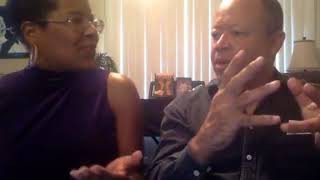
Stephen Barnes and Tananarive Due discuss Afrofuturism as a tool for processing trauma and imagining Black futures. They talk about teaching Afrofuturism at UCLA, horror as a way to reckon with real violence, and how storytelling becomes an act of resistance and social justice.
Chapters
We are live up. You beat me.
Yes.
Oh, no. We are live. We're not showing our pictures yet because we're just waiting. Just. We got about a minute or two.
So we're just here to hype everybody up. Oh, to lift a. Hi. Just say hello to people. Thank you for coming.
Yes. So we'll be showing ourselves in just a minute. But just wanted to let you know that we're already here. We're trying some new technology, so please pardon us. Type in. Can you hear us? Can you hear us? Yeah.
Let me know if the sound is good. If there's anything. Oh, yeah, we're not up. We're in makeup. That's what it is, Jonathan. We're still in makeup. So that's why we have not shown our faces yet.
Can you hear our faces will be up in just a moment.
I'm so glad to see you. Last week I did this from my fan page.
Yes.
And didn't get the same number of people. I was like, well, let me go where my people are. Back to my personal page. Absolutely. So thank you.
So we have comments from people and everything. Everything's looking good. Hey, shall we just kind of.
I think it's time.
Let's. Time. Okay. So I'm going to go over. Like I said, we're using new software.
To make this more high tech people.
That's right. All right. Welcome to the Afro future. Yes. There, there. There you are. There you are.
I am Tanada Reeve Dew.
And I am. I am what remains of Stephen Barnes.
A great line from Dick Van Dyke.
Yes.
I'm gonna have to keep you honest on that line. Yes. Remember, he was at an award ceremony and he said, I'm what's left of Dick Van Dyke.
Okay.
So in any case, welcome to Afrofuturism Live. A lot of you know me. You're on my page. So hopefully you know me.
Who are you?
I am Tananarive Due. I'm a novelist.
The amazing Tananarive Due.
I'm an author. I primarily write horror, so. And a little smidge of science fiction. But I know where the true science fiction God in the house is. So who are you?
Okay, who am I? I'm Steve Barnes and it is my real pleasure to be here. I'm really enjoying doing these shows so much because I've wanted for so long to have a way to just communicate with people. So what you're noticing, if you do, is that every week we're getting just a little bit more professional. We're just adding a few Little different things here and there, which makes it possible for us to communicate with you and say hi and share stuff with you.
Before you know it, we'll have rolling credits and all kinds of stuff going on. But right now, we are really just.
Yes. And people are saying hi here in my office.
Oh, good. We love you too.
We love you. Yes, we do.
Oh, we totally love you guys. Thank you so much for coming. This has turned into a weekly.
Really.
It's a show. Let's call it what it is. That's what it is with me and Steve.
All you have to do is let us know what it is that you want from us, how it is that we can serve you. I start every morning asking, who can I help today? And before I do every show, I assume that there's somebody out there who needs something that I have and that we have. That you need to know that there is hope, that there's something on the other side of the stress, because there is people and just. It is my great, great pleasure to be able to share this time with you. I'm so happy to see you guys. I really am.
Afrofuturism is an important part of our lives. I've been teaching Afrofuturism for some time at ucla. I'm about to launch a black horror course at ucla. Yes, you are.
Everybody's so excited about that. I'm jealous.
I don't understand. You know, I'm getting all these reporters trying to. I was rushing to try to finish my syllabus, which is stressful. Those of you who teach know how stressful it is to create a new syllabus. So here I am, like, weighing every decision and every piece of work, and I have reporters asking to see it. I have other writers ask you to see it. So in any case. But it is exciting for us to be here because we really, really do believe that art can help change the world. That's why we're here. That's why we talk to you every week about what we're working on, about current events, which often are very heavy in the news, and how art can help us recenter ourselves, express ourselves. And specifically Afrofuturism, out of curiosity, because.
I don't think we've ever done this. How do you define art?
Oh, come on.
Come on. How do you define art?
Art. You know, that's a difficult question for me, but art can be. I mean, in the traditional sense, art can be music, writing, visual arts, films, of course. But, you know, when you see something random in nature and take a picture of it, that object also becomes art. So art exists before we describe it as art sometimes, and we don't always create it, we just notice it, you know. But in any case, Afrofuturism, as we define it, and this is a question that's come up, is really black speculative arts. So it's the fantasy, science fiction and horror that centers a black experience using metaphors and symbols and often drawing on history. And often thus the word futurism, pointing a path forward to the future. And that, as I said, as I said about art, it can be music, it can be a photograph, it can be literature, like Octavia Butler, Nnedi Okorafor NK Jemisin these kinds. Well, Steven Barnes Tananarive Due to music like Janelle Monae, George Clinton. And it's a sort of. It's an artistic conversation as we're all trying to really literally just find our way at this point. It's been a difficult time, to say the least.
I would say that art is self expression. It's expression of the deep self, who it is that you really are. At that core level, craft is the specific tools that you use to take that sense of who you are and what the world is, and you channel it into art. You know, poetry, ceramics, dance, martial arts, whatever. It's the specific vocabulary of the discipline that you want to express it into. But the core question is, who am I and what is the world? Those are the two questions. Whether it's philosophical or artistic, those are the core questions that you're asking and then an artist can ask. And the reason that art is so important is that art, storytelling specifically, is one of the ways that civilization knit itself together, society knits itself together. That a tribe identifies itself, that a tribe says, this is who it is that I am. The stories of every group of people on this planet say God made them first and loves them best. With the sole exception of the children of the African diaspora, Black Americans do not have that mythology. And this is why it's so critical. And the thing that's really interesting to me is that there's been blowback about that. People will say it's not important, you know, what differences. They're just stories. They're just stories.
On one level, you have something like, say the Ten Commandments, which is instructional and it really doesn't matter. Everyone can sort of decide to embrace it.
But the story behind the Ten Commandments that contextualize the Jews, slavery and bondage in Egypt and what happened, and that God Almighty came down and smote the Egyptians to free his people. You know, it's like, that is a fantastic origin story that it is non pare. There is no better story than God loves us so much that he smote our enemies in order to free us. And then when we wandered for, what, 40 years in the wilderness and lost our way, God came in a burning bush and gave us the Ten Commandments to put us back on the right track. There is an origin story.
Now, wait a minute, honey. I know you're a little older than I am, but were you there? Wait a minute.
I would have been there, but the dinosaur I was riding at the time broke his leg and we were late to the pyramid party.
Well, what I was going to say is you have art that exists as art that can be for everyone. And a lot of our. All of us grew up watching television shows, listening to music that didn't necessarily have anything to do with us. Sorry I had to do that.
Yeah, you'll never be as old as you look.
He said we. But in any case, there's also something very powerful about when you see yourself reflected in the art. And that's where Afrofuturism really comes in for a lot of us. Jamie Broadnax, who does Black Girl Nerds, she's really rising over there on social media and beyond, was part of a project on Netflix. Basically, it was the first time I saw myself, and people basically tweeted. The first time they recognized themselves on television, the first time they saw someone who reminded them of themselves in the media. You know, one of those people, for me, is Lieutenant Uhura. Nichelle Nichols on Star Trek.
You know, I have heard from my oldest friend, Michael Ellington, that Nichelle Nichols lived up the street from me, and I never knew it.
Really?
Yes. I'm pretty sure I know what house that she had to have been in. I cannot verify this. I don't know that this is true. But Michael has never lied to me that I know about. Says that she lived across the street from him.
What kind of friend is this who wouldn't tell you this earlier?
I assume he thought that I knew. But the thing is that that was one of the downsides, really, of integration, is that it used to be that black communities lived together, all together, and the rich and the poor. Trust me, I was living at the bottom of the hill. The folks up the hill were the doctors and lawyers and the dentists and the actresses.
Well, you might remember playwright August Wilson. We had an epic conversation with August Wilson and Charles Johnson in Seattle many years ago. If only we'd Recorded it. But he spent a lot of time talking about that, about the effects of integration, about the difference in his neighborhood that he loved so much, that he was always writing about post integration and those challenges there. So, yeah, so that's why we look to media sometimes.
If integration meant the destruction of the geographical unity of the black community, then we have an obligation to tell stories, to reach out to each other on things like Facebook. Isn't this amazing that we can reach you guys on Facebook and we can connect with you week after week and share ourselves with you. So this is what we want. We want you to share your stories with us. We want to share our stories with you. And we want to take everything we have learned in our careers and teach you how to create stories that will knit our community together so we can knit our nation together.
To create stories and to find stories that will also give you strength.
My goal is 1 million awake aware adult human beings. And the method that I want to use is by creating thousands of awake aware artists and fans, people who can appreciate art and understand it so that we can in the creation of art and in the consumption of art, we can support the causes and the people we care about.
Yes. And I know that some of you who are watching artists in Masli Dukhan, I see you over there on Steve Speed, filmmaker, doing a great documentary about black science fiction. And also if you could include it in the comments section, if you would write a little bit about your new project, your web series, because that's really exciting.
We need to know our audience includes writers and artists, people of real accomplishment. And so share with each other, just let each other know, this is who we are. This is who this community of life, writers of Afrofuturists is accomplished, intelligent, sharing, compassionate.
Hi. Georgine Bass.
Kimberly. I see Gray Wolf. I see Andrea Maxwell. This is just says that this is so healing. From week to week, I rushed back here from the funeral of one of my great, greatest mentors, Dr. Jerry Pornell. And it was a place of grief, but also celebration. His son. I was talking with one of his sons, Richard, and you know, there was sadness in there, but I just had to say to him, yes, you lost this man. But think about it for a second. You had Jerry Pornell for a father. I mean, it's like you had this man for your father for all of these years. That is an amazing thing. And the cost of love is caring about something enough to feel grief when you lose it. That's the price we pay. But love is what makes the grief and the fear and the pain worthwhile.
Absolutely. And having. It's so hard in our current society to walk around feeling open hearted because if you pay even the slightest bit of attention to so many different issues right now, there are attacks on all fronts, actually. It's so easy to feel dispirited and hopeless. I've seen some hopelessness popping up on Twitter. I don't know what you were about to say. No, it doesn't matter, you know, Officer Jason Stockley was acquitted in St. Louis. And this is a very typical case where it's so difficult to get a police officer convicted for an unlawful killing. And it just takes me back, honestly, to my own childhood. I grew up in Miami, Florida. Those of you who were from Miami, maybe or have heard about this case. In 1980, there was a very visible court trial after a motorcyclist named Arthur McDuffie, again, a black man, was killed after a police chase. So in some ways it was a similar situation. There was a chase going on in McDuffie's case. I think he was just speeding or doing some stunts on a motorcycle, and the police started chasing him. And he led them on a very long chase. There were 12 officers involved by the time they caught him. And at one point he just stopped. He just said, okay, like, you got me. He could have gotten on the freeway. I think maybe he should have. But instead he stopped. He finally complied. And when he complied, the police officers just beat him basically to death. They took the big metal flashlights and beat him so badly that he later died of his injuries. And what was even worse was like, Officer Stockley, they tried to cover it up and make it look like it was an accident, like his motorcycle crashed. And I have to give a shout out to a former co worker, Edna Buchanan, journalist, who uncovered that story, brought it to light before it came to trial. So as it's going to trial, everybody knows that they beat the man to death and tried, or at least that's the.
And what did it trigger?
Well, it triggered what I'll call an insurrection. Many people call it riot. It's the language of the unheard, the language of the powerless and really the fearful. That's what most people don't see when they see rioting and anger. They don't see the fear underneath that. But for a community with bad relations with police, if the worst case scenario comes true, which is literally an officer can kill you and not be held accountable, it does breed great fear. There's very little reason then to want to comply. There's no hope or faith in the system.
And what happens is that you can. This can go on for centuries of lack of justice. And then what will happen is people will pretend, well, why don't you people just respect the police more? You know, these images aren't important. This didn't happen. The amount of gaslighting. The history is not what the history.
Is, no matter what the situation. You could be John Crawford shopping for a BB gun at Walmart.
If someone talks about, show them the picture from the.
Oh, from the Miami. Yeah, you can be John Crawford shopping at Walmart for a BB gun that they actually sell at Walmart. And then someone calls the police and the next thing you know, you're being shot and there's an excuse for that shooting. Or you could be a little. You can be a child Tamir Rice playing with a toy gun by yourself in a park. If you've seen the video, he wasn't menacing anyone. And also in that case, there are excuses for why it happens. Every single case is like an excuse for every single case is treated like an isolated event, whereas it's not. They're not isolated events, they're events that are continuing. So this is very dispiriting. And when I was in Miami, this is photograph from Miami in 1980. I was in. I won't say exactly how old, but I was in middle school and very down, as some people, maybe some of you are feeling right now. The cafeteria was playing Muzak to try to keep us calm. We had this tri. Ethnic middle school. I guess they were afraid we were gonna riot. And in the midst of all this, just feeling so hollow and like, oh my God, my life doesn't matter. I started writing a pro prose poem called I Want to Live. And it was basically describing this utopian society I wanted to live in. And what I was doing with that poem was not just declaring that I wanted to live in this perfect society, but I was also envisioning myself in that future. So it was sort of a kind of Afrofuturism that I was writing as a young person, even though I didn't know it. And it was actually very healing for me to do that. And it did make me feel a lot better. In fact, I was at my son Jason's school this week because Steve and I started an author's club at our.
Son'S a writing workshop at the local.
Junior high school, the Authors Club. And I told them that story about how I didn't get going to all the details, but how I was feeling so bad and I wrote this and it made me feel better. And I also use that kind of metaphor in preparing for this horror class. I've been watching a lot of horror movies, reading a lot of horror stories.
Drag me to the briar patch.
And it really strikes me how horror has this power to take something that represents forces of evil and make it something that you can. If you can't beat it, at least you understand the rules. If you lost, there were rules and you just couldn't overcome it. But it's sometimes seems that when we're facing these incidents in real life, there are no rules, there is no monster, there's no, say this three times, there's no curse. It's just people hate you on site because history, because fear of the other, because, you know, all these other reasons.
There is research that suggests that people who are recovering from operations or are waiting for people to come out of the operating room, if they're just watching television news shows, stuff like this, there's one level of recovery. If they're reading nonfiction, there's one level of recovery. But when they're reading fiction, reading fiction actually helps them heal fast or deal with the stress of waiting. I believe that it's a matter of contextualizing our lives, that there is a pattern that exists and it is important. We were told, we've been told many times when I was a kid, you know, television today is still not perfect, right? But when I was a kid, I could go an entire year and not see a single black person in a lead role in a movie. And I could go several years, I mean, without one on a lead role on television. You know, Julia was the first, was the first one that I ever saw. There had been some stuff earlier than that, but it wasn't until almost the 20th century, almost ended, before there. Deep Space Nine was the first dramatic television series with a non Caucasian male that succeeded. You know, the lead is the person whose name comes first. The title, so you know, I Spy and stuff like this were co leads or, you know, co stars. But in terms of a lead and what I got told when I would say something about this is it doesn't matter, you know, oh, that doesn't matter. It doesn't matter that you don't see yourself in movies. It doesn't matter that you don't see yourself in. Now those of you women, how many women out there were told that it didn't matter that these heroes were not women? How many. Do we have any gay brothers and sisters out there who were told that it did not matter that you were not able to see love expressed in a way that reflected your reality. Have you had that experience, too? Because I know I had that experience. I want to know. Am I talking to people who are feel, who have felt this, who have experienced this?
Give us little likes or hearts.
Yeah, just give us little likes. If you understand exactly what I'm talking about. And also that people told you it didn't matter.
I want to invite all of you to please stay until the end. We usually say this earlier, but if you stay until the end, we do have a special little surprise for you and an opportunity at the end. So please.
So good. We have likes. We have hearts. So you're feeling us. That they will tell you. They will tell you it doesn't matter. That your representation does not matter. And I'm here to tell you they're lying to you. They have lied to you.
My friend, writer Rosalind Bell just typed in. Rosalind got off the phone so I can call Thelma and tell her to turn on Channel seven. There's a Negro on the Dean Martin Show. Which is so true, though. I mean, the sightings were so rare.
That's right.
The representation was so rare.
We would take anything. Rochester on the Jack Benny Show. I would take anything.
I mean, old 30s and 40s.
Yeah. Catch that ghost or whatever that was.
He was the one who could do the buggy eyes better than anybody. Really talented.
I ain't scared no ghosts. Yeah, man. I was listening to. On the radio today, they had some white guy pretending to be black on. On one of the radio shows talking about how hot masks have been attacked, you know, And I'm just, like, saying, oh, my God. No, it was. This was. This was a dramatic series, you know, and one that usually is pretty good about. About this stuff. Yeah, I wanna.
You know, the erasure is so powerful on so many levels because it leads to the misconception that this has not always been an inclusive nation and an inclusive society. Just because there weren't gay people talked about openly doesn't mean that there weren't gay people. Back in the day, the Old west was notoriously multicultural because a lot of freed slaves moved out west to settle. But Hollywood selected stories about white cowboys. So a lot of people today honestly, really don't understand that. It's not just that the country is changing, which, yes, there are some demographics that are changing, but we've always been here.
But what's changing is that the narrative is changing.
Yeah.
Now let's. There was one, a picture that we wanted to show of a wonderful young lady. And I'm gonna. I just cannot wait to put her up here for you. And what we have. That's right. You get your picture up there. So Brie Newsom climbed up the flagpoles in North Carolina, in South Carolina, and took down the Confederate flag. Now this, Confederate flags, Confederate statues and so forth have been coming down across the country and across the South. And the same people, it feels to me, the same people who told me that these images don't matter, that mythology doesn't matter, are now screaming, they're taking.
Our history, having a hard time with it.
The trouble is that the story of the south, they act as if the south was a nation. It was a nation. If it was a nation, it was not recognized by a single other country. So am I a nation if I just declare myself one, or am I a nation if other nations say you're a nation like us? The south was able to sell its story about what it was about what slavery was about what the Civil War was. That story maintained itself for 150 years after the Civil War ended. And as we start taking down these. These symbols, we're disassembling the story. We're not stealing their history. We're disassembling their story. And they are squealing like stuffed pigs.
Which just goes to show, yeah, those stories matter. And it's about time that. That some of the stories were showcased that empower more of us.
Yes. So what. Here's what we're saying. Afrofuturism matters because storytelling contextualizes the past. It creates an image of the future. Without vision, the people perish. And it helps us to understand who we are right now. If you don't tell those stories, you will be the victim of other people telling stories. And they will tell stories in such a way to benefit them, not you.
Right? I might have glitched out for a second.
Yeah, you glitched out for a second, but that's okay. So that's why Afrofuturism is important. That's why. Because we deserve to tell our own stories. We deserve to know that we matter. We deserve to know that we are here, that we've been here. We have always been here.
Right. And Bri is a horror filmmaker. I want to bring it back to.
She was one of your students, wasn't she?
No, she wasn't one of my students.
Oh, you brought her to the.
But I brought her to Spelman College. I have a black science fiction film festival. And she has a wonderful Short horror film called Wake. Halloween is coming up, so check it out. You can find it on Vimeo. Wake, directed and written by Brie Newsom. It was really a student project for her, but it went on to win awards and do film festival circuits. She was one of the people I talked to when we were ready to make our horror film, Danger Word, which is also online. So I've noticed an interesting connection throughout Afrofuturism, but also in horror. Given that Bree. What? Nothing.
Nothing.
Okay. Given that Bree. I don't know what he's doing right now. He doesn't have to tell me what he's doing. But given that Bree was drawn to horror, obviously she has a strong social justice bent and sensibility as I have a strong social justice be and sensibility. And it's so interesting that relationship between people who want to change the world and artists who are drawn to Afrofuturism because what we're up against sometimes seems so insurmountable. I'll tell you about a very sad case I came across in social media this week. Some of you may have heard about this case. There was a child in Claremont, New Jersey, an 8 year old boy who had been subjected to racist. He's biracial and he had been subjected to racist attacks by local white teenagers who then put him on a picnic table under a rope that was hanging from an old swing. But the swing was gone. Only the rope remained. They wrapped it around his neck and just left him to hang there. And he swung three times, the witnesses say, before he was able to free himself. Steve is showing the bruises on his neck on his page, but I'm not going to show the bruises on my page.
I'm just going to show it for a second.
I know some of you get very triggered by that.
I can't look at that picture without wanting to hurt somebody.
Yeah, it's. And so what was even more troubling, or as troubling to me, was that in the initial reports and not much has been made of this in the news. By the way, some of you may be hearing about this for the first time. This is Claremont, New Hampshire. It's not the South. The south gets a lot of the bad rap for racism, but racism is not confined to the South.
No, not at all.
And also the police chief, Mark Chase, his comments were really disturbing to me because they basically centered the perpetrators of this idea. Well, you don't want a mistake to follow these young kids for the rest of their lives without really discussing the victim. And even more importantly, say that our town will not stand for hate crimes because then it makes it safer for other people of color. Apparently there was a vigil for this child. He didn't die, but there was a vigil Tuesday, and at least one person did show up and say, white power. So even though the town is to trying, tried to sort of pull away from the racial component initially, kind of characterizing it as an accident and this kind of thing, it is a racially motivated crime. And it makes me think of Emmett Till. It makes me think of history and all those different attacks in history that have left other young people dead, sometimes on the basis of a lie. And where horror comes in is, for me at least, horror has always given me away to try to process my grief, my anger. I talked about that Afrofuturist sort of prose poem I created for myself when I was a kid dealing with the McDuffie verdict. Horror really does help us process some of this stuff. And soon, before I heard about this, this lynching case, Stephen and I went to go see the movie. It based on the Stephen King novel. And although it's very clear and it. If you haven't seen it, and I highly recommend it if you're a horror fan, but it uses a clown named Pennywise as sort of the personification of evil. So if you have a bunch of teenagers bullying kids and they bullied all the outsiders, it was Pennywise kind of goading them on. And I was especially clear in one scene with the little black boy, Mike Hanlon, from a story who was singled out. They don't make much of it in the film, but you can tell clearly he's being singled out because he's black. He's the only black kid, basically, that we see. They're beating the snot out of him. Thankfully, no N word in this. I'm always appreciative of that. But I could tell it was a racial attack. And Pennywise is standing by, watching on. And you can see that direct relationship that the filmmaker and probably King is making between. Aha. This bad thing is happening because this demon has taken hold of this town. This demonstration demon is to blame. And unfortunately, in real life, we don't have a demon to blame. It's really. You know, I'm sure you talk to some of these kids friends, they'll say they're perfectly great kids. Their families are probably very fine people.
The banality of evil.
The town is probably a great place to live if you look a certain way, certainly. But this is. This is really the insidiousness of racism and systemic racism, white supremacy is that it's so much in the air that we've actually reached a point where the people who are pointing it out are demonized as the racist.
Well, when you have so much privilege that you don't even see it, that you don't even see it. In other words, okay, And I really don't like breaking things down to black and white, but sometimes it's a useful thing. There is a group of people, white people, who are politicized. Liberals. Conservatives will say that when liberals have control of an institution like education or entertainment, that they will discriminate against conservatives. Okay? That they will use that privilege. You know, Hollywood is a liberal town and you can't even get a good job if you're a conservative. Same thing. The educational system is dominated by liberals and they don't get conservatives jobs. So. And then liberals will take the position that when the. When conservatives have control of government or other things like this, that they will. They will exploit that to their ends. In other words, that this is human nature, that they agree that the sides will do this to each other politically. But how can you say that and not think that the same thing is going to be true racially? That if you have the numerical superiority racially, you're going to use that against the people of the minority.
But.
Or how about sexual orientation? If you're straight, you're going to use that in order to reinforce your particular values. How about if you are Christian as opposed to atheist? How about if you are a climate change denier as opposed to a believer? How about if you're American as opposed to non American, that people will leverage their advantage no matter what. This is why we spend time every week begging you guys if you have a creative impulse, if you want to get in there. Now, if you're political, there are lots of people who talk about what you can do politically. We're talking about how to take your political beliefs, your philosophical beliefs, and express them in your art in a way that you can not only change the world, but also actually build a career.
Yeah, There's a great short story by Derek Bell called the Space Traders, which is something I teach in my Afrofuturism course, which is basically about sort of a devil's bargain the United States is willing to make with aliens who want all the black people. Reginald Hudlin did a film adaptation, Cosmic Slop, Space Traders, and I'm including it in my black horror class at ucla, because the actual feeling I get from that story is horror. Even though it is probably more science fiction, but my students were just so flabbergasted to think, would this really happen? Would the rights of minorities really be seen sold out for the comfort of the majority? And then we had Election Day and they're like, oh, yeah, they would. They would. And that's really the power of art, is to sort of help you see where we are even more clearly sometimes than you can see just from watching the news or just paying attention to current events. People who have studied this for long decades. And I know a lot of people want to jump in these racial conversations, but do a little studying first.
Absolutely.
It's not just about your feelings about things. There's a whole history to this.
Nordette Adams said, all art is political. It upholds that status quo or it challenges it. Sweetheart, I could not agree with you more that if politics is the way human beings affect the behavior of other human beings in groups, then art is. This is the way I see the world. This is the way I believe that the world should be or can be. So it is critical. And we're speaking, this group of people are people who believe this. And so we are empowering you. So it's like, just let us know what we can do and we're gonna do it for you.
Yeah, I see my dad is on Steve's stream. How come you're watching Steve's streaming? Not my dad. But in any case, I was raised in a household with some very serious parents. My father, who's right here watching Freedom Lawyer John do, very active as a civil rights attorney in the 60s up to the present day. My late mother, Patricia Stevens Dhu, also a civil rights activist, Great lady, spent 49 days in jail along with her sister, my aunt Priscilla Kaza, and other students from Florida A and M University just for trying to order some food at a lunch counter. So in 1960, you could go to.
Jail for ordering food at a lunch counter.
That's why the term law and order.
Doesn'T mean much to me. Y' all who want to say nothing has changed? You are spitting on all the people who went to jail for sitting in a friggin lunch counter.
But we don't need to get too carried away because we can see how much work is left to be done.
Oh my God.
And it's a lot. And growing up in that household, it's not a coincidence that both of my sisters became lawyers. But I knew after one media law class that that was not going to be my route. I'm so grateful every day that My parents encouraged me to follow my dream to be a writer. And dad, thank you. I might not be a writer today if they had made me feel silly for my little stories about stowing away on a spaceship, or my little story about what if I'd been on the Middle Passage, or my little story about trying to get into the Guinness Book of World Records, or the talking cat. If they had dismissed all that, I might not be a writer today. And even with that encouragement, in terms of horror specifically, as much as I love it and dad, you know, mom loved it. Loved it. That's why I love it so much. I was a little nervous about pursuing horror as my primary form of writing, even though. And I was trying to write around it. So I was writing really weaker stories, trying to avoid what I was good at. And it was really. Two things happened. I read the book Mama Day by Gloria Naylor, which is fantastic and it's art and it's so well written. And it also has the metaphysical elements to show me. Oh, okay. Well, she's doing it. But also, really, it was a phone interview with Anne Rice when I was.
Working for the Miami Herald.
Yeah, I was working for the Miami Herald, and it was just a phone interview. I had actually never read Rice, although she was huge. She was a big best selling author. But I did my research, I read my book for the interview, and I asked her sort of leading questions. You know, some of you who are writers know that when reporters talk to you, they're really trying to answer questions for themselves because they want to be you. So I was asking her questions because I wanted to be like Anne Rice. And I said, how do you answer criticism that you're wasting your talents writing about vampires? And I braced for her to be offended, but she just laughed and she basically said, look, that used to bother me, but my books are taught in universities and when you write about the supernatural. And she just went on and on with all her confidence and all her intelligence, and I was like, hold it, wait a minute. If I write home horror, I can actually write about important themes and I can make people think and I can move people.
Of course you can.
So that was a big. And I started writing my first novel, the between within nine months of that conversation.
See, there you go.
Actually finished writing it within nine months of that conversation.
See, TenOneRive has shared so many stories with me about what it was like to be in a home where you were supported, your dreams. I know that there are a lot of people out here, out there who are listening to this, who had dreams of being in the arts and were not supported. And what I want to know is if you had dreams in your heart that you wished you could have, your parents were afraid for you to pursue the arts, or people said that it was trivial, or if you had that dream of wanting to express yourself but were not able to do it for one reason or another. Come on, give us some likes. Let us know. I want to know, did you have the same experience that she had? My mother tore my stories up. She was so terrified that I would go down a path that would lead to my destruction.
Poverty.
Absolutely poverty. So if. Yeah, you can feel. I see. I'm getting likes. Yes, absolutely. What I want to make sure that you know is it's not too late. That goal that you have, that desire that you have to share yourself with the world, to make a difference, to share your heart in that particular way, you can still do this. That every single day, when I think to myself, who can I help today that informs the writing I do that day. If I can tell the truth, if I can show people the way I feel that they really are, I'm doing something. I'm doing something positive.
That is the truth. You know, some of you are probably wondering, where's your next novel? Where's your next novel? Well, my next novel has been super, super hard to write. It's set in Florida in 1950 at a children's prison. And it's not a fun place to be. And every time, I kind of fall away from it for a little while. Oh, I'm working on a script. Oh, I have to grade student papers. Oh, I'm gonna watch Netflix or whatever it is. A story like this, attempted lynching happens in New Hampshire. And I see that little boy, and I think, I have to finish this. I have to finish the story because it's about our. It's set in 1950, but it's really about the present day. And it's about racial tension. It's about incarceration. And those are conversations that need to be had. So even though it's a ghost story, it's really the first ghost story I've ever written where the human evil outweighs the supernatural evil.
Look, and this is what I want to say. I do not believe in talent. There's somebody out there thinking, I would write if I only had the talent. I believe in focus over time, that if you are willing to give your heart, if you are willing to read and you are willing to write your butt off, concentrate on writing Short stories, because those are small enough that you can actually learn your craft while you're doing it and join communities of writers. We've got a community of writers that we just love to have you as a part of. I believe in the human heart. I believe that we can change the world, and I believe that art does it. What I do not believe in is that some people are just divinely gifted. But I see every time I've ever gotten close to someone who was superb at what they did, I saw a lifetime of hard work. You go into a writer's house, you see a world of books. If you went into an athlete's house and you saw tons of exercise equipment, you. You wouldn't think they were naturally athletic. You would think, my God, this guy works like a fiend. Do you love something enough to give it everything you've got? If you love something, your children, your dreams, your writing, the country, something, what are you willing to live for? What are you willing to die for? Find that emotional wellspring of passion, then gain the knowledge, the technique, the. That enables that the passion then drives. And you have your best chance of living a worthwhile life.
Absolutely. I just know I always wanted to be a writer. I saw a comment from ya. Let me say it. Oforiwa. I'm pronouncing that correctly. I apologize if I'm saying that wrong. Angry because his parents told him to get a real job. Well, my parents also told me to get a real job. I was a journalism major in college, and I did sort of creative writing as an underground major because. And I don't know that that's the way to go nowadays, but back in the day, that was pretty steady form of employment to be a journalist. So I did have a backup plan. And I did work for 10 years full time while I was working on my fiction. But it also led to some opportunities. You know, interviewing Aaron Rice and meeting Stephen King.
Stephen King.
Let me tell you that story.
Please do.
In fact, I'm going to put up my little picture.
Stephen King's 70th birthday is coming up soon, so we're gonna put that picture up here. Yeah, let me, let me get that picture. And then I want to hear. I want to hear this story.
So I played from time to time. Well, wait, let me just start at the beginning here. I am a young writer. I'm also a reporter for the Miami Herald. I had only published one book at that time, but I was a horror writer. And I had grown up loving Stephen King, who didn't. If you were coming of age during that time. And I heard that King was going to be playing with the Rock Bottom Remainders, which was a rock band made up of writers who performed at the Miami Book Fair every year, and that that was a terrific group with Stephen King and Dave Barry and Amy Tan. And I ran into Dave Barry in the cafeteria of the Miami Herald one day and said, hey, listen, I play a little keyboard. Can I? And the next thing I knew, he was inviting me to get up on stage and sing backup to the Rock Bottom Remainders. I play keyboard. I sang backup. I did Proud Mary one year. It's actually on itunes. If you go to itunes and put in Stranger Than Fiction in my name, you can actually buy a really bad recording of me singing. No, it's good. Me singing Proud Mary.
It's Tananarive and the Tananorettes. And who does your backup? Who playing guitar? Warren Zevon, Werewolves of London. Warren Zevon is doing the Ike Turner role on Tananari singing Proud Mary. You've got to listen to this.
That wasn't the most amazing thing ever that I got to do that, which is sort of like, you know, I was always a frustrating sort of rock star musician anyway. But after that, I got to give Stephen King a copy of my book, the Between. I figured I had a choice. I could either get an autograph or. Or I could give him a book because I was too shy to do two things. So I ended up giving him a copy of my book the Between. And when it was time to publish my second novel, My Soul to Keep, I made myself have the nerve. I was in the Horror Writers Association. I found out a way to get fax to him, asking him if he would be willing to blur my Soul to Keep. I was so sure. I didn't think he would do it. But one day I came home from work and there was a letter in my mailbox from Bangor, Maine. And I held it up to the light, and it was like three lines, okay, so my heart's pounding. Oh, my God. What does this letter say? I thought it was sure to be a rejection. His rejections are short. But instead it said, dear to Nananarive, if I may, I really enjoyed my Soul to Keep. I would be happy to. I mean, I really enjoyed the between, and I would be happy to read My Soul to Keep. And do you know, he sent that blurb to my editor on the actual day it was due. I was biting my nails. I was like, oh, he said he would do it, but it didn't really? No, he actually did it. He did it. He blurbed it. And you know, I don't know if it's coincidence or not. That's probably my most popular novel, My Soul to Keep, my second one, and it is the one that Stephen King blurbed. And that was just about having a nerve to ask him.
And we don't, we cannot use names right now, but what just happened with My Soul To Keep, my dear?
Oh, well, it's.
Well, an Oscar winning producer. An Oscar winning producer is optioning her book.
We're not talking about that right now. But anyway, we're making plans. We're making plans for myself to keep and. Because the rights came back to me after, after some time. But, you know, it's been in and out of options since, since it was published in 1997. And, you know, it's been a. It's been a journey. You know, I've met a lot of people and Blair Underwood had it under option for a decade and we came so close at Fox Searchlight. So fingers crossed that, you know, fingers crossed that something happens with that. But this is just a part of a wave of enthusiasm. If Something happens with My Soul To Keep, then that's like Nnedi Okorafor and who fears death at HBO and nk? Jemisin's fifth season. And Victor lavalle with his book. I think it's tnt. So a lot of Afro futuristic artists are starting to fly and soar right now as the wider community is seeing the value in these stories of leadership, these stories of overcoming great odds and just looking different than what we're used to.
You know, I think that a lot of people, if, and I hate to put it this way because I lived in the south for three years and my sense was that these were wonderful people, good people, warm and sweet people. They also have an unfortunate history that they felt obligated to defend. And I think that has created some real misery. But one of the things they did was they had to stay sold a narrative of what black people were that was simply not honest. And as that narrative breaks down, I think that there's a fantastic opportunity for artists of color, for black artists and.
People who love art of color.
That's right too. Because if. If the mythology was not accurate, then the question remains, well, if they're not these natural slaves, if they're not these servile people, if they're not these monsters as presented in Birth of a Nation or whatever, then what are they really? Who are these dark skinned people? Do they hate us? Do they fear us. What are their hopes? What are their dreams? I think that this is the opportunity of a lifetime. That this is the moment at which you can take your passion and if you're willing to learn how to do it. In other words, I had to be willing. When I set up the machine where you write a sentence a day and one to four stories a month, and you repeat this process a hundred times, that was because what I know is if you will take certain steps in a certain order, you can actually get through. How many of you, if you believed, if there was a. But not in front of you, you could put, push it, have anything you want. How many of you would want to be artists? How many of you would want to be writers? How many of you feel that you have a song to sing? Give me some love, Give me some likes.
He's already an artist. Thank you for joining us.
Yes.
So, yeah, a lot of you would have. Would have wanted that. And maybe you haven't had the opportunity or even you haven't explored.
We're getting likes. People know that in their hearts they have this ability, they have that. And we believe in you. And if you can believe in yourself and surround yourself with people who believe in you, you can make something out of those dreams of yours that will have an impact.
Can I just share? Some of you might have read a great. I mean, it's sad, but it's a great novelette by a writer named Kai Ashanti Wilson, the Devil in America. It was nominated for Nebula. And if you go and I talk a little bit about it, I just found it. It's a complex story, but it's mostly about a young child from a magical tradition who meets the devil. And the context of the story is these mass killing events, like Black Wall street, like Rosewood, throughout history to try to contextualize those in the sense of devilry, which again, aha, I can understand that. The devil. That makes more sense to me than why a stranger on the street is calling me. The N word. You know what I mean? It's like, what? So as difficult as it is, it also. I just blogged about this this week. It's on one level, sort of almost a comfort that there's at least a reason that these bad things are happening.
It's the. Why do they hate us, Mommy?
Yeah.
Harlan Ellison, one of the greatest writers of the 20th century, just this fantastic man wrote a story called the Whimper of Whip Dogs, which was about the killing of Kitty Genovese in New York, where all the people in her apartment Building, watched her being stabbed to death and did nothing. And in the story, the metaphor in the story was that they were feeding her to a demon, that they were sacrificing her to a demon. It was, how do we make sense of this kind of evil? When you take a look at these stories about that 8 year old boy getting lynched, this kind of hatred, this kind of fear. If you are willing to think this through and answer the question, why does this happen? How can human beings treat each other this way? And you can take these stories and turn, and take these realities and turn them into stories. Now you have, you have spun crap into gold. You've taken your pain and turned it into something joyous.
And it's not only beneficial to you and cathartic for you, but you really don't know who your stories will touch. Because when I read the Devil in America, I was so excited. I found an email address for Kai Ashanti Wilson. And it turned out that he was familiar with my work. His mom loved my work. He'd read the Living Blood and the Good House. I'm gonna just go ahead and claim him right now. I know he had a lot of other influences besides me, but I was like, yeah, he's mine. And whether or not it's an artist, it's like a reader fighting strength. I got a letter once from a reader who said she fought off an intruder in her house because she remembered the strength of Jessica from the Living Blood. And that just. That's so moving because I've never had to do that. I write those characters in some ways to try to show myself how to be strong.
Well, see, that's. We all have wounds. You don't get through life without being wounded, you know, God knows that I certainly could not. I went into 40 years of martial arts training trying to learn how to deal with my fear. And I talk about fear in my books and what I'm hoping when I'm praying is that there's a little boy who's much like I was, who is as afraid as I was, who might be able to read something that I've written and understand that all that I really needed to know was that my fear didn't mean that I was a weakling. It didn't mean that I was a coward. It didn't mean that I couldn't or I shouldn't or I mustn't. Didn't mean any of that stuff. It just meant I was a. And that everyone else is afraid too. What matters is what you do with your Fear. If I had only had someone to tell me that. I think about, what could I have done with those 40 years? You know what. What could I have done with that time? When we tell the truth in our work, communicate with each other, we're doing something that is almost uniquely human, which is to share our experience so that our children don't have to pay the same price that we paid to get as far as we got. They get to stand on our shoulders. Yeah.
In some reason, in some ways, it's almost just like the cave paintings. This is how you kill a water buffalo.
Yes. You don't have to figure out how to kill a water buffalo from scratch every time, every generation.
So, yeah, I'm wondering how many of you who are listening out there would mind if we take some time.
Look, how many of you feel that what it is that we have in terms of our writing is something that you would like to have more of. I think you can tell we share everything we can with you every week. We answer every question. We got. One question, by the way, that I'd like to answer. It was basically someone asked, how do I sell my stuff? Just like it was an artist who actually runs an afrofuturism website. How does he sell his art, his stories? And there are three core aspects to selling anything, to marketing anything. The first thing is what's called your usp, your unique selling proposition. You need to believe in your stuff. You need to find something about your work that is absolutely unique. There's no one like you in the market, and all you have to do is be telling your truth. So that's the first thing. The second thing is that you have to find what's called your avatar. That is the perfect person, the perfect market for your work. Who is it that is. If you had. If somebody was going to put a gun to your head and said, if you do not sell your artwork, your story today, I'm going to blow your brains out. Who is it that would be sitting across the table from you need to be a stranger, but somebody who is the exact person who needs what you have. If you can figure out and picture who is that person? One person who needs what you have. Now, your marketing can be aiming at appealing to that one person. So the first thing is your unique selling proposition. The second thing is who is your avatar? Who is your perfect customer? The third thing is the medium. How are you going to communicate with that person? Because Facebook is perfect.
Find them where they are, wherever they congregate. That's one of the reasons I started doing Facebook live from my page.
That's right.
Because that's where you guys are.
That's where you guys are. So those three things, and we build on that a lot. But if those ideas about how to create the work that you want to create, how to find the people who will be, are eager to hear you or dying to hear you, and to.
Find the work that will inspire you.
If you would like to interact with us more about that, say yes to us. You know, because what we want is your, is to be able to talk to you a little bit about what it is that we can do. In that sense, if you would like more communication with us, let us know. Come on, give us, give us some.
Like or just say yes or even hell yes, we're growing, but in any way.
So come on. Do we have your permission to talk about this? Because we need, we need to know that. No, we won't.
We're not going to.
That's right, we're not going to. Let us know. Okay, so. Okay, so people say yes, that's great because we have a lot for you and we really want to talk to this. So basically what we've done over the past 20 years, we've both been teaching, we've been teaching school and we've been.
Lecturing and I teach at ucla. I've been teaching a class on Afrofuturism.
Yeah, I've taught at ucla, I've taught at Seattle University, I've lectured at the Smithsonian Institute, we've written articles, we've had study students, we've been doing life coaching, any number of different things. And it was all about how do we boil down this stuff that we fought to get and communicate it with other people? How do we do this? So we experiment. We've taught a lot of different things and we experimented with specifically a group on Afrofuturism. Yeah, that was the specific thing. And we took a group of people through a 10 week process.
It was earlier this year.
It was earlier. What did we give them? What did we give them?
Oh, well, every week we had a different guest and a different lecture. So the first part of the class was a lecture just like this where we would target a specific work, specific artist. You would have done the homework. So you're in on that conversation. Or you can compare your thoughts to ours. Week one, just to give you a little bit of an example, our special guest for the class was Teo Hadari Coker, the showrunner for Luke Cage. Luke Cage, which is about to open season two, our next Guest was Nnedi Okorafor. You might have seen her in the news because they're starting to hire writers and producers for the who Fears Death series on hbo. We talked to her about her work. At the end of class week three, we discussed Jordan Peele's Get Out. We didn't have an interview with Peele, but we did have an interview with Reginald Hudlin, the director and producer of Django Unchained, who's a big Afro futurist. So week by week and of course we discussed the work of Octavia Butler. We couldn't interview her, but we do include an interview excerpt in the course.
That's right.
So we had Nalo Hopkinson, who's also an award winning author. We had the amazing graphic artist John Jennings. We had Dr. Natrice Gaskins.
Yes, we did pop up.
So I know you're here talking about Steam, which was like brilliant, that interview.
Science, technology, engineering, art and math.
And steam. I was going to say, yeah, math. I can't even say the word math without. But she can. But she can't.
Yes she can.
It's a 10 week course and you take it at your own pace. You get week by week, there's a syllabus with the course readings and you keep up with the homework and it's just a fantastic.
And if you were to have taken this at UCLA, it would have cost you about $1300, almost $1300, about $1280 per class at UCLA. So that's the first thing that we've got and the next thing that we did was if you're going to be an artist, the thing that stands between you and being able to create is not lack of talent. It's going to be mostly your emotions that you're going to be dealing with fear, you're going to be dealing with insecurity. Even if you're not an artist, the ability to control your emotions during these, what seemed like terrible times. Terrible times is absolutely critical. So we created a suite of Tools, Mental Tools, MP3s to enable you to tap into. We used hypnotic techniques from neuro linguistic programming, Pan cultural shamanism, the things that I've been studying over the last decades in martial arts for teaching you how to flow if you'd like to. We can destroy writer's block forever. The focus and flow course destroys writer's block forever. The ancient child course helps you to make contact with that little child inside you that has all your creativity and heal that so that you have access to parts of Yourself that you may not have touched in years. The fear class teaches you how to deal with fear in a way that you may never have before. So that fear turns into energy, because that's what it's supposed to be. And the Warrior Sleep class is all about teaching you how to go to sleep. You know, just. Just being able to sleep so that you can recover from your efforts. So this is. This is what it is that that makes it possible to function as a creative person is constantly putting herself out there, constantly putting yourself out there. Because if you can do that, then you have the chance to succeed. If you cannot do that, the stress will blow you out. So we put that together too. And the value on that is about $240. Now, if you add those things together, what we've got so far, and this is just a visualization of all the great things we're doing because it's actually a digital download that means you get access to it on a weekly basis. We're sending out emails every week that have links to all this information.
So it's the Afrofuturism course and. And the Emotional Care toolkit, which if you were to get those two together, that would be worth about $1,520.
About $1,520. The next thing that we're doing is the three greatest mistakes that new writers make. So we're segueing from things that are good for everybody. You know, just understanding Afrofuturism, either as a creator of Afrofuturism or as a fan of Afrofuturism, to being able to take care of yourself to. Now, for those who want to actually look into creating, we actually created a lecture.
It's a 90 minute lecture, standalone.
It's a 90 minute standalone lecture where we decided to tell the truth about what it is like to live a creative life and the three greatest mistakes that new writers make.
It saved a lot of time in your process.
A lot of time, a lot of energy. So if we total these things. So the Afrofuturism course, the emotional care toolkit, the three biggest mistakes new writers make, we're talking about a value. I put a value on these things based on what would I pay for these things if I didn't already have this information?
Not what we're charging. It's what it's worth.
Just want to make that value of $1,720. The next thing that we're doing, because our question was if we're telling you that we're going to teach you enough about Afrofuturism, to help change the world, we have to give you everything. And the next thing is that question about how do I market myself? We've actually created a course that uses one of the most ancient spiritual tools, the Enneagram, to teach people how to market in a spiritual way. And I got my Sufi teacher to talk about these things in a way that gets talked about very rarely. If you're familiar with this symbol, this is not the Enneagram of personality. This is the Enneagram of process. Goes far, far beyond 99.9% of the material on the market. And it's priceless. It's priceless, but I can say it's priceless. But we can still total up that value to around $2,000 if we were to total all this stuff up. Now, the last major thing that we.
Did, of course we did. I believe it was last spring.
Last spring.
Revolutionary writing. Even before the last election, we could sort of see a lot of things in the air that were troubling. And we created a course, really, for people who would consider themselves social justice warriors, which is not, by the way, a dirty word.
No, it's not. Social justice warriors, as opposed to socially hindered Internet trolls. Look at the initials. Socially hindered Internet trolls. What is a sh. Never mind. Basically, we did a full class on how to take the dreams in your heart. If you are politicized, if you're philosophical, how do you create stories that encode that philosophy that can teach something or can move people politically without getting bogged down in the politics of it in dogma.
To have stories that are thematically based and thematically strong, like, let's say, Octavia Butler, who wrote a great deal about hierarchy, but she wrote about it in so many different and unique ways.
And we approach this from points of gender orientation, points of race, points of culture. We had Daniel Jose older. We had David Gerald on there.
So it's like the Afrofuturism course in that there is homework, like watching Ava DuVernay's documentary Thirteen to learn about mass incarceration. But also we had guests. So there was a lecture part, there's a homework part, and there's a guest part.
And this is all delivered through the Internet. And it's once again, so the revolutionary writing class. If you were to have taken this at a college, the classes at UCLA cost about $1,200. And so, once again, the total value of this packet would be $3,000. Plus, the good news is because of the fact that we do not have an infrastructure that demands that we pay dozens and dozens of secretaries and security guards.
We just want to share this with you.
We're dying to. We don't have to charge $3,000 for this. We can do much less than this. And we actually had one question, people asking, why is it going to be so inexpensive? It's because we care so much. It's because we have to get this out. If I'm going to create an army of a million people, I need thousands of writers. I need thousands of writers. But like I said, we're not going to charge that much. But I'm going to ask a serious question. If all we did, if all you got out of this course was enough information to sell a couple of stories, wouldn't it be worth it?
Yeah.
If all you got from this was something that helped you change the world, wouldn't that be enough?
Or even just a deeper understanding of who are the artists in Afrofuturism? Who are the musicians and writers and filmmakers and Afrofuturism.
Now you do not have to be a writer. You do not have to be an artist. We got a wonderful quote just last week from Ginny Underwood who said that her 10 year old is watching parts of the Afrofuturism class with her and already wants to write when she grows up. Now that's what we want. We want to train the next generation. So that's the question we have. If it would be worth it to you, wouldn't you want to change the world if you could do that? And what we've done is we've made it possible to do that with a 100% money back guarantee. It's not going to be $3,000 or anything close to it. It's only $300. Now, we only sell this two, three days a week, Saturday, Sunday, Monday. Because the rest of the week we spend time taking care of our students, making sure that they're in there, making sure that the social media group that we've created is taken care of. So if you want this, you've only got until Monday night to get it.
Monday night at midnight. We'll give you that.
Monday night at midnight.
And if you. We have a special offer too.
Yes, if. Go ahead, tell them what the special offer.
Well, you know, some of you are fans of our work. Perhaps we thought we'd also throw in an extra incentive that if you get the Afrofuturism course, which includes all those courses, the social justice writing, the emotional toolkit, the Afrofuturism course, all of that, we'll also send you for free a signed copy of a book either one of us has written.
That's right. If we can get it on. If we got it on our shelf, or we can get a copy of it on Amazon at retail, we'll give it to you for free. Www.afrofuturismwebinar.com now, there is an additional thing that we're starting to add now. Tananarive and I have both done life coaching, both done writing coaching, and we charged $500 a month for that. And we simply ran out of the time to do it. We simply cannot do that anymore. So what I decided to do is our life writing premium group has the right to submit stories to us, and we workshop so people are wondering how they can get more interaction with us. We're going to open that for the afrofuturism students, too. That if you're writing stories and you would like to have our personal feedback, we're willing to let you into that very, very special group. There's no other way to do this anymore. And so we're adding that on top of everything else. What we're. Our whole thing is how in the world do we give you everything that you need, everything that you need to succeed, to create, to understand, to evaluate.
Yeah. To grow and honestly to change the world. Because I really do feel that my parents believe that artists did have a role in changing the world, which is why I got that encouragement as a child. Even though they themselves were not living in that world of fantasy and science fiction, they were living in the here and now.
So that's what we've done.
Yeah, that's what we're offering. If they were physical items and not digital downloads, you wouldn't even be able to carry it. There's so much in that. There's so much in that. But in any case, in the time that's left, we wanted to ask you guys if you have any questions.
Yes, we have questions, and we've been having some questions over the last. Let's see. So we've had questions over the last couple weeks.
Yes.
And let's take a look and see what those questions are.
10 minutes. We will answer your questions. If I can get my timer here.
Mine is working.
Your timer isn't working. That's okay.
Okay, so just let them see your face. Let them see your face. That's fine. So, you know, people have asked, you know, sometimes they ask, what is Afrofuturism? Afrofuturism is the science fiction, fantasy, and horror of the African diaspora.
Yes.
Of the Children of the diaspora. It is our mythology, and it is critical. If we're going to heal ourselves, if we're going to heal our culture, if we're going to heal our children, we have to be able to have stories that reflect our strength.
Yeah. Imagine ourselves in the future and help our children imagine themselves in the future and in a future that includes everyone. So what's another question?
Okay, what's another?
They got some extra time.
They got a little extra time. Okay. Do I have to be a writer? No, you do not have to be a writer. You can be a writer, you can be a reader, you can be an artist, you can be a lover of art, you can be a teacher, you can be a parent. What you want, what we want is people who will march at our sides. And I think that you. You deserve that. You deserve the ability to tell your stories in your way and to raise your children in the way that you. That you feel most inspires you. Otherwise, what is life if you can't do that?
Well, I can say with all honesty, as a writer, there are times I just have to step away and replenish myself with art to keep going. You know, it's like nutrients. Let me pick up some Baldwin or let me read this N.K. jemisin novel or this Kay Ashanti Wilson story, because it gives me the sustenance to create. And so, no, you don't have to be a writer. You can be someone who just really enjoys being immersed in different worlds in different ways.
You know, I can say that I had to be a writer. I didn't have any choice. I would rather have failed as a writer than succeeded in anything else. The only thing that even comes close to writing. You know, there are only three things in the. In the world that I care about. I care about my family, I care about martial arts, and I care about writing and teaching. That's pretty much it. And they're all interconnected with each other. So if I hadn't been a writer, maybe I could have been a teacher. Maybe I could have wanted in some way to affect young minds, to help share, to be part of that. I buried one of my great mentors yesterday and attended his funeral today. The only way I can pay back the people who been good to me is by communicating. So, no, you don't have to be a writer, but you have to be willing to share. Because when we give up everything that we've got to help you, what we want from you is that you will turn around and help. The ones coming up are you Willing to do that? Are you willing to do that? So people ask how the class is delivered. It's delivered. Download.
Yeah. Email.
Email. We send you an email. There's a link to a Google document. You go to the Google document, there are links to the videos that you need and the information that you need. You take it on your schedule, in your time, whenever you're ready to start. And once again, it's. It's everything that you need to become an expert, really. At the basic level, you Study something for 10 hours and you know enough to conduct yourself in a cocktail party.
Explain it to others, explain it to your children. As the woman said in her testimonial, her daughter is watching it with her and learning too, and wants to be a writer now. Looks great.
There's 17 hours of video there, and there's another six to 10 hours in the revolutionary writing class. By the time you've gone through this class, you will be an expert. You will know enough to be able to guide yourself. You'll be able to join our social media community and we'd love to have you and be able to help each other, to be able to grow by actually doing the work. So whether you would just want to understand, maybe you have a child or a friend or relative who would like to be able to write, be able to create art, create music in this particular genre, whatever it is, if you're.
Part of that pure escapism from the headlines, maybe.
Yes, absolutely. So it's delivered. We know how it's delivered and we know what it is. So let's see other questions. What is the duration of the class is 10 weeks of core instruction. Then an additional week where you'll get the entire revolutionary writing class. Writing for social justice writers. Social justice warriors.
So you start with one email a week for the course, and then there's a dump at the end of the 10 weeks with all the other materials. You can basically absorb them at your.
Own, at your own pace. What we talked about, if you, if you stayed all the way to the end. We have any more questions here? Do we have any questions from. Okay, so let's see. Is there a way. Okay, now one of the things that said that if you. That the. That the course some people were asking, is there a way that they couldn't quite afford the $300? We have a time payment.
Oh, there's an installment plan.
Yeah, there's an installment plan. Just go to the website www.afrofuturismwebinar.com. there is an installment plan. So you know we're doing everything we can to get this to you. Now, we talked about if you stayed all the way until the end. What is it that we promised them?
A treat. In this case, the treat is a story.
Okay.
You know, stories are important.
Stories are important.
This is what. Oh, I can't even. I have a delay, so I can't see myself holding up the book, but I have. I can see a very rare Stephen King edition here.
And over here.
Over here, I have a very rare Stephen King edition that King sent to me in 1997. That same year, he blurbed my soul to keep, because I guess we was buddies, I don't know. But anyway, he autographed it for me. I'm going to show your people the autograph and my people the autograph.
Okay, See, over here, for my people again. Okay, and what does it say?
And it says, for Tanana Dew, thanks for your letter and for writing such an utterly cool second novel. That's my soul to keep. Here are some short stories. Hope you like. Best wishes from your old rock and roll buddy, Steve King. That's how I learned his nickname is Steve. I had no idea. I was, like, pouring over every word. His name is Steve. But anyway, this is. This is my autograph from my buddy Steve King. I was actually afraid to open this and read it, but it had Lunch at the Gotham Cafe. Alti's Theory of Pets, Lucky Quarter, Autopsy Room Four, Blind Willy, the Man in Black. This is my rare Stephen King edition.
Now I have a Stephen King story. It's not as cool as yours, but it's a good one. And it is that at one point, Kirby McCauley was Stephen King's agent, and he was my agent as well. We were both part of the same agency, Blassing Game Spectrum, the Lurton Blassing game agency that was associated with Kirby McCauley. And when my daughter was born, I asked Kirby whether or not I could get an autographed copy of the children's book Stephen King had written, Eye of the Dragon. And so Kirby was going to give him, you know, the. The information. And about six weeks later, I got in the mail a copy of Eye of the Dragon signed to my daughter. And it said to Nikki, welcome to life, sweetheart. Stephen King.
But he didn't say Steve. No, I'm kidding.
He didn't say Steve. That's right.
That's a beautiful story. How dare I be so petty?
How dare you?
But, but, but, yeah, and. And why are we talking about Stephen King in an African Futurism? Webinar you ask? Because he has been an ally. That is why he was not only an influence on my writing, but was supportive to me as a young writer. So shout out to Stephen King, happy seven. 70th birthday coming up.
That's right.
And for the rest of you, well, I think that.
I think that we're just about done. If you have any more comments, questions or requests, make sure to send them to us.
Tanya laburd is here. I'm using one of her short stories in my black horror class at ucla. So good to see you. A lot of writers in the house.
Great.
Former Miami Herald co worker David Hancock.
This is all fantastic. Listen, we love you guys and we're so happy that you spend this time with us. And we want to let you go so that you can get the rest of your weekend going. So remember www.afrofuturismwebinar. we have until Monday and then we shut it down so we can take care of the people who enroll. So until we talk to you again.
Next week, next Saturday, have a great weekend, everyone. Don't let the news get you down. Read a good book or scare yourself.
Silly and write one. Take care.
Bye.
Bye. Bye. Bye.







