Afrofuturism: 8-19-17
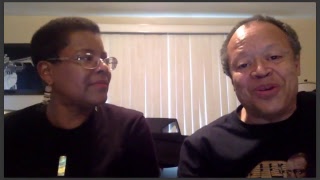
Tananarive Due and Steven Barnes discuss Afrofuturism's history and purpose, from Octavia E. Butler's influence to Black Panther's cultural moment. They connect the genre to contemporary politics and Charlottesville, then introduce an educational course package.
Questions this video answers
August 19, 2017
Tananarive Due and Steven Barnes
$300
www.afrofuturismwebinar.com (also referenced as afrofuturismwebinar.com)
10 weeks (self‑paced, one week released at a time)
Chapters
We have 19 registered.
It's not bad.
So that means if we have 10 people. That would be great. That would be great.
I am Afro Alien. But mine hasn't shown up yet. So we.
There's always a time lag.
Remember? Yes. It's okay.
Okay. The check.
Yeah, let's not forget that. Hi, people. I see you.
So I'm gonna deal with this down here.
Three of you. That is amazing. Let's see the top of my head here. There we go. We'll have an intimate group today.
They don't know just us. We're gonna tell you the real secrets since there's just us here. Okay? So if you're in there, make sure to say hello. Hello. There's Michael.
Hi, Michael.
Hello, Michael.
We were at the Leimert park book fair earlier today. Passed out a bunch of flyers, but probably people are still there. So not able to attend.
Diana Payton. Hello, Diana.
Hi, Diana.
Yeah, so. But the important thing is that we're doing this live for you guys and people be seeing it later on on YouTube. So you're. It's like you're appearing at a taping of a television show. So an intimate taping. Hello, Christine. Hello, Tom Barkley. Hello, Michelle. Tom has been here before. Tom is an old and dear friend. He is. He is true blue. He's a real ally. And we have Michelle and Michelle and Christine and Jennifer. And this is great. And we'll get you getting started in just a minute.
Did you learn the theme song?
No. You wrote a theme song? I'm always behind the curve. So hard you just move too fast. Shall we get going?
Yes. At 6:00'. Clock.
Okay, it's 6:00'. Clock. We're gonna get going.
Welcome to our Afrofuturism webinar. From Octavia to Black Panther activated. T'.
Challa. Those of us who are his intimate friends. His intimate friends get to call him. Those of us who have his email address. So it's a Barkley.
That is my Scott Joplin T shirt.
That's right.
From the Scott Joplin house when I was researching my novel, Joplin's Ghost, which was an amazing research experience. So anyway, welcome to all of you.
You were doing a sort of Afro historical piece of work there and you had something really strange happen while you're at the Scott Joplin house, didn't you?
I played the piano in front of strangers. That was pretty strange. I don't remember a strange thing happening.
Oh, you were told about a strange thing that happened.
Anyway, I'm Tanada Reeve, due I Am an author. Screenwriter. As an author, I won an American Book Award. Share with this gentleman next to me an NAACP Image Award. Just won a British fantasy award earlier this year for my short story collection Ghost Summer. And I teach at ucla. I was teaching Afrofuturism at ucla. Ucla, which kind of inspired this course. But this coming fall, I'll be teaching a black horror course called the Sunken Place.
Ooh. And we will be touching on those things in weeks to come. You know, there's those of you who've been here before. Oh, well, I'm going to be mystery man. I will introduce myself. Those of you who have been here before, you'll know there's always going to be something new, and we're always going to be covering some of the same material. You're going to be kind of covering some of the same things over and over again. But we really do want you to want to develop an audience that's used to talking to us on Saturdays. So my name is Stephen Barnes, and I. It has been my great pleasure to be a science fiction, fantasy, horror, and, you know, suspense writer for over 30 years right now. And over. Over 30 novels out there and television and stuff like that. And I've won the NAACP Image Award and the Endeavor Award, was nominated for Cable Ace Award. One of my television episodes won an Emmy. And it's.
It's.
You develop some perspective over those times. What I'm trying to do right now is to share as much as I possibly can of the things that I know. The specific purpose of our webinar is to talk about Octavia Butler, her work and how she rooted the Afrofuturism movement in many ways, really broke to the surface during her time. And then to also discuss the future. The future, and specifically Black Panther. So we're always going to anchor it with those things, but we are also going to talk about other things as.
An introduction to Afrofuturism. And hopefully, as you hear us speak, you'll understand why we're so excited about Afrofuturism and its power to chronicle and create change.
And we want to remind you to stick around till the end of the show because we're going to tell you how you can earn, how you can win a free copy, A free autographed copy of one of our books.
Any. Any book that either of us has written that you would like us to sign. We will give you one copy.
That's right. If you're among the golden few. So I wanted to start this just by talking about a movie I saw a Long time ago. And I was sitting in the movie theater with a good friend of mine, Dan Pinault, white guy of Hispanic origin. And, oh, she's sitting crisscross applesauce up on the piano bench telling my business. And we're watching the movie Damnation Alley. And in this movie, George Peppard and Jan, Michael Vincent and Paul Winfield are traveling across a nuclear wasteland in an atomic Winnebago. And they come to the ashes of. I think it was Las Vegas. And out of. Out of the ashes of Las Vegas comes the last woman in the world, and she's white. And I turned to my friend Dan and I said, they're going to kill Paul Winfield. And he said, what? I said, they're gonna kill him. They're not gonna pretend that he's not interested in this woman, and they're not gonna let him compete for her. So the only other thing the screenwriters can do is kill him. And Dan looked at me and said, you know, Steve, and you are so cynical, I just can't believe you sometimes. And about three minutes later, Paul Winfield gets eaten by giant cockroaches. And there it is. I mean, and that was, I think, maybe the first time that it hit me really hard. The first time it really gelled for me that there was something wrong. I mean, I. I had known that there were things that were wrong in the image systems in Hollywood, in film, but I hadn't labeled it quite so clearly. I. I think the first time I really recognized that there was something wrong. And I was watching one of a George Powell movie called When Worlds Collide. You know, the Earth is going to get hit by a planet, and so they build emergency spaceships to save all, you know, to save enough people just to start over again. And I watched as the spaceship took off, and all the people on the spaceship were white, all of them. And I thought to myself, they don't care about me. Nobody looking like me gets to survive. They've just killed off everyone who looks like me. And in my heart, I didn't think it was deliberate, which was even worse. It wasn't even a deliberate slight. It didn't even register with them that they were eradicating us. That in their fantasies, people like me were worth nothing, right? Not even consideration.
If I may segue.
Yes, please.
This week's events, unfortunately, on the political stage, have further solidified that idea for many of us who are people of color, who are marginalized, that, yeah, we don't matter when the President of the United States, so called, anyway, does not denounce a neo Nazi marsh. Holy cow. It's been quite a week. It's hard to believe that just a week ago, a little more than a week ago, we were worried about a nuclear confrontation with North Korea. And then this neo Nazi march in Charlottesville took the stage. And then our so called president fanned the flames of that by basically saying, hey, some of them are nice people. Just unbelievable stuff. I really have to. As a black person, I'm used to people not seeing the things that I see. But I can only imagine what it must be like. For instance, if you're a Jewish American and you had family affected by the Holocaust, right? And we think we've moved so far beyond all those conversations. But then the president won't say, Nazis are bad. That's not so hard to say. It's really not a hard thing to say.
So you know what hit me about what was going on was that there were a lot. I saw a lot of conversations on Facebook, I've seen conversations in the newspapers and magazines, on television concerning eradication of history. Well, I mean, the question of whether or not it's history that's being, quote, unquote eradicated by having these statues brought down, or whether it is a particular mythology. This is the lost cause, the noble cause of the South. Good people fighting for something that they believed to be worth fighting for, although it was the subjugation of another group of good people. I have enjoyed movies about confederates and appreciated their courage and this, that and the other. But the thing that hit me was that all these people talking about how important their history was to them. I remember that for years, all my life, whenever I was talking about the things that were taken away from black people, which would be their names, their history, their mythology, their religion, their language, all that stuff, what I kept getting told over and over again was, that's all in the past. Forget about that, get over it. Live here in the present. And now what I'm hearing is people just whining, these little snowflakes just complaining, you know, you're taking our history. It hurts, you know, the fear and anger around this. And I'm thinking to myself, wait a minute, are you saying that you were lying to me all that time? That history was important?
It's your history that's not important.
Should have said something. I mean, what exactly is going on here? Because if this is the baseline, if you're saying that this much pain, this much fear, this much anger, enough that people are killing people is triggered by taking down statues when there are 70,000 books in library of Congress that have to do with the Civil War, apparently. And there are countless more thousand stories, television shows and songs and other things that have to do with that era. Just doing this one thing, slicing this one piece of the pie, triggers that much. If that is the truth, then they should be able to say what happened to black people was at least a thousand times worse than this, caused a thousand times as much damage. If you're creating that baseline, then that's what's going on. But they won't say that. And so this is one of the reasons why the idea of reclaiming our stories of other people. Do not respect your stories. If they will not tell your stories, then you must tell your own stories. And that's what Afrofuturism is about. It's. You cannot rely on. There are so many allies, so many.
Good people who are today in Boston. Yeah, thousands of people. I've seen estimates of 12,000, 15,000, really counter marchers because there was a so called freedom of speech rally scheduled, right wing freedom of speech rally. And just the streets were swarming. I actually had tears in my eyes this morning as I saw the footage of the counter protesters. So it was a reminder that yes, we do have countrymen and women who care about us and are not trying to eradicate us for the future.
There are so many good people.
This is where Afrofuturism comes in. And watching all the protest footage over the past week has reminded me a great deal of my parents who were in the civil rights generation. My father is still living, not my mother. And my mother was the one who got me into watching horror. She loved horror. So from a very young age, I was sitting with my mother watching those old black and white universal horror films. The Mummy, the Wolf man, the Mole People, the Fly, all that stuff. And that's really where my love of horror came from. And over the years, I've come to realize that it wasn't just sort of like the wee. It's a fun way to be scared escapism. But literally that it was easier to watch those kind of films than to dwell in what her reality was, you know, which was one where she was always afraid of the clock turning back. I could hear her voice in my ear now. That was her favorite phrase.
My mom loved horror movies too. You know, my mom would have. We were pretty poor when I was a kid. We struggled to have kind of a middle class existence. But I clearly remember my mother just unable to pay the bills and having horrible nightmares of Being chased by Frankenstein's monster in the war Wolf Man. So she liked horror movies too, you know, the classic, you know, universal horror movies. And she would shiver. And I think that the horror labeled her to personify her more generalized fears. The real fear was being unable to pay the bills, being out on the street, or the fears that she had for me when she told me when I was 10 years old, Steve, if you let white people know how smart you are, they will kill you. You know, this was, you know, her version of the talk I just had.
I just heard it. You have to work twice as hard to get half as far right. I was never threatened with death if I was too smart.
Right.
But yeah, that's the reality of parenting.
Given the reality, even now, a lot.
Of us who thought that was over are realizing, oh, no, we still have to do that.
No, I think that what's going on right now is something that's very different.
You're not going to get killed for.
Being smart, not going to get killed for being smart.
Mouth right.
Or smart ass. I think that, that what's going on right now is we're starting to have the real conversation. It's not, you know, you have to be good and then you'll be able to have your piece of this little pie over here. It is now everything is up for grabs right now. The question of actually sharing power at the, at the highest level is up for grabs. And so we're fighting the same fight again. And there may be another fight after that, but right now, this is the realest it's ever been. And that's why it's, it's, it, it's hitting a lot of people. You know, things are worse than it's ever been. They have no sense of history.
No, it seems worse.
And we have noticed before now, and we have more allies. We have, there are more white people who are aware, who are not carrying the burden of that past with. They're not, they don't have any interest in that stuff. It's the question is what kind of future we're making together. And they were just as excited about Black Panther as we have been. Black Panther crashed the Internet. Now, you were talking about your mom. You mentioned your mom would have loved get out.
Yeah, yeah, yeah.
Well, my dad would have loved Black Panther.
Right. So they planted the seeds, but my mom didn't quite get to see the point where black horror was going to become a thing, which it is. It's going to be. It's not just this one movie teaching a Whole course on it. So there have been others, and there will be more to follow.
And my dad, who was not there to raise me, but when he did come, we would often go to see movies, and we would see movies Journey to the Seventh Planet and the Angry Red Planet and Seventh Voyage of Sinbad and Jason and the Argonauts, fantasy and science fiction, almost none of which featured anybody who looked like us. So I know that he would have gone nuts to see Black Panther. I mean, I know for a fact that my surrogate father, father Steve Muhammad, my beloved karate instructor, he had never seen the Black Panther trailer. He looked at that trailer, and what he said to me was, you know, they let him do this. I know. I mean, he thought that the Black Panther movie would be Black Panther surrounded by white people. When he saw white people surrounded by Black Panthers people, you know, just only two white people with dialogue, surrounded by what seemed like hundreds of Africans, it blew his mind. He could not believe that he was seeing this. So this is. This is such an exciting time. And remember, it's Disney, as conservative an entertainment company as you're gonna get, that made the decision to spend $150 million to create this image. So there are allies out there. The world is shifting. Don't you dare feel like there's no hope. There's no despair. It's just getting worse. Things have never changed. That is nonsense. Things are changing. And this is why the Nazis and the Klan and these people are so terrified.
Well, they're deluded. They're deluded. They've been living in sort of an alternate news universe. They didn't realize how far outside of the mainstream they are. Diane, Diana Rather Peyton had a question about the Confederate TV series. I'm not going to spend too much time talking about that, but the danger of not being aware of where you are in history is that you propose a show like this at a time when people who have been paying attention will see huge possible pitfalls and not very clearly see how to work around them. And then, boom, this explodes. Now, look, no one is saying that show isn't going to happen. We know one of the.
Although I don't think it's gonna happen, in my opinion, I think that it'll die in the cradles.
We're not insiders. HBO is still standing by the concept, but I think over time it will just become clear that we haven't moved far enough beyond this conversation, especially in the hands of perhaps this team, to be able to come up with a constructive way to look at that alternate reality. But art, you know, to me. Well, I'm not going to talk about it anymore. I'm not. I wish. God bless everybody, you know. But the purpose of this webinar is basically to show you why Octavia believed we could save the world together. Yes. Now, she's sometimes considered a pessimist by her own admission. When we interviewed her once, she was like. Was so cute. But. So, yeah, she gets that some of her work seems pessimistic, but obviously, I think on one level, if you don't believe you can make a change, why would you create the work in the first place? You know, so. So she did have that belief. And also why I would say that.
Her fiction was where she put her fear and her hope.
Yes.
That's very well said. And the purpose of this webinar is not just to familiarize you with Octavia's work. And Black Panther, we talk about that stuff every week, but also to contextualize the week's events and said, this is how all this stuff connects, and this is why you should have hope and.
To give you a map for how you can help save the world. That's really. I mean, not.
That's right.
That's what we're.
We are not going to bring up the stuff that's wrong without showing you how you can help set it right and that there is more joy to come.
Take. Take a moment. I'm sorry, honey. Take a moment and chat. Because there's always a little bit of a lag to. Please type just a couple words about why you're here at this webinar. I mean, what are you looking for? What do you want to know more about? Some of you are probably Octavia Butler fans, or you might be fans of my work or Steve's work. Some of you are writers yourselves, probably readers, certainly teachers. I'm assuming there might be a couple of teachers. If you could just say why you're here, what you're hoping to find here that will help us understand you better and help us improve our webinars.
Diana says I want to see t' Challa's bodyguards kick all the ads. There you go. You know, and just, you know, we. We're gonna jump around. We gotta. We got a specific agenda. But one of the things that I think is true. I want to go to the. To. To our. Our screen share.
Sure.
Because we've got. We've got some great stuff.
Get to type in chat. You have a chat function on the right hand side of. You don't know why you're here. Also tell us you don't.
And there's the picture. And I heard from women, white and black, that when they were watching Wonder Woman and the no Man's Land sequence came on and she jumped out there and was. It was running across into the machine gun fire that they were watching this with tears streaming down their faces and they were saying to themselves, I didn't even know I needed to see that. And it is my opinion that the exact same thing happened with the Dora Milaje and Black Widow when she stepped up there and said, move or you will be moved. Black women all over the place. Theater where I was watching it just applauded. It was like. It was just amazing that, that we have been starving for images of power to the degree that. That when these images finally started appearing on screen, we have been. We have been willing to settle for crap all these years for us being secondary for being depicted, left out, excluded, asexual, killed off. We have been. Will accept those images and we're not having to accept them anymore.
Let me go to the chat really quickly because we're hearing from some folks. Diana Payton is a writer. Yes. And wants to here listening to different points of view. I think that's great. I think there's a lot more that happening. I see that happening on Twitter where people are listening to each other more. And Christine is new to me as a reader, has some of Steve's books.
Thank you. You're the one.
So thank you for. For coming to learn with us, with us, to spend this time with us as we tell you about Afro future.
And remember to share this URL the octaviatoblackpanther.com we will be here every week talking about these things and we're going to take questions from you guys and requests so you can, you know, get in touch with us via Facebook. There are things you want us to discuss. We're open. We want to do this first.
I want to go to just the basic, what is Afrofuturism? You know, every time I answer that question, it seems to have a different answer because it's a vast thing. It's actually a movement. It's not just about books. It includes books, music like George Clinton or Janelle Monae. Sun Ra with Space is the place. It involves. A brother from another planet. John Sayles is not a black creator. Ryan Coogler, the director of Black Panther is a black creator. But the creators of the Black Panther were not black creators. So. So it's really collaborative, but it's Mostly driven at this point by black artists. And this picture is from 1997. Steve and I were both invited to take part in a conference at Clark Atlanta University called the African American Fantastic Explorations in Science Fiction, Fantasy and Horror. So let me go back. When you talk about Afrofuturism, there's a lot of emphasis on the futurism part. By my definition, it's really black speculative fiction. And speculative fiction can include fantasy, horror. It's not necessarily futuristic, so you can choose the definition that works best for you. But I was just so amazed to be invited to this event. Just by way of background, I really came into publishing on the heels of the success of Terry McMillan and waiting to Exhale, which really opened up publishing's eyes to the fact that blacks represented a commercial reading audience. So they were snapping up a lot of black authors. And I got caught up in that wave. I was not snapped up because I was a horror writer. I was snapped up because I was a black writer. And I could have been writing about horror, about relationships that probably would have been better for my career if I'd been writing about relationships, frankly, which often.
Seem like science fiction. Is it possible to have a healthy relationship?
Well, that's where my soul to keep came from. But that's another story. In any case, there I was. If you look at this photograph on the far right, you have science fiction pioneer Samuel R. Delaney, who was publishing as a very young man back in the 60s. Next to him in the Space Jam sweatshirt, Mr. Stephen Barnes, back when he had his stash, his mustache, Jewel Gomez, who is known for her Gilda stories, which was just reprinted.
Who is that cute little girl next to Jill Gomez and next to Octavia Butler?
I'm so skinny, I don't recognize myself. But that is Tananarib Du. Just so excited to be there. And next to me is the late and great Octavia E. Butler. And I'm so sorry, I don't know this gentleman.
Anybody who knows who that gentleman on the end is, would you please, please, please send us. Send us his name every week.
I don't know who this is, but. But he was a filmmaker, and we were all invited to Clark Atlanta University to take part in this. I did not know the word Afrofuturism then. I don't think any of us were using that term. It was dubbed just a few years earlier. This was 1997. The term was dubbed just a few years earlier by Mark Derry, who was a cultural critic, you know, and. But. But even before that term was coined, black Writers and artists have envisioned themselves in a future or a revised past. There's a great. Where they can escape, examine and postulate alternative social, economic, political, and personal tableaus. So whether you're talking about W.E.B. du Bois.
Yes.
Best known as a social activist and a co founder.
Got all these great screen shares. I'm gonna go back. I'm go back.
But W.E.B. du Bois wrote the Comet, and he really got down and dirty with it at describing all the dead bodies everywhere. He wasn't just playing around. And this wasn't the only science fiction story he wrote, but the only survivors were a black man and a white woman. So obviously it's an examination of what is it that makes us human and not just black or white. I wanted to change that beat to a couple, because that's pretty crazy. Yep. Boom. Okay, there.
There you go. Okay, there it is.
The English teacher in me could not resist that. So in any case, Afro futurist artists give us images of futurism as a lens through which to view and change the present. But never forgetting the past.
Never ever. You can't forget the past. And this is where the racists and also just decent Southern people who are looking at their history. This is where I have to sympathize with the. It is horrible to see what you see as being your past being taken away. But it's even worse to not feel like you have any past at all, no past that genuinely represents you, to see nothing of yourself there. So this is why Afrofuturism, you know, for. For white people, I think science fiction is almost like ice cream for us. It's gonna be like it's meat and potatoes. It's going to be literally saying, who am I? You know, who are we? What have we been all this time? If we're not these images in film and we're not these images in television, in books and so forth, that were created to nurture the other tribe's children.
Right.
Well, what are we? And we have to answer that for ourselves. We cannot stand up and reach for the sky.
I like to say that Afrofuturism is for everyone, because the comet is a great story. No matter what. We're part of America, but especially for those of us who weren't, well represented, say, in the original Star wars movie. Maybe we were literally erased, and I would say accidentally erased because George Lucas went back and corrected it.
That's right. Lando Calrissian, as soon as he heard. Heard. As soon as he, you know, as soon as people gave him feedback, he fixed it. But that's what you do when if you're saying, oh, I made a mistake, bang, you fix it.
And, you know, even though as a kid, I didn't notice, I didn't notice there were no black people in Star Wars. I was just blown away by the special effects. And I was Luke Skywalker. I was Princess Leia. You know, I have that ability to empathize with characters who don't look like. Because we all have that ability.
But you understand something. Black people had to have that ability. We had to be able to empathize with white people in ways that white people were not forced to turn around and empathize with us.
And Afrofuturism really does give all of us a great way to learn that empathy. Let's say if you're not black, for example, because we're painting a future that includes all of us, and it shows a pathway saying, I'm Asian American, I can draw inspiration from that, from Black Panther. It's only a matter of time. Trust me, after Black Panther blows away the box office, that all kinds of movies with Latina.
Oh, it's Asian. It's already happening. See, that's America. And as long as you can see the humanity in others, then that America is nothing to fear. As long as you can see that as long as you believe in human equality, it's all going to be fine. Women are going to be taking their full place in the spotlight. You know, gays, blacks, you know, people of color of all kinds of. We're all going to be part of this complex braid of humanity.
We actually already are. We're just not always reflected that way.
That's true.
You know, I had a great lesson in Afrofuturism and that power, Afrofuturism recently in Little Rock, Arkansas, where I had the honor of meeting civil rights activist Elizabeth Eckford, one of the Little Rock Nine who helped desegregate Little Rock Central High School in 1957. This photograph on the left of her being shouted at has come up again as people compare that photograph to some of the vitriol that we saw in photographs from the Nazi rally last Saturday. So the reminder is, wow, the past isn't that far away. Her tribute was right before my keynote talk, which was Afrofuturism Dreaming Our who Better to Lead? Where I drew on lessons from the civil rights past, as well as the work of Octavia E. Butler and other artists who use Afrofuturism to help create true life world building. So whether it's Butler's dystopian warnings about the future as she even foresaw the slogan make America great again. You know, she was really paying attention to Nichelle Nichols. Okay. On the. On Star Trek, on the bridge, she's a competent and capable communications director. On the bridge of the starship Enterprise to the long unsung women behind the hidden figures or the Afro fantasy world of mythic warriors and royalty. In Black Panther, all that inclusivity, once normed, can be applied across underrepresented groups. Afrofuturism broadens our vision of our world and our country, both past and present, and helps give form and power to social critiques and leadership models. This is what we really need right now, don't we ever. That can be applied in real life. It's both a powerful tool and a powerful way.
Yeah, I just want to say about that that I think that we have the weakest leader that. That we have had, that this country has ever had. This is goes step outside politics, right or left. I've never felt this way about any leader that we've had. Now we're going to find out our true character. We're going to find out who Americans really are. I do not have fear for the future. Barring some catastrophic action, I think we're going to be just fine. Because I think that America is not just a country, it is a story, it is a myth that is, I think, as powerful a story as you can possibly have that it says that human beings can live together with dignity and grace and power and love. And I think that that dream sometimes has exceeded our ability to actually achieve it. But it's there. It's there. You know, I've always believed in this. And I was taught that belief by my mom. I was raised by my mother and my sister, What they could not. And they gave me my humanity in a very real way. They gave me my heart in a very real way. God knows I love my mom and my sister, but my mom could not teach me to be a man. And my dad wasn't in the home. I had no older brothers. I had no. No uncles. I had no male role models in that sense. And so there was a real hole in my heart into that question, what is it going to take to be a man? What is it going to take to. To win the respect of the kinds of women I was kind of men I respect and the admiration of and to be desired by the kinds of women I desire. Just, just, just. Quite frankly, I look, you know, every. It seemed like all the other guys knew how to do this. What am I going to need to do? So I became addicted to images in film and television and books of macho guys. You know, guys who could kick butt, take names, get the girl. I mean, I was absolutely addicted to this stuff. I had to know how this worked. There is only one problem. Guess what? Every single one of those images that I was addicted. No, it was not that one. Let me find those images. Let's see. Yes, here we go. All of the images that I saw, whether it was James Bond or Tarzan or Conan the Barbarian or anything else, were white guys. And on the occasions when you did see a black man, he got eaten by giant cockroaches, or they would just absolutely demean them, Conan the Barbarian would enter into a town and be repulsed by the stench of Negroes.
This was in the novel, not the movie, by the way.
That's right. You know, when you talk about trying to rehabilitate, trying to rehabilitate Tarzan, it's kind of easy when the core idea in Tarzan was expressed by Edgar Rice Burroughs in Jungle Tales of Tarzan, as white men have imagination, black men have little animals have none.
So this is what you felt you had to read?
Yes, I was reading this poison. I was sucking this stuff down, like poisoned mother's milk. And I needed it in order to try to be a man. But in the process of being a man, I was literally being poisoned against my own skin color. And if you take a look at some of the other images, you know, just the images of fat black women, mammies, you know, in Gone with the Wind, Gone with the Wind was the dominant image system about slavery for almost 100 years. 80 years in America, up until Django Unchained and 12 Years a Slave. Finally, the truth about things started coming out, that there was this range of human relationships under slavery, and it was never good, but it was often horror. There was some decent. There were decent people, but there was also absolute human horror. Yes. This is what. This is what I suffered, right? This is what I went through, that I needed these things. And what I ask you, what I ask those listening to this, how many of you, in order to feed one part of your heart, had to poison another part? And I think that many of you.
You know, it's like, especially women in fandom, let's say.
I mean, it's like staying in a dysfunctional relationship.
You wanted to find strong women who weren't scantily clad for whatever reason. It's like, why is she wearing lingerie? You had to. You had to relate more to the male hero, you know, and that's. That's sort of what we've had to do as. As blacks. We have to sort of wire around our absence. And Afrofuturism is really giving a lot of us so much of an opportunity to. To see ourselves.
Well, I don't know about you, but the first time I saw the image of Wakanda, and in that. In that television commercial, a combination of the fantastic, advanced and the traditional. Yeah, it felt once again, it was. I didn't even know I needed to see this. I never even knew that I needed to see this. Because although I love science fiction, I could walk into a dozen different science fiction bookstores and see thousands of book covers, and all that was on them was white people and their imaginary friends. Okay? Octavia Butler, who was more successful than any black science fiction writer, she would have green people put on the covers of her books. You know, I thought that this was an accident, but when I finally, in my third novel, I find my first solo novel, I had a character was described as being as dark as a Zulu, and they put a white guy on the COVID So it was very, very clear that this was not an accident. That there were forces, market forces and psychological forces and sociological forces that were pushing back that literally, you know, people would say, well, you know, black people. I literally had one editor tell me, you know, I've heard actually more than once, black people aren't interested in science fiction. Not if they can't see themselves, not if they see nothing. We're more interested in science fiction per capita than white people are. We will go further to see images that do not include us. And apparently white people were, at least at that time, allergic to images that did not look like them or like they're wholly synthetic fantasies.
Right?
So I began to wonder, you know, was I risking my soul? You know, was I. What was I doing to create these images when people were whitewashing all my images to nurture white people? You know, I thought that, you know, do I dare begin to really push this? Do I dare go more deeply? For almost 20 years, I was the only black male science fiction writer in the world. And I was afraid that if I went more deeply into this, I would lose my career. And I talked with a friend of mine, a good friend of mine named Darnell Gadberry, and I voiced these concerns that. That if I did it, I could hurt my career. And if I didn't do it, I'd be betraying the little boy inside me. And what he said to me was Steve, eventually someone is going to have to start writing stories that include us in the future. If not you, who? If not now, when and why would you want to write stories for the pleasure of people you wouldn't want to have in your home?
Wow. That's powerful. Let's go to Octavia, because that's sort of what she was walking into. See herself in any of the works? So she wrote herself in. And I'm so glad she did because she's served as an inspiration for so many people on so many levels. I want to talk about something that on a personal level, after Election Day, for me, like, maybe I'm talking about last November, in case you blotted it out already. I was in a state of shock. I really could not believe what was happening on my Huffington Post screen. I kept refreshing it, expecting different results to pop up. And finally, my sister, who is a lawyer at cnn, had to walk me through on the phone and say, there's no path to victory. I still hear those words ringing in my ear because it's like, what? What? Some of us are still saying that all these months later. And it was. It was. It was looking at Octavia's work, actually remembering, because I was teaching Afrofuturism at the time at ucla. And so all this work was really fresh to me, especially a parable of the Sower and those earthseed parables. All that you touch you change. All that you change changes you. The only lasting truth is change. And while those parables gave Lauren Olamina, the protagonist of Parable the Sower, the clarity of vision she needed to be a leader, even as a teenage girl in a landscape even worse than ours, Honestly, not much worse, rapidly less worse, but still worse. Still worse. We all have to agree it's still worse for most of us. But that gave her strength and that gave her inspiration. So, of course, that gives me strength and gives me inspiration. Of course. This is a pendulum swinging back the other way. The only lasting truth is change. It gave me the courage to start journaling, to start working on an essay that admittedly took me so many weeks to write that I didn't have it finished until Inauguration Day. But I was able to publish it on Inauguration Day. An essay on how to use the lessons of Octavia Butler and the civil rights path to forge a path toward real life world building, which is what we're having to do. People are taking to the streets. Some of you who are artists are going back to your art. It's so important. And she has been such A beacon in that way. The world unfolding before my eyes now, you know, still isn't as hard as Butler's world. But she does help us, through visualization and imagination, cross that line from fiction to reality in a proactive way and create hope even when times feel hopeless. Speaking of which, last spring I was invited to a wonderful program called Black Women Rise in West Palm Beach, Florida, and Dr. Angela Davis was one of the speakers. Former political prisoner, activist, beacon, and now. She's fierce in her work, but gentle in her demeanor. And I asked her how she carries so much light in all her face, in the face of all this hardship she's faced personally and the ongoing hardship and the work of change, especially now. And here's what she said. And I think this is something that's very important to remember in general, but about Afrofuturism in particular, she said, if I'm optimistic, it's not because I see the world through rose colored glasses. And as an aside, that's what we're moving away from culturally is the rose colored glasses. Let's see the world for what it is, not what we think it is or what we want it to be. It's that if the work we've done for so many decades, decades and hundreds of years will make the difference in the future, we have to be able to imagine the different future, even though there are no guarantees. But in order to do the work we do, however we do it, whether as artists, as activists, as judges, we have to believe that a different kind of world is possible.
We have to.
And if you look at something like Black Panther now, moving away from her quote, you're saying, wow, there's so much excitement over this. It's just a fictitious character. It's just a movie. Is it really? Is it really? You know, I was one of those women who was so electrified by the. Dora Milaje. This is Florence Kasuma. I looked her up on the Internet. I was like, who is this woman? She spoke for 15 seconds in the movie and I walked away like a fan for life because it was, it was that powerful. One of my co workers said she didn't think she could go to work the next day because that, that strength was just coursing through her based on, based on that experience. So Wakanda, like Steve was saying that that juxtaposition between the ritualistic, like the spears that you see and that kind of thing. Let's look at the group photo. Oh, no, this is a good one.
Okay.
In Wakanda, you see that Juxtaposition between the. The old, the ritual. We have tribal scarring on Michael B. Jordan here, and then the futuristic with the futuristic looking craft. And that is really the visual definition of what Afrofuturism is. It's a future built upon the acknowledgment of the past. We move forward without forgetting. You see, we're living the toll of forgetting right now. We're living the toll of forgetting.
We're living the toll. It's not just forgetting. Of having had experience. Erasure.
Yes.
Of people who literally controlled our mythologies and our histories to their own benefit. The thing you have to remember is slavery is the process of turning wolves into dogs. It is the domestication of human beings. You have to get them to forget what they used to be. That's the only way it works. It's the only way it works. So they actually had to control the image systems so that we would be stuck in what's called a neotenous phase, never maturing beyond adolescence. What's going on is we're creating a generation of kids right now who are actually maturing to full adulthood.
Waking up.
They're waking up. You know, I was. God, I was 14 years old when Black Panther first appeared. 1966. And I. It blew my mind to see, you know, this, this black man, African, create an advanced piece of technology and have him beating the hell out of the Fantastic Four. It was just amazing. I mean, I was thrilled. I didn't even. Once again, I didn't even know that I needed to see this.
Right.
And as soon as I saw it, it was. I felt like I was starving, you know, looking at Wakanda, this, this, this hyper advanced civilization. And I, I have to. I have to give it up. Stan Lee and Jack Kirby, two Jewish comic creators who had seen the horrors of World War II and they understood the cost of erasure. And these two men literally sat down and said, why are there no black superheroes? Why not? And Stan said, let's create them. And Jack Kirby created Black Panther. All I can say is, God bless both of them. That is being an ally. That is seeing the humanity in other people and grasping that you're giving things to your children that other people's children lack. Now they started trying to make black superheroes, and they did. Blade, you know, of course. But the road to Black Panther was a tough one because in order to do this right, they had to get it right. What director could they possibly use to. To get this to the screen? Well, could they use a white director? It'd be difficult unless that director had already proven themselves. It had to be a director who could both handle the images, understood the culture, understood the importance of this, but was also commercial. So what arose was a young man named Ryan Coogler who did a movie called Fruitvale Station about his conscience. About as woke a movie as you can possibly get. And although it didn't make a lot of money, it got on the radar. And he was able to use the leverage from that to do a movie called Creed to create a script that he was able to take to Sylvester Stallone, who's about as conservative and white as you can possibly get. And Stallone took his 40 years of cultural capital and put it in Ryan Coogler's hands. And he made the first movie that has ever gotten across the hundred million dollar mark with a black hero who has a love scene. That's the first time it has ever happened. And so what we're seeing is there are allies everywhere if you can prove yourself. And the way to get movies like Black Panther is to be able to, to support the artists who are making little movies like Fruitvale Station or are writing books or creating other things like this. This is, this is what Afrofuturism is about, is understanding the entire, the entire range of what's happening here, how it evolves, how it's rooted, where you can be a part of it. Because if you're seeing the pain of wondering where our country is going, you can take that pain and turn it into wonder and you can turn it into growth simply by either creating your own work or sponsoring the work of those who have the vision. This is what you can do. There is absolutely no reason to despair. There is every reason to feel that our hearts are in good hands with the kids that are coming up now and some of the masters who've been working for a long time. It's not even, not even talking about my work or Tononari's work. I'm looking at people like Nnedi Okorafor, and I am saying, you know, the future is in good hands.
N.K. jemisin, too, is coming up and her fifth season, the novel, the fifth season, is in development for television, like Nettie's novel, who Fears Death, is in development for television. So believe us, we are not exaggerating when we say that there has never been a more exciting time for Afrofuturism, for the artists who create it and for the. Those of you who appreciate it, who like something different. I know I do. So, yeah, in our conversations with Octavia and reading through her work, we know how strongly she believed that the most endangered. The thing that most endangered humanity was our tendency toward hierarchy. We're very hierarchical and our tendency to believe we are higher on the hierarchy of value than others.
I hope you can see how this happens with racism, with sexism, with homophobia, with cultural elitism of all kinds of. Considering humans are more important than the rest of the biosphere. This is a primary poison which must be addressed if we're to save this planet.
We are literally poisoning ourselves.
We are emotionally, physically, spiritually, politically. But we can take control by taking care of taking control of the stories that we use to organize our reality. There is A quote from Dr. Martin Luther King and it speaks to the fact that. That the artists. Well, I had to pay a price for beginning to speak my truth in the arts. But it's not as high a price as those who have come before paid for that same truth. Dr. King said that we have some difficult days ahead. But it doesn't matter to him because he's already been to the mountaintop, that he understood that he could not get into the promised land.
You're not going to do the voice? No, I don't have to do the voice.
Otherwise, no, no. I would give it a shot, but I. I couldn't do it. I couldn't do it justice.
But there's a reason, you know, this is one of the. The best known speeches by Dr. King. And the sentiment resonates so strongly because again, he was speaking as an Afro futurist and an Afro futurist who also knew that his days were numbered. This was not hyperbole on his part. He had been. Already had an. He had had an assassination attempt already. He knew his days were number. But when you go up to the mountain and you look over and you see the promised land, that is a promised land for all of humanity. That doesn't mean necessarily for me, but maybe my son, maybe my stepdaughter, maybe my grandchildren.
And the point here is that you're not. You can help change the future. You can live King's legacy and you can support his legacy simply by creating the art, by supporting the artists who are creating the images that fill in the gaps, that allow people to understand their past, understand survive their present, and dream about their future. You fight lies with truth and you fight nightmares with dreams.
Yes.
You know, I. I bet some of you may be feeling like you've been drinking from a fire hydrant. We've given you a lot to think about right now. And just kind of take a deep breath, Take a deep breath because you're seeing all the things that are happening and all the wonder and hopefully you're having a sense of where Octavia was coming from, where Chip is coming from, where Tananarive is coming from, where I'm coming from. And understand a little bit of where this comes from. Because now you're understanding what art is, taking that passion and combining it in pain and combining it with skill and having enough hope to feel that if you speak your truth, you're not going to be dragged out in the street and beaten. You know, you're going to be able to support your family. And you might be asking the question, how can you be a part of this? Well, Tononarive has, you know, Tenoni and I have lectured all over the country and internationally concerning Afrofuturism. And our question was, how can we take what we've been doing to teach people what this is so they can be either, you know, more responsive audiences or more conscious artists? And. But, you know, you might not be close to UCLA and you might not have 3, 4, $5,000 to take these classes. And that's what it would cost you if you were taking all the classes. So our thought was, what can we do to make this more available?
If you didn't know that W.E.B. du Bois was. Was writing science fiction, you know, or you didn't know that Janelle Monae and her music was an Afrofuturist, there's just such a deep wow, and it's all connected. And there's so much legacy there when you talk about Afrofuturism. So we wanted to think of a way to bring that course to you.
And what we've done is we've created something that's very special. And what we're hoping is that it will be all right with you if we took a little time and actually described what we have done to create something that does not require that you change your life around or break your bank. What can we do to actually take the combined, almost, you know, 75 years of knowledge of writing, knowledge that Tananarive and I have, and put it into something that you can appreciate. And with your kind indulgence, we want to talk to you about that just a little bit. What we've done is we've created the Afrofuturism class and it's a 10 week workshop and it covers so much and I'm feeling so proud. We're so happy with what it is that we did because we covered so many things in a really easy to absorb, fun form. Just downloadable classes.
Yeah, this is a representation of a class, but it's all digital download and we say 10 weeks. That's 10 weeks at your pace.
That's right.
You get one week at a time. If you don't have time to get to it that week, you get to it when you can. But basically it's like what we are doing here. We lecture for part of it. There are you will read, you'll say, watch Jordan Peele's Get Out Again.
Listen to music by George Clinton and Janelle Monae. You'll read works by Octavia Butler and.
Chip Delaney, Nalo Hopkinson. I mean it'll really. It's an overview course. So.
And each class has a special guest. Yes, we opened our Rolodex to find the very best people out there. So it's not just us that's talking to you. Like we go, we have Luke Cage, showrunner Cheo Hadari Copy.
He's our first guest.
Our first guest. We had Nnedi Okorafor. We have director Reggie Hudlin. We have real life superhero Brie Newsom.
Who went and climbed down and took down the Confederate flag from the South Carolina State House before it was fashionable.
Nalo Hopkinson and John Jennings, the graphic artist and scientist Natrice Gaskins. This, you know, week after week after week, we're bringing you these things. And if you were taking this at Tananarive's UCLA class, it would cost you almost $1,300. The next thing, some of you want to go into writing.
Yeah, I saw that there were writers who were also on the list.
And so what we've done is we've created a full, what we call revolutionary writing class. And the revolutionary writing class has lectures on what is revolutionary art, self care, Writing in the midst of despair, Writing the Other. Yes. And we once again video interviews with Zack Stintz from Thor and X Men First Class, Effie Brown from Dear White People, Daniel Jose Older from shadowshaper, Niecy Shawn and Kate Tempest Bradford writing the Other.
For those of you who aren't black and you're like, well, I want to create more inclusivity in my own work, but I'm a little nervous about mistakes.
For feminism, for gay rights, for gender issues. We're all over this stuff. We've got it. Some of our best friends and people who are willing to share. It'd be like sitting in our living room listening to us having intimate conversations with the people, with other artists, with people we trust and who trust us people will tell you the truth about what the writing life is, what the artistic life is. And I'm telling you that once again, if you did this at ucla, you would have to take the time and the energy and it would cost you about $1300. We, we went beyond that. We, we created a webinar, a standalone. The three biggest mistakes that new writers make. And it's just packed with the things that, my God, if I had only known this stuff when I started my career.
This one doesn't even have homework at all.
That's right. So every week you'll be getting an email from us.
No, but for this webinar, it's just a 90 minute standalone webinar where we share.
That's right. So you'll get the link to the download, you'll be able to absorb it, it, take notes from it, start putting it into your work. Give it to the people who, you know, who are creating work. I mean this is, we're doing everything we can to deliver on our promise of helping art change the world. But we cannot do this alone. We need your help.
And it's not just the art, it's the artist that we want to be concerned about. So that's why we have an emotional care package.
Some of you know that one of my other hats is being a life coach. And I also have a master hypnotist certificate and worked with neuro linguistic programming and high end stress clinics. So I created the. I chose the cream of what I've been doing to help people that I've been, I've been, I've been paid $1,000 an hour for consulting with people in this particular, in this particular way. And they. Focus and flow program Smash writer's block forever. The ancient child connects you with your heart, helps you heal your heart. The Fear Program, the fountain of energy for active response is the acronym how to turn fear into power. And then to help you calm yourself down at night after a full day's work in the midst of the kind of stress that is killing people right now. The Warrior Sleep program. Easily worth $240.
These are all digital download.
It's all digital. You'll be able to have them. You can have them on your phone, you can watch them on your iPad, you can watch them on your computer. The total value of, of all this put together would easily be $3,000. That's, that would be the retail price. But we don't have to support an infrastructure. That is the beautiful thing about what it is that we're doing. But I asked you. So we're not gonna, we don't have to charge you $3,000. But let me ask you a question. If we're right about this, if art can change the world and we can teach you how to create art and how to support art, that would help us change the world, wouldn't it be worth $3,000? I mean, that's the, you know, if, if we were right about that.
Yeah. Okay.
And if just one of the hundreds of ideas that we are going to present you with and the support that we can give you on our social media forum, you know, could help you to, to sell your first book, sell a couple of short stories, wouldn't it be worth $3,000? Even though we're not going to do that now. So I just ask you, do you see the value in being able to take control of your lives in this way? Because the truth is that we're not going to charge you $3,000 or $2,500 or anything close to it. We're going to have. With a 100% money back guarantee. 100% money back guarantee. What we're going to do is it's only $300 and you can get it at www.afrofuturismwebinar.com.
That'S actually less than we charged for the Afrofuturism 10 week course alone when we were.
So this is, this is everything.
Lectures, different artists, music, lemonade. With Beyonce, we get to talk about that. I mean, just, there's so much to Afrofuturism.
It's basically an education in a thousand years of mythological history and in the last century of art in a box. And we put it together for you in a way that you can just absorb it and have fun or you can dig into it and get to work. So, you know, this is, this is. We don't know how to make it better than this. We don't know if you.
And there's a lot there, you know, like I said, you do it at your own pace. So there are 10 lectures for Afrofuturism, six lectures for the revolutionary writing course. You do those as you can. They may last you through the rest of the year or beyond.
And what I can tell you in all honesty is that when I started my career, I would have given anything, paid any price whatsoever for the information in this course. I, you know, just, I traveled the world. I mean, I traveled certainly the country. You know, I would drive a thousand miles to spend five minutes with someone who could Answer a question.
You are great at finding teachers.
That is absolutely what I did. And the cream of everything that I've been taught about how this works, how consciousness and art all fit together, are right here. And we would love, we would love to have you join us. We never wanted to be gurus, but our parents gave us everything. Tananari's mother and father poured everything they had into their children. My mother killed herself raising us. And we were both taught to be part of a chain, to take from the link above and pass to the link below. And that's what we're inviting you to do, is to be a link in that chain.
And let's not forget the free book.
Yes. Well, that's the other thing. We promised that if you stayed to the end of this, we would tell you how to get a free copy of one of our books. And so the first five people who order the Afrofuturism webinar before midnight tomorrow night will be able Sunday will get a free copy of any of our books that are available at retail that.
We will sign to you.
We'll sign it to you. You know, if we don't have it on our shelves, we will order it from Amazon for you and mail it to you. And that we've been having a lot of fun doing that. Www.afrofuturism let's go back to the video so we can see people, people and also.
Not cover. We don't talk a lot about our own work when we do this lecture.
So what are you working on?
I am very excited. I just recently sold a short story adaptation of a novel in progress. I've been working on this novel, probably close to four years now, a lot longer than I'm used to. Those of you who are readers have noticed probably there's a little bit of a lag because I'm doing more teaching and it does take more time. But I bit off a piece of the novel to write as a short story and that sale has really boosted, you know, the wind in my sails to keep going with the novel. So I'm excited. I'm hoping to finish it by the end of the year.
That's very cool. I have my novel 12 days just came out. We've been getting great reviews and you can if you've read it, please post review over on Amazon. We've got a bunch of them over there now and more and more all the time. I'm also almost finished with 120,000 word novel that is connected to two books that I wrote 30 years ago with Larry Niven and Jerry Pornell, my mentors coming into the field. And they have been wonderful just in terms of helping me in my life. And it is my real honor and privilege to be able to give back to them by helping them create what will be one of the crowning achievements, certainly of our collaboration. I want it to be one of the best books that any of us has ever done because that's how you repay the people who came before you. Aside from that, we were in development on a television series over at Fox. We are. We were. We were. So that didn't work out, but we got paid, which is nice. So once again, if you have any questions that you would like us to answer, we've got a couple. We've got a few more minutes and we will answer any questions about anything that we've been talking about here. This is your opportunity to interact with.
Us as a little free extra. I'm over here looking for the link to the Inauguration Day blog I wrote about how using the work of Octavia Butler and remembering the Civil Rights Pass can give us the tools to move forward in the. In the battle ahead. I think we're now a little bit more clear on what that battle looks like.
Yes, unfortunately. Absolutely.
Any questions from you before we go?
Because if you don't, then we're going to get into our evening and I'm hanging out with my son or maybe go out and catch a movie, something like this. But what we really wanted to do is we wanted to have this time with you and subjects that you'd like us to cover in our future episodes because we're going to. We're doing. Be doing this every week. They're going to be certain aspects of things. Inviting you to the Afrofuturism webinar is going to be constant but talk. But talking about Afrofuturism and talking about Afro fantasy and current events will be different every week. And any subjects that you have that you would like us to discuss that are connected with these things, we will be happy. Happy to address.
Right. Well, no questions have popped up.
No questions have popped up, so we.
Will assume we have answered them. But thank you for staying. I know if you're on the east coast in particular, it's getting late. If you're in Boston, Power to Boston after a great protest today. Oh. When you deal with Fox or publisher, are you still using an agent?
Absolutely. You definitely use an agent. If you don't have an agent, you, you as a lawyer, you do not want to be navigating Those waters by yourself. You want. You definitely want to have somebody looking at those contracts. No question. Appropriation. Okay. So the question with appropriation. Would you. Would you like to touch on that?
I mean, it's. I was just listening to Paul Simon earlier, and he had some great other cultural influences in his music that really enriched it. And I'm thinking, hey, nowadays, you know, a lot of people would talk about that as appropriation. Something like, you know, sometimes you feel like you're damned if you do or damned if you don't.
He brought Lady Smith Black Mambaza over.
On the stage with him. Yeah. So how is that appropriate? Right. You know, so perhaps not. The word means different things to different people. If you have, let's say, a lot of white American characters who dress in Native American garb everywhere they go. Oh, Firefly. Great example of appropriation.
Yes, it was.
There were no Asians in that search.
But, you know, there were no Asians in the series. It was very clear that there were Asians that were supposed to be. River Tan is very clearly supposed to be Chinese. They were speaking Chinese. China's supposed to be a huge influence and all. And it was not a single. I think there was one Chinese character who spoke one line of dialogue in the entire series that's appropriate.
I loved Firefly, but that is an example. You know, if you're going to sort of talk the talk, you have to walk the walk. So if we're envisioning a world where Asia has a major influence in the. Or the universe, rather, and there are no Asians having a major influence on that universe. Yeah.
What a concept.
I think that's. That's what it is. I think appropriation happens when writers take, what, a half a step toward inclusivity, but it's not a full step. It's the garb of other cultures. It's. It's the using other cultures, like.
Using them like a society, but without.
Creating a character who is also a part of that culture to help bring it to life. So I think as long as you have more inclusivity of characters in your work, then you can avoid some of those pitfalls of appropriation.
Great. Well, thank you so much for being part of it. Remember, afrofuturismwebinar.com we are just eager to have you join us, and we're so grateful that you're taking this time on Saturday to be a part of this. Send us your questions, things that you want us to address, any questions that you have about the course. Join up. Let us send you autograph copies of those books.
Yes, absolutely. So you take care and have a great night, everyone. And things will get better. Things are already getting better.
Absolutely. And you are part of it. We are living the Afro future right now. Take care.
Bye. Bye.







