BlackPantherAfterAction
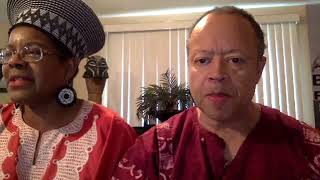
Tananarive Due and Steven Barnes discuss Black Panther's cultural impact, world-building, and characters. They analyze Killmonger's tragic role, celebrate the film's powerful women, and situate it within Afrofuturism and recent Black cinema.
Questions this video answers
February 20, 2018.
Tananarive Due and Steven Barnes.
Chapters
And we're live.
We're live. Hey, there. We're here with Tinanarib Dhu and Stephen Barnes. Yes, yes, yes. You introduce me and I introduce you.
Okay? So, in any case, welcome to the first official United States Wakandan Tribal Council. But you are forbidden from attending this council unless you have seen the deal.
That's right. Do not watch this film, do not watch this review. Because we will be telling secrets here. And it is very important that those of you who have not yet seen this documentary called Black Panther.
Yes. You are not permitted to attend the meeting unless you have seen the film.
Absolutely not.
That is all.
Okay. It is absolutely the truth. It is the truth. You look very beautiful, by the way. My queen.
My friends. My king.
Ah, my.
Okay, well, we won't do the accents the whole time.
No, of course not. No, actually, we're doing an accent now. We've actually been Wakandan spies for quite a while.
We're gonna put on our fake American accent.
I have a very, very good American accent.
I'm as good as Idris Elba with my American accent. Okay. So welcome to the Wakanda Council meeting. We have been dying. Oh, my God. It's been awful.
By the way, share this. Your pages, please. This is just pure fun for you guys. We got no agendas other than to share the love of what's going on right now and what I consider to be a really important moment in American media history.
And also, it's an international cultural event. I am seeing tweets from literally all over the world. The Stephen Biko Theater and South Africa was having a showing. So how meaningful is that? If you were in the anti apartheid movement, just all over the place. In Brazil, there was a black women screening. And they all look so excited.
Absolutely. In Lupita's hometown, you know, they had screenings and I have not yet seen. Before the movie came out, there were Africans who posted videos on YouTube showing how excited they were. But I have not seen their comments after the movie was made. What I'm hoping is that they are can forgive the inevitable flaws. It's just a comic book movie. That's all it is, folks. But on the other hand, it's also so obviously and clearly a labor of love.
I have not heard that many people talking about flaws. Mostly what I hear about is people saying how many times they've seen it, who they saw it with, pictures from the screenings, where they saw it. There's still a lot of celebration. I think for some people, it'll be till the fourth or maybe fifth viewing. Now listen, so they can start thinking about it super critically.
I believe that this movie is good enough that, you know, if I have some things to say that are talking about, well, they could have. This could have been stronger. This could have been stronger. Please understand that in the context of. I think I'm looking at a miracle. Not just that the movie exists, that people are willing to put $200 million worth of resources into it, but that it has earned $218 million in its first four days. Which means that it has been totally embraced by our culture, by America, by. It's being embraced by the world because it was $160 million coming from other countries. But it's. That it is wonderful that it was made and that there is now a celebration of people. Black, white, male, female. And there are conversations going on that are of a quality that I have never heard connected to just. Just a piece of popularity. This is not Schindler's List. It's not the Sorrow and the Pity. It's not something that is, you know, oh, we're gonna go see this. So that we can be uplifted or we can agonize or feel guilt. It's a comic book movie. It's superheroes.
Everybody's feeling uplifted. I don't know what you're talking about.
No, I'm saying that its primary purpose was to entertain, not educate.
Well, I would say, knowing director Ryan Coogler, that there's probably a little of truth in both approaches. He definitely was here to entertain. Yes, but he brought his textbooks also to educate.
Entertainment is the carrier tone. Without entertainment, you make. No, you cannot educate. So this is a learning experience. I think everybody out there has causes, has politics, has philosophies. And this movie is a textbook example of how to do this. So even if you're not into the Afro futuristic aspects of it, what we're going to be saying to you is something that I say frequently, which is take whatever you're passionate about. Take first, entertain with it. Then you have people sitting there willing to look at this. And they will absorb what you're trying to say if you simply present it. So just.
Go there, back up and frame this moment of celebration. It's been a long time for many of us since we have felt celebratory. We're having some tough political times. There's a lot on our minds. Let's just say even right before the opening, there was this terrible shooting in Parkland, Florida. One of my dear friends taught at that school. For many years. So I actually went to that school to address an English class about writing at that school many years ago. So that really just snatched some of my Black Panther joy. And I didn't want to share too much because I didn't want the snatching of my joy to bleed too much over to Steve. I was blessed. I had already seen it. Anthony Breznican from Entertainment Weekly magazine was my host and offered me a plus one so I could see the Hollywood premiere. So I had to keep quiet about this movie for more than a week. I told Steve, this is the only spoiler I gave Steve. I allowed myself one spoiler. I said, honey, at one moment, Martin Freeman's character, after the interrogation scene, is going to go up to t' Challa and touch him. Now, in my memory, it was a touch like this. Actually, it was more like this. And I said, and the looks they gave him. And I left it at that. I didn't even talk about Okoye threatening to impale him or any of that. I just said he touched him. And what a scorching look he got, just so he would get just a whiff, just a whiff of what was going to be coming up in Black Panther. I have seen tweets from the Atlanta area where some of you haven't seen it. I know my Uncle Walter hasn't seen it. It's been sold out in many theaters. I've seen theaters where every single film playing was Black Panther. You said every 15 minutes.
Every 15 minutes in some theaters.
And they're still sold out, still can't find seats. So some of you, and you really shouldn't be here if you haven't seen it. Go away.
Go away.
You are not welcome.
We will be back and we'll. This will be up on YouTube later for you to take a look at. But we want you to be able to enjoy it, and we want to be able to celebrate and just talk about it. You just be able to share it with other people who are excited about it. You know, to me, I.
It's an international party. If I could just go back to the framing one minute before we get to the film. If you took the. For a lot of us, the Obama inauguration, for some of you, a Star wars opening, like a much anticipated Star wars opening. I don't even know what the other equivalent would be, frankly, because it's been since the inauguration, actually, that I've seen this kind of celebration in the black community.
The way I put it is it's Star wars times Roots Yeah, it feels that way. It really is. As a piece of popular entertainment, it's simply wonderful. But also, myth is important. I mean, I would not. I could not have spent my entire adult life creating fiction unless I thought that there was something powerful and positive there. My mother raised me, my father raised me. My community raised me to care about the world and to try to contribute something to it. And I felt, you know, that there was something about just telling stories about human beings struggling to be good in the face of stress. And I've tried that over and over and over again. And if I did not, I could be wrong. But it is a sincere and honest mistake if I'm making it. But I don't think I am. I think that we crave these images. It does matter.
Absolutely matters. And Black Panther is a great example of that. When you see this epic work of afrofuturism with a $200 million budget behind it. So you get not only the vision, but you get black excellence across the board. You bring in a costume designer and Ruth Carter, you bring in a great cinematographer, you bring in a great director story who pours over it and tries to get it right. Because there's a lot resting. Everyone seems to understand that there's so much resting on Black Panther. It has that feeling like it's meant to matter.
Well, it was. Unfortunately, it was carrying an entire continent's dreams on its shoulders. I mean, Africa has been truly ill served by the fiction of the West. You cannot expect Group A to represent Group Baby as well as Group B can. And because of the stresses that have existed in our historical interactions, I don't think we need to go into that. The entire movie deals with it.
It's a lot. It's a lot.
It is a lot. And we're gonna get there as soon as we start talking about the movie.
And this idea of bridging cultures. Jelani Cobb had a great article in the New Yorker about Black Panther. If I could pull up the title real fast for myself. It really talks about that disconnect between Africans and African Americans and how Black Panther really helps to fill that void called Black Panther and the Invention of Africa. And what he tweeted was, yeah, Wakanda is real, but neither is the Africa as depicted in our cinema. Okay, that's not real either. Or in our history books, frankly. That's not real either. So we get to create a myth that isn't real. That gives us sustenance.
Absolutely. I saw a quote on one page from someone who was trying, I think, to Be positive, saying that certain images in the movie had to be the way they were because post colonialism, there was no Africa except in religion, relation to colonialism. And that is totally exaggerating the impact of colonialism. As terrible as it was, as terrible as domination of any kind is. You never completely remove the humanity of people, even American slaves. You know, you did everything you could to remove that stuff. And some aspects still remain.
Yeah, I look today, there are a lot of joyful dances. Even Steve just showed me some little girls dressed up like the Dora Milajah doing a dance on Twitter. I saw another group doing a dance. And I'm sorry, those dances look so African step shows look so African call.
And response in music, in and around.
And we had so much taken away from us. And yes, some of us are living in ignorance and some of us don't know a thing about Africa and really need to learn more. But at the same time, enough remains that we're all just electrified, so many of us, by this sense of connection.
Well, listen, let me give props to Wesley Snipes and Blade, especially Blade deserves love because Blade was first, you know, and Blade did some wonderful, wonderful things. But Blade was not a black film. It was a white film with a black lead. There was one, one or two black people. Everybody else was white.
Right. So. So. And you'll hear this from trolls who all of a sudden love Blade. I don't know who knew that Blade was the favorite film of so many trolls because they try to dampen the story.
Amazing.
Or what about Hancock, where the movie fell apart. When Will Kiss. When Will Smith was supposed to kiss. Charlize Therapy. I guess starting there. Blade was not set in an African utopia that had never faced colonialism. There's no. I give props to Blade as well.
Yes.
But you can't take your children to Blade, and Blade is not set in Wakanda. And those two things are very, very important to Black Panther.
I think you could actually say that when people were asking, why are people so excited about Black Panther? I think that the biggest reason, the reason I put my finger on, is that t' Challa has exactly what was taken from American slaves. He has his family name, his language, his religion, his spirituality, his culture, his land, his autonomy. You know, these are the things that you. Slavery was the act of turning. Of domesticating human beings. Turning wolves into dogs is the way I put it. And if you look at the difference between a Timberwolf and a Chihuahua, you'll know what they were trying to do. They didn't manage to do it. Because what you have is not just black talent coming back up, but also white people who do not have an investment in protecting the past, saying, you're our brothers and sisters. Tell us your stories. This is what's going on right now. They're saying, tell us your stories. And they're voting with their dollars.
And it's a terrific story. It's well put together. Can I talk a little bit about the experience of seeing it? Because I was at the Hollywood premiere, which is always so exciting, even when the film isn't that great, because cast is there and you can feel their excitement. In the case of Black Panther, where you knew you were watching something historic and the cast was there, it was almost unbearably exciting, frankly. And there were. And I was sitting next to a railing, and there were several moments in the film where I felt I was going over the railing. Like I was literally levitating and floating over the railing. That would have to be if you have the score, which I highly recommend. The soundtrack is Kendrick Lamar. That's awesome, too. Especially if you're a Kendrick Lamar fan. But I'm talking about the score that actually accompanies the film. The moment called Wakanda, where Wakanda unfolds, okay? And the art direction and all the decision making gave me that sense of falling I had seen some of in the trailers with the women dancing and all that. But, wow, the arrival in Wakanda was one of those over the railing moments for me.
I think that his moment where he says, I never get tired of this. When they go into the mountain, you know, and there's this city. I'm gonna have some problems with this because it was that. The first time I ever had the experience of feeling. I've waited all my life to see this was in Independence Day, when Will Smith flies up into space and saves the world. I sat there in the audience thinking, I've waited my whole life for this. And when I was watching the no Man's Land sequence in Wonder Woman and I was thinking I was crying, I was thinking, I am so happy for my sisters. I am so happy. What must it feel like, I thought, to be a woman and see this moment? I think that for black people, Black Panther was a movie made entirely of moments like no Man's Land sequence. It was one sequence after another. Oh, my God. I've never seen this. Oh, my God, I've never seen this. Oh, my God. It was the best movies, the best storytelling, takes you away, takes you a place you've never been before. And the density of images was on the level of Blade Runner or Star wars in terms of the quality of the world building.
World building.
This was world class popular entertainment from the get go.
Let's just talk about the small moments of world building. From the moment Shuri is meeting t' Challa after he's just arrived, it's what looks like sort of an airport, little mini airport. And she's teasing him about updates to his tech. And they're going back and forth, his brother and sister. And he says, I can't remember the exact line, but I can't wait to see what updates you come up with for your ceremonial clothing. He says, teasing her. And that's when he gets the finger. Why? Well, because as we find out later, she hates her ceremonial clothing. The corset is too tight. And during the actual ceremony, she complains, she raises her hand and she tries to disrupt the ceremony. So this is just. And also another great moment, tiny moment of world building, which is also tied to my son's favorite moment in the movie is in the lab when Shuri looks at t' Challa's sandals and says, what are those? Which is, you know, in the lexicon of today's teenagers. So of course he found it hysterical. But when you wrap it in, because he says that all the time. Okay, that's his saying. Oh, he loves that. But the world building wrapped around even something that small is that. T' Challa says, oh, I thought I would wear my ceremonial sandals for the first day. And Shuri says, oh, I bet the elders loved that. So she's teasing him because he's kissing up to the elders. He's trying to sort of fit a certain position traditionally. And there's sort of. So there's this war of the generations and just that little stuff.
So what do you have, what do you have set up there? You have. In order to move forward, you have to have a root. A building cannot rise any higher than its foundations. So what you have in this movie was they connected a very basic, just pastoralist above hunter gatherer to pastoral, pastoral lifestyle. The outer ring of Wakanda is pastoralist.
The front.
The front, that's right. And then you go into the mountain and you see the potential. You see the future. This was the defining afro, futuristic.
I mean, like by the third time I saw it, I was just trying to check out all the vendors at the marketplace. I was trying to catch any detail my eye had missed the first two times because it was such a well realized World. I wanted to see more of the lab. I wanted to see more of the marketplace. I wanted to see more of the Garden. I could have spent a whole, you know, 20 minutes in the garden with. With Zuri in there.
I want to say again, see, And I've got a level on top of this. I'm a. I'm a comic book movie lover. I'm a science fiction movie lover. I am a black American, and I'm also a Marvel geek for. For me to watch. You know, I bought the first Fantastic Four comic book in 1966. That first. He was there, I was there. I saw it, I absorbed it. I marveled at it.
And he's just told me, I don't know this from reading it, but Black Panther beat up all of the Fantastic Four. And he said he was preparing for a battle with guess who, Claw. So they brought it all full circle.
They brought it all full circle. So what I realized that, you know, that Stan Lee and Jack Kirby, two Jewish American comic book writers and artists, basically, Jack Kirby said to Stan one day in, like, 1965, why aren't there any black superheroes? And they talked about it, and Stan said, let's create one. And Black Panther came out of that. And it was various levels of popularity. But unlike many characters who weren't able to hold their own comic books, he kept coming back. He kept coming back, and then future generations kept building on the mythology so that Wakanda is probably the most fully realized fantasy world in the entire Marvel canon.
And can I just interrupt you one second? For those of you who are not as familiar with the other Marvel movies, maybe you didn't see Civil War, go back and watch that. That's where they introduced Black Panther. But if you're not aware, the next Marvel film, which comes out in only three months, Infinity War, is going to have scenes in Wakanda. We will see a return of t'. Challa. We will see a return of Danai Gurira's explosive Okoye. We will see a return of Angela Bassett. And I forget there's somebody else from Black Panther who will also be. Do you understand what I'm saying? The next major Marvel movie, which opens up basically the day after tomorrow, is going to take us back to Wakanda when we had to wait 50 years to get there in the first place. It's pretty amazing.
And going forward, one of the things I know is that Robert Downey Jr. And all the original Avengers, their contracts are up. So whatever it is that happens next, I think that Kevin Feige, the president of Marvel, is going to look at the reaction to Black Panther, and I think Black Panther is going to be the new Tony Stark. I think that he's going to be the head of the Avengers. It makes sense to me based on things that have been said and whispered in the reaction, because Kevin Feige said Point Blank was quoted Point Blank as saying black Panther is the best movie we've ever made.
You know what Kevin Feige also said?
What did he say?
Kevin Feige also said you could make a movie just about the Black Panther women. Now, he didn't say he was going to make that movie, but he is absolutely right.
Yes.
That you could make a movie about the Black Panther.
And you know how they cross pollinate. So Shuri is almost certainly gonna end up talking to Tony Stark in some movie.
Letitia Wright Shuri is the one who is also. Who will also be in Infinity War. So we get to see.
This is wonderful. We can talk about this. Look at the conversations that are going on. There are geek conversations on the Star wars level. There are serious conversations.
We are going to unpack some of the more serious conversations. But right now, I'm still geeking. We can geek. So I have to talk about my next over the balcony moment, which is, again, completely. Isn't she beautifully interwoven with that fantastic score is the moment in the casino where the music shifts and you get Okoye picking up that spear or that stick, that staff, whatever. That spear, staff, whatever. And when she swings it around first, that long swing around, and it is on. Now, if we'd seen the trailer, even if you saw the extended footage, which I wish Steve had not seen, you saw the wig throw in the face. That was explosive. That was the Comic Con footage that had everybody talking during Comic Con last year. It was the wig in the face. So that wig in the face footage was released, and I was like, oh, that showed too much. But what no one was expecting was for sister girl to go leaping over that balcony after she knocked. Oh. I was like. And then she's on top of the. On top of the car. I'm sorry, I have to be coherent.
It stops the car with a spear.
Stops the car with a spear. She did okay. Speechless. Y' all know what I'm talking about. Were you speechless the first time you saw Danai Gurira's star turn in that casino scene? We were not expect. I mean, we were expecting something, but I was not expecting that level of dynamism from her. And when you add that To Shuri's character, Letitia Wright with the hologram car. And she gets to participate from a distance. And more of the relationship between the brother and sister from. And the two sisters sliding to a stop. I did.
Now, allow me to say something. And I thought, it's not gonna be nothing but praise here, because I think that the movie is strong enough that I could say, you know, this element could have been better. And I. Right there in that casino sequence, there's an element that could have been better. I did not think that we saw Captain America and Civil War and Bucky. We saw that they tear through normal human beings. And Black Panther not. Well, at least held his own with them and actually made Bucky run. You know, even. Even without his suit. He was beating Bucky's. But so Black Panthers fighting in that casino. He was a super soldier. He was. He was an enhanced human at that point. He was not an enhanced human when he was fighting at the waterfalls, but he was in that casino. And I did not think that they had him be spectacular enough. I thought that I've seen many, many ordinary human beings of high martial skills. That was a single thing. The. When he was in the Black Panther suit, he expressed the kind of physical dynamism, speed and power. I mean, the ability to jump like that implies fantastic speed.
And there were other battle scenes where he had been stripped of his Black Panther powers, so he did not have the same dynamism he would have had fighting Bucky in Civil War.
Exactly. If you remember, Captain America fighting an entire elevator full of guys in Civil War. And Black Panther could hold his own with Cap. So what we saw from Black Panther in the casino was not Captain America level choreography and editing. And there were also some problems with the ways some of the fight scenes were edited, per se. But that said, first of all, it looks better in IMAX 2D than it did in 3D. The first time I saw it, the 3D actually made it difficult for me to see some of what was going on in 2D. It got a lot clearer, so I was able to enjoy that more. But aside from that, that complaint, the way I put it, is that complaining, the things I have to complain about with Black Panther are roughly equivalent to a starving person being invited to the greatest banquet in the world in the most beautiful palace you've ever seen.
The grapes are a little over.
It's not even that. It's complaining about the fact that one of the waiters didn't have the shoes shined.
Well, let's talk about. Let's talk about the distribution of power between the men and women of Black Panther because this is a big meaty topic. Women made up nearly 50% of filmgoers. And obviously black women are. And I would imagine all women are excited about the way the women performed in this film.
Oh, no. I had women. I saw women saying, if you did not like the Amazons in Wonder Woman, you're gonna check. Check out the Wakanda. Right.
That was something else. So, you know, on one level, what's going on is that in the genesis of these characters in the comics, the Dora Milaje are very fierce fighters. Yes, probably. Probably modeled on the Dahomey women.
Almost certainly.
So they exist to be his bodyguards, escorts.
They upgraded it from the way it was in the comics, where they were wives in training, sort of.
Which I'm glad they took that.
Absolutely. No, no, no. That is necessary. They needed to have that autonomy. It's a little creepy.
So what you have is, I would say, in a lot of ways, a film that rather than feeling like it's centering a single character, like, say, the newest Spider man film does, with a few cameos from Iron man, this is actually the presentation of an entire nation and an entire kingdom, lineage, history, and this bevy of characters, including these very strong women. So it feels more communal, obviously, than individual centered. But isn't that also a more African approach to the storytelling?
The Kikuyu view of the human soul ranges. There are many different types of souls, and one of them is our individual soul, and another is the community soul. It is a group like mushrooms are individual, but they're all part of the same mass. That it is far more collectivist than individualistic in comparison to European views of the soul as they manifest in Christianity, which is a flow outwards from Cartesian body mind split. The African view of this being more collectivist. It would make sense that the feeling of Black Panther would be more that Black Panther was not t'. Challa. T' Challa got to wear the mantle of Black Panther. Black Panther is the protector of the Wakandan people. The Wakandan people have a soul. The Black Panther is the soul of the Wakandan people in a particular martial way. So it is about the country of Wakanda. We got to see from the bottom to the top from people's grinding, you know, grinding their food in a pastoral situation to people in the most advanced labs in the world. Show me where. Show me the science fiction movies that show that give you that much of a range. And they may Exist, but certainly not within the Marvel universe. Certainly no comic book movie I have ever seen in my life.
And Tiana, Ella is making the point. We may have addressed it, but Tatala doesn't don the suit until he leaves the casino. Well, remember, t' Challa has powers that have been enhanced by the herb even when he's not wearing the suit, as you would see if you watched him in Civil War. There are some ways I actually told people who hadn't seen any Marvel movie or Civil War, don't bother. This is a standalone film. And I think a lot of you would agree. But one exception would be if you want to see a fuller display of Tchallas powers on his own, then Civil War has some really nice feats with him with the suit on and off.
Look, I do not think it is any.
Compare and contrast the level of dynamism and see what you think.
We know what Ryan Coogler can do from Creed. I do not think that it is discounting the brother who is fantastic. This is his third movie. I mean, really, it is not. Is not talking him down to say that he was carrying so much on his shoulders that perhaps this one aspect of it could have been sharpened because.
It might have even been intentional redistribution. I'm not sure.
It very well could be. Yeah, I would like to talk to him about it. I think that what you have here is genius. You had a young man who is brilliant and so confident in his genius that he was able to surround himself with other smart people, many of whom were women who were strong and had their own view of what was going on. And I think that they might very well have deliberately said, t' Challa is the king. He is the titular character. There's no. And we show him in his magnificence that he goes to a full hero's journey. Let's allow the women to shine. You know, if that would have been. If he said that and I heard that, I would say, fine. Thank you for thinking about my daughter. Thank you for thinking about my eventual granddaughter.
And speaking of the women, again, just to go back to the way the trailer showed us, just a snippet and then scenes unpacked when t' Challa is on his way to the rescue mission that we learn later is Nakia, who has been abducted along with some other girls in Nigeria.
Boko Haram, anyone?
Yeah. Okoye says, don't fleez. And then if you watch the film, you realize she's saying, don't fleez when you see her.
Right.
So this Is speaking to his heart space showing up. Don't he freeze when he sees her? That's terrible. It's hysterical. He freezes.
He's a man in love.
But then, Nakia, look at her. I was so excited to see Lupita in the truck.
Oh, my God.
With the other abductees. And she's so dynamic and her whole philosophy. By the way, I'm on Team Nakia now. We can have a conversation later.
We will talk about that.
We will talk about Killmonger. But when it comes to what the future of Wakanda is, I am Team Nakia because she is out there doing something about it. She's helping abducted women and an abducted boy.
May I also say that a friend of mine, Dan Moran, actually said, I've never seen a movie that lit black faces as beautifully as these were lit. If Lupita is considered the standard of beauty, I mean, I don't know what to compare her to. She was. She was.
I mean, every scene, she just amazing. I mean, the shim. I mean, yeah, we could do a whole thing on Lupita. We could do a whole show on Denied Guerrero. We could do a whole show.
Amazingly fierce. Those women worked so hard. They knew that this was their moment. When you see Danai Gurira ended up doing most of her own stunts. Not all of it, but she ended up doing most of it. The stuntwoman was, like, sitting back and letting her show. You can see. Because you could see her face doing most of those things. And it was not digital mapping. She was. You could. You could see how hard she had worked, that she knew she was representing.
Right.
You know, and she brought it. She. She absolutely brought it. And everybody. Nobody dogged in that movie. Everybody brought their A game.
Yeah, they absolutely did. And the philosophy of giving aid when needed, especially within the continent of Africa, which is what was focusing on when we first met her in the film, moving away from the isolationist bent. Which is interesting, because if you saw Civil War t', Chaka, t' Challa's father was already moving away from isolationism. That's why they were at the un.
Yes.
When the explosion took place. And despite that, they go back. Okay, and look at this. Infinity War comes within the minute after you declare yourself to the world. Now you've got like a whole perhaps future of the universe or the ballots in your home soil. What's going on? Maybe we should stay isolationist.
Well, I mean, isolationism in my mind makes sense until Post World War II at the very least, and quite possibly until the end of the 20th century, I totally understand why they would have been war torn continuously. They would not have been able to maintain the quality of life for the people of their country. And whereas it is wonderful to care about the people outside your borders, no country anywhere cares more about the people outside their borders than they care about what's inside their borders. That was the burden of the kingship of Wakanda, to care about their citizens. Even though they knew we could provide more help, we could do this.
That is a moral quandary, because it's very true. I mean, this is something that comes up in my African Immortal series. Do we tell people we have this immortal blood? Where there are riches, there will be thievery and conflict. So the diamonds in South Africa, the oil in Nigeria, These riches create bloodshed in the continent. So it's not a silly argument to make.
No, it's a fine argument.
Remain secretive and only use their technology to sustain themselves. Someone was pointing out they wish they had seen more about how the Wakandan technology was being used by everyday citizens. I agree.
Yes.
Maybe Infinity War will give us a couple more glimpses of that. But I know this is not the last time cinematically, we will be.
No, they've created a world. There are a dozen different movies that were suggested by what we saw on screen.
Absolutely.
And I just. I cannot wait. And they're already talking about the sequel. I mean, it's like after the first, you know, two days, they were saying, okay, what are we gonna do next?
Right.
You know, because they had no idea that they. You have to realize it. It feels like a done deal. And in retrospect, but from the other side. What a no brainer in retrospect. But this could have failed. There are so many ways that this movie could have failed, could have bombed. Something could have gone wrong.
And there are so many ways this movie did not fail.
That's right. It did not fail in any way. I cannot see any fail.
And as a matter of fact, let's get to it. Let's get to the heart of what has fueled a lot of conversations. Are we talking And Twitter nicknames have been changed Killmonger to involve the word Killmonger.
Yes.
Because Michael B. Jordan's Killmonger is considered one of the best villains in the Marvel universe. He comes with a heartbreaking backstory. It took me three times watching Black Panther to notice that the very first word of the film and voice you hear in the film is the child who would grow up to be Arabic.
Tell me about Wakanda.
Father Baba. Tell me about Wakanda. You know, and I understand that baba is also the word for father in Arabic. So one of my Arab writer friends was like, oh my gosh. Arab speaking writer friends felt up in his feelings about hearing the word Baba at all. But then let's take it to the S word. I'm hearing from people who don't even have the same cultural investment. I do. Shakespearean.
Yeah, I have Shakespearean storyline. I have heard that several times, including from writing instructors.
Yes.
And writers who I respect that it comes. I remember one guy said that he used to go see a lot of Shakespeare with his dad. Shakespeare, Many, many different ways, many experimental ways. And the feeling he had watching this movie was if he was watching Shakespeare that he'd never seen before, the conflict of the man T' Chaka killing his.
Brother, killing his brother.
And that was a combination of necessity to protect, to protect his war dog and anger.
Sure, let's break it down. Yes. Because if you, you saw that scene with t' Chaka in the past, who by the way is played by the real life son of actor John Connie, who plays the older Ch'. Chaka, so they look alike. But in any case, he lashed the gun away from. I think it was m', Baku, right. Who had the he. So there was no danger. After he had smacked the gun away, those claws came out, I think because.
Of anger, that betrayal, not just anger, but anger is a big part. I mean, the more I look at it, the more I think to myself that if they had brought him back to be tried by the council, there would be shame on the king for his brother having betrayed Wakanda. Killing him in that way spared them the indignity and embarrassment of a trial. This was a bad, bad thing to happen.
What was this plan? We go to this Afrikaner, just get him our enemy, by the way, to steal Vibranium, killing people on the way out. I'm killing my own countrymen. You know, at a certain point, no matter how lofty your goals, you have to ask yourself, is it worth the price?
Well, not only that, but certainly could have found somebody besides a South African. I mean, please. I mean, that's just such a slap in the face, you know, that if you want to sell the stuff, you could sell it anywhere, you know. But he needed to find somebody to break in, kill Wakandans. Get out. So there is a corruption already. And this is where, this is where we go with Killmonger, whose stated motivations are about 99% it's like, I'm with him. It's like, okay, why not? If somebody's got to be on top, why not us? You know?
But yeah, yeah, but then, yeah, he gets. He gets off the rails.
Yes.
There were a lot of ways, you know, some of you were still considering yourself Team Killmonger. Let me ask y' all a couple questions. One of the first things he did was he shot his own girlfriend. His ride or die girlfriend at a convenience, basically, in that moment of conflict. So that if that's fine with y', all, then he's just gonna dispose of his girlfriend. Okay, that's strike one. Strike two, he burns the garden. This is the. The makings of a tyrant. He doesn't want there to be another king. This is. I mean, so he's not coming to uphold traditions. He's coming to. To basically be a dictator and a tyrant. Would you agree?
I would say that we see that as soon as he burns the herbs, because by burning the herbs, he makes certain that there can be no other king, no king to follow him. That is the action of a tyrant.
Yeah. The director intentionally does not want us to like this guy on one level, although he also positions him very sympathetically on another level. So, yeah, we all empathize with that kid. Oh, my. The visit. Both visits to the ancestral plane. Actually, there were three visits to the ancestral plan. They were all fantastic. The first one, that beautiful Lion King esque one, was my meditation place the other day when I was doing yoga. The second one, Killmonger, so much more drab in some ways. But that moment and that great moment with his father just speaks volumes where the father knows he has failed his son and knows he. His son is broken and there's nothing he can do to save me.
There's a thing here. Duane Duderville says the polygamy is only creepy when you think of it from a western Eurocentric lens. In regard to gender, African cultures had egalitarian societies with polygamy as a feature. No, it was not the. It's not polygamy I found creepy. It was these women being wives in training. In other words, in essence competing with each other for his. For his favor. I think that that is. That would have been very problematic.
The women would not have liked that.
Yeah, I don't think so. And I wouldn't have blamed them.
They would not have liked that very much. So back to. Oh, and Amy Alexander is saying the missteps from Killmonger speak to the internalization that many blacks struggle with. Your motivation may be pure and righteous, but the immersion in white systems and culture can throw you into destructive.
Okay, let's step.
Good point.
Let's step back from that. I would say the missteps from Killmonger speak to the internalization that many oppressed people or abused people. That, that if you're. If you're. Your concept of yourself is flattened out. If you don't have a sense of, I, I am precious inside you, I am valuable for myself, I am beautiful for myself, then you're trying to. You're going to try to get that external validation. Having lost his father and we have no signs of a mother. I mean, as far as we know, Eric Killmonger was raised on the streets. It makes sense for him to be, in essence, you know, like. Like one of those with favela kids down in Brazil. Just lethal. I mean, they're orphans and at the age of eight or nine, they're starting to kill people. That what we had was someone who was corrupted by his context. And the tragedy was that by the end of the film when he. I think that he accepts that t' Challa was a worthy king. You know, that was a move.
If they had met, if they had known each other.
Yes, they could have been brothers.
Right.
The tragedy was that he had invested his entire life in the quest for revenge. And not only was that a corruptive quest, but he didn't even make it. If he had made it, it would be one thing to sit on the throne and say, God, maybe I could have done it differently. But to be dying and realize that everything you have aimed your entire life at has been denied to you. And then the person who beat you is offering you kindness, offers you life. I mean, he realizes he was wrong about all this when it's too late. That is genuine tragedy.
And Kerry S. Johnson is bringing up. But he was also in the CIA, so this speaks to the corruption of his vision. Why did he join the CIA? I don't know his reasons. You would think that actually someone coming from that background, the CIA, would be anathema to them.
I think he was learning. He wanted to learn how to take a country.
Right. And it remind me, I want to say something about the CIA later, in case I forget. But at one point, remember when Killmonger talks about how that the sun will never set on the Wakandan Empire, he is very specifically using the language of the oppressors.
Yes.
This is what was said about the British Empire. So Kugler is deliberately painting him as someone who has been corrupted by the very system that he ostensibly wanted to fight. This is why I'm Team Nakia, because I can't follow a corrupt leader. And this is the other thing, the CIA. All right, look, Martin Freeman's character, the CIA operative, appears also in Civil War, and probably other. Is that his first time appearing?
But who?
Martin Freeman in Civil War. Okay. So he was introduced in the previous film. He is a CIA operative. If there was one thing I would just erase, it would be the whole CIA connection. Because for a lot of people, they just don't have a sense of humor about that in their films. Given exactly the kinds of activities Martin Freeman's character talks about, disrupting governments, over overthrowing politically, you know, democratically elected leaders, et cetera. The CIA doesn't have a great history to be aligned with your protagonist in the film. And that really rubs a lot of people the wrong way, to the point where it feels like it negates some of their joy. Just that one connection, because that feels too close to painful subjects that have to do with real life history.
I can see that. You know, I look at. You have to. One lesson that I think is important to take from this, because it's. There are a lot of people who feel like they're on Team Killmonger.
A lot of people.
And I want to point out the fact that there is a gap between his rhetoric and his actions that preach on it. That his rhetoric says, let's free black people and put them on top. His actions say, I am totally ruthless. I will kill, I will steal, I will lie, I will manipulate. I'll do whatever it takes. And then by the time he destroys the herbs, I think that a case could be made that he was primarily out to just to rule power. He wanted an empire. I'm sorry, an empire has, you know, an emperor at the top of it.
I can't think of another person who rose to a high office because people sort of believed in the idea of him.
That's right. So we don't have to pay attention to these other actions. Who could that be?
So I'm just saying I. Look, I know.
Well, also, you also have the very typical thing with a dictator who says the right things, their actions are different. People say, well, once he's in power, we will control him. You know, we'll be able to control him. You know, he's getting the crowd stirred up. We will be able to control him. And that is how dictators come to power. That is how liberators become monsters. So Killmonger was a snake Who. If he had gotten. If he had gotten the power, he would have turned into a monster. But that snake was created. The monstrosity was created by action of t' Chanka killing his father. Once he killed. Once he killed Killmonger's father, the best result I can think of is wipe his memory and give him to a foster family, just adopt himself. But he could not remember what had happened to his father. That's Shakespeare. Patricide is not forgiven. You don't. Once you kill my dad, you know, I'm gonna act any way I need to act. But you know what would have happened? T' Challa would have had an accident. T' Chaka would have had an accident. Oh, yeah, you know, and. And he would. And Killmonger would have risen, would have gone to the throne.
There was no way to salvage.
You could. You can't salvage it.
Not by the end. He could have been salvaged as a child. But by the time he was an adult, he had fed himself on so much rage, on what he had been robbed from that when he finally got to Wakanda, he couldn't even appreciate being there. He couldn't respect being there. He was. He was like a toddler knocking over all the toys. He killed his girlfriend. He killed a member of the Dora Milaje. Trust me, Coogler does not want us to like this guy. But at the same time, he's rendered such a complex character that you can't help often empathizing with him.
And I think that there are probably no black people who have not considered what he's saying. Anyone who looks at the world situation, every group of people wants to believe that they're the closest to God. That is the mythology of all people. God made us first, loves us best. You know, it's. It's just. You have to be enlightened, to move above. Above that. So I think that what he said resonated with us. What he said we could understand his attraction, we could understand his charisma, his ability to stir people, you know, let us let Wakanda rise, you know, so it's very believable that people respond in the way they did. But I think that it is also important for us to not allow ourselves to be moved by demagogues, to ask questions, to not pay attention. The way you stay in an abused relationship, abusive relationship, is by listening to what people say rather than paying attention to what they do. Oh, I'm sorry, baby. I love you. It'll never happen again. It's like, pay attention to what people do. I think that Killmonger was one of the best design villains, well, certainly in Marvel history and one of the many popular entertainment, just having fun, comic book movie. He was beautiful because there were some real world concerns underneath there.
And as Nish D points out in my comments, Killmonger is us. He represents African Americans. He definitely does represent what was stripped away from. Yes. That sense of longing and pain we feel for a place we've never known and we're never permitted or we're never able to go. Right, right. And that anger. That anger is absolutely real, which is why that character resonates so deeply with so many.
Absolutely. You know, it was not quite. He had his language, he had his tradition, he had his name. So he represents. He represents us. He's part of the way to us. But imagine what would have happened in a different world if he'd had an epiphany that had caused, that enabled him to heal, and he'd been able to go to Wakanda and simply announce himself, you know, as, you know, as royalty and been able. But they wouldn't have been able to accept him because they would have known what he was. They would have. Well, they wouldn't have known. But the Forest Whitaker character, you know, knew what he was. And so that there's an entire different story about the Erik Killmonger coming in peace without saying, I come for the throne, which automatically puts him in an antipathetical relationship with the royal family. What if he'd come in peace and been a snake in that sense? So there's an entire movie, but that's a quieter film in many ways. And this is a comedy book movie. So you flat. You have to flatten out some of the motivations. And now we have a car chase, and now we have this, because those are the tropes that make it work. But underneath that. And what a lot of critics are saying is that this movie has shown Marvel how to break the box of their formula open. They have now done 17 or 18 movies over 10 years, and there's no way for the formula not to get tired. But by basing themselves not on comic books, but realizing they have created a universe of God figures. Now let's talk about war between the Gods, because those have always been metaphors for the concerns of human beings. And you go back in any culture and you can find those stories with playing with those archetypes. Now you're talking about what it is to be a human being. You've gone, you know, they've broken that. That barrier. And I'm praying that they will take the lessons that they've learned here and go deeper and deeper and deeper.
Yeah. And Nishti, again, who's a star in the comments section on my page, says, tawa says, why did you leave him there? Yo, that hit me in my chest. Yes. Why did no one come get us?
Oh, that's beautiful.
Yeah, it is. It really does speak to a deep pain that a lot of us as African Americans feel with that separation, especially since we have not been wholly embraced on this end. It's a feeling of almost homelessness culturally, many times. So this film is speaking to all of that. It's Free our girls. It's the rift in the diaspora. It's history. It's.
It's so much fun.
Poetry, it's music, it's art. It's a celebration of us and what might have been.
And I have seen people who are pretty close to alt, right, simply saying, well, forget all that stuff. I just went and enjoyed the movie, and it was a fun movie.
And isn't it great that just. If you don't even want to see or can't see any of that, it's just a great story. It's a great story. Ryan Coogler. Unbelievable.
It's one of the best pieces. It's one of the best pieces of popular entertainment I have ever seen. I have never seen one that did more to start serious conversations, but at the same time was, quote, unquote, just a comic book. This was masterful storytelling and masterful filmmaking, and it deserves the money that it's making. It's gonna make all the money.
It absolutely does. Claudia Owen Shields, who went with me when I went to go get this beautiful headpiece and the earrings from Kahtula by Africana in Los Angeles, says, I feel like the very creation of Killmonger character and the choice to kill him on reflects current racism, makes us sick. Blame us, then kill us. So there, yeah, there are a lot of hurt feelings, exposed nerves about that Killmonger character and how he's portrayed and what it means, like the difference in the messaging. But I really don't see it in terms of poles of thought. Like, here's Killmonger on one side and here's t' Challa on the other, because Nakia exists in this film, and Nakia has many of the same ideas as Killmonger, except she goes about it in a different way. So she doesn't have that African American experience of abandonment. She's coming from a place of Plenty. She's Wakandan and she's probably, you know, she's worthy of being a queen, so she probably has a good family line, etc. And she still wants to make a difference. So I guess what they're sort of showing is the difference between change from within Wakanda as. As we see in Nikaea, basically having the king's ear and guiding him to that UN meeting, basically picking up where they left off at Civil War. And Killmonger would have been changed from without. It feels like a revolutionary spirit, and it definitely is a spirit that is won, honestly. But the tactics are problematic for me.
Well, I think that his intent is totally understandable. I think that to temper. To temper that intent with the question, how many people will die? What is the best way to do this? I think that that was, you know, in Civil War, we saw t' Challa have greater emotional maturity by far than any other character in that movie, that in a week he was able to deal with his grief at his father dying in his arms better. Tony Stark had in several decades, in two thirds of a billion dollars worth of therapy. So he was a king. So the question of what are the responsibilities of a king primarily to your country, but also to the world. What is this balancing that There are some very serious questions about power and obligation and race and culture that were encoded in here. The thing to remember is that Killmonger's ideas one, him dying is not important because if he was a good man, he would be willing to die to accomplish what he was trying to do. The real separation between a liberate, a real liberationist fighter and a tyrant in training is that the liberationist would be willing to die for others to see. You know, Moses can't always enter the promised land. You know, Martin Luther King, he wasn't going to get to the market, to the mountaintop. So I think Erik Killmonger was about Erik Killmonger. But the rhetoric he spoke was valid, that the dream was valid. And that is why I think that what he wanted is what was happening by the end of that movie. You know what the positive aspect of what he wanted. Do you want revenge or do you want justice? Do you want to express your beauty and your humanity? I think that it is a perfectly valid question. It's a valid conversation. And I think that I cannot say how proud I am of the men and women who brought this movie to life in the form of an entertainment. A mere entertainment also asks serious questions about what we are and where we're going. And what does it mean to be an adult human being in the world?
Black Panther had a lot of responsibility on its shoulders, and clearly everyone involved with this production understood the weight of that responsibility and really brought it and came to play. I'm sure we could all, after we've seen it about six or seven times, we could all nitpick, little this, little that. I wish it had been more this, more that. A. I say just watch what he does next. I know as an artist, if I think I have genuine critiques, I pay attention. So a growing artist will pay attention to critiques. But beyond that, just, wow, an incredible Wakanda weekend. A little sad to have to go back to the real world after literally feeling like I've just gotten back from a trip to Wakanda. But I want to also frame this in the context of the larger Afrofuturism revolution that we're seeing right now. We're almost a year from the day to the release of Jordan Peele's get out, which, by the way, is showing free in many AMC theaters today, so check your local listings. But that made $250 million itself, based on a $4.5 million budget, without the power of Marvel in the history of a franchise behind it. So there's that. And in only a couple of weeks, in the first week of March, Ava DuVernay's A Wrinkle in Time will be released with a biracial lead, bringing us in the fantasy realm with Oprah and a multiracial cast. And again, I think this film will do very well just demonstrating how important it is and how invigorating it is for all of us to feel represented, not just so we can have a good time and dress up and hang out with family and friends, although that is valuable, especially in these political times. Self care is important, and escapism is a huge part of self care. But more importantly, how can Black Panthers specifically leap off of the screen? And how can the Afrofuturism revolution leap off of the screen? You've probably heard of the Black Panther Challenge, where thousands of dollars, I think $300,000 are raised to send school children to see Black Panther. You can't even measure the impact of that because we don't know yet.
We'll be seeing that a generation from now.
We'll see that a generation from now. But there was Wakanda the Vote, with people setting up outside of movie theaters trying to register people to vote. I saw a tweet today. If you went to a historically black college or university or Historically black high school. Give it back. Give some donations. Let's build a real life Wakanda. Find your own ways to do that, to contribute and to keep this revolution going.
Look, thank you for seeing the movie, you know, but if you want to go beyond that, if you want to start digging, you want to create your own work or support artists, there is a. Just Google Afrofutur. There's a lot of Afrofuturism out there. A lot of people are doing scholarly work on it as well as looking at popular entertainment. And the fact is that we've done our own Afrofuturism thing. But one of the things that we're doing right now just in celebration of it is if you'd like the first chunk of our Afrofuturism class for free.
Yeah, we have a 10 week Afrofuturism webinar. I started teaching at UCLA and we created a private course. We have the first week's lecture and lecture materials free online. If you sign up, they just go.
To wakandalives.com wakandalives.com youm can share that URL with anybody you want. It's totally free.
Www.wakandalives. that's for a free lecture and class materials in our 10 part Afrofuturism class. So you can check that out and see what you think of it and also learn more about other great artists. Nnedi Okorafor, who's written a Black Panther comic, a couple Black Panther comics. One is about to come out. There's so many other artists out. MK Jemisin, Nalo, Hopkinson, Maybe some of you are here. I can't see other names here. Victor Lavalle, there's so many. Cherie, Renee, Thomas, all of you out there. Samuel R. Delaney, the godfather of Afrofuturism. This is a celebration for all of you. Octavia Butler, whose pictures is behind us. Octavia, this is a celebration. We are all celebrating this together. And even if Black Panther didn't answer every question for you or didn't perfectly frame the story the way you'd like to write your own story, this is the beauty of this time. It's never been cheaper to make a film because you can literally shoot a film on your iPhone. The gatekeepers are no longer just keeping you out of the gate. Believe me, in the wake of Black Panther, more will be trying to invite you in. It's a matter of who's prepared, who's ready, and who has the stories ready to go. So get your stories ready. If Ryan Cooler didn't tell your story, you Tell your story.
Absolutely. So thank you so much for coming and. Wow.
Thank you.
Now, you know, there's so much to talk about here, and, you know, if you want to take this onto one of our Facebook pages, ask questions. I think the killmonger is presented as partial evil because he's the villain. It's as simple as that. That you always have the villain have negative characteristics. Otherwise, you have no opposition for the hero. They. I think they came closer to having a believable, empathizable villain than in any other Marvel comic book. You know, if you took those things out, you don't have an opposition anymore. You have them getting together and going out, and that's a completely different movie.
I know. I know people are hurt. Well, that's what happens with. When you have great storytelling and great characterization. It is sometimes painful. There's the fun part of Black Panther, and then there's the sad part of Black Panther for me. But both of them are beautiful parts. I know. We're just going through some of the messages right before we. Before we leave you.
I don't think that Nakia inexplicably invites a CIA agent. He was wounded. He tried to save her life. Makes sense to me. It would have been ungrateful not to.
It's a tough decision, I have to say, for a secretive society. I was a little surprised at how quickly t' Challa was willing to bring Freeman into Wakanda.
Well, they were already talking about the possibility of opening things up. He knew that his father was already on that path.
That's all. I think we're gonna just wrap it up.
All right.
Thank you guys for coming. You can continue to talk in the comments, if you like, after.
Absolutely.
This. Maybe you need to see Black Panther again, see if any of your opinions change. You'll notice something that you like even better, though, the next time. That's my theory. Thanks a lot.
Okay, take care. Bye. Bye.







