Firedance LIVE! March 4, 2023
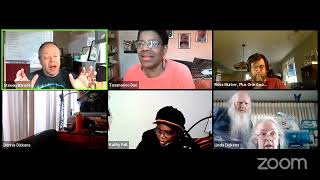
Steven Barnes and Tananarive lead a live session on preparing for high-pressure creative work like showrunning. Barnes teaches the MAGIC framework (map, daily actions, gratitude, intentions, courage) and demonstrates a qigong energy exercise, with participants asking about moving into showrunning and building daily rituals.
Chapters
Well, yeah, yeah. He. He came across that way in that very first introduction when he was talking about the bumps he was going through. He did kind of gloss over it, but I understand. He's a much more positive person. She was going through. He did kind of gloss over it. I understand. He's a much more positive person.
We're getting an echo from the live stream. Honey, I'm sorry to interrupt you.
It's okay. I killed the live stream video audio, rather. Yeah. I mean.
Or was I interrupting? I was interrupting the echo, I think.
Yes, you were. Okay.
It's okay.
We needed that.
I stay on track.
Yeah.
I think that you want to look at people who have accomplished the kinds of things you want to accomplish and start getting a sense of how they organize themselves. You know, how. How much time do they spend thinking about the negatives? It's not that they don't think about the negatives. As you notice, they spend more time focused on the positives. And I interpret that as the best way to deal with a negative situation involves a positive attitude. And so it's not that you're not paying attention to it. It's that you are saying, I've got these problems. What are the best way for me to deal with these problems? It's to look beyond them to a degree, you know, to believe that there is a version of yourself who handled this. You talk to future you as your. Your golden man, you know, who is the future Ross, who has all the things that you're looking for. And if you can get him to whisper to you, that's pretty cool.
Yeah.
Two more weeks of Crystal Lake, huh?
One.
Is that one more now? Is that a wrap on the year, or is that just a wrap on.
The chunk it's submitted on this phase of the first season? Yeah, and we can talk about that because to the degree that people feel that can see that if you look at the. The way that you prepare for something, those things can be applied to all sorts of different arenas. I don't want this to only be useful for writers. That would be. I'd be missing what it is I'm trying to accomplish here. My thought is that the more honest and open I am, the more you can see how I'm applying these things, the easier it is for you to create your own things. And then you can ask me, how would you do that if you had this? How would you do that if your goal was that? And hello, it's Cathy Fall.
How are you.
That.
So with regards. With regards to the room, kind of like, writing as interval training. You know, do a sprint.
Brainstorming and masterminding. Okay, it's. And we can. We can talk about that because it's. It's Hollywood. And I would assume, you know, I don't know where they got this process from, my assuming. My assumption is that it has evolved in corporate and other environments forever. But what it looks to me as if they're doing is they are attempting to imitate the thought processes of a genius. And if you have a bunch of excellent people who are using the mastermind principles, that's what you're going to get. You're going to get a much higher level. As long as everybody's looking in the same direction and nobody's trying to stand up and say, I'm so great, we're going to be great together. This is what I think that they're doing. And I think it's really useful, at least partially, in that you can understand yourself better. If this is a metaphor for the way the human mind works when it's at a high level of efficiency and effectiveness, then what can we learn from this? And I think there's a lot. I think there's a lot. So just a couple minutes. Let me rest my voice for a second. Yeah, Dennis, that's very interesting thought there. We could even address that. Useful.
Ah.
Take a deep breath.
Roll the tornado down the alley.
Are you recording, Steve?
Not yet, but I'm about to.
Yay.
All right, so it is 12 o', clock and I cannot wait to get started because. Because I want to take the ideas we've been looking at and apply them directly to something that's going on right now, and also what the next year of my life is going to be. So let me welcome you. My name is Stephen Barnes welcoming you to Fire Dance Live. It is an incredible experience that we've been having for the last month, the last five weeks almost. Well, it's unprecedented. A different approach to creativity, a different approach to writing. But what I have to do is to find the ways in which this is exactly the same thing as I've been doing, because it's externalized. What they're doing is looking at individual writers, not as individual writers, but as part of an overall process. So if you did not focus in the particular ways, utilizing the brainstorming techniques, the mind storming techniques, and the mastermind techniques, what you get is everybody in that room would write a different script and they'd all have a different feeling, whereas what you want is the feeling, the illusion that all the scripts for A Season are written by the same person. So I'm actually going to be using this particular meeting. I don't know if I'll do this again, but I'm going to use this as one of the segments of, of the course itself that to not only we've got people coming in, please, please, trigger.
Thank you.
Because I think that we've gone far enough and long enough in this that the techniques per se, you have a good overall understanding or at least you have a good sampling of what it is that we're up to. What we're up to I will get into just in just a moment. But first, what I'd love for you to do is to unmute yourselves and say hi. Hello, everybody.
Hello.
Hello.
Great. Fantastic. Fantastic. Okay, so what we're doing is we're talking about the core techniques that I've been using in my life to accomplish the things that are important to me. One of the things that was really important to me is a happy, healthy relationship. So what I would like to do now is to simply introduce my co host, love of my life, the wonderful, amazing, talented, just, you know, have some words for our people. Sweetheart.
Well, it's great to be here. It's great to see so many familiar faces always looking out for new faces too. And yeah, this is a very healthy meeting place. I don't glam up completely for these, although I do have a little bit of lipstick. But every morning we have to take Covid tests. I have to put in my contact lenses and I have to go out and be like, almost like not Hollywood ready. But I have noticed that there's a kind of a style in the writers room. Have you noticed that, Steve, even.
Yeah, yeah. People are a little. They gotta glow up just a little bit, A little bit.
It's always a little something like one of the most conservative writers in the room, her hair is purple. Okay, so that'll tell you everything you need to know. There's always something, I think, that even writers want to pop when they're in a physical space with other people. So trying to pop, you know, you have to pop. In addition to thinking really quickly, in addition to trying to come up with good ideas on the fly, Steve is so right that we would all be writing different scripts left to our own devices, and some of them would be great scripts. I mean, it's a very high level room of writers. I mean, we could fork off in all the directions. But I have to admit, I am so attracted to this showrunner model where even Though the showrunner is a friend, everyone is. Has so much deference for the showrunner. Even people who worked with him for 20 years, they, like, you make the pitch, then you look to see what's he going to say. I would love to do that one day.
He's the alpha in the room. Yes, but it's in the healthiest possible way. True. It's not a school of sharks, it's a pot of dolphins.
Yes, he.
He dominates the room effortlessly.
Yes, he is.
There is no force. There's no raising of voices. There's very, very infrequently, even criticism of people's ideas. He will explain why he's not going to do something, but it's because he doesn't. It doesn't fit into a pattern in his head. Not because you said something wrong.
No. It's like, no, we've been thinking about for season two, we're going to save that. You know, he's got like this whole map of seasons in his head and we're trying to fix a scene. So, yeah, it's.
See, and here's the whole thing. So, because this is going to be a part of the course, what we're going to do now is we're going to talk about the application of the principles to what it is that we've been doing right here. Because I will tell you, this was the opportunity that I've been looking for for decades. And I don't know what will come next. I have no idea what come next. This is live as it's happening. You guys are watching us do it. It's, you know, we're in the belly of the beast in that sense. But the question is, when you're going into something and you don't understand what it is you're going into, and all you know is that you really want to succeed at it. You want to bring. I just. I wanted to bring my A game for every conceivable reason. For the safety of my family, for. To be able to go to Manila in, in. In 2024, to be able to express myself as a writer. So you'll notice right there, I have it hooked into all three major areas that when I want to do something and it's important for me to do it, especially if it's important for me to maintain a level of discipline over time, then I'm going to know why I'm doing that thing. Why is this important to my family? Why is this important to my body? Why is it important to my dreams? So I will make sure. That it's my dreams in terms of writing. It's tied into the three most important things in my life. Business, family, physicality. Okay? So if you take any goal in your life and you tie it into all three of those things, it's going to lock down tighter. It's going to be easier for you. So before I go into it, because what I want to do is talk about process and so forth, I would love it if you guys, Anybody can raise their hand. But comments, questions, or requests about anything that we have covered. Otherwise, we're going to go into a little chi gong, and then we're going to talk about, you know, what, What's. What's been up. Comments, questions, requests. I don't see any hands. Okay, great. All right, so let's. Let's see what would be a really good thing that I can do. Let's talk again about qigong. Let's go back to the very first exercise, which is the energy ball. Now, when I'm in the morning, when I wake up in the morning, the first thing I do is kind of orient myself, where am I? I'm in this beautiful house. I'm with this beautiful woman. I've got this beautiful life. And there are these things I need to do today. So what I do is, if I have a sense, who is it? What part of me is it that can do this and do this at a very high level? Okay. And I go into the darkness inside me, and I find a spark of light. And this is complex equivalent time. There are lots of different things happening inside you. Labeling them enables you to manipulate them or control them or examine them. And I've asked a trusted part of myself to use light, sometimes darkness, sometimes as a symbol. So when I search inside myself, finding a spark, my unconscious mind knows that that spark represents my connection with the part of me that can do this. It is a symbol. There isn't literally a spark inside me. It is that I've trained myself to give me a symbol. And I can also do it so that I envision myself sitting in front of a mirror, and I look and see how much light there is in the reflection. And I literally can manipulate. By manipulating that, I have a better and better idea of whether or not I'm aligned internally. So if I find a spark that is just a spark of that person who can do this thing, my next thing is to protect that spark. I'm building a fire. And I want to build. Put kindling on that spark very carefully, blow it into existence. Put kindling on just powdered wood, dust, sawdust, then little tiny shaves of paper, and then little dry leaves, and then slowly build up the size of the tinder so I get a bigger and bigger fire. This is all psychological stuff, you find. You know, the visual. You might have a visualization of turning on a tap of water or growing a plant or any number of different things. It has to be something that works for you. A fire. Building a fire works for me. And so I'll sit there in meditation and I'll begin the process of nurturing it. Now, we talked about there being two different basic ways to increase energy, One in the yin and the yang of it. The yang of it is to create more forceful energy. You know, we talked about literally changing your body dynamics and so forth, you know, in exercise and lifting weights and running and things like that. The other, in terms of movement patterns, is to become more sensitive to the energy you already have. And this is what I would recommend for anyone who has any questions whatsoever about their ability to exercise hard, you start rather than jumping into it. Yeah, I'm going to macho through this. It's. Let me find where I am today, so. And you can. I can do it in bed. So let's do this sitting down. So rub your hands.
Yeah.
Big smile on your faces. You're deliberately priming your energy. In fact, before you do that, let's just, like, make fists with our hands. Pump our arms up. Say, yes.
Yes, yes, yes, yes, yes, yes, yes, yes, yes.
Run those hands together. You're getting your energy up. You're deliberately getting your energy up. This is absolute calculation. To have the best day you can possibly have, so you can have the best week possible, so you can have the best life possible. Okay, shake your fingers out. Now relax. Relax. Get your hands close together. Feel the tingle between your hands. Get as relaxed as possible. You want to see the little fire that you built there. Eyes closed. Maybe you're envisioning something. Is there a sound, a taste, a smell, a sensation that represents the living energy within? You find that for me, it's like I have pulses coming off of my left hand, pulses coming off my right hand, and they make an interference pattern in the middle. And I can feel that the more I relax, the further apart my hands can get. And I still feel that warmth. That's a little too far. Okay, there it is. Just building that ball of warm air. Let's just stay there for a minute. Inhale through the nose. Exhale through the mouth. Inhale through the nose. Exhale through the Mouth. Oh, yeah, that feels nice. It's nice to feel this after a week of really pushing myself. Gave myself all the sleep time I needed this morning, then I worked out, and then I came here to be with you, with all of you. I know I need to have my energy in the right place, speak my truth, pass the three gates and do all that I can to make sure that each and every one of you has the best day, the best week, the best life that you possibly can, and that we're sharing this together. Okay, thank you. That's nice. So, any comments, questions or requests before we continue? Because you might tell me what you sensed, what you felt, or anything. Any comments?
I felt that.
Sorry.
Yes.
I was going to say I have.
A bigger ball of energy this week than last week.
Good, good. If you've got that ball, there's so many things you could do with it. You could turn it into, you know, you could close your eyes, you could turn it into a womb and see your infant self floating in the midst of that energy. You could use it, turn it into a sun warming a garden. In your heart, you're looking for the metaphors that have meaning to you. Does that make sense? Because if you can do that, you can find the way that your mind and body want to work together to create the best, most expressive and healthiest and dynamic life on your terms, in your values. That energy, take it with my heart. What I want to do is to create as much energy as I can. So I eat and rest and exercise for maximum energy, but then I want to relax and calm that energy down. So when I walk into the room, I'm not vibrating with energy like that. I've got it and I'm watchful and I'm there because what I have to do is wait until I have to listen to what everybody is saying. We're staff writers. Above that are story editors. Above that are co showrunners. Above that are showrunners. The further up you are on the chain, the more carefully the boss listens to what you're saying. You will notice that the people at the very bottom are expected to come up with, as I said before, like words, individual concepts. As you go up the chain, you're supposed to come up with, or you tend to come up with concepts linked together into scenes or sequences. So that you are talking about, well, this is what we could do. And it could work like this, and it would be beautiful like this. What you do is you wait for someone who's higher up than you, preferably to Suggest something that is in alignment with what you are trying to say. In other words, if it's not in alignment, shut up. It's not your. Your place to speak until you're further up on the chain. But if you can find somebody, a moment in which somebody else is saying something, so you can say, yes. And now you're adding wind to the sails. And the captain, the showrunner, is going in the direction that they're trying to go into. It is not up to you to try to correct them. It is not up to you to say, I don't want to hunt lions. I want to hunt tigers. We got to go to another continent and we're going to hunt tigers. Because I think tigers are cool. That's fine. Hunt tigers on your time. They're hunting a lion in this particular jungle. It's humbling. You know, it's like suspend your ego. Be there. Now, in order for me to do this, I had to, because I had never been in here, this room before. All I could do is look at the more general principles that lead to excellence. Overall, I don't know what I'm about to do. What is it that would prepare me to be the best I could be when I don't even totally understand what. What best means? Well, I want you guys to have patterns that you're going through. The one that is exclusive to this process and what we're doing is the magic formula. But there are so many other things. There's the High Performance 6. There's. There's the think and grow rich pattern. There are many, many other. Tony Robbins has interesting patterns. Your religion may have a pattern there. The three gates are a wonderful pattern for certain kinds of advancement. So let's say that I looked at. Let's say that I looked at the magic formula and the high performance habits, because those are the ones that I looked at most carefully. I did not want to totally rely on my own patterns because my thought is that if I rely totally on my own patterns, then if I have something that I'm afraid of, the patterns that I have used most often to get to this point in my life may very well not contain what it takes to grow in these new ways. So I will use the patterns that I have, and then I will find a pattern by somebody else that. Because I know that they're not going to overlap completely. And that's what I want. I want. I want the variation. Life is chaos. And what you have to do is to adjust for the unexpected. Okay, so the magic formula, M A G I C is map or model. Who in the world do I know of who has done this thing? And so I talked to a bunch of different people who I knew who had been in writers rooms, try to get some sort of a sense of what it was that I needed to do, including a book. There's a book. And have Tanana Reeve T. Are you there?
The Writer's Room Survival Guide by Nicole Levy. I'll put it in chat.
Yes, absolutely. Because what that book did was it helped us to demystify the process. What in the world is going on in that room? You know, before I'm in there, it's hard to even understand what it is that I'm being asked to do so. But I knew I wanted a map or model. The daily actions, the a. Well, to a certain degree that's showing up now. I have not had a job job in a quarter century. So I have to get up not on my schedule. I have to go to bed not on my schedule. Have to make sure that my energy is there, that we are taking care of ourselves and taking care of each other. Okay, so we could do that in the car. We take care of. You know, how can I. What are the actions I need to take every day? It's handling business. It's taking care of our bodies. It's taking care of each other, taking care of the family. So I had to make sure. How do I organize my time to be able to do that? The G. Gratitude. Not a day has passed. The Tananarim and I have not looked at each other with absolute astonishment. I can't believe that we're here. This is what we've been waiting for. This is the moment, you know, that that sense of the. The world is being so kind to us right now. We have to bring everything in our ability to this so flooding ourselves with gratitude. So we walk in that room every day, happy. Now this. This is important because you don't know what's going to happen in that room and you don't know what to cling to there. I mean, what would I love? I love, love to walk into the room and be proclaimed an absolute genius. And automatically everybody lifts me up to being showrunners. Like, oh, Steve, you can do all these things. Oh, my God, Steve. Is that realistic? No. Is it realistic for me to believe that I have the capacity to learn this skill? Yes, I believe that is realistic. But I know that I will fail many, many, many times. Every time you pitch an idea and it lands with a thud like a lead feather. There's a part of you, a part of a voice in your head or the voice in my head. Leave you out of this. A voice in my head saying, you can't do this. And then you get the litany of reasons why you are too old, you are too this. It is too late. Those voices never completely go away, and they will poison you. Then they can keep you on track. If they're not like, you know, don't take anything for granted. But they can also poison you in the sense that. How do you take the risk of asking the next thing? Gratitude does it. It's that attitude. I'm not here to be. I'm not here to advance myself. I was advanced the instant I got in this room. I am here to serve Brian. I am here to serve this show. I am here to lift up the other people at the table. And I am grateful to be here to separate what I want, which is career advancement and creative opportunity, from what the need is in that room. What is the mastermind principle? Two or more people working together in a total spirit of cooperation. I am here to be part of Brian's mastermind in life. He is part of mine because he very clearly gave us an opportunity. He said, you guys are writers. We get along. You would like to advance your career. I would like to have people like you working with me. Let's see if this works. After we're done with the six weeks, he will make a decision about what worked and didn't work. But I cannot allow myself, my desire, my hunger, my ambition to sour me from understanding the miracle that just happened here. I wasn't supposed to be able to get back on this bus. I really wasn't. I was told 20 years ago that I was too old to do this. You understand the implications here if I. If I could walk in that room every day saying, thank God that I'm here and thank all of you. It's so wonderful working with all of you. You guys are so great. What can I do to help you? If that's my attitude, if my attention is off myself and on the room, I'm going to come up with the best ideas I could ever have. But I have to deal with my fear. I have to deal with my feeling that I'm not enough, all the negative beliefs. If I deal with all that stuff, then I'm trusting unconscious competence, which is the only thing that really works with art anyway. So what's happening here is that my ego is looking at the stuff that I can consciously look at and saying it's not enough sometimes. Whereas the truth is that the real things that we do are done by what Stephen King refers to as the boys in the basement, the unconscious competence. And that's just a matter of chop wood, carry water. You do things every day. You emotionalize it, you learn it, it integrates into you. And that's the stuff that you've actually got. You have to get out of the way to let it happen. And the way to get out of the way is to simultaneously care very much and not care at all. To care, in other words, about the right things. And the right things are not looking clever. What is it that is true in this moment about this idea? Somebody said something. Tim Fielder asks, is there imagery that is used in the construction of the stories, or is the process mostly verbal and with words? We are using verbal images. We're using verbal descriptions of images as well as verbal descriptions of internal states. A little bit of acting things out. I've noticed that the higher people in the room will act out a little bit that is that it can be funny. I mean, they're not necessarily being serious, but they're. You know, there was one. There was one thing. Oh, God, can I even say that? I guess I can't even say that, you know, but. But there was some fun stuff. One guy broke into an almost hillbilly voice at one time that was just hysterically funny, but all in. Broke the tension in the room. But it also created an image that we could actually use. So, you know, it's a little bit like it was at the Black Karate Federation, where if you were getting it perfectly right, if you were doing the techniques right, you could goof around. If you were getting the techniques wrong, you had to be really serious. If you were getting the techniques wrong and goofing around, you were in trouble. If you were getting the techniques right and taking it serious, you're probably going to learn pretty fast. But actually, it was the guys that were doing things right and also goofing around that actually learned the fastest.
It's interesting to watch.
So what I have to learn to do is to access my excellence, be very serious. But understand that part of the process of being serious is being a little goofy, is being willing to come up with the crazy ideas. There's a lady who's zooming in from England who. She doesn't speak as much as other people in the room, but when she speaks, she has the craziest ideas. And they work. They work. I have watched her ideas get integrated into the warp and the wolf of what we're doing. So it's like, okay, there's another model. Back to model what's going on in that room. How is it that people are accessing their highest capacity?
They.
Does that match with what I know about creativity in life in other arenas? Yeah, it does. What is my intention? The eye? To do the best I can, to learn as much as I can, to help the show be as good as it possibly can, to support other people in the room so that they think, well, Tonon or even Steve are great. We got to have them in our next room. You know, just, you know, it's. It's. You got to want to keep this rolling. I mean, this is really, really good. It's that momentum going and the confidence. Got to have the confidence. So morning ritual there every morning, doing my ritual. You know, when I'm saying all the courage I need is within me now, that's going to the High Performance 6. But I'm using my body and carrying myself. Encoded within the Tai Chi form are movements of both flow and focus, of both courage and caution. So it's one of the reasons why I chose the Tai Chi form because it contains the things, the very emotional metaphors that. Metaphors in physical form for various healthy and dynamic emotional states. Now, that's magic that gets you in the game. My observation is that if I can ask you, what's your map or model for accomplishing this? What are the daily actions you need to do to accomplish this? What are you grateful for in your life? And how do you connect yourself with that sense of gratitude every day? How clear are your intentions? What are your written goals? Show me your goals. And how much confidence do you have that you can and should do this? As long as you don't have a zero in any one of those five, you're in the game. You're actually on the playing field. If you have a zero in any one of them, in all likelihood, you're dead in the water. If you don't have a map or model of what you're doing, if you're not taking actions, if you're not feeling gratitude for where you are, if you don't even have a goal, and if you don't have any confidence that you can or should take those actions or achieve that goal, you're going to sabotage yourself. So make sure you have at least a one in each of those categories before I go on. Any comments, questions, or requests, Okay? No, we don't. Okay, great. So. So that. Got that. Let me know. I Was going to be in the game. Oh, Tom Barcliffe. Tom.
Sorry it took a while to unmute.
It's okay.
The courage element in the. In your morning ritual.
Yes.
What do you tell yourself? You just repeat, I am what I require for this goal.
If I were to look at that, I've got people who specialize in courage within me. You know, Steve Muhammad, for instance, tremendously courageous fighter, but also writers. You know, Larry Niven. You know, if I. If Larry is my mentor and he believes I can do it, then it's reasonable for me to trust him. If Octavia Butler is one of my internal. Internal memoir mentors, and she looks at me and she says, you know, you can do this, Steve. You know, I'm visualizing these people surrounding me with confidence. Dawn Callan, you know, it's like, you know, you know, stevie, you got this. You spent your whole life doing this. In other words, each of these people will communicate to me in a way, it's. What would they say to me about my fear? And what they will really say to me is, if you're not scared, you're not going to take it seriously. Fear is what you need. Fear is your friend, Steve. You were afraid of fear all those years. You cut yourself down because you were afraid. You didn't realize that that was the very fuel you needed to become excellent. It's like if I had understood that in terms of the martial arts, all the people who I had been afraid of in class, all I would have done was every time I was getting ready to work out on my heavy bag, I would spend 10 minutes visualizing that person kicking my butt until I was humiliated, until the people, the school were laughing at me, Until I crawled off the mat, bloody and broken. I would visualize that until tears were just streaming out of my nose. And then for the next 45 minutes, I'd work on the heavy bag. I would beat the holy living crap out of the heavy bag with my terror of not being enough motivating. Every punch, every kick, every strike, I would put all that fear and I would turn it into power. And if I had done that, I would have been a champion. I would have been a champion. Because champions can't ignore the fact that they're afraid. Fear is part of their energy. Okay, so what you want is to have the fear in the correct position in your life. You're not trying to get rid of fear because fear is part of what your body, mind uses to prepare you for action. You want that. It's just trying to help you Survive. It's your ego that says, I shouldn't be afraid. That was my problem. That when I was a kid, I was. I had these dreams, and no one I knew, no mentors, no role models had accomplished my dreams. I had no one telling me that I could do it, except in the most general senses. So I created a false ego shell, a personality that could do these things that was, you know, so I could be, you know, brave and confident. Yeah, I'm cocky. You know, I can do it. You know, I can do this. I can do anything. But it wasn't the real me. What I had to do in order to access the very best part of me is deconstruct the false image, which is terrifying, because if I don't have that false image, who am I? And one of the only ways that I did that productively is by thinking back on the dozen, let's say, smartest things I ever did in my life. What were the dozen smartest things that I ever did in my life? Did I do any of them deliberately? No, it just. They just. Always just popped out of nowhere. However, they popped out of nowhere after I had done a fantastic, fantastic amount of preparatory work, after I had been focused on it, obsessed about it, researched it. But the breakthrough came when I took my mind off of it and did something else. So what that tells me is that you have to chop wood every. Carry water every day, but the sun comes up when it comes up. It's not under your control. It's a bad metaphor. It's the. It's the dog and the cat thing. In order for me to be my best, I have to give it everything I have and simultaneously not care. It is so tricky. It's to find that place inside you that is giving it a hundred percent. But you're also saying, well, what will be will be. You can't attach to it. So that's where the courage comes in. Any other comments, questions, or requests before I go on? No. Okay, more comments. If you have more stuff, just raise your hands. I'm here for you. So the High Performance 6, then. Oh, Amy Pierce. Yes, Amy.
Sorry, I couldn't find the hand rise thing. So I'm curious if this experience has made you want to move up in the hierarchy. Like, do you have the desire to eventually be a showrunner, or are you content with the place that you're at? And would you like to have more experiences as a writer? Or are you done with this? Like, have you done it and you feel like that's enough?
Well, it's two things at the same time. First of all, it's enough. And secondly, no, no, no. Miles before I sleep Tananarive, Go for it.
I am so excited by this experience that I feel like I would love to be a co showrunner one day. By co, I mean being paired with someone who has more experience in the industry to navigate notes from the network, dealing with executives, hiring and firing production elements, that kind of thing. You know, one thing that's holding up and coming showrunners back is that during COVID a lot of staff writers did not get opportunities on set. So it's an unfinished skill set. You might be great in a room, but what we're told is that where Brian really shines is during production. Right. Which is like. That's like a whole different phase that we have not yet been exposed to, except for a couple set visits that we've each had in our careers for other work.
So, honey, danger word.
And danger word. Yes, that's right.
You were.
Oh, yeah, that was huge.
I think we're going to experience it is not a larger, more complete, complex version of something you've already done.
Right.
So we knew in 2013, when we made our short, that that would be invaluable experience for us. And most of the way we've incorporated that experience is as writers, like, understanding what words sound like when they come out of someone's mouth as a. As opposed to how they look on the page or having more faith in the actors to interpret that dialogue so it doesn't have to be so on the nose. It can be more subtext than text and all these kinds of things. But then there's the production part. And now I'm seeing a path. Whereas before television was a mystery, I always wondered what it would be like in a room. Wasn't particularly interested, honestly. But in all the years I've been trying to get my own work adapted, and people have also tried to adapt Steve's work as television has risen in prominence and film is more of a secondary consideration. Like our agents told us when they signed us that television is business and film is dreaming, I think, or I don't know what word he used, but it didn't sound good. You know what I'm saying? So television is where way more screenwriters are working than in film. And given that everything I have in development right now is for television. And I would still like to have a say, you know, because I've heard horror stories about series you all know about. I won't go into details where Things that were going on behind the set really had a big impact on the failure or success of that series. And so knowing that, I'm so grateful this opportunity has come. Now, before we got something set up before, they would have brought in maybe a strong showrunner who would kind of roll all over us. And it's more their show than my show. But see, as a co showrunner, that won't happen. And the more experience we have, the more we can prevent that from happening and be more in partnership with a stronger showrunner. And that now has become my revised goal. I mean, we used to think we just wanted to write the pilot and keep it moving, but now that I've seen the mech, you know, the machinations and how it works, I do have ambitions to help run a room. So what can you take from this, do you think?
Sorry, one follow up question for Tannerie. Do you think that you will be able to avoid the issue of emotional investment in your own work when you're doing the kosher running? Because I think that can be a really big problem for people when they're doing adaptation. That, you know, sometimes the way that you, you translate things, writing is just not going to work for a visual medium. So is that something that you feel like you've learned enough about so that you can sort of avoid that feeling of the. The translation from one medium to another is destroying, you know, what, how you envisioned your work to be received or understood?
That is a great question. And this is something that we addressed in our podcast lifewritingpodcast.com story, a story on creative flexibility because we've been training ourselves all these years to see our work manifest in many different ways. Here's a short story version of this. Here's the graphic novel version of this. Here's the screenplay version of this. And frankly, almost to a fault, I learned early in pitching to kind of bend to the whims of the producer to the point where, yeah, it becomes unrecognizable, but then by the time you get there, you were complicit in it and you. And it's hard to see it happening. You know, it happens in increments and then the next thing you know, it doesn't feel like your work at all. So I think what this is teaching me is especially watching Brian at work because he is so successful as a showrunner and he is very fixed sometimes in his notions, as all showrunners, are when to bend and when to hold. That is the key to all success at Hollywood. You know, sometimes holding Means you walk away.
You walk away.
Which he has also done in the past, you know, if you know anything about his history of television. So I think that he's a great mentor in that sense, because there's no such thing as success if you always hold. And there's no such thing as success if you always bend.
Well. And this is one of the reasons why we feel so much gratitude right now, because there are people in Hollywood that are bigger than Brian. There are people in Hollywood who we know better than we know Brian. But the combination of we know him and love him and genuinely respect him and are in that room watching him on fire, watch him actually work is the best mentoring experience I can imagine. It's like, I don't know how this could get any better. I don't know who on this planet I would rather be, have this first experience of being a matter of fact, I don't think there is anybody. It's just perfect. So that question of how far are you willing to bend? It probably goes. It probably is connected with how deep are you looking at the progenitive creative impulse.
And the level of trust you have with the person that you're working with?
Oh, absolutely. I knew that when I was back, earlier stages of my career where I had to, you know, the race of characters to be changed, structure be changed, this be changed. What am I not willing to bend on? To know that there are. There's something I'm not willing to bend on, and that tells me all the things that I can bend on. I can be as flat, can be very flexible about these things over here. But this, I'll take my name off. I can't do this. And there have been times when I simply was not willing to go any further than that. But I didn't tell them what my limits were, just in case their egos would get involved and they would, like, push, poke against that because, you know, you don't want to poke the bear. It's. It connects to your question, what is it ultimately that I'm trying to accomplish, which connects ultimately to the question, who am I? Who am I? And what is true? Jesse Hayes.
It made me think about you. We were talking earlier about how this is somebody who you know personally, and you guys were able to vibe in that setting and seeing if you could continue that over into the professional environment. I think that maybe part of being able to let go of an idea is when you have a team. Coming from my music background, I'm always thinking about things through that filter. Right. So it's like jazz, right? Like, Miles Davis picked out a band where he knew that everybody was gonna kind of handle their own, right? So because he knew that those. They're the right people in the right places, then there's a greater ability to kind of let go. Guiding the ship, still pointing out when the notes are wrong, but being able to flex. I think that, you know, to that comment about, like, when you're in that position and adaptation or anything like that, if you know that you've put people in place that you feel good about that you have a certain amount of trust in, I think that probably makes the process.
Absolutely. And do you understand that when we're talking about here just to kind of bring this back, the. The mastermind. According to Think and Grow Rents, the mastermind is the only known way of compensating for lack of ability. That literally, if you aren't smart enough to do it, you're not creative to do it. You can build a team that can do it. What is it you're going to offer that team? Maybe it'll be protection, maybe it'll be money, maybe it'll be love, service, something like that. But you can actually gather people around you who have the individual skills that you do not have. And then you're the conductor. You don't even need to know, huh?
It's the allies and powers.
That's right. It's allies and powers. It's the mastermind. It's brainstorming. It is the parts party, you know, where inside you, you know, I've got all these different parts of me, and some of them had to sit down and shut up for the last six weeks that there are things that are going on in that room. I wouldn't write it that way. I don't believe that human beings do that. But you know something? I could be wrong. First of all, I could be wrong. Secondly, I could be right, and they could also be right. Thirdly, they might be wrong. But it's their job to take this project to the network and have the network say, yes, we'll give you tens of millions of dollars to do this. If that's what it takes to get the yes to the network, I can bend down here. It's like, okay, you know, you know, I have a chance to learn. And as long as I remember that, I have an opinion. But I could be wrong. And even if I'm right, I'm not here to be right. I'm here. I'm here to support a vision. And I only see a piece of this, I don't even see the whole thing that's going on. I see far from it. So do I trust the people that I'm working with? Yes, I do. Sufficient to be able to sit in that room and give it everything I, I have. And because I have not spent a lot of time in the corporate environment, this is. I think that a lot of you already understand the value of a team when the team is working well and the pain of a team when it's going badly. So it's. It. Is that so okay, if they're, you know, you guys did that answer your question, Jesse. Okay, great. So let's take a look at it the other way. The other thing. The High Performance 6 have a lot of respect for what Brendan Burchard did in his High Performance Habits book. And that's the six principles. The first one is clarity. It's not too different from, you know, from map or model. So do I have clarity on what it is I'm supposed to do? No, I did not. But I had clarity on how I could be my best. And if I could walk in that room and be my best, then I would assume that I will learn as fast as I can. Hopefully I will learn fast enough to be able to keep up and to be able to do this. That I trust Brian to have seen something within us that said they'll work here. They're better than is necessary. For staff writers. His opinion of us was very clearly that we're a step up from staff writers. So it's much the same as with Larry or it's the same as with Steve Muhammad giving me a high level black belt grandmaster thing. I can doubt that all I want to, but am I going to tell him he's wrong? I don't have any more right to tell him he's wrong than I would have to promote myself. So it is, it's trusting the judgment of the people. You know, you find people who, whose judgment you can trust and you trust them. It's not just for employees, but it's also for employers. I'm learning this. So the clarity on what it's going to take me to do this, you know, I can use the three gates. I will show up and I'll be as honest and as kind and try to be as useful as possible without running around like a little puppy saying, you know, I can contribute here, I.
Can contribute here, I can contribute here.
And trust me, that threw me back into my early days with Niven and Pornell trying to figure out some way that I could come up with an idea that was going to work, you know, working with these two geniuses, like, whoa. So that's the first thing. The second principle is energy, okay? That I understand very well. I could very deliberately say, okay, I'm going to max out my energy, you know, so that every day I walk in that room, boom, I'm ready to go. And when I get home, it's 4 to 5 hours of non stop intense brainstorming. It's like 8 to 10 Pomodoro segments every day. That's brain burning. And there were people in that room decades younger than us who were going home and collapsing just because it was so intense. But you get used to it. So my whole thing is, let me make sure I'm getting enough rest, make sure I'm eating right. Let me, you know, what's my ritual of decompressing? I like watching some Japanese anime, you know, having some fun. You know, we. We had these patterns. Let me see my son. Let me make sure that he's okay. You know, this. What are my rituals to take care of my energy, Raise my energy as high as possible, okay? So clarity, energy. And the third one is urgency. A sense that this is the time when you have to do it. So how does urgency apply? Man, oh, man, I had that urgency. I'm very, very clear on the fact I don't know what comes next. Thank you to the universe for giving me this opportunity. If this is all there is, it's been miraculous. And if there is more, thank goodness. I'm very grateful and I will take it and I will use it. And it's wonderful to be humbled. It's wonderful to have that sense of, oh, I guess I don't know it all. Because when you're working on your own stuff, you can really get to. I know this. And there's nothing wrong with that feeling. But it's such a blessing to be around people who simply know more than you do, who are simply stronger than you, who are simply smarter than you. I love that. Because there's no other way you're going to get better. So energy, Energy. Okay, yeah. Or no, differently. Jesse, it does not hurt my ego to think, oh, this guy's smarter than me. Because I know I'm talking about this particular arena, this particular thing. He's smarter than me. Great. I think that it would be a negative thing if thinking he's smarter than me was accompanied by the thought, and therefore, I cannot do this. I'm thinking he's smarter than Me, and therefore I can learn from him. That's what I'm thinking. He's a good captain. That sense of urgency. It's that sense of now or never. This is the moment. What you don't want is to take a relationship lightly and then years later realize she was. She would have been the love of my life. That would have been the job opportunity. That was the moment, and it's gone forever. No, no, no, no, no. On this side of it, I'm saying I know this is the opportunity. This is it. This is it. This is. This is what I'm doing. This is why I'm here. This is what I have wanted.
This is it.
So that sense of this is it. There's no manana. Every day has to be my best day. But I also understand that giving it your best day means laying back to a degree. You're totally focused, you're totally there, you're totally present, and I don't give a shit. It's like I'm just. I'm having. I'm here to have fun. And when I think through my map and my model of it, does that make sense? Yeah, it does. It makes sense that what I have to do is both be my very best and let be in the lap of the gods. It's the samurai who has already given his life up. You know, he's dead before he even goes to battle. It's not about saving his life. It's about expressing his skills. Amy Pierce.
So I feel like you keep saying you don't give a shit. And it would be more accurate to say that all outcomes are acceptable because you do obviously care about this work, but it doesn't necessarily mean that you expect a certain outcome from it.
That's correct. You're 100% accurate. You know, it's in that position, looking back over your life and seeing the emotional position you were coming from when you did your very, very best, you will need to have your own words and phrases and symbols to represent that, because what you're doing is you're lining up the things that produce your best results. You're using the perspectives that we're giving here and the perspectives that you get from other teachers and perspectives you have yourself, but you come up with your own symbols to manipulate it. So if for confidence, when we're wondering, can we do this tononariv? And I look at each other and say, what is it? We say tonarive.
We are that bitch. That's right.
See, somebody else might not understand that or that might Be something negative. But to us that means we've got this. We've got this. So that's what you're looking for. The words and the images are just symbols. What you're looking for is ways how do I play with me? And for me saying I don't give a shit in a particular tone of voice with a particular internal representation is that thing for me. It might not be for me tomorrow and it might not be for you. So but, but you are accurate about what it represents in terms of, of that. That. Excellent, Amy. Excellent. Tom.
Mute button is going to kill me yet.
Yes.
You about the sense of urgency.
Yes.
So there are, there have been times in my life when I have had a very strong sense of urgency and I chased what was my goal at that point and I got a crash landing out of it. This has happened a number of times and now I am pretty old and wondering how much longer I can keep trying to do things that.
So those goals, here's, here's what you do. You set yourself goals that are small enough that your failures are relatively immediate, but so are your positive results. For instance, if you were trying to write, if you're writing a story a week, very, very short story, not a lot of failure that can be had their worst case scenario, you wasted a week. Best case scenario is that you're learning from the experiences so fast that within a few months you're selling. As long as you calibrate your failures so they don't hurt too much, you have to get the right size failures. The more you fail, the faster you learn. But you have to set it up so that you, you're not hurting yourself when you fail. And the other thing you have to do is never fail the same way twice. Never ever fail the same way twice. If I fail every day, but I'm failing a slightly different way every day I'm going to learn what works. Assuming that anybody could. Assuming that there is an answer. So breaking for me right now, I've got six weeks. I'm going to experiment with bringing the absolute best I can to this situation. And it's not going to be up to me to decide on an external sense whether or not I have succeeded. That will be in the hands of people who are the higher ups. For me, my success is being in that room is learning as much as possible, taking as many notes as I can, supporting my good lady wife. You know, just watching Tananarive, being brilliant in that room, God, I love it. Turns me on. Just like, wow, what a woman. Supporting her, driving her there and back. Every day brainstorming, what have we learned, what's going on, what's happening here? So whatever task that you've got that you want to do, break it down so that every day you have either a success or failure. The morning ritual, fire dance. Morning ritual is so powerful that I believe, and I believe this right down to my toesies, that you could use that as your success failure. Did I do my morning ritual? Yes. No. If I did, yes, then you go deeper. What is in it? Am I, am I setting it up to have my role models for filling myself with gratitude, for dividing up my task into what I need to do today, if those things are in alignment with long term goals and so forth and so on so that you get to feel that every day was a success. Are you doing your morning ritual? Are you doing the five Tibetans? Are you doing your Tai Chi? Then you're taking care of your body, you're taking care of your mind and you're probably moving towards your goals. If you have broken those goals down and your role models include people who are good advisors to you in accomplishing those goals. And you also set yourself up so that every day the things that you can control doing the things that you can control make you happy. It's been a good day. I did the things that I said I was going to do. It's a good day. I win. You set yourself up that way. Life will take everything from you if your definition of winning depends on other people totally agreeing with you all the time. I cannot control what they think about me. I can only control how I show up. And so I will show up to the best of my ability. I will call that a victory. And it so happens that part of what my process is is to learn how to line up what I feel I'm doing with what is needed for me to do it. That there is an external standard. I don't know exactly what that external standard is. I can only know how I can show up to be the best I can be. And I set that up so that it's cool. That make sense?
Yes. You're looking at those small sections of success.
Yeah.
That I was missing completely.
Yeah. It's tiny sections every one day. Did you work your body? Did you work your mind? Did you work your emotions? Yes. Go to bed. You had a great day. Do it again tomorrow. You have it set up so that if you did those things every day, you'd get to where you were going. Then all you have to do Is ask yourself, did you or did you not get a zero on that day? As long as you didn't get a zero, you're at least in the game. So being in the game is the magic formula and also seems to increase luck. It's kind of bizarre how that works when you start getting up around seven, eights and nines in that on a continuous period of time. I like the High Performance 6 for not just being in the game, but becoming a champion in the game. And there are other sets of principles. I suggest that you find one that works for you. Okay, so we've had clarity, energy, and urgency. The next one is productivity. That book on working in the writer's room suggested that a good syntax for productivity is one good idea before lunch, one good idea after lunch. So if I can come up with an idea that people in the room seem to like, I can then relax. And what I know is that if I'm relaxed and aware, I'm going to come up with a better idea. But the ego part of me then knows I only have to come up with two things a day to be getting the productivity in. And that gives me the room to maybe have something brilliant come up that I did not anticipate, or at the very least, the best I can be at being brilliant at that moment. Influence is the fifth part of the high performance habits. And of course, influence is influencing other people to be their best, influencing them to enjoy my ideas. You know, in order to influence them, I have to communicate with them. I have to be on their wavelength. I have to try to catch their rhythms so that I'm speaking, speaking to them in their language at the right moment of time, etc. Etc. And the last one is courage, man. If you're having a bad day where you're pitching and nothing you're saying seems to land, it requires a certain amount of courage to just keep getting up and getting up and getting up and trying it again and trying it again and just letting yourself start over again. Or, you know, in that sense, courage is just living in the moment. You have to forget your failures. You have to say, you have to believe, I can do this. Okay, I didn't do it earlier, you know, maybe I didn't do it yesterday, but, you know, let me, let me stay in this moment.
And if I can.
You're about to do something, go for it.
Yes, if I can just jump in here.
Please do.
We watched something pretty extraordinary happen this week. We're getting down to the last episodes of the first season and had Been stuck on one episode basically all week, scrambling to try to put together a storyline for the next episode. And the higher ups were there early. The day had been pushed to 12, but we noticed the higher ups might be. Are coming in like an hour or 30 minutes earlier to have sort of a mini meeting. The woman in London. And the two higher ups at the cards, studying the cards, shifting the cards, they had come up with what they were very excited about. It's a fix to add more excitement toward the end of the episode. And at 12, when Brian came in, they pitched it with great enthusiasm and theatricality. And Brian was like, you know, he just. It didn't. It didn't work with his image. He had a specific image in his mind of the way he thought that episode was going to end. And everything they had pitched flew directly in the face of that image. And that is probably the hardest thing to move him off of, is when he has the image because he's a very visual person. But by. And they pivoted. They pivoted. Okay. They threw out all that work. They brought all that brain power to try to find different fixes. How about we do this? How about we do that? Very sincerely. By the end of the day, very quietly, Brian had moved back to their original position, or at least most of it.
Sweetheart, doesn't everybody wish they had a mentor, a leader like that?
Yeah, because he demonstrated the necessity to add something more at the end of that episode. And people listened.
He had his own vision. He listened to what they said. He said, let's go back to my vision. Because he had chosen people properly, they dropped their ideas, followed him. But he remembered what they had said.
Yep.
You know, he's remembering all of it. And he circled back around. God, we should all be like that with our families.
Yeah.
Friends and relationships. What happens if you're talking to someone who is over you and they. They don't accept something you're saying and you give it. You know, you bury your disappointment and you give them everything you have. And by the end of that period, they're saying, you know, that original idea you had? I think you were right. I don't know about you, but, I.
Mean, he never phrased it that way.
No, he didn't. He's looking to see whether or not these ideas can work.
Yes.
Isn't that.
That was all I wanted, that. That was a great thing to watch happen. Because that's right. Great thing to watch happen.
That's proper leadership. He's a real, real alpha. He doesn't demand Anything we, we follow him because we love him and because we are, we respect him, respect his mind. That's a natural alpha. He didn't have to bark at people. He inspires us. We watch him going deep into his visual sense or his kinesthetic sense, you know, and he, he's funny and he's playful and he's warm, but he's also strong and balanced. This is, it's a great model for leadership and it's a great model, you know, within yourself. When you're arguing with different parts of your own personality, you know, your fear of this or your, your, your hunger for this. Those things, the different parts of you, they're, they're not trying to hurt you, they're trying to help you. And if they are in conflict with each other, sometimes you might want to listen to them a bit. So that courage. So you got clarity, energy, urgency, productivity, influence and courage on the one hand. And you've got maps, models taking daily action, flooding yourself with gratitude, having clear intentions and being courageous, having clarity that you can and should do this. These are two different ways of looking at the same process that overlap but are not exactly the same. That gave me enough, you know, let me focus on the things I can focus on. I can't control the things I can, I can't control how people are going to respond to me. I can control how I show up in life, not how I'm perceived. So if you can figure out the right things that are your under your control, the right dogs, you can attract the right cats. So learning how to do that, what is the chop would carry? Water. You know, what are the things I must do every day in order to get to the point where I spontaneously create the luck that I'm looking for? It's, this is, this is my task. This is what it is that I have to do in order to perform at the level that I want to. Here it is, also this exact same thing. The magic formula and the high performance habits and the morning ritual are exactly the same thing. I'm going to be applying to the next year of my life. A year after this writer's room ends, I want to be in Manila at a martial arts a week long martial arts workshop. I want to bring my absolute A game. What do I need to do in order to do that? I don't know. Never gone to it. But the same principles. If I look at what is the closest map or model inside me, I have a guy named Danny Inosanto who's one of the world's great Filipino martial arts experts, Just one of the world's great martial arts instructors. He knows what I need to do. What are my daily actions? Working out, meditating, practicing gratitude. I am so grateful that my body and mind work at a level where I can plan to do this. My clear intention is to go there and have the time of my life, come home just humming and the courage that I can and should do this. One of the reasons I should do this is that I will be a better man for my family. I will have more energy that the. That the focus on this goal in March will give me the energy and aliveness I need to accomplish other things. Like, for instance, support my wife who wants to be a showrunner and a co. A co showrunner. You know, I did not necessarily have that intention, although I had the intention of getting my own TV show. If this is what she wants to do, if I don't have to motivate her to do that, if that's something that she wants to do so that she's champing at the bit, well, let's do it. You know, we. We can do this. I mean, who doesn't want a partner who is eager to do the things that would move them to the next level of their life that they want to do anyway? You know, I'm. It's such a blessing to have to. Not a blessing to have a son like Jason who motivates me to be the best I can do or a daughter I love as much as I do Nikki, and I want her to be proud of me. I could use those emotional things. Say, would they be proud of me if I wasn't a showrunner or. You bet. Would it make more money for the family? You bet. Would it further my career? You bet. Would it give me time and resources to go to the Philippines? You bet. So that these things tie in with each other. Can you see that? Can you. Can you see what. What they're doing? I simply want all the different aspects of my personality to work together rather than fighting each other. And I want to bring my absolute A game to the question of living my life, this one life that I have. And one of the things that I have to do is to share it. And part of what I'm doing to share it is that fire dance Tai Chi program. I'm so glad so many of you have bought into the program. I hope that others of you will go to firedance tai chi.com come and get into the program so that I can support you more directly. Does anybody have any questions specifically about the program, movements in the program, anything like that that we can address today? We've got some time to do that. This is your time. I want so much and I'm actually watching over on Facebook. I'm watching the thread over on Facebook too. If anybody has any questions there, you know I will be able to answer. But it's. How can we have the best love of ourselves, the best love with our families, the highest level of financial success, the highest level of health and energy and aliveness. I want you to have all three at the same time. Any comments, questions or requests? Let me go over to chat. Let's see if anything is coming up. I'm not seeing anything there at the moment.
Okay.
Yes.
Tom's hand is up.
How do you work out? Is there, is there even a connection between Tai chi, the yoga and the way you work with kettlebells?
Yeah, it's all breathing. I mean it's, it's all just my body. Tai chi is, it requires that I go inside myself. It's a multi joint exercise. It's like joint mobility drills. Formalized. It is a dream of martial movement so that all the basic movements and the flexions of tendon and muscle and ligament are all in there. Yoga is like putting your car up on the blocks. You know, in the shop, you stop it and you, you, you look at the engine. Tai Chi is like taking it slowly around a track where you understand exactly what you're going to be doing. So you can, you can feel whether or not things are, you know, and viewed that way. It's this. The Tai Chi is one way of looking at the body, mind connection. Yoga is another way of looking at the mind. Body, mind connection. Kettlebells are another way of looking at the body, mind connection. All of these things are using the same body. You don't have a different body when you're doing different things. So learning how to move, internal, external is, is the real task. I'm not there to learn Tai chi or do yoga or do kettlebells. I'm there to strengthen my body, mind connection. Hello.
Hello.
I just, I think I, I have more of like a share. First of all, thank you for your advice. I was having a little author meltdown earlier this week, so one thing that I've been doing with the, the qigong ball is something called the nine breath method. I don't know if you've ever heard of it.
Yeah, there are countless, countless methods and many of them are terrific. So why don't you share what you're doing.
Yeah. So putting my left hand over my right and just putting it right on my solar chakra and then breathing deep like high into my chest, swallowing down and putting that in my diaphragm. Like you're swallowing a breath and just letting my diaphragm expand and doing that over and over like nine times, like in a rocking.
Yeah, it sounds like a golden elixir activity where you're, you're purifying your saliva in, in a way and then swallowing it along with the breath. At least those are the metaphors that they, that they work with. And did you learn that from a teacher?
Yeah, I learned it from a qigong. It was like a four day.
Fantastic.
Yeah.
Always, if you, if you have the option, always trust what, what you did when you were in the personal presence of the teacher. It's like he's like a tuning fork, you know, and you're like a tuning fork. So you learn to vibrate to him. And he gave you those things. He was reading the room. If, if my guess is that a different room, he would have taught different techniques. So that technique is something that he looked at you and the people in the room and said, ah, this will help them. Ah, this will help them. So if I were you, I would trust that, do that. Because you already smile when you're thinking about it.
Yeah.
So you find that, that, that spark of life inside you and then you ask, how can I, how can I fan this into a flame, you know, and just trust your feelings, trust your heart when you are doing these things and your body feels better and you get a little smile on your face. Trust that, sweetheart, that's, that's what you're looking for is that sense of I am in the flow of my life and life is beautiful. Okay, Congratulations. Thank you for sharing. That was a beautiful share. Kathy.
Hi, Steve, once again want to thank you and Tannerie for creating this space because it's amazing and there are a lot of more bigger words, but let's not wordsmith the corporate part of this. I've spent a lot of time in corporate. I want to share with you that I've done my best to try to create rooms like this. That's why I said I so resonate with the writers room because project room is very, very similar. But most of the corporate rooms are rooster fights, cockfights and a lot of blood. A lot of no trust. Lot of trying to be the top rooster in that room. Just a lot of that going on and trying to unlearn that in people while also trying to create a project on a time target. Really hard to do.
Okay, so remember, just really briefly, start by being sure you're aligned within yourself.
Always.
Then find one person. One person who you can totally synchronize with is better than five people who are squabbling. Okay. Yeah. And then only add one more person at a time. As long as that total connection is maintained. But that's for you. You may not be able to do that inside a company because they do that. So I would suggest that this is how you create such mastermind groups outside the strict company framework. Lunchtime, getting together for coffee. Somebody who you can speak your heart, to be totally honest with. That to me, is what you do. But go ahead. What you're saying.
Yeah, no, what you just said. That is what I do. And always outside the room. But inside the room is the. What is it? The party parts. Parts in the party parts.
Party.
Yes. I put a mastermind within myself, different parts of myself to support myself in that room. Because I don't have somebody else I can do with the room in some of these rooms. Some of these. Because you can't choose.
Make sure you have an intention. Absolutely. You define victory.
Yes.
So that they cannot take it from you. Don't let anybody define victory in a way that you cannot control it. In terms of that daily progress. There are going to be certain things that you have no control over. Be sure some of the things are under your control. You did your best.
Yes.
Die with honor.
100%, Steve. 100%. The thing I'm thinking about is what you said about patterns. Because you talked about how your existing patterns may not be able to. To support you and new areas you're trying to grow into.
Yes.
So you're trying to create new patterns. And I'm thinking about and asking, like, maybe the models that you talk to within yourself that you're using, maybe you need new models. Or do you think it's more like LEGO blocks, where there's pieces within the old models that you can put together into a new pattern?
Here's what you do. You have a dozen different models, sweetheart. And dozen different ways breaking them down. LEGO blocks and this and that, this and that. None of them are the thing. All of them are ways of looking at the thing. They're just ways of their fingers pointing to the moon. Every time you shift from one model to another, you'll get slightly different results. So you. I can't tell you. You tell me. All I can do is give you another model. Try this one, try this one, try this one. Look back over the week. How did you do what worked for you in it? In one sense, there's a different success system for every human being on the planet and it changes every day of their lives. In another sense, there are some very solid principles that we can share that you know, the High Performance 6, you know something that stuff works, it's really good magic formula, works like a miracle. Try what it is that I'm saying and understand that nothing I'm saying is the actual way the dao that can be named is not the true dao. We can play with these different ways of looking at things, but the process, the dynamic process of life is outside patterns. It just is. We can talk about patterns partially, so we have a of lot language to discuss with each other. But the experience, no matter what I tell you about about river rafting, the first time you actually get on the river and raft, that's when you understand river raft. Not when you're up on the, up on the bank hearing things. Not when you're reading a book or watching a movie or anything else in the river doing it. And then all the words are irrelevant, but also all the words start making more sense. Oh, this is what he meant by this. I wouldn't have phrased it that way. I would have phrased it this way. Whatever it is, if you are engaging with becoming stronger physically, with loving yourself more and working on your relationships and simultaneously working on your production of goods and services so you can make that money, if you're working on all three at the same time, it is my belief it is the position of fire dance that you are now playing with the actual stuff of your life and then actually playing with the stuff of your life. You're having the experience. You will then try to boil that experience down into words to communicate it to other people or to write it down so you can save it. And you will be frustrated because the words are never the things you know. But you will also from time to time meet someone who can read between the lines. That person becomes your mastermind, part of your mastermind. They get you, they get what you're trying to say enough to be able to walk together. And that's all that Tananari and I have, that we saw the same world, wanted the same things were going in the same direction. And we looked at each other and said it would be fun to climb this mountain with you. Okay.
Yes.
Thank you.
You bet. Sonia asked, said that life the enjoyed sacred cow. When is your book of short stories being published. I'm looking forward to it. You know, something. Trying to juggle all these different things. I had a half dozen different projects that I had to put on hold so that we could do these six weeks. And I. I love you guys so much. I love my fire dance family. I love being able to talk to you about these things. Trying to keep up with everything and keep moving the course forward and everything. I think that tomorrow we're possibly going to go down to the beach and I'm going to video the entire tai chi form out on the beach and then just have different ways of showing you things, because this is just. I'm trying to document this journey. You know, I only have one chance to move through my life, and I'm trying to do this at the highest level of integrity and joy and passion and contribution I possibly can. And I could not do this without you guys letting me know what's working, what isn't working. If you love this, I would invite you, please share it. Please tell two people about it. You know, bring your friends here. Just give them a chance to see and just the best thing you can do to convince them to come here. Use these things in your own life. Move yourself forward. Find, you know, the courage and the clarity and the energy to live your lives with passion and dignity and integrity and joy and contributions.
Any.
Any final comments, questions, or requests before we close today? Because it's almost time for me to kind of chill out. Anybody. Let me see over on Facebook. Tai chi on the beach would be cool. Yes, it will. I'm gonna have a good time. Okay. Over here. Thank you.
All right.
I guess maybe there isn't anything. In which case we. We can just kind of get into our day, you know, I'm have to get myself ready for the last week of this beautiful thing. Tananari, is there anything you wanted to close with?
No, I think you basically covered it, darling. We're very excited that this group has been able to maintain during this period when we change the time and date. So thank you for sticking with us while we stick with you. Join my list@www.tananarivelist.com. just yesterday I sent out a. An early link for our podcast Sunday on writing memoirs with Ashley C. Ford, who wrote Somebody's Daughter. And other than that, everybody, just have a great weekend.
Have a fantastic weekend. We saw. We saw Creed 3 last night. It was great. It was great fun. And if you want, you know, I love the Rocky movies. There's such metaphors for creating your dreams with gut busting work and courage and building the right team around you, being willing to accept failure and pain and in order to get back up and do the thing that defines who you are as a human being. You'll notice in that first Rocky movie, he did not beat Apollo Creek. He had defined victory such that if he was just on his feet at the end, he won. And because that he almost beat the best in the world. You define victory in a way that your actions can determine whether or not you get to say, I'm the champion and I will see you next week. Take care, everybody.
Bye. Bye.
Bye.
Bye everybody. Have a great week.
Unmute yourself. Bye everybody. Bye. Bye.







