"From Octavia to T'Challa" 8-12-17
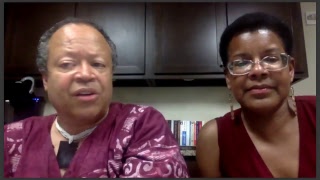
Tananarive Due and Steven Barnes explore Afrofuturism through Octavia Butler's Parable novels and the Black Panther trailer. They discuss how Wakanda represents a visual milestone for the genre and connect mythology and representation to social change.
Chapters
Time for large downloads going on in the background or anything else that drains your Internet connection. If possible, ask others in your household to also avoid streaming any movies or playing any online games like Xbox.
65 total register.
Cool. I thought it would be pretty good. Is this the woman?
It's what? What woman?
Wondering. Oh, this is the suspect. 20 years old.
Yeah.
Yeah.
So we got four people in so far. So I'm glad that they're here where we can take care of them.
If you got limited.
Okay, so, yeah, you're in.
Hi, everyone.
You got 10 lines, 65 total registered.
Did we compile a list of Black Family publications?
Probably not Black Panther publications.
Someone asked, you know, suggestions for which ones to read. Which comics?
Oh, which comics?
The Ta. Nehisi Coates. Right.
Is good.
I'm reading that one, but I know that there are some.
I would say that the Reggie Hudlin Black Panther run is pretty classic.
Okay, well, I'll recommend those two. Well, you recommend that one. I'll recommend Tanisa because I haven't read the other one. Okay. Hello, people.
Well, you saw. You saw it. You saw the. It's the same as the animation. It's the same story. Oh, really?
It's literally like frame by frame, the same stories.
It's. It's close enough. Close enough.
Hi, we'll be starting shortly, everyone. Oh, we're going to avoid that emotion.
Big what?
That big hand.
Big hand, that's right.
And we're here with big hand over here. So we'll try to make our hand gestures back here.
So they say big hands, they don't scare anybody.
Don't be frightened of our big hands.
That's right. Nobody's talking back to us. Who's there? Somebody say hi, we know you're there. Chat working.
We know you're there, so.
That's right. Don't even pretend you are there. We're controlling the horizontal and the vertical, and we know you are there.
Okay. If you're feeling shy, that's fine. We just want to make sure that there's nothing. Oh, there's something.
There's Michael. Hey, kid.
Here we go.
Here we go. Hey, Blair.
Margaret.
We are here. Yay. Okay, great. I'm so happy that you've offered this to us. There's so much to be excited about in blackness and sci fi. Oh, my God. That's the truth. That we're going to be doing this every week. And although we're talking about Afrofuturism, we're also going to be talking about current events and things of that nature to mix things up a little bit.
News.
Julia Chang says we're coming in loud and clear. For those of you who I met. Is there anybody from Willamette writers who I met there? If you're there, then I would like. It's my extreme honor to introduce my good lady wife.
Hello, I'm Tanana Reeve. Nice to meet you. Meet everyone. So cool. Yeah, we will be officially starting in about two minutes. Two minutes, yes. But in the meantime we like to have a little chat and say hello and welcome you to our webinar which is like Steve said, weekly. And hopefully you will feel inspired and a bit of relief after a tough day of headlines.
Yeah, it's been bad. Hello, Jonathan, Candice, Julia, Zoe, Dana, Margaret, Blair, Ken and Michael. Hi everybody. This is great. We want this to be, you know, and as you ask us, you make requests of us. We'll know better and there's esteemed there. We'll know better how to take care of you people are Steves all the way on, remember in good standing of the International League of Steves. I would assume so. This is good. This is good. So we'll be starting in about a minute and we'll keep this, you know, it's. It's nine o' clock where we are. We're doing this. Hello, Tanisha. Hey.
Yeah, usually we're on the west coast, but this week we're on the east coast. So we get to experience it in eastern time, which is a little later than the 6 o' clock time we're used to at home.
That's right. There's any family. Hello. This is Fern from. Fern. Hello. Aubrey from Baltimore. Hello.
Hello.
Hello.
That name sounds familiar.
Oh, to not even recognize his name.
Fern Gillespie. Facebook friends. Anyway, great to see everybody here.
Okay, so.
Oh, it's 9 o'. Clock.
It's 9 o'.
Clock.
And so we're going to get started.
Time to begin. I am Tananarive due.
Oh, that's right.
Oh, maybe the other way. No, no, it goes that way. This is Stephen Barnes.
It most certainly is.
And welcome to our Afrofuturism webinar from Octavia to t' Challa, where we celebrate. You know, I've been looking forward to a celebration today.
Yeah, we could use a little bit of celebration.
So of course we don't want to dwell on this too much, but we, we should acknowledge that.
Yeah, absolutely. Absolutely should. This is, it is moments like this that have made Afrofuturism critical and necessary. So it allows us to create some context and Also make sure that, you know that we're dealing with the real world, that art reflects and influences the world. I would not care as much about this subject if I did not think that it was part of the answer. It was part of a potential solution. So I truly do believe that. My suspicion is a lot of you are calling and feeling despair, anger.
You need to take breath.
Well, okay, before we get to that, okay, we're gonna. I'm gonna touch on dealing with stress. We talked about this before, that if you breathe as if you are relaxed, your body will feel that you are relaxed even though you're under stress. So the trick is people tell you to take a deep breath. No, got it backwards. Exhale. See, when you take a deep breath, what you're likely to do is hold it. But if you exhale, especially down here from your belly, okay, Just from deep down here, if you exhale, you will naturally inhale because nature abhors a vacuum. So what you can do is, if you're feeling like you're up against it, then for one minute, every hour, stop and breathe. If you're under ordinary stressful conditions, just every three hours, stop and take 60 seconds. To do deep dive will just change your relationship, your body's relationship with stress. We just kind of wanted to give that to you at the top of the hour.
And we want to acknowledge that a lot of people are feeling anxiety and fear and rage, or all of those things are a combination of those things. In the wake of the white supremacist riots in Charlottesville and the lack of a leader in the White House to fully address what's been happening, it's all very painful to experience. And I knew something like this would happen. It seemed inevitable to me, but it's still so painful to watch it unfold in real time. So we want to acknowledge that. But this is hopefully where we come to escape, right?
Well, it's where we come to escape and when we come to offer answers both as individuals, you know, we just taught you that that breathing technique will take care of your personal stresses. So please, teach to your friends, you know, teach it to your neighbors. But we're also talking about what we can do as a culture, because it is my belief that. That, you know, the Chinese ideogram, crisis, opportunity. The crisis is opportunity on the wings of danger. I believe that we are seeing this kind of problem right now because the world is in flux because there is so much potential for positive change. And the forces of, you know, of recidivism, the forces of the past, the forces that are anchored to what was as opposed to what will be, are terrified with the potential for change. And so as, as sick as it seems, you can look at what's going on here as a symbol as, as evidence that things are, are changing and we will lose some people. You know, there's no question that is always alive today. That's right. That is always a truth. But the other truth is that we're doing this to protect our children. We're doing this to create a better world for everybody, including those people, those racists out there who are terrified. I care about their children too, you know, I want a better world for their children. I want a better world for everyone's children. I don't think that we can think about creating a world unless it is better for everyone. Now it won't seem to these people that it's a better world.
Right.
You know, because they're operating in a delusion that they're the only ones who can be in.
Clearly. Sometimes people don't know what's good for them. We have Michael up on the screen.
Yes, Michael, you're back up on the screen.
You could take yourself off the screen. Anyway, Steve, I spent the day on the phone with my travel agent, all day trying to book a flight to Wakanda. You would not believe how difficult it is to get a flight to Wakanda, especially today. But I was able to book a trip, so it's open ended. I may stay, actually, is the way I'm working that out. But yes, I have seen the Black Panther trailer twice in two days now because I'm visiting my dad and my dad has seen it yet.
Thank you.
And then he didn't remember I had shown it to him. So I got to see it a second time. And tell everybody what your experience was with the Black Panther trailer.
Yes, I showed it to my, one of my favorite people in the world, my karate instructor, Steve Muhammad, who was, was raised in Mississippi in the 30s by his grandparents who had been slaves.
So let's stop there for a minute. People will often talk about how long ago slavery was. Steve knows a living man who was raised by grandparents who were born as slaves.
That's right.
So let's just.
The history, history is with us. And when he saw the, the Black Panther trailer, he, he was astonished. His attitude was, they let him make this. You know, he thought for sure that Black Panther would be like one black person and a bunch of white people. And you can tell from the reactions of a lot of reactionary Folks that they're upset with the fact that so many black people on the screen. The idea, what a move about a black superhero who's a prince of Africa that isn't filled with white people. What's wrong? Is this racist?
You know, that word gets thrown around a lot, doesn't it?
Yes, it does. It most certainly does. You know, you can have Asgard, you know, totally white, except for one, you know, doorman.
Right.
And people are freaking out, oh my God, they made him black.
He went there.
Yeah. So it's. We're winning. And if you're wondering what you can do as an individual to speed that pool, first of all to take care of yourself and your family, we're gonna, we've got that handled. But if you want to help affect the world, that's kind of, kind of what we're up to. And whether you are interested in this as an artist or whether you're interested in it as a consumer of media, what we want to do is to help you understand what is going on and what is going on in this particular movement and also how to adapt these ideas to other causes. And we'll get more into that.
Other news in Afrofuturism this week. This is your Afrofuturism news broadcast. Macro Entertainment has announced in his partnership with Ava DuVernay that the much talked about dawn television series is still alive. There was some talk about it a couple years ago and then it faded out. But this week there was an announcement and they brought on director, writer named Victoria Mahoney, who was also working on Queen sugar with Ava DuVernay and to help usher the series to reality. So that would be. Quality work and we are super excited. And just, just let's dream for a moment about what a Dawn series might look like. This is a novel by Octavia Butler where basically there's been nuclear annihilation of Earth. Kind of far fetched. No, not that far fetched. And basically the only human survivors have been rescued by an alien species called the Owenkotley. And they're on a spacecraft that doesn't look like a spacecraft. And the human they have designated to basically repopulate Earth with the first human colonist to return to Earth in 200 years is Lilith, a black woman. And just imagine on the screen, even a small screen, how powerful that image is. As a black woman is tasked with basically starting humanity again, but with a few caveats. And you know, the aliens want to intermingle with our DNA and we're kind of prisoners and are they really rescuing us, or are they imprisoning us? And all those great complicated questions that you find in an Octavia Butler novel. But that is really, really good news for those of us who have been waiting to see an adaptation of Octavia, either on television or. Or film.
Okay, and let's take a look at what the purpose of this webinar is. What we want you to do by the end of the time here is to understand how Octavia Butler predicted our.
Current political landscape, understand how and why Black Panther has captured our imaginations as no black superhero has before.
And you'll understand the way Afrofuturism can change the world and what part you can play in all of that. So, yes, you know, we're moving back and forth between our PowerPoint slides and.
Well, yeah, you can keep it that. The PowerPoint I'm about to talk about when we, when we met, because we really want to contextualize what's happening, specifically through the past work of Octavia Butler and the future appearance of what may be the greatest ever work of Afrofuturism. Certainly budget wise, Ryan Coogler's Black Panther. Can you imagine a world in which all Americans, all Americans had empowering myths that linked them not just to their ancestors, but to a positive, joyous future? We can and we hope that by the end of this webinar, you will also.
Okay, so what is this wonderful.
Let's talk about what afrofuturism is. In 1997, Steve and I were invited to take part in a conference at Clark Atlanta University called the African American Family Fantastic Imagination Explorations in Science Fiction, Fantasy and Horror. If I'd known more about black speculative fiction at the time, and I really knew nothing. And by black speculative fiction, what do I mean by that? I mean horror, science fiction and fantasy. I was a horror writer. My first novel was the Between. I just didn't understand the history being made in its quiet way. The other authors there were the late Octavia E. Butler next to the last on the left there. Of course, you probably recognize her on the other end, Samuel R. Delany, amazing pioneer in science fiction in the 60s as a very young writer, Jewel Gomez, who just republished her Gilda stories, her lesbian vampire stories, and this guy, you know, next to me in the Space Jam sweatshirt, really, Stephen Barnes. And there I was, a newbie writer. I had just published my very first book. So I had been marketed more as a black writer on the heels of Terry McMillan's success with commercial publishing. But this was an. And I had been to horror events that were Mostly white. But I had never been to an event where both of those audience blended. Where I was around black folks who liked horror and science fiction and fantasy. It was pretty amazing. And that was. That was it for me. I was blessed enough to be publishing at the coalescing of an arts movement dubbed in 1993 as Afrofuturism, also now known as the Black Speculative Arts Movement. And there's much to learn for people of all groups from the black speculative Arts movement. Although at the time, I think none of us had even heard of the term Afrofuturism. I had not.
Most certainly I had not either. Yeah, Afrofuturism, you might ask, well, what is it? Well, it's literature, movies, art, including music. It's genre bending, historically grounded and future facing. Long before the term Afrofuturism was coined by cultural critic Mark Durie In 1993, black writers and artists have envisioned themselves in a future or revised past where they can escape, examine and postulate alternative social, economic, political and personal tableaus, both through imagination and technology. As early as 1920, W.E.B. du Bois. Let's see, let's get this right.
Yeah.
W.E.B. du Bois published his short story the Comet, where the only two survivors of a post apocalyptic event are a white woman and a black man. His story's thematic question was, when do we simply become human? You might, you know, wonder whether or not to. The 1950s films, film, the World, the Flesh and the Devil, dealt with an idea that's very, very similar to that and probably has its roots there. Afrofuturist artists gave us images of futurism as a lens through which to view and change the present without ever forgetting the past.
I had a really unforgettable experience with. Eckford. You want the picture of Elizabeth Eckford? We can do that. Michael, you're up on the screen again.
Yes, Michael, you're up on the screen. Get yourself off the screen.
So in any case, I was invited to Little Rock, Arkansas, where I had the honor of meeting civil rights activist Elizabeth Eckford. There she is, both on the left and the right one. And when you see some of the vitriol and the faces behind her, those are some of the images that we're still seeing today. Unfortunately, her tribute was right before my keynote talk, which was Afrofuturism Dreaming Our Future. Who better to lead? Where I drew on lessons from the civil rights movement passed because my parents, my late mother, Patricia Stevens Dhu, my father, attorney John Dew, are and were civil rights activists. My father is still very active and I also drew a line between that and the work of Octavia E. Butler and other artists who use afrofuturism to create true life world building. So whether it's Butler's dystopian warnings about the future, she even prophesied the slogan make America great again, as some of you might know, or Nichelle Nichols as a capable and beautiful. By the way, Lieutenant Uhura on the bridge of the starship Enterprise on Star Trek. The long unsung women behind hidden figures. Or the Afro fantasy world of mythic warriors and royalty in Black Panther. Afrofuturism helps us imagine inclusivity and in the future. It doesn't sound like much, but in some ways it's everything, because inclusivity, once normed, can be applied across underrepresented groups. Afrofuturism broadens our vision of our world, both past and present, and helps give form and power to social critiques. Octavia did a lot of that and leadership models that can be applied in real life. It's both a powerful tool and a powerful weapon.
I was raised by my mother and my sister, and as much as they loved me, they really couldn't teach me how to be a man. Having no male role models, it hurt to feel so small and weak and wonder if I'd ever win the respect of men and, well, frankly, the admiration of women. I couldn't even really figure out what this thing called being male was about. Like many other boys, I ate up images from film and novels, feasting like a starving sailor jumping on a plate of sushi. Unfortunately, every single image of power and authority was white. James Bond, Simon Templar, Conan the Barbarian, Mike Hammer, Tarzan. But the exclusion wasn't even the worst part. What was the worst, what was horrifying, was that when they did include people who looked like me, it was almost always derogatory. Robert E. Howard would have a hero enter a town and be repulsed by the stench of negroes. Edgar Rice Burroughs was a lot more specific in Tarzan and his Son. It's a story in the jungle tales of Tarzan. He said, white men have imagination. Black men have little. Animals have none. There it is, the central thesis of all the Tarzan stories. A white man raised by an ape is more civilized than a black man. You cannot get more nature over nurture than that. But unfortunately, I wasn't strong enough to reject it. I needed those images. As I said, once I sacrificed my melanin on the alter, my testosterone. So I have a question for you. Have you ever felt like you were selling your soul just to stay alive? You might Ask the question. Did I really need these stories? I think so. Let me tell you about a ton. I. I was teaching a writer's toolbox at ucla, and I had a student complained they didn't have the time and energy to succeed. He was. He was in real misery about it. The pain was right there all over his face. I could feel it. All the insecurity and pain I felt when I thought of my childhood goals and all the barriers the world had put up for me. Have you ever had that feeling? I mean, really, if you have. Just want to pause for a second. Have you ever had that sense that no matter what you did, no matter what you wanted, you were never going to get what you wanted? Just let me. Let me. Let me hear from you. I just want to make sure that I'm. I'm communicating.
Well. Somebody has. There's sometimes a delay.
Yes, there's.
There's. We know whether you type it or not, we know that that's the case.
Okay. I did something. I got him to look at his life as a story he was writing. Oh, yeah. Yes. Alex absolutely felt that. Dana can. Thank you, Alexis. Thank you, Dana. Thank you. This. Because, really, I can't be more honest than I'm being with you guys. It. It hurts to care. It hurts to love. It hurts to have dreams and to feel that no matter what you do, you're not going to be able to reach them. But I did something. I said. I got him to look at a story. I got this guy at UCLA to look at his story, his life as a story he was writing. You know, I said, if you were a character in a story you were writing, and at the end of that story, that character got everything they wanted. What would you have them do next? And suddenly he had the context to understand everything. The focus, the daily work, the need to gain allies and new abilities. The critical value of understanding in advance that you will have failures. This is why the elders of all the world's tribes tell stories. This is why we consume them so ravenously. I ask you another question. Have you ever learned anything from a story, a song or a movie that helped your life? I'm gonna imagine if the answer that is yes, but go ahead and type it in. If you've ever learned anything from a story, a song or movie that helped your life, let us know.
Eric Stoltz Bodies Rest in Motion There was an emotionally distant woman shying away from his love. And I realized that was me. That was like, right almost before I met you. Honey, that was one of the reasons I could be ready to meet you was because I saw myself in the stories.
Well, for me, it was. Playing, basically, Bob Fosse. In that movie, you had a guy who was a famous choreographer and, Michael, you're on the screen again.
I was just sending him a message.
A man who was a famous choreographer, and he was addicted to sex, drugs, and musical theater, and he literally cared about everything except the people who cared about him.
That was where you learned that you needed to be balanced.
Well, he was. He tore his life apart.
Right.
Trying to. I'm not sure what. Trying to. To get the love of people who did not care about him. And I realized that the process of becoming excellent at anything makes it likely to become unbalanced as a human being. But I needed. I've had this feeling that if I could not succeed, I'd be nothing.
Right.
That the world was going to grind me in the dust, you know? But at the same time, if I went all out trying to succeed, that very attempt to succeed could destroy me because of the imbalance. So if I don't succeed, I'm going to be nothing. If I succeed, I can destroy myself, and I'm caught on the horns of a dilemma. That was what you said. That was when I realized that the only thing that it was safe to be obsessive about was balance.
Right.
And that was when I became. When I decided to. To really, really aim at that. So, yeah, I've learned. I think that we do learn from fiction.
And what's so interesting is both of the stories we mentioned have nothing to do with race. In fact, I can't think of a black character and either. Well, there were some black dancers and all that jazz, but there were no characters.
Not sure what had a line of dialogue.
Right. So stories reach us.
And all that.
I know he's saying a whole.
That's right. My life, my very good friend, the great humanitarian.
We're not going to impose this on you, but the point is, those of us who are in underrepresented communities, and I like to say that Afrofuturism is for people who are not properly represented in Star Wars. That's a lot of us. It's not just black folks. It's. I mean, there was a good part for Princess Leia, but there weren't really any other women so much in Star Wars. There were no Latinos, there were no Asians. So all of us who are in these underrepresented groups have learned to consume art and see ourselves in people. You know, that creators did not intend us necessarily to see ourselves in, but we can because we're human, and all humans have this ability. It's just that those of us who are in underrepresented groups have been forced to do that because we didn't have any alternatives.
If you ask yourself why we did not, well, black people's stories were ripped away from us, along with our religion, our names, our language, and our history. Imagine a human computer with the hard drives wiped clean and Slave 1.0 installed. And then after 250 years, you wipe that clean and you install Jim Crow 2.0 on the drive. Both of these operating systems are incompatible with Free American 1776. When the inevitable crashes occur, you then blame the computer rather than the buggy software. The reality of our experience is that our experience was represented, was misrepresented in the media, and what we had was images of, you know, happy darkies.
Right?
You know, that was the dominance. You could, you know, dominant image of the institution of slavery per se. Django Unchained touched that, too. I wouldn't call it totally serious, but God bless Quentin Tarantino for gifting us with that. But 12 Years a Slave actually was in many ways the first movie that was serious, dramatic, mounted by a major studio that dealt with slavery as the thing itself. And it's really interesting how often people say, well, there have been other movies dealt with slavery. You know, there was Beloved and there was Amistad. No, Beloved had ex slaves. Amistad had free Africans on their way to being slavery. Glory had ex slaves.
Formerly enslaved, I like to say.
Formerly enslaved. So the thing itself, the institution itself, was not shown in films except through a white lens. You know, just. Let's just.
Just happy.
And that's. That's horrifying because without a reference point, it's impossible to make an evaluation of what really happened.
And I have to say, unfortunately, a lot of people have been saying today, this is not America. This is not America. Well, sadly, yes, it is America, and it has been America from the original D.W. griffith. The birth of a Nation, Hollywood's basically first blockbuster film, was distortions that led to the rise of the Ku Klux Klan and lynching sprees in the South. And that was welcomed by the president in the White House and lauded as radar. It's in our DNA. It's woven in our DNA, and we ignore it at our own peril.
No past, no present. If you have no present, you have no future. Racists have to understate the pain of slavery. If you talked about the pain of slavery as the thing itself, then the concept of black inferiority makes no sense, because we can't have been both inferior and subject to that kind of pain. It really has to be one or the other, you know? And for me, the isolation, the feeling that I was surrounded by people who did not understand, could not understand, who had a vested interest in not understanding understanding was horrific. For almost 20 years, I was the only black male science fiction writer in the world. And what I found out was that in some ways, my images were not appreciated. When my first solo novel, Street Lethal, had a character who was described as being as dark as a Zulu, and this is what they put on the.
COVID Well, he's dark a little bit in the shadows.
In the shadows, that's right. And that. That hair, that straightened hair that looks very African.
He's a perm. He's.
Oh, okay. What was wrong with me? I was just being too sensitive, just too PC.
But unfortunately, you know, we're joking. But this was very common. Has been common up until very. I'm reading a James Baldwin novel that has characters on the COVID that looks so light, you really can't identify them as black readily. And that was published in 1974. Sort of the same kind of let's take distance, you know?
And what. The thing that was disturbing was that no one would take responsibility for this. Not my editor. And my. I had a wonderful editor named Beth Meacham, who. I know this was not her fault, but her editor, Susan Allison, you know, was the head of the company, and she blamed the art. The art department. The art department put me in touch with the. With the artist, who blamed the marketing department, and the marketing department blamed the truck drivers who would put the books out on the stands, and they thought that Shaft and Space wouldn't go over with them. So in other words, no one would take responsibility for what had happened. So I began to have the feeling I was surrounded by enemies, that if I were to expose myself, I was to reveal my heart, I would be squashed like a bug. Would actually hurt my career. But the problem is that if I didn't speak my truth, I would be violating my contract with the little boy inside me. You know, the little kid who started this journey in life, who looked out at the world and said, where am I? Why don't I see any heroes like me? It was. It was horrifying. And I remember having a conversation with a dear friend of mine, And I told him, I said, you know, Darnell, I'm scared if I. If I don't speak my truth, violating my compact with my own creative heart. And if I do speak my truth, I'm afraid my career will collapse. What do I do? And he looked at me and he said, one of the best things anybody's ever said to me. He said, steve, someone is eventually going to have to start writing stories that place us in the future. If not you, who? If not now, when and why would you want to write stories for the pleasure of people you wouldn't even want to have in your home?
Write your truth, baby. That's all. That's what I would have said. Write your truth. And that's what all of you should do. If you're writers, some of you are writers, some of you are not. But that is such an important lesson to learn.
You know, I was right. It did cost me. Yeah, it cost me a lot. I can't even calculate the amount of money that I've probably lost. But what I got in exchange was my heart.
Right.
You know, I. I can sleep at night. Yeah, I know. I've done the best I could. And there is no amount of money that is worth. That is, I would give away all the money I have if I got in return. A sense of being an integrity that they will try to buy you with money. They will try to buy you. They will try to change you with fear.
Well, as the Angela, as the actress Angela Bassett once told us, not all money is good money.
Yes.
About a movie role she had turned down, which. Which I won't go into.
Okay. We won't mention the name of the movie. You can probably guess.
Not all money is good money, she said. Anyway, I can't help but think, especially today, as we're seeing what I see as the logical aftermath of the disaster that happened last election day. Like a lot of you last November, I was in an utter state of shock as the real election results were coming in. I was. I wasn't watching tv. I was refreshing on Huffington Post. And there was this man's face there. And I was expecting to see this woman's face come up. And it wouldn't come up. And he was still leading and she was still behind, and the bump hadn't come yet. And it was my sister, who's actually an attorney for cnn, who had to break it to me over the phone While I was refreshing my computer. She said to nanarive, there is no path to victory. I am still chilled by the memory of that moment when I realized that this had. This had happened. This, today is a direct result of that, and I knew such things would happen. So there was a lot on my mind, a lot of fear. I can't even name the areas where I felt fear, especially for our son. You know, Our son is 13 years old, and what kind of world are we leaving for him? So in any case, for a couple days, I walked around with this stupor and this feeling of stupor. And it really took the words of Octavia Butler to help break me out of it. Remembering her. I had had the pleasure of befriending Octavia. She was at that conference at Clark Atlanta University. Friends. And you had a great relationship with Octavia, Steve, you know?
Yeah. Well, she was like a big sister.
Right, In a lot of ways.
She lived on West Boulevard, which was walking distance from my mom's house. After my mom passed away, I moved into the house with my first wife and my little daughter. And so Octavia and I would get together for dinner frequently or lunch. She didn't drive, so I would often drive her around town. I would drive her to signings, and I would drive her to, you know, do different things. And we had a lot of opportunities to talk about life and writing. You know, she wanted me to write with a more what she considered a more authentic voice. I think she was speaking the same thing that Darnell was taught. That's right. You know, that you have to speak your truth. She had the courage to speak her truth.
She certainly did. And thank goodness she did. It was regardless of who was buying it or wasn't buying it, because Octavia Butler was not always the all capital letters Octavia Butler. We know her ass today. She struggled for a long time, but she was writing her truth. And most importantly, she was showing us what she saw. So she saw this coming a mile away.
And by the way, Octavia also dealt with him putting green people on the covers of her books, but when they would not put black people on the covers of her books. So she dealt with the same pain.
Right. So she, I think, really difference between artists who cut to the bone and those who don't are those who are willing to see more than the rest of us are willing to see. And Octavia saw a lot. And I really, truly believe, based on her work and also in conversation with her, that she thought our very survival, and you all know this if you read her, our very survival depends on us changing our practices and behaviors. And her parable novels, Parable of the Sower Parable, the Talents. Our dystopia is depicting a grim picture of a future quickly approaching. You know or some places has already come. And yet, within this dystopian framework, Butler gives us hope, as espoused in her protagonist Lauren Olamina's new religion called Earthseed. And those passages that resonate so deeply well beyond the borders of the story. All that you touch, you change. Say it with me. All that you touch, you change.
All that you touch, you change.
All that you change changes you.
All that you change changes you.
Together.
The only lasting truth is change.
And then it goes on to say, God is change. But it was that line, the only lasting truth is change. Suddenly, it all made sense. I didn't like it any more than I liked it on election night, but at least I understood it, if that makes any sense. It's like, oh, of course the pendulum swings. We're going from one side to another side now, and it's not a shock. It enabled me to really go back to planning and writing in my journal, writing an essay that I finally finished. It took me until Inauguration Day to get my essay done, but at least I wrote it, figuring out a plan, you know, the only lasting truth that's changed. Of course, it felt like a missing piece of a puzzle in my mind. How did this happen? The only lasting truth is change. So the world unfolding before my eyes still wasn't as hard as Butler's world in her parable novels. Knock on wood. But Butler helps us. Octavia helps us through visualization and imagination, cross that line from fiction to reality in a proactive way. And it helps create hope even when times feel hopeless. This past spring, I was invited to a wonderful program called Black Women Rise in West Palm Beach, Florida, and Dr. Angela Davis was one of the speakers. There was just an announcement that she'll have a biopic.
Oh, that's.
Yeah, that's great. So now Dr. Davis is fierce in her work, former political prisoner, but she's gentle in her demeanor. And I asked her how. How could she carry so much light with her in the face of all the hardship she has faced personally and the ongoing hardship in the work of change, Especially now, when it seems like the horizon is receding instead of getting, you know, instead of us getting anywhere we want to go. And here's what she said. If I'm optimistic, it's not because I see the world through rose colored glasses. It's that if the work we've done for so many decades and hundreds of years will make the difference in the future, we have to be able to imagine a different future, even though there are no guarantees. But in Order to do the work we do, however we do it, whether as artists, as activists, as judges, we have to believe that a different kind of world is possible. And that is so very true.
We have to also have the context to be able to see our lives. When stress makes it feel like the entire world is our problem, we can step back and see that there is still beauty and there is still hope and there is still love and growth. It can save lives. Right?
Right.
Depression is fear with no one to fight and nowhere to run.
Right, Exactly. And this is all to bring us to the conversation that I know a lot of us are excited to have, which is about Black Panther. Okay. Because a lot of you are saying, wow, there's so much excitement over this. It's just a fictitious character. It's just a movie. But no, for some, I don't have to tell you all, but even the Civil War. Okay, I was. All right, a quick rundown. I came to Marvel after the Iron Man. Okay. I was a late comer. I was not a comic reader. I came to the whole Marvel universe through Iron Man, Blade. First, I have to give props to Blade, but it was Iron man. And it wasn't until Captain Civil War that I got elect electrified because it was the introduction of Chadwick Boseman as Black Panther and also Florence Kasumba, who played his Dora Milaje, who basically said, move or you will be moved to one of the most powerful characters in the Marvel universe. And my co worker at UCLA was so excited by that move or you will be moved line that she said, I don't know if I can go to work tomorrow. Because just, you know, just like what, you can be that strong and you can have that much dignity and walk within that space. So, yeah, I. The imagery in the Black Panther trailer alone, the juxtaposition of honoring ancient tribal scarring and spears, while at the same time giving Wakanda the world's most advanced technology, is the visual definition of Afrofuturism. The future. Show us Wakanda. What's up? Yeah, what's the. It's the visual definition of Afrofuturism. The future builds upon the acknowledgment of the past. We move forward without forgetting. Feeling strong matters, being seen matters.
You know, people respond to Black Panther very differently than they have previous black superheroes. It may have something to do with the same thing that happened with President Obama. You know, nobody anticipated the first black president would have an African name. Most of the other black. Most of the black superheroes are descendants of slaves with slave names. They carry slave names like, you know, Barnes do. Yes, that's the name of the man who bought and owned my family, you know. And most of them were given their powers by white people sometimes while they were in jail. Luke Cage. And they often work specifically under white authority. But t' Challa would be t' Challa even if Europe had never existed at all. You have to consider specifically what was taken from slaves that differentiates them from immigrants once again. Their names, languages, cultures, history, religions, mythologies, even their tribal affiliations. You might notice something that doesn't get talked about a lot. White people will divide themselves into hundreds of different ethnicities. Irish, Greek, Russian, Jewish, French. But they clump Africans into a single category, Black. It is a phenomenally successful tactic, an attempt to deny access to the wisdom and power of your ancestors, denying you your heritage while demanding that you acknowledge theirs. This is so bad that a book about a descendant of slaves tracing his heritage back to Africa became one of the best selling books of all time. It's just that bad. But even though his father was not there, Obama knew his ancestral name, knew who he was in this critical sense, and this gives him strength. Like Obama, t' Challa knows who he is. And if Europe had never existed, he'd be a very similar man. Now, that can't be said about the other black superheroes. And I think that this is one of the things that makes a huge difference. I suspect that in Black Panther's home of Wakanda, audiences see a world that is not driven by racism or reaction to the deprivations of slavery or colonialism. Almost all black American characters deal with this one way or the other, but not the challenge. He is unapologetically not just black, but African. That is an amazing thing. He gets to define himself in terms of his own soul and the souls of his ancestors. Everything else is a waste of the energy you need for self discovery.
In our conversations with Octavia and through reading her work, we know how strongly she believed that thing that most endangered humanity was one hierarchy, our hierarchy, and secondly, our tendency to believe we are higher on the hierarchy than others. So can you see this race, this tendency with racism and sexism and homophobia? Of course, considering humans more important than the rest of the entire biosphere. That's us. Check. This is a primary poison which must be addressed if we are to save this planet. And her warnings feel prescient in works like Parable of the Sower and Parable of the Talents because they illustrate. Can we put Octavia? Because they illustrate the imminent harm that can be caused by hierarchy in a near future world that, under our current political landscape, seems less like fiction with each passing day.
Hierarchy includes considering our mythology's primary and excluding others. Like so many of us, Octavia looked at the field, at the movies. She loved Devil Girl from Mars. Anyone? Go ahead.
She basically said, I can do better than that. We owe a lot to Devil Girl from Mars because this is the work that made Octavia decide she could be a writer.
Absolutely. You know, and we need these mythologies. You know, in all seriousness, mythology is about facing death and fear with courage, protecting your village, your nation, your family. This is precisely exactly what slave masters had to remove from their chapel because it would otherwise be too dangerous to control them. Slavery is domesticating human beings. It is turning wolves into dogs. They not only had to break us to the harness, they had to convince themselves that we enjoyed it. Because if they could not believe that we enjoyed it, they would never be safe in their homes after emancipation. They had to promote a fiction that we were all just getting along. Movies like Song of the south promoted this, which is a reason the NAACP protested it and had it banned. Now, after 12 years, a slave in Django, maybe we can have a slave of the South, a Song of the South. But as long as the south controlled the narrative, as long as white supremacists march in the streets to protect Confederate symbols. No.
Yeah. Why should honestly, we honor the right to fly the Confederate flag any more than Jews would honor someone's right to fly a swastika?
There's no reason in the world.
Yeah, I mean, it's. And we never dealt with that history here properly, so. So, in fact, we're trying to run away from it as quickly as we can. So black people were freed with none of the thousands of years of cultural knowledge all other people have about who they are, what the reality map, even. They only had fragments. And their dominating, controlling mythology was Christianity given to them, except for the Ethiopians and some in those areas who were pre European Christians. But here, it was given to them by their masters, placing those masters closer to God than themselves, something that no other group on earth suffers.
So science fiction is the mythology of the 20th century. And Octavia Butler took it on herself to fill the gap in ranging from discussing the past in books like Kindred and Pattern Master to the parable of the Sword. In doing so, she illuminates the present. Was this a political act?
Yes.
Okay. I'd say it depends on your definitions that art can be political, but it Is always philosophical, Always asking what and who we are as beings. And something as silly as a comic book can make a difference. I was just 14 years old when Black Panther beat the snot out of the Fantastic four and changed my little world forever. It was originally conceived in 1966 by a pair of Jewish writers and artists, the amazing Jack Kirby and st. Stan Lee. I suspect that the horrors of World War II awakened them to the dangers of exclusion and erasure. But for whatever reason, bless them, bless their hearts, they wanted to fill that gap in. T' Challa was the king of an unconquered, technologically advanced nation, as well as its superpowered protector. The Black Panther was immediately popular. Not popular enough to survive in his own comic, which was called Jungle action. But he was a popular guest star in other books, A member of the Avengers and more. After Blade ushered in the modern Marvel era of comic book superheroes, There were rumors of an attempt to create a Black Panther film, But nothing came of them, unfortunately. What? You know, there were questions, like, was there really an audience? What would the look and feel of such a film be? Who would direct it? Brian Coogler? Could a white director bring Wakanda to life? Possibly. But if I ask an important question, Is there a white director who has proven that he could bring a black male character of force, intelligence, sexuality, and regality to the screen? Who would that director be? Allow me to be intersectional just a little bit. How many women saw Wonder Woman? How many of you out there saw Wonder Woman?
I see you raising your hands so we know you saw it.
I heard again and again that the no Man's Land sequence in Wonder Woman blew women's minds.
That's the one where she comes out of the bunker where they were all scared. They've been there a year, and they said, oh, we can't go, because they're shooting at us. And she's like, hey, those people need to be saved. So she goes by herself, and she runs out, and they're all shooting with her, and she repels the bullets. That's the scene.
Yes, that's the scene.
That's the scene.
I know women who sat in the audience with tears streaming down their faces. And what they said to me was, I didn't even know I needed to see this. And the interesting thing to me was that when they said that, when they said that Wonder Woman was different, that Wonder Woman was a breakthrough, There were people, all of the men, who said, well, there have been other female superheroes. This is nothing special.
We don't have a picture.
But next, and what I say is, they're blind. The question they should have asked was what are women seeing in this that they didn't see before that they've never seen before? It may be something different to define or communicate, but I find it plausible that director Patty Jenkins brought something to this movie that was deep and strong and that too many men just could not see. That ineffable something is what a black director can bring to the story of the principal conduct. But was there a black director who could handle a project like this? Probably several. But the star is aligned for one man, Ryan Coogler, to take that role. And from all reports, he has risen spectacularly to that challenge.
You think about that trailer is an indication.
Yeah, but you think about what was necessary, necessary to happen to make this occur. Disney is a very conservative organization. Most successful entertainment conglomerate in human history. They don't mess around. They had to believe that there was an audience for this. The budget looks between 150 and $170 million.
Real dollars.
That's real money. It will need to make more close to 400 million just to break even. That suggests that they have a very positive feeling about the social context.
Well, my ticket sales alone should take them part of the way because I will probably see it 12 times, so.
So yes, it also, it required a director who'd be acceptable to the studios, to the audience. Okay, that means a black director tested under fire because of the action component, probably a black male director. Although the wonderful Ava DuVernay was brought into pitch revision. Now the question how did Coogler get this job? He created the critical favorite Fruitvale Station, which is about as socially aware as a movie can be. Yes, but then he created a script for a Rocky movie, Creed, and talked Sylvester Stallone, who's as white, about as conservative as he can be, to let them use the three, four decades of cultural capital built up in the Italian Stallion. And he knocked that movie out of the park. The park. For the record, Creed made history. It was the first film with a non white male star that has a love scene and made over a hundred million dollars at the domestic box office. The first one in history. And that implies both a ready audience and a pre existing property with massive cultural capital. And the right story and movie all came together.
So I'm thinking Black Panther is going to be huge hit if the reaction to just when that trailer dropped is any indication. I am not embarrassed to say I have watched many trailer breakdowns myself, so I don't miss Anything. And just as the Black Panther film is the end product of centuries of social change and creative output, it will also influence future generations. In fact, I would say it probably already has. There's some young artists out there, not necessarily black, but who are having their perspective widened and coming up with a story idea right now.
Look, I sat in Wonder Woman and I saw that scene and I was crying, so. Right.
Sorry.
What I do. I know that I can see beyond gender, and I know that I have empathized with endless heroes who are white. What we are developing is a society that really can see beyond gender and race and sexual orientation and see the beauty of human beings at the core of this. If. If I did not believe that were true, I could not get excited about Afrofuturism. I just couldn't.
I'm not.
I'm not wired up to be able. I'm not wired up to be able to do that.
Right, Right. So it's just. It feels to me as if there has been pressure building and building and Black Panther is going to enable us just to sort of explode out. This is how we have seen ourselves and our imaginations, if we dared to dream. This is what we really wanted to be seeing when we were watching other movies that we also love. There's so much happening there. So.
For centuries, the lies that crushed the children of slaves were encoded in custom mythology and popular entertainment. And I say it's time to take it back.
Take it back.
And also the. The thing this. The lies that kept men and women in separate boxes, the. The lies that kept people in boxes saying, you must love this way. You can live this way. You have to function this way. We can tear all that down. As long as it isn't. It is in alignment with what human beings are at a basic level. As long as in order to do this, we have to have artists making argumentation saying, this is what I believe human beings are so we can come together as a group, as a species, and reevaluate everything that got us here to this point.
Right. Right.
Things aren't going to change overnight.
No.
They're always going to be disappointments and setbacks that I believe. The world has changed. And that is why the Nazis in Charlotte are scared. In Charlottesville are scared because they know that things are changing. And I think that there are two groups that can make that change. Artists and the people willing to support art with their dollars. We can vote, we can act, we can create the future for our children to live in. Now, what does all this mean for an audience as artists. It means that we have a new wave to catch. It will ebb and flow, but your efforts, your support will make it last longer and also hasten its. Its return. Hasten the return of that. Of that tide. I think we can.
We could have a tide that lasts for a long time if. Especially if the dawn series goes, wow.
That would be so powerful. It's amazing. And. Well, you know, the. There are. Are signs like the television series, you know, Confederate, you know, which. Which is touching. Some very painful, you know, historical aspects with. I hope will either. I hope they either will dump it or they'll find a way to surprise me and do it with sensitivity and brilliance. Yeah. The political implications of being an artist in this time, massive. Martin Luther King knew he would not survive to see the promised land, but neither did Moses. And Jesus knew he would have to die to fulfill Old Testament prophecies. If you lead a political movement, if you challenge the status quo too strongly, you can die. If you lead an artistic movement, get too far ahead of the crowd, and you can starve. But in many ways, it's like my friend Darnell said, if not now, when? If not us, who? And why should we warp ourselves for the pleasure or comfort of people who don't see us as wholly human?
Absolutely. Absolutely.
So that's. That's the basics of what we wanted to touch on.
I want you to see that even within the dystopias that Octavia Butler created, she would not have worked so hard to create so much if she herself had not had hope that we could steer a course toward change. And her characters are our leaders to help chart that path toward change, to give us leadership models to see how you can stand up and be a leader even when you are doubted by those who are following you. And with Black Panther, we see how unleashing imagination can really help us all grow and imagine a better world.
Artists have always sacrificed to create their visions.
Afrofuturism really is littered with the bodies of the crushed. Octavia stood tall, but she was a woman of phenomenal strength and intellect. And still, for most of her career, she was quite poor, as we said. Most of the time Steve knew her, she was living in a tiny duplex on a street she was afraid to walk at at night. And she actually asked him for lessons on self defense. And until she was discovered by black women reading groups, feminists reading groups, and then she won the MacArthur genius grant to become an overnight success, she really, really had to struggle. You don't have to starve. That Path has been marked clearly. In fact, the Afrofuturism movement is so established that what we need now is discriminating consumers. The group action is informed consumption. So you can really change the world by doing what you love. Actually having fun, like watching television you love.
Right.
Reading comics you love. Reading novels you love. Watching movies, you love. So does that sound good, that we can actually help effect change by escaping a little bit sometimes? So tell us from this rocky reality.
Do you like the idea of changing the world of art? As either producers of art or consumers of art, let us know whether or not you like that idea of being able to do that, whether or not your skill, seeing the potential.
Yeah. Candace is talking about A Wrinkle in time, which Ava DuVernay is directing and has cast very multiracially. So that's a part of that vision we're talking about here.
Absolutely. So just. Just let us know if you're. If you're on our wavelength, because we would love to be able to share something with. Yes. Can you imagine what would have happened if Blade Trinity, the character of Blade that evolved as Wesley described the commentary. Blade 2, about the character's acceptance. More of his vampiric. Absolutely. If he'd been given a love interest.
He wanted a love interest.
He wanted to love.
He left.
He was promised a love interest.
Yes.
And they reneged as soon as they had his name on the contract. That's why Wesley was turned off to the third film.
He knew how important that aspect of his humanity was.
Okay, so what we want here is we just want your permission to, you know, to spend about five minutes talking about something that we have spent years putting together, which is a package that would enable you to take your dreams and turn them into artistic visions or know to understand the art that is going on right now, the movement that is going on, so you can support it. That's what we want to do, and that's what we want to. That's. We're asking permission from you to do that.
And some of you would even be a part of that movement if you're.
If you're writers yourselves, art writers, artists. Are there any writers out there? Any artists? Any. Any musicians, sculptors? I know so many different ways that you can do this, and we are looking for you, and we just want to support you. We want you to be part of this. And great. So Lita says yes, and Julia Chang says yes, and great. Absolutely Fantastic. Okay, so. So this is what we're doing. This is what Tananarive and I are doing. We spent. Tell us a little bit about your teaching at ucla.
I teach at ucla. I've been teaching a course on Afrofuturism and basically I've taught that for a few quarters now. And Steve and I created our own version of an Afrofuturism course that we taught as a 10 week course online. And we call it Afrofuturism Dreams to Banish Nightmares. Yes, it came out around the election time. Afrofuturism Dreams to Banish Nightmares. And it's an overview course. I mean, we said sort of in passing what some of the principles of Octavia's work are and Black Panther. But this course really discusses the work of pioneers like Octavia Butler, Samuel R. Delany, films like Jordan Peele's Get Out. What's the music of Afrofuturism? Well, it's George Clinton, it's Janelle Monae, it's Sun Ray. You'll learn all that. Each class video includes lecture discussion with us and each week in addition features a special guest. So for week one, it was Cheo Hari Coker, Luke Cage, the showrunner for Luke Cage.
That's right, we did, we introduced it. We, we go over Jordan Peele's get out, We analyze Ava DuVernay's documentary Thirteen. And every week you have a chance to watch movies and read stories and books and we give you a portal into what is really going on for 10 weeks. And we deliver one of these every week. And it's just fantastic. If you took this at UCLA, it would cost you almost $1,300.
I also forgot to mention Nnedi Okorafor was one of our guests. Reggie Hudlin, the director, was one of our guests. We talked to Nalo Hopkinson graphic artist.
John Jennings, scientist Natrice Gaskins audio interview with science Samuel R. Delaney.
So, and we have an excerpt from an interview that we did with Octavia.
That's right, we sure do. And so we get all of that. We also, for those of you who are writers, basically the idea is we wanted to give you everything that you need to take it to the next level. Everything that I have Learned over almost 40 years in the field, everything that Tananari has learned, what is the difference that makes a difference? And so we also add what's called revolutionary writing. Writing for people who have a political bent, who have a philosophical bent, who want to convey something that they believe to the public without it hurting their.
Potential for sale, without it being dogma and being true to the craft. So what is this revolutionary art? This is a six week course it also has video lectures and PDFs. We have some sections on self care. Writing in the midst of despair. Does that speak to anybody writing the other? Maybe you're not black, but you want to be more inclusive of characters who are black or of other ethnicities or you are black and you want to have more Asian Americans. How do you write the other?
This works for people of color. It works for different sexual orientations, it works for gender. It works for anything that is politically dynamite that you want to convey in your fiction. We know how to do this. We've done this with millions of words. We've done this on television, we've done it in film, we've done it in books, and we want you to be able to do it.
And in addition to those lectures for the Revolutionary Writing course, which is part of the what's included here, we have interviews also with Jack Stence, who wrote Thor X Men. Thor Rather and X Men First Class. Effie Brown, you might know her from Project Greenlight. She was a producer on Dear White People.
Daniel Jose Older.
Daniel Jose Older.
Niecy Shaw and Kate Tempest Bradford, David Gerald, who wrote one of the most famous episodes of television in history. The Trouble with Tribbles and Star Trek.
Speak to LGBT issues. So that's a whole course unto itself, our six week revolutionary writing.
And once again, if you took that at UCLA, that would cost you $1300 almost. Then we have extras. The three biggest mistakes new writers make. Now this is gold, because what we're trying to do is to put you on the path to being. If you're a consumer of art, then you've already got everything that you need. But if you want to be a writer, it's critical that you understand the pitfalls. And getting the right guides can save you years on your career. What Tanadariv and I have done here is put the cream of the cream of what is critical for you to understand in order to take your career to the next level. And the value of craft, more important? Absolutely. The value of this is at least $200, because if you know you can sell a single short story and make that money back in an instant. The last major piece.
Is Emotional Care for Social Justice Warriors.
You know, if you're an artist, your heart is open and something like happened in Charlotteville will rip you to pieces. And frankly, terrorism is about instilling fear, is about stopping people. So what you have to do is find a way to connect with your love. Find a way to connect with your hope. Find a way to keep going no matter how bad things get. And with one of my other hats, you know, I'm a. I have a master hypnotist certificate in Ericksonian hypnosis and have been a life coach and worked with doctors at high end clinics at stress management. And we put together a suite of visualizations that are fantastic in terms of helping you to connect with your creativity. Break writer's block, deal with fear and stress. The focus and flow course, the ancient child meditation, the fear false evidence that appears real is what one group people say. Forget everything and run is what other people say. I say it's a fountain of energy for active response. Then if you're having trouble sleeping because of stress, a fantastic visualization to help you go to sleep at night called Warrior Sleep. It's designed for people who are in high stress situations to allow them to get a good night's sleep. And it's everything that you need to deal with the inner game, being an artist, the inner game of the artist. And the total value of that suite would be at least $240.
So it's the Afrofuturism 10 week course, the Revolutionary Writing six week course. And this is again at your own pace. So you it's all download, get it week by week. And it's at your own pace. The three biggest mistakes new writers makes, that's something you can listen to in a couple of sittings. And then the emotional care toolkit is a working course where you basically would return to the meditations and you know, again and again. And so if you put all that together, we're estimating that would cost you probably about $3,000 in the real world.
In the real world. And.
But this isn't as a fantasy world.
One of the reasons why we did the courses this way is because if we did it at ucla, you'd have to pay for the entire infrastructure. Infrastructure and all the employees. And so that $3,000 is fair if you, if you take all that into account. And what I wanted to ask you. We're not going to ask you to pay $3,000. We really aren't. But this is what I wanted to ask you. If all you got was an appreciation of how Afrofuturism has changed the world and how your own patronage or art can create the future we all want. If all we got, all you got was a game plan to survive the current political landscape, wouldn't it be worth $3,000? I mean seriously, isn't your peace of mind worth that? Isn't changing the world worth that just one of the hundreds of unique ideas from the dozens of creative forces we are bringing to you. Like we're welcoming you into our home. We're having relaxed conversations. We opened up our Rolodexes to introduce you to the people who can make a difference in your lives and in the world. If just one of those ideas triggered something that you use to create the book or the movie that you dreamed of doing, wouldn't that be worth it? Well, here's the good news. We're not going to charge you $3,000 or $2,500 or anything close to it. All of this, together with a 30 day, 100% money back guarantee, is only $300.
We should do something for the first, first people who sign up.
Absolutely. And this is what we're going to do. The first five people who sign up before midnight tomorrow can have free autograph copies of any of our books that are available that we've got or that are available on Amazon to buy retail. We will buy it for you, sign it and ship it to you.
One book a piece.
One book a piece. Unless you sign up multiple times, of course.
But yeah, the first five people, if you sign up by midnight tomorrow, which is Sunday, we will also add on top of all of that an autograph, a personally autographed copy of any book we either have in our home or can order and sent to you.
So that is for you. And you know, if there's anything, if there's anything that you need, you need to understand about what we're doing or why we're doing it that you think would help you to take your dreams, turn them into realities, whether that's books or movies, poems, art, music. To help you understand the world better through this particular window, this thing called fiction, let us know. You know, we've got a social media group that's a part of this where we're so responsive. And it's like almost every day we're hearing from people who are selling. You know, we're, we're able to actually support people in this. This is for real. And it's. I spent a lifetime working my way up to the point where I felt like I could help people in this particular way.
Yeah, I'm just putting up the Facebook page, which has nearly 700 members. We call it Life writing. It's absolutely free. So if you just go to Facebook and find LifeWriting, the spellings, L I F E W R I T I N G, we will let you in and you can see we have a community Already in progress. And there are a lot of Afrofuturism students in there too, discussing various works that we discuss in the course. So if you're also taking the course, there's more supplementary interaction with, with the community. I know a lot of you are craving community. We are craving community, especially people who like to talk about Black Panther and people who like to talk about activity of Butler.
I never wanted to be a guru. I didn't particularly want to be a teacher. But the people who've helped me over the course of my life, my career, classes that I took, I was the kind of person I would drive, you know, 2,000 miles to spend 15 minutes with someone who could give me an answer. I do not want you to have to pay the same price. Because if you paid, if you could get the information that I have in my head without paying the same price for it in treasure and energy and time, you'll be able to go further than I've gone. You'll be able to go further than Tananarib has gone. That's what our commitment is. So that's our offer. That's what it is that we're doing. That's the presentation. So let's answer some questions. If you have any questions.
It's a little late and I know some people have already left, so we don't want to you too long. But if you have a quick question you'd like to post in chat, we would be happy to answer it. Last week someone asked if I want to know more about Black Panther, what are the best comics to read and you were recommending?
Yeah. Well, Reggie Hudlin did a. Did a run on Black Panther that has been collected. I think you can find that on Amazon. So, Reggie Reginald Hudlin, Black Panther on Amazon, you'll find that collection and it's good stuff.
And also Ta Nehisi Coates is doing a current run with Black Panther. I'm reading those and those are also fantastic. So I don't know how they compare to the older Black Panther comics because I'm coming late. But so far, so good.
So come on, a couple questions.
Any questions?
Any questions about anything?
Oh, thank you, Jenny. Well, thank you for joining us on the seminar.
Thank you, Jenny. And what book of ours would you like? Anything that we've got or that's available on Amazon.
You won't hurt either of our feelings if you. You pick. But we're really glad to welcome you. That, that course, the Afrofuturism course, I know when I was teaching it at ucla it was really helpful for the students to contextualize the election because I was teaching that course when the election took place and they were shell shocked. I lost a student, a dreamer who literally go to class. So stories do help give context to our times and offer solutions to our times.
So.
Oh, Go Summer. Jenny wants Jenny.
Jenny wants Go Summer. She's the one who sent it in. So Jenny's the one who gets to decide the name of the comics against Black Panther by Reginald Hudlin. Reggie Hudlin. Reginald Hudlin. I'm gonna type this in old Hudlin. L I n Reginald Hudlin. Black Panther. So you put, if you put that and Black Panther in on the Amazon search bar, you will find it. And it's good stuff. He also did an animation, you know, so if your kids like comic strips, like, like, like animated cartoons.
Yeah, we love.
He did a great job. Yeah, it's, it's a, it's a lot of fun. So.
Yeah.
So Zoe. Yeah, you're, you're very welcome. And Maritza, you're very, very welcome. So, any other questions? Otherwise, we're going to wind this up. We want to make sure. Afrofuturismwebinar.com AfrofuturismweBinar.com is where you go. And then you've got until tomorrow night, midnight.
Yes. And we've got four more books to give away.
And besides developing your courses, what are some of the current projects you can share? We just got out of development with a television project over over at Fox. We're working on a screenplay. I've got. I'm almost finished. See, my latest novel, twelve Days came out about a month and a half ago. Tananeri was almost finished.
Well, I just sold a short story. I realize now I'm not supposed to say where I sold it. I know, but it's very exciting. And it's an excerpt from my novel which is set in 1950s Florida. And if you've read Ghost Summer, it's set in the same town of Gracetown where children see magic.
We have so much fun writing. You know, it's, it's so much more open now. There's so much more potential now, so much more possibility now. We really want you to have an opportunity to explore the 12 days on my bookshelf. Now it's up next, please put a review on Amazon. Please, please, please would like to talk to you about novel idea I have. Okay.
Take it over to the Life Writing.
Yeah, that's right. Join the Life Writing group. You know, get you know, sign up over there and, you know, get the course. You have a 30 day opportunity. If it doesn't feel like it's what it is that you need, you have 30 days to get your money back. We really believe in what it is that we're doing and we really want you to have that opportunity.
Thank you, Alexis, for you thanking us. And I'm really glad to see your name here. And I know you just friended me on Facebook too, so yay, we're back together. And anyway, everyone, thank you all for being with us tonight. Yes, check out afrofuturismwebinar.com for the course we described. And go easy on yourselves. Maybe don't watch any more news tonight.
Absolutely. Enjoy yourselves tonight. You know, life is short.
What happened, happened. But we don't need to swim in it all night. Let's.
Okay, so yeah, let's, let's.
Let's party.
Hey, we love you guys.
You know, we should do.
What should we do?
We should watch the Black Panther trailer again.
Yes, we're gonna watch the Black Panther trailer again. You guys should go over to YouTube and watch the Black Panther trailer. And we will imagine that we're all in the same room watching it together. Watching it together. Booking our vacations to Wakanda. You take care.
That flight is next week, by the way.
That's what flight?
Our flight to Wakanda.
Our flight to Wakanda is next week. So tell your friends about the webinar about this. About this webinar that we're doing. We're going to be doing it every week. Some parts of it are the same because we want to get you. We want to get you started with your careers. We want you to have the things that you need. So we're always going to be talking about the Afrofuturism course, but we will be talking about what's going on in the world every week. So you take care. We love you guys and thank you so much for being here.
Pamper yourselves.
Pamper yourselves. Take care of yourselves. We love you.
Good night.
Good night.







