Horror Noire
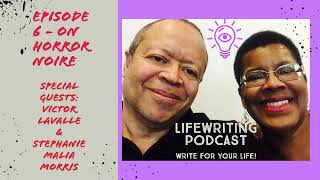
Tananarive Due and Steven Barnes talk with Victor LaValle and Stephanie Malia Morris about adapting Black horror stories for screen. LaValle adapted his own short story "Daddy" for the Horror Noire anthology, while Morris wrote an original piece that a screenwriter adapted into "Bride Before You." They discuss casting, budgets, and why Black horror is thriving right now.
Chapters
Welcome to the Life Writing podcast, where married authors and screenwriters Stephen Barnes and.
Tananarive due talk about writing during stressful times, breaking into Hollywood and balancing life.
Every week we'll share more tips on how to build a better life while you create your dream projects, even if.
It'S only one sentence a day. Life writing is the application of the tools of writing to life and the.
Tools of life to your writing. Hello, darling. Welcome. Episode six.
Ah, time passes so quickly when you're having fun.
I mean, the podcast is off to such an unbelievable start. We had NK Jemisin in our last podcast. We've had Patton oswalt, Roy Wood Jr. And of course, us. Sometimes I slaplift us.
Must never forget that.
But today we have two guests instead of just one. We have Victor Lavalle and Stephanie Malia Morris, who worked with us on horror noir. But we'll talk about that a little bit later. Hun. First, what do you have going on?
Getting ready for the Eightfold Path to be published. I've been nervous about that for 10 years. It's a graphic novel. Through what, Megascope?
Yes, with John Jennings.
And John Jennings at Megascope. And because of a paper shortage, it's been delayed until the middle of March, it looks like. So it's just, you know, stress, stress, stress. But, you know, in life they pay you for how much stress you can take without cracking. So it's like, just get over it, get on with it. What else is what? What are you working on?
I just found out today that we are ready to make an announcement about our upcoming graphic novel, the Keeper. So we can do a cover reveal today. It'll be a little while. Um, you will already have seen the COVID reveal audience, hopefully by the time this podcast comes out. But we're taping it early and today is the day and the world gets to know this. You know, we've mentioned before, this was a project we wrote as a screenplay. We got very close to attaching it to our dream production company with the favor of a dream director, but couldn't get it past the next hurdle at the studio. And what a kick in the stomach that was. I just knew that was going to happen. I was so sure that was going to happen. Our manager walked us through what the meeting was going to look like at the studio when they sold it. But anyway, none of that happened. But we did send it to John Jennings again as a treatment just to sort of see what he thought about it. And he said, this will be a great graphic novel. And he found an Artist Marco Finnegan, who was like a director and cinematographer and the decisions and choices he made in illustrating that. So the Keeper will be coming out this fall. So excited.
Yeah. And you have every reason to. I think it's going to do well. I think that people are going to enjoy that. It's a very, it's a, it's a very cool story. We'll talk more about that later on.
Yeah, just a thumbnail. It's about a little, really sort of 8 year old, 9 year old black girl whose grandmother passes away and a creature comes to take care of her. That's. That's all I'll say about it.
Let's see. We had some good conversations this week about a television pilot that is being done over at a, over at a network where it felt a little bit like we'd reached a, a dead end in terms of understanding how to make the conversion from, from one format, a book to another in a television series. Which is one of the places where a collaboration can be very, very useful because sometimes you can get so close to the trees you can't see the forest. Yeah, that, that another person coming in from the outside can often see patterns that you cannot see from inside the maze. You know, it's just like you have to go up in a drone to see what the whole pattern of the maze is so you can figure out how to get out of it. And this is where having a group of readers, a group of trusted writers or people whose opinions on your work, or opinions on work who understand you enough to know what it is that you're trying to accomplish and you trust enough to be able to actually dialogue with them about what is working, what is not working in your work is critical. So you and I were able to bounce stuff back and forth, I think in a very productive and useful way.
Yeah. And we mentioned in our last podcast that we'd had the breakthrough and now you know that we've been putting those ideas to paper or at least to a digital document. We are seeing it start to flower and come to life. So you are that extra lobe of my brain. You know, it's just like, wow, it's amazing. It's like, like you say, it's like having elves come in and fill in the creative pieces that are missing when you run out of your own ideas.
So I'm going to be reaching out for an ally just a little bit later on today. Betsy Mitchell, who was my editor over at Time Warner for Warner Books for four novels. Great. Sky Woman, Shadow Valley Lion's Blood and Zulu. Hart is taking a look at an outline for a new novel that's, that's connected with, with some of my older work. And I need some perspective on it. And even though she's retired from being an editor at a, at a publishing company, she still does, you know, she still will contribute her wisdom to, for friends and as a, and I think as a, as a professional, you know, money making activity as well, and I'm really looking forward to that zoom. I really want the perspective, the sense of, you know, what do you see here? What am I, what am I missing is, does this story flow? Does it work for you? Am I too far on the inside of this? Have I, am I neglecting some, some important building blocks of that story? Does it communicate emotion to you with these events happening this way? Transfer a feeling for me to you. Questions like that. When you have somebody that you can trust, who you believe understands you and will tell you the truth, that is gold. I think one of the greatest wealths that you can build in a creative field is a circle of artists who you trust. You have to earn your way into that circle, but find your allies where you can.
That is a great transition to our topic today because not only were you and I part of our circle of allies and collaborating on horror noir, which has recently dropped on AMC in series format. Now, a lot of you, not enough of you, but a lot of you may know that horror noir actually came out last fall on Shudder as an anthology film with six different stories. Now it's been chopped up as a sort of a series format. So they're not news stories, but they're taking the same stories from the horror noir anthology film. And AMC has started releasing them two at a time. By the time this airs, you should have been able to see at least four of the episodes, including the Lake, which Steve and I collaborated on, and I think maybe even Fugue State.
I think Fugue State is in the second group.
Second, yes, in the second week. So by now you should have a good idea of what horror noire looks and feels like. I also want to shout out, in addition to today's guest, the screenwriters, the other screenwriters who worked on horror noir were Ezra Clayton Daniels, Chernaud Edwards and Al Letson. And of course, Victor Lavalle worked on a screenplay, too, and he's here to talk about that. But this was such a unique experience. A you and I haven't had that much produced television together. So these, this was only the second project that we've worked on that's come to light as a collaborating duo. And then also it was a group effort. The executive, Crystal Holt at amc, made sure that the screenwriters felt like a family, which doesn't always happen. And we got to celebrate this victory kind of together, even in person. Hard to believe. Now, we actually went and met in person at one point, right after the vaccines and before Omicron in that window. Victor, you couldn't make it, I think, because you were out of town. But in any case, without further ado, should I introduce our guest?
Honey, I think you're champing at the bit. You should.
I am tamping at the bit.
And then a few minutes later, we'll introduce Stephanie.
Yeah, so. So, because this actually, this next guest, whether or not we were doing horror noir, is such a worthy guest and such an interesting writer, and I'm a great fan of his work, so. Victor lavalle is the author of the short story collection Slap Boxing with Jesus. Four novels, the Ecstatic Big Machine, the Devil in Silver, and the Changeling, and two novellas, Lucretia and the Croons and the Ballad of Black Tom, which I know a lot of you have read. He's also the creator and writer of two comic books, Victor LaValle's Destroyer. Oh, you got your name in the title. I see how that is. Victor lavalle's Destroyer, which I teach in my Black horror class, by the way, and Eve. He's been the recipient of numerous awards, including the World Fantasy Award, the British Fantasy Award, the Bram Stoker Award, the Whiting Writers Award, a Guggenheim Fellowship, the Shirley Jackson Award, American Book Award, and probably most importantly to him, the key to Southeast Queensland, where he was raised in New York, now lives in Washington Heights with his wife and teaches at Columbia University. And he wrote the episode Daddy in Horror Noir, all about doppelganger. So, Victor, welcome, welcome, welcome to the podcast.
It's so good to be here. I'm really, really happy to join the party.
Yes. And speaking of parties, I'm still sad that you couldn't make it to the premiere party, which we had limited, limited, limited space. But our friend Brian Fuller, the showrunner, hosted a premiere party, basically at his house in his courtyard. And we were just able to invite, like, the screenwriters and a couple of executives, and you could not make it, unfortunately. But we missed you and you were there in spirit.
I was so sorry to. I mean, one of the. As. As I'm moving more and more into the screenwriting end of things. I love living in New York, but I do there are some Downsides. You don't get to go to parties. You don't get to meet people for lunch.
Right.
I'm by.
Well, if it makes you feel any better, under Covid, a lot more people aren't meeting for love right after parties.
It doesn't matter.
We do zoom lunch meetings. You know, it's like, you know, literally we're doing one this. This week with a studio executive that we really like, and he just. We're just. Just talking, you know, and eating lunch.
Nice.
So, Victor. Yeah, it is nice. Victor, this isn't your first Hollywood experience. Can you just briefly kind of summarize what you can talk about anyway in terms of what's been happening with you in terms of adaptation?
Sure. So I've had a couple things that are. I have a couple things that are in development. Works of mine that either. I'm developing the the Bout of Black Tom, my novella, and then another novel called the Devil and Silver are both in development process. And then my last novel, the Changeling, is actually about to go into pre production. Next week. It'll be an Apple TV series. So we got a season. And we'll see. We'll see what goes after that.
That is. Let's just. Let's just stop right there. That's amazing.
It really is amazing. I would love. Give us an outline very quickly, you know, just no more than a minute or so of how you saw the steps that you went through from. From the time that it was published to them saying you have a season. What are the steps you went through? Because most of the people listening to this have no idea what that process is. So anything that you.
Any.
Any light you can shine on, that process would be great.
Of course. So I published the novel. My agent sent the book to a book agent at an agency in LA called caa. That book agent had agreed to represent a previous book of mine to resounding silence from the world of Hollywood. Nobody cared at all. So he said, I'll send this one out too, because I enjoyed the book. Just like the last time. We'll see if anything happens. As a result, he sent it out. And this time for the Changeling, there was some interest and a production company called Annapurna decided that they liked it and they optioned the book. And then they went out to a few screenwriters to see if anyone was interested in adapting the book for me.
Can I stop you right there really quickly? I'm sorry to interrupt you. At that point, had you been attached as a screenwriter to any other works? Was there Any conversation that you might be attached or it was just sort of understood, well, we're going to go find a screenwriter. Now.
I had zero experience with I like I. The previous book that he tried to sell. I then worked with a talented director. The two of us tried to sell that using her connections. And that also went nowhere. And so I didn't have anything that was produced or even in the pipeline for production. And so Annapurna, at that stage did not have. There was no conversation about, hey, would you like to do this?
Okay.
They said, we want to take this out to other people. And I said, I can't make you do otherwise. So, okay, let's. I. And, you know, we're talking. This is the, like, the honest part of the life, right? Is the book was a successful book, whatever that might mean, positive reviews and positive sales, but it was not the kind of sales where I could dictate the terms.
Right.
I did not have that kind of power. And so they said, we want to go find someone else. And they said, okay. And who they found was a writer named Kelly Marcel, who, at that point, she made saving Mr. Banks, Tom Hanks movie, a show called Terra Nova she created but didn't make. She's a white British woman, and. But she really vibed on the level of parenting and marriage as. As a. As a sort of. I don't want to say ordeal. As an experience.
Yeah, no, no. Ordeal.
And then to her credit, to her great credit and to my great appreciation, as soon as she signed on, she called me up and said, I want to come to New York and let's have lunch. I don't want to take this book away from you, in part because there's lots of things about this book that I don't feel I have authority on. And so if you're open to it, I would love for this to be much more collaborative.
And this is the changeling you're talking about?
Yes.
Okay.
And so I would say that was. That seems from. At this stage, I was. I understand that seems pretty unusual for that to happen, but she was really adamant along the way. So she send me scripts. She'd ask me for notes. I'd send those notes to her, and then, wow, apple. It was really very. And, you know, those notes were always very respectful because she was doing a wonderful job. So it was kind of. It was fun to do them because I didn't feel it was. There was no sense like, I'm. You're messing up my book or anything like that. It was like, this is A show. This is not my book. And so I'm enjoying seeing how this changes into a show. And then here or there I would give notes. And so essentially, after we would go through that notes process, then she sent it to Apple, Apple gave their notes. She would send it back to me and say, here's what they're thinking. And then she would come up with the finalized script.
Let me ask you a question. There are a lot of writers who, during the process of adaptation, they freeze and it's like, no, it has to be this way, but not that way. And they literally will get shut out of the process. What I was wondering was you're displaying a lot of conceptual flexibility and what I would consider to be emotional maturity around the question of your art. And I was wondering whether or not that's always been a characteristic of yours or whether you've developed it, you know, through needing to collaborate on teaching or other things in life. How have you always been this flexible?
No, no, no. Definitely not.
How did you develop it? You know, talk to me about that a little bit.
It's a great. You, you, you. You named it, right? It's through teaching. In my teaching process, I teach in the MFA program. I'm reading people's students work all the time. And in those conversations, essentially, I'm the note giver. And we're talking about how students might rethink their work, reshape it, take it apart and put it back together. And I think what I have seen is I've seen the students who refused that kind of tutelage or collaboration. And I've seen sometimes they know exactly what they want, and maybe they're right. But more often than not, I would say when they were willing to hear other students or myself, it doesn't have to be that I was always even the one giving the right advice. You could see over the course of a semester, their work blossomed.
Yes.
And you could see how they would change and rethink everything.
Yes.
And doing that, I mean, it's been 20 years now of doing that. It's. It made it clear to me as well, like, you can't tell this to other people and not think that you also would benefit from being open to hearing.
Beautifully put.
Beautifully put. Beautifully put. The only issue then would be how do you know who to trust, who to let in and who to say, no, this is not right. How did you. I suspect that you had to develop some sort of an instinct about the times that you can be flexible and the times not to be flexible can you speak to that at all?
Well, you know what? I. At this stage now, like, one of the things I ask my readers a lot of the times is two questions I ask them is like, what was boring and what was unconvincing? And the stuff that's boring is one kind of conversation. Because then we could get, in a way, we get into aesthetic. You know, sometimes something I think is really interesting, someone else thinks is boring. And I can decide, like, well, I think people might want to know a little bit about this process. Or other times I. It's, oh, it's okay for me to just hear, oh, no one cares about this process because I really trust this person. I'll just cut that. But the more useful thing is what's unconvincing, because then we have a real conversation about how or why they might be willing to hear about a thing or learn about a thing or get to know a character. And in the process, I'm getting to hear a different way of thinking about how you believe in people, how you care about a character, things like that. And my own shortcomings in how I communicate, right. What things am I taking for granted? What do I assume everybody thinks or does? And I'm learning that that's incorrect. And so those are, like, questions I ask almost everyone. And in a way, like, their answers help me start to figure out if this is a person I can trust. Right? Because if the answer is like, well, I didn't like this because I saw it in, you know, like a. What is it like? I don't think you should. I don't think you should show that marriage is difficult. That's. That's. That's like something that shouldn't be said because. Because it should always look like love is great or whatever. And I kind of go, I don't trust this person.
Right?
Yeah, that's a silly thing.
That you don't trust them. It's not that they're being dishonest. Perhaps it is that they see the question very differently than you see it. And you think that they actually, you know, being. Having been married, having observed marriages, it is reasonable to say this is an immature attitude. They have an immature, romantic, overly romantic notion that love conquers all. They don't see the work that it is. Therefore, it is in conflict with your perspective. So whether they are intelligent and mean, well, they can help you express your perspective if it is too different. And there's people you can't trust, not because they're bad people or unintelligent, because they see the world very differently.
Yeah.
And that's a big. Yeah. Like, it's not. It's not to say that, like, they might write a story where love conquers all, because at that age, at the. At the place they're in, in life, that is the story that needs to be told, and that they are going to find people for whom that is exactly what they need to hear. And they'll serve them well. It's just that it won't serve me.
That's not what you're trying to tell. So let me. Let me fast forward to you a little bit at this point. I mean, because I've also had the experience of having work optioned and then other producers, other screenwriters have your work and varying experiences from Blair Underwood, who had my soul to keep for 10 years, who kept me completely in the loop. I saw every draft. I heard about every meeting or we did where I've had a situation recently with my soul to keep. Never saw a draft, never heard anything, you know, except, you know, just through. Through sort of sideways means. An accident, accidental, like an accidental meeting with a screenwriter. It's like, so. So it's a struggle. And even now, you know, our. Our agents are trying to negotiate for. For us to have a chance to write a pilot on a. On a. Where we. We've already had a Twilight Zone, we've worked on more and more. Steve has a bunch of TV credits, but there's still that push to get in and to get that opportunity. How did your opportunity to actually write a screenplay come about? Did you fight for it or did it fall in your lap or what happened?
No, I fought. So the other two projects Battle, Black Tom and Devil and Silver. I've been able to get my. To be able to write both of them. And in both cases, I pitched myself. Like, when they optioned the book, essentially what I said was, like, I have a sample script. Because even though that first pass of selling a book didn't work, I had written a script for it. And so I had at least something to say, like, hey, I would love it. Before you decide to go out to anyone else, would you be willing to look at this script and then have a meeting with me where I could talk with you about how I would like, what I would do differently between book and show, how I'm thinking of it on a thematic level, on a personal level, all those kinds of things. And they said, we won't promise you anything, but we'll listen. And so then I went into that meeting very prepared. I'd given them the script. But then I'd also spent a couple weeks really putting together like, here's who, here's what I think the themes are of the story. Here's why I think it's, it speaks to today. Even though it's said a hundred years, almost a hundred years ago. Here's the parts of it that are fun and horror related. And so I just made that pitch. And if I'm being totally honest, I think what I also benefited from was I don't know if they wanted to pay a real, if I could say like a real screenwriter. I don't know if they wanted to pay get. An established screenwriter would get paid cheap.
You're cheap.
I was cheap.
How did we get you for scale?
Right? That's right. And at that point I was incredibly happy considering book advances, I was incredibly.
Happy to get paid tremendous amount of money running around Hollywood.
Yeah, what's cheap in Hollywood isn't cheap anywhere else. Like you can get thousands of dollars for a page and a half treatment or a three page treatment. It's crazy. It's one. So we want to bring Stephanie in soon, but I also want to talk to you just specifically about having had these experiences, having won your, your right to work on screenplays. How did the horror noir experience strike you as feeling different? Did it feel different with the community aspect?
Well, I will say so. The first thing that was different was that I had a black exec working on it. Right.
Crystal Hold.
Crystal hold.
Makes a difference, doesn't it?
A huge difference. And a huge difference. Just in that like I've had the other execs and the other places are wonderful, truly wonderful. So it's not a diggy get that, but it was the first time that I was just talking to a black exec and who, when we sat down to talk, she, she saw the story, she understood the basic idea of everything. And what we got into was maybe on some level not about explaining the surface of things, but getting into the deeper aspect of things.
The roots.
The roots, yeah. And then the other thing that Crystal did like, I, I could never stop singing her praises was as you mentioned, brought all the screenwriters involved together. We had a virtual cocktail party to say like all of us are part of this team as opposed to the way it can sometimes feel like you're a little siloed in your little project, crossing your fingers, hoping things will move forward. So when we had those opportunities to meet each other virtually or I'm imagining in person, you know, I imagine it's like, what it would be like to be in a band. It's like you have a crew as opposed to you're a soloist. And it just was so wonderful when we were doing those toasts and I was just looking at everybody being like, look at this crew. I can't believe I get to be a part of this and these stories and that this would be my first. While these other things are being developed. Paranoir was the first thing that was ever produced.
Your first credit.
Yes, my first credit. Congratulations.
So excited. So exciting.
Many, many successes to come.
I appreciate that so much.
And speak.
Perfect place to start.
Yeah. And speaking about, speaking of, rather first, I'm not. I'm not trying to, like, take credit and brag, but I'm going to take credit and brag for a second because I have half my syllabus here on this call for my black horror course. I'm already teaching Destroyer, and I've been teaching this young woman's short story for years as well. Stephanie Malia Morris is an MFA candidate at the Michener center for Writers at the University of Texas. She graduated in 2017 from the Clarion West Writers Workshop, where she was a recipient of the Octavia E. Butler Memorial Scholarship Award. Congratulations on that. And is a 2019 Cambilio Fellow and inaugural 2021 Paraplus Fellow. Her short fiction has appeared in Faya, Pseudopod Nightmare, Apex Magazine, and Lightspeed. And her short story, Bride before youe was adapted as a short film as a part of horror noir. Crystal had a story that she'd been working to pin down that she couldn't get kind of like, oh, my gosh. She reached out and said, do you know of a story? And I read a lot of short stories and I thought about a lot of writers. But right before you really jumped out as a story that could work really well. And I'll have you talk about it, Stephanie, but what was it like? So here you, at the time, you had published a few short stories and then just describe for the young writers out there what it was like to get the call.
Yeah, it was a surprise. It came out of nowhere. I wrote Bride before youe in 2017, and it was the application story that I sent in for Clarion West. And so. And before then, I had really never shown my writing to anybody. So to get into Clarion west with this story was just like, wow, completely unexpected. And so, yeah, I had written a few short stories after that. And then all of a sudden, out of the blue, hearing from Crystal Holt and then. And Being introduced by Tony Reeve to her as to get my story adapted was just. I still didn't quite believe it happened.
That's how it should feel. That's how it should feel.
I'll send an email, and I'll be like, yeah, I see the evidence of it, but I actually don't think it happened.
How was it when you're in an MFA program, you know, and you're going around the table and like, yeah, and I. I had my short story on TV the other day. Or did you feel shy about it? Or were you kind of like, yes, it was me.
How did they react to you?
Well, that was interesting. So I do feel very shy about it. And what was hilarious was that after it came out, one of my classmates in my cohort, she turned to me and she was like, is your middle name Malia? And I was like, yes, it is. And she's like, because me and my boyfriend were watching this horror noir anthology, and they're like, stephanie Malia Morris. And I was like, I think I know her. And he's like, very random. But, yeah, the people in my cohort were very supportive, very excited for me. And, yeah, it's just been really wonderful to be able to share this with people. But I am very shy about it because I don't quite know how to bring it up. Like, yeah, yeah, it ties back into. Was this a real thing that actually happened?
Well, your. Your path to getting into Hollywood, there are countless people who've had that experience. You can't predict it. You can't push it. And one of the things I always say is that no two writers ever get into Hollywood in the exact same way, but you have to put the work out there and then nibble around the edges and find connections. You weren't even nibbling around the edges. All you did was create good work, get it out there. You know, you did your work, and then stochastically, somebody saw it who was in Hollywood. Tananarive, who then took it to Crystal Holt. So it's important to take a look at how this path. How did you walk that path? And in your particular case, you were just focusing on doing good work and short stories.
And that's such an important thing, too, because it is a short story, and we. We chopped it up last time with NK Jemisin about the importance of writing short stories. But one element is just. It's ip. It's intellectual property. A short story can be optioned for film or tv, just like a novel can. Takes so much less time. To write. So we'll all talk about the process of working on our scripts, but I'm actually wanting to start with you because you wrote the original story, but you did not adapt it. Could you explain really quickly what the original story is for people who haven't seen it? And then also the major changes that screenwriter Chanel Edwards made, and she did, I thought, an amazing job. What were the major changes she made and how did you feel about it?
Okay. And it would be fun, I guess, just to kind of spoil things for people who haven't seen it, or try.
To skirt a little bit around the spoilers, but tell as much as you need to for the story to make sense.
Okay.
Yeah.
So the story is the adaption of a fairy tale, a Norwegian fairy tale called the Prince Lindworm, and it's set in black Washington, D.C. kind of like after reconstruction. And the story, it's told from the perspective of the. Well, in my story, it's told from the perspective of the antagonist. And then you just kind of get to see, like, what the problem is, and then book full resolution, stuff like that. And so that was how I wrote that story. And then to have the adaptation where it was from a different point of view, from one of the other characters. So there's a mother character, and that is what Cheryl Edwards did, the point of view. And so, yeah, there's a completely different point of view. So it's a bit of a mystery, like. Like, if you read the story, you know who the main character is, but that character is a mystery in this. In the adaptation. And, yeah, I was just very fascinated. I just loved the whole. Just looking at the creative differences between my story and the script. I come from a background of writing fan fiction, being in fandom, and I love adapting fairy tales and things like that. So to be able to see someone kind of bringing that same process of transforming a work onto something that I had written was just so completely amazing and such a thrill. And I was just really loving the creative differences that were brought in. Like, in the script, a new character is added, and I just love that choice of this new character who's kind of like a housekeeper and is a confidant of the mother. And so. So things that you wouldn't be able to get without having that secondary character for the mother to kind of bounce off of and to be able to talk to. I think, yeah, I have to externalize.
Some of those thoughts. So prose is so inward, and there's so much interiority, and you have to make all the all of it visual somehow in an adaptation. And I'm so excited we have this on tape. That a writer is happy with the way a screenwriter adapted her story. This is amazing. This is an amazing moment. We're capturing a history in Hollywood, people. She's happy, so. Well, I'm happy for you. I talked about it in every interview. You know how excited I was for you having your not having to wait 30 years, almost like some of us did, to get our first adaptations on the air. Victor, you decided to write an original script. Daddy is an original script, Correct?
I adapted a short story of my own.
Oh, it is a short story. Sorry.
Yeah. Great.
Okay.
And in my case, the biggest. So the story is about a couple, but focuses on the young father, or new father, I should say, who is really, really in that overprotective dad state, really wants to take care of his. His child. And then his child basically starts saying they lived in an apartment in New York City. And he starts saying, there's someone at the window at night. That's all I was saying. It kind of builds from there. And who is it and what is it? Is it real? And it kind of goes from there. And for me, one of the biggest changes was Crystal Bridington, because in the story, the child is about three. And so Crystal called me. She was like, look, this baby can't be three. We need this child to age up a bit. And I was like, okay. And she said, it's just about like, what we can manage. Like, you need someone who can act. Right, Right.
Well, that child they cast. Yeah, I know his name. Oh, my goodness.
He's like, I can look his name up.
Senior.
Wonderful kid. Wonderful kid.
I don't even. Really. Great energy.
But then the funny thing was then. So I said, no problem. And I aged him up. But then she called me up and she said, like, well, I appreciate you aging him up, but he's still. Now he's still talking like a three year old. So now you need to give him some dialogue, please. And so that was a very funny process with Crystal, like calling me being like this sounds like a 4 year old. Can he sound like a 6 year old? And I said, okay, okay, sorry. And so it was. It was me sort of almost like having to catch up to the realities of what a show would need versus what a book could do.
The production realities. What can you actually pull off?
Yes.
Just in terms of actually, you know, a camera, a set, the actors, the time, the resources involved. You have to be able to juggle all that stuff. And understand these are not bad people. You know, when they ask you these things, they're not being monsters, they're trying to. To get you. Help you get your football across the line.
Right. Well, what about for you? So you two adapted to things.
We did. Yes, we did. It's a beautiful.
Bring that up. And you know what's so funny? I swear, I think I thought of Stephanie's story before I thought of anything else we had done. It didn't even dawn on me to suggest another story for us, but Crystal dug it up. Dug up. You know, the second one, which I'll let you.
You.
What we do is, is if I take lead on a story, my name comes first on the script, and if Steve takes lead, his name comes first in the script.
That's how we talk about the lake first, sweetie.
Oh, yeah, let's talk about the lake first. So the lake is a short story of mine, basically about the monster within. A woman moves to my fictitious town of Graystown, Florida. I have several stories set there in my short story collection, Go Summer. And basically the conceit is that magical things happen in the town, mostly around young people. But in the case of the lake, an older person is also affected by the magic, and she's warned not to swim in the lake, but she does anyway. Why do people do that? And it really is about the monster within. And Steve and I really set out with what was a pretty faithful adaptation of the short story. We did not. We added a girlfriend for the high school students so they could have conversations and we could hear what he was thinking about the fact that his teacher wants him to help out around her house after school. But aside from that, it was very faithful. Except we knew we had some production limitations, right? We weren't going to get that big CGI monster moment that we might. I mean, I like practical effects, too, but we knew we would have some. Some budget limitations, so. So we tried to confine it a bit, but we had the settings of her house and the school and just the lake. And I would say the major difference in the production was that in the short story, and really more so even in the script, because we were leaning into some haunted house imagery, some misdirection to try to make it seem like, well, I'm not going to be giving away a spoiler, but some misdirection, let's just say. And in the production, the house is actually a lot nicer than it was in the script. So it doesn't have that same feeling of like a House and a life that's falling apart and kind of those haunted house kind of angles. But having the nicer house actually does add something unexpected, which is that she's sort of using her money in some insidious ways. And I'll leave it at that. So even though we don't get the haunted house imagery, what we do get is sort of this, this picture of privilege, which does give it an entire entirely different flavor, unexpected from when we wrote it. But Leslie Ann Brandt, who was in Lucifer, stars in that, and she did an amazing job. And tell them about Fugue State Darling, which is the second one we did.
Okay, so Fugue State was originally a story we did. While we were teaching a course in writing, I decided to do something unusual.
A life writing course. As a matter of fact, it was.
A life writing course on writing. We had the students actually suggest subject areas. The idea was to create a story right in front of them. So they pitched a bunch of about a dozen different subject areas. And I saw politics and religion, and I considered politics and religion, when they overlap, to be an area that is really great in terms of horror. So I said, okay, we're going to take that. And so then we created an outline on a Google Doc that enabled us to kind of build, you know, this is what I think a story could be. And we actually linked them to the Google Doc so they were able to see us developing the story in real time. Terrifying, terrifying Google Doc to a piece of software called Writer Duet, which is script writing software, because I tend to write scripts of, of stories first in order to kind of get a fleshed out outline of what the story is. And I, I promised to Nari, okay, I'm going to take the lead on this because I can see what this story could be like in. In. Initially, it was the same idea about what might happen if a charismatic preacher actually began to manifest real powers of persuasion in a particular ugly way. And originally it was also thematically the idea that masses of people who are all hyper emotionalized will operate at the lowest common denominator level. They behave like a group mind at a fairly low level. And so if there were some parallels between that and some political realities in America at the time, you know, mia culpa, mia Mac. But the original, the original story climaxes at a, a huge event at a football stadium.
Right now, we weren't gonna get that budget.
Definitely weren't. So what happened is we did the, we did the lake. And then after we had planned a trip back to Atlanta to see Tananeri's family. We got the call that they wanted another episode and that they were interested in Fugue State. So we had to create an outline that scaled that down. You know, we had realities of budget and time and so forth and so on. So I had to reconceptualize the story. By the way, that story that was, you know, went to Writer Duet and then was fleshed out, and then we sold it. So we actually. Our students actually got to see the entire process, from initial concept to final sale at Apex, I think, or Lightspeed. But then we took that story and began to reinterpret it, find the core of it, which was a husband and wife who love each other. And what happens when. I thought, you know, the thematic on this. I think I might have to change this a little bit from a comment about society as a whole more to what happens in relationships when one partner bends so much, try to keep the relationship that they break. That I. That became the image in my mind of two people who love each other, and they're trying to find a way to continue to hold hands in life as one of them is warped out of true. So the core then became. I knew that we couldn't do big scenes, so we had to do deep scenes. We had to find. You know, I wanted to find scenes that would enable us to really feel this relationship so that when it began to break apart, we'd really feel that. Not with some big special effects like this, but just the quiet moments and trusting the actors that they could pull this off. So I always felt like I was in collaboration with actors I had not met. Can you do this? Can I leave space for you with. With your vocal tonalities and facial expressions and body language and silences, can you create this? Tananarive pulled me away from one thing. I wanted a moment where it felt like this relationship was in real danger. And she warned me that if the husband hit the wife, that the rapport would be broken so that people would stop caring about that relationship. So we pulled. I pulled that back. So with the lake, she did the first draft, and then I gave feedback with few state. I did the first draft, and then I asked her, I need you to be sure that I am being true to this female character. That if our core audience, in many ways, let's say that our core audience for this is black women, that we want to create a metaphor that is really powerful and that the horror is within the human heart. Be sure that I'm staying on the path. Be sure that I'M not accidentally doing something and not realizing the implications or how it's going to hit. So we did that script. I was writing it on the road, you know, while we're trying to hurry and have a very truncated time period to do that. And then we got notes back and I had to rejigger it.
So scale it down even more. Oh, no, no. Make less. Less money.
Less money, Less money. And ultimately I didn't even know how little money there was going to be.
I wish.
Because if I had known that, if I had known that the budget was. Was quite modest, then I would have start. I would have reconceptualized the whole thing until it could have been done as a. As a stage play, one act play. Okay. And then I would have built up from a play rather than down from a cinematic experience, which would have had a stadium scene.
So.
Yeah, that's right. We would have had a stadium scene. So then we got. We got lucky in terms of Rachel True.
And as Malcolm Barrett and Rachel True put their foot in it and also.
Absolutely did. No, no, I'll say this one.
Okay.
We got Tony Todd as a preacher. And the instant I heard that, I knew that we could tweak the dialogue so that it had his vocal cadences and I knew that he could absolutely tear that up. He could do a fantastic job. So trusting the actors to be the special effect, creating an image of black love, which we very rarely get to see as far as I'm concerned, and then place that love in danger. And so it's a tragic love story in many ways that then has a resonance through, you know, religion has resonance through politics less directly. The political arena got short shrift, but the intimate relationship, psychological arena got pumped up. So that was that. That was that process. You know, I wish I'd had more information, but what I know is everybody involved in that brought their A game. They did the very, very best they could. And ultimately that's all you can hope for, is you're trying to. Trying to take steps along this path that you're going to work with other people who care about the stories and care about storytelling as much as you do, and then trust that they will bring their own special genius to it. You assume that they're. They're artists just like you. What can they bring to it? How can I leave room for the art director? You know, the. Just the. The composer, you know, the actors, the director. And if you do that and you can trust them, eventually you put that child in their hands and they're the ones who have to deliver it.
Yeah. One thing I'm noticing when I hear about all of these different stories, Daddy Bride before you Feud, State the Lake, they're all so very different. They're different types of black horror. Which is something that I truly, truly appreciate about black horror noir is this idea that black horror is not one thing. Black horror is as infinite as the minds of the black creators. I'm wondering what what you, Victor and Stephanie think about the state of black horror, how you're feeling about the future of black horror and your place in that.
Well, speaking for myself, I guess, you know, it's a funny moment. Like there's a part of me, the immediate answer is to say I feel so enthusiastic. There's been such a flowering of black horror. Right. But then I take a second and I think to myself, maybe what I mean is there's been this flowering, but suddenly there's a channel that was not open for a very long time that has opened and there are more venues talking about, if you talk about screenwriting, talking about like for TV streaming services, independent film or big budget film, but then also talking about literature like online venues and print venues. And the idea that none of these things is to my mind at least anymore given prep, like you publish a thing online, it gets read all over the world, potentially. That is this powerful, beautiful thing as opposed to sort of an old school model that said, if it's not a movie or if it's not in a print magazine, did it happen?
Right, Right.
And I'm loving that all these things are sort of existing. And then the pleasure of all these different black creators showing up and being like, I'm here and I've been here. And then newer black creators saying, and we're here too. And I really appreciate that. It doesn't have to feel like and one of you is going to get the ring.
Right?
Right.
Which is there can only be one way.
There can only be one. And you all kill each other and we'll just take who's left. Because it creates such a poisonous atmosphere for the creators, for all those black creators. When you know then and who's your enemy? It's not one of. It's not the rest of us.
Right.
And I appreciate that at least for me it hasn't felt like that in a way that speaking coming up through like literary fiction, it is very much still like I'm cutting throats. There's one book contract out there and I'm taking it for my debut, whatever. And maybe even then it's outloaded because I haven't been on the student side or the younger writer side, even mfa, literary fiction, whatever you want to call it anymore. But I certainly remember that feeling back then. And I kind of love, like, when I've been doing stuff, getting to know folks, black horror across all these different spectrums. Then you include comics as well. I have yet to run into people. I have yet to run into the crabs in the barrel feeling that I felt in literary fiction ten years ago, five years ago. And it's beautiful, you know, so this.
Feels more like family to me, you know?
Yeah.
I'm so glad about that. I've said this before to MK Jemisin. It makes me so incredibly happy to see all these voices coming in there. You know, both the feeling of not being alone, the feeling that there are gonna be more people creating images that satisfy that particular hunger that I have had. People I can talk to who understand the journey that I've been on, and just, frankly, just, you know, people who. Evolution works. If you have enough separate mutations that you can lose a lot of them and one or two of them will succeed, that that is true about nature. But when we have enough individual artists, that the onus isn't on each and every one of them to be a genius every time they step out of the house, that you have to have room to fail. You have to have room to fall on your face to look stupid. You know, if you don't have permission to be stupid, you start playing it safe. And that, once again, is the beginning of being a hack. You're doing the thing that you know you can do rather than let me do something I've never done before and something I've never seen before. You know, if you do that, then your. Your unique perspective is going to give us new stuff.
How about you, Stephanie? Yeah. You're the newcomer in that space that Victor was talking about. How does it feel to you?
Yeah, it definitely feels like just the broadening of the field that Victor was describing and you all were describing. I definitely do feel that there's kind of this idea out there of being able to be the black mediocre writer. Kind of like that idea of black mediocrity, which I am extraordinarily excited for.
Explain. Explain.
Yes, yes. So there's. I've always felt that, like, when I was younger, wanting to be a writer, looking at the black writers who were my predecessors and who were my example, there was a feeling that I had that you had to be good because there was only so much room. And yet, on the other hand, you have a lot of writers, like white writers and things like that, who could write stuff that wasn't the best of the best and still find a large audience and. Yeah, and so basically, to have so much more people, so many more people in the field, to have so much more freedom to do things that really fascinate you, whether it reaches this high literary idea of what is good fiction or something like that, you just get to really write what speaks to you. I mentioned earlier that I come from a background of fan fiction. And one thing that I love about fan fiction is how specific you can be about your tropes. It's like I want to read friends to no enemies, to friends to lovers, and there is only one bed and there is just like takes place in a coffee shop. And it's very, very, very specific. And I'm seeing that now in like commercial fiction and where you get to be specific. And this is one thing that I really admire about the romance genre is that you have a lot of authors who, instead of writing something that's like some high literary whatever, they just write the very specific tropes because that's what their writers, their authors, I mean, sorry, their readers want to see, you know, how it's going to end. But that's the joy of it. You don't have to really surprise anybody because they're here for a very specific thing. And so that's what I'm seeing more is that now we don't have to do so much 101, where it's like you have to be good to this specific standard that somebody else set. Now you can be more. Now you can be good to a standard that you and your niche readers set and want to see.
That's a great point. That's a great point.
It really is.
It speaks to freedom.
I think that you have to. Once again, it's that idea that you have to be free to fall on your face to ever get the balance and experience you need to do a triple axel at the Olympics. You know, you. The road to excellence. Inevitably, that's what the. One of the things that the hero's journey says. There is this thing called confront evil and fail. Dark night of the soul. The only way you know how far you can go is by going too far. You have to try things that aren't going to work. And the people who think that every story, every word, every sentence has to be perfect simply get paralyzed. They simply can't move forward and they never become the writers that they were going to be, unless somebody can give them permission to look silly. Permission that you're not carrying a race on your back, you know, you don't have to be twice as good, you know, to get half as far every time out of the gate. Sometimes you can just be Stephanie, sometimes you can just be Victor, or you can just be Tananarive or Steve. You can just play and discover.
Yeah, I definitely remember that weight on my shoulders as a. As a learning writer. Yes. Not seeing myself and not knowing what I was supposed to contribute. If I wasn't Alice Walker, if I hadn't had that rural background, then who was I as a writer? And. Yes. So that freedom is so important.
So, Steve, I'm sorry.
No, go on, Greg.
One last thing on this, to Stephanie's point, to this larger point, I watched this video just this morning about the making of Maximum Overdrive.
Yeah. Stephen King.
Only directoral effort, only directorial effort. And the whole point of it was, this movie ain't great. Well, how did it get made? Blah, blah, blah, blah. One of the things I really loved, they talk about Stephen King the whole time when he agrees to do it, when he's on the set and all this stuff. He said, I wanted everybody to know we're making a moron movie. That's what he would say, we're making a moron movie. Which means you just turn this on, you just sit back like a moron, and you just watch trucks crash into stuff. And he said, and that was the extent of my dream for this thing. And there was something beautiful about just hearing him say, like, you know, he wasn't like, it's my first effort. And I knew I really wanted to get into the depths of what he just like, I just wanted to truck crash trucks.
If you don't have that attitude, how in the hell do you write as much as Stephen King is written, he clearly has clear permission to question, you know, Casey is a brilliant man who works very, very hard, but there's one part of him that's just an evil child.
Yes.
There is great wisdom, you know, and this, it is. Learning how to connect with that creativity and give yourself permission is part of what we are always trying to do when we. When we talk about these things. The entire, you know, life writing system is about connecting the structures of story to the process of writing the story to the process of living your life. So that this, the intelligence is problem solving. So the same problem solving you're using in your stories, you can use to. How do you Write the story to. How do you sell the story? You know, you're just writing a heroic journey about somebody who wants to be a writer. What do you have them do next? The.
The life.
And so I've been teaching this for like 30 years. Once I realized that there was this connection between the hero's journey and the process of our lives. And then with Tananarive, we started teaching these things online in a very specific way. And then we created Life Writing Premium, which is the flagship product of what we're doing. It's a year long course. Every week people get another lesson and they are the, the sponsors of this podcast, right?
So we got, we're paying our bills.
Talk about it a little bit.
Paying for our new audio engineer, Life Writing Premium. It's a subscription course, a new module every week. As Steve said, you take it at your own pace. And it really is a combination of so many of our teachings, Whether video lectures, PDFs, exercises, you name it. As a part of the course. My favorite part is the sentence of a day. A sentence a day principle. Because that's what got me through my most difficult writing project, that when I.
Had written one sentence a day, you can write a book in a year.
To outline my novel with a sentence a day and then to carry that into a difficult writing process. And obviously you're going to write more than one sentence, but that's right to the one thing.
That's the trick. It's a psychological trick. The idea I don't have any time to write. And I've seen people spend an hour explaining why they don't have five minutes. They'll be on social media and they will spend 50 sentences telling me why they don't have time to do one sentence. And I'll just sit back and laugh because their demons are stopping them. Once you say, I'm simply going to spend one. Write one sentence a day every day this year you will start figuring out how to do more than that. Once you actually make the time to sit down and do a sentence, you're going to find the part of you that said, oh, that's ridiculous, I got to see the next sentence, I got to write the paragraph, I got to write the next paragraph. But if you're thinking to yourself, I have to write five pages or 10 pages, that can seem like it's just too much. So it is a psychological trick. But if you can promise that you write one sentence a day every day for the rest of this year, Life Writing Premium will help get you published.
We Kind of. We got a bunch of the tricks and tips, so check it out at www.lifewritingpremium.com. it was the process that gave birth to Fugue State, which is now on amc. And for those of you who haven't seen the horror noir anthology film and you have Shudder, it's still on Shudder. You can watch the whole thing at once or watch the series version now on amc. Thank you so much to Victor Lavalle and Stephanie Leah Morris. What a great. I could have talked to you all day.
For us, this was. I just was saying thank you to both of you tonight or even Steven. Just, this was wonderful.
Do you want to shout out your websites or plug anything? This is the time.
The only thing I can plug is writing a Marvel comic. It's out last week.
Great.
Yeah, check it out.
Stephanie, good.
Thank you so much. This was amazing. I really love talking with you all. You can find me on stephaniemaliamorris.com and.
Yeah, there it is.
Fantastic. I like the idea of doing writers salons. We're going to start talking about just getting, I mean, just conversations for us. Just working writers who are willing to share everything that they have, who just get together maybe three times a year via Zoom.
Yeah. Without the mics on. But we'll wrap really quickly. Really, thank you so much for taking part in the podcast today, everyone. Go on and write for your lives.
That's right. Be the hero or heroine in the story of your life. Take care, guys. See you next week.
Sa.







