Interview with Steven Barnes
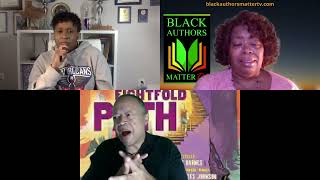
Steven Barnes shares how he became a writer and his six-step method: write a sentence daily, write short stories, submit work, wait for editor feedback before revising, read more than you write, repeat. He uses martial arts stories to explain fear and clarity, and discusses his upcoming graphic novel Eightfold Path with John Jennings, Charles Johnson, and Brian Christopher Moss.
Chapters
So we have. As our next guest, we have Stephen Barnes, and a lot of you all know him from his science fiction paranormal books. And he has a new book coming out. It's a graphic novel anthology, and he's going to tell us all about it now. He. He was here, then he left. So we'll see. Maybe. Okay. There you go. Okay. Welcome to Black Lives Matter tv.
Thank you. I thought that you guys had turned off my audio and video, so I almost didn't touch it myself, but turns out, turns out I was in control all the time.
Okay, well, welcome to the show, and it's great.
Thank you. Thank you. It's wonderful to be here. Thank you for asking me.
Okay, so we. The last time we saw you was at the National Black Book Festival. I think it was in 2018, if I'm not mistaken. You and your. Yeah, yeah. So I think that was the year that they came, because I think Eric. Were you there with Eric? Jerome Dickey, Were you and your wife there with Eric?
I don't remember. It sounds possible. It sounds possible.
Okay. I'm trying because he was there in 2018. I get mixed up between the years, but at any rate, what city was it in? Houston.
Houston.
Houston.
It'll come back to you.
I'm trying to think. It's possible. I remember doing something in Houston, but I don't remember what it was, and I'm not sure it was 2018, so can't be certain.
Okay, but you have been writing for many years, and I read one of your books a long time ago, before I even really knew who you were. And I can't remember what made me read it because it was Blood Brothers, and that's been. That's been some years ago. But it was an excellent.
A little bit, yeah.
It was an excellent book. And. And I can't remember why I read. You know, sometimes books will lead you to other books that are similar, and I think that's what happened in that case. But you're now doing something different. You have a graphic novel anthology. But just get. Give us an update on a couple of things. One, your writing career has been long, so just kind of tell the audience how you got started with writing books. I know you have to kind of think back.
No, no, it's. It's. I get asked that question often enough that it's not like in the back of my mind someplace buried on, you know, underneath the shoe. You know, I just was always writing or telling stories, and there came a point when I realized I wanted to be a Professional. And so I started sending short stories in for publication because that's what I consider to be the most reliable route to publication, is to work on short stories first. Then when you published enough short stories, you start moving on to longer forms. And so I just worked my way into the industry. But I also had help in the sense of looking for mentors, looking for people who could guide me, looking for people who had information about how the business really worked. Because the clearer the map of the territory, the easier it is to navigate it. So I would ask questions, you know, how did you do this? How do I do this? Can you help me do this? Will you take a look at this? So that was, you know, pretty much my, pretty much my route in.
So what were your, some of your lessons learned along the way?
You know, we have a six step process that we teach in our life writing class for to help people get into the industry. And the first, you know, and it's a collection of everything that I've learned, so I think that'd be the easiest way of telling people if they wanted to get in the industry based on that. Six steps. The first step is you write one sentence a day, every day, no matter what. You just make that commitment. I'm going to write a sentence a day, period. Nobody fails to have the time to write a sentence a day. You just have, we all have that much time. So that's the first step. The second step is you write one to four short stories a month for lots of different reasons. Short stories are the fastest way to leverage your intelligence and your drive into skills that you can then operate with at a professional level. In the time it takes you to write a hundred thousand word novel, you can write 25,000 word short stories or 42,500 word short stories. And you're going to learn vastly more about writing with, with a novel's worth of short stories. And with a novel, not only that, but it's much less emotionally damaging if it gets, if, if what story gets rejected? It's like, eh, you're already on to the next story. If a novel, if you spend a couple years writing a novel gets rejected, it can be devastating. People fall apart. So, you know, write a sentence a day, huh? He said, you think they're gonna fall apart? Yeah, I mean I've seen people, I've seen people spend decades working on projects and get so scared at the idea of being rejected that they never even sent the projects in. Yeah, I've seen that happen. And that's a shame because I Don't really believe in talent. I believe in hard work and honesty over time. Every single person I've ever seen who was successful at a level of expert or master at anything, all I saw when I got close to them was a lifetime of hard work. You know, it's like looking at it. You go to an athlete's house, and their house is filled with exercise equipment, and you say, oh, you must just have been a natural. You're not looking at the work, the pain, the resistance to exhaustion and fear that allows you to do something every day, even when you're not getting the outside reinforcement. So, a sentence a day, one to four short stories a month. Finish your short stories and submit them for publication. Send them in. Fourth, once you're finished, don't rewrite that story anymore unless you hear from an editor. You know, if you change this or this, I'd buy your story or I'd like to see it again, if that's what you're looking for. You're looking for an editor to give you a personalized feedback, saying, this is almost what we're looking for. So you just keep writing until you get that personalized feedback. You're not getting a form letter anymore. And the fifth step is you read 10 times as much as you write. Now. I could. I could go into any one of these steps. I could talk about any one of these steps for hours. But this is important. Too many writers don't read enough. And they're not reading. They're reading other people who are writing. You know, if you want to write pulp fiction, you. You can't just read pulp fiction. You should be reading the very best writing that you. That you can process emotionally, that you can understand, that you can feel. It's. It's like eating the very best food you can. If you're working out, you know, your body is trying to rebuild itself, you need good food. You're not going to eat cotton candy and make it to the Olympics. You're not going to make it into something as competitive as the writing field. If you're reading garbage, you just, you know, be careful about that. And the last step is, huh?
You elevate yourself.
That's right.
You read what you aspire to be.
That's in above and above. I don't aspire to write a Shakespeare's level, but I love Shakespeare. You know, it's. It's like, you know, it is. I would say that you want to read one level above whatever you're aiming at.
Yes.
You know, so if you want to write bestsellers, read classics. See what I'm saying? So, and the last step is to Repeat this process 100 times. Once you get started with this process, figure I will write 100 stories and send them out for publication. And if you will. If you can't do that, if you can't, if you, if you are not sufficiently committed to your path that you're willing to write a hundred stories, I don't know why you're doing this. You know, I, it's, you know, how many times you, how many dates you want to go out of, out on to find the love of your life, you know, how many, how many training sessions are you willing to go to to earn a black belt, you know, or whatever it is, it's not going to come to you. You know, your ship doesn't come in. You have to roll out to meet it. You know, it's, it's those, those six steps and the psychological and tactical and strategical things that fit into those steps are the essence of what I've learned over the course of my career. And I would, I would teach those to anybody I like.
The ship doesn't come to you. You have to roll out to it. I haven't heard that one before, but that's a good one. And it's true.
You know, I was going to say, how do. Now you say send it out. It's very easy to send your work out. I mean, all you have to do is if you don't know where to send it, there are so many public publishers out there. There's the book of the writer's market. Thank you. That you can send it out.
But.
So that's the easy part. The hard is getting over the fear of rejection.
Well, let me say that the easy part in terms of the sending your stories out, you should send your stories out to the same place you read them. If you're reading 10 times as much as you're writing, you're doing your market research at the same time. Okay. Yeah, so. But anyway, the fear of rejection. Fear stops people more than everything else put together. Your, your fear of not being able to fulfill your dreams is, consists of memories of all the times when you got beat up emotionally for having a dream, for saying that you were going to be something, be someone, change your life, you know, find love, lose weight, you know, get a, get a new job, you know, know, and people laughed at you because they don't want to deal with the possibility that maybe their lives could be better. So what they want is to. Is for you to give up your dream so that they feel good about giving up theirs. So it's that plus just. It doesn't matter whether the change is positive or negative. You're still going to be afraid. That fear. Fear is about change. Your ego thinks it's you. It's actually made up of all the symbols that you use to represent yourself to yourself and other people. And you can begin to. To mistake who you are, the essence of who you are, for. For your ego. And your ego thinks that you. And anytime you're going to make a major change, your ego dies. And so your ego will try to make you afraid. Don't change. Stay where you are. It's pretty comfortable here. Yeah, I mean, and I think this is what we all have to do. And to a certain degree, I think that you have to. Life is a lot like driving your car through a swarm of locusts. You know, those bugs spatter on your windshield.
You're a born rider.
Who would have thought that driving your car for a form of locust. That reminds me of. On our road trip last August.
We.
Went west to California. We drove from Houston to Southern California, and then we went through New Mexico and Arizona. And we were remarking. I think we were on, like, day five. We were remarking that the weather had been incredibly beautiful the whole trip. Then we come upon monsoon and a hail storm. All together, everybody. Everybody stopped. All the traffic just pulled over and stopped. But it only lasted about 10 minutes.
That's good. That's a good. And the. The storms of locusts don't last forever either.
Right.
You know, but what I'm saying by that is that it's not locusts in the sense that they'll eat your crops, although they will. It's that they spatter all over your windshield. The things that, the obstacles, the things that you overcome in the course of living your life, each of them leaves a splotch on you. And if you don't clean your windshields every day, it could be that you're no longer seeing the road, you're no longer seeing the world. What you're seeing is all the dead locusts.
Now, have you told this, have you done this analogy before?
No.
It is so descriptive and visual.
This makes a natural writer.
Because when you go, like anywhere, like in the swampy area, like Louisiana, Mississippi, if you're driving by the time you get wherever you're going, just all kinds of stuff that's on your car, you have to get it washed because it's.
Just the same thing, is True of our lives. How many times have you had your heart broken? How many times have you been disappointed? Eventually, when we started out as children, we just love to dance and, you know, sing in the sun and watch caterpillars spin spin chrysalises all day long. And we could be happy doing almost nothing because we had our dreams and we had our love. But as you try things and they don't work out, or as you try things and they do work out and you lose friends because of it, you can develop so much scar tissue that you forget who you are and you forget who you were. So I would suggest that what you do is you admit, I have fear. I was dealing with so much fear from being bullied that it took me 17 years to earn my first black belt because I was dealing with real fear. And I searched and searched and searched for an answer. It was just. It was literally a phobic response. And I went to therapists and shamans and hypnotists and coaches and interestingly enough, I finally got an answer that spun me into another direction. When I was talking to one karate instructor, it wasn't my instructor, it was an instructor of my brother in law at the time. I said to him, I said, listen, I have this phobia about sparring. It's, you know, when I'm. When I'm fighting, I'm fine, but it's waiting to fight that just absolutely just kills me. It feels like I'm about to be executed. And is there an answer? And he said, your problem isn't fear. Your problem is a lack of clarity. And I said, what? He said, yes, a lack of clarity. I said, is there an answer to that? He said, oh, yeah, sure. So you just visualize a glass tube filled with water and there's glitter suspended in the water and it'll probably be swirling around. Just watch the glitter until it settles to the bottom. I said, what? He said, yeah. I says, okay. So I went home and I started trying it. And every day for like 20 minutes to 60 minutes, I would just visualize a glass tube filled with water. And there's glitter in the water. And the water is all violent and swirling around. And in about six weeks, the glitter settled to the bottom. The water was still and it was clear. And I saw it was mind blowing. I had clarity. And I saw that the problem was not that I was afraid. The problem was that I thought the fear meant something. I thought the fear meant that I couldn't or I shouldn't or I mustn't Or I was weak, or I was a coward or I was stupid, it didn't mean any of that. It just meant that my body and mind were getting me ready for stress. That's all it was. It was getting me ready to either, you know, to run or fight. That's all it was. And once I saw that my problem hadn't just been that I was afraid, the problem that I was guilty about my fear, and then I was ashamed of my guilt about my fear, and then I was anxious about my shame, about my guilt, about my fear, in this hall of mirrors, these. All these secondary and tertiary, all these other emotions were in the mix instead of just the primary thing. Being able to honestly say, I am afraid. This is a human experience. I'm having it. Everybody has it. If I have 100 units of energy and it takes me 80 units to overcome the fear, and all these other emotions are there, they're draining away all the energy that I would need to just deal with the fact, I guess, I'm afraid again. That was the moment at which I realized. Well, I realized a bunch of different things. One of them being what it had cost me to not have my father in the home, that. That given the right circumstance, my dad could have just said to me, oh, you're afraid. That's okay. I'm scared. I'm scared too, Steve. You know, I'm scared every day, but I still go to work and I still love you. I still do that. I would have said, you know, thanks, dad, and hugged him, and I would have gotten on with him. We both would have been afraid, but I wouldn't have been. I wouldn't have thought that the fear meant I couldn't do it. Yeah, you know, yes, that's right. I overwhelmed myself. I did it to myself. So, you know, I look at my life as a writer, and there are three things in life that I care about. I care about my. My. My writing and teaching, you know, so I come here to talk about this. I don't. I'm not really here to sell books. I'm here to talk to readers about the craft, you know, people out there who maybe want to be writers, you know, that. You know, I'm delighted to do that. And, yeah, you know, hopefully I'll sell a few books, too. But that's not. That's not as important to me as the communication. And I care about the martial arts. I spent most of my life in them at this point. I've got, you know, a bunch of different interesting ranks in that. And I Care about my family. You know, I care about. I care about my wife, you know, the good, beautiful, brilliant woman that God gave me to love my children, you know, to care about my. My sister and, you know, my nieces and nephews and my friends, you know, my community. If it doesn't connect to one of those three areas, I don't do it. You know, from the time I wake up in the morning until I go to bed at night, I don't do anything that doesn't go into one of those three slots. So every morning I wake up and I think to myself, what can I learn today? Who can I help today? How can I move my life forward today? Because I am very aware and very clear that I'm going to die. I want to make sure that every single day of my life, I get as much joy in it as I can possibly get. The little kid inside me, as you can probably tell, is still very much alive. That little boy I used to be, he is still there, and he's very happy with me because I never gave up on any of the dreams that he had. Okay, I fell down thousands of times, but I kept getting back up. You know, I. I don't know how to quit. Once I. Once I engage myself, I don't. I literally don't know how to quit. It's very, very tough for me. Anyway, just rattling on on a relatively.
Simple question, but I feel like the best part of everything that you said is that you would not have gotten to that point unless you had admitted to yourself or admitted to your colleague that you were afraid.
Yeah, and primarily myself. You know, here's what I would suggest that people do. I would suggest that, you know, there are two things in the arts and in human psychology and philosophy, there are two questions. Who am I? And what is true? Those two questions are at the core of epistemology and science and so psychology and philosophy and the arts. Because all there is to write about is what are people and what is the world that they see? So I would suggest that your primary task is to know yourself. And the best way to know yourself is to set goals in all three major arenas of your life and then give it everything you've got going for it, and you will fail thousands of times. It's like, so what? There's nowhere to get to. There's just the road. There's just the path. And so it's like, what did I want when I was a kid? I wanted a family to love. I wanted to be a martial arts master, and I Wanted to be a master writer. Yeah. And the path of these things, in between those things, what am I physically in the physical world? What am I intellectually? What am I emotionally? Somewhere in there, you'll start catching glimpses of who you really are. And if you start with love, you love yourself. I mean, love yourself. You have done the best you could with your life. Every one of us has done the best we could with the resources we have. And all you have to do to forgive yourself is be able to forgive other people. Forgive the people who hurt you, neglected you, betrayed you, because they were doing the best they could, too. If they messed up over you, trust me, they're in their own private hell. Because what. All that anybody ever really wants is to be. Is to have fun and be loved and loving, you know, and not have all this drama. So they didn't. They may have hurt you, but it wasn't about you. You barely even existed to them. They're. They're in their own private hell. They're the center of their own universe. So if you set those goals and then you say, well, what happens to me as I try to move towards, you know, becoming a professional writer, you know, and writing these things and studying these things, what happens? What comes up for me emotionally? You'll start finding about every hidden corner of your life. You know, you just. You do it. You try to do it, and you watch and see what happens. And you're mapping your internal territory. You know, you're saying, well, who am I in this sense? Who am I in this sense? Who am I in relationships, in love? Who am I about controlling what I eat and how I work out? Who am I in the matter of telling the truth in my stories? And you don't have to tell anybody else what you find out, but you better tell yourself you'd better be honest with yourself. Given that I think that you're on the path as much as anybody can, to being what I call an awake, aware, adult human being, which is, you know, I think that's within all of our reach. And when you do that, you come alive in a different way.
Well, I will say that you said you didn't come on here to sell books, but I think that the words were a blessing to a lot of people. For instance, Deborah Thompson, who watches the show quite regularly. She said that she loves your philosophy and it makes so much sense. She's never heard fear explained that way, but it provided a lot of clarity about what it really means.
Beautiful. Beautiful. You know, people say, you know, fear is False evidence appearing real, you know, or f everything and run.
That one. But I like it.
Yeah, yeah. And you know, philosophy, I. In working, you know, all I ever really wanted to do was to be a storyteller. And two, I wasn't trying to be, you know, a literary titan, but quote unquote, just writing stories inevitably leads you into questions of, like I said, what are people? What is the world? What is storytelling? And you don't want to be a hack, so you don't want to do the same thing you've done before. You want to do something new. Because that's part of how. Well, I don't know about you, but I get turned on by the thing. What's the new thing? You know, what have I not done before? You know, it's just like, let me, let me do that, let me do some of that. And so you go deeper and deeper and deeper. And so inevitably you do ask questions about philosophy and you do look for ways to put your philosophy in your work. And you know, if I was to. Okay, so commercial time. So, you know, the new book, Eightfold Path, you know, in this, in this non commercial commercial that I'm doing here, because I don't, I'm not trying to sell books.
Buy my book.
Please buy my book.
Anyway, so you might as well talk about it.
Sure.
You know what, what this is? It's a graphic novel. I've never done a graphic novel before. I've published 3 million words of fiction, 30 something books and I've written, you know, television and film and plays and radio and stuff like that. But I love comic books, always have. And about 10 years ago, I got an idea where I wanted to write. I wanted to write a book, do a series of comic book stories, each of which represented one step of Buddhism's Eightfold path to enlightenment. What the Buddha taught when he received his enlightenment. Right speech, right action, right meditation, you know, right perspective, you know, so forth and so on. And it took me a long time to put together a series of allies, a circle of allies who could make this happen. John Jennings at Megascope Books was doing a series of, of graphic novels by people of color, black people and others. And he was willing to take a chance on this, on this idea. And Dr. Charles Johnson, who wrote Middle Passage, just, you know, National Book Award winner, doctor in philosophy, great guy, he's been a friend for years, agreed to work with, with me because he's a devout Buddhist and I am not. And so that gave me some legitimacy, you know, to talk about a religion That I do not practice is something I would be very careful about. Very, very careful about. So it's. It's eight stories of madness and murder and time travel and monsters and all sorts of fun stuff, but underneath them, there's a serious intent. And the art by Brian Christopher Moss is beautifully impressionistic. You know, I'm used to photorealism, more photorealism in, In. In the comic books I read. But John thought that a different style would be useful for this, and I wasn't sure it would work. I'm still reading my way through the book, but what I'm noticing is Brian's art is sucking me in. You know, it's. It's. I'm really. I'm really. Jazz is what happens between the notes. Poetry is what happens between the words, art, images that ask us to fill in. Ask us to. To. To fill in the gaps between the images, and we fill those in with content from. In ourselves. What's going on in this book, I think, has been a true collaboration between people who really cared about trying to present something that had never quite been done before. And I'm hoping it will be. It'll be published in about three weeks.
The 10th. It comes out on April 10th.
Yeah.
So.
In the chat for people who may want to reach out and can they pre order the book?
Yes, on Amazon. You know, it's available. It's Eightfold path. It's available on Amazon. If you have any more questions from people. Yes, you can probably tell I can talk at any length about anything. I'd rather answer questions, you know, from you fine ladies or any of the people who are listening. If, if there's some way that I can be of service, then that's what this time is, because otherwise I'm going to go camp out in the living room and watch television. I mean, seriously, my work day is over. I'm gonna chill.
Okay.
Because your time is up.
And we would love that. Well, we have one more guest for tonight, so.
Okay.
I want to keep her waiting. And so we really appreciate your wisdom and just your message to people who want to write may have been fearful about it.
Tell them to go to lifewriting premium.com. that's the class that we teach. Or our, our podcast, lifewritingpodcast.com and we'd be glad to see them and, you know, whatever we can do to serve. And it's been a pleasure.
Okay. Thank you so much, Stephen, for being on the show. We really appreciate your. Your work all, all these years, and you really are a beacon of light for the industry.
Thank you. Take care.
Thank you for the words.







